
A Possible Patchwork
Speculative infrastructures, outposts in collapsing realities
Originally published in Speculative Infrastructures: Outposts in Collapsing Realities (2026), edited by Klara Debeljak and co-published by MASKA, Institute for Publishing, Production and Education.
It has become quite hard to name the moment. Even harder to predict its movements. Fragmented theories that collapse into each other, competing ideas and explanations, phenomena that make it seem they will dictate our whole existence end up vanishing in seconds.
Pessimism seems like a fair response. And I feel myself becoming more and more pessimistic about the future. Or, more accurately, pessimistic about the present moment. Whether the future has been slowly cancelled, or whether it was never really there, I have trouble bringing my imagination to desirable configurations beyond the hedonistic wishes I am able to fulfil in my daily life. Food, friends, trips in wonderful nature, city weekends, a flirt, a great love, a great youtube video to watch with dinner, the best album of the year, the next club event in my city. This is the realm of desire in which I can exist. When it comes to concerns of political nature, of social nature, of economic nature, of a cultural one even, I have issues with imagining anything good, or truly, imagining anything at all.
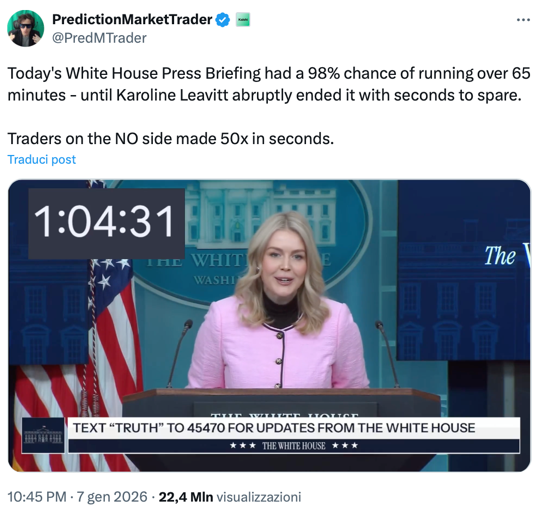
But just because I struggle to exercise my imagination, doesn’t mean that imagination itself is in a global crisis. There are countless examples of imagination running wild and ringing true. Think of the bets that are placed on Polymarket. Daily, weird yet perfectly plausible scenarios are bet on the cryptocurrency-based prediction market platform. The weirdest, worst possible things you can imagine along with incredibly banal and trivial ones are described in detail every day on prediction market platforms. Hundreds invest in it; insider trading will ensure that any speculation, no matter how absurd, can come to fruition.
To blame is perhaps the embrace of post-truth, which led to the disintegration of a stable narrative and consensus-reality, making the post-modernist dream come true. Fermenting epistemological chaos, the deliberate strategy of (populist, far, alt, new) right, has made it hard for anyone to define contemporary conditions through stable narratives. The uneven grounds onto which the present struggles to stand seem perfect for capital, perfect for tech broligarchy, perfect for violence, perfect for undesirable imaginations. Perfect for speculation. To speculate, to conjure a theory without evidence, to invest with hope of gain and risk of loss. Who holds the right to speculate? Who is investing, who is inventing? Who is still capable and willing of imagining beyond today?
A POSSIBLE IMAGINATION OF THE WEB
In thinking through speculation, one should perhaps think through imagination first. How do you imagine the internet is a question I have posed to myself and others many times. There’s a degree of strength in the social contract which makes me think our view of the web is shared and certain. But the ephemerality of the object at hand makes it quite impossible to put a finger on its shape.
While the internet does not exist as a definite object, it exists as an internet imaginary, mental pictures of hardware and software assemblages, the internet being a technological object as much as it is an economic, social, cultural one. Narrative building is our solution to the complexity of something as ephemeral, vague and influential as the internet. We need to tell ourselves a story of what the internet looks like to live through it. The Dark Forest image is one of these stories.
The internet’s Dark Forests are digital “spaces” made meaningful through a posture of opposition to the requests of the platformized internet. It can be used to describe both the digital subculture or scene that brought this name to light, but also can be more generally applied to a set of attitudes and behaviours, ways of being online linked to an internet imaginary. Antagonist relations to the requirements of the platform, including monetization systems, algorithmic curation, scrutiny, privacy, real name policies, invitation for maximum clarity and authenticity. Dark Forest dwellers prefer concealed messages, exclusive communication, smaller cozier angoras in which sociality feels less stressful.
This approach to being online is not new and is not unique. From the more violent corners of the chan and image board forums, to the pirating communities, to drug and organ dealers, to insider trading, to experimentation in post-internet art circles, gamers, incels, artists, hackers, sex workers, nerds, musicians: many communities find their space online in the shadow.
My journey through the Dark Forest was, as it always is, non-linear, rhizomatic, accidental. I begun my research in dark forests, unknowingly, sometimes in 2019. I had been following a few Dark Forest-y spaces for a while, without ever getting involved. I would listen to their podcasts, see their memes, encounter the various forms of content they produced in different mainstream spaces, but I only ever felt like an observer. These spaces felt ripe with hidden activity and inside jokes, as well as the potential for artistic and critical expression. The pandemic made us retrieve inside, and online. I myself was seeking a less socially stressful digital space, one with less algorithmic pressures and visibility from real life peers. When two years later, I began the process of writing my master’s thesis in New Media and Digital Culture, I decided to dive deeper into these spaces, letting my e-body follow the paths that would open in front of me. I was in the unique position of a highly situated researcher. My online behaviour was my source material. My digital surroundings were my sites for investigations. Posting was my research. Yet, I mostly felt like an observer, just one step removed from these communities. I was larping: larping both as an esoteric dark forest shitposter, and as an academically trained digital anthropologist. But, at the margins, I could observe from above.
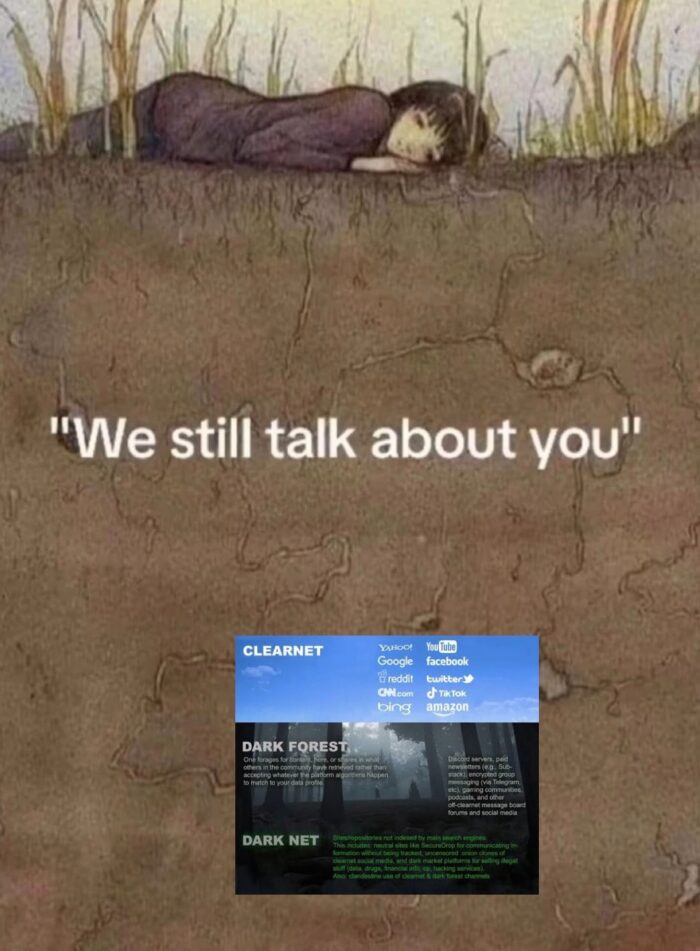
What felt special, at the time, about the Dark Forest space, was a combination of alternative practices and alternative theories, praxis, putting the criticism of platforms towards production of content aware of the self and of its relation to the Clearnet. My academic angle was one that tried to combine platform critique and subcultural analysis. I was trying to understand what the original sin of the Clearnet was, bridging academic theories with critical media theory from below. This approach was supported by trying to understand how subcultures and scenes are recreated online, rather than e.g. in urban spaces. At the time of writing, academic digital culture research I was exposed to in my studies was very much concerned with the alternative internet imaginaries of the deep vernacular web: meme culture, mask culture, 4chan, the manosphere, mainly negative and dark alternative internet imaginaries. In my research of Dark Forests, I wanted to try and find a positive one. I wanted to understand if it was possible to be online without taking the rules of platforms at face value, believing that alternative practices could be constructive, that subculture can shape possible alternatives. Despite what some tech agnostics might want to profess, the internet does not exist void of the influences and behaviour of pre-internet eras. People keep rearranging themselves in the same configurations they did centuries before the arrival of the web. Inspiration for my research came from offline spaces, such as the 1995 Club Cultures: Music, Media and Subcultural Capital by Sarah Thorton, from Birmingham school of cultural analysis, which made me understand digital scenes as subcultures of taste, ripe with subcultural capital and engaged in practices of distinction from others, often from a mainstream, existing in constant negotiation and opposition to a hegemonic power. Dark Forests, at the time, a cope/hope pendulum.
As a “counterculture” it voiced the then adolescent concerns over the hypermediation of politics, economy, culture, sociality, identifying the requirement of visibility as an especially dangerous prerequisite of onliness. The internet, (as we see it today) a machine that requires constant interaction and constant noise. The internet, more than an object, an image. An assemblage of physical material objects visually present in differing forms (the phone, the laptop, the screen on a smart fridge, the data centre tucked away in the periphery, the underwater ocean cable, the rare mineral extracted through slave labour) and of phantom feelings, hallucinations (the image of unspeakable violence you scrolled through on X, today’s wordle, ghosted on hinge, your work’s administrative software, the bug in the national health website, scammed out of an inheritance in a few simple clicks, a chat bot replying to another chat bot). The internet, besides being a machine that constantly requires our input,is a machine that activates our need to communicate. I am reminded of my friend who, frustrated with her own overattachment to the platform, deleted Instagram but quickly started posting Whatsapp statuses. Once the virus of making your voice heard had entered our brains, it became hard to stay quiet. The Dark Forest theory applied to intelligence tells us: if you want to survive, you better operate in silence. To imagine the internet means to make sense of it. The internet is not real unless we make it so. And we do, every day, constantly, we speak it into existence. There is nothing more valuable than an imagined capital. This means, there is nothing more valuable, to capital, than a product with infinite mental reproduction, completely detached from the nitty gritty real. Cashing in on imagination, on futures, on the existential plane of speculation. That’s where the money’s at.
But the Dark Forest imaginary of the internet was based on a now, somewhat outdated vision of the Clearnet as byproduct of Silicon-Valley’s imagination. Much has changed since the Dark Forest metaphor had been chosen as a possible narrative of the internet. In my research, I had tried to identify the original sin of the Clearnet to understand how Dark Forests might represent salvation. But where are we now?

SOMETHING HAS SHIFTED…
Post Silicon-Valley-peak came Silicon-Valley-freak, the deep entanglement of platform-capitalist and techno-epistemological frameworks in our contemporary sociomaterial realities, becoming entrenched in our daily lives and exercises, a kind of extra-statecraft. Well beyond the “platform economy”, well beyond “surveillance capitalism”, well beyond a simple new exercise of capital, as its entanglement with software runs deeper than just a fling. On a material level too, Silicon-Valley-freak has embedded itself in our built environment beyond recognition. The urban landscape not only carries traces of tech, but it is also now built to afford data capture. Even amongst the most ancient ruins, even in the desert and sand dunes, the slimy blob of the internet has stained everything. Nowhere are we safe. Not online, not offline, not in the city, not in the forest.
How do we respond to this paralyzing moment? Who is the enemy? Who are we fighting against? Where should our anger be directed at? Who do we need to counter with our strategies?
What are our narrative tools? What does our narrative bag look like? What shape can the container take, what can it hold? What does it mean to speculate? Is the goal to ask questions or are we ready to answer them?
The book I wrote as the culmination of research in Dark Forests, had as cover an illustration ripped from a meme which presented itself around me over and over again. It read “Lacking a grand narrative we carry tiny mythologies” and featured a jolly medieval being carrying a tiny owl. It was a meme that was circulating at the time of my research, and that I later found out was created by one of the online friends I had made somewhere in a Dark Forest. Its message felt resonant. Mythologies are fundamental. The power of narrative is indisputable. Our brains are pattern seeking machines which constantly need stories to function. Mythology serves as the infrastructure underpinning common beliefs. To steer the ship we must steer history, narrative, mythologies.
Quite often when I am tasked to write something and I feel like inspiration is hard to come by, I go back to my previous writing. Fleeting notes on the side of my notebook, broken sentences in my notes app or underdeveloped paragraphs from abandoned writing projects. I go back also to fully developed pieces, published ones even, to see what was in there that gave me the permission to put things out there. What I often find, besides a reassurance that if I, in the past, have been able to write, I will once again experience that flow state again, is breadcrumbs, morsels of meaning and thought that I had left unexplored in previous moments. Like random pieces of fabric, I lay them out in front of me to see what pairs well, what can be left out for a possible future new quilt, what needs to be restitched. My research had started as a master thesis, so it was shaped by the nature of academic inquiry which requires one direction, one focus, one object. Perhaps it is given to my “exit” from academia (had I ever even entered?), perhaps it is given the state of the world, today I find it much harder to lean into a single narrative box. Perhaps because I was a student then and am a working professional now. Working in a scattered art and culture sector, I learned that the deficit is not only in attention but also in knowledge production. So, what I am able to present, in a time of fragmented narratives, are pieces of possible patchworks, [1] morsels of ideas, some already published, tiny myths that struggle to come to fruition as a single story, breadcrumbs that we can try to follow to form a new story. Interconnected trails that overlap in imperfect ways, to try and see if we see an exit path.
ANTI-FRAGILITY
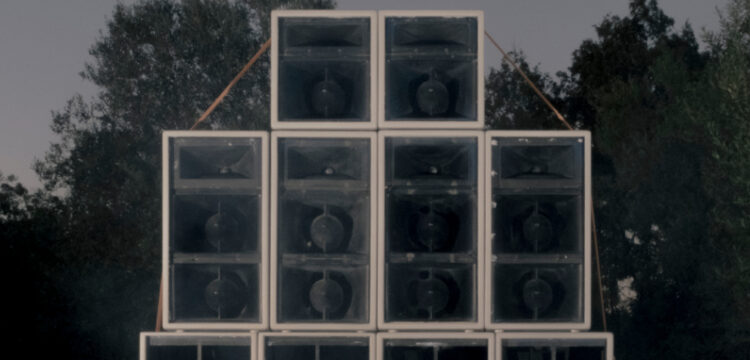
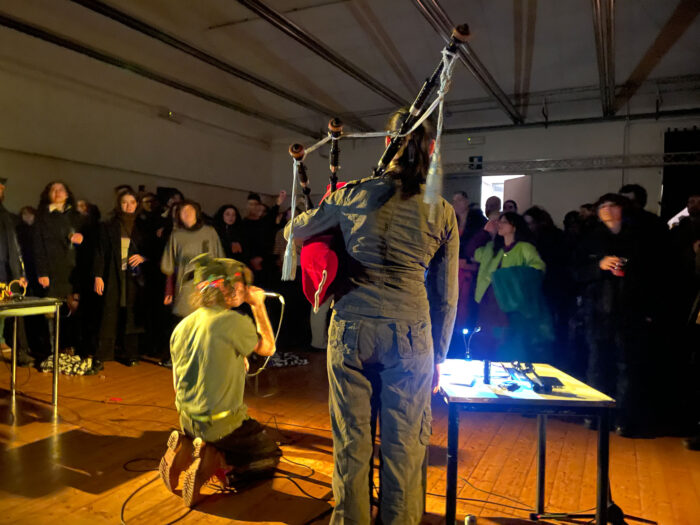
A few weeks ago, I was in Bologna at DAS, a cultural centre for experimental art. Jazz Lambaux was playing, and my friends and I decided to take a weekend trip from Rome to see him play in the evening and then go to a party/rave thing organized by other friends on the same night. Jazz Lambaux, the fool, an experimental artist who plays with the role of the jester, in chaotic, fun, folkloristic tropes, juxtaposing traditional elements and sounds, was accompanied this time by bagpipe player Enora Morice, and sometimes by a small acoustic ensemble with a friend, Lucie, and experimental screamo artist 300SkullsAndCounting playing unplugged shows on megaphones. During this show, he was surrounded by bad cable management that ran around the round non-stage. The audience was first sitting down around him, but after an invitation by Jazz himself, we all got up and surrounded him.
In growing ecstatic dancing, we started jumping around, kicking, taking each other under our arms, spinning. Someone accidentally stepped over a key intersection between plugs, and everything turned off. In disbelief and solidarity, a few of us got closer and tried to figure out what had gone wrong. The cables had been tightly taped to the floor, making it impossible to simply re-plug them, so (reminded by my own experience in bad cable management) I pulled off the tape and let the wiggle room do its job. It took a bit before the weird laptop Jazz had built himself in a toolkit/briefcase would turn back on. He said, “well, that was bound to happen sooner or later.” Jazz started singing unplugged, inviting Enora to play without amplification, the audience clapping to keep rhythm. The energy was rebuilt in that break, and now we were even louder, dancing even harder, waiting for the backing music to start again.
This reminded me of a conversation I had just a week before with an experimental noise artist who was accompanying Iceboy Violet during their live set in Rome. Apparently, he had performed for a while with his entire set on a shitty hard drive badly taped to the side of the table. In that precarious state, he felt an exhilaration of failure, a nerve twinge that pushed him to perform better. In not only accounting for the possibility of everything going wrong but actually building that into the space of possible outcomes, in the fatalism, in the agency of lack of agency, lay the motivation for excellence. In a sense, this was an act of anti-fragility.
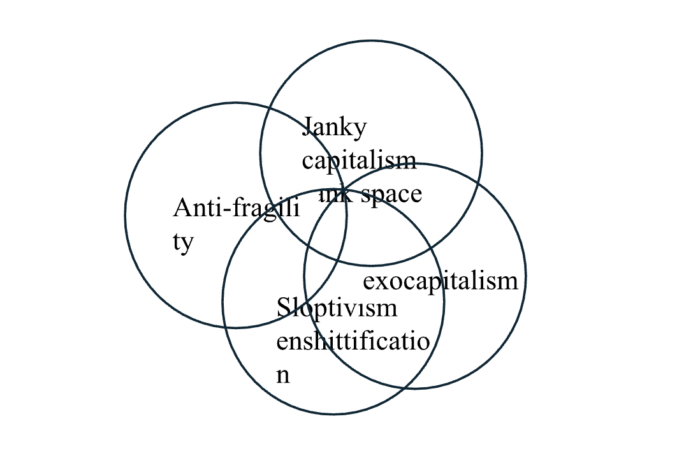
Antifragility is a neologism that attempts to describe objects that are not only not fragile, but that benefit from the very actions that make fragile objects break, burst, or collapse. Fragility and antifragility depend not only on the qualities of the objects at hand, but on their relation to the environment. Fragile objects are not fragile all the time. Their fragility depends on their characteristics plus the environment they are put in. I would also add that antifragility accounts for fragility and plans that in. Achilles’ heel is part of the equation. The term was coined by Nassim Nicholas Taleb, a practitioner of mathematical finance/hedge fund manager/derivatives trader, who warned against financial crises and subsequently profited from them (namely 1987’s Black Monday and the 2008 financial crisis, a “black swan” grifter, The Big Short style). I know nothing about financial flows, let alone risk management in financial flows. But it seems clear that we are facing an antifragile goliath. Beyond shitty cable management, on a larger scale, how can we think through the lens of antifragility? How do we make ourselves antifragile too?
EXOEXO, GOSSIP GIRL
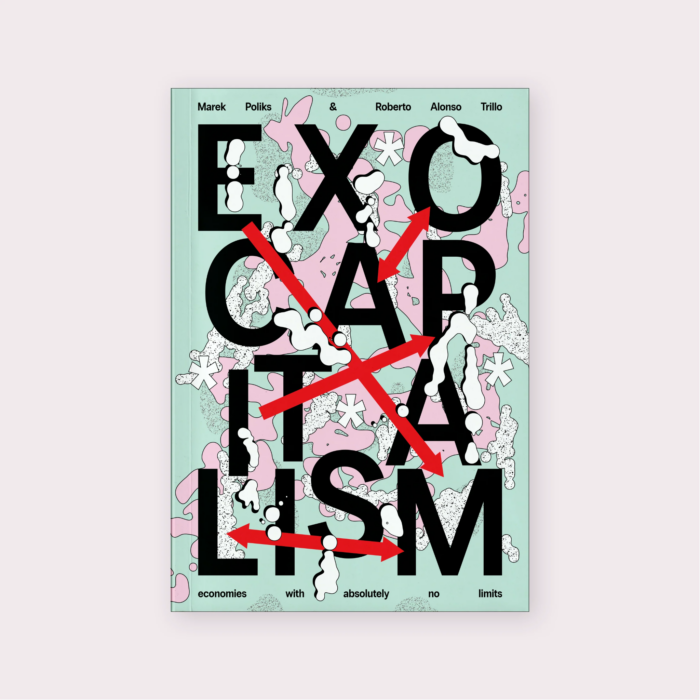
The most convincing piece of theory my brain has been capable of slowly but truly digesting in the past post-academia years has been the one of exocapitalism, developed by Marek Poliks and Rober Alonso Trillo. Researchers but also podcasters, offshoot from Dark Forest spaces but also from academic research in the field of deep learning, media and software philosophy, which places AI as inorganic vehicles through which biological epistemological and social information is encoded. Their book Exocapitalism. Economies with absolutely no limits, published by Becoming Press in 2025 has received praise from a wide cohort of thinkers from the Dark Forest and scenes adjacent to it. A provocation, accusing the critical apparatus of underestimating the power of software economy, and of not understanding scale. Capitalism is not socially constructed, it’s not dependent on humans, the exo delineating a beyond-humanity character. (Exo)capitalism is: “infinite, unbound, untethered, independent, totally unbothered with the human condition, completely preoccupied with its own obsession”, at best an “independent metaprocess, a cancer, a catastrophically poor replacement for social structuration”, an “entity that operates on different scales than we do”, it “hates fixed costs and it loves getting wacky with price” hence it “loves software.”
Fold, lift, and drag describe how exocapital detaches from material, human life. Fold: capital builds recursive layers of software and intermediaries where price is generated internally, less and less tied to real goods. Lift: capital pulls away from fixed costs and human needs by turning things into financial abstractions and speculation. Drag: humans try to anchor this abstract capital back into everyday social life, but these attempts end up pushing capital to become even more abstract. Together, capital stacks abstractions (fold), escapes the real world (lift), and uses our efforts to ground it as fuel to escape further (drag).
Consider how capital has scaled: from material objects to industrial processing, to information, and now to abstractions of information infrastructure. From steel to manufacturing, from real estate to data and services, and now to a financial service economy. The dominant concern of contemporary capitalism is injecting value into abstract financial processes, or the move from hardware to software. For Trillo and Poliks, current financial flows are rearranging themselves to follow the idea that physical commodities can scale only so far; hardware has material dependencies that software does not. Of course, this is a very specific perspective on the economic flows of tech. There are some insuperable contingencies in software, as it requires, still, and perhaps forever, hardware. And hardware requires, still, and perhaps forever, raw materials. So, if we want to indulge in the analysis proposed in exocapitalism, we should consider speculation as the central modality of growth. It is scale, the authors argue, that needs to be put into the picture.
The software industry, but more specifically the platform economy, can operate at a scale far better than previous drivers of capital accumulation. Speculation over physical capital limits was demonstrated dramatically by the 2008 mortgage crisis, where housing (a dependency too close to human need) could not sustain unlimited speculative growth. But with software, value can be invented more freely. Even the “attention economy” has limits. For all its promises, ad tech was a bubble. Surveillance capitalism frightened us into believing that our behaviour, purchasing power, and susceptibility to influence were the ultimate source of value that GAFAM (Google, Amazon, Facebook, Apple, Microsoft) was thirsty to extract. But the real profitability of platforms did not lie solely in selling behavioural data as billboards to the highest bidder. It lay in a secondary abstraction, a further lift away from human interaction. By building cascading orders of abstraction, exocapitalist firms no longer sell things; they generate capital by making educated bets, speculating. Amazon transforms its business to integrate levels of abstraction beyond material goods: from marketplace to logistics marketplace, to infrastructure for others to sell, to software-only AWS. Airlines, for example, operate not only as marketplaces of loyalty points connected to banks like American Express, but also through fuel hedging, a financial strategy using futures or swaps to lock in fuel costs, trading potential savings for price stability.
Value is created in the folds of platforms. Poliks and Trillo’s understanding of platforms deviates a bit from the one I had employed for my research. Still seeing it not as a discrete technical object but as a posture, the authors identify four key orientations of the platform. First, platforms tend toward dedifferentiation, meaning the platform-as-brand stays flexible and somewhat ambiguous, able to take on different meanings or uses depending on the context. Second, platforms are defined by their modularity. They are built from smaller parts arranged in layers or hierarchies, and these subcomponents can be combined in different ways to create various solutions.
Third, platforms rely on integrability. They depend on third-party tools, services, or components to deliver their full value, rather than working as completely self-contained systems. Finally, platforms are structurally incomplete. They are open-ended, overlapping commercial and technical systems that remain flexible and interdependent, relying on partnerships, ongoing development, and integration to function fully. Dedifferentiated, modular, and incomplete software objects are created, deployed, and sustained through subscription revenue that gates access to virtual space. This economic model, Software as a Service (SaaS), is basically asking for rent of an “environment,” with the most striking examples given by the authors being Salesforce and Amazon Web Services.
Fold occurs in the nestling of these environments, as every Software as a Service is an abstraction of itself against which price is generated. In exocapitalism ‘inefficiency = value’, as capital generates more of itself by building these recursive structures. Exocapitalist firms move away from commodity production to the production of intermediaries through which price can be decoupled from material value. The folds of exocapitalism need to be elevated, lifted, as they do not like the human layer of the stack because it is not (yet, or ever?) scalable. As folds produce often fictitious speculative volatile value, lift serves as a way to try to get as far as possible from the nit and grit of human life. For Poliks and Trillo, the state is positioned within this map as attempting to appeal and contain and legitimize the exocapitalist world order through financial and legal actions including regulatory bodies, capital injections, bailouts. Similarly, other entities such as NGOs are part of a system that attempts to punish and fix the exuberances of exocapitalism which the authors identify as drag. Drag is the attempt of humans (and the state) to embed itself in the lift process by reproducing social processes along the dotted lines of exo’s lift. Abstracting white collar labor, for example, but also instituting highly lifted and financialized mechanisms of welfare. Examples include pension funds and social security being used as capital pools dependent on stock market performance, or the (US) food stamp system being mediated through private payment infrastructures. Bureaucratization increases opportunity for the management layer of exocapitalism, but it also allows for a larping-like experience for which social relations are maintained. We still experience pension funds as state sanctioned service. We still experience food stamps through swiping a credit card like object. Drag converts a public good into objects ripe for interest and speculation. Drag asks us to pretend the emperor is wearing great new clothes.
JANKSPACE, JANKY CAPITAL
The idea of junkspace was introduced by Rem Koolhaas in 2001. As Koolhaas explains it, junkspace is the material result of the failure of modernity and its architects to understand space as anything other than highly abstract and purified. The very processes modernity embraces for its implementation (institutions, bureaucracy, planning committees, basically everything that slows down the integration of high-level visions of progress) leave little room for actual inhabitation. What remains, Koolhaas argues, is junkspace: a “low-grade purgatory.”
Building on this idea, Daniel Felstead and Jenn Leung propose jankspace as the “grotesque, empty space in the digital network of techno capitalism that we fill with our slimy human bodies.” Expanding further, Maya B. Kronic defines the janky as “the residual unregulated space in which the remaining problems of implementation which systems architects have not addressed—for cost reasons and/or because they relate to knots of contingency and materiality that are difficult to model and regulate and/or because they have not yet been identified as potential zones of profit and optimisation—are tackled ad hoc by users-customers in bricolage fashion.”
When put into practice, the blemish-free promise of capitalism must confront the uneven terrain of diverse cultural, political, and infrastructural contexts. The result is a series of weird assemblages: old and new, tradition attempting to update itself in order to remain the same. We live in the sloppy gap between the design wet dreams of Silicon-Valley-freaks and the frictions of embodied, daily human life. No matter how hard Silicon-Valley-freaks try, basic human needs can only be optimized to an extent, an optimization available only for a few. The masses remain textured. So does the city.
Jankiness becomes most visible where existing infrastructure has yet to be updated to the latest iOS. Jankspace is simultaneously success and failure: capital’s success in inserting itself into every mechanism of life, however outdated, and its failure to conceal its mismanaged cabling. Following Felstead and Leung, jankspace is the Uber e-bike with a taped-on battery pack, the rider’s three cracked phones zip-tied to the frame, the gaffer-taped power banks, the gloves permanently attached to the handlebars. Janky capitalism is AI slop ads. Janky capitalism is the failure of nationwide railway systems because of a nail hammered into a cable. These are not bugs but features of a system that was never designed to fully land in the places it operates. It was built for an imaginary Metaverse that nobody inhabits, nobody wants and nobody actually believes in. Human demands (being fed, being mobile, being warm) are met through the contingencies of platforms: always-on connectivity, location tracking, five-star ratings. The result is often horrific mechanisms of labour exploitation.
Silicon-Valley-freak logic flattens the world into an equation: users + platforms = humans + cities. Ideally, the optimization of user (human) behaviour and platform (city) infrastructure should move synchronously. Think of tech CEO Bryan Johnson, or of Silicon Valley’s beloved Soylent. Who needs food when you have nutrition? Who needs vague self-evaluations of what feels good when you have biomarkers? Everything becomes a question of discovering the right protocol or algorithm for the best-performing machine. In a transhumanist vein, human demands are plotted as contingencies, as inputs to be optimized. Proteins, carbs, omega fatty acids are reduced to a beige mush fed into the human machine. The underlying belief is that human needs can be abstracted into formulas, lifting us away from the animal and dragging us toward the machine. Evidence-based, data-driven removal from humanness transforms organic mechanisms into a living algorithm.
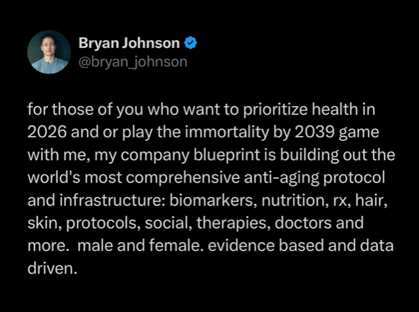

But the city shows that the human is still there, the battlefield of the last mile of exocapitalism. The exo dream of being fully separated from the human layer is shattered especially in cities, like mine, in which the routes and roads and possible paths for lifting are ancient, badly kept, and traffic prone. I live in Rome, eternally stuck in its history, yet plagued by the very contemporary demands of hyperaccelerated tourism, years of terrible municipal management, and uneven distribution of wealth. Exocapitalist dream and nightmare: a complex topography with pre-existing folds one must lift itself from, the last mile so vast and extended, speculation and value abstraction much slower to appear, inefficient and profitable. This is applicable to many large-scale metropolises, no matter how apparently developed, interconnected or neoliberal they are. On a human-urban level of interaction, transport (a very tough to scale industry), has represented itself to be a place for companies such as Lime, Dott, Bird, Cooltra, Sharenow, to operate within the cracks left open by failing state/municipal systems.
Patched from: Marta Ceccarelli and Ruben Stoffelen, Infrastructures, Not So Difficult (NSD7), The Inspiration Issue.
In the Italian/Roman context, the success of the Lime bikes represents the greatest win of privatized public service against the loss of government and municipalities, the sharing economy nestling itself in a city in which promises of smooth neoliberal functioning are obscured by terrible driving, dangerous traffic, holes in the ground, complete absence of coherent bike paths. This is exactly why the janky capital of the Lime bike works so well, a patch in disconnected public transport lines, a way to connect peripheries to usurped centres, taking full coverage of the city, appearing everywhere.
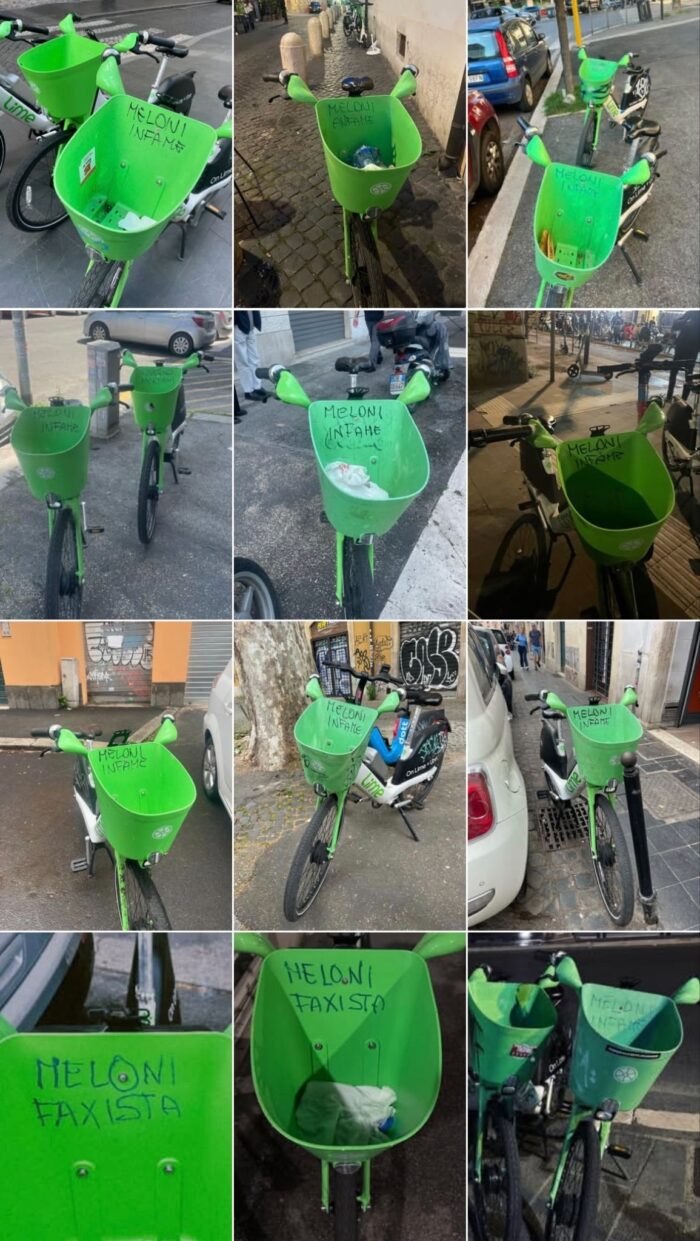
In the past months, a bunch of Lime bikes have been graffitied with short effective messages against the right wing protofascist Meloni government: variations of Meloni fascista, Meloni infame, governo infame, written with a permanent marker over the bright green electric bike basket. Carriers of people but, in some cases, also meaning, messaging. The lime graffiti nestle themselves within the offline urban space while being, as everything is, hypermediated. They ride the waves of platform capitalism, driving the message across through the sharing-economy’s foot soldiers. In a world where immediacy of protest is necessarily stretched and bastardized by constraints of social media, we must find these alternative pathways for information. To cut through the noise, to piggyback on the inescapable stack systems.
If Capital is inescapable, then how do we accept it? If it’s easier to imagine the end of the world than the end of META, how do we re-inhabit the platform? Where is the space for humans in the metaverse?
The economic failure of a hypermediated data extractivist life would come by practicing to the best of our capabilities, not an offline life, but one in which the convenience of Amazon, Deliveroo, Airbnb, Doordash, Hinge is replaced by the richer experiences of irl shopping, going to restaurants, staying at friends of friends, sleeping with friends of friends. The more isolated we are, the more we seek online attention, the more tough it is to find stable jobs, the more we will become gig workers, the more we disengage from localized action, the more we seek global connection, the weaker our weak ties in the urban landscape are, the stronger the ones of online life will be. The urban is the real we often take for granted but which most quickly and dangerously gets eroded. The city is human, it should be. Social bonds across urban spaces are what makes life bearable if not enjoyable. Financial speculation kicks people out of city centres, how can we inhabit them again? What cities can be born out of the janky capitalist rubble? What new infrastructures can we imagine?
SLOPTIVISM LORE
Something that strongly grounded my previous research in Dark Forest was online visual culture, specifically memes. It’s something all digital subculture scholars are obsessed with, often assigning great political power to memetics. Meme scholarship, by virtue of its research object, is always outdated. Memes keep evolving. While there is a degree of maintenance of older forms of meme-making (either as separate veins of memes or integrated into newer ways of doing) in some ways, I would argue that the concept of the meme as a single image that gets replicated and modified has been put to the side by the youngest, most avant-garde meme makers. In the latest, current stage of digital culture, it is lore that has taken the stage: meta-narratives that place you in an imagined, ephemeral, invisible, but demonstrable public.
PATCHED FROM: Marta Ceccarelli, Internet’s Dark Forests: Subcultural Memories and Vernaculars of a Layered Imaginary (Ljubljana: Aksioma – Institute for Contemporary Art, 2025).
Lore is a form of myth-making, hence of meaning-making too, contributing to the formation of identity and belonging by elevating individual fragments of media into collective narratives.
(…)
Shared memory allows communities to collectively create and read lore. Even though mnemonic devices such as memes are used by in-groups for stability, it would be wrong to impose any sort of concrete story onto these objects. To read the internet, one must learn to recognise its patterns, following their breadcrumbs into “hyperlinked, branching rabbit holes of lore”. Specific signals, users or accounts can be entry points into a rich lexicon, but one must first come close to where the language is first created. No amount of googling or knowyourmeme research will be enough to decipher fully the fragments of lore floating through the internet. Being in the right place at the right time is all it takes to begin to grasp the shapes and sizes of subcultural lore.
(…)
To read the internet, then, one must not assume or impose linearity. There is no one path for the internet. Or more specifically, given the contingent nature of much of the web’s content, there are as many entry points into any networked narrative as there are users.
(…)
While there are as many interpretations or understandings of lore as there are readers of it, in places where the difference among narratives is minimal, tight communities can form. (…) However, sometimes there might be too many tiny mythologies to follow. The speed and contingency of lore formation can make it difficult even for insiders to keep track of the granularities of in-group culture. Then, communities give up on maintaining consensus, deciding to simply embrace the ambiguity and chaos, and “celebrate the collapse of shared understanding, accelerating into our own incomprehensibility.”
If 2000s kids had the same Disney Channel show to talk about in school, 2020s kids have the same set of recurring characters that appear on their feed to talk about. The lore becomes a shape-shifting container of meaning.
The energy has also shifted due to the towering presence of TikTok and the consequent short-form video explosion. Two elements of TikTok, in particular, feel salient. First, the algorithm: it presents you videos from the same category not all at once, but fragmented. Stories with linear narratives are not fit for this; what works well instead are fragmented narratives with recurring characters. The most engaged audience members might see all the content from one account or one topic; less engaged audiences will still see sufficient content to piece together a vibe. Lore is readable to some, intelligible to others, but, as always, discoverable. Discoverability comes into play through a second element, the comment section: a living archive, a place to show one’s knowledge, where one can learn, anchor oneself, and discover lore. Affordances such as the “blue comment” (a comment picked for its relevance and awarded with a link to a search page) create a space in which one can feel something akin to a public forum, an agora, a simulation of it.
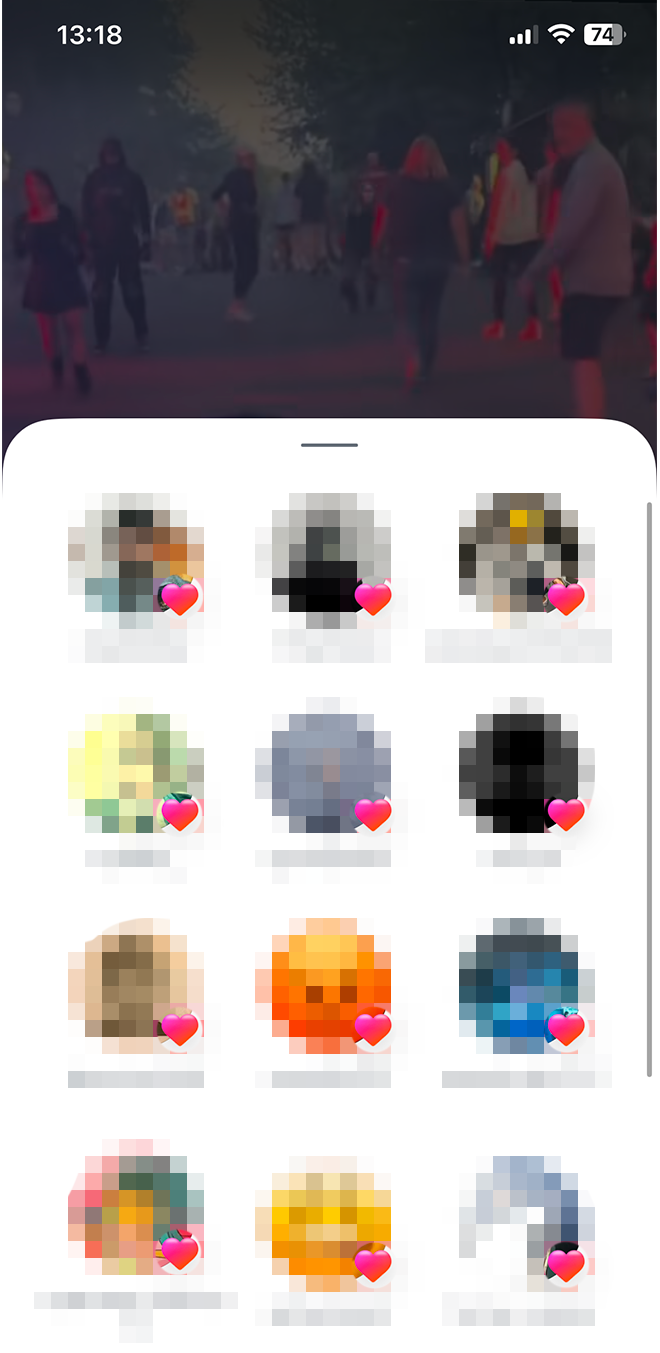
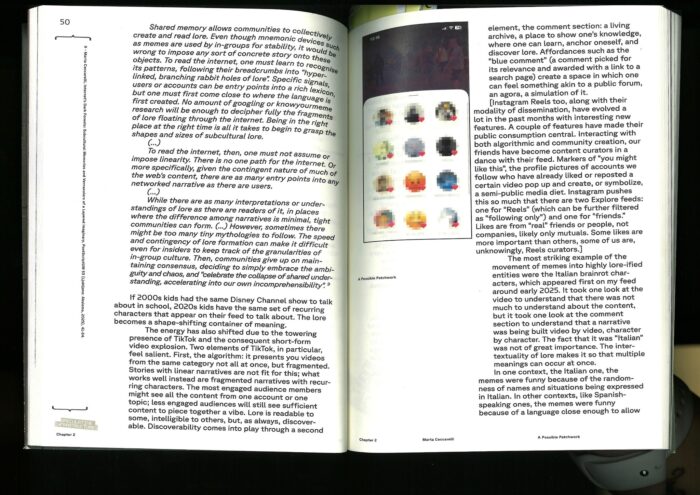
[Instagram Reels too, along with their modality of dissemination, have evolved a lot in the past months with interesting new features. A couple of features have made their public consumption central. Interacting with both algorithmic and community creation, our friends have become content curators in a dance with their feed. Markers of “you might like this,” the profile pictures of accounts we follow who have already liked or reposted a certain video pop up and create, or symbolize, a semi-public media diet. Instagram pushes this so much that there are two Explore feeds: one for “Reels” (which can be further filtered as “following only”) and one for “friends.” Likes are from “real” friends or people, not companies, likely only mutuals. Some likes are more important than others, some of us are, unknowingly, Reels curators.]
The most striking example of the movement of memes into highly lore-ified entities were the Italian brainrot characters, which appeared first on my feed around early 2025. It took one look at the video to understand that there was not much to understand about the content, but it took one look at the comment section to understand that a narrative was being built video by video, character by character. The fact that it was “Italian” was not of great importance. The intertextuality of lore makes it so that multiple meanings can occur at once.
In one context, the Italian one, the memes were funny because of the randomness of names and situations being expressed in Italian. In other contexts, like Spanish-speaking ones, the memes were funny because of a language close enough to allow for some reference to meaning, but distant enough to allow for even further misunderstanding, assumption, gap-filling humour. In even more distant ones, like English-speaking or Indonesian-speaking ones (apparently Tuntun Saur’s origins are Indonesian), the linguistic distance was filled in by stereotypes, images of Italianess—ever-present signals of culture used as branding, or present as remains from hybrid cultures (e.g. Italian-American ones). But Italianess in itself was just a morphological dimension, a texture onto which the slop could be built. A chance for folding. A distinctive character chosen not for any specific intrinsic value of Italianess, but as any distinctive vibe onto which the machine of AI-slop could feed to generate content.
It worked, why? Maybe we are in an age, a fragile one, of sloptimism, in which AI-slop moves through the internet in reiterative, continuously shifting and evolving processes of context-gapping, narrative patchworking, and lore anchoring. AI-slop of Italian brainrot is at once the water one drowns in and the life jacket, at once the brothy, sticky substance of nothingness and the attempt at the creation of meaning. Hyperstition, some might call it. AI-slop tricks us into thinking that it is some weird manifestation of machines nearing consciousness, while it is the careful product of Silicon-Valley-freak mechanisms that award continuous nonsensical production and engagement over solid linear narratives. Our pattern-seeking brains might still want that meaning. We might create that meaning. We might build meaning in the very content we assign generative AI to create. Collective memory will then build itself out of fragments. In our sloptimist age, it’s more important to be seen than to be understood, and it’s more important to be seen than to understand.
THE BIGGER PICTURE
Patchworks, quilts, are stitched together, form patterns, recurring ones, but are made from scraps, symmetry is preferred but imperfect, logic exists but it’s not fundamental. They come from collecting, from embracing the tiny pieces and trying to see the bigger picture. If exocapitalism folds, lifts, and drags toward abstraction, perhaps our task is to be grounded in the concrete. If value is created in the folds, what do folds in the social look like? No grand narrative, but a fabric of minor ones.
During fall ’25, a series of protests, actions, strikes, and occupations, marked by the slogan “blocchiamo tutto,” saw Italian cities, like Rome, filled with people and banners, Palestinian flags and Free Palestine graffiti wherever the corteo had passed. Beginning from grassroot organizations and labor unions, evolving into national movements which cut through differences and indifference. I remember marching at night as a vigil over the Global Sumud Flottilla. I remember the joy and surprise of seeing so many people out in the streets. I struggle to remember a time of solidarity as strong as the one felt in those weeks, those moments. I struggle to identify a moment of fear, sadness, grief, confusion, powerlessness as the historical one we face now. Months before and months after those protests Palestinian flags have and will still hang from balconies, but the graffiti in the Traforo Umberto tunnel was painted over in a matter of hours. For a moment, the city, the social, felt synchronized in that anger, that grief, that solidarity. The ceasefire arrived. For us, on the safer side of the world, fatigue, appeasement, dispersal. The machine resumed its flow. If there was victory, it was temporary, if there was defeat, it was incomplete.
In the bigger picture, perhaps this is what resistance looks like now: not permanence, but recurrence. A refusal to let abstraction be the only imagination of the future. Perhaps survival is in the tiny mythologies. The bigger picture is not a single image waiting to be revealed, but one waiting to be built. We must be willing to gather the fragments and hold them in provisional relation. Survival is in the acceptance that meaning will be partial, collective, retroactively stitched, patchworked. It is accepting that there will be moments of absolute solidarity and moments of absolute struggle and moments of absolute apathy. Resistance will be imperfect. None of this escapes capital, nothing seems to do anymore, but it inhabits the seams, the folds. In an antifragile, exocapitalist, janky world, survival does not look like moral clarity. It looks like patchwork. It looks like lore. It looks like dancing around bad cable management and trusting that, sooner or later, something will short-circuit — and that we might know what to do when it does.
[1] I have kindly borrowed the abstract use of patchwork from someone much smarter than me, someone who has worked with this idea for years, someone very close to my heart: my grandmother, Laura Balbo. A sociologist who lived her discipline as both a public and private practice, weaving together intellectual work and everyday experience. An avid collector of patchworks, she drew on the image of quilting as method: the art of gathering “fragments of material and fragments of time” and stitching them together. It described an economy of everyday life and, at the same time, a creative way of composing one’s existence. She connected this image to women’s lives in particular: to the double presence of women in family and professional work, to welfare, to the structuring of time (life time, work time, care time) and to the broader transformations brought by feminist movements. The labor of quilting was repetitive, tedious, inventive, and necessary. It was often overlooked, then later rediscovered and celebrated for its artistic merit. In this way, it mirrored women’s domestic work more broadly: essential to social life, historically undervalued, yet rich in knowledge and symbolic meaning. Her simple yet powerful intuition inspired me to think through patchworking as a practice, as a metaphor, and as a way of seeing the bigger picture.
Bibliography
Ceccarelli, Marta. Internet’s Dark Forests: Subcultural Memories and Vernaculars of a Layered Imaginary. PostScriptUM 53. Ljubljana: Aksioma, 2025. https://aksioma.org/internets-dark-forests. ISBN 978-961-7173-60-4.
Ceccarelli, Marta, and Ruben Stoffelen. “Infrastructures.” Not So Difficult, no. 7, The Inspiration Issue. Brussels, May 2025.
Felstead, Daniel, and Jenn Leung. “Welcome to Jankspace, Babes.” DIS.art, 2025. https://dis.art/welcome-to-jankspace.
Koolhaas, Rem. “Junkspace.” October 100 (Spring 2002): 175–190.
Kronic, Maya B. “Cute and/or Janky.” readthis.wtf, 2025. https://readthis.wtf/writing/cute-and-or-janky/.
Paglen, Trevor. “Invisible Images (Your Pictures Are Looking at You).” Architectural Design 89, no. 1 (2019): 22–27.
Poliks, Marek, and Rober Alonso Trillo. Exocapitalism: Economies with Absolutely No Limits. London: Becoming Press, 2025.
“Blackout Trains at Termini: The Transport Authority Says RFI Negligent, Faces Risk of Penalty of Up to €2 Million.” Il Sole 24 Ore. Accessed February 18, 2026. https://en.ilsole24ore.com/art/blackout-trains-termini-the-transport-authority-rfi-negligent-risks-penalty-of-up-to-2-million-AH2hyGfB.