
Hyperacustica’s Persona Sound System
A conversation on creating space for a sound
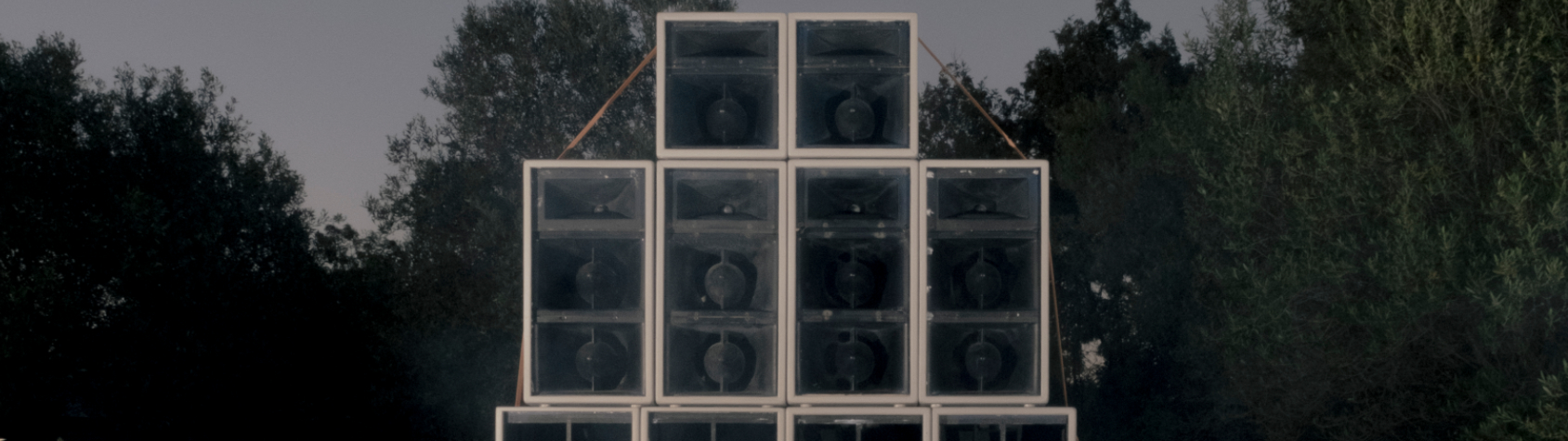
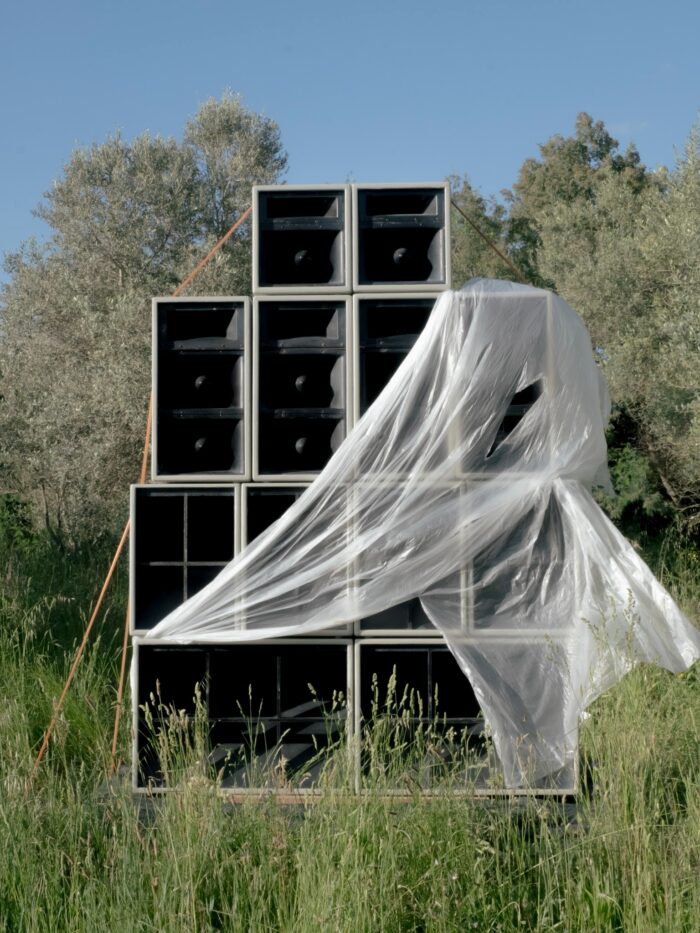
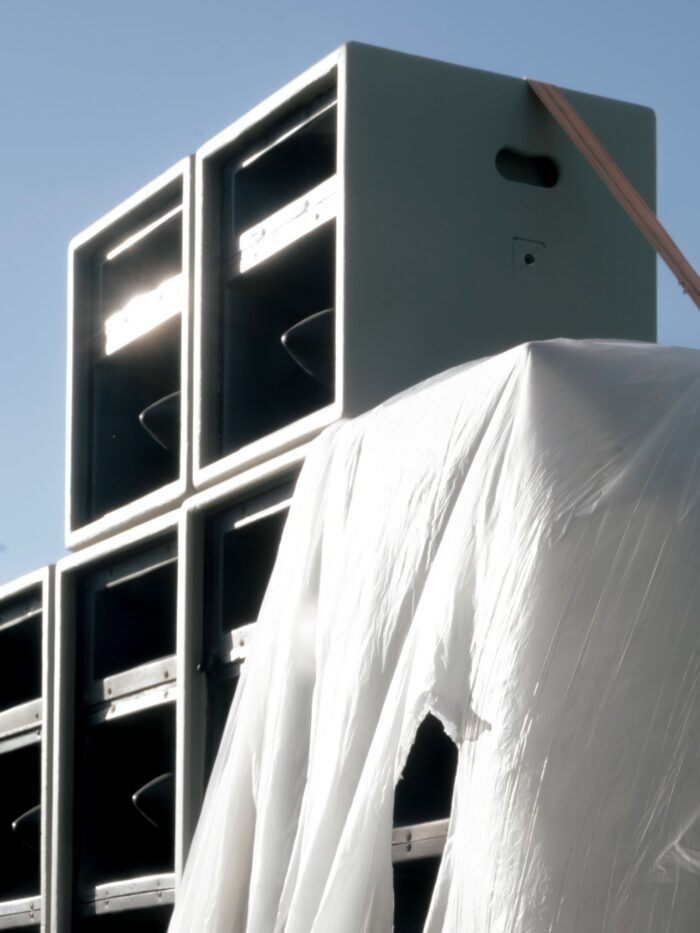
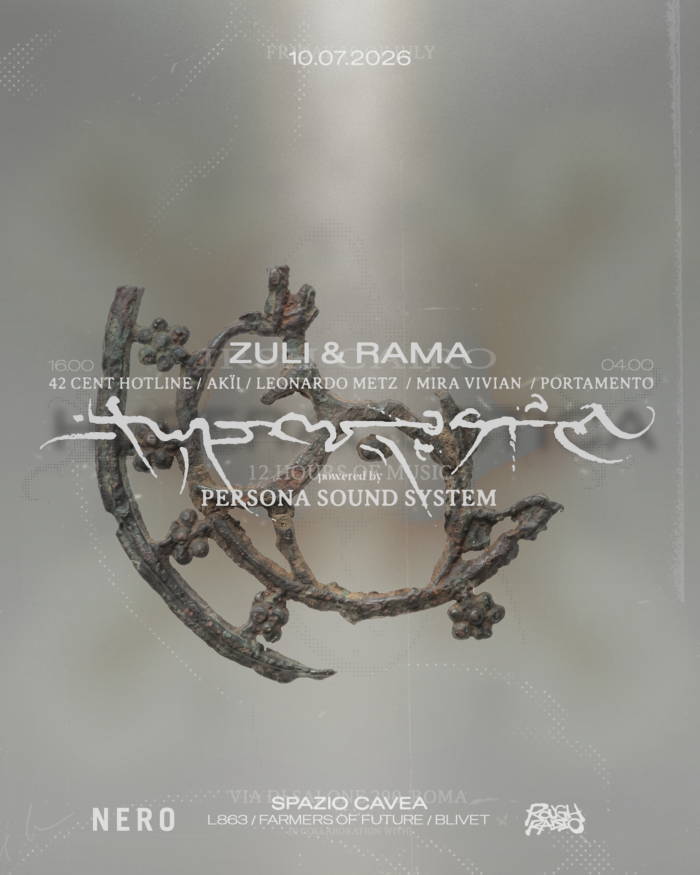
I sat down with Hyperacustica to chat about the unveiling of the newly built Persona sound system. A 3m-high and 2m-long renovated and reworked Turbosound TSE from the 1990s discovered some months ago in a warehouse somewhere around Civitavecchia. On the 10th of July, Hyperacustica will switch on Persona against the incredible backdrop of the Cave di Salone, at Spazio Cavea, with 12 hours of music operating at the forefront, margins, nooks and crannies of dance music. The Persona sound system will host the experimental Egyptian label irsh, whose output hybridizes dancefloor sounds from trance and breaks to pure abstraction. The label will be represented by a back-to-back set from founders ZULI and Rama. Hyperacustica’s own 42 Cent Hotline, Mira Vivian, and Leonardo Metz will also be playing, alongside Rome staples Akii and Portamento. The program is completed by installations from Farmers Of Futures and Blivet, as well as a stand by L863. At a time when club culture is increasingly subjected to cultural and political pressure, at a time when event spaces in Rome are being shut down on a weekly basis, Hyperacustica’s wish is to create a safe, authentic, and genuine listening space. A temporarily autonomous zone where sound becomes a tool for encounter, reflection, and collective experience.
I had first met, and interviewed, Hyperacustica more than two years ago. I had only moved to the city a few months earlier, and even if the excitement of a new massive urban space to explore was there, I had felt the first signs of night-scene boredom; or, maybe, better said, I had already reached a level of familiarity with the city that made it so that any sign of experimentation, break from the norm, divergence, to became clear, loud, irresistible. Those signs are what I recognized the first time I stepped into a Hyperacustica party. It’s what led me to want to talk to them, for an artist interview (actually my first one ever). It is also what led me to want to become friends with them, to be involved somehow. Through the past years I have seen the collective grow, evolve, expand, contract, drift apart, come close again. Always changing out of necessity and out of curiosity, always searching for a way to make space for themselves, for their vision, for their sound.
Marta Ceccarelli: Let’s start from the end—or rather, from the present. Tell me about Persona soundsystem: when did the idea come about, what was the process of building it, and what are the future plans for this system?
HYPERACUSTICA: Persona actually came about by chance. We were heading to Urbino in January—we were organising an event with Hyperacustica for the guys from Tensione, across two rooms. One room was a renaissance hall, the Sala del Maniscalco, where we were doing DJ sets, but the PA there was missing a sub. As usual, we travel by car with all our gear—lights, equipment, we always move around loaded with stuff. We went looking for a service company to try to find a sub for free. The only one willing to lend one was a company I’d worked with ages ago, in Civitavecchia. So we set off at dawn. We needed to reach Urbino by lunchtime, so you can imagine: Rome, Civitavecchia, Urbino, a journey of hope. We left at the crack of dawn from Centocelle and arrived in Civitavecchia, at this surreal place, a massive hangar in the industrial port area. We go in, they hand us the sub, and as we’re heading out the guy mentions they’re selling everything off and invites us to have a look around and see if anything interests us.
We start wandering around and everything is just thrown about, dismantled, broken. And there was this Turbosound, a Turbosound TSE, a historic model that shaped the live music scene of the ’80s and ’90s, a standard rig. Tony Andrews, its creator, is the same person who later went on to make Funktion-One, so it shares the same design architecture as a Funktion-One, just older, of course.
As soon as we realised it was a Turbosound, we said, ‘hold it for us, we’re buying it’. About a month later, we rented a van, together with Sandro (Alessandro Tosi), an essential character in this story. He’s a technician/audio engineer, an electronics man, an electrical current man. I mean, everything related to electricity, he knows it, he knows how to handle it. He builds amplifiers for Masotti, Mezzabarba, amps used by guitarists all over the world. We call Sandro, he’s from Tuscania, like me (Leonardo), and I say, ‘we’re doing this crazy thing, we’re getting this Turbosound’. Full of excitement, he replies ‘no way, that’s the best-sounding rig in history’. He knew the service company in Civitavecchia, he had even played that very sound system. So he just decided to embark on this odyssey with us.
When we got the system we realized it wasn’t really working, the whole thing was completely broken. We put it back together. Yes, it’s a Turbosound with its own history, but we repainted it, replaced all the speakers, modernised it in some way. This sound system found us in a way. The choice was very much in keeping with our kind of madness—when we decide to do something, we say let’s do it, and then we actually do it.
We spent years talking about spaces. At first we were just hanging out at the Muretto, the space in San Lorenzo that was the first home of Hyperacustica, in 2024. When that chapter was over, we were debating if and how to take a new space. The economic inaccessibility of getting a space and doing it properly made it almost impossible, especially right now in Rome, where doing things properly means spending a huge amount of money. So we said: let’s buy a sound system. It replaces the space, because wherever you put it, the space creates itself.
And also having the ability to certain frequencies that in the Rome clubbing scene—unless you’re going to the big clubs—you just don’t hear. Bringing those frequencies out is massively important. Especially because we’re part of the whole electronic, bass, deconstructed music scene. In most clubs where we play, you can’t hear certain frequencies with that particular punch of sound that immerses you in the genre music we make. So this sound system was partly a necessity.
A lot of money and a lot of effort went into building it. The plan for this sound system is to be shared, to stay in Rome, to travel between spaces. We’d imagined a tour—Naples, Bologna, Milan, two dates in Rome. Each time bringing in a guest, taking our sound with us, collaborating with all the relevant communities. And then maybe, who knows, by 2028 setting it up somewhere permanent. If there are other friendly collectives who want to use it, we’re happy to share it. What serves us also serves the whole underground community and the scene right now.
NERO: Tell me a bit about this evolution—from the beginnings at the Muretto, to a period of a lot of travelling around Italy throughout different spaces, to building a space with your own sound system.
HYPERACUSTICA: The beginning, which was Muretto, was also a very necessary meeting point for each of us, but at the same time something that happened by chance. We didn’t all know each other before that started. We were a vaguely connected group of musicians who had a space in which to do music programming. Muretto was a container for the varied things, everyone in some way with their own idea in their head, but all searching for a path that wasn’t yet fully defined. And already from there, one of the recurring themes was the low frequencies. When we were at the Muretto we took readings on the upper floors, because the neighbours’ rooms and walls would shake if we turned the volume up too high.
So this idea of reproducing a sound that is both faithful and at the same time total—one that gives you the possibility of immersing yourself, and where there’s a physical exchange between the sound and the listener—I think that’s the fundamental thing for the music we make: the fact that it’s not just listening but also something embodied.
The season at the Muretto was beautiful, intense. After that, there was a two-month summer break. We didn’t see or speak to each other, we were all exhausted. We had the idea of finding a new place in Rome, but it was very difficult. We’d almost managed it and at the last minute the plans shifted a bit, and that actually gave us a strong push to start being more nomadic in a way. In Muretto there was a need to put on lots of nights, we had stayed closed inside out of necessity. When we no longer had those worries and expenses, we could breathe. We did not want to just be event organisers, we are also musicians and DJs. So in the phase after the Muretto we could take things a bit more slowly and broaden our horizons, as a collective, as individuals, and start to get out a bit more, do shows further afield, without the weight, also economic, of having a space to manage.
When we saw each other again and came back from that summer break, there was something like a re-awakening of consciousness. We found spaces that were already formed in their own was—like Liminal Space, or La Redazione—spaces that already have very specific connotations. At Liminal Space we did things that were perhaps more listening-oriented, where we also brought in the clubbing dimension. At La Redazione, the same thing but in reverse. Those spaces lend themselves to two slightly different things.
I think the evolution that led us to the sound system, which was already something we had in mind before it found us, was something like this: it’s a way to manage to bring all these things together without too many compromises. The moment you have a sound system, you create the space. You can afford to bring in that more experimental side, that more club-oriented side. You’re no longer bound in some way to the structure of the space, but you can bring the sound, literally and figuratively, which is what we’d been looking for, what was maybe the starting point, and which has now come full circle with this.
Since we closed the venue, we’ve also started playing, producing, putting stuff out—and now having a sound system where we can actually hear it. All of us producers of this music are always in our bedrooms with two small speakers, and then when you go into a club they use enormous systems and you actually notice certain things. And for us, having a sound that lets us bring our music out in its totality—that’s a real satisfaction. Especially because we’ve been working a lot on various releases from January 2025 up to today. So yes, being able to hear them properly at last.
MC: Let’s talk a bit more broadly about Rome right now—the various adventures and misadventures around spaces, what you think is happening, and how we might perhaps get out of this moment of stagnation and continuous limitations, problems, closures, irregularities. How are you dealing with it, first of all as organisers for the July 10th date, but also more generally: how did we end up here, and how do we get out?
HYPERACUSTICA: After Crans-Montana there was clearly a switch. Also, Meloni’s right wing government is in power, so we know what position cultural initiatives take at the infrastructure level when a certain type of political party is in government. The methods of control themselves change.
Spazio Cavea, like Cave di Tufo as well, had been shut down for various permit issues. To do everything fully above board you have to put in an enormous amount of money, and in our scene, in the music we make, that money doesn’t exist. Not in Rome, not in Milan—it’s lacking in New York too; maybe, who knows, there’s only money for this in Berlin.
They shut Spazio Cavea and we were at a standstill for two weeks, with the venue closed and without the permits. Then we went back and managed to rebuild a dialogue. We figured out how to make it work, but even there only under extremely precise conditions. To do this requires a disproportionate amount of money. In Italy, and particularly in Rome, opening a club often requires either significant personal wealth or involvement in more opaque, under-the-counter forms of financing. Venues who don’t have the capital or the connections open anyway without all the permits, and then the authorities show up and shut them down during the event.
MC: Examples like that have been everywhere in the last year. Last weekend, Angelo Mai, but also Circolo dei Cerchi, Club Industria, Cave di Tufo, those are just a couple. And of course, compliance and safety are absolutely critical.
HYPERACUSTICA: Yes it’s fundamental, but as things are structured here in Italy, it requires a capital investment we simply don’t have. And so the idea of being nomadic, of having things that can be moved, becomes essential. Especially because our scene is increasingly tied to the sound system as well. Collectives like ours, in order to exercise a certain volume power, the right amount of decibels, have to move away from the city. And that shift away, in my view, runs parallel to gentrification, to rising rents, to the rising cost of living in cities, and to all the other various dynamics of the contemporary world, of Italian metropolises, in our case Rome.
But what I think is happening is that there will gradually be a slow shifting away from the city. A bit like the Middle Ages repeating themselves: back then people moved from the great cities out to the fiefdoms to work the land. Now we don’t work the land, we scroll. But that same dynamic is kind of repeating itself. Something to figure out, in terms of what the cities actually become, because they were always the places where people gathered. But if people start moving away from them, a lot of dynamics will change.
Most of the Hyperacustica crew actually comes from outside of Rome, so we feel the tendency to drift further out, partly because at a certain point we simply won’t be able to afford to turn the volume up. Volume power is also a kind of weapon, isn’t it?
Especially in the current political climate, we see a sound system as a kind of weapon from below, in a way. Given the way things are evolving politically, and all the repression directed at the world of nightlife, it’s impossible for it to be silenced. So it’s something that will move, and it will move to where that becomes possible: where there’s less control, where there are more grey zones. Which obviously means going further and further out from the city centre. I think this is inevitable. As Steve Goodman writes in Sonic Warfare, there’s a dynamic of prey adapting to predator. That’s essentially what this is.
MC: Tell me a bit about the July 10th night then. What can we expect?
HYPERACUSTICA: What I’d want is to somehow live this experience in the present, in an insane location, where they quarried the stone they used to build the Colosseum. So even there, Rome becomes a symbol for us: everything it’s been over these years, and rediscovering it now with a new sound, but in a completely ancestral way.
In this sense, I don’t know, we’re trying to create a ritual space within something that is already, in itself, deeply evocative and we’re doing it with artists who are hugely important to us. Partly because of all the research that’s happened over these last months and years is trying to break away somewhat from the whole Northern European vision of clubbing. And now doing that through a sound that—I’d rather not always use the word Mediterranean, but one that intersects, sonically and culturally, with everything that belongs to the south of Europe.
Zuli and Rama, the Egyptian artists, are doing exactly this, hybridising everything that is Northern, everything that is Southern, in a way that leans more towards a clearly different aesthetic and a different way of making a party. In Rome there has never really been club culture, in the strict sense, you know? And maybe there never will be as we think of it today.
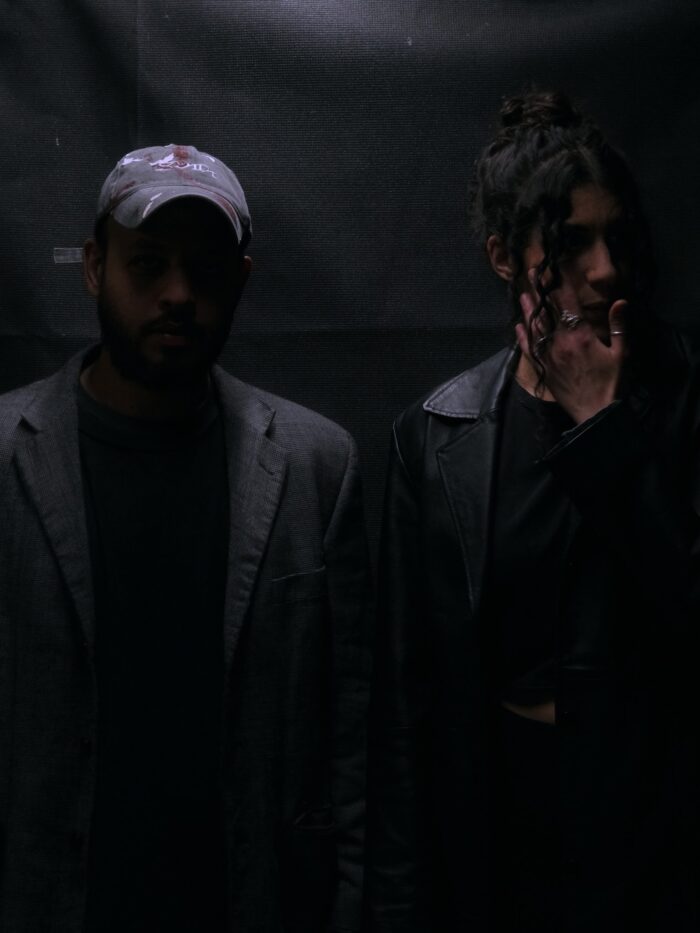
I think they as musicians and as guests for this night are very much in line with everything we’ve been talking about. We already had the pleasure of hosting ABADIR, and we had the chance to talk about their collective irsh—many of them have moved to Berlin, some have stayed in Egypt—where he told us that the situation there is maybe even more drastic than ours: they’re one of the few realities of this kind and they really struggle to make things happen. So there’s also a real affinity in the themes and in the practice, not just in the sound.
Then of course it’ll be a party with Portamento and Akii—people who, like us, have tried to bring a certain kind of sound but also a certain way of making a party to Rome. Friends. So there’s also a strong desire to be together in collectivity, in community, in a completely free way, thanks precisely to a sound that carries that weight. To have our friends play, and to let them hear those frequencies.
And yes, that desire is very much there. Partly because Rome is multifaceted and we have not grown up in it alone, so there’s also something about recognising the other and making them part of it.