
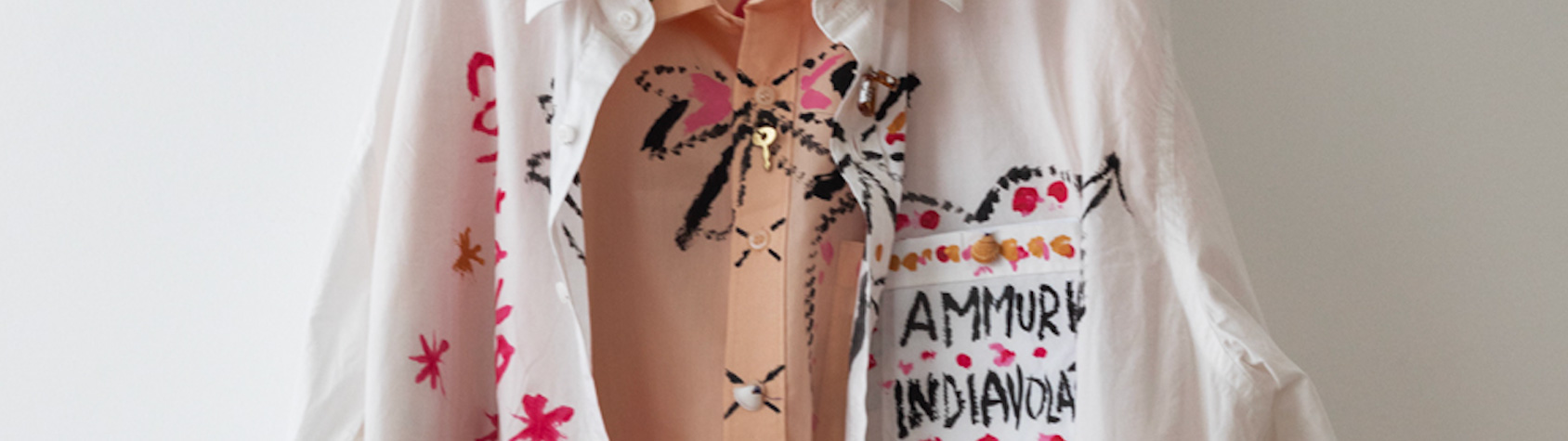
Where Things Bind Together
A shared, situated, and transformative experience, not a program, but a territory in the making, a living field of relationships
Curated by Simona Squadrito, Giulia Currà, Francesca De Chiara, and Aurora Piedigrossi, for MACTE Museum, in Termoli, in May 15, 2026.
Where things bind together is a meeting point between the practices, bodies, stories, and imaginaries of Simona Squadrito, Giulia Currà, Francesca De Chiara, and Aurora Piedigrossi. It is a shared, situated, and transformative experience, not a program, but a territory in the making; a living field of relationships, crossings, and possibilities generated through collective action and brought into being through encounter itself.
We came together, each bringing our own way of inhabiting the world and producing knowledge. We recognized in one another a common aspiration: a form of knowledge that is not possessed but inhabited; that is not transmitted from above but generated through contact, contamination, and reciprocal presence. We perceive ourselves as inhabited and transformed, both as agents and as those who are acted upon. A form of knowledge that is always body, gesture, voice, trace, threshold.
Poetry and writing become ritual, territory, landscape, not as background, but as inhabitable places. Like the rhizome described by Deleuze and Guattari, they grow horizontally, through connections and contagions, without center or periphery, without predetermined beginning or end. The rhizome is not merely a metaphor: it is a way of thinking and being in the world that overturns the vertical and hierarchical logic of Western thought, the image of the tree, the single root, the foundational principle upon which everything depends and towards which everything converges.
An entire philosophical, scientific, and theological tradition has constructed the idea of knowledge as something transmitted from the top down, reproduced through tracing and replication, imposing the verb to be and its metaphysics. The rhizome, by contrast, operates differently from the tree: it grows through lateral connections and horizontal proliferation, without a privileged center and without a predetermined direction.
Where things bind together therefore embraces the plurality of perspectives as a resource: a network made up of nodes that may be any kind of object, place, memory, gesture, or body, connected laterally and free from hierarchies between disciplines or relations of dependence between forms of knowledge. Like the rhizome, this collective experience resists partial destruction: it can be broken at any point and resume its course along other lines, like an organism that survives and regenerates precisely where it seemed interrupted.
And it is always in the middle, always among things, in between: it has neither origin nor destination, only a continuous in-betweenness, a connective tissue that replaces the binary logic of opposition with an open and multiple conjunction.
It is in this spirit that the experiences brought together at MACTE converged: not to forge unity but to proliferate, not to converge toward a center but to follow their own lines of flight, not to reproduce but to create.
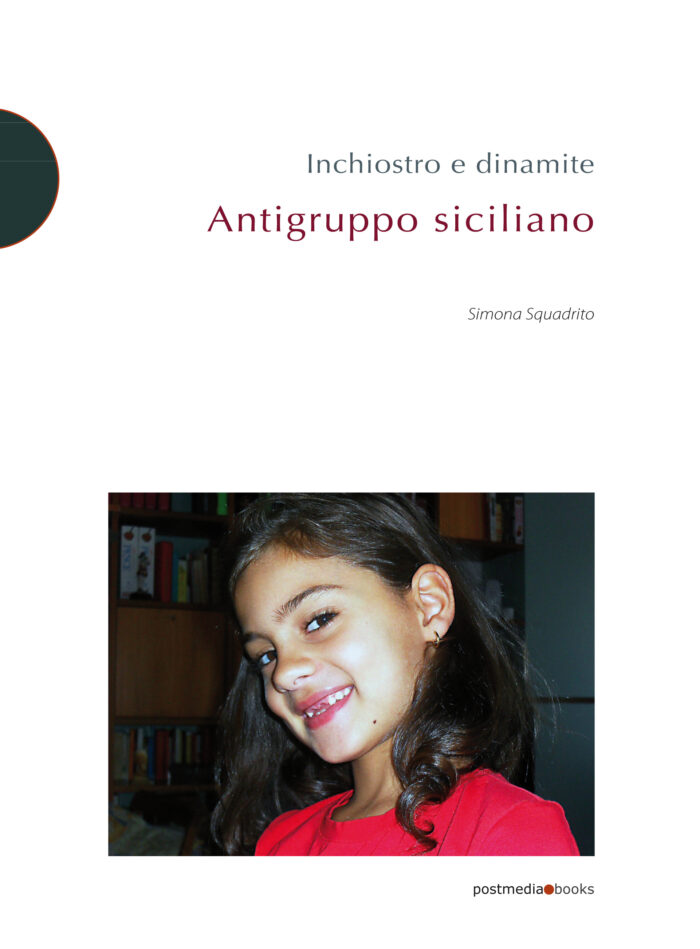
Simona Squadrito, Inchiostro e dinamite. Antigruppo siciliano, Postmedia Books, Milan, 2025.
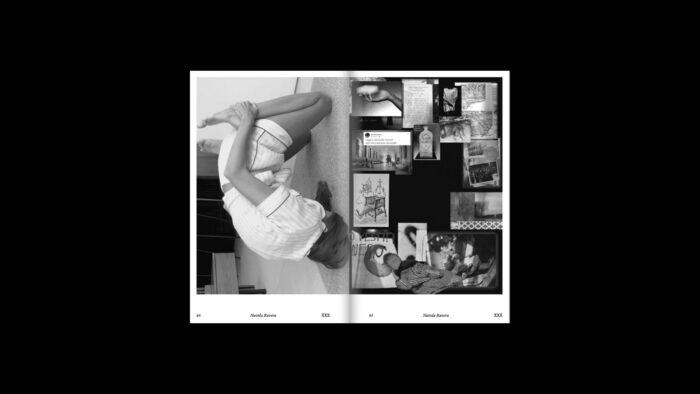
Two volumes opened the day, not as objects to be presented but as devices for new connections and paths of inquiry: Inchiostro e dinamite. Antigruppo siciliano by Simona Squadrito, published by Postmedia Books, and xxx by hello.dear, published by Witty Books, conceived not as the end of a research project but as an opening to new practices. The book, the map, the gesture: tools to continue meeting, to pursue a research that does not close but branches out, that does not archive but generates.
At the center are distinct and complementary paths, which in this project have intertwined like threads of the same fabric. On one hand, the research on the Sicilian Antigruppo (Simona Squadrito) as well as Strip Practice (Giulia Currà), which in the preceding days had already given rise to a further collective experience in the project Poesia poesia portami via, organized together with PIA Independent School for Visual Arts and Curatorial Studies and the Castromediano Museum in Lecce. On the other hand, the artistic practice of hello.dear (comprising Francesca De Chiara and Aurora Piedigrossi), which, before arriving in Termoli, had traversed other spaces and communities, from Cripta747 in Turin to Radio Sherwood in Padua.
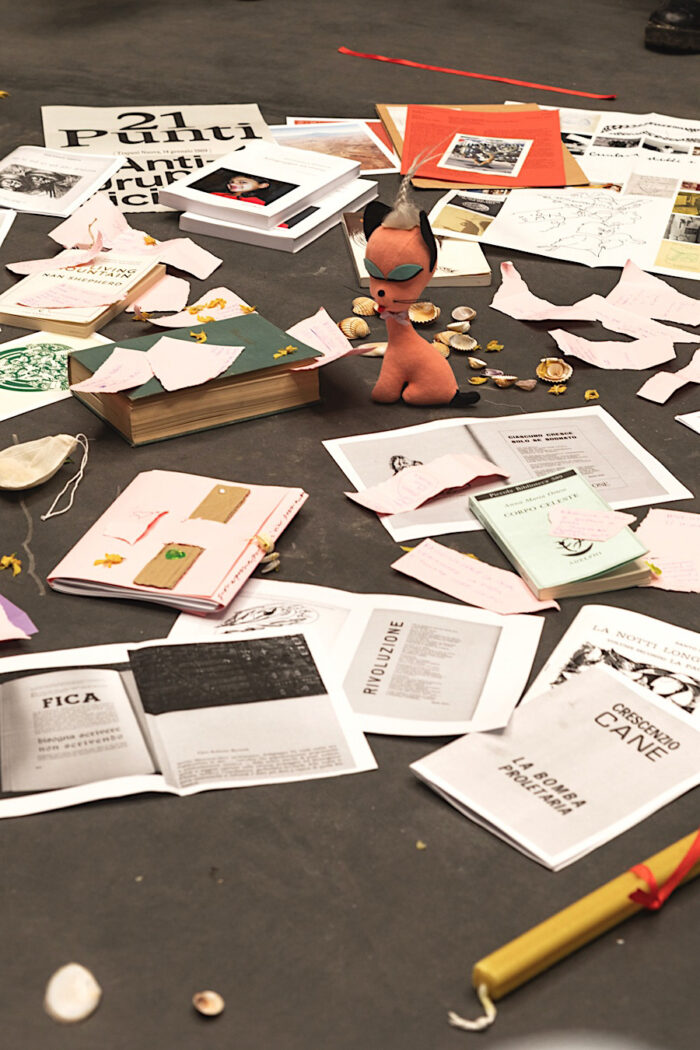
All these experiences have come together at the museum as tools for unearthing forgotten stories, inhabiting the margins as an epistemological position, and transforming the body into a living repository of gestures, memories, and knowledge. In Giulia Currà’s research, “cura” (care) is not merely an affective gesture but a political and aesthetic category; a way of being in the world and of producing knowledge together. If you move, what do you leave behind? If you move, what do you take with you? In Simona Squadrito’s research, however, it is the poetic word that becomes body, voice, and occupation of a physical and mental space, as a form of siege. Nomadic bodies in transit recreate their own home wherever they go, live in absence and desire, rethink daily life through the gestures of their ancestors, and right in the chaos, on the threshold, re-enchant the world. Reclaiming a southern, decentralized history such as that of the Sicilian Antigruppo—long ignored by the circuits of national cultural power—is not a nostalgic gesture but an epistemological act. It means recognizing that marginality is not a flaw to be corrected but a position that allows us to see differently, think differently, and produce differently. The question is not how to eliminate conflict, but how to remain within difference without ceasing to build relationships.
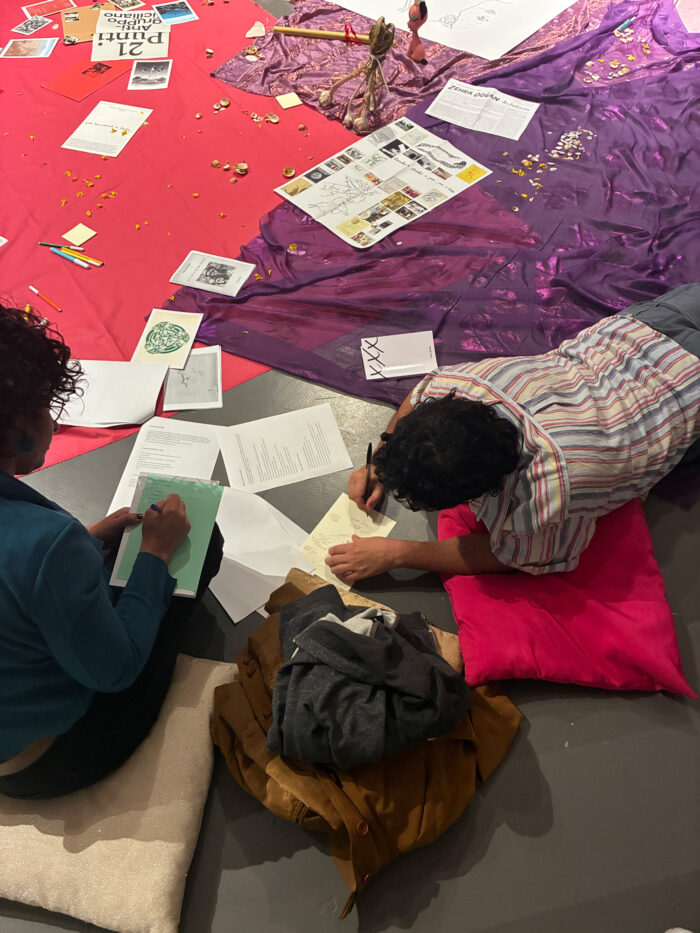
Intertwined with these practices is the collective construction of affective cartographies inspired by the Carte du Tendre (hello.dear): maps that do not represent territories but generate them, tracing relationships, proximities, and crossings. Territory is not a given space but a lived space, laden with experience, emotion, and feeling: emotion as an immediate impulse, feeling as its elaboration over time. Affectivity is not an individual quality but a dimension constructed within relationships, made up of dense zones and empty zones, passages and accumulations, places of arrival and places of loss, shared spaces and solitary spaces. Building a collective affective map means recognizing that the territory is never neutral: it is always traversed by bodies, affections, and stories.
Both gestures say the same thing: it is necessary to do things differently, to practice decentralization as a method, to imagine new forms of community that can speak to the future with frank boldness.
Collectively performing our experiences, as Diana Taylor suggests, did not mean providing an abstract theoretical tool, but eliciting a wide variety of social behaviours. It is a creative act and at the same time a method for transmitting cultural memory and identities: a means for understanding the world, the dynamics of power, and their dismantling. As Taylor writes, “the power that performance has to make it possible for individuals and collectivities to re-imagine and reconfigure the social rules, codes, and conventions that prove most oppressive and harmful” (Acts of Transfer, in Performance, Politics and Cultural Memory): performance plays a vital role in the transmission of memory, in the formation of cultural identities, and in the political actions of collectivities.
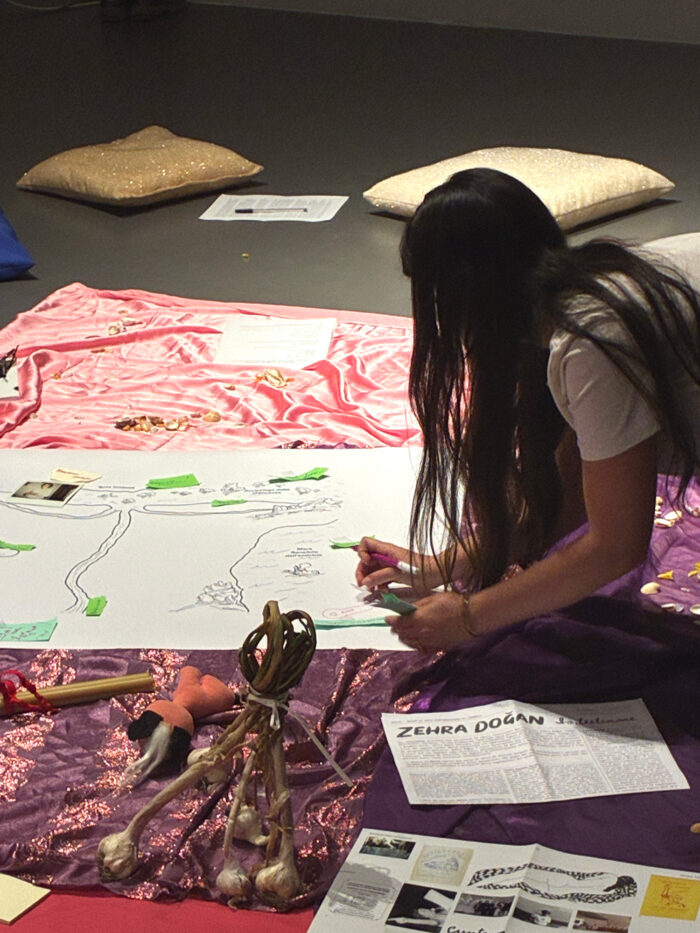
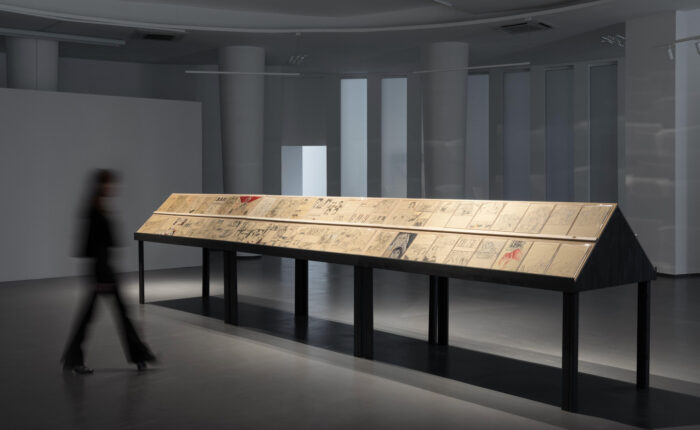
Central to the evening at MACTE was the reading of a collective diary created by the artists and curators of the event, to which, at the suggestion of the museum’s director Caterina Riva, excerpts from the personal and diary writings of Kurdish artist Zehra Doğan, on display at the museum, were added: a space where everyday thoughts, images, personal fragments, and shared reflections converge, returned to the audience through readings in multiple voices. On a large white surface, a fabric laid out in the center of the room, a map emerged. Signs overlapped, interrupted one another, followed the trajectories of others, or diverged. The sound remained sparse and low-impact, consisting of voices, readings, and a gentle ambient sound diffused throughout the space. The audience was invited to bring thoughts, silences, actions: everything became part of the map, and everything contributed to keeping it alive. The closing felt as if we had all shared the same dream and were trying to tell it to one another.
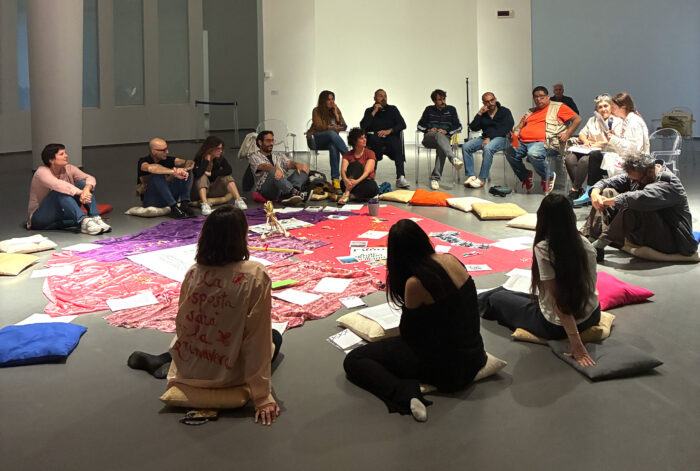
What brings everything together is a shared intention towards doing things collectively: a way of acting that refuses isolation, recognises a generative resource in the plurality of bodies and voices, and chooses the margin not as a limit but as a place from which it is still possible, perhaps, to re-enchant the world.
The fracture to pay attention to today, as Taylor reminds us, is not between spoken word and written word, but between the archive of supposedly lasting materials, texts, documents, buildings, and the repertoire of embodied knowledge and practices: spoken languages, dances, rituals, gestures. It is within this tension that the project moved, choosing the repertoire as method, the body as living archive, the encounter as a form of knowledge.
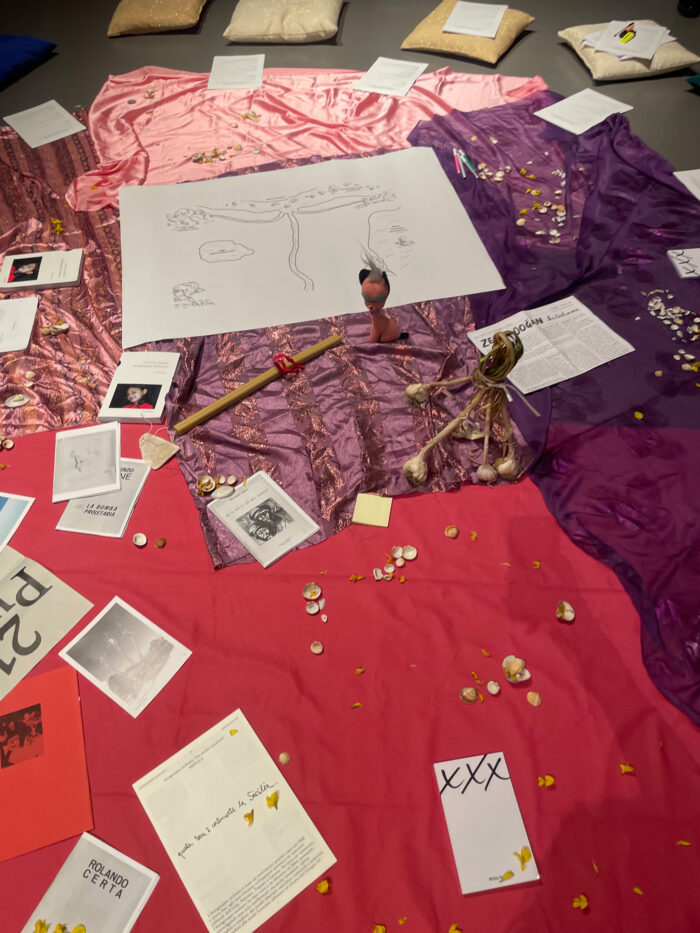
extract from the collective diary—where things bind together
. . . . . . . . . . . . . . . . . . . . . . . . . . . . . . .
Catania, April 13, 2026 – 14:21
it’s that I have two homes and two hearts
and two hands:
one for writing and the other
for ripping
(Rosa Maria Ancona, Parlare di sé)
…………………………………………………….
(Shh… pins coarse salt marzipan lava and chamomile)
. . . . . . . . . . . . . . . . . . . . . . . . . . . . . . .
Paris, April 15, 2026 – 14:33
today was grandma Elodia’s birthday, we gave her the calla a yellow plant
(from a diary of mine I found again, it was 7 May 2006)
I leave you, things.
May your being missed by me be the melody
that now guides me
(Mariangela Gualtieri,Bestia di gioia)
. . . . . . . . . . . . . . . . . . . . . . . . . . . . . . .
Paris, April 14, 2026 – 21:36
Better to be on the map of what matters than to be forgotten (…) The politics of forgetfulness requires making absence visible.
(Françoise Vergès, Like a Riot: The Politics of Forgetfulness, Relearning the South, and the Island of Dr. Moreau)
I believe in a dimension of resistance that is not only a shield against what is, but a seed of what can still be born. And in affectivity as a daily practice of presence, which restores body and voice to what risks being erased. The bond is a political gesture and shared care.
…………………………………..
Misterbianco, April 15, 2026 – 15:49
I think of the margin.
……………………………………………………
Paris, Charles de Gaulle airport, April 17, 2026 – 21:15
“The first duty of a woman writer is to kill the Angel in the House,” wrote Virginia Woolf. It is a powerful sentence taken up by Virginie Despentes in King Kong Théorie. I am reading it for the third time. The affectivity we have been taught is often a well-furnished cage. Unlearning it is violent, but necessary.
. . . . . . . . . . . . . . . . . . . . . . . . . . . . . . .
Milan, Friday April 17, 2026
. . . . . . . . . . . . . . . . . . . . . . . . . . . . . . .
Naples–Salerno, standing on the bus
What a pain in my feet and legs
The earth is hard and grey, moving on a road even greyer and harder.
It is hard, truly
To see the sea holding Capri like Eve’s forbidden apple
To pass under the giant crest of the mountains that hide the coast
I always thought the giants were hiding things down there before leaving
perhaps the green soil was a blanket
the signs of its soft folds are still there
It is hard, truly
To know that you could draw that mountain profile with your eyes closed
and it comes back to mind every time you are far away
And if I left…
Perhaps I would never discover what the giants are hiding
Perhaps I would discover that I don’t have to leave at all
But these are only ifs and maybes
………….
Milan
The traslocatrice (mover) recreates her home everywhere
She lives in lack, in unsolved debt and in desire
She rethinks her daily life through the practices of her ancestors
The traslocatrice (mover) becomes with the things and voices she collects
The depot is her home
She tends to what people decide to let go and what becomes an object of love again
She falls in love often
She practices striptease to rethink the layers that compose her
She gossips with her friends to remember that if you touch one, you touch them all
She likes to confuse, but it is precisely in chaos and on the threshold that she always re-enchants the world
(Lack has a voice and it laments. Writing screams this lack.)
. . . . . . . . . . . . . . . . . . . . . . . . . . . . . . .
Milan, April 19, 2026
November 8, 2017
Zehra Doğan
I have temporarily moved to a bed near the window. It is impossible to stay there without being wrapped in a blanket. We are like homeless people sleeping on the street. In prison, you understand even better the situation of those who have no home. When you sleep, not a single part of you must remain uncovered. So I sink entirely under the blanket, even my head, to avoid finding myself with a frozen nose. I seek warmth like cats do, I cannot bear such cold.
…………….
April 24, early morning – Milan
I have always loved dawn, I feel close to it
I often climb onto rooftops to listen to it
murmuring silence
a moment of possible compassion
it seems we could live again
to make a tomb tremble with a rose, a leaf, a whisper
the tomb must tremble and resonate
laying tears like dew on the shoulders of those who still remember and cultivate memory
the swallows arrive
the swallows always return
they seek shelter in the darkness of corners, doorframes, of paper that moves forward without adhesive
to inhabit again
to inhabit
does it perhaps mean discovering unexplored places?
I have not returned home
the home has always remained deposited
scraps remnants of pink yellow and orange silk
The bed for orgies quiets down and seems hooked in listening
it waits and hosts, it trusts
I do not
I cannot lie down on a new bed, it seems too cold
I remember the smell of sofas
the bedbugs
the smell of smoke, of beer, the hairs in the bathtub
and my sweat in my hair
the tape makes more noise
now it seems to evoke layers
…………………….
Catania, April 28, 2026
one year exactly
you left me
laconic hours
sunken again
that bottom
deeper than the bottom
it never convinced me
one finds oneself again
without understanding how
it remains it remains
months
I am up
the light comes through
the one that was denied
the windows shut not even
the air
May 3, 2025 I was agonizing
Missiva n.16
the vodka consumes itself consuming me
I read it
I put it down
to make it explode
buon appetito
my love
…………………….
Milan
POETRY AS WITCHCRAFT
for confabulations to come
. . . . . . . . . . . . . . . . . . . . . . . . . . . . . . .
Catania between April and May during the full moon in Scorpio
The neck of the foot with a bottle in hand
in May but it is still April
solemn the evening found me furious
leaning forward to deflower a star
Piero Ciampi
The green parakeets sing, the green parakeets scream
Your alternatives
your violences
you wanted that desperate face now, with such sorrow
I can only embrace you again
Piero
The green parakeets sing, the green parakeets scream
Your voice runs over the others
confusing
it in a sound I will never be able to hear again
intent on defending myself from you
from that person who doesn’t quite convince me
the neck of the foot
The body is an atrocious sublime
swine
Ciampi
it’s not quite like that but
I dreamed of a goat devouring a fish
and you gutted
these dreams of goats, flights, bicycles, whales and kerosene
speak and they tell me
that I see things in dreams
you are trapped between the dust and the spoon
and you explaining to me that life is a serious matter implored me to ignore
your thought
this love has devastated me
it is only because there is nothing else
I have returned
to that person who doesn’t quite convince me
the neck of the foot
……………
Paris, May 4, afternoon
Mega Mingiedi Tunga is an extraordinary artist. Today he took me to visit his atelier: he talks to me about the Congo, about the beauty of his land and the suffering that capitalist society pretends not to see. He talks to me about humanitarian crisis, climate crisis, he asks me if we know where and how the batteries of our ultra technological phones come from. He talks to me about violence against women, about addiction crises. Mega makes maps, enormous cartographies using biro pens and collage. He studies enormously. He studies the causes, he studies the effects, he underlines the distorted colonial vision of a continent that in our Western eyes again and again and again and again. He has nothing. His maps are real and imaginary. He imagines leaving the Congo arriving in Italy (and in all the other countries of the world). And he creates bonds, connections. And I ask him: what is the most beautiful connection you have found so far?
He answers: “the people who inhabit.”
. . . . . . . . . . . . . . . . . . . . . . . . . . . . . . .
Strip Practice, September 29, 2024
start walking through the space and breathe
welcome all the emotions you feel,
let fragility emerge, can you feel the skin trembling?
breathe into it and don’t seek relief
connect the body to the space you move through
the field is active and feels you, try to trust it
as you walk slowly feel the soles of your feet as they rest on the ground
find the breathing points of the room
in these points place, hang, or glue, scraps of fabric,
curtains or cutouts of tartan wallpaper
these squares will be your breathing points during the trasloco (moving)
as soon as you feel a sense of vertigo, move closer to them and stop to breathe
without air, we cannot move
. . . . . . . . . . . . . . . . . . . . . . . . . . . . . . .
I love you my friend
my home is yours
be strong today
Message from Simona Squadrito, August 31, 2023. Full moon in Pisces.
. . . . . . . . . . . . . . . . . . . . . . . . . . . . . . .
Yellow metro in Milan, May 3, 2026
the trasloco (move) shifts ways of inhabiting
ways of existing in the world
sometimes it all sticks to you like slime a broken egg a trail of algae and salt
here with the water the new load
words stick as you walk apparently safe in the night
gazes create pools where we can meet
words like ants compose and rhythm infidelities
there are those who help, those who find no peace, those who open their mouth and stuff it with witch’s syrup
there are those who hide and those you listen to, in silence
to discover that it is possible to remain vigilant
sometimes it all sticks to you for hours and then the weight becomes body
(salt, honey, smell and do not be afraid to say no)
sewing skins forever
(if I hadn’t fallen I wouldn’t have heard the sound of my bones)
creating skeletons with small shells, crucifixions without guilt
(hail fortune, daughter of my desire)
……………………………………………………
Paris, May 5, 2026, 22:22 and it is pouring
I read here Zehra Doğan
September 30, 2017 Zehra Doğan
Sometimes I think: “One day History will write this infamy.”
Then I think: “What if it didn’t?” Will there always and only be an official History?
Should we wait for the powerful to write our history?
Today we resist, but what will remain of it if we let history be written by rulers with a fascist ideology?
We will thus abdicate before the future! As long as we do not write our own history ourselves, rulers will write their versions and will succeed in annihilating us through thought. Yes, History, in reality, is not written History and cannot be reduced to events of relative importance, History is the present. It is the present moment lived by the entire universe. We must therefore take ownership of our struggle, take each other by the hand, or else, just as women have no history, one day, those who resist will find themselves stripped of theirs too. But would History be a repetition of the past?