When Sound is Body and Body is Territory
Thinking with Ametonyo Silva’s “Assombração”
Sound reverberates in the body as gestures shatter across space. Ametonyo Silva’s choreography creates territories where memory and body meet. Nebulas where movement acts as language and sound becomes a presence.
Ametonyo Silva (1994) is a choreographer, performer, and artistic director born in the Sertão region of Paraíba, in northeastern Brazil. He grew up steeped in sound and dance. Popular festivals, radio hits, and religious rituals led him to discover the body as an expressive code. He studied at LAPETT (Laboratory for Research and Studies in Tanz Theatricalities) [1] in São Paulo and at the Centre Chorégraphique National de Montpellier. In France, he began exploring the impact of migration on identity through the lens of the economic and ecological pressures born from colonisation and neoliberal development in Brazil.
As if sound were body, and the body, territory. This is the sensation Assombração leaves behind. Presented at Paris’s Ménagerie de Verre and Parc Jean-Moulin between May and June 2026, the choreography acts as a manifesto for Silva’s practice. A warm, sudden wave that can cradle or overwhelm, into which Silva immerses those watching.
Linda Motto: In Brazilian Portuguese, assombração refers to a presence, a body, or a ghost. It’s also the title of a piece that comes across as your artistic manifesto. How did it all start?
Ametonyo Silva: Assombração took shape in Montpellier between 2022 and 2023, born from a need to confront personal memories and familiar sounds. That process brought me to the word assombro, which in Brazilian Portuguese carries the sense of “wonder” or “enchantment.” Then one day, while walking, I heard Tudo no sigilo by Vytinho NG and Bianca. A brega funk track that grips you. Its rhythm drove me toward the accumulation of gesture as a core choreographic principle. Working with sound artist Eduardo Joly, we stripped back the original lyrics, turning the song into the catalyst and sonic floor of the piece.
Music isn’t a background in your practice. It’s raw material. You seem to focus on frequencies and sound waves, on how they reconfigure our connection to space and to the listener.
I carry this memory of driving with my father as a kid. A long road trip with the radio on. I kept asking him to turn it down, but he just cranked the volume. There was something magnetic hidden inside that discomfort. Another core memory ties back to sound. Right outside my grandmother’s house, local bars lined the street. At night, people would park, pop their trunks to reveal massive sound systems, and duel over who had the loudest setup. It felt like an assertion of existence. The music hung there like a physical presence. A heavy mass driving bodies to move.
Performance Description: Assombração
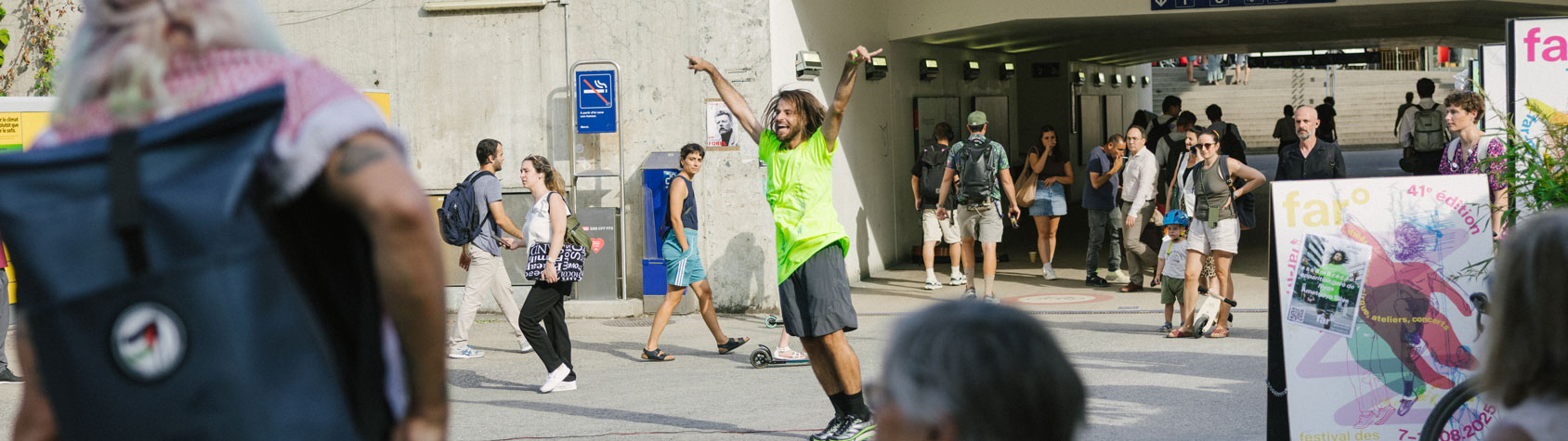
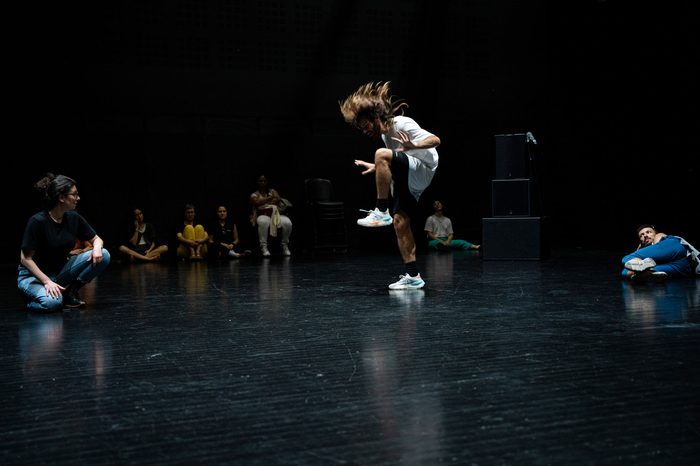
Created by Ametonyo Silva in collaboration with Flavia Pinheiro, a Brazilian choreographer based in Amsterdam and re-adapted site-specifically for theatres, public squares, or parks, Assombração is a 40-minute choreographic device built on a chain of sequences. It balances sound against space, and the solo body against the collective. Music signals the start. Wearing a white t-shirt, shorts, and sneakers, Silva enters the frame. He moves along a long diagonal path anchored by two speakers playing the instrumental track to Tudo no sigilo. The dance moves at a dense pace, constructed through an accumulation of alternating steps, jumps, sonic silences, and sudden bursts. A climax builds at its centre: shifting focus from the limbs to the entire spine. Silva strays across the diagonal before changing trajectory entirely, taking the audience with him. The crowd watches, drawn in by the physical exhaustion of his body. Mid-way through, the music cuts out, but the repetition carries on. When the sound returns, Silva slips offstage, re-emerging at the finale with his mouth green.
What fascinates me about choreography is the creative process itself and all the improbable elements that leak into it. That was a constant point of debate during my studies: How do you explain a finished work when the process of making it is the actual core? On stage, I’m interested in appearance and disappearance. Nothing is left to chance, yet everything remains unpredictable. I play with the presence of sound and silence, architecture, venue work lights, and the bodies and gazes of the audience, who sit or stand at eye level with me while I dance.
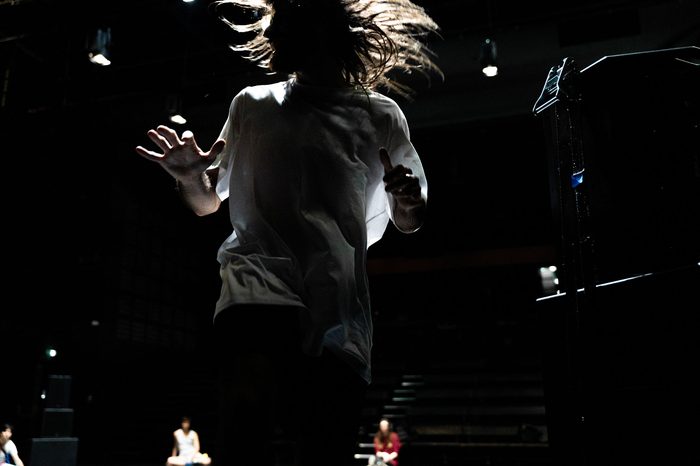
Assombração might look spontaneous, but its structure is tightly “controlled”, built on meticulous counts, repeated breaths, and precise physical study.
It’s interesting that you use the word “control.” As a foreigner in France, verbal translation carries real weight for me. To describe my body on stage, I usually use the word “delirium” (delírio). Yet its connotations in French, Italian, or Spanish don’t quite align with what I mean. For me, a state of delirium points to a generative condition. One that grants access to another way of perceiving reality. Similarly, “control” doesn’t mean restricting the gesture; it means organizing it. In Assombração, control becomes liberation because it’s pushed to the point of exhaustion. That’s why I speak of a “choreographic delirium.” Behind every gesture lies a precise score, but within every score, there’s room for the unpredictable. I never know how a performance will end, or how my body will react to each repetition.
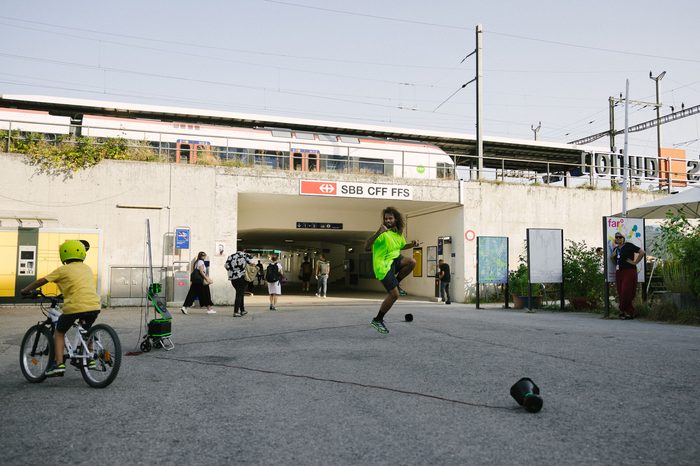
Having experienced Assombração multiple times, first at the Ménagerie de Verre and later at Parc Jean-Moulin, it’s clear how vital the site is to the work. The Ménagerie is designed for performance, while the park is an everyday public space filled with joggers, kids playing, and people relaxing. How do you adapt to different audiences depending on the setting?
The experience across the two sites was completely different. At the Ménagerie, the audience was immersed in a protected environment. In the park, there were endless distractions competing for people’s attention. Regardless of the setting, to relate with an audience, I first have to connect with myself. Staying grounded in my own body is what allows people to feel close to the work.
In Assombração, you expose a body that shifts, gasps, and sweats, prompting an empathetic response to your physical strain. It echoes an epistemology of suffering. An approach that treats pain as a site for connection and care, framing it as a critical space for collective, decolonial reflection.
AS. Moving between Brazil and France forced me to process migration as a social and relational disruption. Being a foreigner shapes how I relate to others, and my background releases an intense, warm energy. I chose choreography as a medium to channel that force. What’s fascinating is that this heat is directly felt by the people watching me dance.
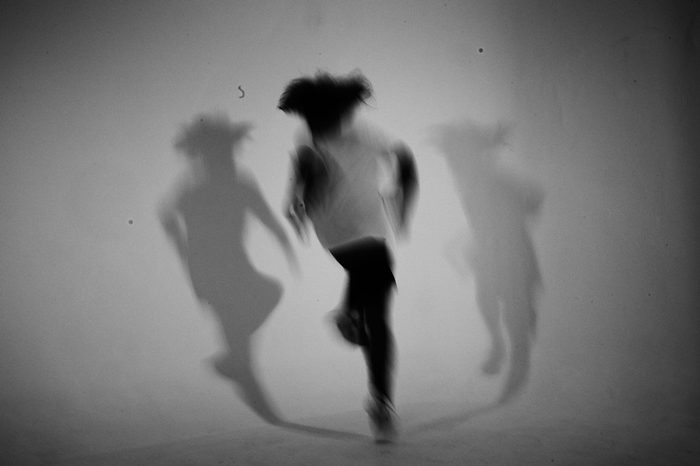
For a long time, the body was framed as mute. By the twelfth and thirteenth centuries, theologians and philosophers like John of Salisbury and Thomas Aquinas began proposing that what holds the body together is an incorporeal principle: the soul. In your practice, the soma feels like an embodied presence shaped by spectral memories that appear and fade away.
Dance sits right between magic and reality. People often read my work as a celebration of a trance state. That’s true to a point, but the “trance” or “delirium” I talk about isn’t tied to coded religious spirituality, something people quickly project onto me because I’m Brazilian. It actually comes from ordinary gestures. Assombração is, first and foremost, a choreographic exercise. I’m building a ritual out of everyday actions: walking, jumping, breathing. Repeating them over and over is what pushes me into a “bodily delirium”.
In Science as a Vocation (1919), Max Weber wrote that the future would be defined by the “disenchantment of the world,” a loss of wonder driven by extreme rationalisation and the disappearance of the sacred from daily life. In her essay Re-enchanting the World theorist Silvia Federici revisited the idea, describing it as an inability to imagine human development outside of capitalism and technological dependence. Without advocating for a return to primitivism, Federici proposes a new stance: one capable of opening up a process of re-enchantment. The word itself, derived from the French chanter and Italian cantare (to sing), invites to chant the world into being, to affirm it.
Rooted in lived experience, Ametonyo Silva dances forms of everyday re-enchantment. Much like repeating a song’s chorus so many times that the words drain of their original meaning only to open up to new ones, repetition in Silva’s dance acts as a generative baseline.
What lingers after watching Assombração? Not just the memory of movement, but the reverberation of thoughts and images sparked by its energy. In Silva’s universe, accumulated gesture becomes an engine for metamorphosis, and delirium a space to re-imagine. It is a physical practice where choreography and sound expose interior landscapes, generating new narratives and alternative ways of inhabiting the world.
Bibliography
Silvia Federici, Re-Enchanting the world, New York, PM Press, 2019.
Soh Bejeng Ndikung, The Delusions of Care, Archive books, Milano 2021.
Rosi Braidotti, Materialismo radicale, Meltemi, Fanu, 2019.
Yuna Visentin, Spiritualités radicales, éditions divergentes, 2024.
Weber, Max. Science as a Vocation. In From Max Weber: Essays in Sociology, edited by H. H. Gerth and C. Wright Mills. New York: Oxford University Press, 1946.
Deleuze, Gilles, e Félix Guattari, Mille piani. Capitalismo e schizofrenia, a cura di Paolo Vignola. Trad in italiano. Giorgio Passerone, Napoli-Salerno: Orthotes, 2017.
[1] In this context, dancer, choreographer, and professor Sayonara Pereira is a central figure for Ametonyo Silva.