What is a Festival for?
Thoughts from a conversation (and more) with Elias Rønnenfelt at C2C Festival
What is a festival for? For some reason, that was the question I left this edition of C2C Festival with. Not entirely because of my own experience, but perhaps also to the immediacy of opinions and reviews I felt coming in just as the festival closed its doors. This was an edition that was not going to be left undiscussed: 25 years of C2C Festival, a celebration, but also a clear move towards an artistic direction that left some people particularly critical.
In some ways, every edition of a festival is prone to being questioned and put under scrutiny. But one that marks a quarter of a century of existence will especially be used as a frame to observe changes beyond the festival itself. An occasion to evaluate the shape and health of the genre, public, or scene an event taps into—“avant-pop”, in this case.
In many other ways, though, the fruition of any club night, live concert, sunset rooftop DJ set, rave, sleeping concert, live radio show, and so on, entails, at least for a portion of the audience, a discussion. The debrief with whoever was there with you, the review for whoever was not: the success of an event will always be a point of conversation with others, especially if they have been there before, especially if they can trace its narrative arc. Don’t even get me started on artists or event organizers: “addetti ai lavori” will likely spend a great portion of their time in a place the size of Lingotto imagining how to deal with crowd control, estimating the costs of security personnel, fantasizing over impeccable cable management, observing the front-of-house desk to catch a glimpse of how sound is handled in such a space. As someone who lives and observes club spaces and festivals both as a writer and as someone trying to have fun, I am not exempt from a degree of dissection of what I am immersed in.
I joked with a friend that my favorite thing to do at festivals is to talk about other festivals. These occasions are unironically a very important point of meeting for people with whom I share a good portion of my music taste, a chance for disparate friend groups and conglomerates of event organizers scattered across Italy and beyond to come together.
C2C Festival is, and has been for many people and for many years now, a place of encounter and a benchmark for the state of the Italian “alternative” “electronic” music scene. I only partly mean this as a benchmark for artists stemming from the Italian scene itself, as the share of Italian artists at C2C Festival has been (almost from the start) quite low. What I mean more directly is a finger on the pulse of the triangulation of the Italian audience (aka the reaction and attention), the organizers (aka the curation and production) and the institutions (aka the regulation and legitimization). If your friends are not discussing this triangulation after coming back from the club, then what are you doing?
To use my brief but insightful and unsurprisingly poetic conversation with Elias Rønnenfelt as a ploy to dissect every element of that scheme of analysis would be silly, reductive of the depth of that conversation, and unfair to the generosity of Elias in so quickly opening up and offering insight into his undoubtedly legendary artistry. But traces of the conversation carried through all my thoughts and evaluations of the experience as a whole, and it wouldn’t feel right to isolate those ideas and not put them in dialogue with wider observations about the festival. This is what conversations are for, aren’t they?
That specific conversation took place backstage a few hours after the opening on Saturday. The voice note I recorded managed to catch the beautiful voice of Joanne Robertson performing on the main stage just a few meters behind us. Out of my usual comfort zone of phone interviews days before or after a festival, I was a bit hesitant to dive right in with Elias, an artist whose impressive discography and long career have traversed a variety of experimentations with punk, post-punk, folk and singer-songwriting. Best known as the frontman of Iceage, formed in Copenhagen in 2008, he has also released music as Marching Church and, most recently, under his own name with the solo debut Heavy Glory (2024). Iceage’s latest album, For Love of Grace & the Hereafter, came out in May. I was soon comforted by the quiet confidence of someone who has been around these spaces for most of his life. Elias was quick to offer the same depth, rawness, and honesty one can find in his music.
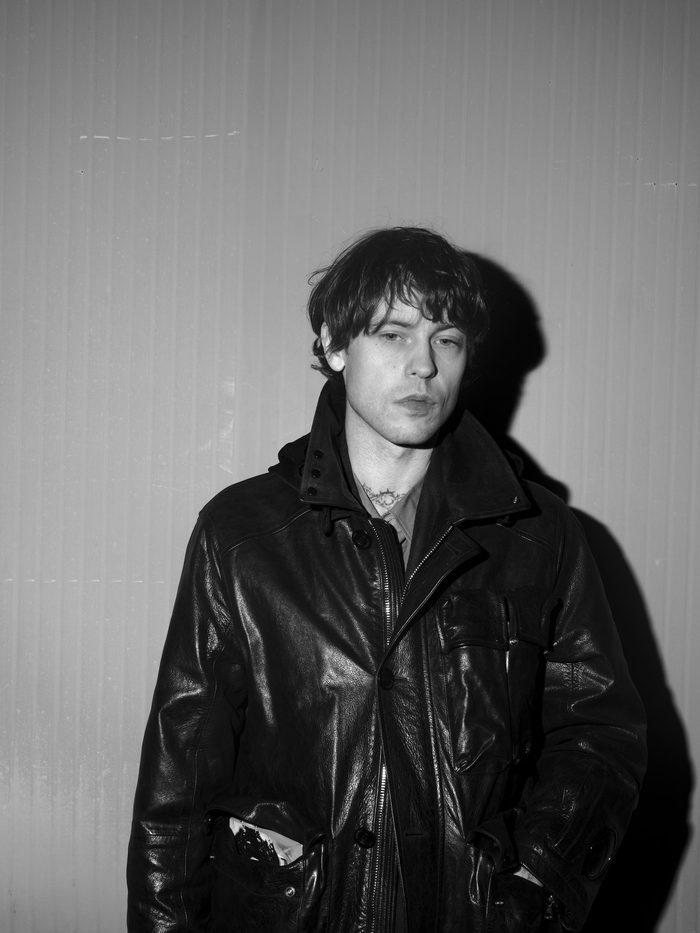
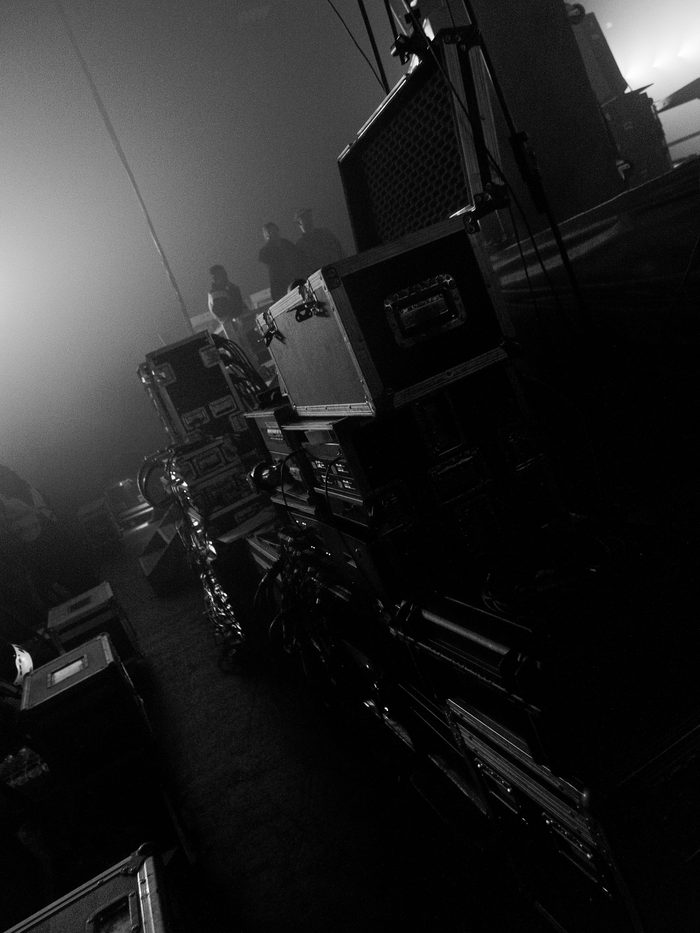
A lot of Danish was being spoken backstage. I exchanged a few words with Rune Kielsegaard, drummer and founder of experimental collaborative music format and platform 2014 Assembly, who has taught many of the musicians from the Danish scene we have come to know and love. Joined by Villads Tyrrestrup, they play drums and bass respectively for Smerz, who had just played that morning at Teatro Carignano. Next to us, Fine was getting ready to go on stage. The two bands, Elias, Joanne Robertson, and ML Buch have all released on Escho, the Copenhagen label founded in 2005 by Nis Bysted, which has been home to much of the city’s alternative scene over the past two decades, Elias being the first, with Iceage’s self-titled EP in 2009. Given that his music has been around way longer than any Spotify CPH+ playlist, it might have been too obvious to ask Elias his opinion about the Copenhagen hype, but I could not help myself.
Marta: Copenhagen and the Danish context: there is this strong image of a Nordic European music scene growing. Is it branding, or does it feel like there’s actually some sense of locality that makes it a place with so much great music?
Elias: Smerz played earlier, Fine is about to play, I’ve made music with her before, Smerz’s bassist used to play bass for me, everybody kind of knows each other and has played with each other. Copenhagen, for being a metropolitan city, actually feels quite small. The whole hype aspect of it, I don’t really care about. And I don’t care if they want to talk about it all coming from some school. It’s just simply various people doing cool things at the same time. I think things do go in waves and sometimes it seems like there’s more stuff spilling out, but everybody’s been doing various sorts of music in Copenhagen for ages. It’s just a lot of people who care about making music, that’s really all it is. It’s not fabricated.
My curiosity to understand why Copenhagen is able to produce such a space for genuine, high-level music artistry comes from an Italian (and wider southern European) experience of a music sector that is underfunded when it comes to the underground, and overbloated when it comes to commercial artists: from conservatories still stuck in neo-jazz purgatory, to underground spaces constantly at risk of eviction; from unpleasant nightlife audiences of mainstream clubs, to the continuous criminalization of, and crackdowns on, informal parties and raves.
The infrastructure that is supposed to support the development of artistry is underfunded, not up to date with contemporary music, or perhaps it never actually existed. For many municipal administrations, the potential of the music event industry lies only in scale: the logic of limitless growth, which only has room for a sanitized, populist music shaped to the taste of mass culture. Ultimo’s show at Tor Vergata attended by over 250,000 people is this attitude’s most striking example. C2C Festival is the rare exception in the Italian music and festival scene. Fragmented event series scattered across Italy exist and resist, proposing a rich and exciting plethora of DIY efforts from below. That feeling is one of a genuine scenius, Brian Eno’s neologism, putting together scene+genius to defined the type of collective creativity and intuition that subcultural groups develop. While present, the Italian scenius is rarely recognized by outsiders and tends to hit a ceiling of growth. So, when you see a local scene become an internationally recognizable marker of artistic quality, it is natural to question the conditions that made it possible for them to succeed.
But the scene that this year’s line-up tapped into was beyond a geographical grouping: a not so specifically defined but somewhat identifiable range of artists whose work interlinks beyond sound. Rather than building from disparate genres and attempting to please everyone and therefore no one, the bulk of the curation emerged from a very specific perspective on contemporary music. The various backstage group selfies of Robyn, Arca, and Kelela speak of something similar. It makes sense for them to be in the same room, to play on the same stage, one after the other, or even with each other. This is another notable difference from other editions, when artists who might have been collaborators did not (or perhaps could not, contractually) play together. Elias too played with long-time collaborator Joanne Robertson, Yung Lean hopped on stage during Robyn’s set, Underscores during Oklou’s.
This choice of curation created a perceivably specific public. My friends and I joked about which of our fellow festivalgoers was there for Robyn and which one for Underscores, based on age, which one for Yung Lean and which one for Bladee, based on outfits and general proneness to smiling. It was perceivable that while the algorithms that shape our subcultural tastes in music, fashion and, more generally, consumption fragment us into employing ever more specific signifiers of belonging, a wider “vibe” exists. Notably, for the first time, international visitors outnumbered Italian ones in this edition of the festival. Anecdotally, it was the first time any of my international friends had ever mentioned or asked me about C2C Festival. The line-up put Turin on the map as the festival for a niche of pop, well beyond Italy. Besides some recurring names at C2C Festival like Kode9, Bill Kouligas, and Arca, besides the divisive 7-hour Theo Parrish set, and besides an (incredible) showcase of the Italian label Hundebiss (can we call it “avant-club”?), C2C Festival’s curation felt quite busy with one task, the one of bestowing the “avant-pop” title upon two separate but neighboring sounds.
One is the constantly updated, electronic, synthesized sound of the hyperpop continuum to which Underscores and Oklou belong. I would consider Yung Lean and Bladee to exist on this spectrum too, but I don’t want to get too controversial. The other one is the “cloud rock” or “neofolk” sound, music often punctured by grunge and punk just as much as jazz and ambient, anchored by a preference for the band as unit of performance. This sound is carried by Elias Rønnenfelt, Chanel Beads, Fine, Joanne Robertson, and Wendy Eisenberg, but also by the off-site shows of Smerz, ML Buch, and Marina Herlop. Live performance was the undisputed king of this edition, and the band more specifically, at the heart of this sensibility. Elias Rønnenfelt’s act was perhaps its most elevated, matured form.
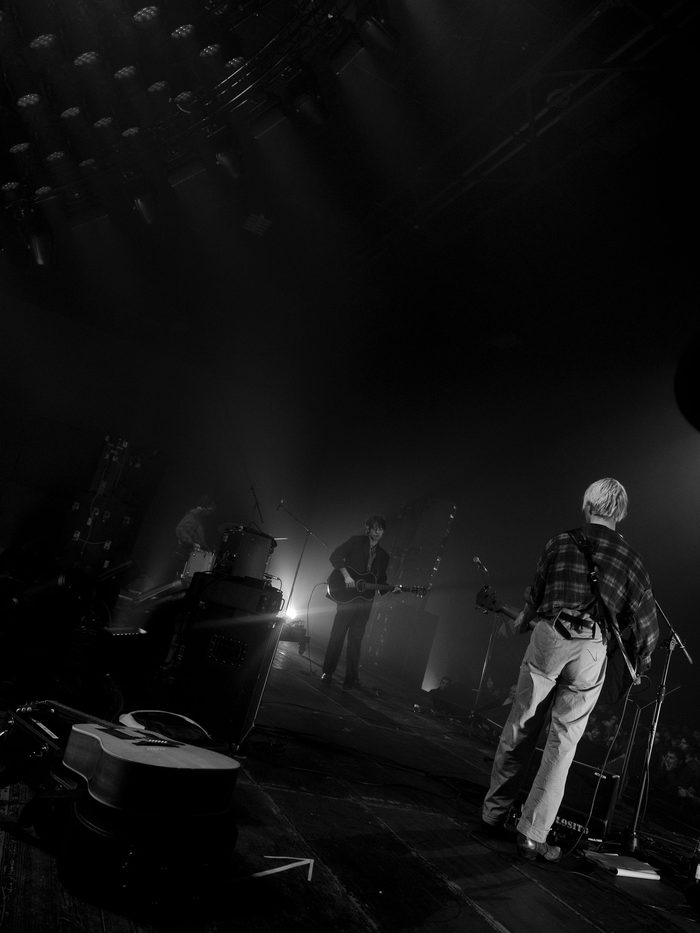
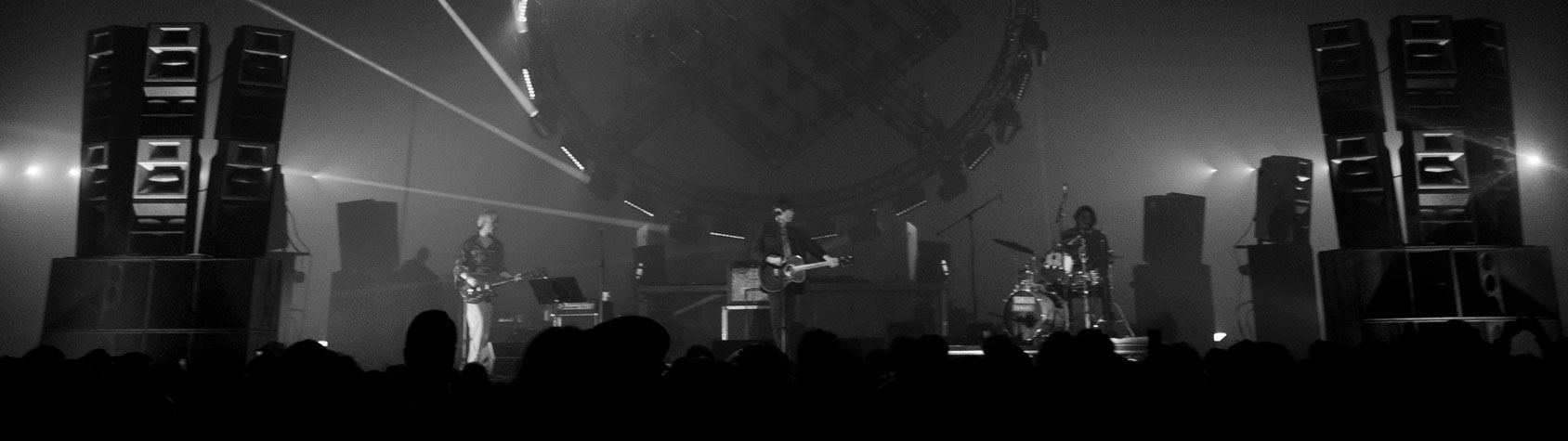
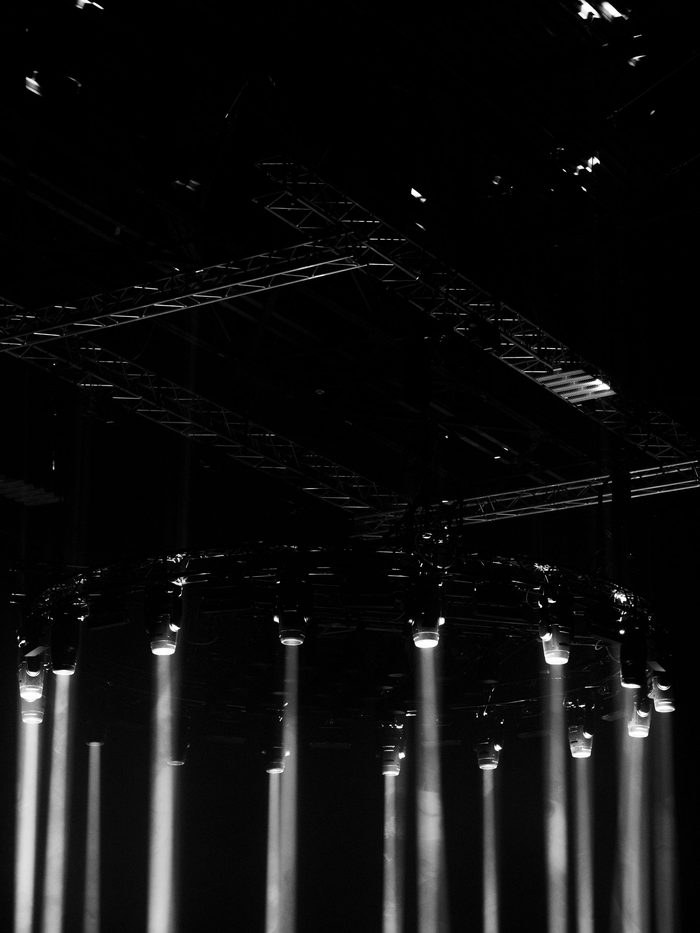
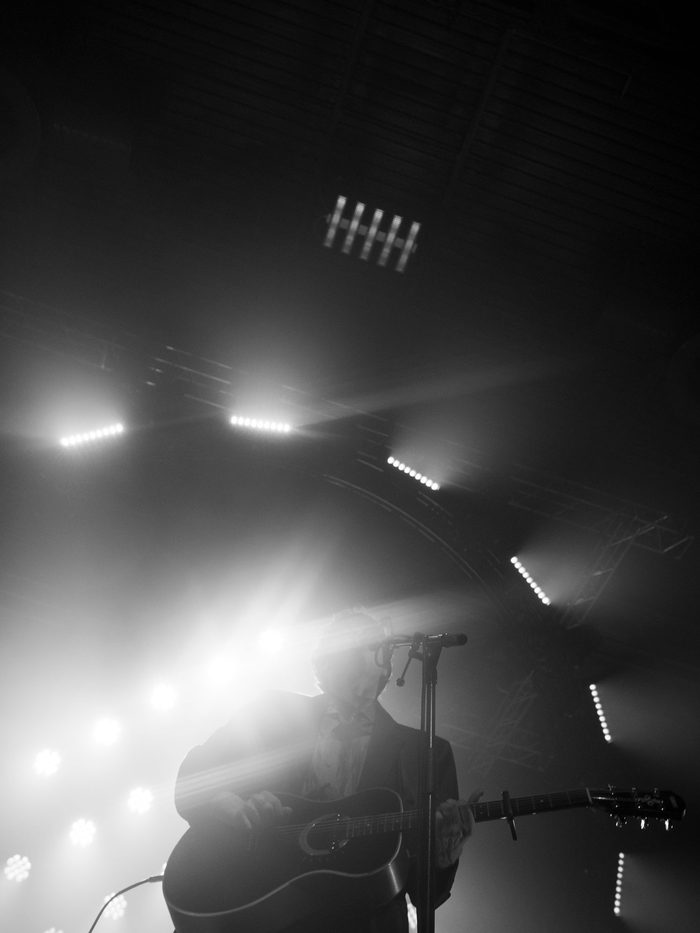
His show displayed in full force the new lighting set-up of the Dazed stage (f.k.a. Stone Island Stage): a circular lighting rig suspended above the circular stage, able to be lowered, raised and tilted to a range of angles. For Elias’s performance it was lowered all the way behind him, forming a backdrop, a halo lending a godly aura. Soft oranges and reds flooded the room, blue ambience lights, sunset colors, something between an alien abduction and sun shining through a cathedral’s stained-glass window. The cold, dispersive Lingotto hall felt intimate, the distance between audience and performer mediated, beyond light, by Elias’s deep delivery: the familiar rawness and depth of a voice that carries so much meaning with so little effort.
Marta: I was wondering about your process when it comes to writing and inspiration. Does it happen in isolation from the world? Does it happen as a way to find refuge from reality, or to confront it?
Elias: There’s no general rule there. I do find that discipline is somewhat necessary if you want to get things done. If you were just to wait for inspiration out of nowhere, then you wouldn’t get a lot of stuff done. So some of it is sitting down with the discomfort and dread of feeling like you have nothing, and then just sitting there anyway. But I was just talking to RP Boo outside and he told me about writing “Speakers R-4 (Sounds)”, which is a track that came out when I was a teenager and completely blew my mind. He said he wrote that whole track in his head when he was out in town and had to rush back and recreate it from his head. Sometimes there’s stuff like that where things just kind of come almost fully formed, seemingly out of nowhere. Sometimes the easy ideas are better than the harder ones and vice versa. There’s a fabric of being solitary when it comes to carving things out, but a lot of ideas are formed when I’m not trying to have them as well.
Just as different fragments of the festival can stick to you for no reason, the lyrics of “River of Madeleine”, from his solo album Heavy Glory, the one with the most folkloric, piercingly romantic feel, persist in my head. Recounting them feels like knowingly sticking my hand on a thorn of a bouquet for a lover.
You know words, they travel through wind and through rain
Like headlights piercing through what dark still remains
This is the ballad of the viciously broken, untamed
Lights out, it’s time that you go to sleep
Through your weeping, I’ll keep an eye out tonight
Like the title coincidentally suggests, I feel like Proust biting into his madeleine whenever I hear a snippet from that and other tracks played at C2C Festival. Some are obvious earworm hits: Robyn’s “Dancing on My Own”, Kelela’s “Bank Head”. Some a little less so: a snippet of J.Lo’s “On the Floor” in Arca and Bill Kouligas’s surprise mystery guest closing set on Saturday, a pleasantly surprising “Rather Lie” by Playboi Carti and The Weeknd played by HEDACHE at OGR on Sunday (who also played 10cc’s “I’m Not in Love” and Lali Puna’s “Faking the Books”, among others), or Regular Citizen’s “Touching Softness” in Lorenzo Senni’s closing set, also at OGR. From my embodied reaction to those memories it might be clear that Sunday’s OGR programme was my festival highlight. Grouper, in particular, with a capacity for deeply reverberating sound that pierces through one’s most inner core. The feeling of music permanence resonates with unpredictable fragments of the festival. Just like a lot of ideas come when you are not trying to have them, memories have that quality too: they become earworms against our will. How emotional memory might function in a space such as a festival I am not sure about, but I wonder whether there is an archival, stratified quality to how we experience a music event.
Especially if you have been in such a space before, there might be some unspoken predispositions in the way we relate to it. It was only my third time at C2C Festival, but this time there was a sharp difference in my perception of Lingotto: for the first time in three years I considered it an adequate venue for the task at hand. I think the incredible use of space and light played a big role. The Dazed stage’s moving cage of light replaced the previous, somewhat distancing cage of speakers. The side screens of the main stage could also move all the way down to the height of the dance floor, creating pockets of “clubs” in four corners of the otherwise dispersive dance floor. The video direction on those very screens was impeccable, perfectly tailored to every artist that set foot on the stage: the soaring image from the tallest perspective of the room used only for Yung Lean and Bladee, the overlapping close-ups for Chanel Beads, the fancams of Oklou. And then the hallway, for the first time, finally opened and used to its full potential. A former bottleneck turned into a space of calm transition, of rest, of charging up.
Memory and space are also things I asked Elias about.
Marta: You’ve been performing on stages of all kinds since quite young. How does memory play a role in performance? Does the experience stratify in some way, forming a sort of archive?
Elias: A lot of experience is stored in the body, I think. I was 16 when we started Iceage, and I started playing in punk bands. When you’re that age, at least in my case, you don’t have any sense of your motor skills. You are an awkward teenager who is growing, you don’t know how to place your arms or your legs. Suddenly you’re in a position where you’ve got to present in front of people. And we started out playing mainly floor shows, in warehouses and squats. The shows were often chaotic. Which was nice, because I felt like I could sort of disappear into the chaos of it all. And the intensity of so much motion makes you forget about what you’re doing with yourself, busy dodging someone’s elbow. But then you’re holding a microphone in one hand and it’s like, what do you do with your other hand? I feel like in a sense, my way of movement, the things I feel comfortable with and play into, got discovered by just trial and error in real time. It’s just failing and winning in front of people. Then eventually, we started playing some stages that were elevated further from the floor, and it became an ongoing conversation with a room.
Marta: What space do you think you build with your music, and what space does an audience construct back?
Elias: Tonight is interesting for example, because we’re playing in an old car factory with humongous walls, with the longest delay. We hear Joanne in the background and her voice carries so well with the reverb. And then there was the Bourse de Commerce earlier in September, in the big round, spherical room, me and Jo together. And it had a reverb possibly even longer than this room. As soon as we started sound checking, I realized instantly that the way the music is played has to be modified to the room. Tonight as well, we’re gonna have to play slower, and we can’t play too busy. You want to drag the noise out. And I find it interesting when you have to adapt to something like that, because it forces you to be extremely present, because if you go automatic with it everything would be drowned.
It’s just kind of a fortunate thing when there’s actually people who grant their attention to what you do. I could see myself as like an outsider artist, building a clay tower filled with seashells in the middle of the forest. Having done stuff for a while, everything I’ve done kind of becomes a mosaic.
Anything just gets gifted so much more meaning when it’s lucky enough to get interpreted or filtered through another mind. That’s where art can provide a service, because we apply to our experience something that somebody else created, totally regardless of us. When it resonates, we apply it to our own set of circumstances, and that’s kind of where it gets this real meaning.
And plus, there’s energy that can’t be replicated in a room by yourself. People together in a room, something rubs off on each other. There’s a spirit that isn’t there during sound check. It is the communication and generosity of the people in the room that totally informs what comes from the stage. Sometimes even if they hate you, it comes as an antagonistic relation.
Marta: Attention is a scarce resource these days, so whether it’s positive or negative, it’s really something if someone is listening.
Elias: Of course there are all of these filthy people trying to ravage our attention, but… I don’t know, it’s not actually what I’m seeing. I find that people are pretty hungry for experience, and where I go out, I feel like people are willing to commit to the moment. I mean, in society at large, maybe there’s an attention decrease, but I don’t think it’s absolute.
That felt very real. Despite the undoubtedly high number of phones present at every act of the festival, there was a perceivable wish for presence. For experience. For some it lay in the mindless use of various substances. For some, in listening to music. For some, in the critical analysis of every choice made by the organizers.
An ongoing conversation with a room, and more than that: an ongoing conversation with a scene, with an audience. Despite the constant discourse about fragmentation, lack of attention, overengagement with a virtual version of reality, I find that we are all craving ways to get out of those spirals. Spaces of gathering, of aliveness, of togetherness are vital, and they occur in pockets of a contemporary condition that prefers a fragmented, isolated, individualized self.
Just on Friday, as I was getting ready to moderate a talk with Kode9, aka Steve Goodman, as part of the C2C Festival talks series, from the windows of Teatro Regio I was observing Piazza Castello, first scattered with police vans, slowly building into a densely crowded protest. As students began to gather behind a sound system, I was reminded of a story Steve would later recall in our chat: the observation that led him to begin researching the belligerent use of sound in asymmetric conflict. Watching the crowd at Notting Hill Carnival moving to the rhythm of a sound system, it was hard to tell if the bodies were dancing or fighting. Commenting on the use of sound in protest contexts, Steve observed that, to him, music can often be a ruse in places of high tension, a way to mediate some of the high energy of being in a place of resistance or defiance of authority. The dance floor, like the square filled with protesters, is a space of kinetic encounter that only a conglomeration of bodies can reproduce, a momentary place of sociality built by speakers and a few other things. Music can be the sticky medium where social encounters that are for some reason awkward, unusual or not ideal can occur.
What is a festival for? To listen to your favorite artists? To discover new ones? To be surprised? To be satisfied? To hang out with your friends? To make new ones? To get high? To sing along? To feel something? Is it to escape from the daily? Is it to confront it?
And who is a festival for? For the superfans of single acts who leave after the headliner? For those who have been coming for years and years? For unprepared first-timers? For the ones who know the line-up by heart? For industry insiders? For journalists scattered on the floor and in the backstage? For the ones who got the early bird ticket? For the ones who paid a fortune last minute? For the haters? For the losers? For the lovers?
I have a sneaking suspicion that a festival might be an ongoing conversation built for the ones willing to take part.