Berlusconismo in the Collapse of Politics
…into art, and algorithmic entertainment, after the harmful banality of the television stream
To grow up in Cologno Monzese, in the north-east part of the so-called hinterland of Milan during the late 1990s and early 2000s was to feel the stagnation of a migratory district moved and infatuated by the business running around and inside the memorial-like broadcast tower of Mediaset, the private Italian mass media and television production and distribution company that is the largest commercial broadcaster in the country. In the local vernacular, that was synonymous with a dream factory for some, a localized Hollywood of the working-class periphery that promised the neon-lit geography of entertainment and commercial dream of working in television.
Living in the immediate vicinity of this media monolith meant witnessing the physical translation of political power into urban space. It was and still remains an environment where the boundary between citizenship and viewership vanishes entirely. The same smile that flashed across the screen was the smile that plastered the electoral billboards along the highway: Berlusconi’s iconized presence, the master behind and leading the laboratory of a cultural hegemony that had already won into a city and a nation immobilized by the idiocy produced in the “media set”. It is only years later, looking back at that landscape through the lens of contemporary art and media archaeology, that I realize the impact the genetic code of how power was and still is exercised, transforming our domestic spaces into the primary testing ground for a global and simulated politics of broadcast and mediated propaganda and mental annihilation epidemic.
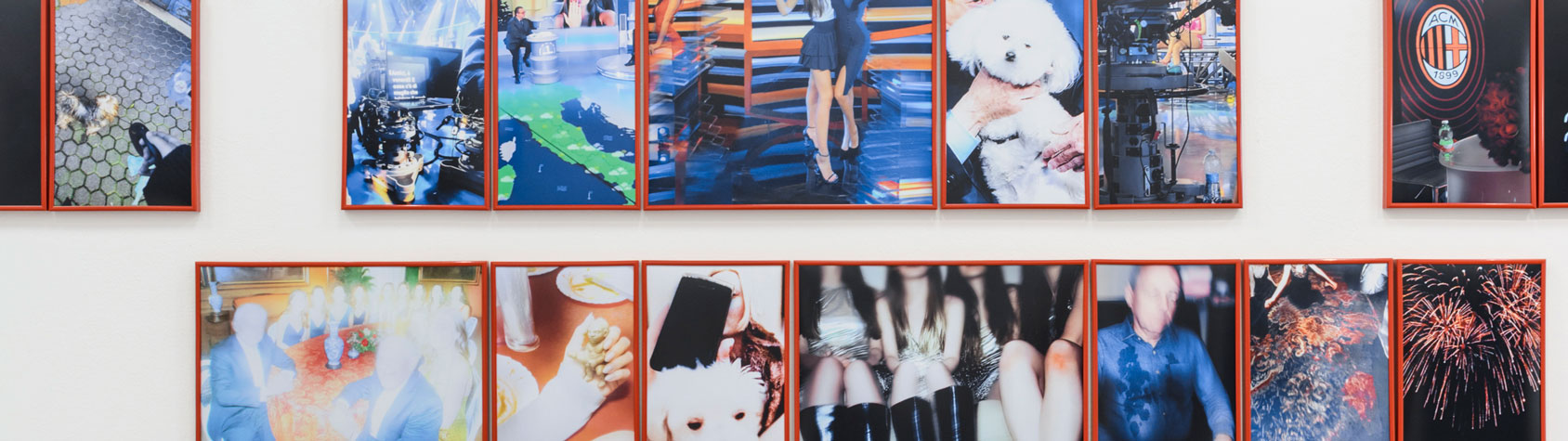
The foundation of democratic governance rests on the assumption of a rational public sphere as a deliberative arena where speech, policy, and ideology intersect to form consensus. It was from this Mediaset laboratory that a new paradigm of power emerged, one that utilized media as a tool for political communication and collapsed the distinction between the two entirely. If Berlusconismo began as a commercial venture in private television, it culminated as the genetic algorithm of contemporary global governance, transforming the citizen into an audience member and public debate into a continuous variety show. To understand the hybridization of contemporary politics, one must return to the spatial and cultural laboratory of Cologno Monzese in the late 1970s and 1980s. Prior to the rise of Mediaset, originally known as TeleMilano, television in Italy was dominated by the state broadcaster, RAI, which operated under a strict pedagogical mandate, framing its programming around the desire to educate, elevate, and unify the nation under a shared, often paternalistic, cultural standard. Politics within this traditional framework remained solemn, verbose, institutional, and visually austere. Mediaset shattered this pedagogical mirror and replaced it with a commercial one. Cologno Monzese became an assembly line for a new kind of cultural hegemony, one that did not seek to instruct the citizen but rather to satisfy the immediate desires of the consumer. Through a calculated mixture of American soap operas, glitzy variety shows, and game shows filled with bright neon lights and ubiquitous showgirls, Mediaset constructed a parallel reality softly leaking into the real. This was an aesthetic environment characterized by unceasing optimism, domestic comfort, and hyper-stimulation. This shift went far beyond a mere change in entertainment preferences, representing a profound philosophical restructuring of the public sphere itself. Complex systemic issues, such as class struggle, economic instability, and institutional corruption, were erased or sublimated into the highly digestible format of the game show or the talk show. In this new space, the politician was no longer an administrative representative or an ideological leader, but an entertainer who had to compete for ratings within the same flow of images that contained laundry detergent advertisements and slapstick comedy. Berlusconi’s genius lay in recognizing that the commercial television format itself was a highly effective form of governance. By neutralizing the critical distance required for political reflection, Mediaset created an audience that was hyper-reactive yet politically passive. The citizen-subject was entirely re-engineered as an audience-subject.
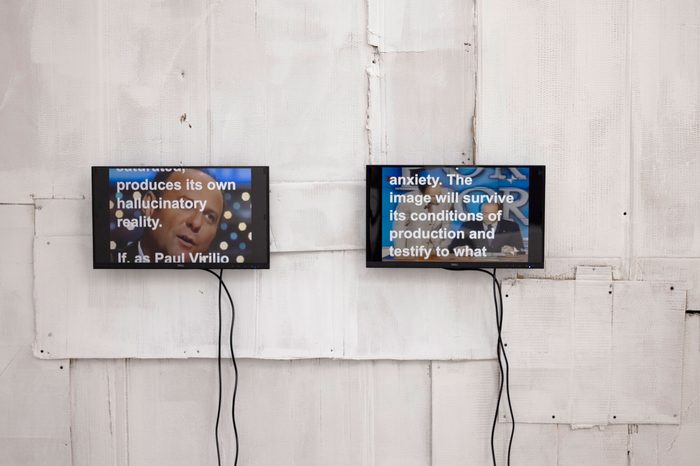
In recent years, contemporary artists have increasingly turned their attention to this archaeology of commercial television. Artists treat the archives of late-twentieth-century broadcast media as an active archaeological site containing the precise origins of our current digital flows of information. This practice involves a specific value transfer, defined as the extraction of low-resolution footage, glitchy VHS recordings, and pixelated screenshots from the historical flow of commercial television, and their subsequent recontextualization within the spaces of contemporary art galleries and museums. This methodological approach shares deep structural affinities with the work of artist and filmmaker Tiffany Sia as an example. In her filmic and textual essays, such as Scroll Figure #5 and Scroll Figure #6 Sia appropriates excerpts from Mediaset broadcasts to examine television as a material and a force for counterinsurgency and propaganda. Part of a series that combines video with the premodern form of the scroll, the two works exemplify Sia’s practice of examining film and video as primary sources for a structural reflection on geopolitics and Cold War narratives. By treating early Italian commercial broadcasts with the same forensic detachment she applies to state propaganda, Sia reveals the calculated and harmful banality of the television stream.
This harmful banality finds a vivid correspondence in the work of Carla Rossi: Bellissima. Rossi’s project functions as a hyper-stylized performance and video-essayistic interrogation of the iconic, yet profoundly grotesque, visual tropes of early Mediaset variety shows. By stepping directly into the screen, Rossi employs a strategy of exaggeration and critical drag to replay the hyper-feminized, neon-soaked aesthetics that normalized the objectification of women and the lobotomization of public discourse. The low-fidelity quality of the image, marked by the scan lines of the cathode-ray tube, the color bleeding of magnetic tape, and the digital artifacts of compression, slowly opacize the propagandistic visual language.
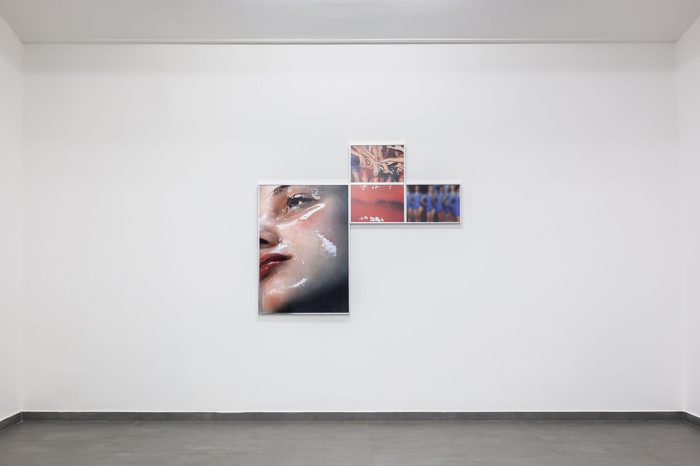


One must question whether the act of placing a Berlusconian screenshot or performance inside a white cube serves as an ideological exorcism, stripping the image of its hypnotic power to reveal its underlying mechanisms, or if it merely represents the latest celebration of a system that has already won and leaked into other contexts: global matters. Arguing that the white cube and institutional validations are not neutral, when the streams of commercial television is converted into an art product, it risks becoming a source of nostalgia or a fetishized relic of a bygone media era. Rather than breaking the spell of the spectacle, this transfer can inadvertently confirm the thesis of Jean Baudrillard, who argued that reality has been so thoroughly imploded into simulation that even the critique of the show becomes part of the show itself. Politics is consumed as entertainment, and the artistic exposure of that entertainment is consumed as high culture, leaving the underlying architecture of power completely untouched. I find the contemporary artistic reuse of Berlusconian footage operates as a deeply conflicted critique of a historical process, namely the counterproductive hybridization of art, politics, and entertainment. When a political leader behaves like a television producer, the traditional tools of political analysis become obsolete. One no longer analyzes a policy proposal through economic theory, but through the lens of mise-en-scène, narrative arcs, and audience demographics.
The danger of contemporary art entering this archive is that it operates on the very terrain it seeks to critique. Because the hybridization of art, politics, and entertainment is to some extent total, any artistic attempt to deconstruct commercial footage risks reproducing the exact same strategies of spectacularization if not reappropriated into a counter-narrative. An installation that loops a glitching video of Berlusconi for example interacting with smiling showgirls may intend to mock the vulgarity of that power, yet it simultaneously relies on the innate, magnetic fascination of that very vulgarity to captivate its audience. Politics loses its capacity for structural change, art loses its autonomy and critical distance, and entertainment expands until it becomes the sole epistemological lens through which the world can be understood. The artistic reuse of the archive must therefore navigate a narrow ridge, avoiding the trap of mere reproduction, simply showing that past television was manipulative, and instead finding ways to disrupt the spectatorial relation itself. It must transform the viewer from a passive consumer of ironized media into an active forensic investigator of the image.
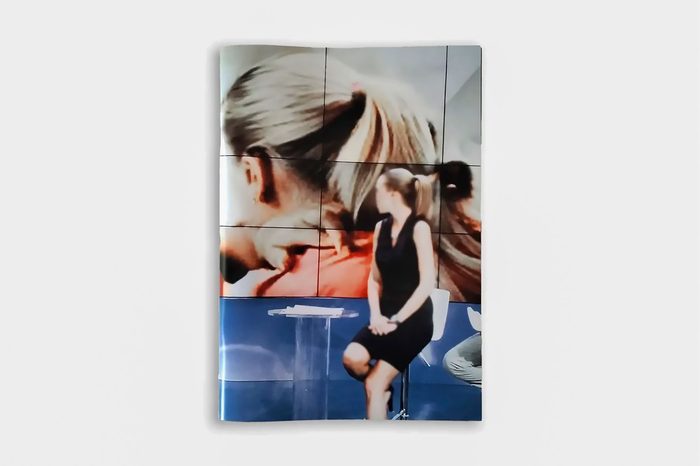
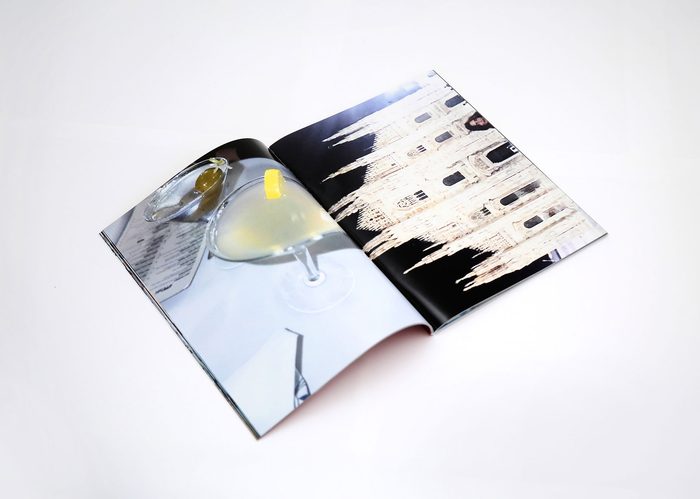
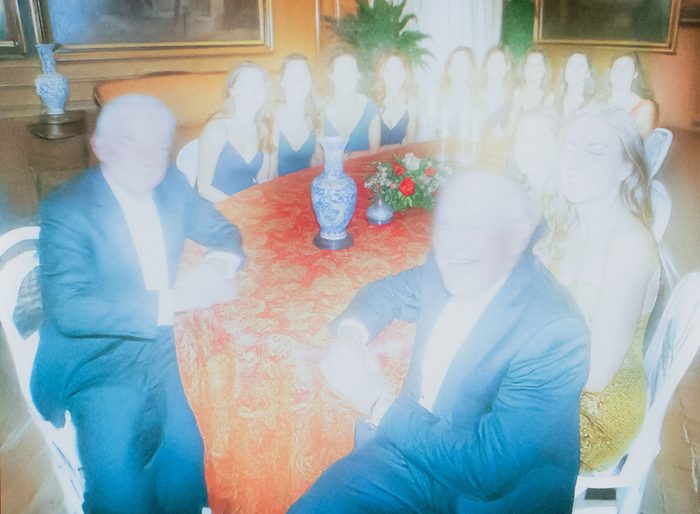
It is exactly in this quest that Eva Rivas Bao’s An Italian Story (Una Storia Italiana) stages a reappropiation of the Berlusconismo’s visual language. She enacts an intervention directly into the ghostly machine of artificial intelligence, turning the very medium of visual saturation back on itself. Her project pivots on a profound subversion of mediatic memory: she takes the titular Una Storia Italiana, originally a sleek, highly distributed propaganda magazine mailed by Silvio Berlusconi to millions of Italian households in 2001 to solidify his image and radically deconstructs it. Where the Berlusconian model achieved power by reducing the representation of women to a few hyper-sexualized, low-resolution pixels, Rivas Bao uses AI to reappropriate that iconography encountering the ghosts of Berlusconi within the ghost of AI itself. Her focus centers on the tragic figure of Imane Fadil, the Italian-Moroccan model and key witness in the Arcore trials who exposed the structural abuse of power within the “Bunga Bunga” parties, and who died under deeply suspicious circumstances in 2019.
The ghost of Berlusconi is nowadays argued to be the genetic algorithm upon which contemporary global politics rests. It is the operating system that has been updated, scaled, and distributed across the entire ecosystem of contemporary digital platforms. The model remains entirely based on visual saturation and the spectacularization of politics. The contemporary political landscape is populated by figures who are the direct genetic descendants of the Mediaset experiment. From the reality-television presidency of Donald Trump to the algorithmic populism of European media-politicians, the strategy remains identical: occupy the visual field entirely, eliminate nuance through constant stimulation and the pulse to self-idealization, and transform governance into a series of highly polarizing events. The machine demands constant engagement, requiring a continuous production of content, crises, outrages, and spectacles to keep the screen illuminated and the data flowing. We can see exactly how the transition from the old media ecology to contemporary digital networks normalized a deeply problematic value transfer, resulting in the absolute transformation of political consensus into an aesthetic commodity. Isn’t the ultimate challenge to dismantle the operating system that transforms democracy into entertainment? A mechanism to create a false sense of participation into the political sphere, while the world happens in the obscurity of politicians in the grip of their self-idealization and narcissistic behaviours.