
What If
If the United States Were Represented by Walid Raad
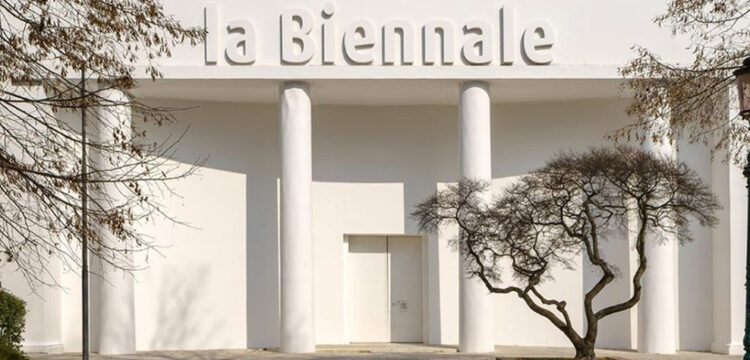
It is the second day of the preview of the 61st Venice Biennale, In Minor Keys, the title chosen by Cameroonian-Swiss art curator Koyo Kouoh. Following her premature death in May 2025, the Biennale was carried forward by the team she had brought together. Kouoh’s absence is palpable throughout this edition, whose preparation was marked by broader political and institutional tensions. One of the central concerns surrounding the pre-opening days was the role of national pavilions: not simply exhibition spaces, but geopolitical devices within a system increasingly struggling to sustain its own contradictions. In such a context, curatorial decisions inevitably became entangled with broader global narratives.
Walking through the Giardini, buzzing with art world professionals, I find myself imagining a curatorial gesture: what if Walid Raad’s Far from Quieting (2026), presented in the Central Pavilion, had instead occupied the US Pavilion? I draw on Raad’s work as a model for thinking about political histories through absence, contested archives, displacement, and instability.
To visit the French and German Pavilions, I wait in the usual queues. Yet these waits are brief compared to the endless line outside the Austrian Pavilion, where choreographer and performance artist Florentina Holzinger, curated by German Nora-Swantje Almes, presents a radical reflection through bodies and water. Among the installations is a human aquarium filled with purified urine: one example of many works in this year’s Biennale openly engaging ecological crisis, violent histories, and unstable collective memories.
But there is no queue outside the US Pavilion. Whether fair or not, many visitors seemed drawn to works engaging more directly with the historical tensions shaping the present moment. Of course, attendance is not a measure of artistic quality. Yet in the context of a preview marked by heightened expectations regarding national representation, the quietness of the pavilion becomes difficult to ignore.
Inside, I have the rooms to myself. I wander among the biomorphic sculptures of the American sculptor Alma Allen, curated by Jeffrey Uslip. Large in scale, the sculptures occupy the pavilion with a quiet presence that resists immediate identification. Their forms seem suspended between geological formations, fragments of bodies, and organic growth. Allen’s US Pavilion emerges within a particularly charged critical context, especially in relation to expectations for artistic positions that would respond more explicitly to the conflicts shaping contemporary US society. Historically, abstraction has not necessarily coincided with ideological withdrawal. From Malevich’s Suprematism to American Abstract Expressionism, non-figuration has often operated within fields of political tension. More than Allen’s work itself, it is the process of selection that brings forth a broader issue: can a national pavilion today detach itself from the political pressures structuring the Biennale? And what happens when such a distance no longer seems possible? At stake is not whether Allen’s work is political, but how political expectations shape its reception.
I find myself thinking about the works of Walid Raad (1967, Chbaniyeh, Lebanon), which I had just admired in the Central Pavilion. For more than thirty years, Raad has constructed partially imaginary archives, unstable documents, and narratives difficult to verify, often connected to the contemporary history of Lebanon. Today he lives in New York. His life in the United States opens the space for this speculative review, which relocates Raad’s Far from Quieting (2026) from the Central Pavilion to the US Pavilion.
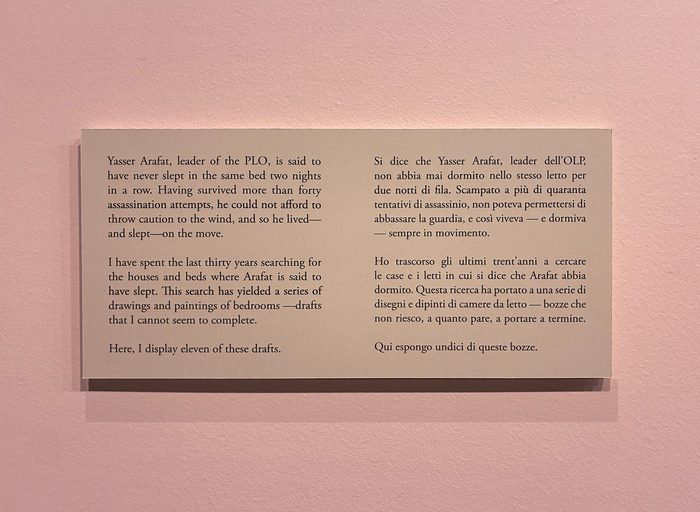
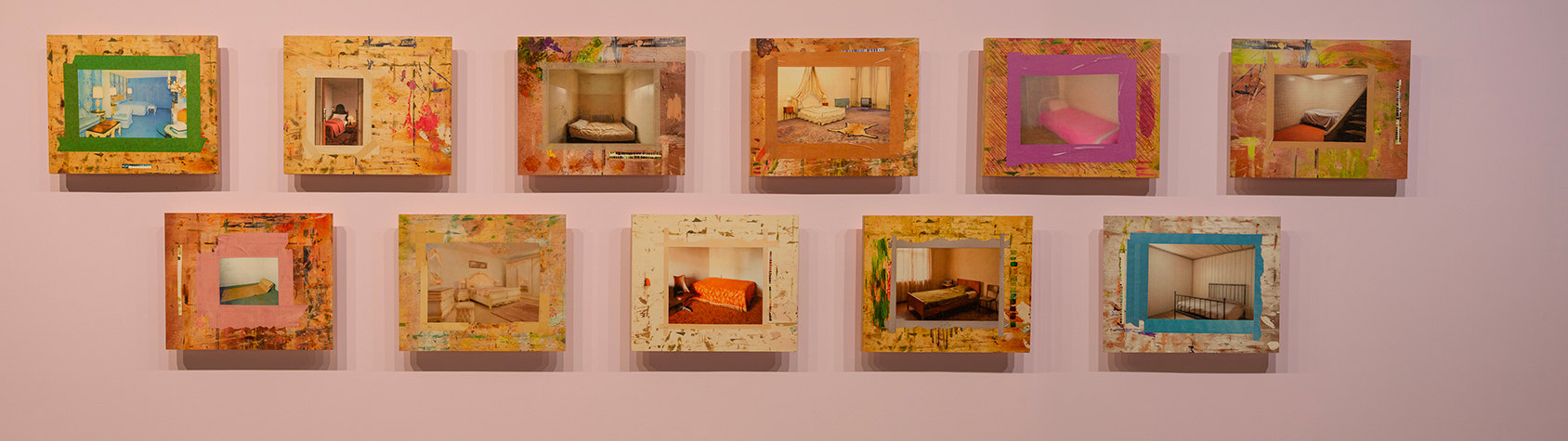
A key part of the work is Raad’s accompanying caption, which recounts how Yasser Arafat, leader of the PLO (Palestine Liberation Organisation) and recipient of the Nobel Peace Prize, allegedly never slept in the same bed twice while continuously escaping assassination attempts. Raad describes having spent the last thirty years searching for the houses and beds in which Arafat is said to have slept, a process that resulted in a series of paintings. Eleven paintings are exhibited in the installation. I imagine a US Pavilion in which Raad fills the rooms with them.
Arafat is never depicted. Raad approaches him indirectly, through traces, locations, and objects that point toward a presence while withholding the figure itself. Absence becomes not a void but a structuring force. Walking through the Biennale, I encounter a similar condition. Koyo Kouoh’s presence is registered through the exhibition she conceived, the artists she selected, and the relationships she set in motion. The parallel concerns a mode of appearance rather than any equivalence between the figures themselves. Absence becomes another lens through which the Biennale is seen.
As often happens in Raad’s work, the installation unfolds through information that remains suspended. Some elements appear authentic, others deliberately unstable. The titles of the individual paintings anchor each work to a different location: Amman, Tripoli, Lebanon, Kuwait, Algeria, Geneva, Moscow, Tunis, Yemen, Oslo, and Riyadh. Together, they trace a geography organised through political mobility that extends far beyond any single national territory. The paintings map a network of movements across spaces of diplomacy, exile, and temporary refuge.
This tension becomes particularly significant in the context of a national pavilion. If national representation might rely on coherent narratives of territory, identity, and belonging, then Far from Quieting exposes the complexities disguised within coherence. Relocated to the US Pavilion, the rooms would be encountered both as traces of Arafat’s movements and as fragments of a broader geopolitical landscape. Gathered under the sign of the United States, the paintings would bring into the pavilion a constellation of places through which the histories of America, the Middle East, Europe, and the Cold War repeatedly intersect.
Yet the scale of the work remains domestic. The geopolitical breadth suggested by the titles is brought back to the dimensions of a room: a temporary space where rest and exhaustion become difficult to distinguish; where the borders, negotiations, and conflicts remain implicit. By painting the interiors that precede, accompany, or follow large-scale historical processes, Raad shifts attention away from the events themselves towards the spaces that quietly sustain them. The work oscillates between mobility and the enclosure in rooms that vary considerably. Some appear elegant and carefully furnished, with curtains, lamps, and tiger-headed carpets, while others are so narrow that they barely contain a bed. Others are reduced to little more than a mat on the floor. Together, they suggest markedly different conditions of hospitality and protection.
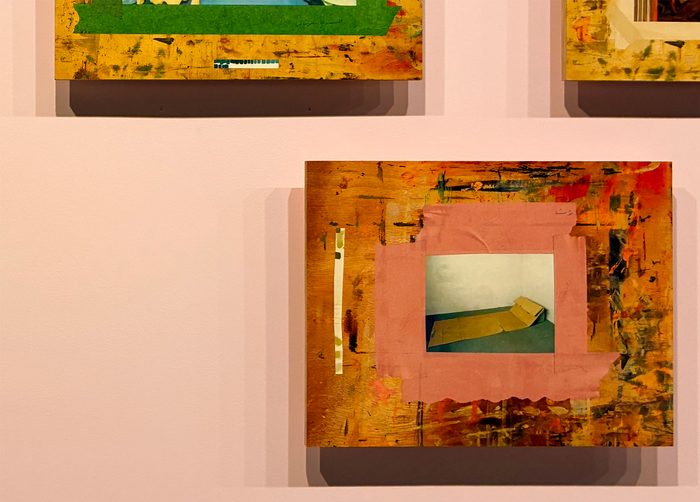
As a viewer, I feel invited to move through a space in which document and fiction lose their boundaries. The paintings seem to promise access to historical reality while at the same time drawing attention to their own construction. They create friction through the methods of their making: the images are highly detailed, almost photographic in their rendering, yet heightened through pastel tones. Their mode of display frames them as in process, attached with tape to what appear to be the wooden panels on which they were painted. Some even retain the color scales used during their production, foregrounding the process of their making as provisional, as if still awaiting completion.
I see this tension between precision and incompleteness echoing the mechanisms through which historical narratives acquire authority. Perhaps this is also what makes me imagine the relocation of Far from Quieting as productive. The proposal shifts attention towards the kinds of works that become legible within particular historical moments and the forms of attention they generate. If Allen’s sculptures invite contemplation through form, Raad’s installation does so through narrative instability. Both resist straightforward interpretation, but they do so through different means. One unfolds through sustained looking, the other through sustained questioning. In each case, meaning emerges not from recognition but from remaining with uncertainty.
For me, in this perspective, Raad’s artistic methodology invokes the shifting narratives circulating through contemporary political discourse, purposefully operating at the limits of verifiability. Their functions, however, are radically different. In politics, unstable narratives can erode the conditions under which claims are evaluated. In Raad’s work, uncertainty becomes a critical tool. The impossibility of fully verifying the stories he constructs encourages viewers to examine more carefully the mechanisms through which documents, archives, and historical truths acquire legitimacy.
This distinction is crucial. Raad does not ask viewers to believe or disbelieve his stories. Instead, he foregrounds the processes through which belief is produced. The work continually shifts attention from the content of the narrative to the structures that authorize it: captions, institutional contexts, and acts of interpretation. As certainty recedes, the question becomes how truth claims acquire credibility in the first place, beyond the truthfulness of a particular story.
Read through the lens of Raad’s practice, the United States Pavilion would no longer appear as a stable national subject, but as one fragment within a transnational history composed of incomplete archives. Imagining Raad’s work in the US Pavilion exposes forms of instability, displacement, and mobility that exceed the territorial logic on which national pavilions continue to depend. Rather than consolidating a national narrative, the pavilion would become a site in which the coherence of national representation is unsettled. The question would no longer be who or what represents the United States, but how representation itself is produced, negotiated, and sustained through histories that inevitably extend beyond national borders.