
The World is Sleepwalking
A delirious journey to the edges of the synthetic world, unfolding through a conversation with Zach Blas, Silvia Dal Dosso, Malpractice, and Most Dismal Swamp
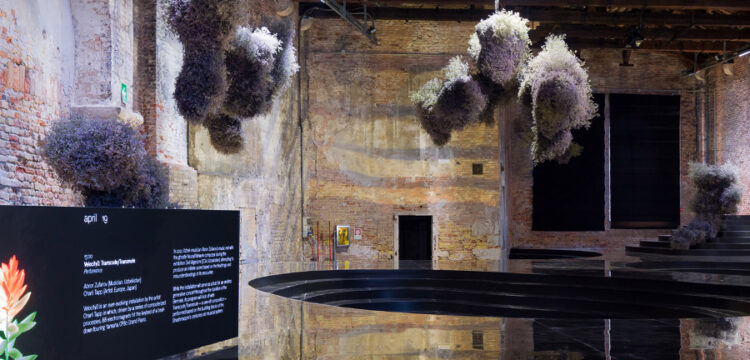
Curated by Daniela Cotimbo for Drugo more, the exhibition The World is Sleepwalking is presented at the Filodrammatica Gallery in Rijeka as part of the festival Mine, Yours, Ours 2026. This 21st edition of the festival unfolds as a hallucinatory journey at the edges of the synthetic world, through the works of artists such as Zach Blas, Silvia Dal Dosso, Malpractice, and Most Dismal Swamp, which investigate the condition of somnambulism that permeates the contemporary world.
Contemporary reality is increasingly described as a waking dream. Indeed, the current media landscape echoes many of the characteristics of dreaming: an incessant flow of unlikely content and improbable associations, deepfakes, memes, documentary fragments, and artifacts of post internet culture.
Images and words merge on the retina, reaching the most hidden corners of the unconscious and connecting intimate and personal dimensions with clichés, fears, delusions, and collective rituals.
A defining feature of these media flows is their ability to reach our consciousness even before any form of critical evaluation or value attribution takes place. This may help explain the phenomenon of brainrot and the compulsive fascination with absurd and nonsensical content.
Another common characteristic of these cultural artifacts is that many of them are generated through large scale artificial intelligence models. This is far from trivial: it is precisely the material conditions produced by the AI industry that encourage the proliferation of imaginaries and aesthetics in which high levels of realism and plausibility converge with AI’s inherent tendency to mine online archives in search of clichés and recurring semantic patterns.
The rampant production of synthetic artifacts has not gone unnoticed politically. While the AI industry promises enormous economic advantages, often grounded in the commodification of narratives rather than products or services it has become increasingly evident that this technology can also operate as a weapon of mass confusion: a tool capable of reinforcing ideological rhetoric, if not directly deployed in the operation of drones and other military technologies.
The result of this collective psychosis is our entry into a regime of uncertainty, an environment in which the high probability of encountering fabricated content has profoundly altered our relationship with reality itself, shifting it away from notions of objectivity toward the search for reassuring stories and mythologies. On the one hand, we strongly advocate for tools capable of verifying authenticity; on the other, we allow ourselves to drift within a fluctuating landscape of absurd narratives and conspiracy theories.
If, as Claude Lévi-Strauss argued, the production of myth is a foundational mechanism of cultural thought, the typology and quality of contemporary mythologies now appear increasingly shaped by the extractive logic embedded within algorithmic culture. Who, then, holds agency over these narratives? Is it possible to transform these dreamlike flows into lucid dreams? And what role does AI actually play within this condition?
A constellation of artists, practitioners, and various kinds of algorithmic sleepwalkers engage with these issues in order to outline new perspectives capable of opening the algorithmic black box, recovering dreams, nightmares, distortions, and hallucinations in an attempt to break the fourth wall. The exhibition explores how these authors construct speculative scenarios that challenge the very nature of artificial intelligence itself.
These works amplify and at times exacerbate a shared sense of instability, staging the potential collapse of a technology that progressively learns from the very outputs it produces. Real and simulated hallucinations invite us to question the value of perception while simultaneously distancing us from a hyperreality that seems to have reached a point of no return.
Daniela Cotimbo: In The Future Is Weird AF, you edit three years of generative production as a time capsule of an era, and one of its symbols is the Will Smith spaghetti video, which went viral precisely because AI was not yet able to represent something as simple as food. For this exhibition, you had a physical reproduction of the spaghetti made, turning the algorithmic glitch into an object. Now that these problems seem to have been solved and the error no longer seems to mark the boundary between reality and fiction, how is our relationship with these images changing? Does it still make sense to try to distinguish the real from the fake, and if not, what is the role of this fake narrative?
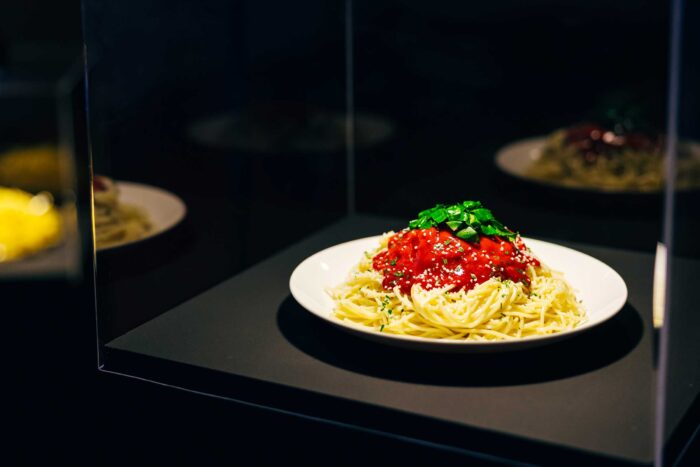
Silvia Dal Dosso: Yes, the trilogy explores the implications of the widespread use of generative artificial intelligence over a period of three years, through online found footage. After travelling across Europe, I felt it was time for these videos to begin materialising in the physical world. One of the most prominent presences in the works is food; as the voice-over notes at one point, “Food has been madly hyping lately. A fairly blatant allegory of the gluttonous engulfment of images and imagery that is now reaching epic, historic heights.” The idea, therefore, was to create a sort of “spaghetti timeline,” crafted using the traditional Japanese sampuru technique.
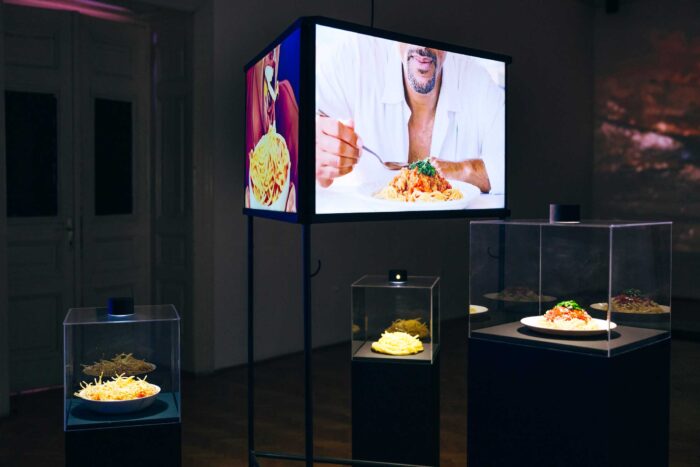
While Will Smith appears to be eating increasingly normal spaghetti, the world around us is becoming weirder, faster, and harder. My impression is that, just as after years of using computers we came to realise that distinguishing between real life and digital life no longer made sense, because the two constantly overlap, we may now reach a point where we can no longer disentangle what is real media from what is fake. The situation is becoming extremely complex, yet I also think that “post-truth has been around forever, pals,” and “our serious threats are others.” Lately, I have been interested in feedback loops running amok between agents, robots, animals, plants, and all the other cognitive entities that are messing around with us. So, the world of Weird AF will continue to expand: I’m doing it right now with a new work titled The Weird Whale Song. We all have the feeling that much more will happen in this eerie domain, and I will be there, attempting to document it in my own way.
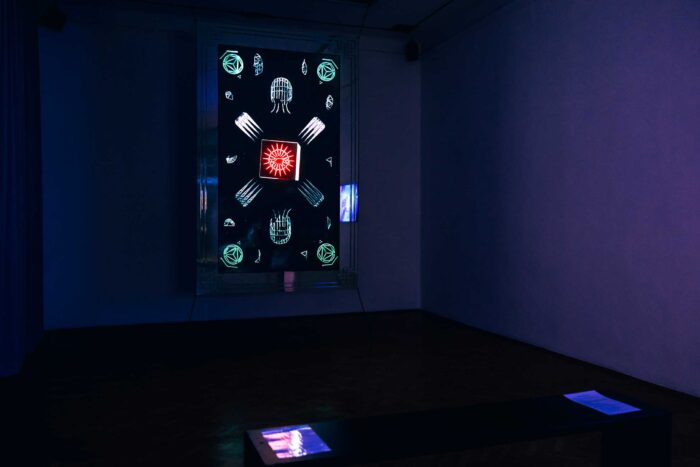
Daniela Cotimbo: In IUDICIUM you weave together religious and occult iconographies, seals, glyphs and esoteric symbols to address technical systems such as biometric recognition, military targeting, and predictive scoring. The reference is both to Michelangelo’s Last Judgment and to the increasingly pervasive algorithmic control. The two things meet in the work not only on an imaginative level, since more and more often the rhetoric of big tech seems to blur with the eschatological one. How much do you think the construction of a counter-imaginary that uses the same materials as the power it criticizes, myth, ritual, symbol, is an effective form of critique today?
Zach Blas: Your question is a challenging one with seemingly no easy answer, at least for myself. On the one hand, concerning working with myth, ritual, and symbol, as you put it, I would refuse an understanding of these practices as totalized by dominating power structures. Myth-making, partaking in ritual, and creating symbols have long and expansive histories within minoritarian communities, including those that are feminist and queer. Thus, these practices are the site of a battleground between control and liberation; the struggle is not over!
On the other hand—and perhaps a more difficult aspect of your question—there is the issue of working with AI itself. Of course, the term AI can refer to a wide array of tools and technologies, such as commodities produced by the tech industry, academic research, and beyond. As your question pokes at being complicit with regimes of control, I approach AI here specifically as Silicon Valley products. Today, many—artists included—take a strong position on corporate AI technologies: either an attempt at a total refusal or a happy-go-lucky adoption. In reality, relations to AI look much more gray: total refusal is not always possible; more likely, people adopt some AI platforms and models, refuse others, and are unwittingly folded into more. I highlight this dynamic to point to ethical contradictions and complicities at the core of AI usage today. I have no interest in morally judging this; rather, I am interested in the moral ambiguity here. As far as crafting counter-imaginaries goes, most of us, then, are beginning from places of impurity; most of us are not outside the materialities of power and domination. How artists work from this condition is another matter, but I would approach understanding it with nuance and specificity. Artists, at the very least, should be able to investigate AI in order to assess and grapple with contours of power. Might these investigations produce counter-imaginaries—perhaps!
In the end, there actually is an easy answer concerning my artwork IUDICIUM and the construction of counter-imaginaries with the master’s tools. IUDICIUM is not a counter-imaginary. IUDICIUM is a presentation of religious dimensions of Silicon Valley’s power structures. The artwork utilizes AI generation (text-based training with GPT3) in order to surface aspects of power that are not always so apparent. In this regard, the work had to emerge from the informatics of domination, as the installation stages an opportunity to analyze religious power and reflect on how one is implicated and complicit. I believe that analysis and reflection can spur revolt.
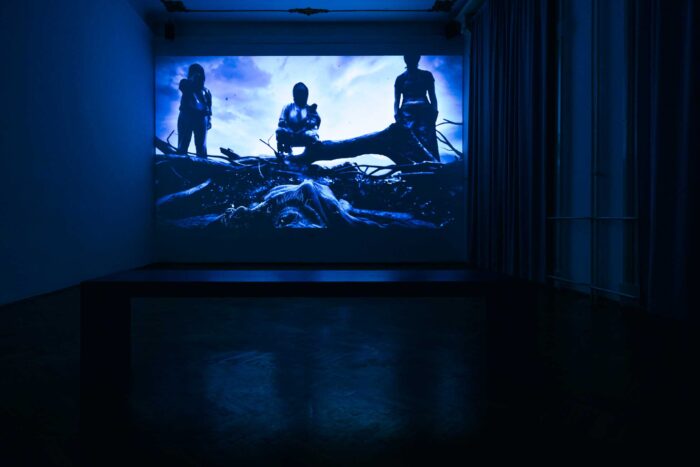
Daniela Cotimbo: In The Bastard Fields you build a landscape inhabited by figures at the edge of the imaginable, moving through a terrain defined by model collapse, that state in which AI systems trained on contaminated data have saturated and flattened the field of shared reality. The drift you describe is not a dystopia in which AI takes over, but something more insidious: the progressive loss of nuance, the reduction of everything to something programmable and repeatable. In a show that talks about algorithmic sleepwalking, I wonder if the swamp that gives your practice its name is for you a critical metaphor or also a proposal of method: a degraded and impure space in which the forms that the system cannot classify, and therefore cannot neutralize, manage to survive.
Most Dismal Swamp: Swamps all over the world are exemplary of indifferent or even hostile spaces that make navigation among them extremely difficult, and this includes their common characteristic of problematising our systems of classification and taxonomy. Most obvious, is the swamp’s confusion of land and water along with its teaming biome of interdependent lives: a world of many worlds. Furthermore, swamps have historically functioned, through folklore and other media, as imaginal repositories for human anxieties, fears, romances, and adventurism.
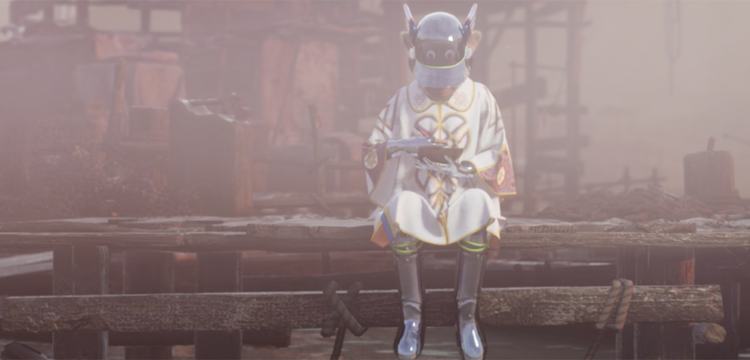
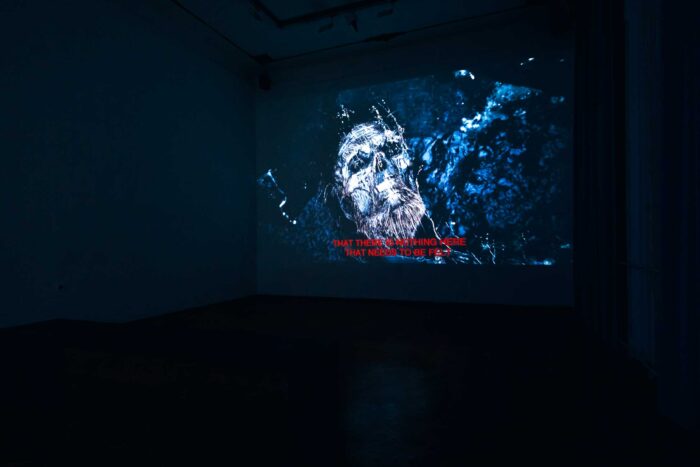
Regarding the “terrain” elaborated in The Bastard Fields, I am interested in depicting and exploring the experiences of traversing the emerging neural mediascape, which not only includes familiar systems of classification and extraction (such as data-harvesting) but also their recent social-technical adaptations (platforms and content-creators alike pursuing “context creation” as a model-collapsed version of world-building: for example, while some research suggests that Facebook encourages extremes in behaviour among users to improve behavioural modelling, contemporary independent content-creators also tend to form “communities,” the “multi-user shared hallucinations” of which I explore in the video as “warrens of cultivated anomaly.” The neural mediascape is something I present as full of seductive hallucinatory worlds.
A key character here is also a “bog body” with a wooden pair of wings attached to it. Bog bodies have often been found and attached to romantic tales of fugitives, outlaws, and heretics. But I wanted to highlight that in this system, we are all bog bodies. While this character is a combination of human remnants and its own environment, the lives of the neural mediascape are entrained towards a kind of visibility and value that speaks to the degenerative hallucinations vying for attention.
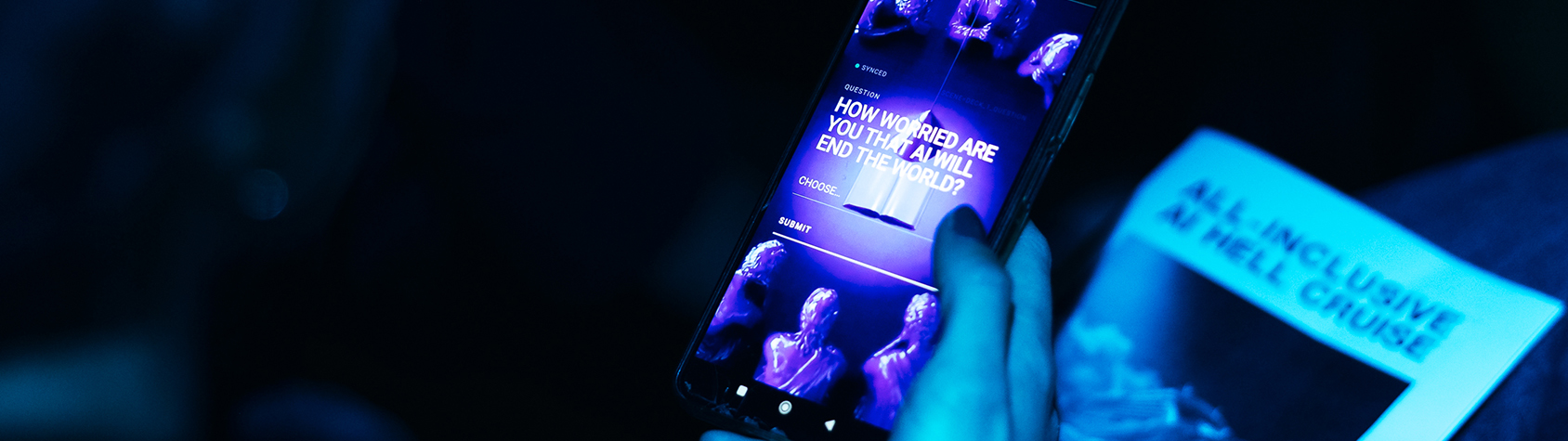
Daniela Cotimbo: On the opening day of The World is Sleepwalking, your performance All Inclusive AI Hell Cruise took place at the Galleria Filodrammatica in Rijeka, an initiatory journey through nine circles composing our daily hell in relation to AI. Our Virgil in this case was an agent ready to evoke our habits, fears and hopes in relation to AI. The performance is interactive and the audience can measure themselves against their own expectations. What struck you about this relationship, and what remains in you after this navigation?
Malpractice: Virgil is a multiple of himself on this All Inclusive AI Hell Cruise. There is no singular guide but several agents, each speaking from inside the deck they narrate and organize. The Doom agent is a doomer, the Acceleration agent is himself an accelerationist, the Aesthetic agent has read our notes and is willing to read us back. Each agent is implicated in its own position, only able to see from where it is standing, each one pulling the audience into its bubble by asking a question and metabolising the audience’s answers through the deck’s own logic.
This way of externalising your own cognition through third-person thinking is a framework we have been calling Prompted Perspectives, and the Hell Cruise is the largest collective application of it we’ve built so far. Within this logic, the agents are not strictly generators but perspective machines, prompted to hold a fixed worldview and made to think from it against whatever the room hands them. The ship itself can be seen as a scaled summary of the hyperpresent field of AI discourse, which we are too embedded in to see clearly. So we step outside it by inhabiting all of its incompatible positions at once. We hear what our answers mean to a doomer, then to an accelerationist, then to seven other agents who disagree with all of them, and the discourse we have been standing in becomes briefly visible from the inside out.
If Virgil is multiple, so is the audience. They are simultaneously the material the piece runs on and the addressee it speaks back to. They are inhabitants of the room, sitting next to other passengers, sharing physical space with positions that rarely sit beside each other. Their phone is open and their answers appear on the bridge. What they type is read back to them through someone else’s worldview. They move between observer, performer, and observed. Without the audience’s answers there is nothing for the agents to think against.
Which is also why one sailing is never quite enough and never quite the same as another. Each room brings its own distribution of tensions. The agents’ monologues are written live from what the audience hands them, so the piece is never repeated but rather reconstituted each time. For us, as artists and performers, this means we are not staging a fixed work but entering a situation that unfolds at the same narrative speed for us as it does for the audience. We know the architecture, but not what will move through it. We move in and out of the piece: at moments we are its authors, at others its spectators, at others still just another surface it passes through.