
The Ever-Shifting Sonic Architecture
Hotel Infinito and its invitation: a conversation with Matteo Gualeni and Alessandra Leone
There is a moment in Pauline Oliveros’ description of deep listening where sound ceases to be an object and becomes a resonating chamber—something you enter rather than observe. Years later, in a still optimistic view of the future to come, David Toop’s Ocean of Sound would echo this drift, describing ambient music as a form dissolving into an atmosphere where the composition (with sampling at its core) is guided by the conditions of the socio-political spectrum. Between these coordinates, and underlying the ever-emerging necessity of listening within the contemporary belligerent geopolitical framework, Hotel Infinito opens its gates.
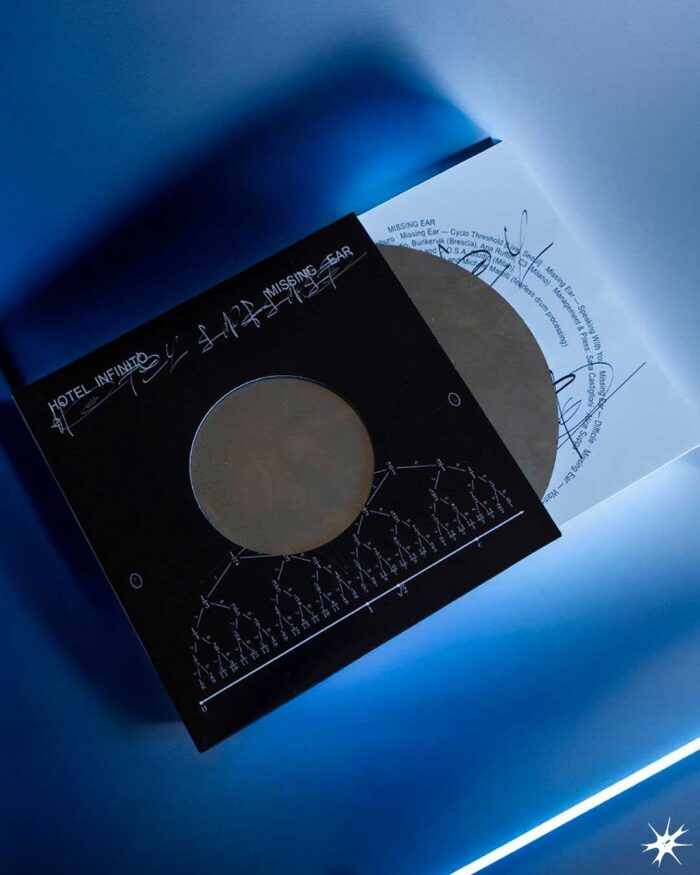
Milan-based experimental drummer and sound designer behind the moniker Missing Ear, Matteo Gualeni presents us with a sequence of tracks conceived as a spatial continuum. Hotel Infinito unfolds like an architecture of rhythms and industrial textures referencing IDM, post-breakcore, and deconstructed clubbing palettes. The album opens and closes with two quieter thresholds, framing a central passage that feels in constant mutation, as if the listener were traversing a structure that reorganizes itself in real time. Almost like a hotel hall, the first track welcomes us with a spoken word manifesto on listening. The album closes with an exquisite dialogue between various layers of synths and viola da gamba in “flautando” lines.
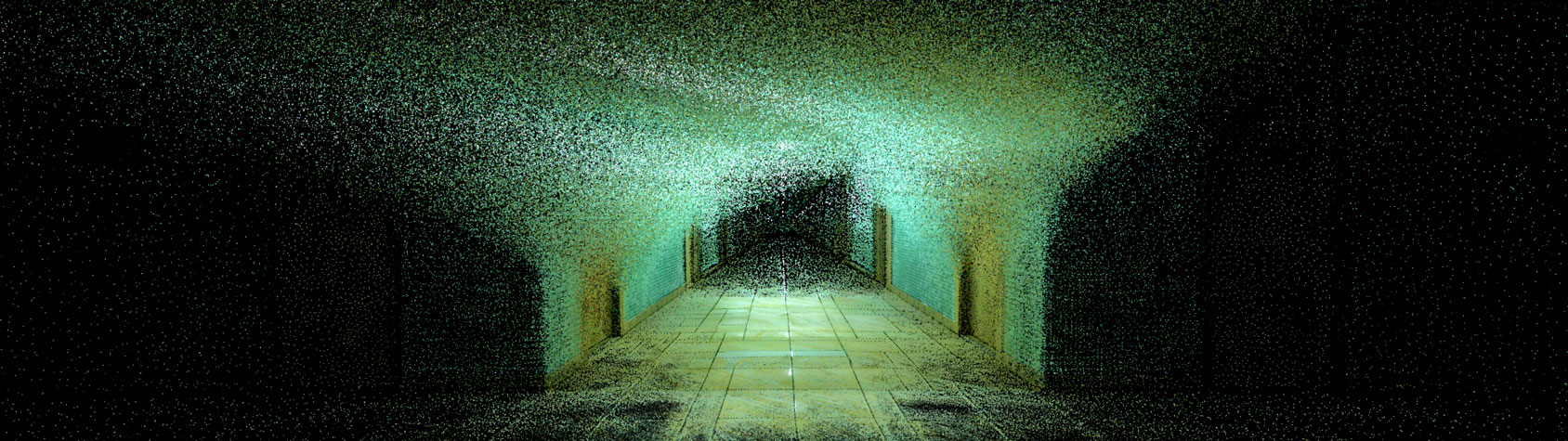
The reference to Hilbert’s paradox is not metaphorical decoration but structural logic. Just as the infinite hotel can always accommodate one more guest, Hotel Infinito operates through continuous expansion. The collaboration with Berlin-based director Alessandra Leone extends this logic into the visual field, where space itself appears unstable, continuously changing, dissolving into grains and resolving—as an infinite scroll. If contemporary experience is increasingly defined by accumulation—of signals, images, stimuli—then Hotel Infinito does not step outside of this condition, but intensifies it, rendering it perceptible.
Lorenzo Saini: Can you tell us more about the process of making this album? Was this sense of “infinite form” something you were consciously searching for from the beginning, or did it emerge through the process? Did the collaboration contribute to or expand this concept? Moreover, how did Alessandra’s practice intertwine with the musical approach?
Matteo Gualeni: The idea of infinite form wasn’t something I arrived at consciously from the start, it emerged through the process, and then I recognised it retroactively. I’ve always worked with acoustic drum recordings as raw material, processing them digitally until the point where rhythm dissolves into texture, where a single hit can expand into a drone or a spatial environment. At some point I realised I was never really finishing anything, just finding a moment to stop. That’s when Hilbert’s paradox clicked and crushed with Auditory Scene Analysis.
Bregman’s idea is that the brain doesn’t receive sound as a unified whole… it actively separates and groups acoustic information into distinct streams, constructing a version of reality from what it selects to follow. That completely changed how I think about composition. If the listener is already choosing which thread to follow, then the song form doesn’t need to impose a single narrative. The structure becomes a field rather than a line. This is where Hilbert becomes more than a metaphor, a compositional principle. In the infinite hotel there is always a free room, always space for something new. Each layer in Hotel Infinito works exactly like that: a room that may or may not be occupied depending on where the listener places their attention. You can follow the percussion and find one record. You can follow the spatial dimension and find another. The form doesn’t close because there is always one more room available, one more route through the stratification.

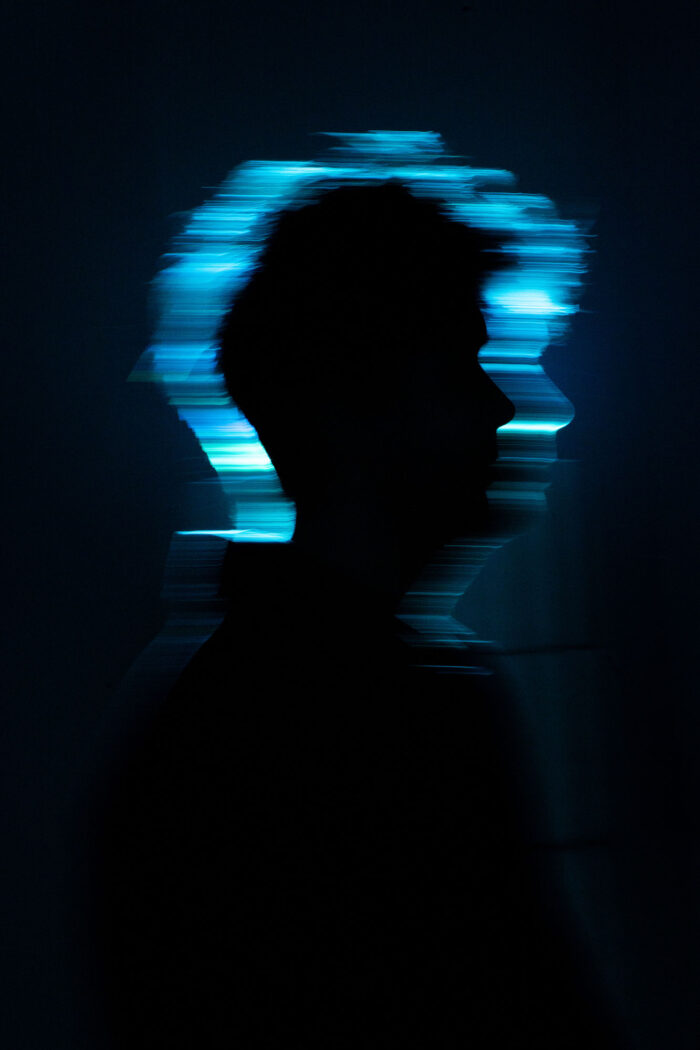
The collaboration with Alessandra arose from these and others shared discussions… The first email connection was years ago literally. Her contribution primarily expanded the immersive dimension of the project, making the concept more tangible and creating a parallel to the visual world, especially for the live shows. To quote Matteo De Giuli in Persi nello scrolling infinito for Not… the visual imagery is clearly central to this theme.
Alessandra Leone: When Matteo first approached me, his reading of Hilbert’s paradox into the Hotel Infinito concept and the way it unfolded throughout the album clicked with me right away. Both the conceptual framework of the album and the music felt grounded and precise, but also absolutely open by nature and unpredictable. POROUS somehow? And thinking of it in terms of a live audiovisual show, a strong SPATIAL component emerged: a musical live as a timeless landscape, a suspended space where listening happens through navigation rather than reception.
That intuition became the opening gesture of the live show: a thick fog-filled space, a sort of collective deprivation tank. Volumetric, almost physical light, blurred depths, and then a slow dim into absolute darkness right before the first sound. Listening to live music in pitch black is something I find simultaneously terrifying and thrilling. Once all other stimuli are shut off, you become extremely sensitive to even the smallest triggers, and your brain tries to decipher them, building a whole scene around the sound. That’s already Bregman, maybe, but approached from the visual side: give people less to see so they can hear more precisely. From there we reintroduce light, image, reactivity—but very gradually, and without ever fully honouring the 1:1 correspondence ears and eyes would expect.
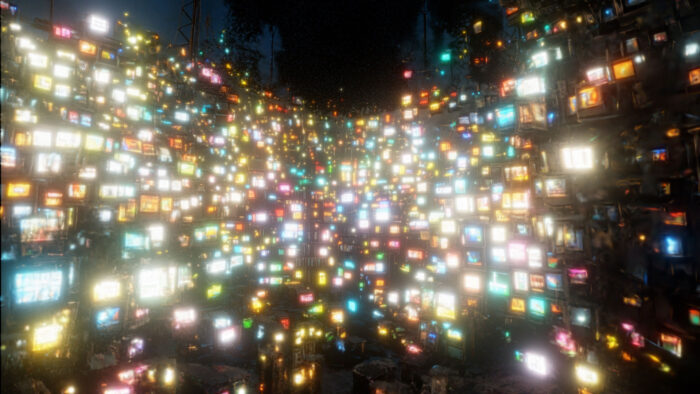
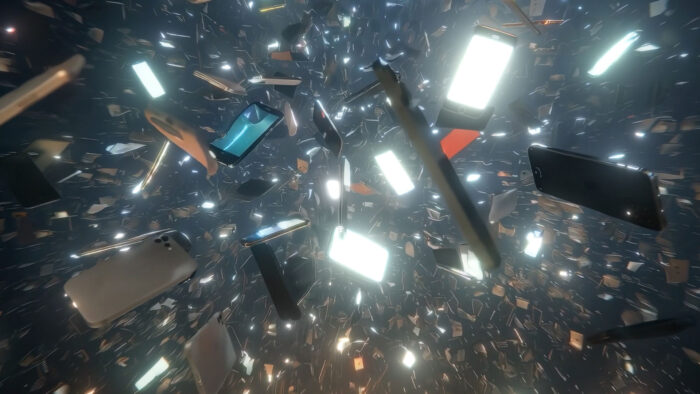
From there, the visual narrative kind of unfolds as a sustained meditation on perceptual overload. It traces an arc that starts from the infinite architecture of Hilbert’s hotel and slides into something much more contemporary, the infinite scroll of digital content, embodied quite literally in the smartphone. Against that saturation, the visual language introduces two counterforces: one aggressive, almost physical in its demand, and another much quieter, closer to a visual equivalent of silence. Taken together, I think these visuals are not really there to illustrate the themes of the project, but to try and enact them. The idea that intentional listening, like intentional seeing, is a form of resistance, and that what we choose to attend to, and how, is maybe one of the defining questions of the present.
So Matteo’s approach gave me a world I could move through rather than decorate, and the visual world of the live, in return, might offer the record a kind of experiential, perceptual frame; a way of asking the audience not just to watch, but to notice how they’re watching. I’d say the collaboration with Matteo really lives into this reciprocity.

Lorenzo: Where does the listening position itself when there is no stable foreground? Is the drum kit, with its overall coherent space in the stereo field, or with its function of delivering patterns, the backbone of Hotel Infinito? How drumming and live visuals are gonna interact in the live AV, can you give us a preview?
Matteo: The listening doesn’t position itself anywhere fixed and that’s intentional. When there’s no stable foreground, the listener is forced to make an active choice about where to place their attention, and that act of choosing is already part of the experience. It’s not disorientation for its own sake: it’s closer to what Bregman describes when he talks about the brain constructing an auditory scene. You’re always selecting, always partially losing one thread to follow another. That pov is the work.
The drum kit on this record is something I’ve been building toward for a long time… and it marks a necessary passage for me personally. I come from a deep practice of acoustic drumming, and for years that background stayed somewhat hidden inside the electronic processing, absorbed into texture and sound design. With Hotel Infinito I made a conscious decision to let it surface more openly. Not as a display of technique, but as a way of being honest about where the material actually comes from. There’s an industrial quality I’ve always been drawn to and I found that the drum kit, treated and amplified in the right way, carries that naturally.
That said, I don’t think of the drums as the backbone of the album… It’s a characterising element, one voice inside a broader spatial field where sound design and three-dimensionality carry equal weight. Sometimes the kit drives the structure, sometimes it dissolves into the environment completely. The relationship shifts. For the live AV, the interaction with Alessandra’s visuals will be built on synthesis rather than “only” synchronisation. The drums are in many ways the most unpredictable element of the performance, the most extemporaneous, and that freedom is something I’d like to preserve rather than lock into a fixed timeline.
Alessandra: The sound of the drums continuously evolves throughout the album and the live: it takes on different forms and different types of presence. That was clear from the start, and it was clear that the visuals couldn’t be locked into a stable relationship with such a shapeshifting element. So when Matteo says synthesis rather than synchronisation, that’s really the operating principle on the visual side too. We’re not building a timeline that the drums have to meet; we’re building a dense field where visuals, darkness, light and smoke can respond to the acoustic instrument in ways that stay porous, spontaneous and a bit unpredictable.
Practically, there are moments where a kick hit might push the image off its balance, or where an accumulation of percussion collapses a point cloud into a different density. But there are also long stretches where the drums dissolve into texture and the visuals stop tracking them altogether, drifting on their own logic a bit. The 1:1 audioreactivity relationship is used sparingly, almost as a punctuation. Most of the time we’re somewhere in between: light that floats within dim values, images that move as if we were falling slowly past them. The goal is to preserve the extemporaneous quality Matteo talked about. If the drumming is the most unpredictable element of the performance, the visuals HAVE TO hold space for that unpredictability rather than contain it.
Lorenzo: If the best music we continue listening to is the one that soaks in through context and meaning, what is your approach to listening? How do you discover new music?
Matteo: Listening deserves its own time and space. Not in the car, not between one thing and the next, not as background to something more urgent. I try to give it a window where nothing else is competing for attention. Since becoming a father my schedule has shifted in ways I didn’t expect, and I’ve found that the “late hours” or early morning between 5 and 7am, have become my best listening time. There’s no pull toward messages or emails or calls. There’s a difference between being accompanied by music and being dedicated to it. Both are valid, but they produce completely different relationships with the material. I remember when Gunver Ryberg sent me something we were working on together (radio show) and she sent it the day before and I got up at 5am and spent an hour with it in full attention. That kind of listening changes what you hear. You catch things that would otherwise slip past completely. For discovery, I stay as far from algorithmic bubbles as possible. Bandcamp, Nina Protocol, Subvert… these are the places where I actually find music that surprises me, and where I can directly support the artists and labels making it. Bleep, Boomkat, RA, Pitchfork are part of my regular reading. But honestly the most reliable filter is still people, friends, the community around you.
Alessandra: Honestly, my approach to listening is pretty mood-driven. I tend to reach for specific music depending on what state I’m in, or what state I’m chasing, and these can be quite diverse. Each mood has its own set of well-fitting scenarios and modes of listening, let’s say.
When it comes to discovery, the HOW matters a lot. The way I get to an artist becomes part of my own relationships with the artist’s music itself. Whether something reached me through a friend, a studio conversation, a small label’s radio show, or a live set, all of that stays attached to the music for me. Each piece of music ends up carrying its own little origin story, and that story is part of how I listen to it afterwards. So the discovery is never really separate from the listening, it’s already part of it. Which is also why discovery via algorithmic platforms doesn’t work at all for me. Easy access to infinite catalogs sounds more like a nightmare than a privilege honestly. The filter I trust most is still people, and the contexts they bring with them.

Lorenzo: There are albums that resonate more in particular environments and seasons (car, countryside, seaside, bedroom etc.). The reflective nature of your work on Hotel Infinito makes me curious about what could be the preferred space and time to listen to it, if there are.
Matteo: The honest answer is that I’m not sure there’s a specific place but there’s definitely a specific state of mind. And I think that state is something each person finds differently, in different contexts, at different hours. What I do know is that Hotel Infinito “doesn’t work in a hurry.” It’s not built for half-listening. I think that choosing to sit and listen, participate for 40min without doing anything else it’ like a small luxury, maybe even a radical choice given how compressed and fragmented most of our listening has become. But I think that’s also part of what the record is asking for. Not as a demand, more as an invitation.
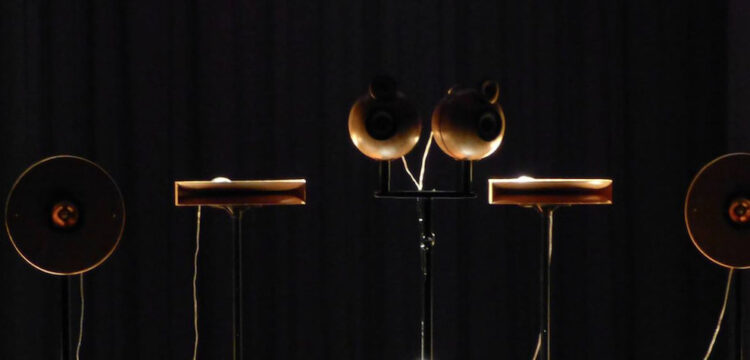
But if I’m honest about the ideal context, the one I had in mind while making it, it’s the live performance. That’s where the record fully becomes what it’s meant to be. In a room with a proper sound system, with the drums present and physical, with Alessandra’s visuals, with the lighting and the smoke and the collective attention of people who have chosen to be there together…something happens that the record can only approximate. The spatial dimension opens up completely, the sub-frequencies reach the body in a way that headphones simply can’t replicate, and the extemporaneous nature of the live set means that every performance is its own version of the infinite hotel: the same structure, endlessly reconfiguring itself. That’s the space I’d point anyone toward first.