
The Death of Elon Musk and Other Stories
What is the place of art and cultural work faced with these various ends of the world?
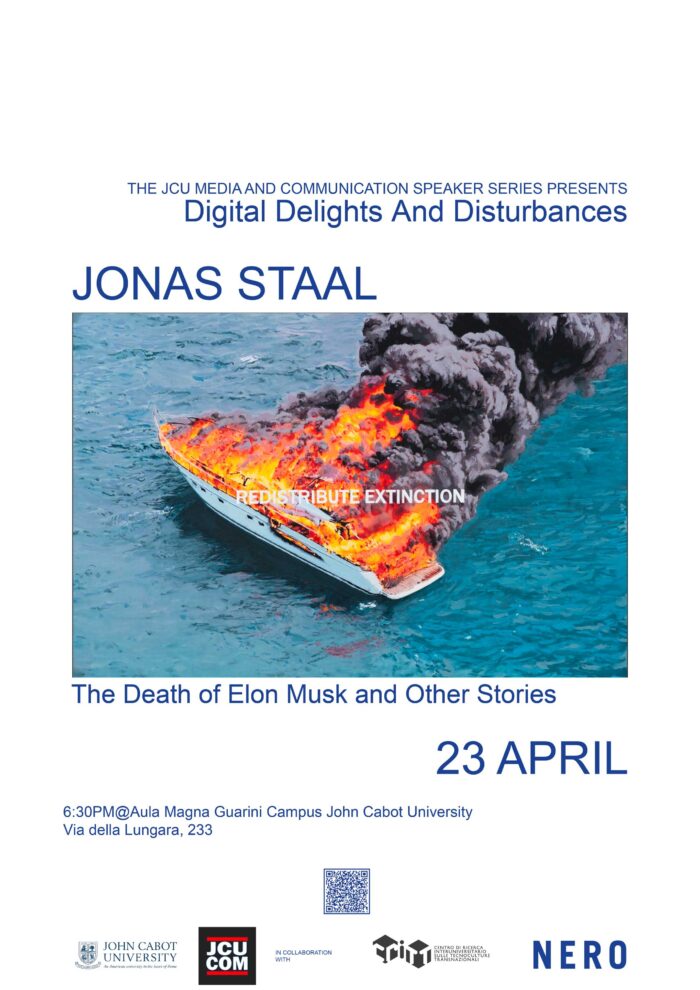
On April 23rd, at 6:30pm, at John Cabot University Guarini Campus, in Via della Lungara 233 (Rome), the Department of Communication and Media Studies at JCU will host The Death of Elon Musk and Other Stories, a talk by Jonas Staal, as part of the Spring 2026 edition of the event series Digital Delights & Disturbances (DDD).
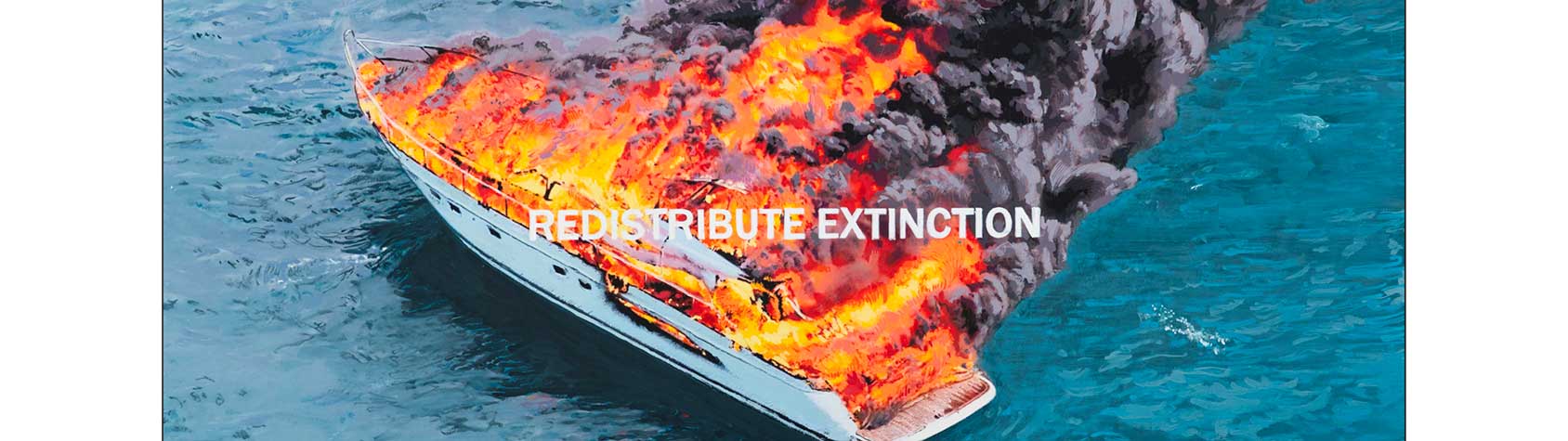
Our time is shaped by interconnected devastation: the obscene rise of trillion-dollar companies, new forms of authoritarianism, a monstrous war machine and climate collapse. What is the place of art and cultural work faced with these various ends of the world? How do we contribute to imagining meaningful forms of collective life, when the very idea of a future is increasingly unthinkable? In this lecture, artist and propaganda researcher Jonas Staal argues that exactly when worlds end, our resistance—artistically and politically—matters more than ever. He will discuss the need for transnational climate tribunals to prosecute fossil fuel elites, the aesthetic practice of burning superyachts and the necessity to liberate our imaginary of the future by demanding a million more years.
The DDD Event Series is organized and sponsored by the JCU Department of Communication and Media Studies.
Make sure to RSVP here.
What triggered your propaganda art research? What was the outcome?
Jonas Staal: In 2004 Dutch filmmaker Theo van Gogh was killed by a member of the extremist Hofstad Group. Van Gogh was a right wing artist who had been on an anti-Islamic and pro-Iraq War campaign. It was the moment I realized there is nothing neutral about art: art and culture shape our reality – they propagate our realities: sometimes with life or death consequences.
How does propaganda art construct reality? And how does one become a propaganda artist?
Propaganda aims at manufacturing consent, meaning, to create a “new normal”: a new reality, in the interests of specific powers. So for example by propagating a narrative of your opponent as a “terrorist” you essentially dehumanize them, and place them outside of a democratic order, or even outside of a human community all together. That enables mass deportations, mass death at the Mediterranean Sea and genocide in Palestine.
But propaganda does not only belong to fascist and settler-colonial regimes! From revolutionary socialist to black liberation movements, from feminism to climate justice movements, emancipatory politics also tries to propagate its own realities, based on principles of radical equality. But rather than othering already precarious or vulnerable peoples and communities, our Us-versus-Them divide trues to identify powerful elites as “Them.”
The role of artists and cultural workers in propaganda relates to the way we imagine a new normal: to change reality, you have to imagine reality first. So, there, cultural work is critical. No wonder Trump was brought to power by filmmaker Steve Bannon, just as Putin’s power was shaped by dramaturg Vladislav Surkov and the French Ministry of Defense is assisted by a Red Team of science fiction writers: they shape the narratives and visual horizons of the world they aim to bring to being.
Of course, this is not exclusive to authoritarian and imperial regimes of power: artists and cultural workers have been central to propagating the emancipatory imaginations and horizons of social justice movements throughout history as well. Think of the critical work of artist Emory Douglas, Minister of Culture in the Black Panther Party, or Khaled Hourani’s ingenious Watermelon Flag (2007) that bypassed the banning of the Palestinian flag.
And your final question, how does one become a propaganda artist? Upton Sinclair once said, “all art is propaganda”, because all art is always created in relation to power. But of course, we have a choice which power we help to propagate into being. Do we succumb to rising authoritarianism and technofeudalism, or do we stand with the movements and peoples that struggle for a horizon of political self-determination in the 21st century?
3) How does artistic practice become a means to organize for larger political struggles, or indeed a tool to collectively “demand a million more years”?
By not just making work “about” politics, but as part of social and political movements and organizations. I myself work for and with political bodies such as the Democracy in Europe Movement 2025 (DiEM25), Progressive International and the Democratic Self-Administration of Rojava. Of course, within the context of political struggle, artists and cultural workers have specific competences to contribute, especially by insisting both on the urgency of day to day political struggle, but also horizons of deeper transformation. We need to demand not just a liveable world for our “children and grandchildren,” as mainstream politics tends to phrase it: we must demand a million more years!
How does the Court for Intergenerational Climate Crimes function?
The Court for Intergenerational Climate Crimes, or “CICC”, I co-founded with Radha D’Souza. We organize public hearings across the world to prosecute states and corporations for climate crimes committed not just in the past and present, but against the very possibility of a future. It works largely like the model of criminal trial, we bring together judges, public prosecutors, witnesses, the accused, and the public operates as a public jury. Each is required to act alongside the principles laid out in The Intergenerational Climate Crimes Act 2021, which centers on the principles of intergenerationality, interdependence, and regeneration.
In essence you could say, we put the law on trial by showing how existing law and rights-based regimes have not only enabled colonial theft and mass extraction that laid the foundation for today’s climate catastrophe, they legitimized it. The law is not the solution, it’s the problem, and through our court we re-imagine—we propagate—what justice could or should look like, and outperform the existing courts by building our own popular more-than-human institutions instead.
Since its establishment in 2012, is the New World Summit still thriving and how did it unfold throughout the years?
The New World Summit is an artistic and political organization that creates temporary parliaments for stateless and blacklisted organizations: groups banned from existing democratic structures. Since its founding it has gathered many different stateless peoples and nations, as well as groups prosecuted in the so-called War on Terror, through our temporary parliaments, embassies, and our own school, the New World Academy (2013-16).
Because the work was a response to the Us-versus-Them propaganda in the War on Terror, and the use of the “terrorist” label to criminalize opposition, I feel its urgency never ceased, because the War on Terror never ceased. Today’s genocide in Palestine, but also the illegal wars against Venezuela, Iran, Lebanon and Cuba, they all continue to rely on this neo-imperial propaganda model. What we try to do instead is, through our alternative parliaments, to recompose who exactly constitutes “Us” in the Us-versus-Them dichotomy. To seek for broad unity against the elites that represent the true existential threat through permanent wars and climate collapse.
I think this is the essential task of emancipatory propaganda today: to propagate horizons in which the possibility of collective life, of meaningful collective survival, remains imaginable and possible.