
No Object is Passive
A conversation with Gala Porras-Kim
Gala Porras-Kim’s practice sits at the intersection of multiple fields, bringing together drawing, sculpture, video, performance, installation, archival research and institutional critique to question the systems through which objects are collected, classified, preserved and displayed, and the broader ways in which these systems of knowledge production shape, and are shaped by, the realities they seek to describe. Her work often operates through a form of hacking entering existing structures, exposing their internal contradictions and making visible the paradoxes that ordinarily remain concealed. Rather than working from the outside, she inhabits the logics of institutions in order to test their limits from within.
Central to her practice is an investigation of the often invisible infrastructures through which knowledge is organised and made authoritative. Museums, archives and collections become important sites within this inquiry, but they are not its ultimate horizon. Porras-Kim is concerned more broadly with the mechanisms through which meaning, value and legitimacy are produced, how systems of classification shape our understanding of the world, and how the objects they seek to contain in turn destabilise, exceed or redefine those systems. Taxonomies define objects, but objects also define institutions through what is excluded, misplaced, preserved, reclassified or left unrepresented.
Her work draws attention to the assumptions embedded in the ways we perceive, collect, catalogue, exhibit and conserve. Systems presented as neutral, objective or scientific are revealed as constructed and contingent, sometimes disconnected from the histories, material conditions, functions or needs of the objects they seek to contain. For Porras-Kim, the object is never entirely passive within this process. It carries its own material history, previous uses, cultural associations and, in some cases, forms of agency that cannot be fully absorbed into institutional categories. Classification may stabilise an object conceptually, but its material and historical existence continues to exceed the systems designed to account for it. Questions of agency are therefore central. Who is permitted to make decisions within these systems, and, more fundamentally, who is recognised as an actor within them?
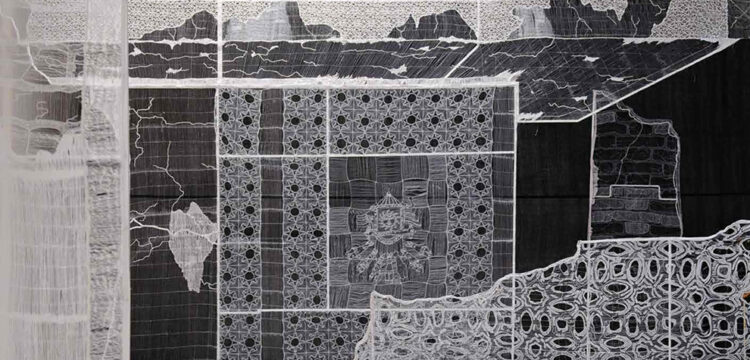
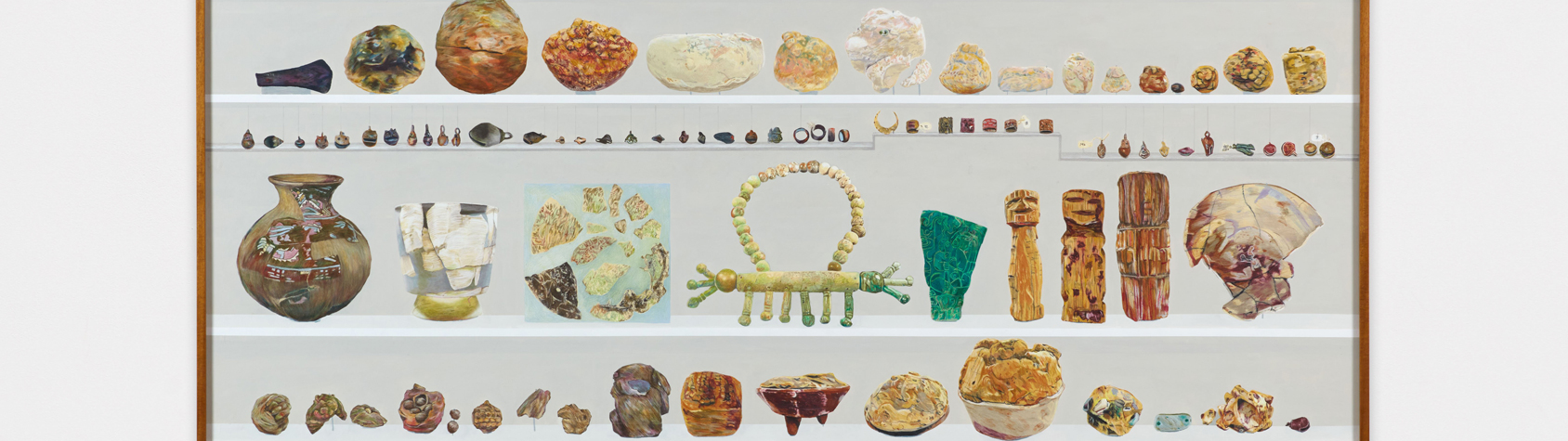
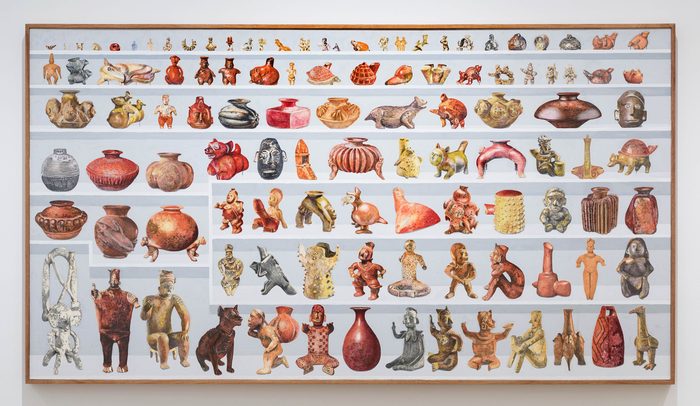
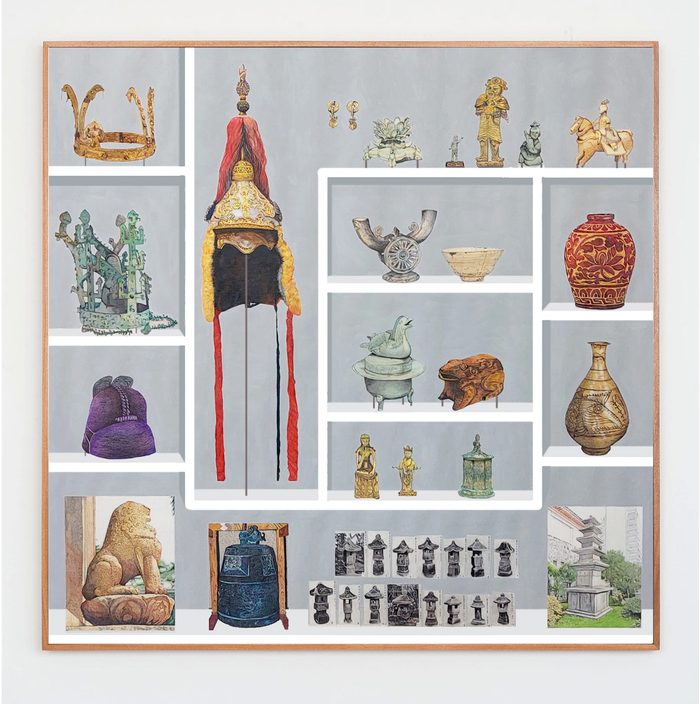
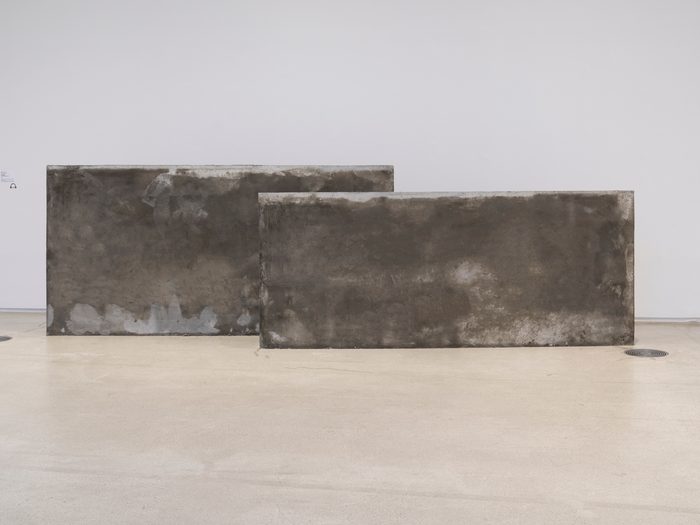
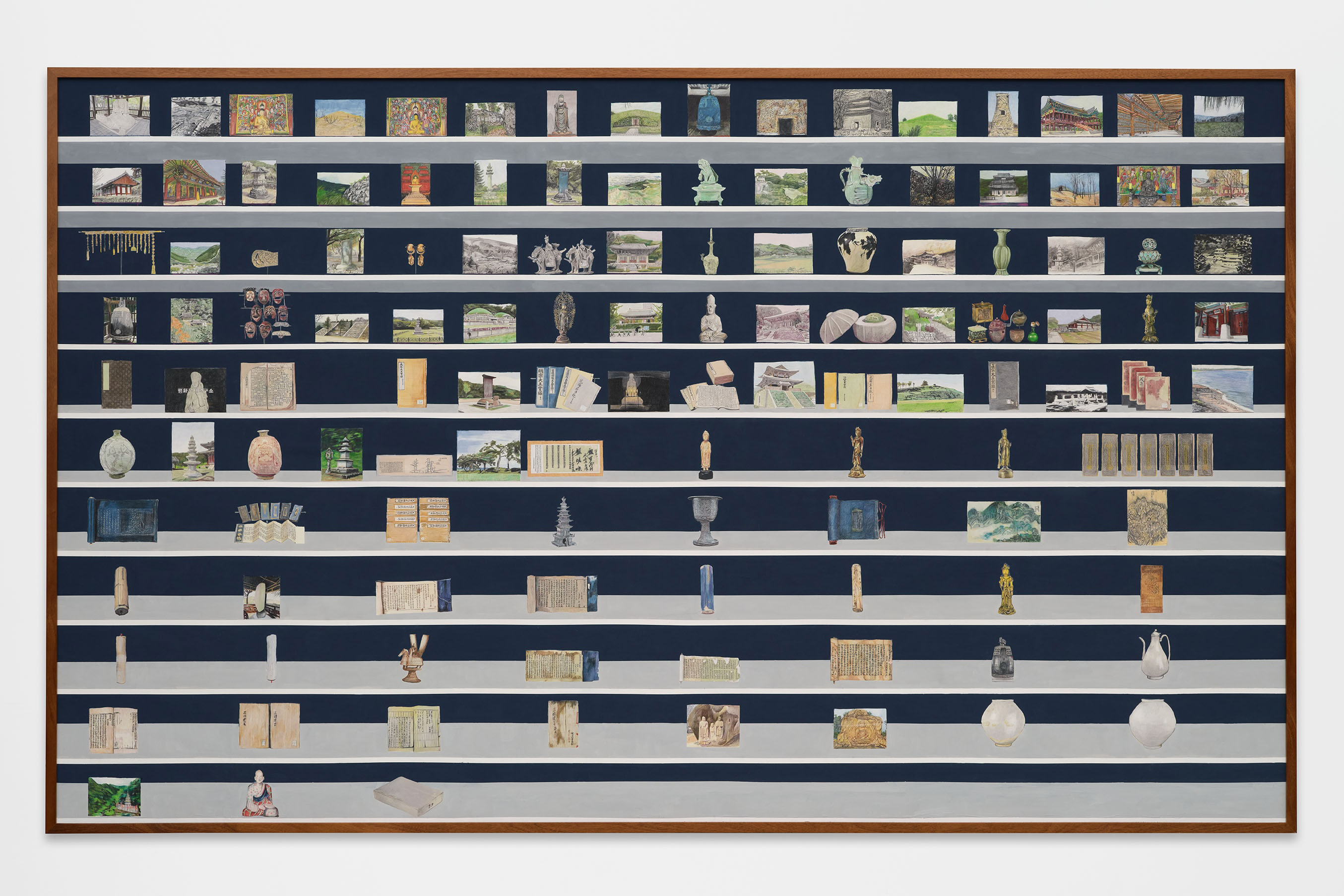
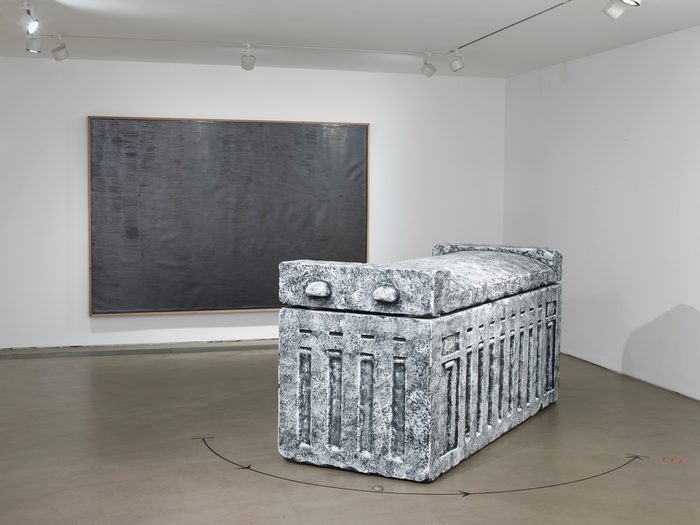
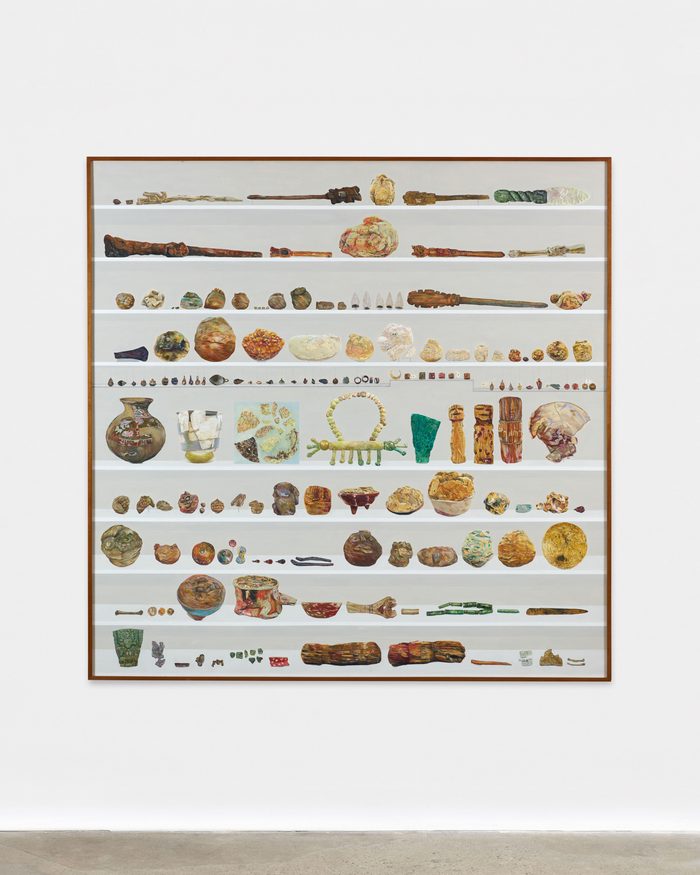
Across works ranging from her meticulous drawings of ethnographic and archaeological collections—such as 228 Offerings for the Rain at the Peabody Museum (2021), 109 West Mexico Ceramics from LACMA Collection: Colima Index (2017), 530 National Treasures (2023) and 37 Uprooted Artifacts (2023)—to more sculptural and material interventions including *Untitled (Efflorescence) (2018), The Michael C. Rockefeller Wing at the Met 1982–2021 fragment (2022), and Sunrise for 5th-Dynasty Sarcophagus from Giza at the British Museum (2022), a persistent underlying question emerges: why? Drawing, in particular, is a deliberate medium within this inquiry. Its slowness requires prolonged attention, turning the act of representation into a method of looking and learning.
In this edited conversation, recorded for blaxRADIO’s Unravel, [1] I spoke with Gala Porras-Kim about these questions and about the role of space within her practice. We spoke about process, intuition, responsibility, care, preservation and attention; about the ways works change through the systems and spaces they enter; and about how exhibitions themselves can become generative structures through which meaning is continually reorganised rather than fixed.
Livia Nervi: What fascinates in the way you exhibit your works, is how it is not simply the presentation of a process; it becomes an entity in itself. You question “site” conceptually but you also go as far as changing the climatic conditions of spaces. The site in your work feels like it moves beyond itself, with the audience no longer simply being tied to presence or absence. You speak to so many different temporal instances that the audience, understood merely as the viewer, becomes obsolete. I am very curious about how space enters your process. When you work on a commission or exhibition, is it something you consider from the outset, or does it come later?
Gala Porras-Kim: I think it depends on the flexibility of the exhibition space. Many of my shows are now determined by shipping budget and timelines. If there is the possibility of making a new work, a site visit is not only a practical walkthrough “Will this work fit on this wall?” but I start looking for the things that are there but are not obvious.
When I do a site visit, I really try to listen to the people who work there as they explain the circumstances. People skip over many parts, the supposedly obvious parts. They might say, “We have a pretty standard exhibition space,” but what is a standard exhibition space?
It feels like a game. I try not to be too serious in the beginning, because I obviously feel strongly about the subject of my work. I try not to overdetermine. I go into an absorbent, sponge-like moment, and I put myself into the perspective of playing with the museum. I remember being a child and asking a lot of questions. That is how I approach walkthroughs to some degree. I do something similar whenever I visit collections or sites, not only for formal visits.
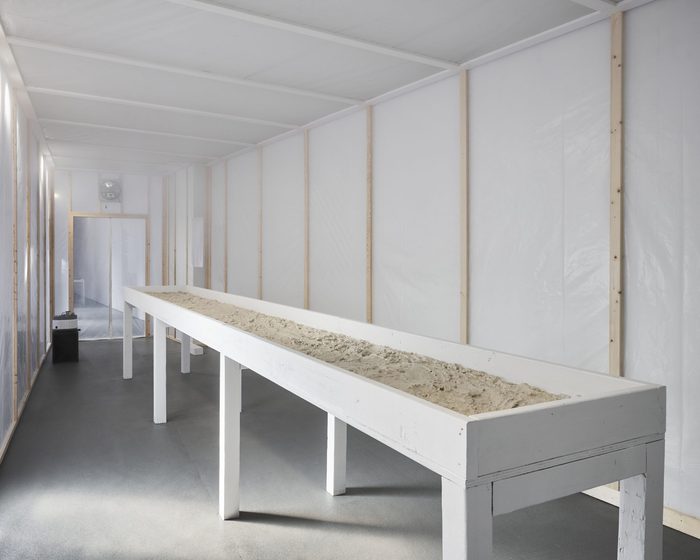
I made this “hot room”—the idea came because I had gone to Puerto Rico and visited the Museo de Arte de Ponce. You can imagine being in the extremely humid climate of Puerto Rico, and then suddenly walking into the museum: your body notices the change immediately. I thought, “It must take a lot of energy to keep this place ‘dry,’ because every time the door opens, moisture enters. There is no holding it back.”
Many exact, scientific, registrarial processes feel very precise and resolved, but they become impractical—whether something is too tiny, too little, too large, or whatever. Then I began asking myself: how does a museum in Puerto Rico show works made by local artists about their own everyday climatic conditions without having to translate those representations of moisture into a dry version?
Part of the reason I make these interventions is that my own work is entering the same system as the other works I examine. I do “one-and-a-half” work: the institution is the subject of my work, but I can also learn how my own work will be affected by anticipating where it is going, or by listening to my friends’ and peers’ experiences.
Your practice has evolved as you’ve become more immersed in this reality. Have you developed any guidelines for how your own work should be preserved?
No, because the works are very different. I don’t want guidelines, because I don’t want my work to always operate in the same way.
Now that I have spent more time making, I can see patterns in my own work. I realise, “Wait, I made a work fifteen years ago because I had the same feeling then.” I have a terrible memory, so I often forget past works. When I see the feeling return, I recognise it.
Does it ever happen that you begin a work, leave it, and pick it up again later?
Oh, yes. I have many of these works because I write them down—not tightly written, but I keep them in my notes app. This is my studio when I’m on the bus or whatever: “art ideas.” It is literally just a list. These are interesting shapes, and these are interesting ideas that do not yet have a shape. It holds them loosely. If I don’t catch it, I’m going to forget.
Your process is then very much guided by sensations and shapes?
I trust my visual and formal intuition to some degree. I don’t necessarily begin with those things, but when I have the structure of an idea and don’t know what shape it might take, I can look through the list and think. Then the ideas are fragments. There is one I really want to make: “The concept of extinction came from egg hunters.” “People who study eggs are oologists.”
Because I write so many of them, patterns emerge. I think, “Wait, all of these have the shape of a feeling of missing something,” or they feel very strangely nocturnal. When there is an exhibition and I want to make a work about one of these ideas—or there is something site-specific that connects with one of them— I explore it further.
Sometimes I cannot anticipate it and it comes super-randomly. When we made a site visit in Yucatán, we went to the swamp and found all of this white clay. I immediately thought, “That is a sediment-particle work.” Then it was only a matter of resolving it practically.
That is the difficult part: you cannot really anticipate it. I can go to the studio with the list, but I cannot simply say, “Make a work.” I am a super-anxious person, and I need to be so relaxed and bored for work to connect.
I understand that it is similar for me. When I am doing research, I have these very large A3 sheets where I map out concepts, start drawing lines, and then I am able to form a coherent pattern of thought.
The list is similar, except that I never delete anything.
Because the ideas can return in different forms.
Yes. I move an idea to the bottom if it is complete.
It is like a living archive of your practice.
More like the archive of my intuitive moments that have not formed into a shape yet. Sometimes they are so dumb. I remember looking through it after COVID and finding something about pyjamas: “We only wear pyjamas,” or something. I put an idea there no matter how dumb it is, because somewhere inside it there may be something that can emerge and evolve.
I was curious to read that, for your Biennale participation, you did not simply produce a body of new works. Through a different lens, you looked back at your work and created a mapping in which each piece spoke about different agents regarded as causes of deterioration in conservation. I found that fascinating. Now it makes complete sense in relation to how you describe your process: returning to ideas through a different optic, and allowing works to become generative in new ways.
There can be different groupings around what the works are about. When I make exhibitions, I try to put existing works and new works together so that they contextualise one another.
One work may be about a relationship to the environment in one exhibition, and about conservation processes or cataloguing in another. Exhibitions create different groupings.
It also helps me relax my idea of what a work “should” be. It no longer is singular but becomes a material I can reuse to think about something else.
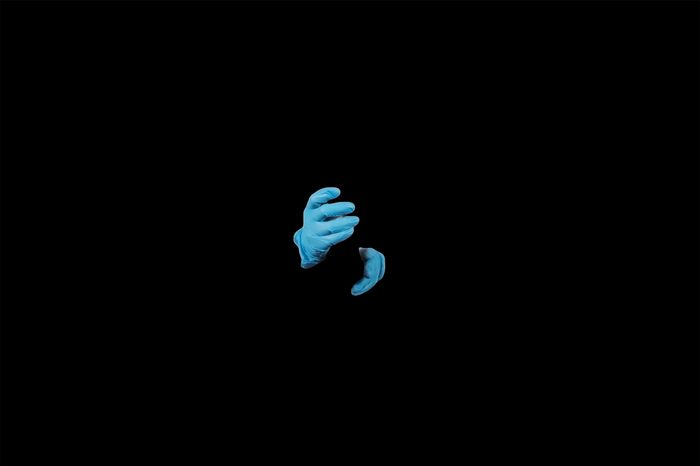
Did bringing these works together for this exhibition help you to return to or rework a piece?
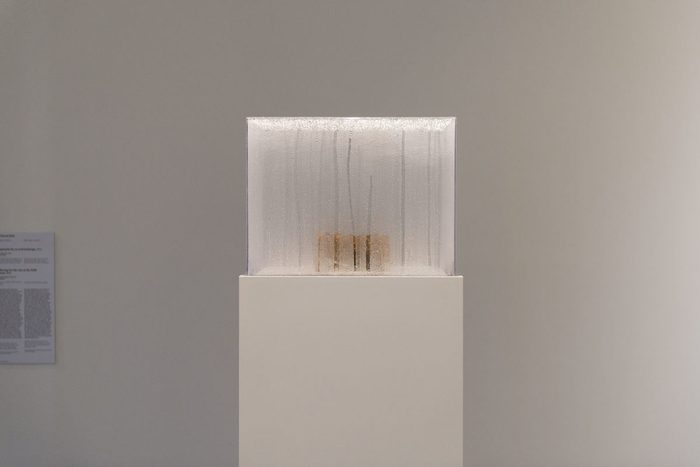
Yes. I’m trying to think of a concrete example. The new works were the curtain and the light—the “sunburn” or sunlight-exposure work at the back.
That exhibition space was so large and the time was so short. I thought, “What do I already have that will make a cohesive exhibition?” I had always wanted to do something with the ten agents of deterioration—not in a strict one-to-one correspondence.
Because Venice is such a major exhibition, I did not necessarily have enough time to make a completely new presentation at that scale and know it would work. Sometimes it works; sometimes it doesn’t. There was too much to test. We tested the curtain. I had never made a curtain before.
It was also very much against what is generally expected within the institution of the Biennale, where everything tends to be commissioned and site-specific to that moment and space. I wondered whether that opposition was subliminally part of the decision.
They never directly specified that it had to be new work. I don’t know whether that is particular to this edition or if it is sometimes like that. It is also an unusual project: it is within the exhibition but is also its own pavilion, so it has a custom set of guidelines.
You were speaking both to the curatorial team and to the V&A?
I made the exhibition with the curatorial team. I had access to the V&A for any new research I wanted to undertake. I did research there for the curtain, and they provided the objects we are exposing now, as well as answers to many cataloguing and production-research questions.
When I received images of previous exhibitions in that room, I saw that many artists had resolved it similarly. The room is too large, and the schedule—which is normally around seven months—was even shorter this time. It was five months. So it became a mix of existing and new works.
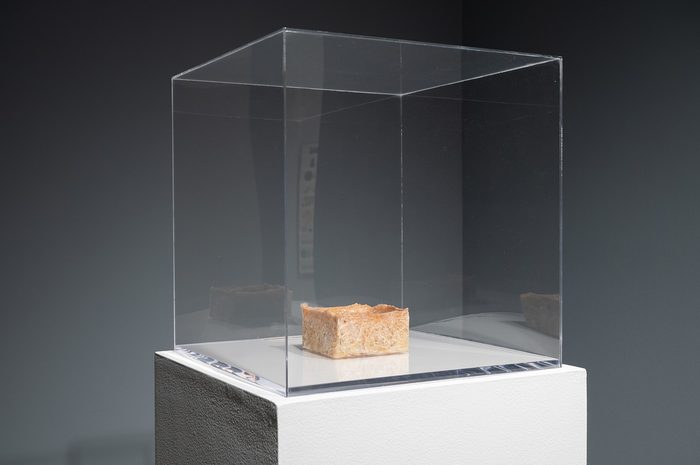
I was able to see many of your works in person that I had not seen before, and to revisit older works. I had recently been to the Museo delle Civiltà in Rome and saw your work there. It was interesting to see it again in a different space.
At the Museo delle Civiltà, the video is more directly related to the specific collection. You think more about the objects. In Venice, you think more about the hands. When it is separated from the collection, it becomes almost a different work.
Most institutional spaces you interact with directly have collections and archives. I wondered how it felt to place your work within the institution of the Biennale, which is itself extremely dense with material but mostly inmateriality. The part in the Arsenale in which your pavilion is located—the Artiglierie—was historically connected to the production and storage of arms, so it is a charged space. At the Biennale the manifestations are ephemeral—everything arrives and then leaves—but the structure remains and repeats cyclically. As someone so attentive to these things, how did that enter your process?
I thought about it a lot. My room, as you said, had been an arms room. Coincidentally, it was also a place where arms were shown, so it had always been an exhibition space. I was thinking about protection and conservation. The room itself is humid; it is not like the Central Pavilion, which has more climate control. That matters physically for my drawings.
But I was not only thinking about the physical conditions of the work. I was also thinking about the conceptual space, especially in relation to national pavilions. What does it mean to conserve the mental space of the audience? My room is in a corner. Will anybody be able to think about these comparatively small conservation problems after walking through the very real problems occurring in our actual world?
It was very difficult to be “free,” as the Biennale says artists should be, while ignoring the actual infrastructure you described: national pavilions representing states within the exhibition. We are asked to suspend certain realities for some things, not to suspend them for others, and to ignore others.
What does it mean to protect the conceptual space in which we are able to pay attention to nuanced work? The exhibition was about minor-key, subtle things, you cannot move through it looking for something very quickly. You could see in the poetry, the selected artists, and Koyo’s own text that she wanted a mode of slow viewing. I kept thinking: how do you listen to these minor sounds when a major sound is playing directly in front of you? For many of us, it was also an attempt to preserve the exhibition we knew existed—the exhibition that exists beneath all of that noise.
On the other hand, one of the best parts of the whole experience was the dialogue among the artists, even before the exhibition was made, about the situation in which we had been placed. Of course no exhibition space is neutral. We try to pretend it is, but to some degree that is impossible. When we met during the installation period, it felt as though we already knew one another. We still have a WhatsApp group. It was great to see such a large group come together and organise.
One thing that has surfaced is how much invisible labour the appointed curator of the Biennale actually takes on. When that person is not there, you see that the institution itself does not take on that labour. It is beautiful that there was an understanding that this responsibility had to be redistributed, but it also reveals what the infrastructure lacks.
Absolutely. It was a clear moment of labour of love, especially because, when we were meeting beforehand, everyone was trying to finish the actual exhibition. I remember being in the studio, trying to finish the works, while also reading all of these threads about problems surrounding the exhibition. I thought, “We haven’t even started.”
Was there anything in the exhibition that particularly stood out to you—among the different presentations or participations?
What I really liked was learning about artists I had not known before. This exhibition also had so many drawings, which I loved.
The feeling I took from the exhibition—not only because I know some of the artists—was that so many of the works felt as though they had been fun to make. You could sense that the artist had had a good time in the studio. That relationship between a work and its author is something I look for.
I could also sense it in the curation. Many of the works had a temperature similar to mine. They seem funny and light on the surface, but if you spend more time with them, you see that they are much larger than the immediate circumstance they present.
[1] Unravel is a series of interviews, curated by Livia Nervi, that seeks to map a constellation of practitioners whose work can be read through five interconnected lenses: emancipatory pedagogy; hacking as method; non-reciprocal gifting; communing and commoning; and the practitioner as a reader of the contemporary condition. Each episode invites listeners into the work, methods, and thinking of a different practitioner, while gradually tracing affinities, tensions, and possible connections across these fields of practice. Unravel is part of blaxxRADIO, the radio platform of the collective blaxTARLINES, part of their intervention for the 61st International Art Exhibition La Biennale di Venezia In Minor Keys curated by Koyo Kouoh.