NERO is an international publishing house devoted to art, criticism and contemporary culture. Founded in Rome in 2004, it publishes artists’ books, catalogs, editions and essays.

NERO explores present and future imaginaries beyond any field of specialization, format or code – as visual arts, music, philosophy, politics, aesthetics or fictional narrations – extensively investigating unconventional perspectives and provocative outlooks to decipher the essence of this ever changing reality.

NERO
Lungotevere degli Artigiani 8/b
00153 Rome
Italy
+390697271252
[email protected]

Distribution
ITALY – A.L.I. Agenzia Libraria International 
BELGIUM, FRANCE, LUXEMBOURG, SWITZERLAND, CANADA – Les presses du réel
UNITED KINGDOM – Art Data
USA – Idea Books and Printed Matter
NETHERLANDS, GERMANY, AUSTRIA AND ALL OTHER COUNTRIES – Idea Books

For other distribution inquiries, please contact [email protected]

Media Inquiries
To request review copies, press images, or for other media inquiries, please contact [email protected]

Privacy Policy - Cookie Policy

Heads of Content:
Valerio Mannucci, Lorenzo Micheli Gigotti

Creative Director:
Francesco de Figueiredo

Editor at large:
Luca Lo Pinto

Editors:
Michele Angiletta, Alessandra Castellazzi, Clara Ciccioni, Carlotta Colarieti, Giulia Crispiani, Tijana Mamula, Valerio Mattioli, Simone Sauza, Laura Tripaldi

Designers:
Elisa Chieruzzi, Lorenzo Curatola, Marco De Ieso, Lola Giffard-Bouvier

Administration and Production:
Linda Lazzaro

Distribution:
Davide Francalanci

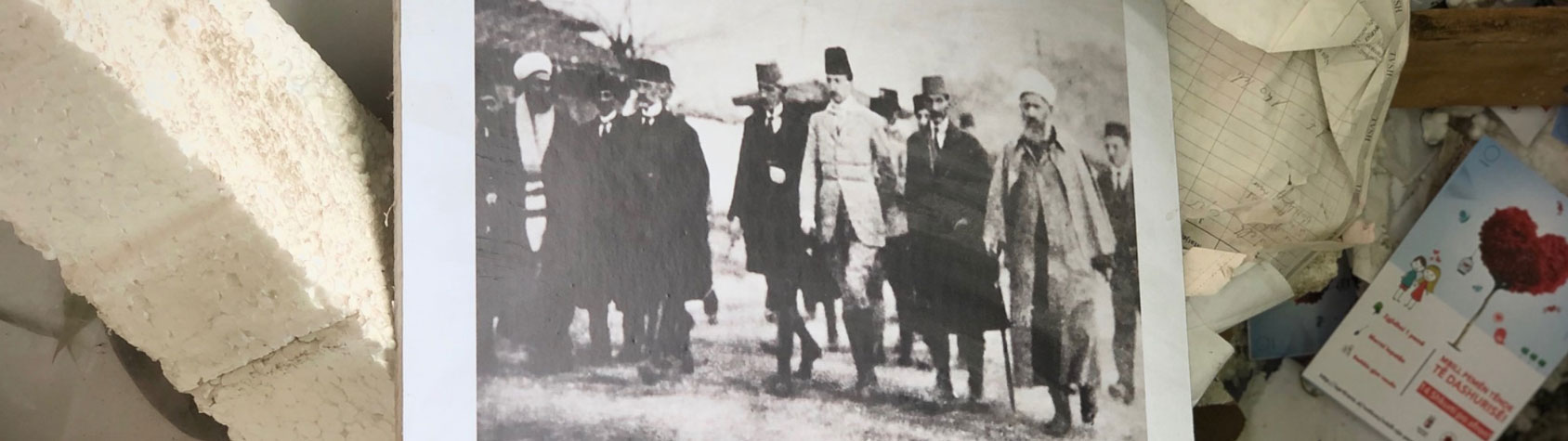
Among the National Theatre’s ruins, a print showing the government formed by the Congress of Lushnjë arriving in Tirana, Albania’s new capital, in 1920. May 2020 (detail). Photo Valentina Bonizzi.

Museum(s) of Necro-Desire

Art as neo-fascist propaganda: Albania–Italy partnership and the promise of EU accession

On 13 November 2025, Albanian Prime Minister Edi Rama announced beside Italian Prime Minister Giorgia Meloni in Rome, “I hope the Italian Museum of Art in Albania will become a concrete reality.” He was speaking about Albania’s National Gallery of Arts, whose renewal had entered a partnership encompassing migration control, defence and cybersecurity, with Italy backing Albania’s EU membership.[1,2] How had an Albanian public institution come to be promised an Italian future? What relationships between artists and political power had developed over the years to make a museum an organic part of this deal—and how had Rama made his political project a future that artists themselves were invested in sustaining?

What began in May 2026 as protests against luxury development around Zvërnec then grew into the Flamingo Revolution, and subsequently converged with student protests in October, challenging a model of progress in which investors’ interests are made to stand for Albania’s future. Demands for Rama’s resignation and imprisonment contest both his continued rule and the impunity that protesters see as sustaining this model of development, while heavy police repression of students and other demonstrators works to preserve it.[3]
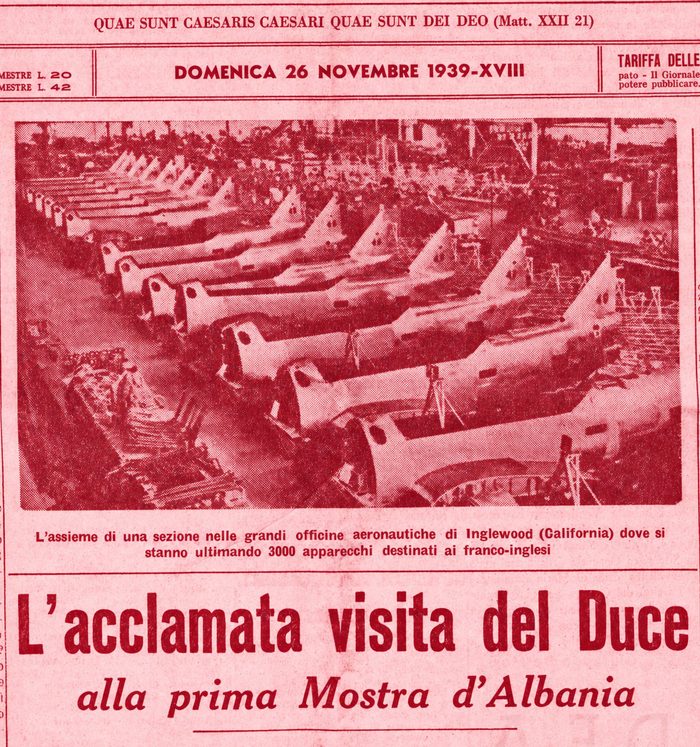
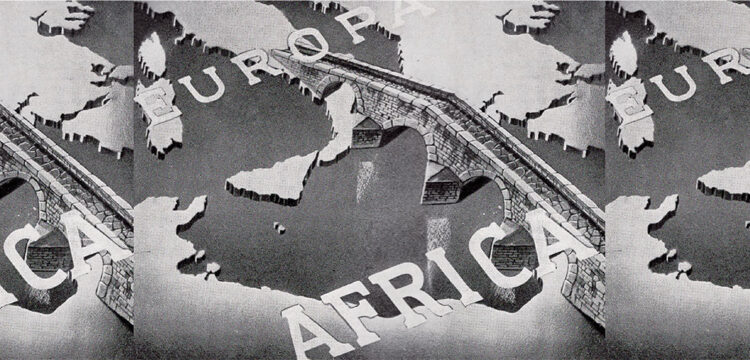
“L’acclamata visita del Duce alla prima Mostra d’Albania”, L’Avvenire d’Italia, 26 November 1939, front-page detail. Biblioteca Civica Vincenzo Joppi, Udine. Red-toned editorial adaptation.

While protesters contest this model of development at home, Rama’s government secures support for it abroad. Within an unequal relationship shaped by Italian colonial rule, Rama’s government acts as an intermediary with interests of its own. It negotiates the use of Albanian territory and institutions for Italian-operated migrant detention, military cooperation, and cultural renewal with an Italian government led by a party rooted in postwar neofascism.[2,4] In 2017, Meloni described migration as an “invasion of Europe” and a project of “ethnic replacement.”[4] Italy’s endorsement has been strengthening Rama’s claim to lead Albania into Europe, while his government’s cooperation on migration control and military priorities gives European partners an interest in sustaining his authority.[2,5]

The leadership’s capacity to broker foreign access to Albanian territory and institutions allows subordination abroad to reinforce its power at home.[6] Investigations into suspected corruption in construction and property development, disputed land transfers and the suspected laundering of drug-trafficking proceeds through property show how much is at stake in the political control of land: decisions over land can turn private wealth—including suspected criminal proceeds—into projects presented as national development.[7] Those rebelling against this transformation contest both the interests it serves and the government’s claim to impose it as their future.
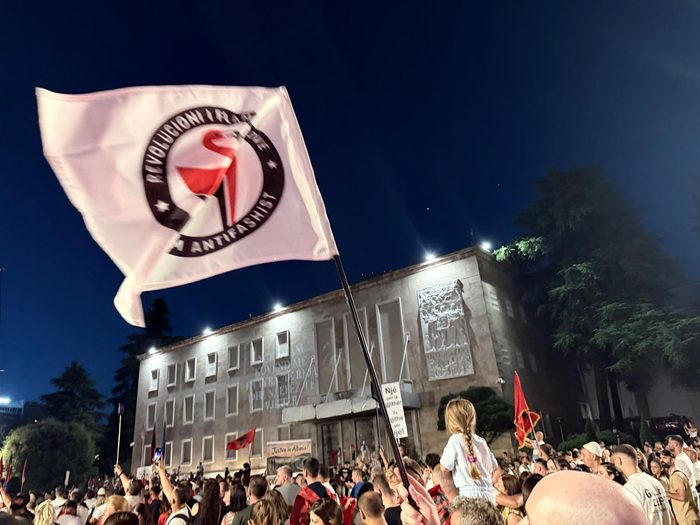
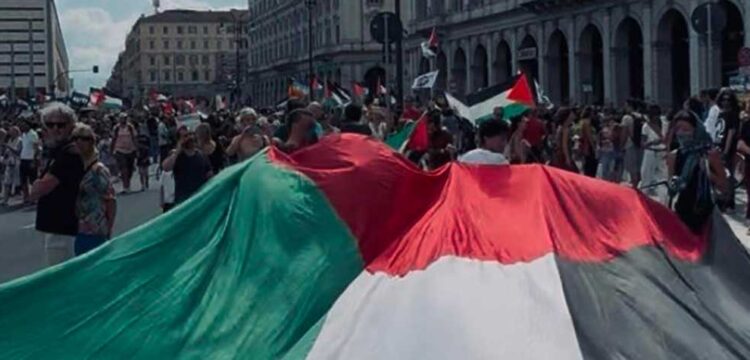
Flamingo Revolution protest, Tirana, 4 July 2026. The flag of the Flamingo Revolution’s Antifascist Front in front of the Prime Minister’s Office on Dëshmorët e Kombit Boulevard. Photo Valentina Bonizzi.

Contemporary art has helped secure support for this political project among artists, curators, and institutions abroad, giving them a stake in its continuation. Curator Lorenza Baroncelli has helped coordinate architect Stefano Boeri’s Tirana 2030 plan while advising Rama, and both she and Boeri promoted his standing as an artist; she now supervises MAXXI’s advice on the national museum.[8] Boeri’s studio recounts its work on the plan in The Albanian Files, edited by Anneke Abhelakh and published in June 2026 with a foreword by Rama; activists submitted the book to SPAK, Albania’s anti-corruption authority, requesting an investigation of the relationships it describes, and SPAK retained the book.[9]

Having lived abroad for over two decades, almost ten of them now spent in Albania, I write as an Italian artist and researcher for whom independent publishing and political organising are inseparable.[10] The genocide in Gaza has laid bare institutional allegiances that the art world’s language of emancipation has helped to conceal.[11] Writing from Albania and building on research and criticism that have long challenged these arrangements, here I attempt to trace how cultural institutions can condemn political violence while sustaining the relationships through which it is exercised. My work within this system makes that contradiction a material concern: the institutions that adopt the language of critical practice can also withhold its means of survival and marginalise the histories from which it draws. Setting this knowledge in motion is part of the struggle over the conditions in which we can work.
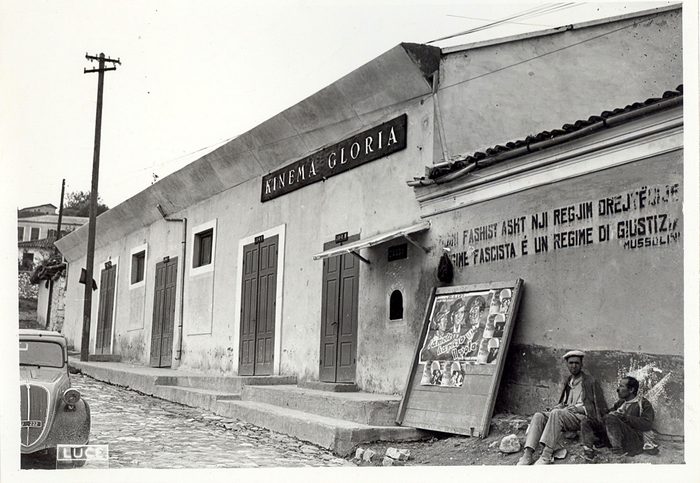
Gloria cinema, Durrës, during the Italian occupation, c. 1940. A Fascist slogan appears on the façade in Albanian and Italian. Photographer unidentified; Luce mark visible. Arkivi Qendror i Shtetit, Fototeka 7, via the Balkan Cinema collection, University of Graz.

the deal

Let’s begin on Friday, 4 July 2025. Tirana was forecast to reach 39°C. Edi Rama was turning sixty-one, and the Israeli airline Arkia was inaugurating its Tel Aviv–Tirana route. At Albania’s Ministry of Economy, Culture and Innovation, minister Blendi Gonxhja was receiving representatives of MAXXI, Italy’s national museum of contemporary art and architecture, and the Italian foreign ministry. On the agenda was the future governance of Albania’s National Gallery of Arts (Galeria Kombëtare e Arteve), being redeveloped as the National Museum of Fine Arts. The Gallery first opened to the public in 1954; its building closed for reconstruction in October 2021. The later implementing contract anticipates its reopening in 2027.[12] On 4 July, the ministry also published its call for the Gallery’s director. The Council of Ministers appointed Adela Demetja on 31 July, with discussions about the MAXXI partnership already under way.[1]

On 13 November 2025, Demetja and MAXXI president Maria Emanuela Bruni signed a three-year memorandum during the first government-to-government summit—G2G—between the two countries. Rama presented the museum’s promised “Italian” character as an improvement, endorsing a colonial hierarchy in which Italian guidance becomes the measure of an Albanian institution’s progress.[1]

The museum memorandum was one of fifteen instruments accompanying an overarching agreement on strategic cooperation. The official list places MAXXI alongside cybersecurity and defence agreements, and industrial memoranda linking Leonardo and Fincantieri with Albania’s state-owned KAYO. The strategic agreement envisages the production and co-production of weapons and ammunition. It also commits the governments to implementing their 2023 migration protocol—the basis for the Italian-operated facilities at Shëngjin and Gjadër—and promoting it as a model for other countries.[2]
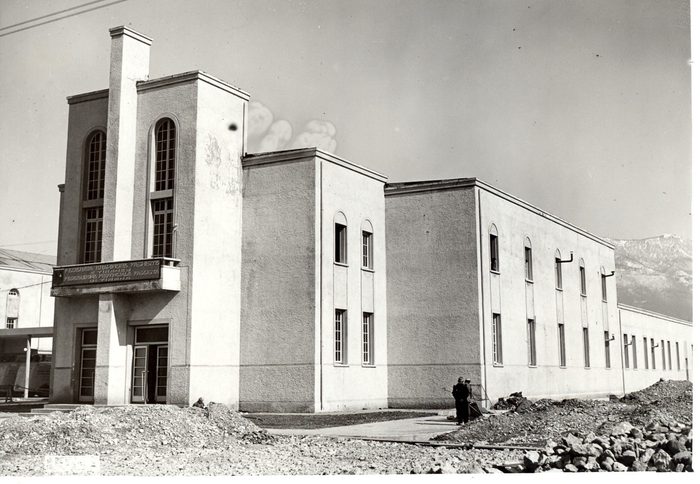
Savoja cinema, Tirana, c. 1940, with the sign of the provincial Fascist federation above its entrance. The archive identifies the building as the later National Theatre. Photographer unidentified. Arkivi Qendror i Shtetit, Fototeka 30, via the Balkan Cinema collection, University of Graz.

The summit even promoted Corridor VIII, linking southern Italy to the Black Sea through Albania, North Macedonia and Bulgaria. Rama explicitly described its importance for NATO: the infrastructure promising economic integration would also serve military mobility. Albania’s territory becomes valuable as a passage for trade and armed forces, while its government presents that strategic usefulness as progress towards a European future. The museum’s renewal enters this same account of what the partnership will deliver.[2]

This connection between cooperation and European belonging was explicit at the summit: Meloni praised Albania’s participation in the migration protocol as evidence that it was already acting like an EU member, renewing her support for accession. Neither detention facilities nor museum advice is a formal condition of membership. Cooperation with Italy was nevertheless being presented as proof of Albania’s European credentials.

That promise of European belonging also has a date: 2030, the horizon of architect Stefano Boeri’s plan for Tirana and Rama’s target for EU membership. Urban reconstruction and European accession converge in a political narrative through which the government presents its choices as the country’s passage into Europe. The museum memorandum consequently gives established political and professional relationships a further claim on Albania’s future: their continuation can be presented as the path to EU membership.[1]

In her essay Hands Across the Water, curator and researcher Chiara Cartuccia examines how Italy’s DL Cultura connects cultural cooperation to the Piano Mattei, the Meloni government’s programme for Africa, joining it to energy strategy, corporate expansion and migration management. Culture, she writes, “is inserted into the Plan’s circuitry as one of its central elements.” Indeed, the strategic agreement with Albania also seems to invoke the Piano Mattei and the EU’s Global Gateway strategy in its migration provisions, while the museum commission belongs to a separate bilateral framework, within which cultural prestige, commercial interests and border control are again negotiated together.[13]

To understand how this relationship was being organised through the museum, I obtained, through an access-to-information request, the memorandum and the €40,000 contract that followed in August 2026, signed by Alessandro Ruggera, director of the Italian Cultural Institute in Tirana, and Paola Macchi, MAXXI’s director general. At the Albanian leadership’s request, the Institute had committed public money to commissioning MAXXI to advise on the museum’s organisation, finances and programme.[14]

Article 4.3 of the contract assigns scientific supervision to Lorenza Baroncelli, director of MAXXI’s architecture department. The promised renewal of the National Museum of Fine Arts gives an older distribution of authority a new justification: Italy supplies the expertise, while Rama’s government extends the role of collaborators already involved in its political project. Public money finances the continuation of these relationships, allowing those who have helped shape the existing order to present themselves as the people qualified to renew it.[8]

Working with Demetja, MAXXI is to develop proposals for 2026–2028 covering the Albanian museum’s permanent collection and exhibition programme, fundraising, staffing, decision-making and measures of success. Prospective sponsors enter the calculation of what the museum can sustain. Public participation appears among the things to assess, although the brief specifies no role for the public in drawing up the plan.[12]
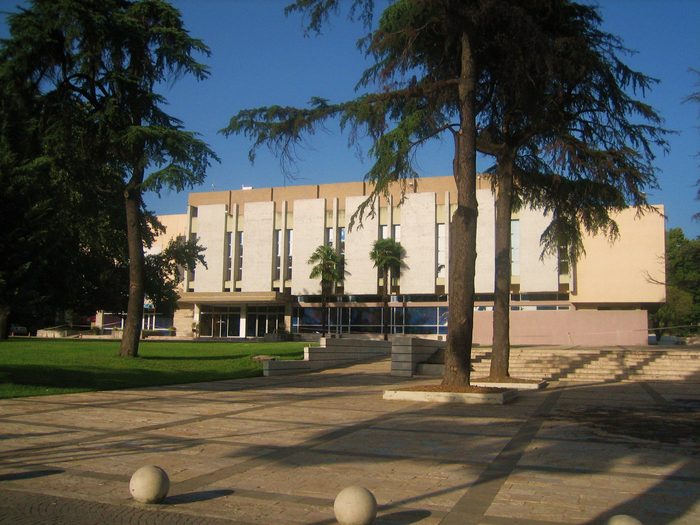
National Gallery of Arts, Tirana, 25 July 2009. Photograph: Gertjan R., via Wikimedia Commons.

That influence operates through the proposals themselves. Final legal authority need not pass to MAXXI for its recommendations to shape the choices available. Presenting this work as technical assistance allows the political assumptions carried by those models—and by the relationships through which they were selected—to pass under the reassuring heading of expertise. Article 2 also identifies a working paper as an integral part of the memorandum. This was missing from the documents I received, and I have since requested it.[14]

The €40,000 is only one part of the bill. Article 4 of the memorandum envisages equal contributions from the Albanian ministry and the Italian Cultural Institute over three years, subject to further contracts and available funds. Training requires a separate agreement between MAXXI and the Albanian ministry. The documents I received do not establish the total cost, how much Albania will pay, or whether the Institute’s €40,000 has already been transferred.[14]

The fifty-fifty formula makes the proposed funding reciprocal, yet the direction of expertise remains one-way. Both governments would pay for Italian advice on the Albanian institution, and both could claim its reopening as an achievement. Against the history of Italian colonial rule, the assumption that Albania’s cultural future gains authority through Italian guidance carries a political weight that equal contributions do little to dissolve.

The exhibition programme extends this imbalance. Article 3 of the memorandum envisages exhibitions of Italian art after the Albanian museum’s reopening, alongside access to MAXXI’s networks. The Italian Cultural Institute, an office of Italy’s foreign ministry charged with promoting Italian language and culture, is therefore financing advice on the Albanian institution expected to exhibit the culture it promotes.[15] Italy funds both the promotion of its art and a role in organising the institution that will receive it. This reproduces a colonial hierarchy in which the foreign partner’s authority to shape an Albanian public institution is presented as assistance, and accepting that authority becomes a measure of progress.

A renovated museum, international connections, opportunities for artists—there is plenty here to desire. Visitors will not need to approve of detention centres to welcome the reopening, nor will artists need to endorse military cooperation to partake in an exhibition. Artists’ participation can lend legitimacy to a political and economic order in which European institutions extend their influence through an Albanian leadership that uses those relationships to consolidate its own authority. Even artists’ denunciations of institutional violence can be absorbed as evidence of openness, while the institutions they criticise retain control over commissions, resources and appointments. These relationships were built through exhibitions, commissions and urban projects long before the museum agreement.
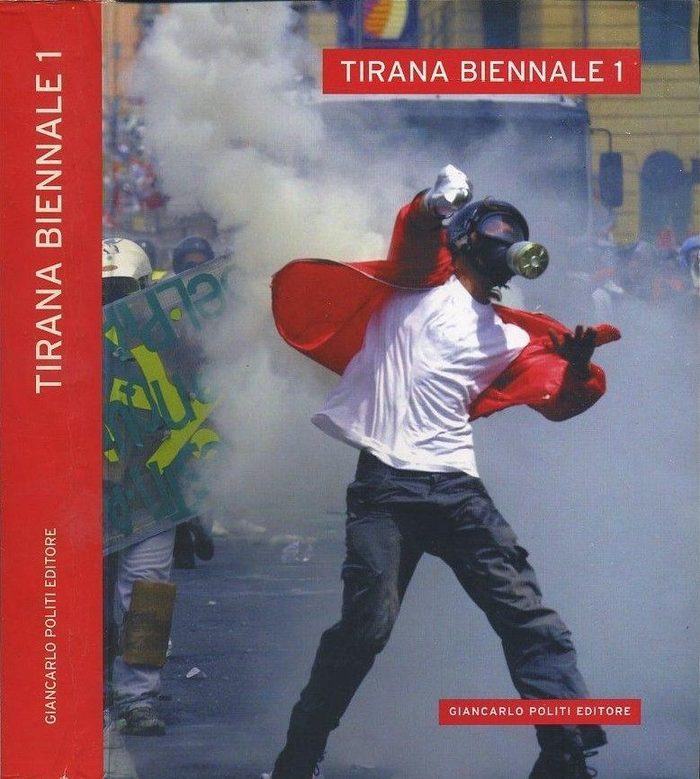
Cover of Tirana Biennale 1: Escape. Giancarlo Politi Editore, Milan, 2001.

the state of the art

Rama embedded contemporary art in his neoliberal reconstruction of post-socialist Albania, using the Western promise of emancipation to legitimise the political and economic order he was building. His position as an artist encouraged the international art world to recognise its own transformative ambitions in his exercise of political power. International recognition helped present private investment and urban redevelopment as an emancipation whose political terms no longer needed to be questioned. Exhibitions and commissions rewarded this alignment: careers and institutions flourished through the same relationships that authorised the government’s transformation of the country. This government-centred model of contemporary art reproduced the concentration of power that constrained the scene’s political independence. Artists’ freedom to criticise did not mean equal power to change those arrangements: some depended on decisions they could scarcely influence, while others controlled access to resources.

The memorandum draws on relationships cultivated long before MAXXI’s arrival, when access to the international art world was becoming a political resource for Rama. IIn 1998, curator Edi Muka invited Giancarlo Politi, publisher of Milan-based Flash Art, to Onufri, the then annual visual arts exhibition at Albania’s National Gallery of Arts in Tirana; Politi then proposed presenting Albanian artists in Venice. Muka recognised the “post/neo colonial feeling and fashion” surrounding this interest, telling media theorist Geert Lovink in 1999 that “we have to kind of follow the rules.” He also used those rules: Politi left the selection to him, making the exchange an opportunity to exercise curatorial authority. Recognising the inequalities did not place Muka outside the arrangement; he negotiated a position within it and helped develop the relationships through which it would grow.[16]

The 2001 Tirana Biennale, organised by Rama and Politi and coordinated by Muka and curator Gëzim Qëndro, put these relationships to work at the National Gallery of Arts. As art historian Jonida Gashi argues, contemporary art helped legitimise further neoliberal reform after the collapse of pyramid investment schemes in 1997, while accounts locating its beginnings around 2000 obscured the preceding decade and the economic policies that had produced the crisis.[16] Artists and curators participated in shaping this promise of a new beginning, presenting international recognition and urban redevelopment through private investment as signs of progress. The rupture celebrated through contemporary art made the continuities of that economic order harder to recognise.
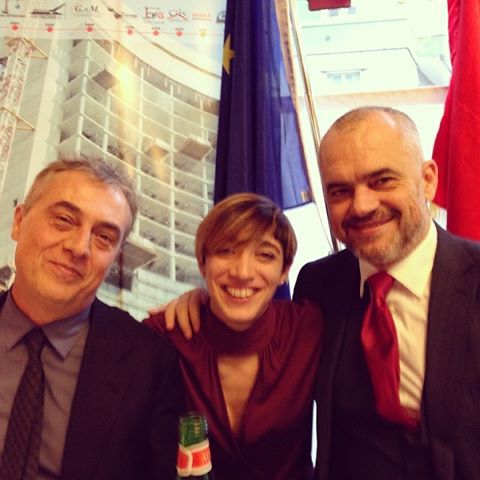
Stefano Boeri, Lorenza Baroncelli and Edi Rama, Milan, 1 February 2014. Source Stefano Boeri’s website.

In artist Anri Sala’s Dammi i colori (2003), Rama’s painted city travelled through exhibitions with the mayor supplying its interpretation. The licence granted to an artist’s imagination was being extended to decisions governing other people’s lives. Writer and critic Vincent W. J. van Gerven Oei’s reading of the film follows this conversion of artistic freedom into political authority: the international audience encounters the transformation through an artwork, while those living in the city remain subject to the decisions being celebrated.[17]

Architecture gave that authority a lasting influence over the city’s development. The relationships behind Tirana 2030 also extended into the exhibition circuit: Baroncelli co-curated Rama’s 2016 exhibition in Naples, and Boeri joined him at his Florence exhibition the following February. Those helping to plan the capital were also helping establish Rama’s standing as an artist, allowing authority over urban development and recognition within contemporary art to reinforce one another.[8]

In 2017, curator Christine Macel invited Rama to the Venice Biennale’s Viva Arte Viva, whose curatorial introduction presented art as a realm of freedom “above and beyond trends and personal interests.” The Biennale’s reply to my access-to-information request distinguishes his personal invitation from Albania’s national participation, organised through its Ministry of Culture. It also states that production and installation costs were the participant’s responsibility and that the Biennale incurred no direct costs, without identifying whether Rama’s participation was financed personally, through Albanian public funds or by a third party.[17] Its own account of the exhibition also lists him among the visiting heads of government. Sala joined him for an Open Table conversation over lunch, giving their longstanding collaboration the public form of an encounter between artists. Curatorial recognition placed the prime minister within a language of artistic freedom while leaving intact his power to determine the conditions under which others could work. The distinction between artist and state representative could be maintained administratively while the prestige of one reinforced the authority of the other.[17]
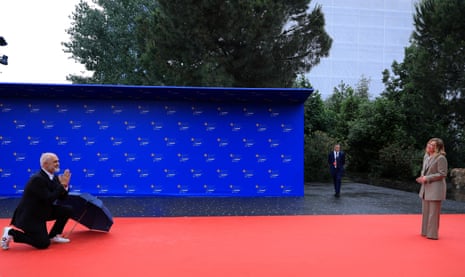
Edi Rama kneeling before Giorgia Meloni at the European Political Community summit, Tirana, 16 May 2025. Photograph: Adnan Beci / AFP via Getty Images.

At the Center for Openness and Dialogue, inside the Prime Minister’s Office, even critical work could provide evidence of openness. I undertook a year-long project there in 2017 and subsequently resigned. I remain accountable for the privileged access that enabled me to propose it. In 2015, Jonida Gashi had already described contemporary art as “quickly becoming his alibi,” examining how the COD’s cultural programme could obscure private architects’ influence over public planning and the lack of transparency surrounding their role. My participation could lend credibility to the government’s claim to openness, whatever the criticisms raised within the project.[17]

The influence of private architects over public decisions also emerges in the accounts collected in The Albanian Files, where invitations and personal introductions are presented as evidence of a country exceptionally receptive to their ambitions. Van Gerven Oei’s critique draws attention to the political discretion celebrated in these encounters. In these accounts, designers’ freedom to realise a project receives considerably more attention than residents’ ability to oppose projects affecting their homes. The consequences of that imbalance are visible in 5 Maji, a neighbourhood of Tirana, where redevelopment under Boeri’s masterplan guidelines brought demolitions in January 2022; a year later, families were still waiting for the promised replacement flats. The celebrated freedom to build depended on powers exercised over somebody else’s homes. While researching against those demolitions, the architects’ account of their success becomes a record of the authority through which residents could be displaced.[9]

This concentration of authority also extended into the art scene, where the contemporary-art organisation Harabel acquired the reach of a private ministry of culture. Founded in 2018 by cultural promoter Ajola Xoxa and artist Driant Zeneli, it combined an artists’ archive and public commissions with diplomatic collaborations, including Italy’s Embassy and Cultural Institute. Artists supplied the work through which it could represent Albanian culture; my portfolio was in its archive too. Contributing to its standing did not give artists a collective say over its priorities or resources. Xoxa’s husband, Tirana’s mayor Erion Veliaj, has been in prison since February 2025 and is on trial on corruption and money-laundering charges. Xoxa and Harabel were also referred for trial in February 2026 in the case brought by SPAK. Beyond the alleged offences, the political question concerns how so much capacity to commission and represent a scene could gather around municipal power.[18]

The relationship between cultural patronage and municipal power was also visible at Sharra, where cultural prestige was pursued while accountability for a young worker’s death remained unresolved. In 2021, Harabel unveiled artist Sislej Xhafa’s public artwork Bleta at the municipal landfill where seventeen-year-old Ardit Gjoklaj had died while working five years earlier. The municipality had promoted the workplace as safe. Harabel contracted with the later concessionaire, Integrated Energy BV SPV, a company paid by the municipality headed by Xoxa’s husband. The artist and his commissioners gave the landfill an occasion for celebration. The young worker’s death had not prevented the municipal waste economy from becoming a source of cultural patronage.[19]
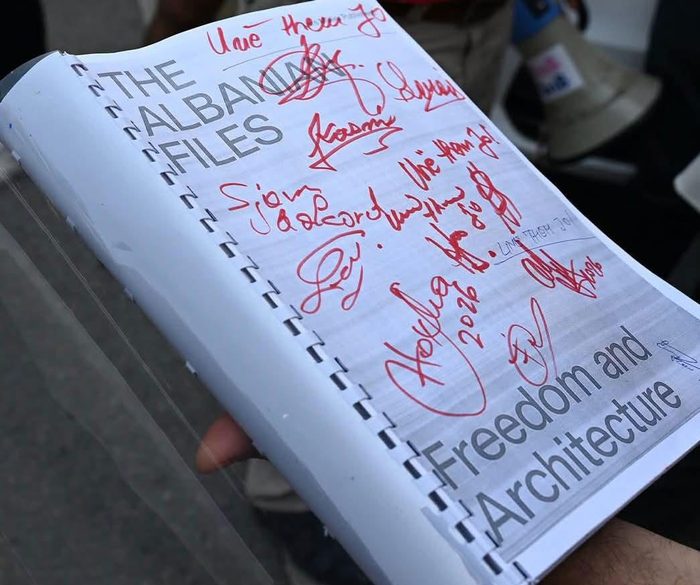
A copy of The Albanian Files: Freedom and Architecture signed by protesters before its delivery to SPAK, Albania’s Special Structure against Corruption and Organised Crime, on 1 July 2026. Photograph: Elira Kadriu / Citizens Channel.

The concentration of resources around these institutions made collective organisation an urgent question: could artists use an association of their own to challenge the political conditions of their work? The independent arts and media institute Bulevard, which I co-founded, helped establish the Albanian Visual Arts Network, AVAN, in 2024, with Adela Demetja as its executive director. AVAN’s founding purpose was to give independent art organisations a collective voice, advocate for sustainable funding and better working conditions, and support critical thinking and freedom of expression. Its website still names solidarity among its principles. The board, however, made producing Tirana Art Weekend the main focus of its work. The festival’s first edition took place in November 2024. In 2025, AVAN was asked to speak in solidarity with Palestine and support a boycott of Israeli Culture Week, organised that June by the Israeli embassy with the Albanian culture ministry and the municipality of Tirana. Although a majority supported issuing a statement, the board required unanimity, allowing a single objection to block it. This gave opposition to speaking out more institutional force than the majority’s demand for solidarity. In August 2025, Demetja resigned as AVAN’s executive director, following her appointment as director of the National Gallery of Arts in July. Bulevard resigned from the network that same month. That November, eighty artists joined the second Tirana Art Weekend, which AVAN director Elian Stefa called “a collective statement of purpose.” The festival also launched an annual commission with the National Gallery of Arts. The network she had previously led had become a commissioning partner of the public institution she now directed. Its claim to represent an independent scene now accompanied a role in building the national collection—an institutional convergence already criticised in Conversation #2 by the collective DebatikCenter of Contemporary Art, founded in Albania in 2003.[20]
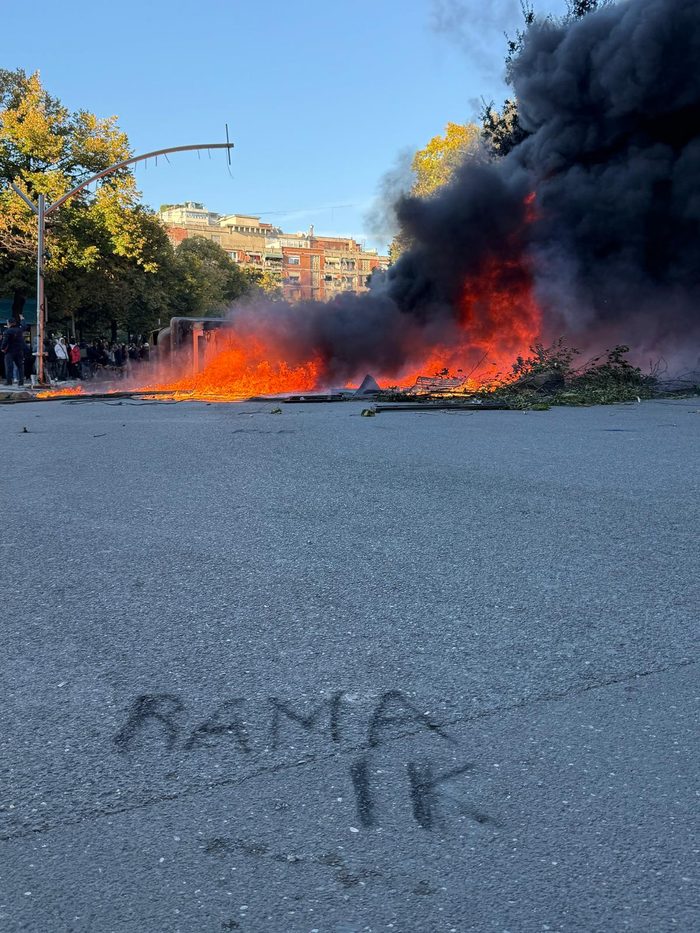
Student protest, Tirana, 14 October 2026. “Rama ik” (“Rama, leave”) is written on the road in front of the fire. Photo Valentina Bonizzi.

Within these overlapping networks, an established artist can occupy an intermediary position in which international recognition strengthens his own authority while his collaborations lend legitimacy to political power at home.[6] Artist Adrian Paci, whose Art House is a member of AVAN, condemned Rama after the National Theatre’s demolition in May 2020; that November, Harabel unveiled his The Calligraphy, reproducing a childhood exercise: “Our beloved leaders live in Tirana.” His denunciation of political authority circulated alongside a commission from an organisation closely connected to municipal power. In The Albanian Files, architectural practice Kuehn Malvezzi describes collaborating with him on their 2024 EXPO Albania proposal, in the same passage where they praise Rama for “curating Albania” like an exhibition. In June 2026, during the Flamingo Revolution, Paci called on the governing class to step back. That same month, the government listed him among the collaborators on a finalist proposal for Durrës’s new university campus. His public criticism did not interrupt the exchange: he retained a place within these cultural and architectural networks, while the government could continue to draw on his artistic authority to legitimise its development projects.[21]

The promise of international artistic exchange also shaped the reopening of Vila 31, former Albanian dictator Enver Hoxha’s residence. Closed to the public after 1991, with occasional access by invitation, it opened as an artists’ residency in 2025 through a partnership between Rama’s government and French billionaire Frédéric Jousset’s Art Explora foundation. Still under Ministry of Defence protection, the villa opens its doors without placing decisions about its use and the public presentation of its history in public hands.[22] After fireworks and Molotov cocktails were thrown at the villa during a Democratic Party protest on 28 February 2026, minister Blendi Gonxhja described the attack as me egërsi—“with savagery”—and its residents as “elite artists from around the world.” Only the exterior of the villa sustained some minor damage. I saw the Villa share his post, and Rama denounced those responsible for the attack as “last night’s barbarians.” The institution circulated a colonial vocabulary that authorised the government to distinguish culture from those threatening it.[22]
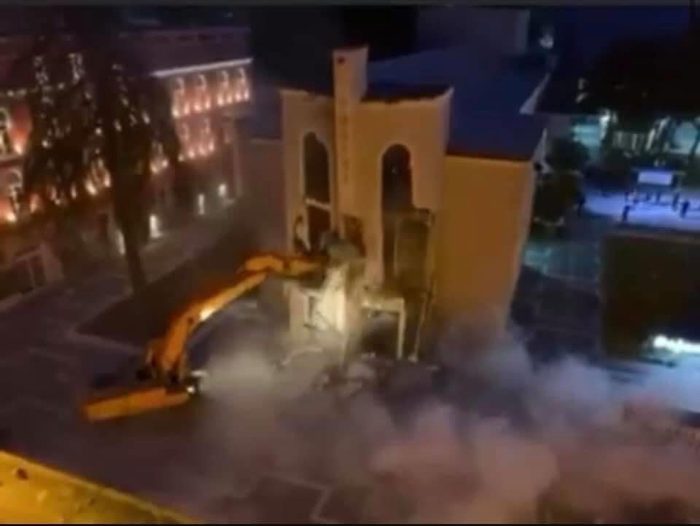
Demolition of the National Theatre, Tirana, 17 May 2020. Image published by Nyje; original image-maker unidentified.

The government’s identification with cultural achievement was again on display on 12 October 2026, when Gonxhja received a Leone d’Oro al Merito from the Golden Lion of Venice Committee at a ceremony in the Italian Senate. He recalled his participation in the student movement of December 1990 and shared the honour with artists and cultural professionals, speaking of closer cultural relations with Italy. The following day, students protesting in Tirana alongside participants in the Flamingo Revolution demanded affordable education, decent university conditions and the government’s departure. Police used tear gas and water cannons during clashes; on 17 October, Reuters reported police firing what appeared to be rubber bullets. We are still here, documenting the violence from the ground. Sharing the honour with artists allowed Gonxhja to present their achievements as credentials for his own public service, while students challenging the government he served faced police violence.[3]

Later that October, while Italy and France were extending restrictions on protest, Rama said his government had prepared its own measures in coordination with Italian and French partners, explicitly invoking French models.[3] The European example becomes a justification for extending the state’s power over those contesting its decisions. Albania approaches membership while its government strengthens the means to suppress opposition, borrowing authority from the very states held up as its democratic destination.

This claim to defend culture against its enemies has a history. Gonxhja’s distinction between “elite artists” and “savagery” becomes harder to sustain alongside the footage in DebatikCenter’s archive. You can still hear the frightened voices of activists occupying Tirana’s National Theatre as the authorities began demolishing it on 17 May 2020. I was on the boulevard before dawn, where police brutalised peaceful protesters. Following the demolition, an open letter with nearly five hundred signatories called on the international art community to stop artwashing Rama’s politics. Six years later, damage to a villa’s exterior brought Rama to denounce “the barbarians.” At the theatre, it was his government that sent in the police.[23]
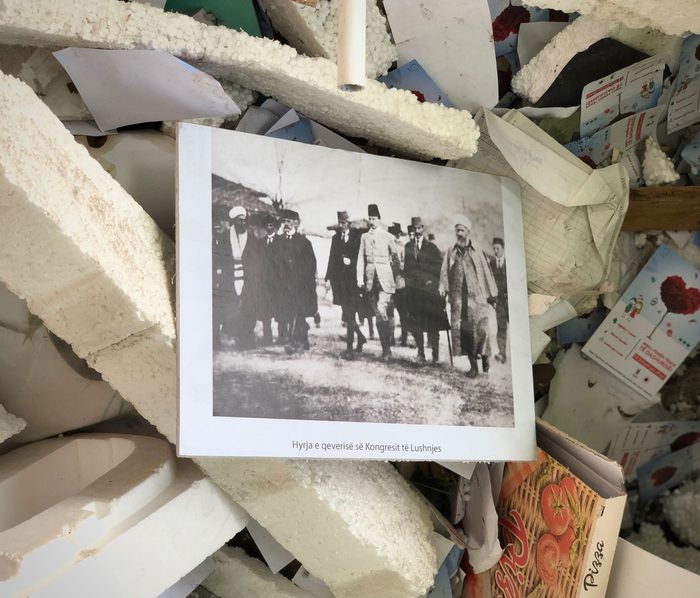
Among the National Theatre’s ruins, a print showing the government formed by the Congress of Lushnjë arriving in Tirana, Albania’s new capital, in 1920. May 2020. Photograph: Valentina Bonizzi.

This selective protection of culture belongs to a wider authority to decide whose home can be demolished, whose movement is restricted and whose presence deserves protection.

As I mentioned above, in her essay Cartuccia shows how cultural diplomacy makes Italy’s neocolonial ambitions acceptable.[13] The memorandum gives those ambitions an institutional form negotiated with an Albanian leadership whose own cultural networks have helped make concentrated power appear emancipatory. Italy finances its museum’s advisory role; Albania’s leadership commissions expertise formed partly through its own collaborations. The agreement promises a better museum while leaving its future in the hands of many of the same political and cultural figures. Those negotiating these agreements exercise power over families’ homes, workers’ safety and migrants’ freedom of movement, while those who contest their decisions face repression. Around Zvërnec, wetlands and coastlines are offered to investors, with the lives they sustain being treated as obstacles to development. The loss of homes, livelihoods and habitats continues long after the event that briefly makes the violence visible.

Under these conditions, an independent art scene has to struggle for the resources to work and the collective power to dispute these terms. The institutions implicated in these relationships have repeatedly offered visibility without surrendering control, and opportunities without the solidarity needed to challenge their political conditions. Established artists can retain commissions while speaking against the government; others risk losing access to the places and relationships through which work becomes possible. The capacity to criticise is distributed as unequally as the protection afforded to those who do it.
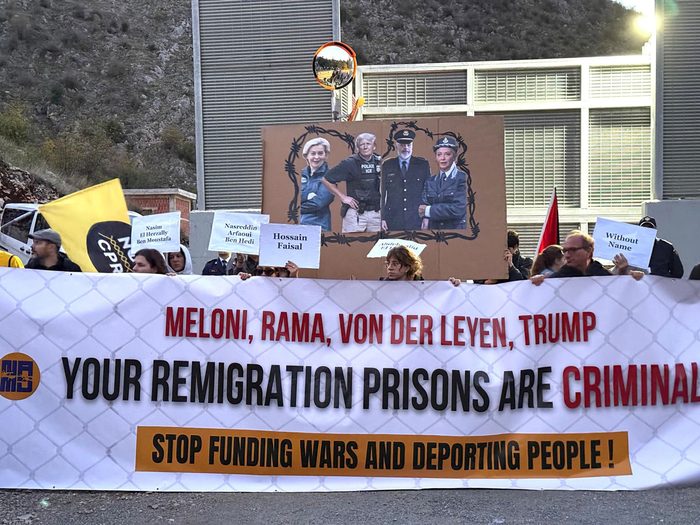
Protest outside the Italian-operated migrant detention centre in Gjadër, Albania, organised by the Network Against Migrant Detention, 1 November 2025. Photo Valentina Bonizzi.

This is the hold of necro-desire: the cultural future promoted by neoliberal Europe remains attractive for the recognition and resources it offers, even when the violence sustaining it is openly condemned. Those who control commissions, funding and appointments cannot dissolve their responsibility into the compromises of people whose livelihoods depend on their decisions. The cruel banality lies in how cultivating these alliances becomes respectable professional conduct, while answering for their consequences is always somebody else’s business. Public criticism can itself become a credential, preserving the authority of those who continue to benefit from the arrangements they condemn. Accountability requires examining how that authority is exercised, including by those of us who claim to oppose it. A revolution would have to reach the power to decide who receives support, on what terms, and who is left without the means to work.
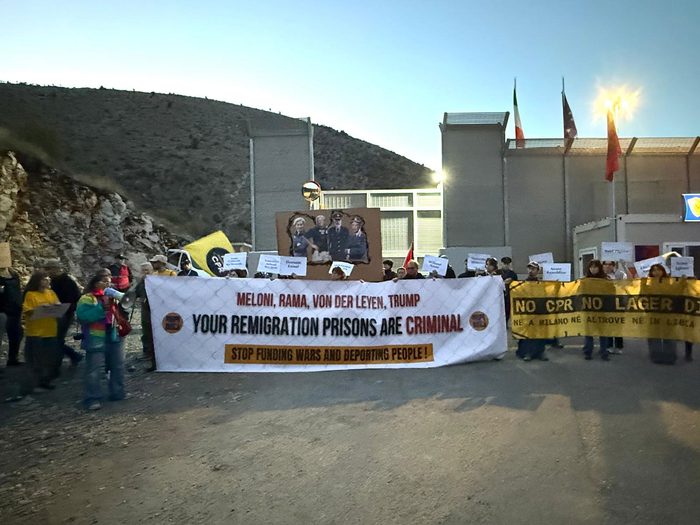
Protest outside the Italian-operated migrant detention centre in Gjadër, Albania, organised by the Network Against Migrant Detention, 1 November 2025. Photo Valentina Bonizzi.

notes
[1] Albanian Ministry of Economy, Culture and Innovation, meeting notice, 4 July 2025, https://mtks.gov.al/newsroom/takimi-ne-meki-me-delegacionin-e-nivelit-te-larte-nga-maxxi/; director’s vacancy notice, 4 July 2025, https://mtks.gov.al/newsroom/njoftim-per-vend-pune-drejtor-i-galerise-kombetare-te-arteve/; Council of Ministers, decisions of 31 July 2025, https://www.kryeministria.al/newsroom/vendime-te-miratuara-ne-mbledhjen-e-keshillit-te-ministrave-date-31-korrik-2025/. The memorandum’s preamble dates the preceding Rome meeting with Lira Pipa to 10 June 2025. Jim Liu, “Arkia Adds Tel Aviv–Tirana Service From July 2025”, AeroRoutes, 15 July 2025, https://www.aeroroutes.com/eng/250715-izjul25tia. For the forecast, see “Ditë përvëluese! 39 gradë Celcius sot në Tiranë dhe Durrës, si parashikohet moti”, Koha Jonë, 4 July 2025, https://kohajone.com/aktualitet/dite-perveluese-39-grade-celcius-sot-ne-tirane-dhe-durres-si-parashikohet-moti/. Prime Minister’s Office, Rama–Meloni joint press conference, 13 November 2025, https://kryeministria.al/en/newsroom/shqiperi-itali-konference-e-perbashket-per-shtyp-e-kryeministrit-edi-rama-dhe-kryeministres-italiane-giorgia-meloni/; Rama–Kallas joint press conference, 8 April 2025, https://kryeministria.al/en/newsroom/konference-per-shtyp-e-kryeministrit-edi-rama-dhe-perfaqesueses-se-larte-per-politiken-e-jashtme-dhe-sigurise-se-be-njekohesisht-zv-presidente-e-komisionit-europian-kaja-kallas/. The latter states Rama’s 2030 accession target. Accession remains subject to EU requirements and approval procedures; the shared date does not establish a common origin for the urban plan and the accession target.
[2] Prime Minister’s Office, “Rome, Italy, strategic cooperation agreements exchanged (G2G)”, 13 November 2025, https://kryeministria.al/en/newsroom/rome-itali-shkembehen-marreveshje-bashkepunimi-strategjik-g2g/; Camera dei deputati, account of the Italy–Albania strategic cooperation agreement, 7 July 2026, https://temi.camera.it/leg19/temi/ratifica-ed-esecuzione-dell-accordo-tra-il-governo-della-repubblica-italiana-e-il-consiglio-dei-ministri-della-repubblica-di-albania-in-materia-di-cooperazione-strategica-nei-settori-dell-assistenza.html. The summit list identifies fifteen instruments alongside the strategic agreement. For the wider partnership’s economic and military dimensions, see Italy’s Ministry of Foreign Affairs, “Minister of Foreign Affairs Antonio Tajani in Tirana for Ministerial Meeting on Corridor VIII”, 17 February 2026, https://www.esteri.it/en/sala_stampa/archivionotizie/comunicati/2026/02/corridoio-viii-il-ministro-tajani-in-albania-per-la-riunione-ministeriale/. The museum memorandum has its own parties, remit and financing; its presence at the summit does not make its budget a military or detention budget. Rama’s summit remarks explicitly link Corridor VIII to NATO and defence and, later in the same address, present the museum partnership as a European cultural institution; see the joint press conference of 13 November 2025, cited in note 1. The Foreign Ministry’s February 2026 statement also identifies EU and NATO military mobility among the corridor’s purposes. On 16 November 2026, Austria, Denmark, Germany, Greece and the Netherlands announced that they were exploring a “return hub” in Rwanda for people subject to enforceable removal decisions, aiming to reach an arrangement and begin transfers in 2027. Their joint statement places migration cooperation within a wider partnership covering other shared interests. This remains a proposal, distinct from the Italy–Albania arrangement, but extends the effort to organise removal beyond EU territory. Source accessed 17 November 2026.
[3] “Gonxhja vlerësohet me çmimin ‘Luani i Artë për Merita’ në Senatin italian”, 24-ore, 12 October 2026, https://24-ore.com/gonxhja-vleresohet-me-cmimin-luani-i-arte-per-merita-ne-senatin-italian/; Erisa Kryeziu, “Albania: students’ protest escalates into violence”, Osservatorio Balcani e Caucaso Transeuropa, 14 October 2026, https://www.balcanicaucaso.org/en/cp_article/albania-students-protest-escalates-into-violence/; Fatos Bytyci, “Albanian police fire rubber bullets as student protests rage”, Reuters, 17 October 2026, reproduced by Internazionale, https://www.internazionale.it/ultime-notizie-reuters/2026/10/17/albanian-anti-government-protesters-clash-with-police-in-tirana. Gonxhja’s award belongs to the Gran Premio Internazionale di Venezia, separate from the Venice Biennale. Kryeziu reports the students’ demonstration on 13 October alongside participants in the Flamingo Revolution; Reuters describes police firing what appeared to be rubber bullets on 17 October. For Rama’s account of coordination with Italian and French partners and his invocation of French models, see the Prime Minister’s Office, address presenting the package against violence and urban anarchy, 25 October 2026. For the contemporaneous measures, see Italy’s Council of Ministers, press release no. 193, 20 October 2026; and Grégoire Biseau, “France bans protests and imposes curfews in dozens of cities, raising concerns over rule of law”, Le Monde, 23 October 2026. The demand for Rama’s imprisonment is recorded here on the basis of my own participation in the protests. See also Ana Otašević, “The flamingo revolution soars on”, Le Monde diplomatique, English edition, October 2026, which records the chant “Jail Rama, jail Berisha”.
[4] Fratelli d’Italia, “Migranti, Meloni: UE complice invasione Europa, progetto sostituzione etnica. Mogherini si dimetta”, 3 February 2017, https://www.fratelli-italia.it/migranti-meloni-ue-complice-invasione-europa-progetto-sostituzione-etnica-mogherini-si-dimetta/. The phrases are translated from Italian. For Meloni’s later description of Albania’s cooperation as European solidarity, see the 13 November 2025 press conference cited in note 1. On Fratelli d’Italia’s origins in the neofascist Italian Social Movement, see Elena Ventura, “Italy: The Radical Right Becomes More Pragmatic in Government”, chapter 8 of Charting the Radical Right’s Influence on EU Foreign Policy, Carnegie Europe, 18 April 2024, p. 71.
[5] Alba Brojka, “EU integration is not Rama’s to own”, Kosovo 2.0, 9 November 2026, https://kosovotwopointzero.com/en/eu-integration-is-not-ramas-to-own. Brojka examines Rama’s appropriation of the accession process and the EU’s prioritisation of geopolitical stability. I extend this analysis to the migration and military cooperation documented in note 2.
[6] Frantz Fanon, The Wretched of the Earth (1961), “The Pitfalls of National Consciousness”, on the national bourgeoisie’s intermediary role between foreign capital and the newly independent nation. I draw on this analysis to examine how unequal international relationships can reinforce domestic political authority, including through artists who mediate between international cultural recognition and political projects at home. Chapter reproduced by South African History Online.
[7] On construction, property and money laundering, see Anesa Agovic Djozo, Washing away crime: Money laundering in the Western Balkans (GI-TOC, July 2025), p. 23; and Europol, “Internationally active Albanian organised crime network busted – 10 arrests” (12 August 2025), on tourism and property assets seized in a suspected cocaine-trafficking and money-laundering case. For Zvërnec, BIRN, “Jo vetëm Kushner: Tre resorte të tjera po projektohen në zonën e mbrojtur të Zvërnecit” (Reporter.al, 29 September 2026), reports an investigation into Artur Shehu for suspected money laundering connected to a land sale associated with the proposed resort. Residents contest the ownership claims; Shehu maintains that his ownership is undisputed (Reuters, “Kushner project being developed on disputed land, Albanian villagers say”, 13 June 2026). The European Commission’s Albania 2026 Report (4 November 2026), pp. 34–35, distinguishes investigations into property-title transfers at Zvërnec from a separate investigation concerning one landowner’s alleged involvement in international drug trafficking and large-scale money laundering. These are distinct investigations, not findings of guilt. Sources accessed 17 November 2026. See also Otašević, “The flamingo revolution soars on”, cited in note 3, on the land disputes and investment privileges contested by the movement.
[8] TU Wien, biography of Lorenza Baroncelli, https://wohnbau.tuwien.ac.at/en/team/lorenza-baroncelli; Stefano Boeri Architetti, Tirana 2030 project credits, 2 March 2016, https://www.stefanoboeriarchitetti.net/en/?p=6743. The biography records her advice to Rama and Veliaj; the project credits identify her as a scientific coordinator. See also “Edi Rama”, Artribune, exhibition listing, Alfonso Artiaco, Naples, 31 May–3 August 2016, co-curated by Baroncelli and Joseph Grima, https://www.artribune.com/mostre-evento-arte/edi-rama/; Eduardo Secci Contemporary, “Edi Rama”, exhibition information on Artsy, February 2017, https://www.artsy.net/show/eduardo-secci-contemporary-edi-rama/info. The discussion with Boeri, moderated by Tommaso Sacchi, was scheduled for 25 February. Stefano Boeri Architetti’s contribution to The Albanian Files, ed. Anneke Abhelakh (Zurich: Lars Müller Publishers, 2026), p. 644, recalls Boeri’s 2008 Abitare article on politicians capable of changing the world, including Rama. For Baroncelli’s contractual role, see Article 4.3, cited in note 14. Last accessed 10 November 2026.
[9] Anneke Abhelakh, ed., The Albanian Files: Freedom and Architecture (Zurich: Lars Müller Publishers, 2026), https://www.lars-mueller-publishers.com/albanian-files; Stefano Boeri Architetti, “The Albanian Files”, 4 June 2026, https://www.stefanoboeriarchitetti.net/en/publications/the-albanian-files-stefano-boeri-architetti/; Vincent W. J. van Gerven Oei, “Architects Must Pay for This”, The Albanian Mechanism, 26 June 2026, https://thealbanianmechanism.substack.com/p/architects-must-pay-for-this. The book credits Boeri’s studio with Tirana Riverside’s masterplan guidelines and local firms with implementation. Elira Kadriu’s report for Citizens, 19 January 2023, records the residents’ continued wait and Mazniku’s promise of replacement flats within a year, https://www.citizens.al/en/2023/01/19/side-effects-of-the-earthquake%2C-the-residents-of-May-5-have-been-waiting-for-houses-for-a-year/. See also Francesca Barca’s reporting for Voxeurop, February 2026, https://voxeurop.eu/en/tirana-demolitions-5-maji-tirana-riverside/; RTSH, “Protestuesit në SPAK, firmosin dhe dorëzojnë librin ‘The Albanian Files’: Do bëjmë kallëzim penal”, 1 July 2026, https://rtsh.al/protestuesit-ne-spak-firmosin-dhe-dorezojne-librin-the-albanian-files-do-bejme-kallezim-penal/. RTSH reports that SPAK retained the book submitted by protesters, who requested an investigation of the relationships it describes. The report does not establish the book’s formal evidentiary status. The submission requested investigation; it was not a judicial finding against the book’s contributors. My reading of the architects’ accounts of access to Rama and their celebration of his patronage draws on van Gerven Oei’s critique in The Albanian Mechanism, cited above.
[10] In Britain, I lived as a migrant from southern Europe; in Albania, my Italian nationality has afforded me privileges. Moving between these unequal circumstances has shaped my understanding of the relations I examine here. This account grows out of what I have learned in Albania, including through the work and struggles of those alongside whom I have lived and organised.
[11] In its statement of 10 November 2023, documenta confirmed that its shareholders required the committee selecting documenta 16’s artistic director to have no affiliations with the Boycott, Divestment and Sanctions (BDS) movement. The four remaining committee members subsequently resigned; their letter of 16 November 2023 described a restrictive climate incompatible with open debate and complex artistic approaches. In its statement of 28 February 2024, the Venice Biennale refused to consider calls to exclude Israel’s national participation, invoking the eligibility of countries recognised by the Italian Republic. The same statement pointed to the inclusion of Palestinian artists in its exhibition programme.
[12] Municipality of Tirana, “Galeria Kombëtare e Arteve”, https://tirana.al/pika-interesi/galeria-kombetare-e-arteve; Albanian culture ministry, notice of temporary closure, 18 October 2021, https://mtks.gov.al/newsroom/mbyllje-e-perkohshme-e-ambienteve-te-galerise-kombetare-te-arteve-muzeu-i-arteve-te-bukura/. The Gallery opened to the public in 1954 and moved to its present building in 1974. Reopening in 2027 is the implementing contract’s anticipated date. The director’s recruitment brief, cited in note 1, already covered strategy, finances, staffing and programming. Annex B assigns MAXXI proposals in overlapping areas, to be developed with Demetja; it does not displace her legal responsibilities. On naming, the appointment announcement and memorandum use National Gallery of Arts (Galeria Kombëtare e Arteve), while Article 205 of Law no. 27/2018, Për trashëgiminë kulturore dhe muzetë, uses National Museum of Fine Arts (Muzeu Kombëtar i Arteve të Bukura), https://ikmt.gov.al/wp-content/uploads/2025/12/Ligj-nr.-27-2018-Per-trashegimine-kulturore-dhe-muzete-i-perditesuar.pdf. The ministry describes the redevelopment as a transition to that museum. Here, “Gallery” identifies the historical institution and the named party to the memorandum; “museum” refers to the redevelopment. Last accessed 10 November 2026.
[13] Chiara Cartuccia, “Hands Across the Water”, NERO, 31 July 2026, https://www.neroeditions.com/hands-across-the-water/. On the strategic agreement’s references to the Piano Mattei and Global Gateway, see Article 1, paragraph 5, discussed in the parliamentary account cited in note 2. A separate programme is Italy’s Direzione Generale Creatività Contemporanea, “Officine Contemporanee”, 16 October 2026, https://creativitacontemporanea.cultura.gov.it/officine-contemporanee/. Its €606,500 call invites Italian diplomatic missions and cultural institutes to propose contemporary-art projects in Africa and the wider Mediterranean, particularly Piano Mattei countries. It is not the funding source established by the museum contract.
[14] Fondazione MAXXI and the National Gallery of Arts of the Republic of Albania, Memorandum of Understanding, Rome, 13 November 2025, MAXXI protocol 986E, Articles 2–4 and 9; Italian Cultural Institute in Tirana and Fondazione MAXXI, Contratto: Elaborazione del Piano Strategico e Finanziario, definizione di un modello di governance per la Galleria Nazionale delle Arti (GKA) di Tirana, dated 4 August 2026, digitally signed by both parties on 7 August, CIG BCA17527E5, including Annexes A and B. Both documents were supplied in response to my access-to-information request. Article 4.3 of the contract names Baroncelli; Article 3 sets expiry at 10 June 2028. Articles 5.3–5.4 require delivery and verification before payment, scheduled for October 2026; the documents do not confirm payment. Article 5.3 specifies €40,000 plus VAT and statutory charges, whereas Annex A quotes €40,000 VAT-exempt. This inconsistency leaves the tax treatment unresolved. Article 4 of the memorandum makes implementation conditional on a tripartite contract and formally secured funds. See also Albania’s Ministry of Tourism, Culture and Sport, “Vijon puna me ekipin e Muzeut MAXXI për Galerinë Kombëtare të Arteve”, 28 January 2026, https://mtks.gov.al/newsroom/vijon-puna-me-ekipin-e-muzeut-maxxi-per-galerine-kombetare-te-arteve/. Its announcement of a strategic report predates the August contract but does not establish whether that report was the memorandum’s working paper or the deliverable covered by the later contract.
[15] Italian Cultural Institute in Tirana, “Chi siamo”, https://iictirana.esteri.it/it/chi-siamo/; MAXXI–National Gallery of Arts memorandum, Article 3, cited in note 14. The latter provides for exploring joint exhibitions, including Italian modern and contemporary art, and participation in MAXXI’s networks. Last accessed 10 November 2026.
[16] Geert Lovink, interview with Edi Muka, 1 June 1999, posted to the Syndicate mailing list on 7 June 1999, https://www.nettime.org/Lists-Archives/syndicate-9906/msg00248.html; “Tirana Biennale”, e-flux Announcements, 25 June 2001, https://www.e-flux.com/announcements/43671/tirana-biennale; Riccarda Mandrini, “Tirana Biennial”, Domus, 14 September 2001, https://www.domusweb.it/en/art/2001/09/14/tirana-biennial–.amp.amp.html. Lovink’s interview describes Onufri in December 1998, Politi’s visit and the Venice invitation. The Biennale announcement names the National Gallery and Chinese Pavilion as venues; Mandrini connects the event to European attention and economic growth. For Politi’s later proprietary claim to the name, see Jennifer Higgie, “Tirana Biennale 3”, Frieze, no. 96, 15 January 2006, https://www.frieze.com/article/tirana-biennale-3. This account of contemporary art’s role in neoliberal consolidation after 1997 draws on Jonida Gashi’s contribution to Claudio Musso, “Conversation #2”, interview with La Société Spectrale (Jonida Gashi, Armando Lulaj and Pleurad Xhafa), DebatikCenter, https://debatikcenter.net/texts/conversation2.html. Gashi connects the early 1990s shock-therapy reforms and the growth of pyramid investment schemes to the crisis of 1997, then traces contemporary art’s role in legitimising further neoliberal reform. Her analysis shows how presenting Albanian contemporary art as beginning around 2000 erased the preceding decade, obscuring the relationship between capitalism and the crisis, its continuities with the present, and the alternatives that might have emerged.
[17] Vincent W. J. van Gerven Oei, “Give Me the Colors . . . and the Country”, Art Papers, March/April 2016, https://www.artpapers.org/give-me-the-color-and-the-country/; La Biennale di Venezia, “Biennale Arte 2017 in numbers”, 2017, https://www.labiennale.org/en/news/biennale-arte-2017-numbers; “Open Table”, 2017 programme, https://www.labiennale.org/en/art/2017/open-table. The report identifies Rama as both an invited artist and a visiting head of government; the programme lists Rama and Sala together on 24 June at 1 p.m. Christine Macel, “Introduction”, 57th International Art Exhibition, 2017, https://www.labiennale.org/en/art/2017/introduction-christine-macel; Andrea Del Mercato, Director General and Transparency and Anti-Corruption Officer, La Biennale di Venezia, reply to my access-to-information request of 21 October 2026, email of 13 November 2026 (author’s archive). The reply distinguishes Rama’s personal invitation from Albania’s national participation through its Ministry of Culture, and states that responsibility for production and installation costs lay with the participant and that the Biennale incurred no direct costs. It does not establish how those participant costs were financed. Jonida Gashi, “These are (not) the things we are fighting for!”, Reporter.al, 29 November 2015, https://www.reporter.al/2015/11/29/these-are-not-the-things-we-are-fighting-for/, also reproduced by DebatikCenter, https://debatikcenter.net/texts/jonida_gashi. I had not read Gashi’s essay when I accepted the year-long project at the Center for Openness and Dialogue. Afterwards I taught Italian in a Tirana call centre.
[18] Harabel, “About us”, https://harabel.org/about-us/; Italian Cultural Institute in Tirana, “Piccolo Mare”, exhibition programme, 31 January–14 February 2023, https://iictirana.esteri.it/it/gli_eventi/calendario/piccolo-mare/. The latter names both the Italian Embassy and Cultural Institute as supporters; Harabel’s board lists Anri Sala, Tommaso Sacchi and Marco Scotini. For the judicial proceedings, see Panorama, court-referral decision reproduced on 9 February 2026, https://en.panorama.com.al/lajmi-i-fundit-gjkko-miraton-kerkesen-e-spak-dhe-dergon-ne-gjyq-erion-veliajn-klotilda-bushkan-eman-abulen-dhe-biznesmenet-e-tjere-emrat-vendimi/; CNA, report on the Veliaj trial, 3 November 2026, https://www.cna.al/english/aktualitet/zvarritet-procesi-shtyhet-serish-gjyqi-per-veliajn-i478779. The referral concerns alleged offences and is not a conviction; the November report confirms the trial is under way and Veliaj remains detained. My account of contributing a portfolio describes my own involvement in Harabel’s archive. For the analysis of Harabel’s role between the art scene and Albania’s political and economic elites, see La Société Spectrale, “Conversation #2”, cited in note 16.
[19] Lindita Çela, “Vdekja e Ardit Gjoklajt zbulon kantierin çnjerëzor në landfillin e Sharrës”, BIRN/Reporter.al, 23 August 2016, https://www.reporter.al/2016/08/23/vdekja-e-ardit-gjoklit-zbulon-kantierin-cnjerezor-ne-landfillin-e-sharres/; Vincent W. J. van Gerven Oei, “Si e mbështeti projektin e Ajola Xoxës kompania e inceneratorit të Tiranës”, CNA, 6 May 2024, https://www.cna.al/denoncim/si-e-mbeshteti-projektin-e-ajola-xoxes-kompania-e-inceneratorit-te-tira-i397721; Vladimir Karaj, “Hetimet për vdekjen e Ardit Gjoklajt rihapin vetingun e prokurorit Julian Zonja”, BIRN/Reporter.al, 19 June 2023, https://www.reporter.al/2023/06/19/hetimet-per-vdekjen-e-ardit-gjoklajt-rihapin-vetingun-e-prokurorit-julian-zonja/. Harabel’s agreement concerned Bleta’s installation and maintenance. Integrated Energy was not the plant operator when Ardit died; the connection here concerns the later concessionaire, municipal payments and Harabel. The available account does not establish an artist’s fee.
[20] AVAN, “Network”, https://avan.al/network/; Erka Shalari, “Tirana Art Weekend 2024”, interview with AVAN board members, Les Nouveaux Riches, 25 November 2024, https://www.les-nouveaux-riches.com/tirana-art-weekend/. The interview identifies Demetja as executive director. “Tirana Art Weekend brings together 80 artists from Albania, Kosovo and around the world”, Euronews Albania, 30 November 2025, https://euronews.al/en/tirana-art-weekend-brings-together-80-artists-from-albania-kosovo-and-around-the-world/; “Tirana Art Weekend 2025”, Coeval, 2025, https://www.coeval-magazine.com/events-spotlight-by-coeval/tirana-art-weekend-2025; Tirana Art Weekend, “Program for 2025 edition”, e-flux Announcements, 12 November 2025, https://www.e-flux.com/announcements/6784961/program-for-2025-edition. These sources document the second edition, Stefa’s phrase and the annual commission with the National Gallery. Embassy of Israel in Albania, “Israeli Culture Week in Tirana”, programme, 9–12 June 2025, https://embassies.gov.il/albania/en/events/israeli-culture-week-tirana. My account of the board’s priorities, solidarity request, unanimity requirement, and the August 2025 departures of Demetja and Bulevard draws on my participation in the network. For the critique of its institutional relationships, see Claudio Musso, “Conversation #2”, interview with La Société Spectrale (Jonida Gashi, Armando Lulaj and Pleurad Xhafa), DebatikCenter, https://debatikcenter.net/texts/conversation2.html. Last accessed 10 November 2026.
[21] BalkanWeb, report of Paci’s public condemnation of Rama, 18 May 2020, https://www.balkanweb.com/en/dikur-miq-artisti-i-madh-shkodran-publikisht-kunder-rames-artisti-i-banalitetit-ulurites-shembja-e-teatrit-akt-brutal/; Harabel, The Calligraphy, inauguration, 19 November 2020, https://harabel.org/21166/. These dates establish the coexistence of criticism and collaboration, not that the commission was offered after or in response to his criticism. Kuehn Malvezzi, contribution to The Albanian Files, cited in note 9, pp. 408–410; “Curatorial Design” dates the EXPO Albania proposal to early 2024 and credits Paci. BalkanWeb, report of his call for the governing class to step back, 14 June 2026, https://www.balkanweb.com/15-dite-revolte-marjana-koceku-u-largua-nga-grupi-i-ps-artisti-paci-uroj-qe-shume-te-tjere-te-marrin-te-njejtin-vendim/; Prime Minister’s Office, final stage of the Aleksandër Moisiu university-campus competition, 23 June 2026, https://www.kryeministria.al/en/newsroom/durres-zhvillohet-faza-finale-e-konkursit-nderkombetar-per-kampusin-e-ri-universitar-aleksander-moisiu/. The latter credits him in the finalist team with FRPO Rodríguez & Oriol, Porras & La Casta Arquitectos, Studio B&L and Agim Seranaj. These are competition credits, not evidence of an individual fee or an awarded public-art commission. Van Gerven Oei also discusses Paci’s participation in the EXPO Albania proposal alongside his public distancing from the government in “Architects Must Pay for This”, The Albanian Mechanism, cited in note 9. My discussion draws on that critique alongside the project and statement sources listed here.
[22] Prime Minister’s Office, “Vila 31 x Art Explora, një hapësirë inovative për art dhe kulturë”, 9 April 2025, https://www.kryeministria.al/newsroom/vila-31-x-art-explora-nje-hapesire-inovative-per-art-dhe-kulture/. The public opening followed the project’s launch by Rama and Macron on 17 October 2023. Gonxhja’s statement on the attack, reproduced by Report TV, 28 February 2026, https://report-tv.al/lajm/sulmi-me-molotove-drejt-viles-se-enver-hoxhes-gonxhja-akt-terrorist-ndaj-imazhit-te-shqiperise-nuk-mund-ta-digjni-dot-frymen-e-lirise; Prime Minister’s Office, Rama’s visit to Vila 31, 1 March 2026, https://www.kryeministria.al/newsroom/kryeministri-rama-denon-sulmin-ndaj-rezidences-vila-31-x-art-explora-dhe-kerkon-ndjese-artisteve-nderkombetare/. Me egërsi describes the manner of the attack; “elite artists from around the world” translates artistë elitarë nga e gjithë bota. Rama’s response denounced the attack and its political instigators. This was Sali Berisha’s Democratic Party protest, distinct from the later movement demanding accountability from both Berisha and Rama. My account of the Villa circulating the statement and continuing to advertise Open Studios draws on my own observations. The account of access by invitation before 2025 and continuing Ministry of Defence protection is based on the author’s knowledge of the site. See also “Le bateau-musée « Artexplorer » reliera vingt ports méditerranéens durant trois ans”, Le Monde, 8 February 2024, https://www.lemonde.fr/culture/article/2024/02/08/le-bateau-musee-artexplorer-reliera-vingt-ports-mediterraneens-durant-trois-ans_6215476_3246.html, which identifies Jousset as a billionaire following the sale of Webhelp in 2023.
[23] Armando Lulaj, Live, Sunday, May 17, 2020, 4:31 AM (2021), video, 9 min. 45 sec., using footage recorded by Doriana Musai, DebatikCenter, National Theatre archive, https://debatikcenter.net/archive/national-theatre; Jonida Gashi and Vincent W. J. van Gerven Oei, “Stop Artwashing Edi Rama’s Politics”, open letter, 2020, https://debatikcenter.net/texts/open_letter. My account of the police operation on the boulevard is first-hand.

Valentina Bonizzi is an Italian artist and researcher based in Tirana and founder of KUR’AJO Press. Her work brings together independent publishing, feminist and queer histories, and political organising.