We Are Here, We Are Everywhere, We Are Precious
Bibliomancy by Salotto delle preziose at “Con te con tutto”
“We are here, we are everywhere, we are precious
We yearn beyond dogma like old women never born
In tune with the sound of our ancestors
We howl and whisper on the fringes of kingdoms
We have broad shoulders, untameable hair, venomous tongues
Hands like blades, like gentle caresses
In our nails we carry thorns and almond oil, olive oil, castor oil
We cut our plaits and, with knotted strands, weave our wings, our webs
Like cloaks to appear and vanish wherever desire takes us
We are homeless wanderers, we dwell everywhere
We are fragile and we weep in the night, to water feelings on the brink of extinction
We cross the breaking points barefoot
We haunt fragilities like ghosts
We are thorns in the sides of those who wish to tame us
We are in ecstasy
We are here, we are everywhere, we are precious”
—Il Salotto delle Preziose
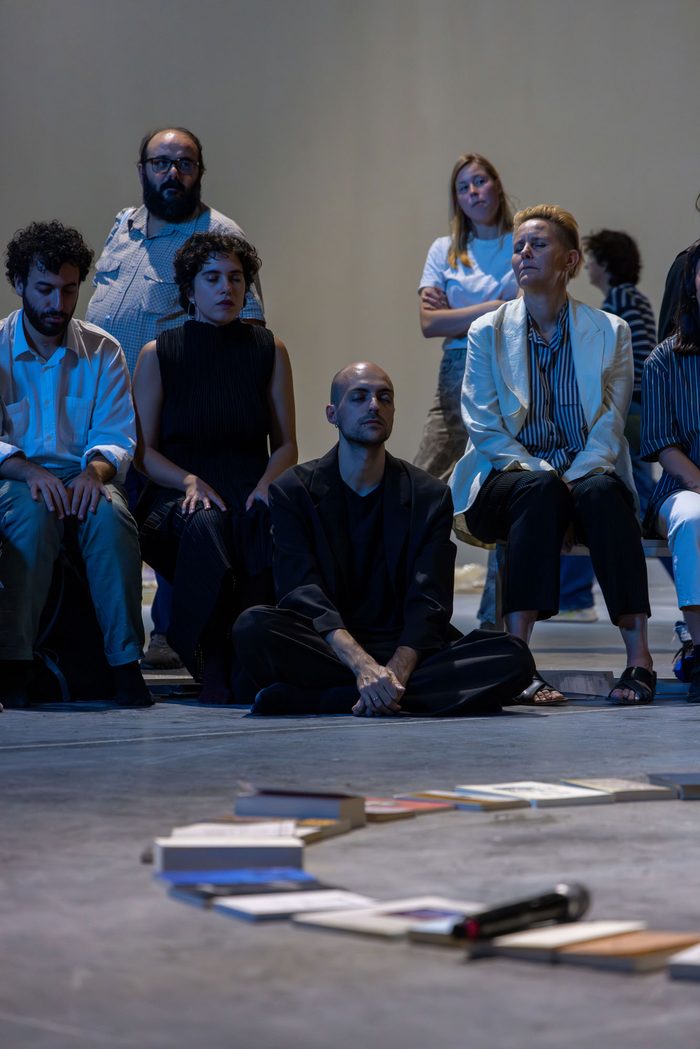
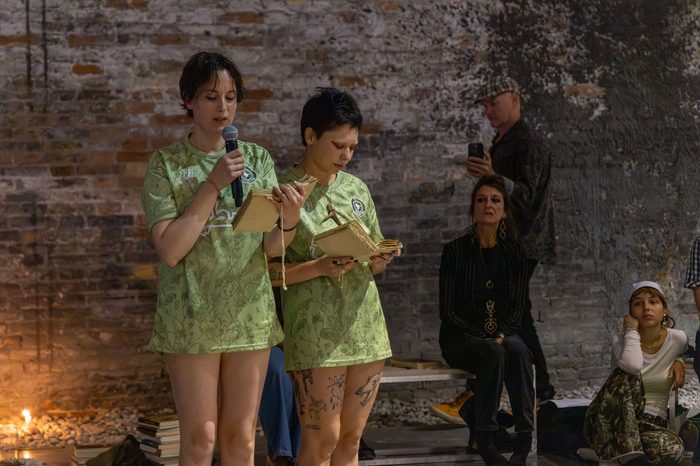
The ritual opens with this letter. At the Tese delle Vergini, the spaces of the Arsenale that host the Italian Pavilion, on September 25, around forty people have just listened to Giulia Currà and Cora Baratti read the letter of the Salotto delle Preziose, while a sheet of paper is being passed around among those taking part in the ritual for them to sign. It is a contract. Seven clauses, each beginning with “I accept”: taking part in a gathering, opening a crack between oneself and the Other, suspending judgment, experiencing the body as a river, accepting eroticism as an inevitable form of magic. At the bottom, two lines establish the pact: “We are not asking you to be spectators. We are asking you to be custodians.”
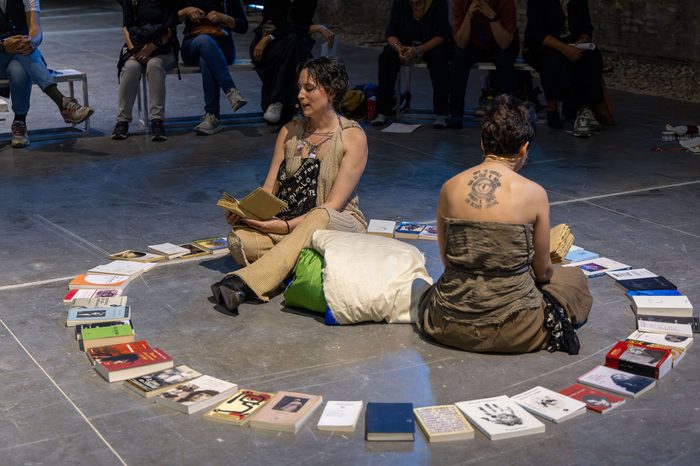
Bibliomancy, the collective ritual that NERO brought into the public program curated by Lungomare for the exhibition Con te con tutto, Chiara Camoni’s Italian Pavilion, curated by Cecilia Canziani, was born from a chain of invitations. Camoni had already invited other artists into her project; the public program conceived by Lungomare’s Angelika Burtscher and Daniele Lupo added another layer; then came NERO, the publisher of the pavilion’s catalogue.
The Salotto delle Preziose was founded two years ago at Casa Cicca Museum, Currà’s house in Milan, as a gathering devoted to magical practices. Tarot cards provided a structure for the meetings, which combined theoretical sharing, Strip Practice, spells, readings, banquet, and potions. The first cycle had opened precisely with bibliomancy, and NERO and Lungomare’s request brought them back to that point of origin. The context changes, but not the nature of what takes place: at the Salotto as at the Pavilion, what happens is a ritual.
“We don’t perform anything,” Currà and Baratti say “We didn’t carry out the bibliomancy ritual because we needed to perform bibliomancy. It is a practice we do every day.” Behind it lies a precise genealogy. The witch who interests them is not the one with the pointed hat and cauldron, but the healer, the midwife, the woman who knows how to cure, a figure whom a long tradition of feminist scholarship, from Barbara Ehrenreich and Deirdre English to Silvia Federici, has interpreted as the target of a process of delegitimization in favor of a male-dominated knowledge. Historiography has partly challenged this interpretation, but it is from here that their act of reclamation begins. Cora Baratti, who devotes her PhD to the political reclamation of the word witch, explains that the word still causes discomfort and raises a wall. For her, the contemporary witch is concrete: “the woman who casts a curse on her abusers because the justice system has done nothing, or their friend who does a tarot reading.”
But this reclamation has also produced its own orthodoxies, and the two artists do not identify with them. In many circles, written and unquestioned rules prevail, a dogmatism that reproduces on a small scale what it originally sought to overturn. Theirs is a deconstruction of deconstruction. Tarot cards and books can be used to blindly trust someone who tells you what will happen over the next six months, or they can be used to talk about yourself and your processes, to challenge beliefs rather than confirm them. The point is not to control reality or to have the absolute answer to a question, but to engage in explorations that shift small things and, through accumulation, concretely alter perceptions. This is why the contract asks participants to question the books without experiencing the ritual in pursuit of an answer. What matters instead is the idea of getting one’s hands dirty with the unknown rather than taking shelter within a system of rules: refusing to reduce the complexity in which we live is also a political position.
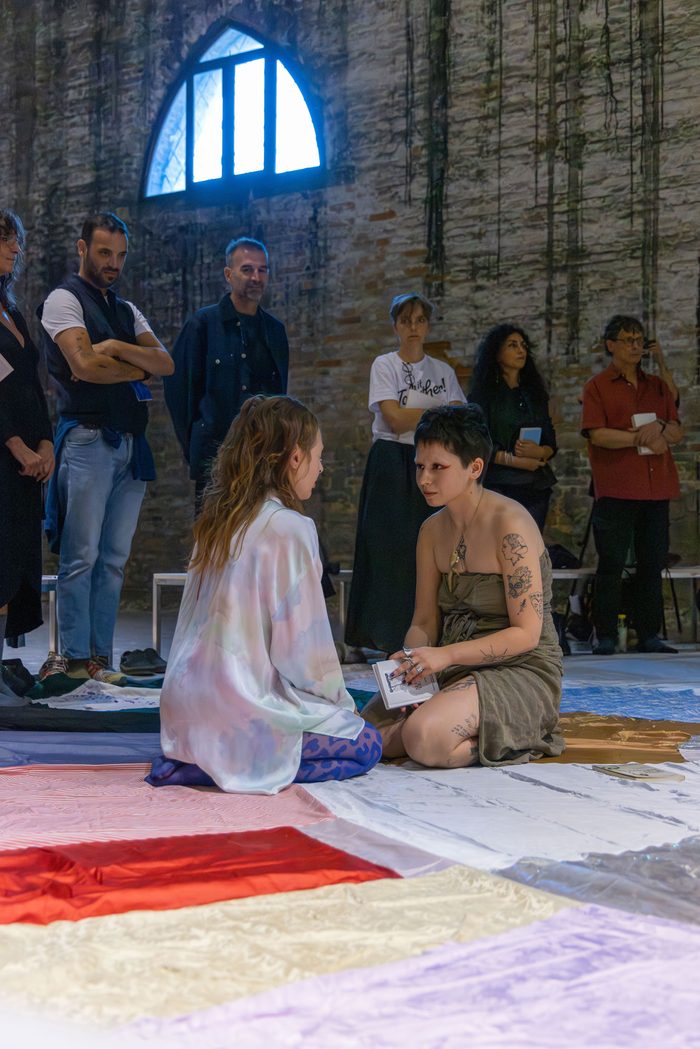
Within the ritual, this becomes another idea of guidance. Currà and Baratti are companions and facilitators: guidance remains, but always leaves open a part that cannot be predicted. It is a process of moving beyond practices in which the person guiding uses their role as a form of power, and it is precisely this model that they want to dismantle: if one speaks of collective knowledge, one must know how to let go. Even missteps become part of the form. There is no such thing as a mistake, they explain, because there is no body performing; there is a body exploring.
The most radical reversal concerns the central moment. People are called one at a time, but the climax of the ritual, which traditionally belongs to the person guiding and delivering the reading, becomes collective: voices overlapping, bodies close together, phrases circulating among everyone rather than an answer being delivered to a single person.
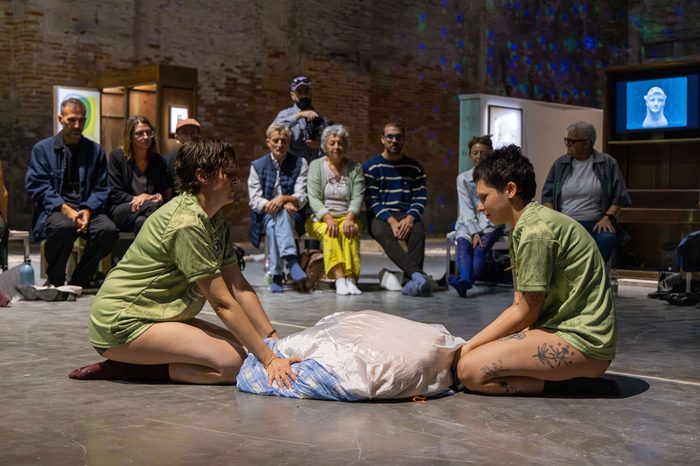
The same trust asked of the participants also sustains the relationship between the two artists. Working as a pair means understanding each other with a glance, but also constantly negotiating roles and moving through small crises. The decisive passage was a trip to Scotland, a land that, Baratti explains, experiences magic as both tradition and political and queer practice, with a freedom that elsewhere requires greater effort. On the Isle of Mull, they wore the clothes that would later arrive in Venice, activating them there. They call it another beginning, a brick laid down: there is never a single beginning, but rather a process. It is matter that speaks, because places and things have their own agency. In this, the ritual touches upon the thread running through the public program, which is attentive to ritual, ancestral forms of knowledge, and other-than-human intelligences, not as a subject to be illustrated but as a practice. Recognizing intelligence in matter, places, and books means shifting the center, ceasing to think of the human as the only acting subject: matter vibrates, sometimes more intensely than we do, and decides for itself. Practicing what one wishes to share means giving real space to the sensible.
The altar, which they reconstruct in every place they arrive and which, at the Salotto, houses their archive, is the starting point for the objects used in the ritual: placing an object on an altar means giving it a different specific weight, even when it is an everyday object that has remained hidden in a home for years. This is why they call the objects of the ritual organs: nothing is ever merely matter. The instrument used during the ritual is a composition of things taken from their homes and removed from their original functions, each carrying an emotional history, such as a broken necklace or some buttons. Wearing the jersey of the Palestinian football team is one of the stages of the ritual: not simply something to wave as a symbol, but a gesture to which time must be devoted. Leaving that presence outside, they say, is impossible.
The thread holding the organs together is that of voices. Of the women tried for witchcraft, no testimonies of their own remain; what survives are the records written by those who prosecuted them. The artists respond to this silencing by filling the ritual with other voices: ancestors, authors they have read, people close to them. This is where bibliomancy changes function. The book opened at random does not provide an answer but reactivates a voice, bringing it out of the page and into the circle. The collectivity of the ritual also passes through this: questioning books becomes a way of allowing authors distant from one another in time to speak together and of giving a genealogy a body. The library consulted for the ritual, comprising around fifty titles, can be read as a constellation: Hildegard of Bingen and Sappho alongside Carla Lonzi, Audre Lorde, and Valerie Solanas; Clarice Lispector three times; Cristina Campo, Antonia Pozzi, Amelia Rosselli, Antonella Anedda, Mariangela Gualtieri; The Lesbian Body by Monique Wittig, Il libro delle streghe by Joyce Lussu, the letters written at midnight by Virginia Woolf and Vita Sackville-West, Derek Jarman’s Blue, Emma Rose Hodne’s Poems Collection. And The Gardener by Marijke De Roover, one of the figures to whom the ritual is dedicated.
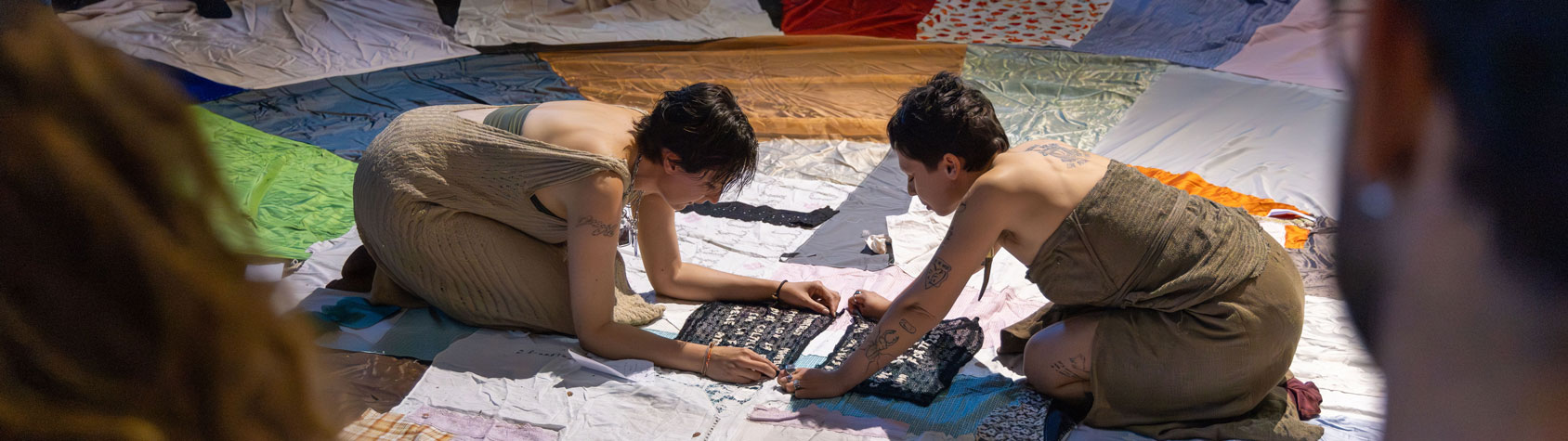
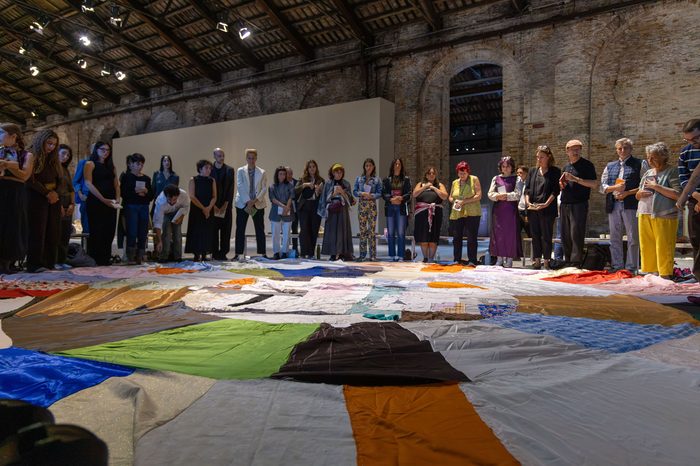
The final organ, the one that ultimately spoke the loudest, is the great cloak. Valentina Angeli, from the Casa Cicca community, already had garments made of copper wire, which became those of the ritual. The artists gathersed different fabrics, some assembled together with the Preziose during the Salotto, and entrusted them to Chiara Bonomi with a minimal instruction: three circles. At the center, the densest compositions, the visceral part; around them, the transparencies; on the outside, a protective circle made of the Preziose’s fabrics, measured according to the people expected to attend.
The final section was assembled in the courtyard of Pinky Rossi, who completed the cloak with embroidery on a piece of lace found in the streets of the Southern Italy. The sound present during the ritual is by Arianna Tomasiello, who works with the sound archive of Southern Italy: an electroacoustic composition of voices, a dispersed archival body. Michele Angiletta and Chiara Romeo followed the process. None of these hands were called upon to execute someone else’s project. They are fragile choices, the artists say, challenges, a step back from control.
At the end of the ritual, the cloak has to be folded. No one asked them to do it, and yet the participants stood up together to pick it up, move it, and wave it. Anyone familiar with performance practices knows how rare this is: usually the audience has to be pushed into action; here, they moved on their own. The two artists looked at each other and let it happen. Out of the seriousness with which everything had been followed up to that point came a moment of collective liberation, joyful and even playful. In almost every Salotto, they say, there comes a point when even the most skeptic person cracks, and from there emerge the most interesting moments, those that no guide could have predicted. At the Pavilion, it happened around the cloak, held up by around forty people who had signed to become custodians.
The Public Program is realized within Padiglione Italia at 61. Esposizione Internazionale d’Arte – La Biennale di Venezia, promoted by Direzione Generale Creatività Contemporanea of the Ministero della Cultura.