
No Genocide Pavilion
at the Venice Biennale 2026
In October 2025, after confirmation of Israel’s inclusion in the 61st International Art Exhibition, the Art Not Genocide Alliance began circulating a letter among participants and workers of the Venice Biennale. ANGA’s call responds to the appeal issued by Palestinian civil society to challenge the normalisation of Israeli apartheid and occupation within international cultural platforms. In this context, the Venice Biennale cannot be exempt from scrutiny. The letter calls on the leadership of the Venice Biennale to exclude Israel from the 2026 exhibition. It has been signed by 232 artists, curators and art workers involved in this year’s Biennale and formally delivered to the President and Board of the Venice Biennale.
How is ANGA organizing in preparation for the upcoming Venice Biennale, and what kind of feedback have you received from the Biennale so far?
ANGA: To date, we have not received any response from the Biennale, and at this point, we don’t expect one. On the 17th of March, ANGA delivered a letter to the Biennale demanding the exclusion of the genocide pavilion. This letter is now signed by 232 signatories, including 18 national pavilions, 104 artists, 38 curators, and 76 art workers.
What does it say about what is considered one of the most important and respected art events in the world that it does not deem it a matter of urgency to address the concerns of the very people who constitute and sustain it?
The extraordinary institutional, political, and diplomatic pressure surrounding the Statement of Intention published by the international jury of the 61st edition of the Venice Biennale lays bare precisely what is at stake when cultural institutions are asked to reckon with the ongoing genocide of the Palestinian people. In recent hours, the Italian Ministry of Culture’s decision to send inspectors, the jury’s subsequent resignation, the readmission of Israel and Russia to the awards, and Minister Giuli’s statement supporting the artist representing Israel all point to an institution shaped by the political agendas of nation-states. Despite its claims of art as a neutral, open field, it appears complicit with those accused of crimes against humanity.
We have been organising for a long time; it’s an ongoing effort, especially when a genocidal regime operating with impunity is welcomed by La Biennale. In Gaza, after the systematic destruction of infrastructure and essential services, Israel continues to exert control and violence. In the West Bank, expropriation and settler violence are intensifying. The expansion of the conflict across the region—from Lebanon to Iran—further escalates an already devastating war. This year’s campaign was sparked by the decision of La Biennale to offer Israel a space within the Arsenale despite the closure of its official pavilion at the Giardini. The campaign has unfolded along two main lines: first, directly engaging participants in this year’s edition to sign a letter addressed to the president and board of La Biennale calling for Israel’s exclusion; and second, building direct relationships with Italian trade unions and cultural organisations.
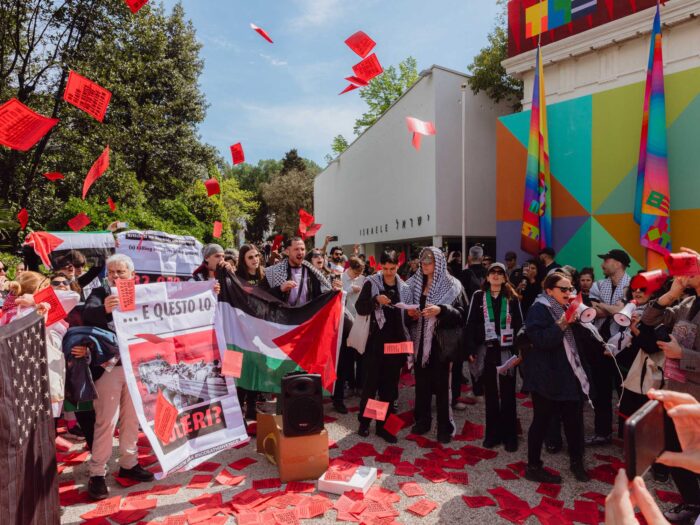
In what broader context does the ANGA campaign position itself? What alliances are you building, and toward what goals?
ANGA brings together people from across the arts and cultural sectors worldwide. Over the past year, we have felt a pressing need to strengthen our alliance with art workers—arguably the most precarious and vulnerable sector within the art world. Among Biennale workers, many find Israel’s presence unacceptable and have expressed deep discomfort at working within an institution that supports the presence of a genocidal regime.
ANGA works in alignment with the Palestinian Academic and Cultural Boycott of Israel (PACBI), grounding the campaign within a broader call from Palestinian civil society. Our aim is not only symbolic refusal, but to contribute to the material isolation of Israel through sustained cultural, institutional, and economic pressure.
ANGA stands with them in rejecting artwashing and the instrumentalisation of culture. Together, we denounce the transformation of La Biennale from a platform of international cultural exchange into one entangled with genocide and the circuits of global capital. At the same time, Italian trade unions have mobilised against the militarisation of the economy, which erodes welfare and deepens already precarious conditions. La Biennale exemplifies this reality in the cultural sector: low pay, insecure contracts, outsourcing, false self-employment, and abuses that often go unchallenged due to weak union representation. It is important to stress that war and genocide are directly tied to our living and working conditions.
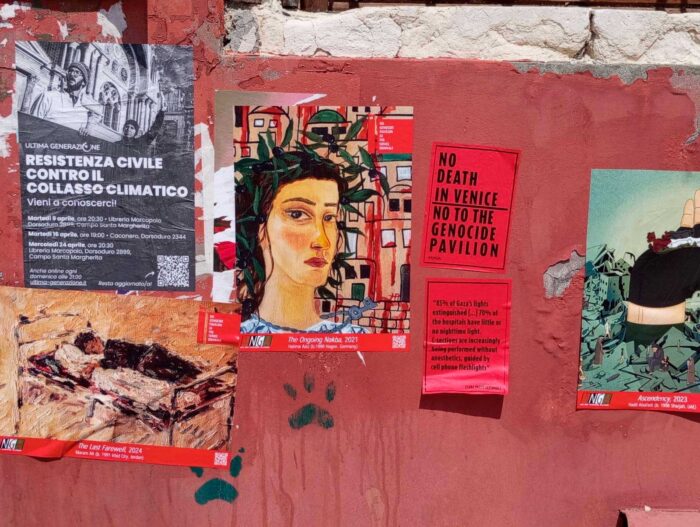
How are you organizing locally?
Local organising has been essential in understanding and navigating dynamics that would otherwise be difficult to grasp, particularly in a context as specific as Venice. We have been working with comrades on the island since 2024. In particular, S.a.L.E. Docks, Biennalocene, and Mi Riconosci have been key allies in sustaining the campaign. This work also responds to the broader dynamic fostered by La Biennale itself, where each year—across both the Art and Architecture Biennale—a large number of participants arrive in the city with little engagement with, or consideration for, the social context in which they are operating.
Is there a call towards any mobilization during the Biennale opening, and what are the demands?
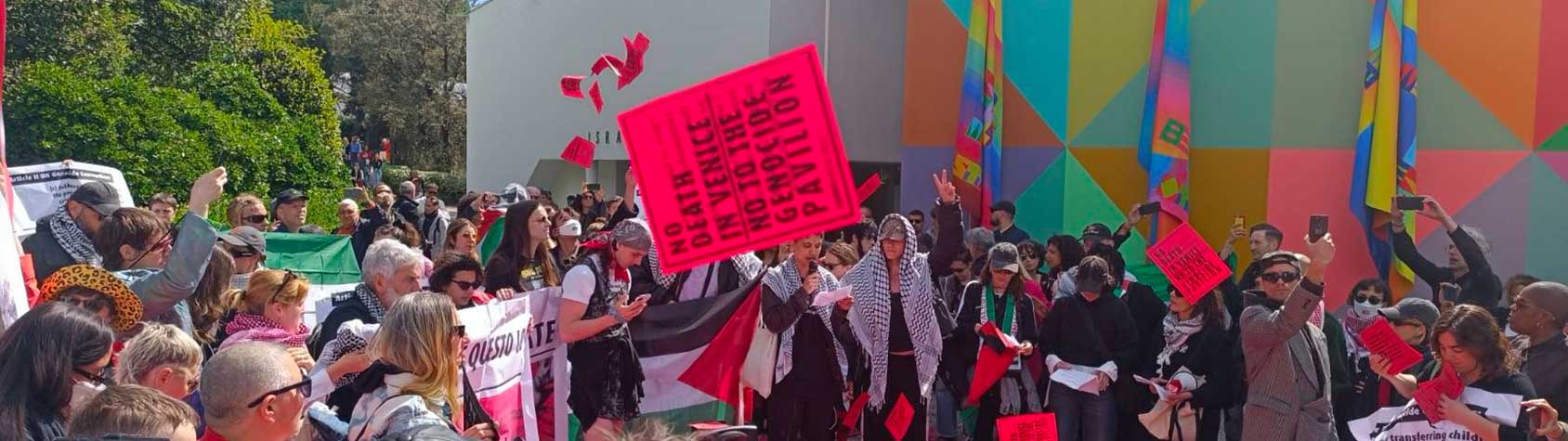
The central action is the strike of the local cultural sector on Friday 8 May, together with trade unions and cultural organisations. We have been working for months on this 24-hour strike, the first ever to occur within the Biennale. It will be a crucial moment, bringing together different constituencies and sending a clear message during the pre-opening days of La Biennale. The strike rejects the normalization of Israel’s presence in cultural spaces and the economies of genocide, while also confronting the precarious labor conditions underpinning the Biennale. These conditions reflect the broader insecurity faced by cultural workers and the resulting lack of agency in asserting their rights. No artist or cultural worker should be asked to share a platform with a state accused of genocide.
The strike denounces the material conditions of our sector: widespread precarity, inadequate contracts, outsourcing, and lack of protection. The same economy that funds war erodes welfare and rights here as well. It is called by Italian trade unions (ADL Cobas, USB, CUB) together with ANGA and Biennalocene. On that day, every worker has the legal right to refuse work and join the strike. ANGA is encouraging Biennale participants (signatory artists, curators, and art workers) to take part by closing their national pavilions and exhibition venues, blocking public access wherever possible. A public demonstration will follow at 4:30 pm, starting in Viale Garibaldi.
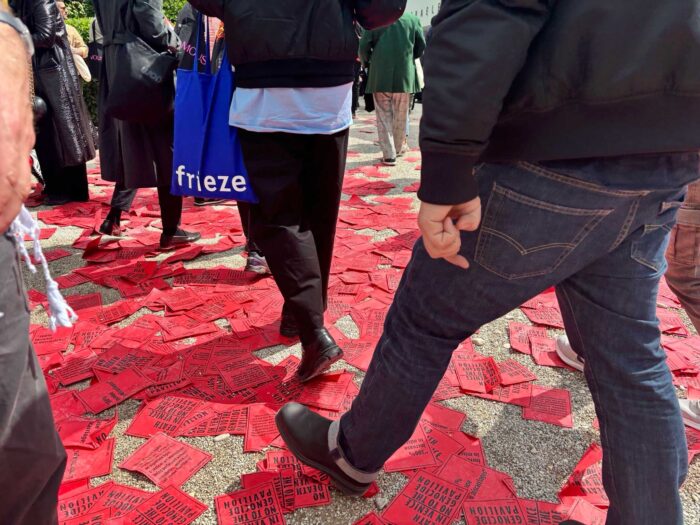
How can audiences join and amplify ANGA’s work?
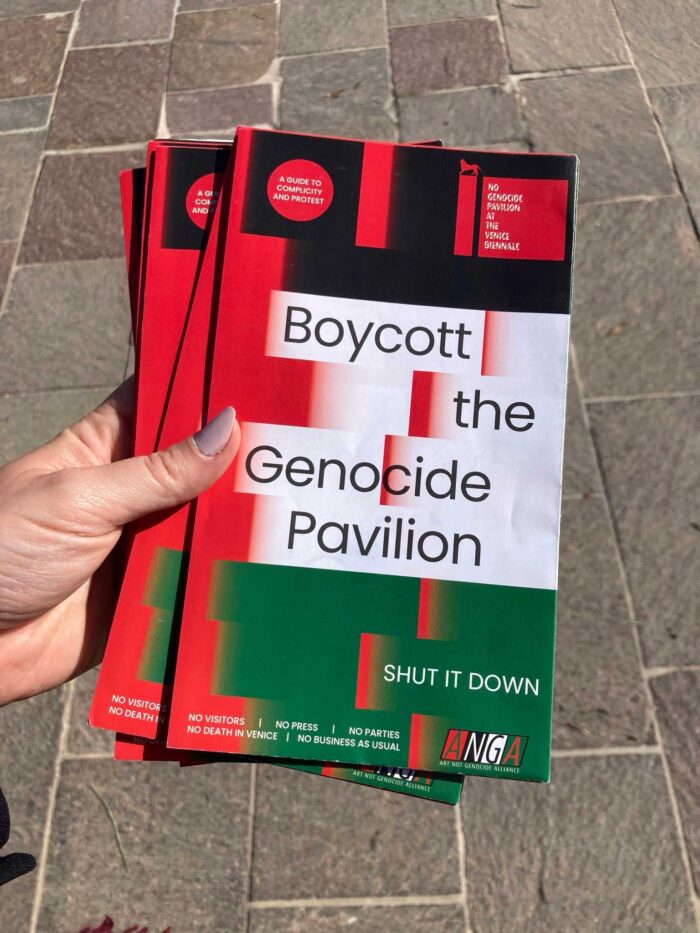
There is strong momentum around the campaign, with growing engagement also in the strike. We are currently producing counter-narrative and protest materials, including posters and statements supporting the demands of the strike, as well as the updated version of the Guide to Complicity to boycott the Genocide pavilion, including information on the complicity of various nation-states in genocide and in the structures of global imperialism; the Venice Biennale’s complicity with genocide; genocidal facts and figures; a history of Biennale protest; Palestine in Venice; a Giardini map of international complicity with genocide; and how we can shut down the Genocide pavilion and stop genocidal art washing. We encourage people to take part in the strike on May 8, refusing to visit the Biennale and to join the demonstration in the afternoon, as well as to follow our social media for updates, and to contact us directly if they would like to get involved or learn more.