


Hijacking Video Games
An interview with Total Refusal
Mainstream video games are among the most dominant cultural forces today. Far from neutral entertainment, AAA titles regularly reinforce neoliberal paradigms-from hyper-individualism and meritocratic myths to systemic depoliticization.
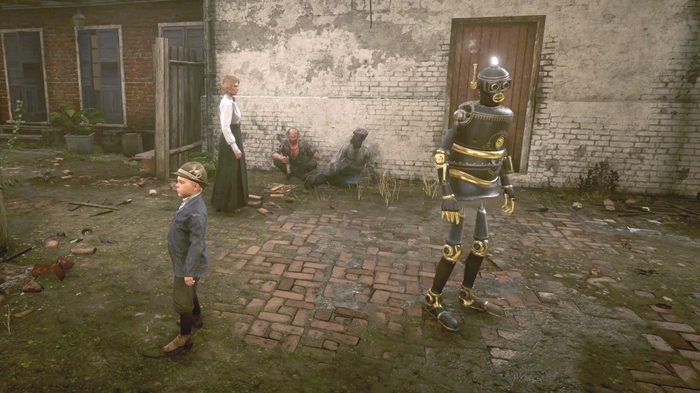
In this talk, Susanna Flock from the media guerrilla collective Total Refusal explores how video games can be hijacked and subverted for artistic intervention. Moving beyond viewing digital worlds as mere backdrops, Total Refusal uses machinima (filmmaking within game engines) to perform artistic counter-play and détournement. Through an analysis of projects like Hardly Working—an ethnographic study of looping, exploited NPCs in Red Dead Redemption 2 and A World At Stake, this lecture demonstrates how misusing virtual spaces can expose hidden labor, digital algorithms, and capitalist ideologies. By shifting focus from the heroic avatar to the marginalized background character, the presentation reclaims video games as sites for critical reflection.
Total Refusal will deliver a lecture on Monday, September 28 at 6:00pm in GG2 – Aula Magna Regina, Guarini Campus, John Cabot University via della Lungara 233 Roma, as part of the DDD Event Series, organized and sponsored by the JCU Department of Communication and Media Studies. This event is organized in joint effort with Re:humanism e Roma Europa Festival.
Make sure to RSVP at this link.
How does mainstream video game culture influence their users? Are video games meant to normalize certain hegemonic narratives, or are “employed” for instance to numb people into normalization of violence?
Total Refusal: Mainstream video game culture, especially blockbuster games (AAA) are functioning as hegemonic signifiers. Because AAA titles are multi-million dollar, profit-driven products, they reflect and naturalize specific class interests and socio-political norms as standard “common sense.”
Rather than explicitly numbing users to normalize physical violence, games function within a broader system of hypernormalisation and pre-mediation. In this framework, militarization, and neoliberal concepts are presented repeatedly until they feel natural and without alternative. Specifically, mainstream games are largely built upon four ideological pillars:
- Meritocracy: frames progress as purely individual effort through leveling, loot systems, and constant personal rewards.
- Militarism: Embeds violence in clean-war tropes, necessity narratives, and the explicit “othering” of enemies.
- Masculinism: Reinforces traditional power fantasies and gendered hierarchies.
- Majestism: Replaces democratic concepts with stories of “rightful rule” and gameplay centered on absolute domination over non-player characters.
These 4 Ms characterize the narrative backbone of almost every big game production, and yet, as they are disguised as part of the gameplay. Games are very good at making these implicit rules invisible while they are actually deeply ideological.
Where does the name “Total Refusal” come from? How and when did you start? How do you operate today and what is your long term horizon?
The artist, researcher and filmmaker collective and pseudo-marxist media guerrilla Total Refusal (Susanna Flock, Robin Klengel, Leonhard Müllner, Michael Stumpf) appropriates and upcycles contemporary video games and writes about games and politics. The collective’s themes are informed by critical game studies and social theory in an attempt to promote and popularize a counter-hegemonic left.
We also gain our inspiration from the gaming communities to practice “agitainment”—a synthesis of agitation and entertainment. By pouring post-Marxist analysis into the glossy world of video games, the collective aims to provide an accessible yet critical examination of mass media and its underlying ideological algorithms. Our work spans films, video art, live in-game performances, texts and educational initiatives. We call our films “Machinifestos”—political manifestos expressed through machinima. By bridging the worlds of academia, art, film and gaming, Total Refusal catalyzes a Marxist critique of society through playful, analytic and humorous practice in order to radicalize its audience.
2018, that’s when we first called ourselves “Total Refusal”, taking inspiration from the anti-war movement and the act of refusing obligatory military training. Total Refusal emerged from the project “Operation Jane Walk”, which was initially conceived as a performance based on playing a video game.
Robin and Leonhard, who founded the collective, are obsessed with architecture. Shortly afterwards, we met Michal Stumpf in the game Company of Heroes 2 and became friends. We were interested in the same topics and games, and we both considered ourselves to be politically minded.
During the pandemics our collective profited from still being able to do projects and that the digital realm grew in importance within the field of art and film festivals. So we doubled our size with taking in Susi and the former members Adrian (until 2025) and Jona (until 2024) .

We take on research-heavy projects so that we and our audience might learn a lot. Humor, political essays and to twist the hyperreal imagery of hundred million dollar blockbuster games has been proven to be the special sauce of Total Refusal. What we do we call agitainment in order to radicalize while entertaining our audience—which we have to admit, for the most part, is already convinced. We are agitators as well as we are passionate gamers and researchers writing papers and teaching in universities. What actually unites us is our radical political stance and gaming and the long history of friendship.
Our goal is to generate our own alternative narratives within these ever-expanding digital worlds. In doing so, we do not alter the structure of the software or reprogram it, but rather artistically exploit it as a resource and reveal its inherent ideology. Currently in production: a feature-length film (Money Is a Form of Speech, shot in The Division 2) and solo projects by individual member Susanna Flock like ORBITING (shot in Star Citizen).
The feature-length documentary Money Is a Form of Speech is a post-apocalyptic “lecture ballet” that explores the connection and incompatibility between capitalism and democracy-filmed in the digital Washington, D.C. of the video game Tom Clancy’s The Division 2. Using the game’s depiction of crumbling architecture along Pennsylvania Avenue between the White House and the Capitol, the film traces the current signs of disintegration, patterns of play, and programming errors within the political and economic system.
ORBITING is an experimental machinima short film shot in the sci-fi game Star Citizen, where avatars go on dates rather than engage in combat. Meeting on space stations, visiting space bars, or floating through extraterrestrial landscapes, their attempt at digital intimacy is doomed to failure-the game engine simply cannot construct genuine closeness. Their programmed movements stay wooden and their gazes empty, creating an unsettling awkwardness reminiscent of modern online dating platforms. Guided by a narrative voice humorously recounting personal dating experiences, the film explores love and sexuality in the dating-app age while revealing the tension between market self-branding, visible abundance versus tangible scarcity, and optimized images versus dashed hopes.
What methodologies do you employ to expose exploitative conditions in virtual spaces?
- Appropriation/upcycling: existing AAA worlds aren’t rebuilt, they’re repurposed, resources, landscapes, physics engines, NPCs.
- Machinima as format, we call the films “Machinifestos” political manifestos made in game form.
- Live performance/lecture-performance staged inside the game.
- “Agitainment”: agitation plus entertainment, to make critical content accessible outside academic contexts.
- Theoretical frame from critical game studies and post-Marxist social theory, applied to concrete game mechanics rather than abstract critique.
- Educational Workshops: Teaching media literacy, game analysis, and guerrilla mini-machinima production.