

Prompt Thinking
Have we gone beyond the need for human philosophy?
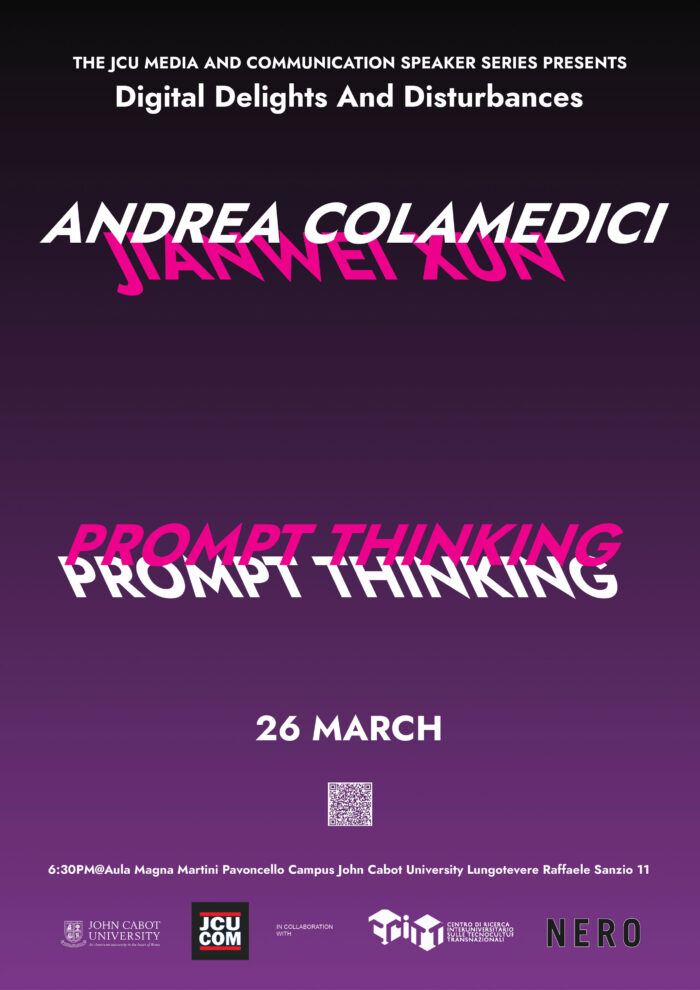
On March 26th, the Department of Communication and Media Studies at JCU welcomed Andrea Colamedici for a lecture on Prompt Thinking, part of the Spring 2026 edition of the event series Digital Delights & Disturbances (DDD). Prompt Thinking explores how artificial intelligence is fundamentally transforming the nature of thought. In the age of generative AI, prompting becomes more than a technical instruction: it emerges as a philosophical practice. This book arises from an experiment with AI in which the fictional philosopher Jianwei Xun sparked global debate by publishing a book about power and perception in the digital age. That book, Hypnocracy: Trump, Musk, and the New Architecture of Reality, was written with the assistance of AI. Rather than casting AI as either savior or threat, Prompt Thinking proposes a third way: conscious dialogue with artificial intelligence as a means to expand critical awareness. The book shows how critical philosophical engagement with AI can produce unexpected insights while preserving intellectual autonomy. Part theoretical framework, part methodological provocation, Prompt Thinking offers tools for navigating cognitive transformation. It proposes an ethics of the threshold, neither rejecting technological change nor surrendering to it.
The DDD Event Series is organized and sponsored by the JCU Department of Communication and Media Studies.
“History always repeats itself three times: the first as tragedy, the second as farce, the third as trance.”
“In 2024 I invented a Chinese philosopher named Jianwei Xun. Le Monde, El País and Libération reviewed his book. When the hoax was revealed, it demonstrated the thesis: we live in a regime that operates directly on consciousness. Co-written with Claude and ChatGPT as critical interlocutors.” Italian philosopher Andrea Colamedici’s revelation turned heads in the world of philosophy, and led to a series of uncomfortable questions arising: Have we gone beyond the need for human philosophy? If the works of Jianwei Xun, a phantom philosopher generated through the use of ChatGPT and Claude, can end up in publications and various studies around the globe, where does authenticity still factor in? Have we moved beyond the need for the “real”? Andrea Colamedici’s concepts discussed in his works Hypnocracy and Prompt Thinking explore this relation between humans and AI. With these constantly evolving generative AI systems becoming increasingly pervasive in daily life, Colamedici and Xun provide a unique insight on the philosophy behind these apparatuses through the perspective of human and machine.
Hypnocracy
Society has entered a new regime of power, in which the traditional western-centric neo-liberal school of thought has been stomped out, and what stands tall today is what Xun calls Hypnocracy. If authoritarianism rules our bodies, and totalitarianism rules our minds, then hypnocracy rules our ability to determine what to think. The new ruling class of tech elitists (Thiel, Karp, Zuckerberg, Musk, etc.) has effectively created an ownership structure that shapes our desire to think, and what is thinkable. The systems in place have been crafted and engineered to keep us engaged through an endless creation of events, in which everything and nothing is happening simultaneously. Colamedici argues that traditional political analysis of this power structure is ineffective and useless, as the means of analysis have been greatly outpaced by innovations in technology and power. Political analysts and international law are left grasping at straws while our new ruling class ushers in more measures of hypnocratic methods of control.
Prompt Thinking: Critique of Generative Reason
“If Hypnocracy is the diagnosis, Prompt Thinking is the navigation method. The book proposes a new discipline: the art of formulating questions that generate thought, not just answers.” Colamedici articulates that AI has fundamentally changed the nature of thought. Companies have spent and made billions in order to create AI systems better at delegating tasks, using users’ cognitive labor to generate more detailed, “human” responses to prompt. Thinking has been made to seem obsolete, as thought in the GPT era has been rendered to be too expensive and slow to be rational. However, Colamedici argues that AI does not replace human intellect, as long as we maintain our critical stance. He emphasizes this idea of AI only being as good as we make it. Generative AI as a technology isn’t inherently “good” or “evil” but users must remain vigilant in the way in which balance is maintained between the concepts of elevation and exploitation. Colamedici highlights the fact that generative AI should not be used to replace human thought but holds the agency to elevate our own ideas and concepts to a higher level.
This co-creation of thought leads to what Xun calls the Oversubject: a thought that humans can’t produce alone, and the system cannot make it alone. While both parties are transformed through this exchange of information, the question of agency is brought forward. If work comes from both human brains and generative AI prompts, to whom does the dialogue belong? This Oversubject does not truly belong to any singular party. It is independent, created in the gap between machine capability and human intellect. The Oversubject is not a sum, but rather is the product of the tension between the two.
These systems are repurposed as an exoskeleton by some, leading to a phenomenon described by Xun as cognitive atrophy. As generative AI systems strengthen their chokehold on younger generations, it becomes fundamental to educate the youth in how to critically think, and use these tools to boost educational prowess, just as we have learned to use the internet. The greatest risk according to Colamedici, is for us to lose our will to think. If we have lost the ability to know how to think, and more so know why we think, then we have lost what it means to be human. These systems hold us over a delicate seesaw, with the stakes being putting our minds to sleep, or to wake us up. It is as if we are falling from the sky and must build our own wings before we land. What artificial platforms fail to do is to create new illusions for us, shattering what we assumed to be everlasting and “normal.” Illusions have been the backbone of our society, and democracy has always been the greatest illusion of all. What reality is now being produced by generative systems? Who and what is missing from said reality? Colamedici tries to explain the human emotion behind these phenomena by turning to Freud’s concept of narcissistic wounds. Copernicus told us we’re not the center of the universe, Darwin told us we weren’t molded by an all-knowing creator, and now generative AI shows us we are not special. No longer are humans the only thing capable of writing poetry, playing the guitar, or painting a masterpiece. We no longer are in sole possession of what we believed to be fundamentally human, nor are we the best at it. This should be an opportunity for humanity to thrive, with our own abilities being augmented by machines to create works previously deemed unimaginable. However, the looming threat of ownership hangs heavy over this potential augmentation. To unlock the full potential of generative AI systems, Marx’s cries of liberating technology from ownership rings true.
Colamedici keeps a more optimistic outlook on AI than most. At the end of the day these systems are here to stay, and it is the sacred duty of us, the cognitive thinkers of today, to use these systems to not simply exploit our intellectual property, but to supplement our own competency. If a man and machine pairing such as Colamedici and Xun can create profound works such as these, then the opportunities granted to us through AI open the gates to a new era in human thought and philosophy.