
Escape Room
“How may I continue to be a National Pavilion when my nation is fighting itself?”
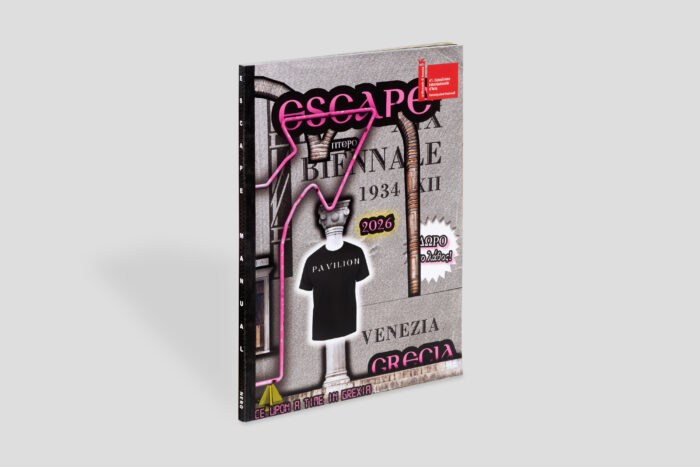
Escape Manual is Andreas Angelidakis’ exhibition catalogue accompanying Escape Room, his immersive installation for the Greek Pavilion at the 61st Biennale di Venezia. The book presents an elaborate visual archive of the artist’s research and sketches, featuring original collages and texts, where the research is queered into a personal narrative articulated through the perspective of Grecia, the pavilion personified.
“Benito had heard so much about Adolph. As a German, Adolph was more reserved, but he was excited too. He was dying to impress Benito with his staggering election results. Benito didn’t even blink.” June 1934: Hitler and Mussolini met for the first time in Venice, whilst a small pavilion, designed to resemble a Byzantine church, made its debut at the Giardini della Biennale. The paragraph above does not come from a camp historical novel, although it might well have done: it comes from the official catalogue of this year’s Greek Pavilion, that is the living—and talking—memory of that debut.
Ninety-two years on, the pavilion is still there, and the world for which it was built is going up in flames: forty-three degrees in Athens, the Acropolis closed to the public during the hottest part of the day, tourists fainting in queues with their phones in hand, antiquity having become the most booked trap on the planet. Athenian, educated at SCI-Arc and Columbia, an architect who, by his own definition, does not design buildings, Andreas Angelidakis has taken note of the situation, and the pavilion has been transformed into an escape room: classical columns slumped to the floor like pouffes, a dance floor in place of the white cube, no exit in sight. The exhibition’s equation: the nation, the pavilion, Plato’s cave and the escape room are one and the same—rooms in which you are locked away with a riddle you did not choose, mistaking the shadows on the wall for reality. Angelidakis does not believe in national pavilions, after all: he regards them as late-19th-century foreign policy disguised as art. The catalogue is called Escape Manual (NERO, 218 pages, 35 euros) and is, quite literally, the instruction manual for the trap.
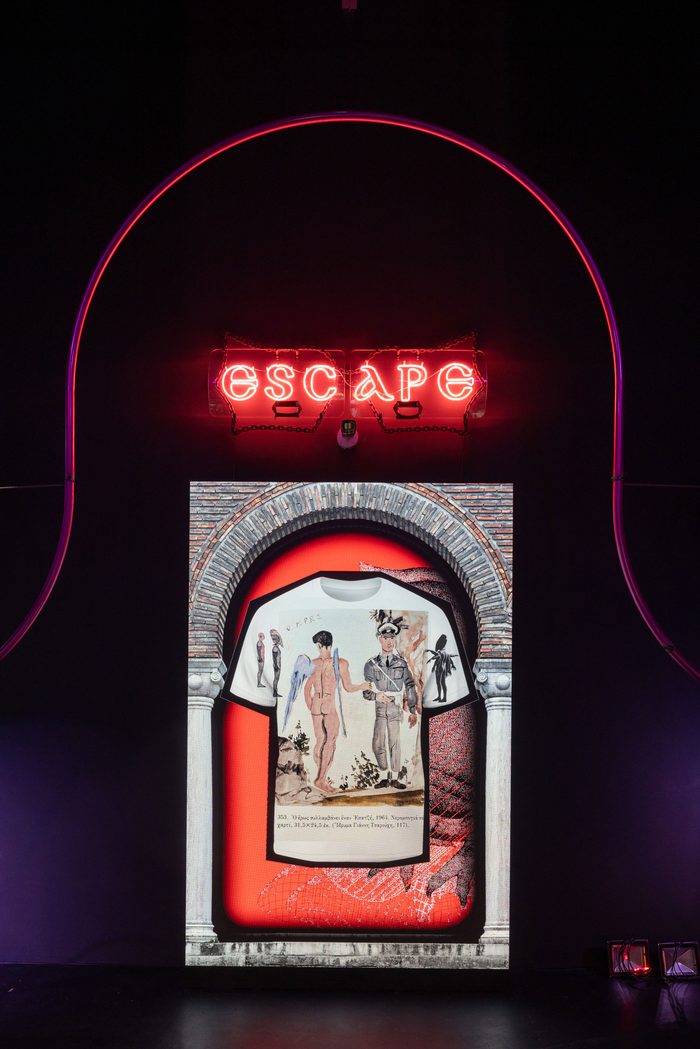
The central concept: the book gives a voice to the building. It is called Greece, is female, and recounts her own life as if in a children’s book, with the high-pitched voice of a Pixar character, an audio guide in the throes of a nervous breakdown. It stems from a barter deal—Italy builds the pavilion in Venice, Greece reciprocates with a school for nuns in Athens—and immediately asks the right question: “Why are all other pavilions white and smooth, and I have skin made of stones?” Her architect reassures her: “White is the Fascist Fashion, Ancient Rome with a Renaissance Filter. You, my dear, will be the only Byzantine pavilion;”—because “Byzantium for Greece was like the Renaissance for Italy: The closest moment in history when they were great”—and with that look, who knows, she might even become the prom queen of 1934. Then came the ultimate consolation: “It’s gonna be ok, just imagine you are a country. That’s what all the other pavilions are doing.”
From there, the fairy tale spans the century, blending invention and archival material in every chapter. January 1946, as Greece slips into civil war: Greece writes to her beloved Sister, the Casa d’Italia in Athens: “How may I continue to be a National Pavilion when my nation is fighting itself?”, and underneath, in tiny letters: “If Greece wins against itself, do I wear black?” The years of the dictatorship: the end-page illustrations from a genuine gymnastics textbook, rows of identical children with outstretched arms, regime exercises that resemble a chorus of salutes; and in the middle, a child, in blue ballpoint pen, has drawn a deer. 2017, Documenta moves to Athens: Greece writes to the curator Adam Szymczyk to ask him whether a building can ever be “National” (P.S.: “I’m a neighbors with Poland, she also investigates herself often.”) 2018: the memorial for Zak Kostopoulos, a queer activist murdered in Athens, alongside T-shirts featuring Tsarouchis’s *Eros* (1964), in which a man in uniform is being arrested. Today: a screenshot of a chatbot cheerfully summarising The Story of Ferdinand the Bull, the pacifist bull banned by Franco, and Greece rewriting it for itself: “Once upon a time there was a small pavilion and it was called Greece.”
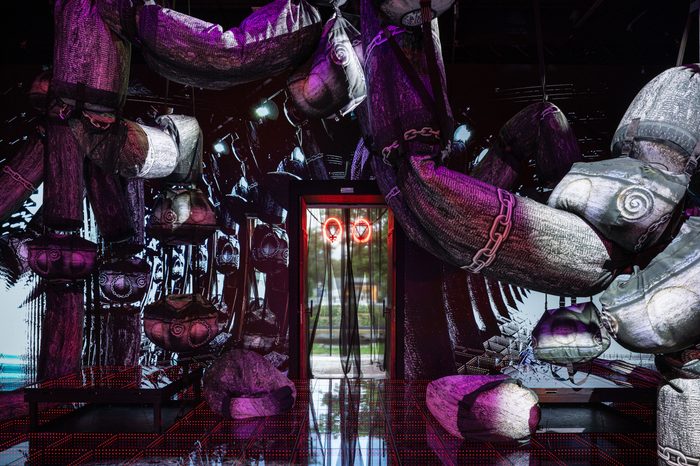
The thread linking it all is a single thesis: classicism has never been a taste, it has always been a programme. From Mussolini’s “Case d’Italia” (“Fascism cosplaying as education”) to Metaxas’s Third Hellenic Civilisation, right through to the marble renderings in the “Trump Gaza” video—genocide recycled into luxury property, clean lines, radiant light. Those who promise to make antiquity great again, yesterday as well as this morning, are always selling something else.
And the way out? There isn’t one. The most beautiful double-page spread in the book features Byzantine arches nested within Byzantine arches, leading to a blind vanishing point: heritage as a corridor with no door at the end. Close the manual and you’re still in the room; the room is the pavilion, the pavilion is the nation, the nation is a story, and this summer that story is sold out and ablaze. Then you step out into the Giardini, onto the lagoon, and the escape room continues by other means: an admission ticket, a set route, rising water. The only reliable map is that of the deer drawn in blue ballpoint pen by a child across a whole page of raised arms. Follow it.
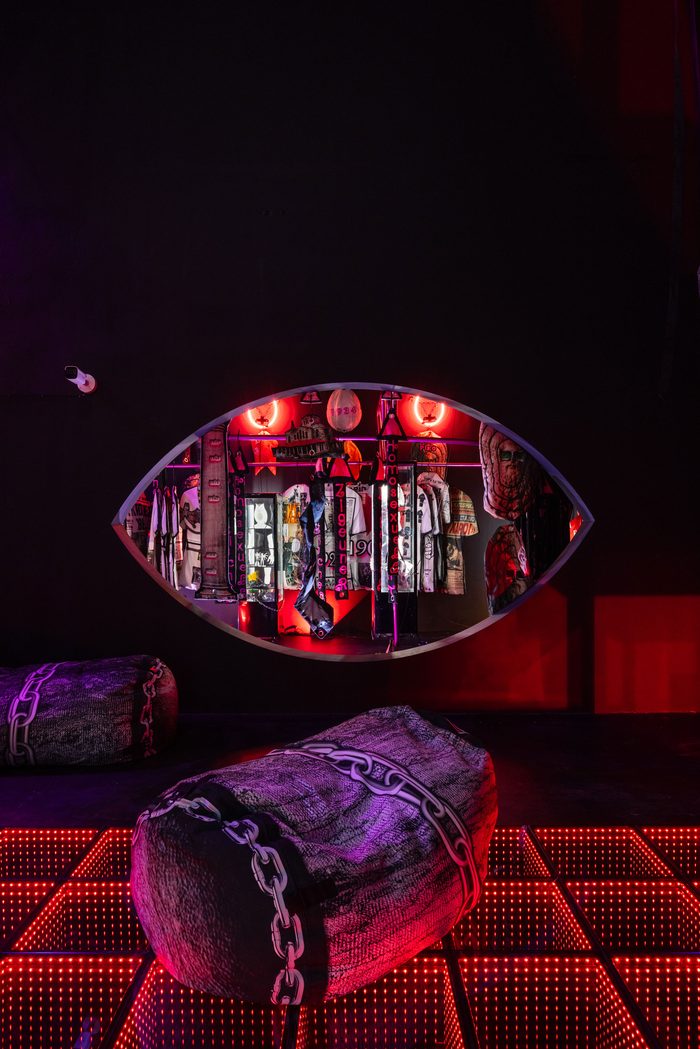
Escape Manual is the exhibition catalogue for Andreas Angelidakis’ exhibition at the Greek Pavilion of the 61st Venice Biennale (2026).
Editorial Team: Ioli kavakou, Andreas Angelidakis, George Bekirakis. Design: Oddd Studio / Em Kei
Publihed by NERO