
Forever Informed
Deciphering Phantom Subjectivity
In November 2024, I was a resident invigilator of the Vigil Workspace in the Cyprus Pavilion at the Venice Biennale. This Vigil Workspace was integrated within the exhibition On a wildflower-lined gravel track off a quiet thoroughfare…, reconfiguring the labour of invigilation—a seemingly passive art world gig—into an active motor of the project. Along with the exhibiting artists, invited researchers and practitioners were prompted to hold a space of remembrance, reflecting on bodily presence, rituals of vigil and the politics of remaining vigilant today. This labor was directly connected to the show’s premise, which conceived ghosting as a paradoxical act of withdrawal and persistence that calls for a recalibration of perception in order to address the turmoil caused by the revenants of historical injustices. During my residency, I spent time welcoming the guests and engaging with the works in the after hours. Two years later, the following paragraphs present a brief reflection that develops the themes of spectrality and vigilance, considering spectrality through Mattin’s notion of “phantom subjectivity” [1] and vigilance through Hayles’ concept of “non-conscious cognition.” [2]
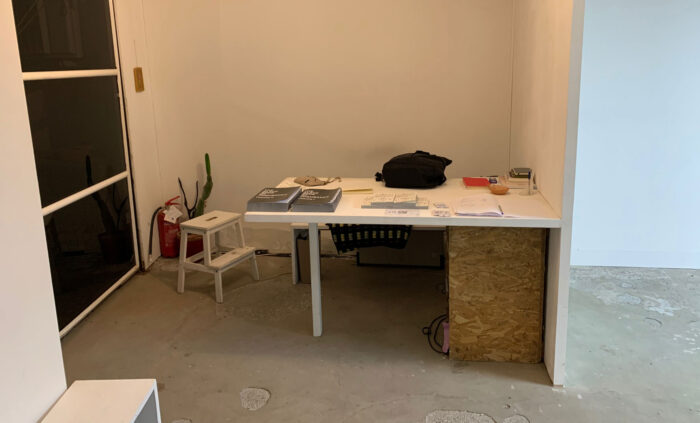
It all begins at my invigilator’s desk, in a time out of joint. On the table are the two volumes of The Black Book of Pushbacks, by the Border Violence Monitoring Network, former residents of this Vigil Workspace. [3] Next to them are several copies of the publication On a wildflower-lined gravel track off a quiet thoroughfare… (also the title of show), a guest book, and a candle. To my right, a small painting with a rose carved inside. Opposite is an empty bench reserved for those who come to do community service at the Associazione Culturale Spiazzi, and a pattern of polished ware on the wall. Some visitors have asked me if all this is also part of the exhibition. I didn’t know how to answer. Emiddio Vasquez, one of the artists, has suggested that I contribute a response to the pavilion as a revenant, approached more as an autofictional account. I take a seat and begin to write. I’ll do it in English, even though I usually write in Spanish.
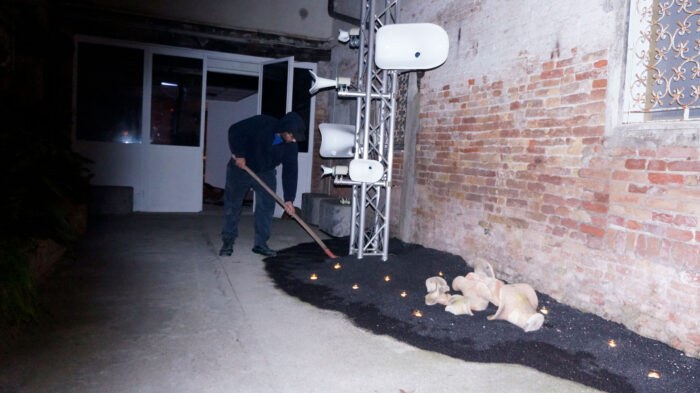
As an alternative to the disenchantment regarding the significance of contemporary art’s claims to reality and political transformation at the 2024 Venice Biennale, and as a complement to other reviews that have focused on the issue of Palestine and provided an overview of the Cyprus pavilion and its curatorial background, [4] my departure point is a single aspect of On a wildflower-lined gravel track off a quiet thoroughfare…: the fact that the pavilion took the form of a shell agency called Forever Informed. This parafictional device was materialised through a website, [5] a slogan—“smart solutions to weak signals”—, the piece LED Screen (Forever Informed, 2024), [6] and the different spaces of the exhibition: the reception, which operated not only as a welcoming area for visitors, but also as an information collector; the office, with a severed cable leaks out of a missing ceiling tile, channelling the undulating tones of water and wind travelling through pipes that peer in from the outside canal; the thoroughfare, with horn speakers diffusing high frequencies recorded across sensitive locations in Cyprus; and SOUNDR*, a dark cross-section of transmissions from Cyprus and Lebanon, named after Sounder, a codename for a joint British/American surveillance station in Cyprus which has been revealed as a key site for mass communications monitoring and interception in the Middle East. But the spectrality and vigilance that I am interested in addressing here are not exactly identified with the frequency range in which covert acts of espionage and surveillance are carried out from Cyprus, nor with the clandestine operations, transmissions and intelligence interception across the wider region. Rather, it has to do with sharpening self-perception as a necessary step for anyone who wants to reconstruct their cognitive cartography.
Forever Informed points in a different direction than works such as those by Trevor Paglen or Niklas Maak. [7] In the case of the Cyprus Pavilion, it was not a question of making the hidden infrastructure of surveillance visible or disclosing the opaque architecture of power, but rather engaging in a practice of deciphering, as Sylvia Wynter has characterised it: the revelation of rules governing structures that establish oppressive, discriminatory or alienating conditions while promoting a liberal idea of the subject and society. [8] So the deciphering by Forever Informed is not so much about revealing secrets as it is about getting involved in detecting hidden contradictions or illusions in the modes of access to social and individual reality. In this sense, deciphering requires a specific attitude of vigilance: not the espionage carried out by intelligence services in control societies, but rather an exercise in questioning the ways in which our self-perception is constituted. And it is at this point that the type of spectrality on which I want to focus begins to appear.
Forever Informed’s gesture of transforming the entrance to a pavilion at the Venice Biennale into a customer reception area in a para-fictional shell agency dedicated to gathering and processing information, placed visitors in the position of someone who wants to decipher something, something related with spectrality and vigilance: the statement of the exhibition was to “sidestep the superstitious provenance of ghosts to consider the present socio-technical and material forms of ghosting”. Here LED Screen, the only work in the show authored by Forever Informed, offered the following key to unpacking our argument. This LED display was fitted onto the pavilion’s façade and remained lit throughout the whole Biennale, instigating questions of vigils from a more digital/computational perspective and doubling down on the “forever” of Forever Informed. The screen featured fragmented scenes from a 2019 Forbes documentary with footage granted by “exclusive access to spy-tech dealer Tal Dilian and his $3.5 million to $9 million van, which he claims can intercept WhatsApp messages and spy on people’s locations.” [9] Dilian is a former commander-in-chief of the Israeli Defence Forces’ secret technology unit and CEO of the spyware company Intellexa, which was implicated years later in the Predatorgate scandal. In the documentary screened, Dilian shows his black van in Larnaca, Cyprus, and what his agency does: “It’s more than hypocritical to say, ‘Oh, it’s not right to use Trojans’; No! It’s not wrong to use Trojans, or Wi-Fi interception, or GSM interception, or switch interception; none of those who say ‘it’s not right to use this technology’ want to live in a neighbourhood without all these systems around them protecting them from crime, drugs and terrorism.” But this statement encapsulates the kind of fallacious self-perception that Forever Informed calls for denaturalising.

In his book Social Dissonance (2022), Mattin theorises the concept of “phantom subjectivity,” which characterises the self as a neuro-computationally generated illusion and considers the manifest image of the person and its phenomenological experience as a phantasm: “The model of selfhood gives us a phantom sense of subjective agency that comes from a reification of first-person experience which in turn renders opaque the possibility of understanding the complex mechanisms that produce this reification. […] Phenomenal experience is based on an activation of consciousness that triggers the processes for the generation of the illusion or phantomaticity of selfhood. Phantomacity here means that it is not substantial, but counterfactual, a kind of projection simulating a sense of nowness and ownership.” [10] Phantom subjectivity “has to do with the way in which biological systems produce self-models in order to cope with the exorbitant costs of processing information in their environment […] the self-model is a kind of navigational instrument generated by subpersonal processes, a ‘user interface’ generated by our brains. Because we don’t have access to the mechanisms that produce this illusion, we cannot help but experience the self-model as a foundational reality.” [11] In a similar train of thought, Katherine Hayles has argued in her book Unthought that “consciousness is not the whole of cognition, and that nonconscious cognition is especially important in environments rich in complex information stimuli.” [12] Neuroscientific research over the last two decades has studied these essential functions performed by non-conscious cognition, of which non-brain cellular memory analysed by Nikolay Kukushkin and Thomas J. Carew is one of the most recent examples[13]. This is how Hayles lists the essential functions of non-conscious cognition: “integrating somatic markers into coherent body representations, synthesizing sensory inputs so they appear consistent across time and space, processing information much faster than can consciousness, recognizing patterns too complex and subtle for consciousness to discern, and drawing inferences that influence behavior and help to determine priorities.” [14] In this sense, it could be said that the most important human cognitive function is to prevent consciousness from collapsing due to the internal and external information flows that reach the brain every millisecond.
Hayles proposes her theory of non-conscious cognition as a means of guiding action, as an appropriate framework for discussion in contemporary ethics. This claim, together with that of not falling into an anthropocentric position, leads the American philosopher to place cognition at the centre of the debate on human-technical assemblages, defining it as follows: “Cognition is a process that interprets information within contexts that connect it with meaning.” [15] Following the publication of Unthought, Hayles has acknowledged that this definition is incomplete and, in her most recent work, Bacteria to AI. Human Futures with Our Nonhuman Symbionts (2025), she has added some criteria for something to be considered a cognitive system: perceiving, interpreting, responding flexibly, anticipating and learning. In this sense, cognitive systems, both human and technical, make choices and decisions, and to that extent are responsible. If this characterisation is accepted as a premise, the utopian potential of cognitive assemblages would lie in their ability to establish desirable relationships, constructive dynamics and sustainable connections in socio-ecosystems. The political hypothesis of Unthought is an argument in favour of cognitive technosymbiosis, of structures, flows and functions that are complementary rather than exclusive, and cooperative rather than competitive, in human-technical cognitive assemblages. In my view, Hayles’ theory provides an appropriate framework for discussing the ethics of the present socio-technical and material forms of ghosting considered in On a wildflower-lined gravel track off a quiet thoroughfare… One of the contributions of Forever Informed is to provoke this ethical-aesthetic discussion, rather than cancelling it out, as Intellexa does.
On the other hand, the question of how the “unthought” prevents the collapse of consciousness also ties in with the notion of the self which Hayles constructively revisits. If we apply to the realm of human consciousness the critical principle that identifies the formal contradiction at the heart of a work with the problem that the work seeks to resolve, we could say that the form of the self characteristic of our historical moment is articulated from the contradiction constituted by the processes of ego infatuation—narcissism, supremacism, neoliberal fantasies of individuality and self-realisation, etc.—and its annihilation—depersonalisation disorders, dissociative pathologies, identity crises, character corrosion, etc. In this sense, Hayles’ theory points in a different direction in relation to contemporary processes of self formation, offering an alternative to the aforementioned polarities: “The anthropocentric bias for which humans are notorious would not be possible, at least in the same sense, without consciousness and, even more so, the impression of a reified self that higher consciousness creates. The same faculty that makes us aware of ourselves as selves also partially blinds us to the complexity of the biological, social, and technological systems in which we are embedded, tending to make us think we are the most important actors and that we can control the consequences of our actions and those of other agents.” [16] This entire characterisation of non-conscious cognition allows us to consider Forever Informed’s activity under a new light.
The reifications that arise from phantom subjectivity produce a condensation of selfness, a personification that tries at all costs to avoid exhibiting its porous, fragile and unstable character, and its dependence on unthought cognitive operations. My reading hypothesis, then, is to understand Forever Informed as a metaphor for these non-conscious cognitive processes. Moreover, by evading the retreat into a positivist framework of reality, the spectrality of Forever Informed would constitute the material condition of possibility for a questioning of our self-perception that operates in a contrary manner with respect to the fabrication of alternative facts and pseudo-mythological narratives by colonial and financial powers in Cyprus. This is not an affirmation of reality in the face of denialist or fake positions, but rather a critical fabulation that enables one to conceive new modes of self-perception, individual and collective. In this sense, returning to our departure point, the utopian horizon pointed to by Forever Informed is a form of vigilance that can act on the perceptual limitations related to the alienation of phantom subjectivity: it refers to a denaturalisation of self-perception that makes alternative self-perceptions possible, being a constituent praxis. What would happen if we fully accepted that our self-perception is determined by processes of information gathering and processing that are completely hidden from us, and we set out to decipher them? Revisiting Forever Informed’s Cyprus pavilion from the 60th Venice Biennale signals possible ways of answering this.

After closing the doors to the rooms, when visiting hours have ended and the sun has set, I wander around inside, stopping in front of and spending time with each work, trying to decipher them and speculating on the possibility of transposing the phantom subjectivity of Forever Informed to my own condition as an invigilator. I reflect on the contradiction between contemporary processes of ego infatuation and their breakdown. I imagine the ghost that emerges from the death of that model of the self. I sense it walking along a wildflower-lined gravel track off a quiet thoroughfare…, carefully, without denying intimacy in favour of empiricism, or desire in favour of suffering. And in the midst of darkness, reflecting on the even darker state of the world, I begin to sing:
I go to sleep
But sleep doesn’t come to me
I’m bored of long nights, yet I stay up
I put my face up against the night’s
Looking out for dusk, but it doesn’t come
How am I supposed to go to sleep when I am in this state?
O Heart…
Heart wrapped around a dagger
I pull eyelash to eyelash, it’s of no use,
I cannot close my eyes [17]
[1] Mattin, Social Dissonance, Urbanomic, 2022, p. 107-146.
[2] N. Katherine Hayles, Unthought, The University of Chicago Press, 2017, p. 9-40.
[3] Hope Barker and Milena Zajović, The Black Book of Pushbacks, Volume I, Border Violence Monitoring Network, 2022.
[4] See, respectively: Dean Kissik, “The Painted Protest. How politics destroyed contemporary art”, Harper’s Magazine, December 2024https://harpers.org/archive/2024/12/the-painted-protest-dean-kissick-contemporary-art/; Lamia Abukhadra, “On Which Side Of The Screen Lies The Ghost?”, Mizna Online, 2025: https://mizna.org/mizna-online/on-which-side-of-the-screen-lies-the-ghost/; Giulia Crispiani, “A Quiet Thoroughfare”, Nero, 23 January, 2025:https://www.neroeditions.com/a-quiet-thoroughfare/; and Alessandro Cazzola & Forever Informed, “On a wildflower-lined gravel track. A conversation with Forever Informed”, Nero, 14 February, 2025:https://www.neroeditions.com/on-a-wildflower-lined-gravel-track/
[5] Forever Informed is a parafictional shell company created by Lower Levant Company (Peter Eramian, Emiddio Vasquez), Endrosia Collective (Andreas Andronikou, Marina Ashioti, Niki Charalambous, Doris Mari Demetriadou, Irini Khenkin, Rafailia Tsiridou, Alexandros Xenophontos) and Haig Aivazian. See the website:https://foreverinformed.com.
[6] Seehttps://foreverinformed.com/led-screen.
[7] See Trevor Paglen, “Overhead: New Photos of the NSA and Other Top Intelligence Agencies Revealed”, Creative Time Reports, February 10, 2014: https://creativetimereports.org/2014/02/10/overhead-new-photos-of-the-nsa-and-other-top-intelligence-agencies-revealed-trevor-paglen/; and Niklas Maak, Server Manifesto. Data Center Architecture and the Future of Democracy, Hatje Cantz, 2022.
[8] Sylvia Wynter, “Rethinking ‘Aesthetics’: Notes towards a Deciphering Practice” in Ex-iles: Essays on Caribbean Cinema, African World Press, 1992.
[9] Thomas Brewster, “A Multimillionaire Surveillance Dealer Steps out of the Shadows . . . and His $9 Million WhatsApp Hacking Van”, Forbes Magazine, 9 March, 2020:www.forbes.com/sites/thomasbrewster/2019/08/05/a-multimillionaire-surveillance-dealer-steps-out-of-the-shadows-and-his-9-million-whatsapp-hacking-van/.
[10] Mattin, Social Dissonance, Urbanomic, 2022, p. 111-2.
[11] Ibid., p. 110.
[12] N. Katherine Hayles, Unthought, The University of Chicago Press, 2017, p. 52.
[13]https://www.quantamagazine.org/what-can-a-cell-remember-20250730/.
[14] Katherine Hayles, Unthought, The University of Chicago Press, 2017, p. 10.
[15] Ibid., p. 22.
[16] Ibid., p. 45.
[17] I go to sleep but sleep doesn’t come to me [Anam wa ma yijini al nom]Mawwal. Quoted in You May Own the Lanterns but We Have the Light. Episode Two: Eyeshadow Dark as Night (Haig Aivazian, 2024).