
Beyond Scenography
On publicness and togetherness
The Pier Luigi Nervi Foundation presents the exhibition If All Time Is Eternally Present, featuring new and existing moving image works by Kandis Williams, Meriem Bennani & Orian Barki, and Tai Shani, curated by Chiara Carrera and Marta Barina, staged on the façade of Palazzo Nervi Scattolin in Venice, with the exclusive support of Bottega Veneta.
A Collateral Event of the 61st International Art Exhibition – La Biennale di Venezia, the exhibition is a nocturnal encounter between moving image, architecture, and public space. It is the first in a cycle of exhibitions which foster a dialogue between artistic practices and the built environment, as part of the Foundation’s long-standing commitment to the promotion, conservation, and critical rethinking of Pier Luigi Nervi’s legacy.
“What is called upon to endure, through perpetual renewal and continual refoundation, is not a form, but a way of being in relation […] even the most sacred places are not considered untouchable. What endures is memory, which must always and again be made present.”— Manfredo Tafuri, Tempo Veneziano e tempo del “progetto”: continuità e crisi nella Venezia del Cinquecento
An exhibition in public space does not begin when the work appears, but with the construction of the conditions that make its appearance possible.
If All Time Is Eternally Present is a curatorial and exhibition project that seeks to redefine the relationship between architecture and the visual arts in public space. To recount it means to retrace the genesis of a temporary cultural infrastructure: the result of a system of relations, a discursive palimpsest, an interaction of presences, artistic practices, spatial and symbolic choices which, precisely because of their urban condition, carry cultural and political implications.
Curated by Chiara Carrera and Marta Barina, If All Time Is Eternally Present inaugurates Building Dialogue, a curatorial programme promoted by the Pier Luigi Nervi Foundation, aimed at activating a critical gaze toward the issues of our time by rereading Nervi’s oeuvre through the language of contemporary art. To date, the Foundation’s activities have focused on the promotion, conservation, and rethinking of this legacy, fostering debate around architectural matter in its multiple forms and meanings. With Building Dialogue, this line of inquiry expands toward the intersections between art, architecture, and critical discourse, positioning Nervi’s architecture as a speculative tool through which to interrogate the contemporary condition.
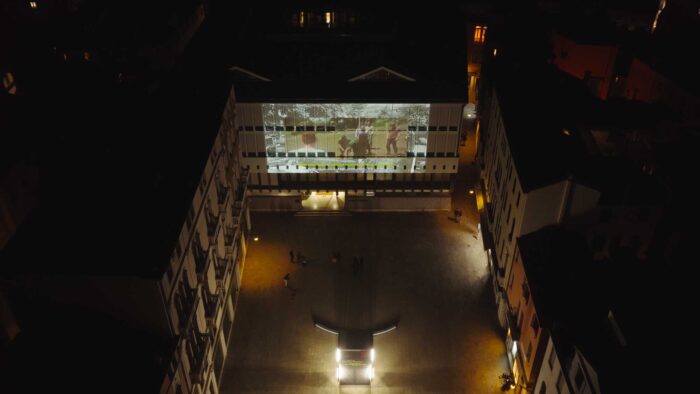
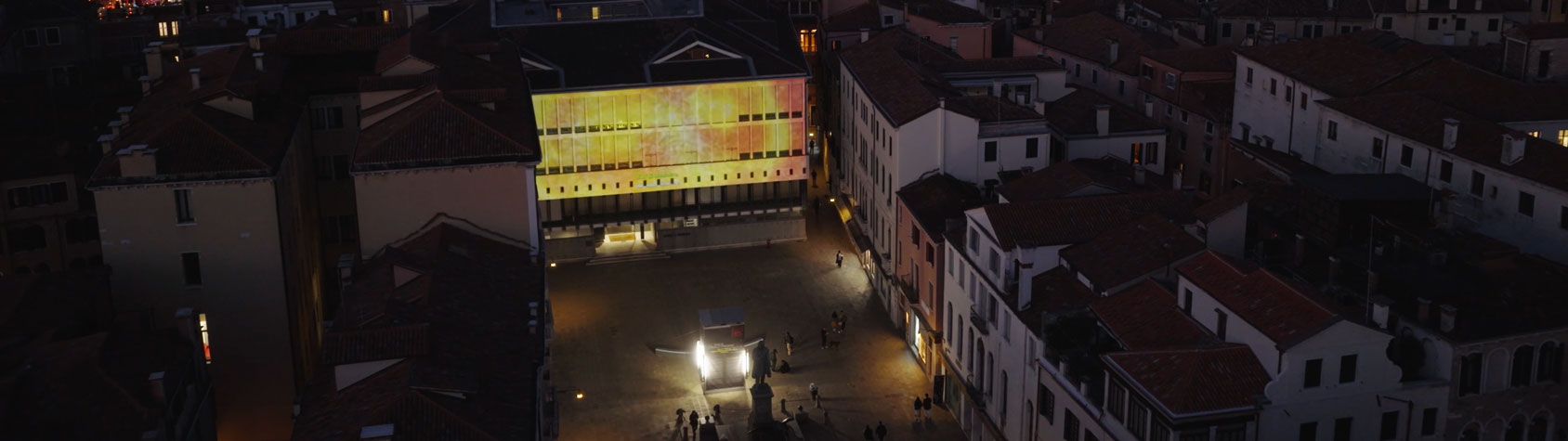
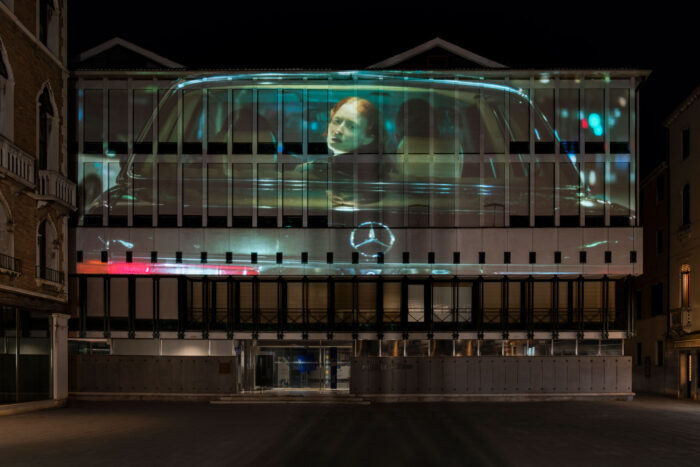
The chosen site for this first intervention is the façade of Palazzo Nervi Scattolin (1963–1972) one of the few examples of Venetian modernism—which becomes an exhibition space for video works by Kandis Williams, Meriem Bennani and Orian Barki, and Tai Shani, projected every evening from May 6 to June 7, 2026, as part of the Official Collateral Programme of the 61st International Art Exhibition of La Biennale di Venezia and made possible through the exclusive support of Bottega Veneta.
The idea of the present evoked by the title, borrowed from T. S. Eliot, is reflected in the way the project positions itself across three coexisting temporal dimensions. First, there is the past of Pier Luigi Nervi’s legacy, which takes shape in the challenge of reactivating his architectural and intellectual heritage, moving as far as possible from an understanding of that legacy as static inheritance and favouring instead its reading as a living body of work, still capable of articulating new complexities.
At the centre of this system lies the present, embodied by curatorial action, which does not simply “organise” content, but materialises in the construction of meanings, counter-narratives, and forms of project-making through the dialogical platform of the exhibition. The curatorial occasion becomes a space in which the past is questioned through contemporary perspectives and tensions external to the discipline of architecture, turning it into a resource for new forms of discursivity.
From here, the future opens up, represented by the voices of the artists as “subjective readers of a collective condition.” Their work translates into open fragments, images, and stories capable of conveying the urgencies of our time, contributing to a more conscious sense of collectivity.
The notions of Zeitgeist, the spirit of the time, and Jetztzeit, the time of the now, become the theoretical devices through which the relationship between the modernist Palazzo Nervi Scattolin and the artists’ practices can be made intelligible. What binds them, even if not immediately visible, is their ability to question the status quo and to act as critical devices capable of opening future scenarios.
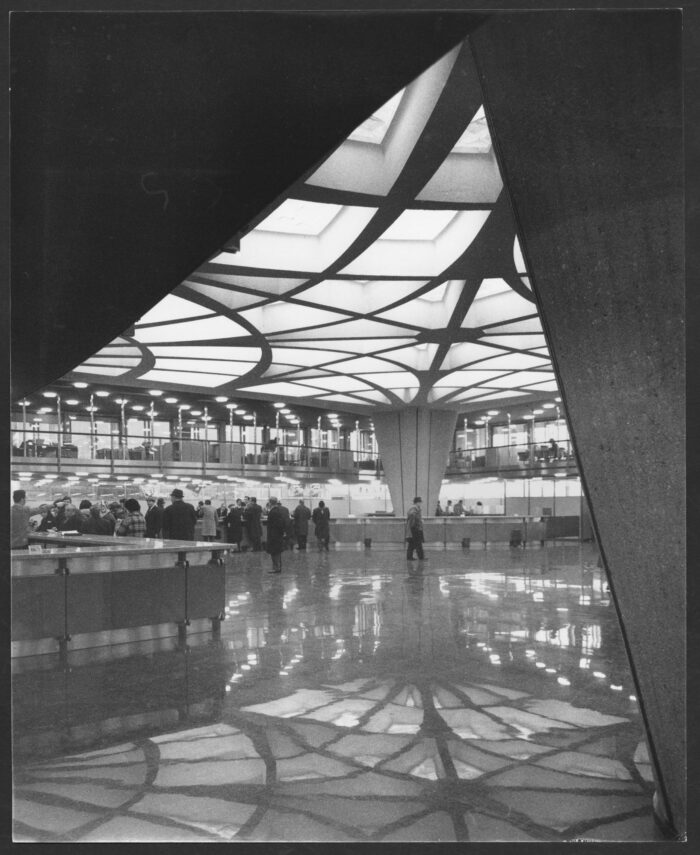
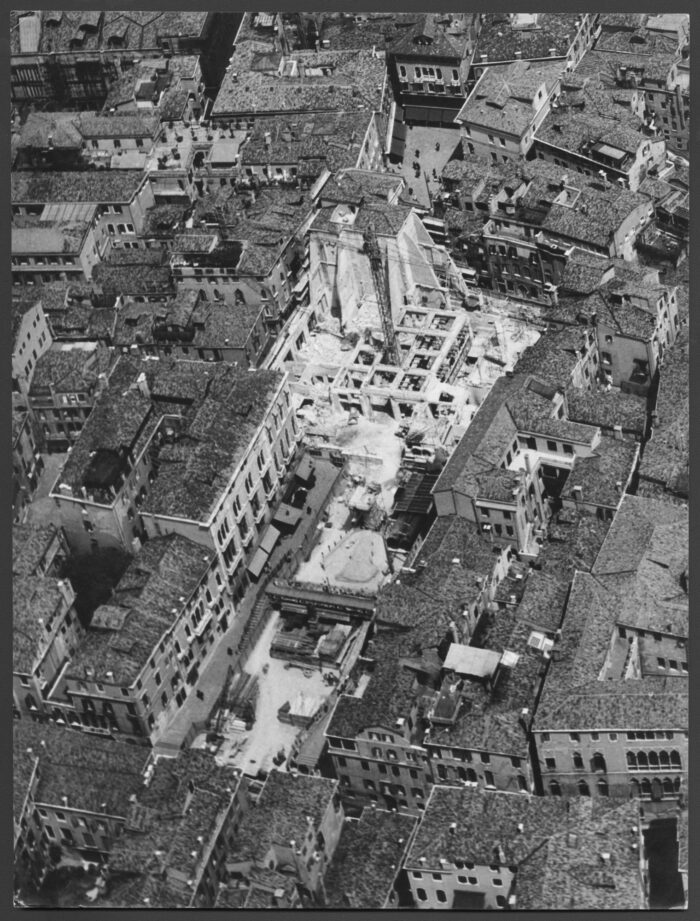
In the 1970s, Palazzo Nervi Scattolin stood as one of the few examples of modern architecture able to breach Venice’s long-standing resistance to the approval of modern interventions within the historic city, where such projects were often perceived as a threat to the city’s supposedly unified image. Commissioned to architect Angelo Scattolin and Pier Luigi Nervi by the Cassa di Risparmio di Venezia, which sought a new headquarters better suited to the image and efficiency of a modern banking institution, the Palazzo took shape through the complete demolition of the pre-existing nineteenth-century building and the construction of a structurally audacious project, unprecedented in the Venetian historic centre and in clear rupture with the formal language of its context. It thus became a living testament to a reflection on conservation and modernity, and to the challenge of visual and cultural disruptiveness.
Similarly, the work of Williams, Bennani and Barki, and Shani captures “the razorblade-thin moment of the present,” offering critical and interpretative tools with which to read the urgencies of our time, much as Nervi’s architecture was able to do within its own historical moment. Their encounter with Nervi’s architecture amplifies the resonance of these discourses, triggering a reflection on Venice as a place of infinite interpretability and as a stage for the negotiation between tradition and innovation.
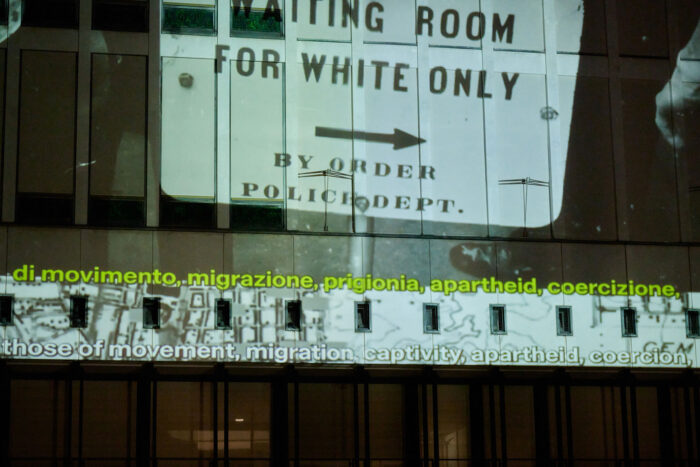
Time also traverses the practices and works presented in the exhibition. Kandis Williams presents A Travel Guide: Black Gothic in South Korean Horror (2025), a new video work composed through a multi-source collage that examines what it means for Black culture and Black bodies to move through the world, from the era of Jim Crow laws to the present day. Through The Negro Motorist Green Book, Williams opens a reflection on spaces of safety and exclusion, showing that if mobility equals power, then its denial is a condition shaped by surveillance, racialised governance, and inherited violence. The work confronts the ways contemporary culture continues to aestheticise and extract Black pain, from horror cinema to digital platforms, where visibility is often offered as spectacle rather than repair. At its core is a reflection on shared and displaced trauma, drawing parallels between Black and South Korean collective memories and tracing resonances across histories of state violence, suppressed mourning, and the lack of reconciliation. The work moves between the present and the historical time of its quasi-scientific research, following a modus operandi in which the present must always, and necessarily, be reread through history.
Meriem Bennani and Orian Barki lead us, instead, into a work suspended in a kind of eternal present, 2 Lizards (2020). By sharing their individual experience of life during the first months of lockdown in New York, they turn a temporally circumscribed moment into something collective and strangely universal: a moment that appears outside time, or always present, so central was its role in all our lives, and so immediate is the ease with which it can still be relived. Created in the first months of the pandemic, the project refracts the upheaval of life in New York through the eyes of two anthropomorphic lizard avatars voiced by Bennani and Barki themselves. Although its setting is hyper-specific, the work resonates far beyond that moment. By animating creatures who speak with irreverent humanity, 2 Lizards turns intimate, anecdotal experience into a shared narrative. The work perfectly embodies the Jetztzeit, in the alchemy of the local made global, still uncannily alive.
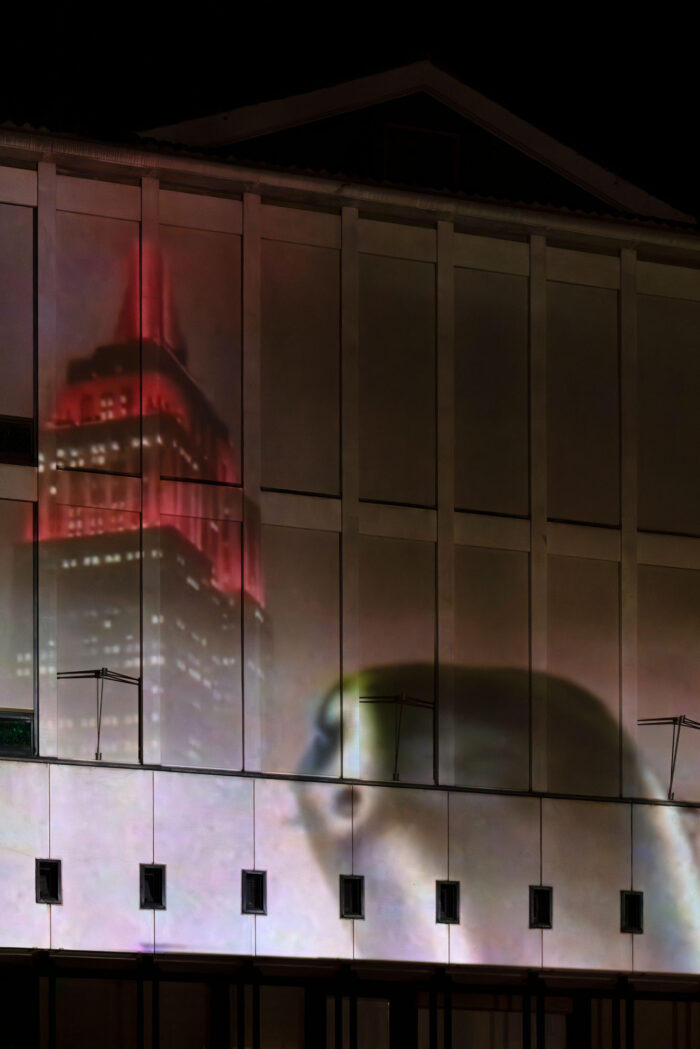
Finally, Tai Shani’s work, and her practice more broadly, move through cosmic and epic temporalities. For the exhibition, Shani presents My Bodily Remains, Your Bodily Remains and All the Bodily Remains that Ever Were and Ever Will Be (2023–2026). The film is a fantastical series of filmic tableaux that articulates her ongoing research into non-sovereignty, collective embodiment, and radical affect. Conceived as a technicolour cinematic dream, it unfolds as a speculative journey narrated by a constellation of figures grappling with questions of love, grief, and societal change. In The Ghost for Revolution, the protagonist of the work, these questions become charged with the historical residues of fascism, while histories of non-violent resistance surface as possible forms of endurance.
But what happens when the space of the exhibition is the city itself? And what does it mean to show these works in this context?
The show, as a temporary urban object, prompts a re-evaluation of the city as a cultural matrix and opens a reflection on what it means to show in public space and to engage with its public. Once the exhibition leaves the venues that traditionally contain it, exhibition space is no longer given: it has to be constructed. The project is situated within this material and symbolic production, taking the form of an infrastructure capable of transforming a piece of the city into a device of attention and collective encounter. By bringing the history of Palazzo Nervi Scattolin into contact with artistic practices emerging from geographical and cultural contexts distant from the lagoon, the show reactivates a Venetian history marked by difficult negotiations around the preservation of the city’s image, while offering new points of access to the urgent questions addressed by the works on display.
The physical superimposition of the projection onto the façade does more than bring the building literally into light. Through the strategy of projection, it creates a condition of attraction that draws inhabitants and passers-by closer to the architectural context around them, inviting them to question both the works on view and the place that hosts them. The expanded field in which the project operates is therefore spatial as much as imaginative: it situates viewers within a cultural experience embedded in the city, while allowing seemingly distant elements—architectural history, artistic practices, the works themselves, and their reception in public space—to act upon one another.
Many of the project’s exhibitionary and curatorial choices were directed toward distancing If All Time Is Eternally Present from being understood solely as a site-specific installation, and toward insisting instead on its nature as an exhibition project that advances a reflection on the extra-institutional dimensions of curatorial discourse. The gestures and forms of project-making activated by the exhibition aimed to make this space legible as a space within another, while providing the conditions for a genuinely public experience to take place. This was also a way of preventing the project from being read as mere spectacle, or as yet another act of museification imposed on a city already particularly sensitive to urban staging and cultural extraction.
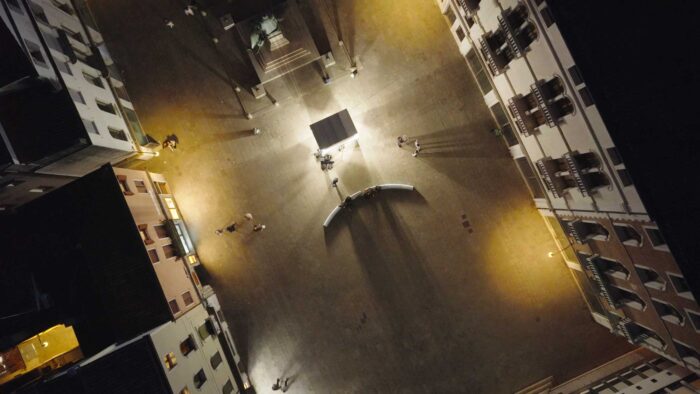
The exhibition draws on a scenographic quality that has defined Venice throughout its history: the coexistence of a monumental, seemingly immutable image with a volatile, performative one. For centuries, the city has been repeatedly dressed and undressed through ephemeral events, celebrations, and temporary, often floating, architectures that momentarily altered its face and gave form to its rituals of public life. In seeking to leave a mark on collective memory, If All Time Is Eternally Present draws on these languages of festivity and on practices that foreground imaginative scenarios. In Venice, the ordinary is never too far from staging itself as extraordinary: the city is always ready to make room for dream and wonder. The exhibition, at once a fragment of architecture and a fragment of the city, works within this condition, balancing the need to slip almost unnoticed into the ordinary life of the Campo with the desire to be perceived as an exceptional occurrence. Light, sound, cultural mediation, and above all the permanent seating installed in the square become the quiet supports of this shift: the elements that allow passers-by to stop, look, listen, and recognise the project as an urban and experiential opportunity.
It is wonder that opens one of the channels through which the project taps into the public, touching on a tension that has long traversed exhibition culture: the distance between those trained to recognise the codes of art and those who encounter them laterally. We were interested in thinking of the exhibition as a laboratory for testing forms through which a cultural actor can offer content to a public that, until that moment, perhaps did not even recognise itself as such. In urban space, in fact, the public does not pre-exist the exhibition; it forms through encounter and, at times, through surprise. Unlike the museum, here the exhibition exposes itself to discontinuous and unforeseen forms of attention: it may be desired or ignored, crossed distractedly or received for only a few minutes.
The question, then, was not only how to reach a public, but how to construct one, and how to generate the awareness that urban experience itself is already a cultural fact. The city is never a neutral background, nor is it the background of the exhibition, but rather its first material. Within it, what appears familiar and already known coexists with something less evident and often made invisible by habit. Cultural experiences of this kind can facilitate access to that hidden layer, acting as tools of knowledge and strategies of awareness. Looking up at a building illuminated at night does not simply mean looking at an image, but perhaps beginning to ask questions about the places that surround us. The exhibition works within this gap, at the moment when everyday passage becomes an aesthetic, cultural, social, and therefore political experience.
Publicness, therefore, does not coincide with an outdoor location. It has to do with the construction of conditions of reception for interlocutors who may be passing through, or only partially available, each bringing different sensitivities and degrees of engagement. To offer them content means attempting to trigger a generative interference grounded in the awareness that complexity does not belong only to those already accustomed to certain forms of discourse. It also belongs to those who encounter them unexpectedly. Yet, this unprotected offer imposes responsibilities and must be balanced by strategies of mediation capable of making the content legible without simplifying it.
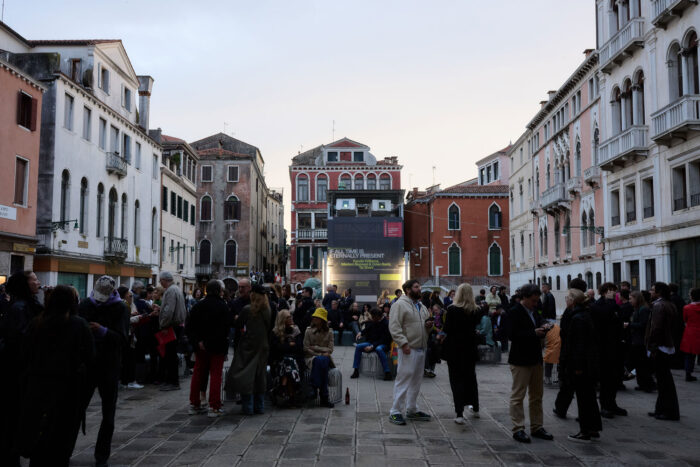
The project also operates in another zone of mediation: the tension between the institutional and the extra-institutional. To participate in specific cultural systems is to enter their frameworks, accept their responsibilities, and work with the conditions that make certain projects possible. It also means testing how those same systems can be stretched from within. This is where part of the exhibition’s meaning lies: in inhabiting a platform such as the Biennale di Venezia while protecting an independent, bottom-up, interdisciplinary, and co-authored mode of working. From the earliest stages, the “architecture” of the project was conceived as a hybrid exercise, a way to use the system that made it possible while exceeding its perimeter and rooting the work in the public and urban core.
The open-air dimension of the exhibition therefore finds its reasons in the desire to test exhibition making as a device of mediation between those who produce culture, those who articulate it as discourse, and those who receive it. Among the historical precedents to which the project looks, the Estate Romana (1977–1985) occupies an important place, precisely because it represents one of the moments in which new forms of relation between culture, politics, and the city were tested. Conceived by the architect Renato Nicolini, when he was Councillor for Culture of the Municipality of Rome, the project emerged at a particularly complex moment for the city’s public life, when widespread political tension had contributed to distancing citizens from urban space. Nicolini reimagined the relationship between culture and the city, using culture as a tool to repair the bond between the city and those who inhabit it. For nine summers, Rome was populated by installations, open-air cinemas, ephemeral theatres, poetry festivals, art exhibitions, and temporary devices capable of acting on the cultural life of the city and on its perception.
The Estate Romana offered a precedent through which to rethink the possibility that the ephemeral might produce lasting effects, that a temporary device might alter the way a space is inhabited, imagined, remembered. The city becomes a platform in which to stage the relationship between urban space and its citizens, and to test the friction between high culture and low culture, cultural programming and everyday life, institutional forms and more lateral forms of cultural production. The point is not to replace content with spectacle, but to work within those fissures in which wonder and encounter can become critical strategies.
For this reason, the use of projection was never intended as entertainment. The selected artists and video works, together with the way they are displayed, seek to produce a complex, even contradictory space, capable of holding dissent, resistance, marginality, and collective experience.
The language of spectacle is consciously assumed as a critical strategy, a way to make layered content approachable while leaving the public to calibrate its own level of engagement. The experience may stop at aesthetic reception, at wonder, but it may also become a space of listening and porosity. The nocturnal dimension is central to this process. If darkness first arises from a technical necessity, making the projections visible, it soon becomes a cultural, perceptual, and political condition. Choosing the night means taking a position within a city in which less and less space is granted to nocturnal life, increasingly compressed and made difficult to inhabit. Yet the night remains a space of personal expression and collective life, a hybrid time of grey zones and opacity, in which content can be absorbed in less linear forms.
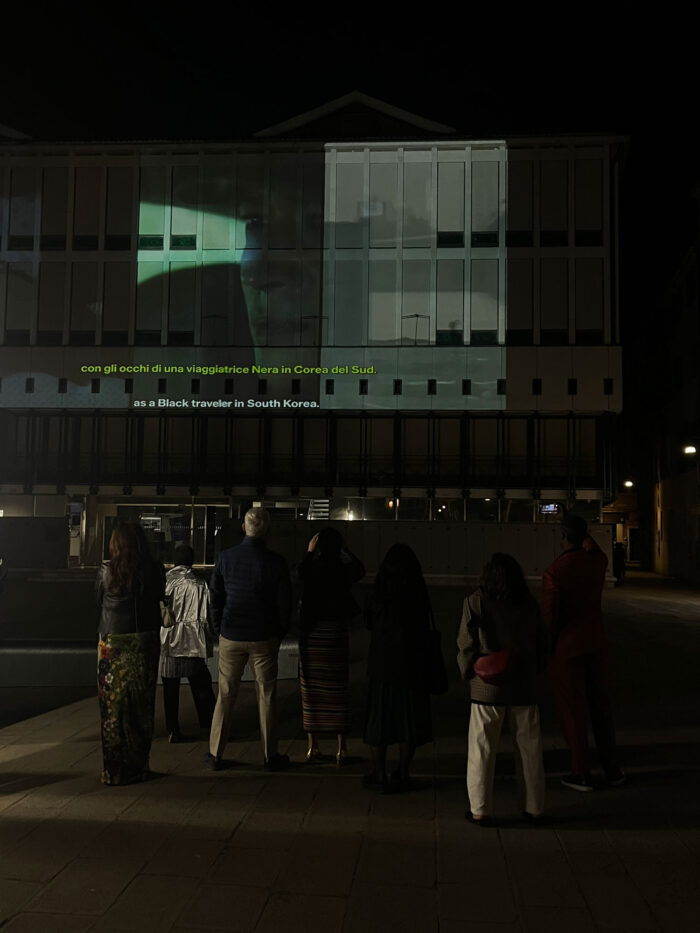
Campo Manin thus becomes a physical space to which a new responsibility and a new function are temporarily assigned, and also a thirdspace which, like the night itself, opens onto intermediate worlds. Distinct from the domestic and the workplace, thirdspaces offer a platform of encounter between representation and practice, in which relational space and subjective experience overlap. They render life intelligible through narrative, memory, and imaginaries that give shape to the material world. It is precisely the subjective, dreamlike dimension that characterises these spaces, pushing sociality toward the cultivation of a sense of belonging. The night, then, shifts from an aesthetic condition into a social and cultural experience: an environment mediating between real and invisible dimensions, between what takes place in the Campo and what images and sounds render perceptible.
If crossing the city does not necessarily mean being present within it, the exhibition seeks to create the conditions for that presence to become more conscious and available. The encounter with the works takes the form of a stumble: we like to imagine the spectator as someone in transit, cruising, suddenly finding themselves in a suspended world, in a square transformed by light and sound, surprised by content that had not been pre-arranged for them and that can therefore be absorbed in a condition of openness toward what may still happen.
This is where the exhibition’s public dimension becomes more than a matter of format. It becomes a conscious positioning turning the exhibition into an act of repair. This takes on a particular urgency in Venice, where urban belonging has been made progressively more fragile by the governance of recent decades. In this encounter between culture and urbanity, one recognises an idea of making a city by making culture, a form of “immaterial urbanism” as the negotiation between institutional culture and independent, bottom-up practice. Such a concept also points to a sharper contradiction: the fact that a cultural institution expands into the city does not mean that its contents become accessible. To spill beyond institutional walls is not, in itself, to become public. Publicness is not a condition guaranteed by physical location, but a project.
And it is perhaps here that If All Time Is Eternally Present finds its most precise stakes: not simply in showing works in public space, but in asking how public space might become, even temporarily, a cultural and collective space. A place in which the city is not the passive support of an image, but an active part of the discourse; in which the public is not simply convened, but continually produced.