

We Met in the Shout
A conversation with Katerina Andreou and Mélissa Guex
I interviewed Katerina Andreou and Mélissa Guex at the end of July, after attending their performance Shout Twice at Centrale Fies, during the 14th edition of Live Works. As every year, the three-day programme brings together a number of guests alongside the fellows of Centrale Fies’ Free School of Performance. The presence of guests introduces more established practices alongside the works in progress of the participants; some are artists who return, years later, after having taken part in the school as fellows, as in Andreou’s case.
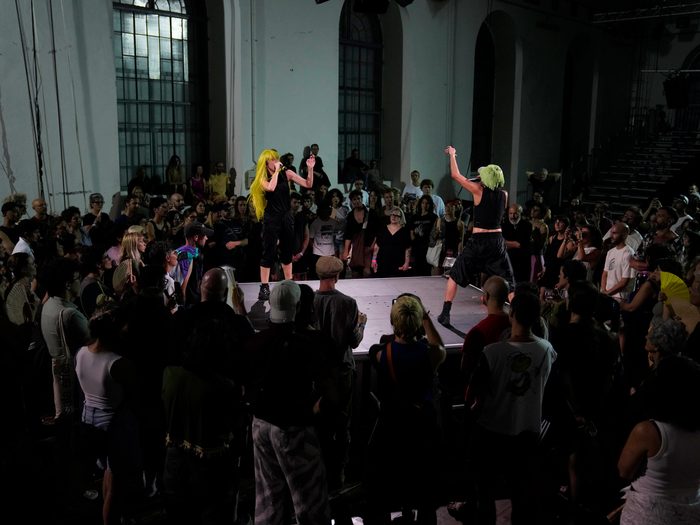
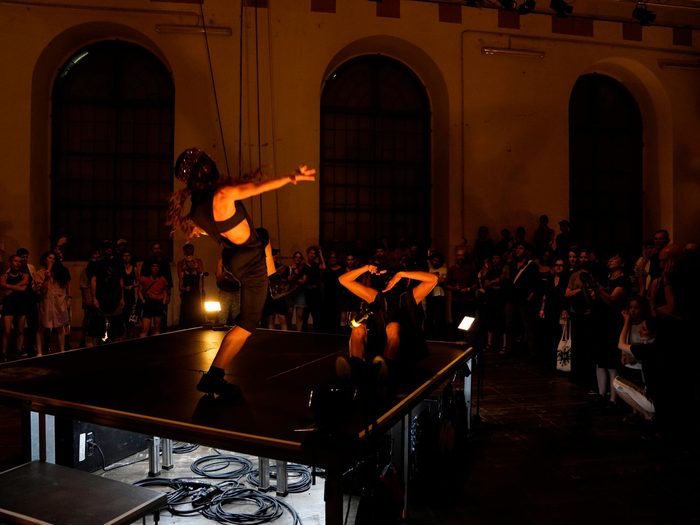
I had seen Andreou and Guex perform together before, but Shout Twice—the first piece they co-authored—offered an experience very different from what I already knew of their work. The performance breaks with the frontality of the stage and transforms the performers’ energetic charge into a force capable of setting both the space and the audience in motion. The audience is drawn into a physical and emotional journey in which sound and the relationship between bodies continually reshape the possibilities of being together.
As emerges from the words that follow, Shout Twice is a work that explores resonance, reciprocity and collectivity. It reminds us that performance is, first and foremost, a practice of presence: a way of being with others through the body, and of allowing oneself to be transformed by this encounter. The two artists engage in a process of exposure and sharing that feels all the more urgent in a present marked by violence, which increasingly reveals the limits of living and acting as isolated individuals.
Marta Federici: I am really happy to be able to ask you some questions about the performance you presented at Centrale Fies, Shout Twice. I really enjoyed it, it was incredibly powerful. My first question is about your collaboration. Shout Twice is the first piece you have co-authored together, after having collaborated before on other occasions. The title itself evokes doubling, echo, repetition—perhaps even a dialogue. Could you tell me how you started working on this piece? What were the initial questions or intuitions that brought you together? And what did each of you bring into the process, both artistically and personally, from your individual practices?
Katerina Andreou: I would say that the intuition was not only an idea; there was a desire to do something together with Mélissa. It started with Bless This Mess, where we were already performing together. So, in a way, our dialogue about this piece started in another work. There was a kind of—not exactly an agreement, but a tuning that we felt in terms of imagination, of how we enter improvisation. Even though we each have very different references, we could see that through performance and by dancing, we could dive together, take the same waves. We were both curious to explore this in a format where, also in the writing of the piece, we would be on the same level.
We both have a huge love and interest in sound, not just as an element of the work, but as a kind of source of inspiration, a source of context, a source of content. And we wanted to make something together in which we could find the common sound, let’s say. We wanted to collaborate, Mélissa and I, trying to find out how I can make her listen to the sound I have in my head, and how she could make me listen to the sound she has in hers, by describing it. It’s like in this film, Memoria, where Tilda Swinton is trying to make someone hear the sound she has in her mind.
Mélissa Guex: Yes. She’s hearing something like explosions. And there is this very long scene in the movie where she’s trying to explain to a sound designer, to describe with words what she is hearing in her head. So the sound designer tries different sounds, and she says, “No, more deep, more long.” When I saw the movie, I started to imagine this invisible sound—something that no one else can hear. I guess that Shout Twice was also a way to communicate these really deep sounds to each other and to make them resonate. You spoke about echo, and we also spoke about amplification. For me, this work was also a way to go somewhere where I could never go alone. And I know it’s the same for Katerina. I know that she has my back, or I’m taking her hand, and we can really go deeper and explore this sound.
KA: You know, in performance, sometimes we have a kinship. We talked about a performative kinship. Maybe it is also metaphorical, but I always felt that you, Mélissa, listen to my same sounds. It’s not visible, but we can recognize each other in the same sound place. That’s why, with Shout Twice, the starting point was to make a kind of concert—not in order to make music, but to communicate this common sound that we hear, that we feel with a lot of emotion, and to empower each other to communicate it better through the performance.
MF: In this piece, sound is in dialogue with the body and movement. Could you tell me more about how these two elements interacted during the development of the work? Did one generate the other? Does sound generate movement, or do they emerge simultaneously? And, since you just said that you were looking for this common sound, could you describe it a little more?
KA: The sound we were looking for came from the experience of very deep frequencies. There is this sequence in the performance that we call a beatbox between us, with different vocalizations that can sometimes be a little figurative. At first, we wanted to go as deep into the frequencies as we could, to make the voice very percussive, and to look for a kind of deepness within the voice. We wanted to make it resonate, to create a friction with high-pitched screams or shouting. So, working with different frequencies of shouting was very important for us.
MG: Yes, bringing ourselves to frequencies that we don’t normally use in everyday life. We were also speaking a lot about how, as two women in society, we could explore these really low frequencies and really high ones, and about taking up these places with the voice and the body. We were searching for places that are like hidden spots. How can we go there, and take our place there?
KA: Yes. And in terms of sound and dance, I would say that they emerged somewhat simultaneously. We were working with sound and the body at the same time. Perhaps it may seem too easy, but we were looking for sound materials that could put us in a state of improvisation, of movement, of dance. I think we made choices in terms of musicality as if the music were dance, and sometimes our dance was the music. The way we treat movement and sound is a bit special in Shout Twice; for me, it is sometimes almost reversed. Sometimes, when we dance, it’s as if we are making the rhythm. We talked about polyrhythmicity, about how we can be a music beside the music, and how the body is very musical. And sometimes the sounds can almost be a dance in themselves; they can create movement. So I think we treated them without any hierarchy or fixed order. At least for me, it’s very hard to tell which comes first.
MG: We can say that they are always connected; it’s never just the sound or just the body. Even though we’re playing an instrument, for example, the body is fully engaged in performing. And I remember all this talk we had because the title is Shout Twice: as the process developed, we started looking for the different shouts within our work, not just thinking about the shout as something that comes from the mouth. For example, the first track, at the beginning of the performance, is also kind of a shout. It’s 20 minutes of one track and our bodies in the space; for us, it was also a way of shouting in the space.
Katerina was speaking about the concert before. That was the first idea: we asked ourselves how we could test in our work what we like when we go to a concert. And this helped us shape the dramaturgy. We took the different elements of a concert, not as an aesthetic, but more as a form of composition. The inspiration was the rhythm of a concert, with the really big ups and downs, then silence, then a big guitar solo, and then the audience. The crowd also plays an important role in a concert. So it’s also about good chemistry: it’s not just about us on stage, but also about what’s happening with the audience. And this, at Centrale Fies, was amazing for us. It was beyond what we had imagined at first. We didn’t need words, we didn’t need explanations; something happened. When I’m at music festivals as a spectator, I’m really amazed by this sense of agreement within the crowd. You know, everyone moves to the same rhythm for two or three days. And you don’t know the people around you, and you just move with the stranger next to you. It could be a crowd of 100 people, 1,000 people. And in Shout Twice, at Centrale Fies, we had this same sensation. It was just 45 minutes, and I hesitate to use the word “community,” but I felt something like a community, or an agreement with strangers nearby, that felt like we knew each other.
KA: What we felt in Centrale Fies was a kind of circulation, in the sense that we were getting back what we were giving. There was some feedback coming in that was very nourishing for our state, taking away some of the frontality of the dispositif that can be imposed despite us. You said it was powerful, but for us it was also very powerful as a moment of sharing. What was shared was a common vibe, an energy. And I think this work has this challenge of sometimes being in places where expectations about what a spectacle is, what dance is, what music-making is, can be at stake. But at Centrale Fies, we felt that the circulation was easier, and that the exchange between us and the audience could happen more freely.
You asked before what each of us brought to the collaboration, and it is difficult for me to track. When we talk about sound and the body, it is very difficult, and I think very interesting, to distinguish between what comes from Mélissa and what comes from me in the process, even though we are very aware of our differences. So for me, this is a personal success. It is a collaboration where I don’t know exactly where mine ends anymore. It’s really like Shout Twice, in that sense, we really supported each other in a way that has allowed us to arrive at this work, which is, let’s say, a common space. We both have this very frontal emotionality in our dances, and I think in Shout Twice we brought this, but in a way that allowed it to circulate. It is a kind of affective frontality.
MF: You were talking about the ways you enter improvisation in your practice, and then about the relationship with the audience in this work. I was curious to ask how much of Shout Twice is scripted and how much is left open. How much do you respond directly to the audience in the moment?
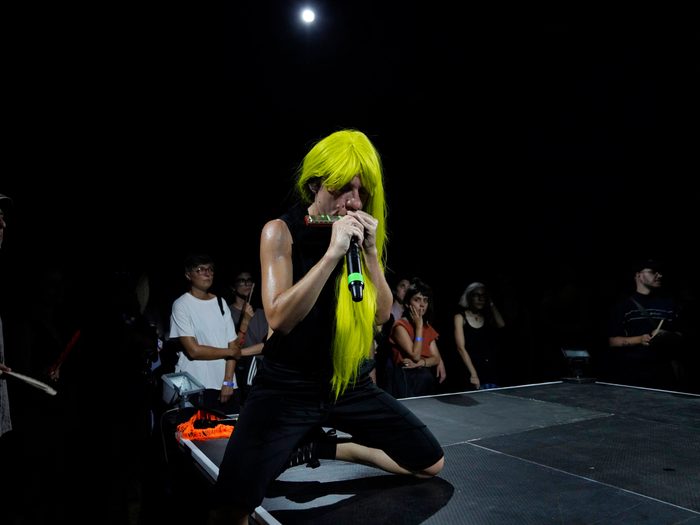
KA: There is a structure that is scripted, as you said, and that is always there. Mélissa used the phrase “safety nets” to describe this script—I liked it a lot. Shout Twice started as a kind of safety net, but now it feels more like a building. One thing after the other, we have built something, and now these steps have become part of the structure.
MG: Improvisation is a practice because we respond to the present moment, and this piece is also really connected to the present moment. We respond to the audience, but also to the architecture. The initial idea of using the concert as a reference was also a way to get out of the black box as soon as we could. Centrale Fies offered a spontaneous answer to this need to experience a different architecture and also in a way a different audience. These elements brought something to the work that we could respond to directly. So, did we respond directly? Yes, I think we respond to the space, to the architecture, and to the sharing. As Katerina said before, it is like a sharing process.
KA: I think we both have a tendency to keep on writing, without being too obsessed with fixing things. But there are things that we have come to understand. Now we understand better how we can invite people in, and how we can also manage the circulation of this energy that we want to have. Of course, there is the script, but performatively we have this response-ability.
MG: It was hard during the process, because we didn’t have an audience while rehearsing, even though we tried as much as we could to work with people present, because we needed that. And because we are working with this responding improvisation and the present moment, we needed to be able to grasp some elements to structure the net. I remember this as one of the most interesting but also most challenging parts of the process. We did, I think, around 100 different performances during the process. But then you need to choose, and you need to grasp on something. Something has to stay. And I really like this idea of grasping; it is hard but also beautiful. This was also important for the technical team, and for Cristian Sotomayor, who worked a lot with us on the sound and the lights.
KA: What we grasped through this challenge of fixing without fixing, while still remaining responsive, is how we activate moods, what these moods are, and what we communicate in terms of affect through them. In order to bring these moods together, we work with sound, with space, with relationships. This makes a kind of map for us.
After the performance at Centrale Fies, I told Simone Frangi that it was wonderful for us because people were responding. We could see our script operating, not just as a composition, you know. It was like, okay, now we go somewhere. It is fragile when the audience is not immediately involved. And Simone said to me, “You made a building.” I really liked the metaphor: making a building piece by piece. So it’s nice that you talked about the script, and it’s nice that someone talked about composition as building.
MF: Throughout the performance, you continuously transform yourselves through costumes, wigs, and objects, almost moving between different figures or states. Could you tell me more about these transformations? Are they conceived as characters, states of being—as you said, moods—or something else altogether?
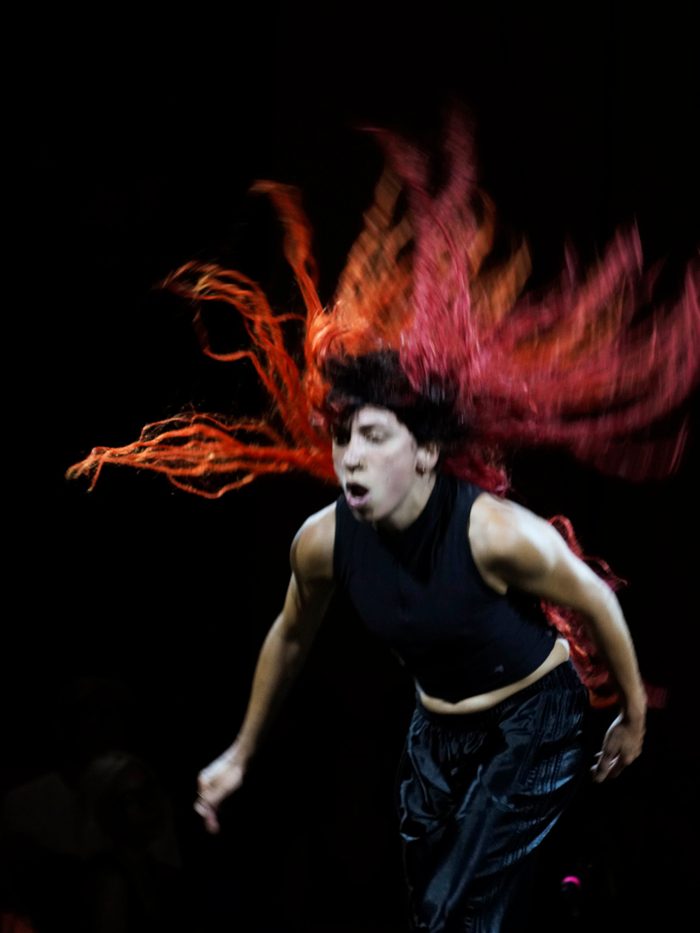
MG: I really like the word “transformation,” and I actually think it is about transformation without being too specific. It is not just about characters. It is about characters, moods, sounds, and also what Katerina said before about the mixture of our two universes. Let’s say, we tried to push this aspect a little bit further. We realized, somewhat late, but it was nice, that it is possible not to recognize who is who when we also play with masks and invisibility, when we hide. This process of transformation can regenerate, give another kick, first of all to us.
We are two, and when we perform Shout Twice, we are twenty. People speak a lot about energy, about how we have energy, but when we are twenty, of course you feel that energy, because you have twenty different ways to move. What I really like about going on stage is being able to transform, to move into other bodies, and to play with the visible and the invisible. All these tools are there to activate the imagination. The source is inside our heads, but also around us. For example, there is a lot of inspiration in what we see in the audience. Sometimes we just look at how people move, and then we take inspiration from that.
KA: Transformation is something Mélissa works a lot with. I got very inspired by the way she can be affected by something very small! For me, transformation is also, in some way, a tool of empowerment in performance. It is not so much about hiding, but more about revealing other aspects. It is very close to a game, and to the kind of empowerment, the freedom that you can have when you enter the territory of play, or better, of playing.
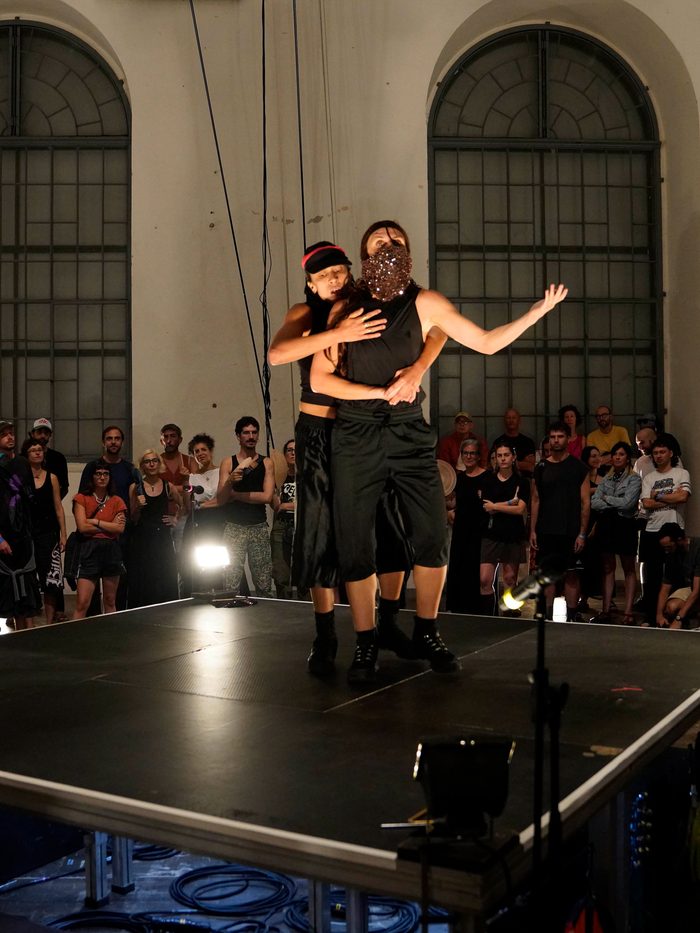
We talked a lot about those anonymous figures—when we cover our faces— and about how much it is not about hiding, but rather about multiplying. For us, it was important to multiply and to imagine ourselves among a lot of people. And I would say that it is a performative tool, it is not a theatrical tool. We don’t want to create fiction in terms of dictating characters, but rather to enhance qualities and imagination, which is something different. So it is not a theatrical tool in that sense. It is a tool to get the energy circulating.
MG: And it’s something very physical. You put on a hat, and your eyes don’t see the same thing they saw before, so this changes your body. It is a physical reaction. You put something on in order to have a physical reaction. It is not about storytelling. The wigs also give you a different movement, the cap, the jacket—everything is very physical.
We got inspiration from different kinds of crowds. We already mentioned concerts, but we also spoke about carnival, big gatherings, political gatherings, demonstrations. Different kinds of crowds that come together for an event—for a political or social purpose, or simply to be together and to do something, and to transform. Sometimes you have to hide and not show who you are, like in the Antifa movement. You have to hide your identity. In carnival too, you can hide. Sometimes hiding is a way of revealing other things.
MF: You have mentioned a connection to game, to playing, and this is an aspect that I find interesting. There are moments in the performance that are very intense, even tense, but at the same time there is a sense of humor, lightness, and playfulness. I was wondering if you could tell me more about how these different qualities coexist in the work, and about what happens when you move between intensity and lightness.
MG: Sometimes, when we speak together, we have this kind of cartoon mood, like being in a lunapark, with all the lights, games, and roller coasters. It connects to what we were saying before: the shifts between high intensities and low frequencies, silence, big lights. The process that we share is like those kinds of rides where you can go and you don’t know: is this real, or is it just an amusement park, or is this what’s happening right now in the world? For me, this really high intensity is for sure an echo of what’s actually happening right now in the world. And this lunapark is a place that Katerina and I have in common, in our heads, in our imagination.
KA: When we were performing together in Bless This Mess, we already entered a little into this moment, this imagination. But I think there is also something about a performative quality that we share a lot, that doesn’t concern only the dramaturgy—the way we built the work—but also the way we are very attracted to embodiment, in a very precise way, a way that is very expressive without being expressionistic. I like the word you said, “light.” It makes me think of something with no bones and muscles… And also of something very graphic, like a cartoon. There is something very graphic in our dance, especially in Shout Twice, and we talked a lot about cartoons, even if we didn’t conceptualize it so much. We just had it in mind. The thing is that cartoons can have very strong emotions. They can have an affective weight or—even with what is happening around us, you know, like a lot of violence—they hold a kind of humor that is embodied physically.
MG: For example, even when speaking about war or violence, in cartoons you see very graphic, really precise bodies. It can be an explosion, and then blood, and different kinds of expressions. Everything is really on the point, sharp, and the rhythm is also very fast. As you could see, our body rhythm is really fast as well. So we go along very well with cartoons: our heads go as fast as cartoons, and so do our bodies. While Katerina speaks, I can see the cartoon around her body, and she does the same with me!
I say this a lot: working with Katerina brought me back to the room I had when I was really young, where I would invite friends over. You know, you have a friend with you for an afternoon and you just, like—or at least I did—wear dresses, disguise yourself, transform. And the world disappears. Suddenly, it’s another world. Being together with Katerina in the studio gave me the same feeling: the world disappears, but at the same time we are constantly in the world. We are really aware of what’s happening in the world. But we can still enter each other’s imagination to pass through what’s happening right now and to be together.
Really, I’m even more grateful now that we decided to do this together. For me, it’s such a beautiful act of being together, an act of resistance and of kinship, yes, as she said. Now it’s done, the part of creation is done, and I’ve also realized what we did. And I’m super proud of ourselves, really—not for the result, but for the work we did together, for the process, which is bigger for me than what we can see at the end.
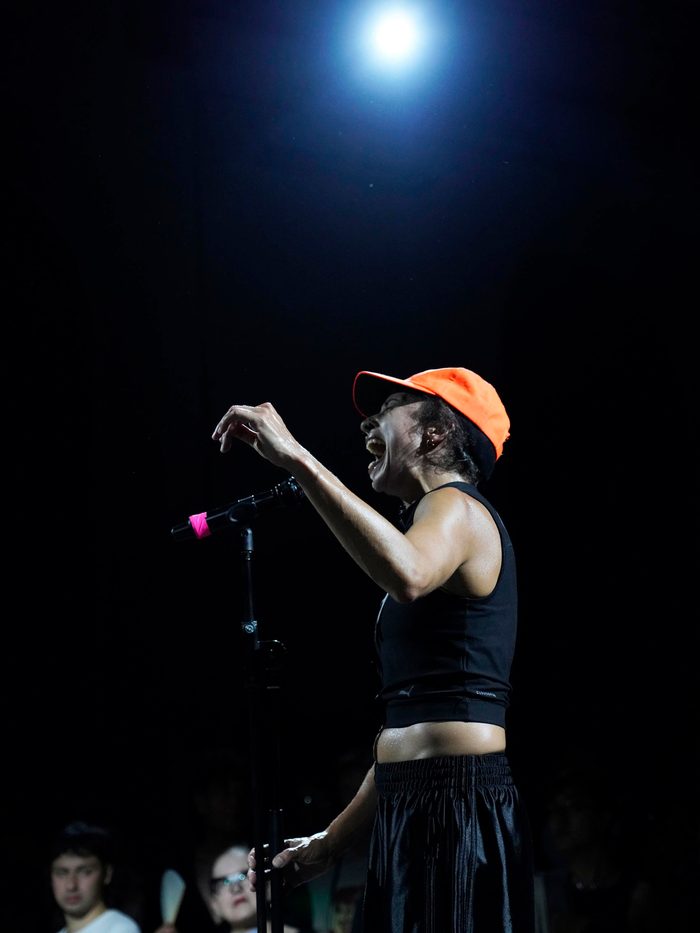
KA: Cartoon or not cartoon, there is something also that is very, very close to this work—I don’t know, maybe it resonates with you, Mélissa, in general, something I heard somewhere and have as a mantra: everything is very important and, at the same time, nothing is important! When you realise the depth of this paradox, it creates a tension, a dynamic that I find very interesting and that can sometimes become genuinely punk… We are of course fully engaged, two hundred percent present and invested, because it is very important to us, and at the same time we acknowledge the relative importance it may hold… It is a kind of spirit that encourages playfulness within a deep physical, emotional investment. And I believe that serious play—the kind that doesn’t make fun of a situation or of someone—can be a precious tool for making things matter.
MF: I have a couple more questions, and one is about the act of shouting. Shouting is a form of communication that precedes language. It is something very physical, very visceral. It can be an expression of resistance, a call, a way of gathering people together, but also a moment of release. So I was wondering: what kinds of possibilities does it open up for you in this work, politically, emotionally, or physically?
KA: It’s hard to talk about shouting by giving it a specific content. As I said before, there is a lot of emotional frontality in the work, and I think this means, for me, that we are moved, we are driven to make work in general, and to be together, by a need, a necessity. We always talk about necessity as something that drives us to make things, and even to make Shout Twice. Mélissa and I talked a lot about emotions, about anger, and how anger also motivates this work. How anger can lead to distress, and how that distress can lead back to playfulness, as a way of surviving it.
We talked—not so much, but also—about the fact that we are two women having to navigate different fields, especially in the present moment… That is also why we worked on low frequencies, high pitches, and on how we can address ourselves in ways other than those expected of us. So, of course, for me, the shouting—which could simply be the making of what we do!—is very much coloured and motivated by us, Mélissa and Katerina, as two women, as citizens of a world that is very stressful and very much in distress. And it’s very hard to get heard, or even to make something that could make sense, because everything is so confusing.
MG: We were speaking about different emotions, and for me, the shout transforms as well. As you say, it can go from anger to something like joy, and then to distress. So the shout transforms as we transform throughout the piece. Maybe what is really precious, and really difficult as well, is that it’s impossible to shout for only one reason or one cause.
With Katerina, we had many conversations; we shared a lot of joy together, but we also shared a lot of distress. We talked about what was happening in the world, politically and geographically, about different things that were happening at the same time. I think the shouts that we are making are infused by all the talks that we had. And we are aware that not everything can be visible. Are you shouting for Palestine right now? Are you shouting for women’s rights? It’s not one specific thing, for sure, also because we are two different bodies and two different minds. But we met in the shout, and we know that our shouts are fed by the subjects we share.
MF: I would like to ask you one last thing, a more general question about your practices today. Both of you have been speaking about the body not simply as a medium, but as a site for connection, relation, and resistance. What does it mean for you to work with the body today? And has working together on Shout Twice made you think differently about what the body can do and communicate? Are there particular urgencies that you feel are shaping your work at this moment?
MG: Something that I can say—a lesson that I’m still digesting from what we did together—is precisely this act of shouting twice, of being together, of going through this process together, versus holding an adventure like this alone. This makes me think a lot about the collective versus the individual way of living in the world, not just in a creative process. I’m still digesting this, but it was a beautiful and huge lesson for me. And I think this act, as I said before, this act of resistance, has given me a lot of hope. It makes me want to move really far away from the idea that we should be independent, alone, and do everything by ourselves in our own apartment. Suddenly, in this connection, I found freedom, and independence as well, and a lot of strength, because I knew someone had my back, and I had the back of someone else. I take this experience with me into thinking about collective processes, and about not owning something but sharing something.
KA: I find it interesting that you bring up the body in your question, the work with the body, because it made me think about something that is not very much talked about. I mean, I think today, working with the body is becoming more and more important. I think it is difficult for people to be patient, to stay with something, and to watch people experimenting with their bodies, or with bodily affects, and communicating things not only through form, but through how the body waits, how it is present, and what it does. Your question made me think that I see the public shifting a bit, as if the body has to reclaim its space materially. Bodies have to sustain, remain, be very present. Dance and performance, especially when the form is more experimental, are already an act of resistance. To exist and take over, to take a place. To take up space, to reclaim some space, as two bodies, and to affect other bodies. I think that is already important today.