Unsettling Genealogies
The hidden heritage of fascism in Italian cultural memory
Through archives, photographs and family memories, Alessandra Ferrini explores the relationships between fascism, colonialism and Italian cultural institutions. In Unsettling Genealogies (2024), artistic research becomes a tool for challenging official historical narrative, and bringing to light the hierarchies and inequalities that underpin them.
Right-wing culture portrays the past as a unified and immutable heritage of absolute values: tradition is filtered and manipulated to suit the political needs of the present, yet the historical and cultural roots remain ever-present and ingrained. Perhaps the solution lies precisely in the need to break away from these deep-rooted ideas, unsettling and liberating the past from the claim that it is an indisputable history. But what happens when a cultural institution preserves and celebrates its own history without making visible the ideologies and power relations that shaped it and still remain present?
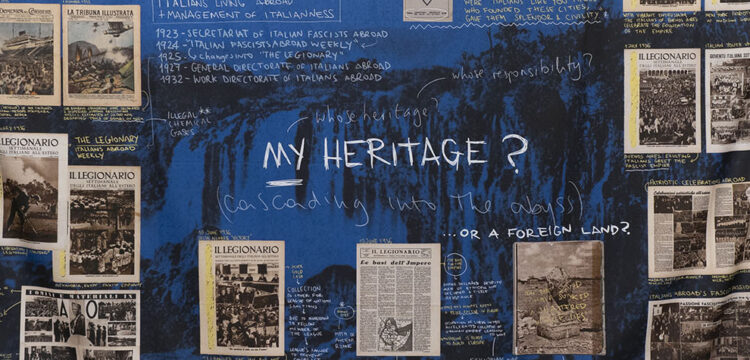
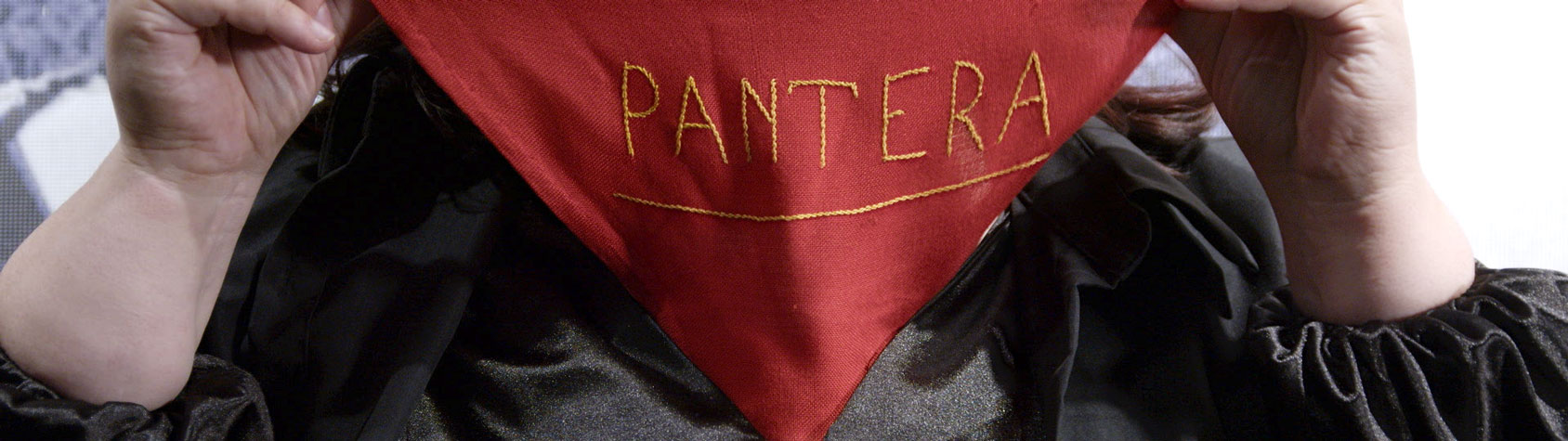
In Unsettling Genealogies (2024), artist and researcher Alessandra Ferrini brings into question the authority of mythical narrative through an investigation of both historical and affective archives. The reinstallation, curated by Alberta Romano for the XIX edition of Archivio Aperto in Bologna in the Refettorio delle Monache of the former Convent of San Mattia (now Sala Berti), marks a further development of their collaboration, started through the research project Kinship and Archive: From Private Narratives to Public Discourse Through Amateur Archives, a project that “seeked to approach personal and amateur archives as living, contested spaces in which the intimate sphere can bring to light voices, silences, and counternarratives of history.”
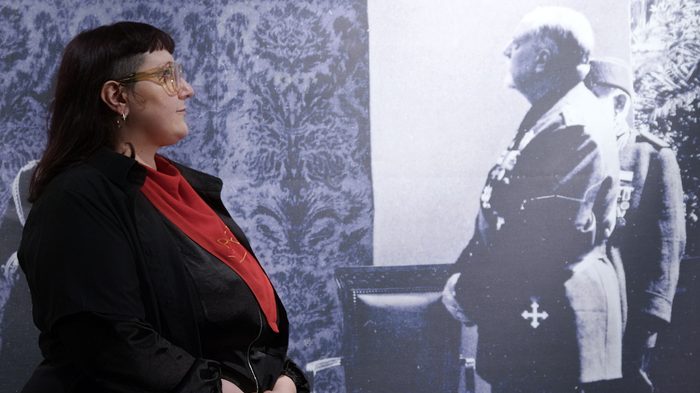
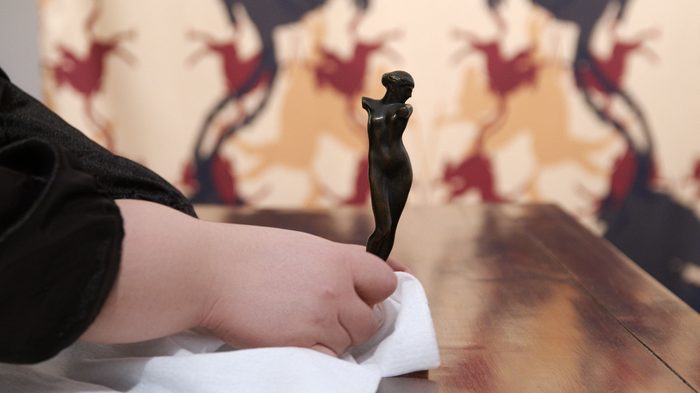
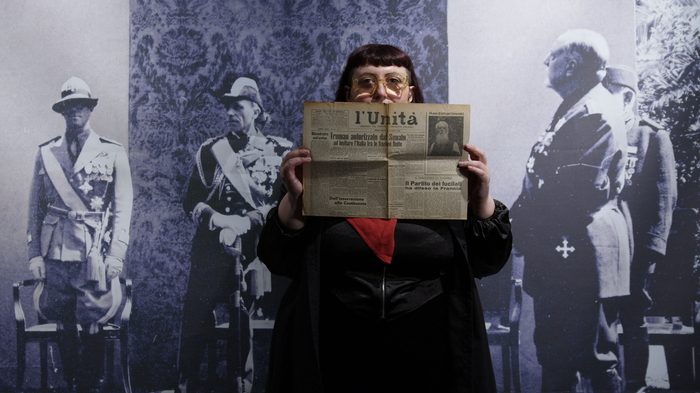
Set up in two rooms, the installation recreates a space that is both uncanny and familiar at the same time, featuring a table, books, plants, decorations and tapestries, and a more intimate, collected space in which a giant picture of Giuseppe Volpi, Count of Misurata, portrayed at the opening of the third edition of the Venice International Film Festival in 1935, takes centre stage, alongside a video performance featuring a succession of images, photographs and readings of texts, articles, and testimonies by the artist. Ferrini’s research begins precisely with this image. Giuseppe Volpi, an industrialist and politician who played a central role in the economic and institutional development of Fascist Italy, from the founding of Porto Marghera to his tenure as Minister of Finance, right through to his involvement in colonial policy in Libya, a man who “came to Tripoli as a man of peace, but pacification proved impossible,” and demonstrates how his trajectory of power contributed to the consolidation of economic interests and imperial ambitions. Through her analysis, Ferrini reconstructs a history in which Fascist industrial modernisation and cultural promotion are intertwined with colonial violence and the construction of consensus. The reflection extends to contemporary Venice and the persistence of this legacy, starting with the Venice International Film Festival, which still preserves a trace of that history in the name of the Coppa Volpi for Best Female and Male Actor.
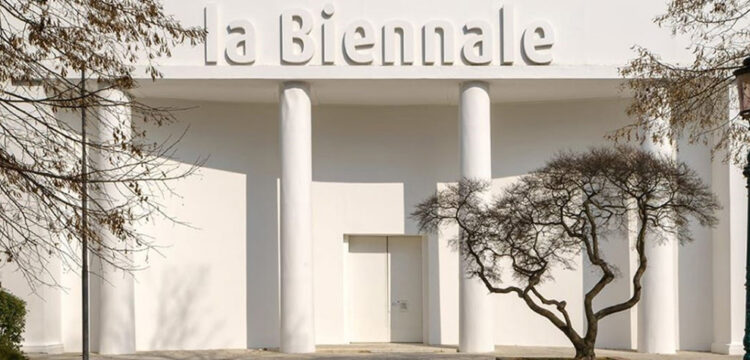
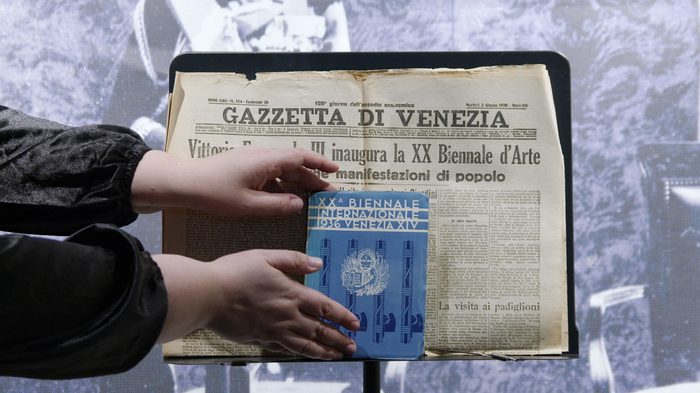
The nomination of Giuseppe Volpi as president of the Biennale and the role played by figures such as Antonio Maraini as general secretary helped to strengthen the link between artistic expression and fascist propaganda. In 1932, against a backdrop of international economic crisis and difficulties in the tourism sector, the Venice Film Festival was founded by Antonio Maraini, Luciano De Feo and Giuseppe Volpi, with support also provided through Volpi’s resources and hotel facilities: the festival immediately became part of a broader strategy to promote the image of Fascist Italy, transforming cinema into an instrument of political and diplomatic communication which, according to Mussolini, would carry responsibility as a “vital instrument linking the State and the individual wherever he may be.” Hitler’s visit to the Art Biennale in 1934 (and then also Goebbels), accompanied by Mussolini and welcomed by Volpi and Maraini, highlighted the role of cultural institutions as venues for showcasing the alliance between the two dictatorships. The establishment of the Coppa Mussolini, awarded to the winning films in the festival’s early editions (up to 1942), further attests to this politicisation, whilst the Istituto Luce and the subsequent founding of Cinecittà confirm the central role that Fascism attributed to cinema in disseminating its own imagery. This propagandistic function is also evident in the artistic programme of the 1936 Art Biennale, at a time when the regime was celebrating the conquest of Ethiopia and the proclamation of the Empire: official statements of the time presented the year as a season of national victories, establishing an explicit link with the exhibition, a visual celebration of the regime beginning with the exhibition layout, whose structure evoked the key milestones of Fascist military history, from the March on Rome to the war in Ethiopia and the Spanish War. The Biennale had by now taken on an ideological function, permeating institutional rhetoric.
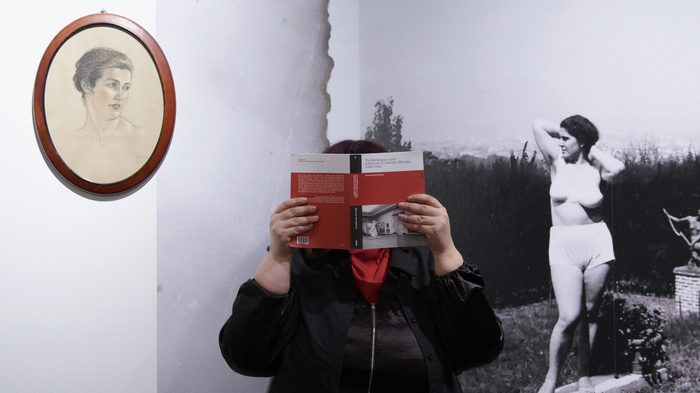
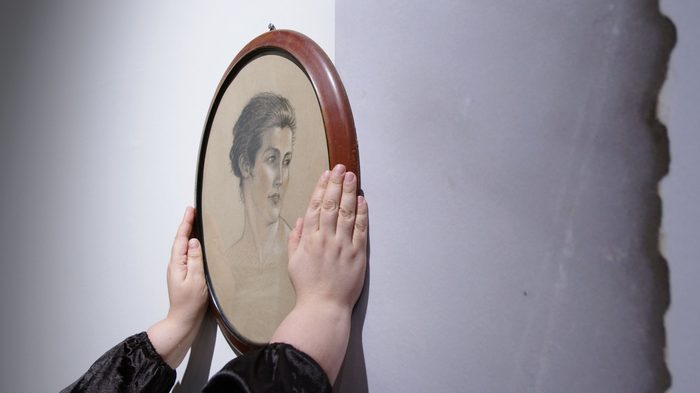
The project takes on a more intimate dimension through the artist’s family photo archive: understanding the tension and interdependencies between the domestic and institutional spheres is fundamental to developing an ethical and political stance that distances itself from nostalgic interpretations and mythologising. Alessandra discovers that three members of her family worked for Maraini’s estate in Florence during the 30s and 40s: in particular, her great-great-aunt Ada worked as a domestic employee. Some images show Ada posing in the villa, whilst others depict her in uniform, revealing a tangible connection between the private history of a working-class family and that of the artistic and political elites of the Fascist era. A conflict arises between the regime’s leading figures and those who navigate its spaces daily from a position of social subordination, an economic and social dependence that binds common people to those in power. It is within this context that also the story of her grandfather unfolds: a member of the Socialist Party who became embroiled in the controversies of the Liberation period for having testified in favour of Maraini. This position raises a more complex issue that the work does not reduce to a single-dimensional moral judgement: to what extent did the need to keep a job, economic precariousness and dependence on a wealthy and influential employer influence individual choices in the post-war period? To what extent did cultural and artistic considerations play a part? It is a space for questioning responsibilities and inequalities that limit the possibility of acting freely.
This reflection is directly linked to Ferrini’s personal experience, as she recounts her own migration to London and her encounter with low-paid jobs, undertaken not from the privileged position of a brilliant European professional living abroad, but from the more precarious position of an immigrant. The experience of migration thus enables the artist, in the present, to recognise some of the material conditions that have characterised the history of the generations preceding her family: wage labour, social vulnerability, and relationships of dependency become experiences through which that past can be understood first-hand. The artist’s scepticism regarding the concept of beauty in art can also be interpreted in the light of this perspective: the idea of art as autonomous, universal and detached from social conditions risks obscuring the power structures that determine its production, legitimisation and preservation.
The current cultural stance of many institutions is never entirely clear-cut, as demonstrated by the fact that the Coppa Volpi still exists in 2026: coming to terms with a culture rooted in fascist and colonialist nostalgia is, today, more than necessary, and it is precisely by acknowledging these issues that a society can be educated and made aware. There is a sense of urgency which, for Alessandra Ferrini, is “just like when I began my work more than ten years ago: pedagogy. We are at a delicate juncture where education and history are increasingly becoming battlegrounds. We are witnessing direct attempts by institutions to control and manipulate history. Following a period of openness and the beginnings of an awareness of the colonial past and its continuities in Italy—which emerged in public debate in the wake of the Black Lives Matter movement protests—we are now experiencing a wave of repression. Colonial history lies at the heart of this action, and more generally, the current government has a declared interest in exploiting the teaching of history, which is described in the new ministerial guidelines as a tool for building national identity. We are therefore witnessing history being distorted along nationalist and ideological lines. For this reason, my priority is to devote myself to educational activities rather than artistic production, and to creating works that are educational and accessible, so that viewers can develop a set of tools for analysis and awareness regarding the institutional structures we inhabit and which govern us.”
Cultural memory is never merely a neutral record of the past: it can help to preserve hierarchies and keep them (repeatedly) invisible in the name of a culture that must be preserved as it is because it is “great.” It is the most powerful tool of propaganda, and today it does not take much imagination; those needs only evoke old nostalgia. This is why Alessandra Ferrini’s work is urgent and more necessary than ever.