
Two Woven Histories
India and Pakistan intertwine at Venice Biennale 2026
From May 9th to November 22th 2026, Venice Art Biennale presents Sumakshi Singh Permanent Address for the Indian Pavillion, Geographies of Distance: Remembering Home at Arsenale, and Faiza Butt for the Pakistan Pavilion Punj•AB – A Sublime Terrain at Ex Farmacia Solveni.
The textile tradition of the Indian subcontinent is ancient, and the variety of weaving techniques and methods—as well as the materials used—is immense. It represents more than just manual craftsmanship and artisanal skill: textile art is culture. It tells collective and personal stories, epics and myths and religious traditions; it clothes people in both everyday life and on special occasions; it serves as ornamentation or symbolic furnishings. Textiles have bound communities together for centuries: it is a social, ecological and resilience-building tool, and at times, it is a philosophy in its own right, and a political symbol.
The revaluation of textile art in museum and curatorial contexts in recent years has become increasingly evident. Many exhibition institutions are embracing this trend, which weaves together the most contemporary and interdisciplinary artistic languages, and this year’s commitment to highlight the materiality of textiles brings together two histories and two peoples that have always been intertwined—or knotted together—at the 2026 Venice Art Biennale: the works of Faiza Butt for the Pakistan Pavilion, Punj•AB – A Sublime Terrain, and the installation by Sumakshi Singh for the India Pavilion, Geographies of Distance: Remembering home, on view from May 9th to November 22th 2026.
Before the emergence of the independent states of India and Pakistan, the subcontinent’s textile heritage played a significant role on several occasions in relation to the social transformations and political developments of the time, highlighting its symbolic and expressive value as a reflection of culture and identity.
Among the first forms of socio-political and cultural reform and movements of dissent against the British Raj, the Nil Bidroha (literally “Indigo Revolt”) around 1859 is paradigmatic. This peasant revolt, considered one of the earliest forms of colonial “mutiny,” originated in the small village of Chaugacha in Bengal and quickly spread to several other districts: due to excessive demand for blue dye in Europe, local production led to the replacement of food crops with the monoculture of the indigo plant (Indigofera tinctoria), effectively causing the oppression of farmers, the depletion of the land and severe famines. Following the violent suppression of the peasant movement, the color “indigo” became a symbol of British oppression in the Bengali countryside. [1]
Nor can we fail to mention the Swadeshi movement during the struggles for independence from colonial rule: derived from svadēśī, literally “self-sufficient” or “autonomous,” it emerged among anti-British factions as an economic movement and a boycott of British goods, but soon evolved into an intellectual, cultural, and artistic movement, representing a crucial response to the need for an artistic vocabulary that would serve the nationalist movements. Among its objectives was encouraging the production and consumption of Indian goods, particularly textiles: symbolically at its heart was white khadi (or khaddar), a hand-spun and hand-woven Indian cotton fabric which quickly became a philosophy and a way of life (associated with the leader Mohandas K. Gandhi), a symbol of India’s self-sufficiency and economic independence—and together with the charkha, or spinning wheel, a synonym for the nationalist movement and India’s independence.
Since the years of the Partition (1947) and the institutional separation of independent Pakistan—and present-day Bangladesh (1971), the landscape has been shaped by new borders: despite the violent separation along religious lines and the now “chronic” conflicts it has generated, the fragmented regions inevitably continue to share common sociocultural practices, for instance as evidenced by the textile traditions of ajrakh [2] (spanning Kutch, Rajasthan, and Sindh) and Punjabi phulkari. [3]
These traditions should not, however, be understood as static survivals of the past. Rather, they have continuously evolved in response to changing social, political and economic realities. As textile practices move into modernity, artisans preserve inherited techniques while simultaneously incorporating new motifs and visual vocabularies that reflect contemporary life. Phulkari embroidery itself—which typically features floral, animal, geometric designs—has evolved to incorporate modern motifs, depicting trains, trucks and cars, demonstrating how vernacular craft traditions assimilate modern experiences without abandoning their regional aesthetic languages.
Another particularly striking example of this adaptive capacity is found in the emergence of the so-called “war rugs” (qalin-e jangi or qalin-e jihad) woven by artisans from different ethnic communities in Afghanistan and neighbouring regions. Developed following the Soviet invasion of Afghanistan in 1979, these wool pile carpets integrate conventional weaving techniques and ornamental structures with unprecedented imagery of rifles, tanks, helicopters, maps, scenes of armed conflict, often conveying explicit political messages. Although rooted in local weaving traditions, many of these carpets were produced for an unregulated Western market, illustrating how textile production simultaneously documents lived experiences of war and responds to the demands of global circulation.
But beyond national and administrative boundaries, traditions continue to embody the value of shared history, knowledge and identity. While maintaining a strong connection to their roots, they do not remain unchanged: they transform and renew themselves, finding new forms and languages that inspire numerous material and conceptual explorations in contemporary artistic practices.
The distinct artistic journeys of Faiza Butt (born 1973 in Lahore, Pakistan) and Sumakshi Singh (born 1980 in New Delhi, India)—both female artists with ties to the Punjab region—converge in their reevaluation of the so-called “minor arts”: they both adopt a slow and labor-intensive manual process, transforming practices associated with women’s work into contemporary and independent expressions by bringing the subcontinent’s textile tradition into dialogue with international artistic research.
Sumakshi Singh lives and works in Gurgaon, the ultra-modern satellite city located on the southern outskirts of Delhi. Her artistic approach—both spontaneous and meticulous—explores “memory, time, and the shifting boundary between tangible and immaterial space” through an innate sensitivity to materials. For the grand return of the Indian Pavilion at the 2026 Biennale, Dr. Amin Jaffer’s curatorial vision brings together five artists at the Arsenale (Alwar Balasubramaniam, Ranjani Shettar, Sumakshi Singh, Skarma Sonam Tashi, and Asim Waqif) and invites us to reflect on the concept of home as both a physical and spiritual place, a refuge—imaginary and real—in constant transformation, a dwelling of emotion and memory.
Cities change, expanding vertically and horizontally in step with the accelerated pace of technological, urban and economic renewal; people migrate, moving between villages and new neighborhoods, toward new opportunities, new roots, new “homes”: so “as time passes, what of our home remains? What disappears? What do we actively sustain?”
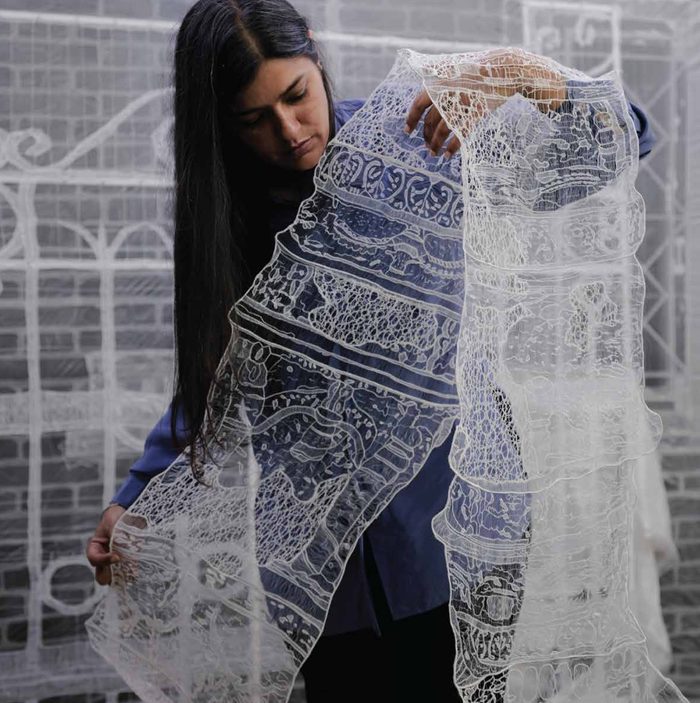
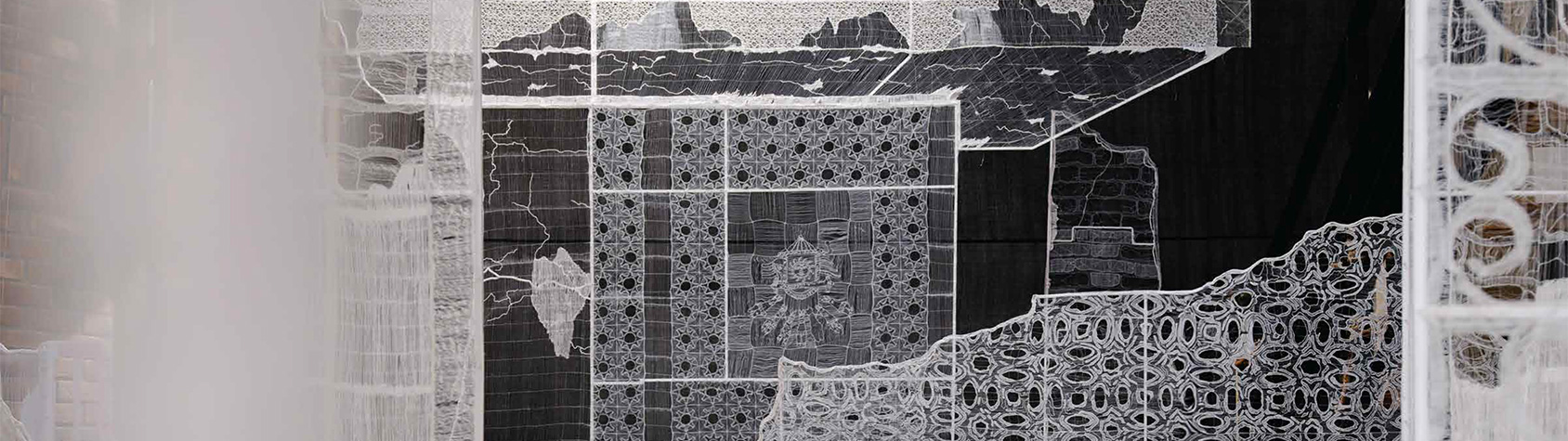
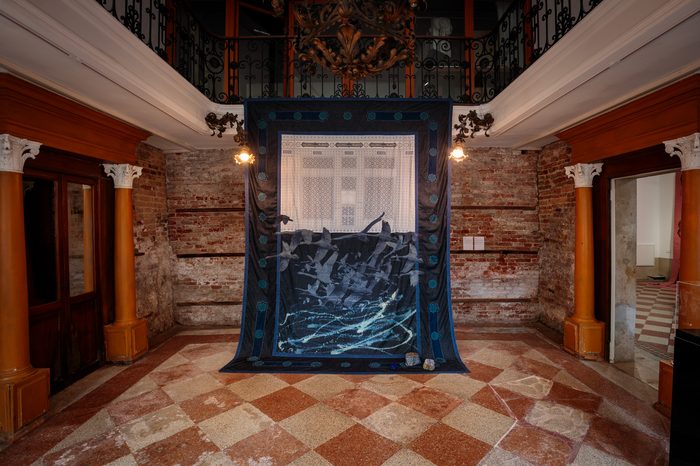
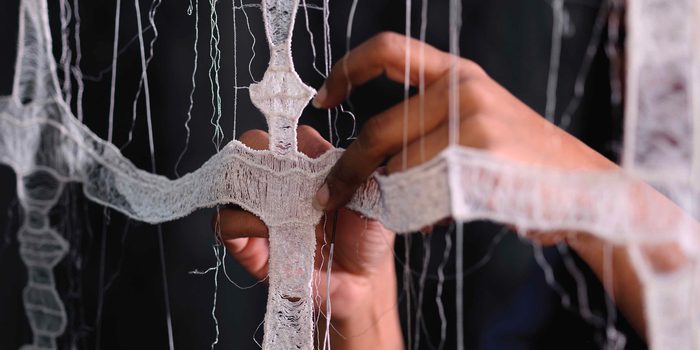
Sumakshi Singh answers these questions with Permanent Address (2026), an immersive, site-specific installation created by weaving together nylon, cotton and silk threads. It is an emotional mapping or documentation of the beloved home of the artist’s refugee grandparents: after serving as a decade-long point of reference for her family, the unchanging address, or, as she suggests, the “symbolic anchor” for stability, intimacy, and belonging, the building was sold and subsequently demolished.
Singh preserves the vanished architecture by reproducing architectural details, facades, staircases and doors, creating a translucent, both delicate and decadent environment, devoid of solidity and symbolic of the shifting boundary between tangible and intangible space.
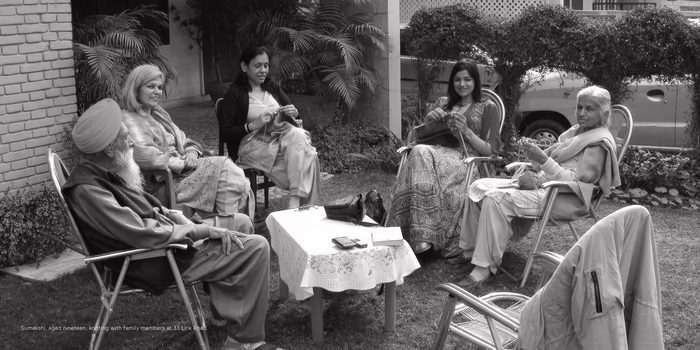
Memory—a fragile yet enduring presence—unfolds in space as a trace: “Every place carries multiple layers,” she explains, “architectural, historical, personal.” Thread implies labor, repair, care. The artist does not use a specific traditional weaving technique, but emphasizes that her choice of slow, laborious embroidery stems from the women in her family, who are originally from Punjab. Sumakshi Singh grew up watching them silently embroider phulkari while sitting together and sharing stories of daily life.
Through her artistic practice, she not only joins them but also assimilates a tradition passed down through closeness, shared time, and listening: Singh emphasizes how, historically, embroidery (as in the specific case of phulkari) has been associated with women’s domestic labor, secondary to weaving (which was predominantly the domain of men). The artist moves in a very clear direction, creating the detailed picture of “a house in the air”: despite the low status attributed to women’s work—the marginal, the embroidery—Sumakshi Singh demonstrates how it can stand firm even without support. As she explains: “Embroidery is seen as decorative rather than structural, as surface rather than substance. For me, this mirrors the historical positioning of women’s labor—as supplementary rather than foundational. In my work, when the base fabric disappears, only the embroidery remains. What was once considered ornament becomes the essential framework, holding both the form and the narrative together. This quiet inversion unsettles inherited hierarchies—between surface and structure, figure and ground, primary and secondary—and asks us to reconsider how value is assigned and whose labor is remembered. It is an homage to these softer histories.”
Power, social recognition and female identity are also central themes in Faiza Butt’s practice. Through the works on display at the Pakistan Pavilion (curated by Beatriz Cifuentes Feliciano) in the charming Ex Farmacia Solveni, the artist explores the generative landscape of the Punjab, “shaped by exchange, invasion, and cultural cross-pollination, where material abundance has driven prosperity and rupture.”
Through her extensive series Men of Punjab and Women of Punjab – Weavers, she expresses her interest in ordinary people, portraying the heroes of everyday life with simple acrylic portraits on paper. Faiza Butt advocates a reversal of the representation of women as muses—simultaneously earthly and divine—in opposition to the long history of the objectification of the female figure in art. Not only does she place male and female weavers on an equal social footing, but she also restores visibility to vernacular and marginalised cultural forms, and to the craft of weaving: among the key figures featured in the exhibition, Butt includes those of the weavers who collaborated on the creation of the monumental tapestries.
With the masterful assistance of the weavers from Havelicrafts and her trans-historical approach, Faiza Butt succeeds in transporting the traditional form of the tapestry into an immersive and pictorial context, “a critical site of intergenerational knowledge, labour, and cultural memory.”
Founded in 2010 by Jugnu and Moni Mohsin in the village of Shergarh (in Pakistani Punjab), Havelicrafts is a community project dedicated to rediscovering the local textile heritage. Among its most significant initiatives—such as the revival of disused tools like the charkha—is the revival of the native cotton of the Indus Valley (Gossypium arboreum), which has been cultivated in the region for millennia but has gradually been replaced by intensive farming.
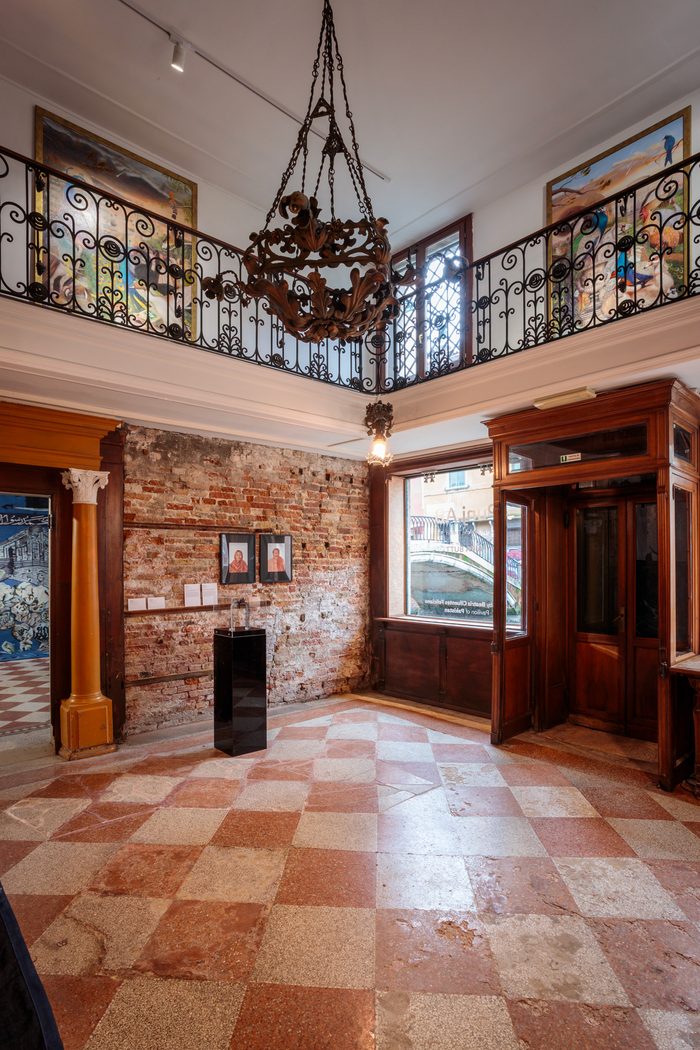
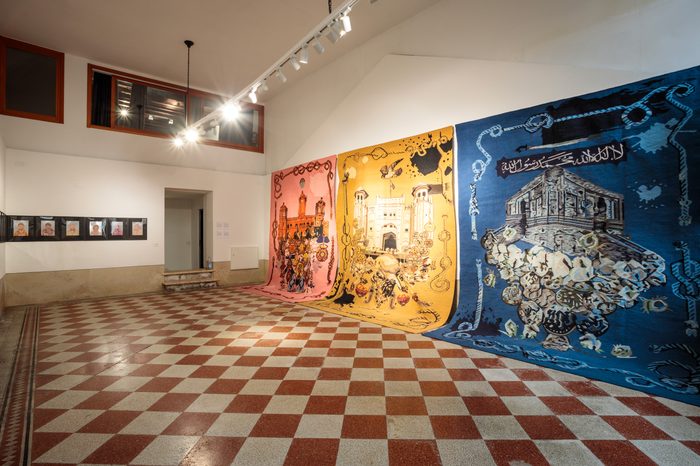
Collaboration, sustainability and cultural memory. The monumental series Memory of a New Age (1–10) is a project that constructs a historical and socio-cultural map of Pakistan through a layering of eras, symbols and architectural forms. The journey begins with the early “chapters” of Punjab (Memory of a New Age 1 and 2: Indus Valley Civilisation; Vedic Age) and, through the mural fabrics, recounts one of the world’s oldest urban civilisations, depicting the central stupa (a Buddhist structure) of the city of Mohenjo-daro (2600–1900 BC). The works, created with a focus on celebrating materiality (natural fibres, recycled fabrics and handcrafted techniques), highlight both environmental and social sustainability: in the former, Butt extends her practice into an educational context through her collaboration with students at Beaconhouse National University in Lahore.
The depiction of the Arab Sultanate and Mughal Empire periods draws on Islamic architecture and the richness of its decorative apparatus. In these tapestries, Faiza Butt interprets power as a system of political, economic, religious and cultural relationships structured around exchange and assimilation, thereby capturing the process of Indo-Islamic hybridisation that has profoundly shaped the history of the Punjab.
With Sikh Sovereignty (Memory of a New Age 7–8), dedicated to the Gurdwara Panja Sahib in Hasan Abdal—one of Sikhism’s holiest sites—the artist continues this exploration of cultural stratification. Through a collage-like composition, a hallmark of her practice, Butt assembles architectural, numismatic and ornamental elements within a single visual field. Coins and medals from the reign of Ranjit Singh interact with crowns, floral motifs and decorative details that bear witness to the convergence of Sikh aesthetics and European influences, evoking a historical moment in which cultural syncretism reached its zenith.
With Contemporary Punjab (Memory of a New Age 9), the focus shifts from the past to the present. Instead of depicting a large metropolis, Butt chooses Shergarh, a small rural town that is home to Havelicrafts, where she worked closely with a group of local weavers. At the center of the tapestry is a 15th-century shrine associated with the annual celebration dedicated to the memory of a Sufi saint. For the artist, this place embodies contemporary Punjab through spirituality, community and the everyday reality of rural life. The composition, flattened like a map and inspired by the conventions of illuminated miniature painting, weaves together symbols of mobility, transformation and fragility: birds evoke the crossing of borders, while rolled-up banknotes, plastic bottles and cotton flowers refer to themes of economic exchange, the environmental crisis and the complex legacy of cotton cultivation.
Woven in the green color that symbolizes Pakistan (and the Muslim community) using an off-loom technique introduced for the first time to the artisan women involved in the project, the tapestry is the result of a co-creation process that expands the weavers’ skills through new methodologies and new scales of operation. Made with hand-spun cotton, natural dyes and energy-efficient processes, it demonstrates how sustainability can be achieved not only through the choice of materials but also through the empowerment of local communities and the preservation of traditional craft practices.
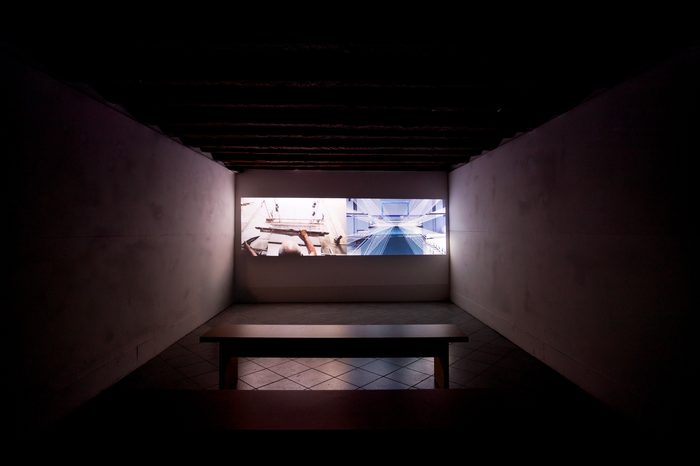
As summarised by the artist in the two-channel video installation Shergarh/Izmir Town: “Time, transient, intangible, yet quantified. Land, history, trauma, resource, mediaeval culture, belonging and quest. Love, ishq, as the foundational essence of existence. Love, unbounded, yet transcending from mere emotion to all encompassing force. Punjab, a sublime dream.”
The exhibition concludes with Memory of a New Age 10, located at the entrance to the pavilion as a synthesis of the entire project. Produced at the US Group factory in Izmir (Turkey) and developed in collaboration with the manufacturer, this jacquard tapestry serves as the industrial counterpart to the handmade works. Drawing on the Arab period of Punjab’s history, it depicts the Shah Gardez shrine in Multan and establishes a dialogue between mass production and artisanal tradition. The choice of denim brings indigo to the forefront—as mentioned earlier, a pigment with a fascinating history: in this context, the so-called “blue gold” creates a bridge between architectural heritage, devotional memory and the contemporary textile industry. The collaboration with the factory therefore does not represent a break from manual labor, but rather expands its potential, demonstrating how even the industrial process can become a space for experimentation, the transmission of memory and sustainable innovation.
Ultimately, the works of Faiza Butt and Sumakshi Singh demonstrate that textile practices are never merely repositories of tradition. They are living systems of knowledge that preserve memory while remaining open to transformation, capable of connecting personal histories with collective narratives, local identities with transnational exchanges and inherited techniques with contemporary artistic languages. Their respective projects reveal how thread can simultaneously bind together places, generations and political histories, while also exposing the fractures produced by displacement, colonialism and shifting borders.
Butt’s phantasmagoric historical cartographies and Singh’s delicate architecture of absence both return to the everyday and the intimate, repositioning authorship, visibility and care at the centre of artistic practice. In resonance with the Biennale’s In Minor Keys, they amplify what has historically been considered peripheral—women’s labour, ornament, vernacular knowledge and textile craftsmanship—transforming the non-monumental into the monumental. In doing so, they invite us to understand Punjab not as a fixed geography or a singular history divided by political borders, but as a living continuum of intertwined memories, shared cultural practices and evolving identities.
Here, the textile ultimately becomes more than a medium: it is an archive, a political or ideological statement and a space where the past is continuously rewoven into the present and, perhaps, the future.
[1] The Indigo Revolt also had a significant impact on the government, which immediately set up the “Indigo Commission” in 1860, in addition to the Indigo Act of 1862.
[2] The Punjab region was one of the areas most severely affected by the mass migration following Partition. This phenomenon led to a significant decline in numerous traditional craft practices and, in some cases, their complete disappearance. Among these are ajrakh, an ancient technique of dyeing and block-printing on fabric, and phulkari, an embroidery tradition closely linked to pre-Partition Punjab, encompassing the present-day territories of northern India and eastern Pakistan. In particular, phulkari has suffered a drastic decline as embroiderers faced the loss of their homes, the violence and trauma associated with migration, as well as the difficulty of sourcing the raw materials needed to produce the embroidery.
[3] Pulkhari (meaning “floral work” in Hindi and Punjabi), as mentioned, has been handed down and practised by women in the Punjab region; it is a form of embroidery using the filza stitch with brightly coloured untwisted silk threads (historically imported from Kashmir and Bengal), characterised by precise and regular geometric and naturalistic motifs. Traditionally associated with important social occasions (such as weddings), this type of embroidery is typically worked on a plain fabric such as khadi.
Main References
Art India Magazine. 2026. A Space Like Home/Geographies of Distance: remembering home. Vol. 29, n. 1. [1, 2]
Bizzarri, Cosimo. “Afghan Carpet Weavers Are Putting Drones on Their Rugs.” Quartz, January 30, 2015. Accessed October 9, 2024.
Coxon, A. 2022. “Beyond Craft: Textile Practices in the Art Museum”. The Journal of Modern Craft. 15. 153-165.
Jaffer, A. a cura di. Geographies of Distance: Remembering Home. National Pavilion of India, 61st International Art Exhibition – La Biennale di Venezia. Venezia: National Gallery of Modern Art, 2026.
Kouoh, Koyo, a cura di. 2026. Biennale Arte 2026. In Minor Keys. Catalogo della 61. Esposizione Internazionale d’Arte. 2 vol. Venezia, Cinisello Balsamo: Edizioni La Biennale di Venezia, Silvana Editoriale.
Riello, Giorgio, e Tirthankar Roy, a cura di. 2009. How India Clothed the World: The World of South Asian Textiles, 1500–1850. Leiden: Brill.