To Escape What Has Already Been Determined
On Riccardo Benassi’s commission by Xing for FESTA
On the occasion of FESTA project, Xing and NERO asked Paolo Gabriotti to document its outcomes as a witness. Each event in the project will therefore have its own account on NERO.
I walk down the stairs leading to Fondazione Merz’s underground exhibition space. I am in Turin for the second [festa¬] by Xing, realized in collaboration with GAM and entrusted to the imagination of Riccardo Benassi: Le ultime fabbriche rimaste in lontananza intonano gospel ripetitivi… [The last remaining factories in the distance chant repetitive gospels…].
The project [festa¬] invites different artists to conceive a performative work informed by the festive event, addressing its role, possibility, and urgency in our contemporary times. Each <festa> can take a different form, not as parties in the conventional sense, but as gatherings that can generate a temporary <change of regime> through a suspension of the ordinary. Unfolding over two years across different Italian locations, the series of <festa> will ideally trace a new calendar that was inaugurated on 10 May 2026 in Bologna with Simon Vincenzi’s <farewell to the flesh>. A new date has now been circled: 18 September, the day Riccardo Benassi’s <lying-in-state for the internet> took place in Turin.
[¬]
I walk down the stairs and, at the fountain facing the space’s entrance, I find a small offering laid out: some booklets—the publications each artist produces as an appendix to their work—and energy drinks. Canned iced coffee, a sort of Italian-style Red Bull. A few minutes pass, just enough time to leaf through the publication, and a sound emerges from the doorway. It calls us into space.
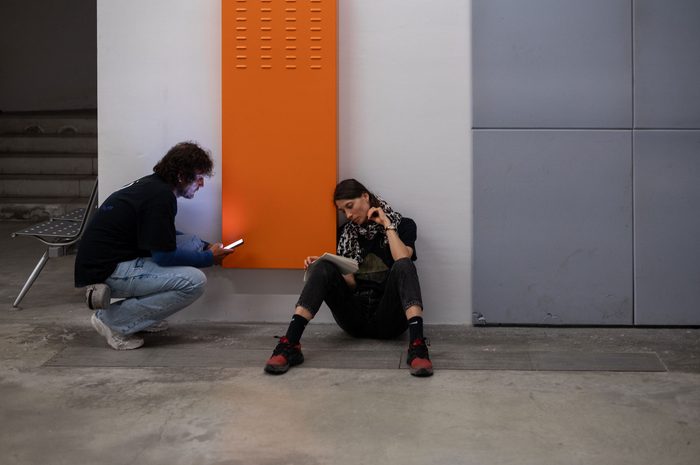
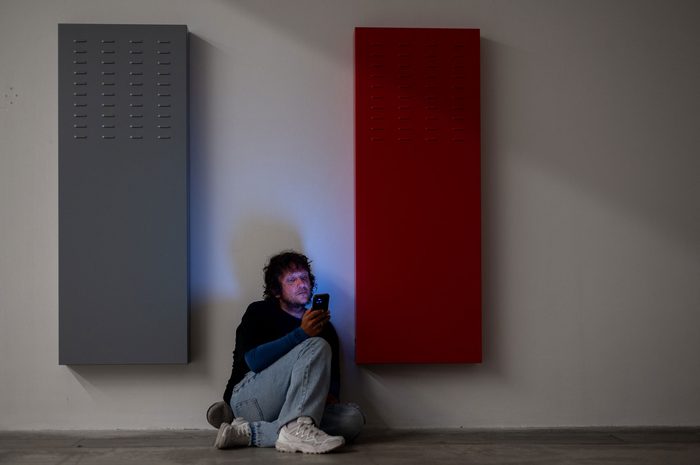
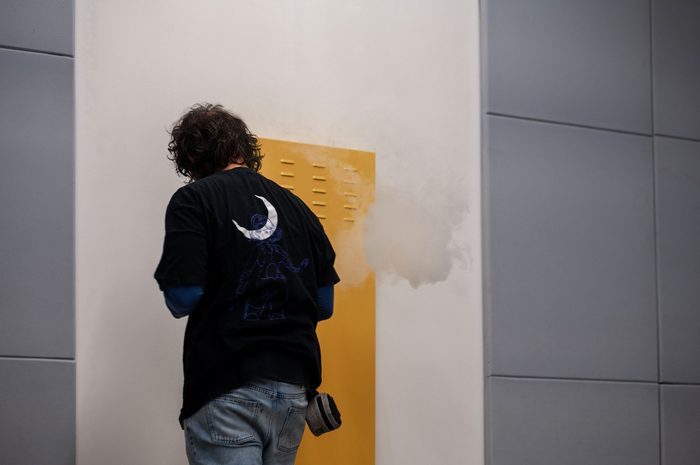
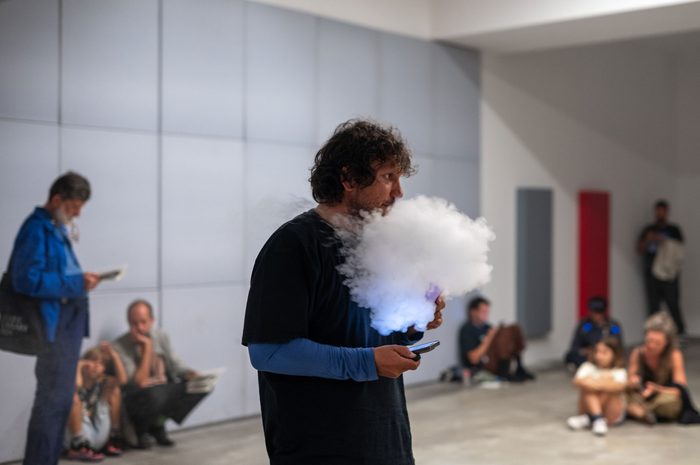
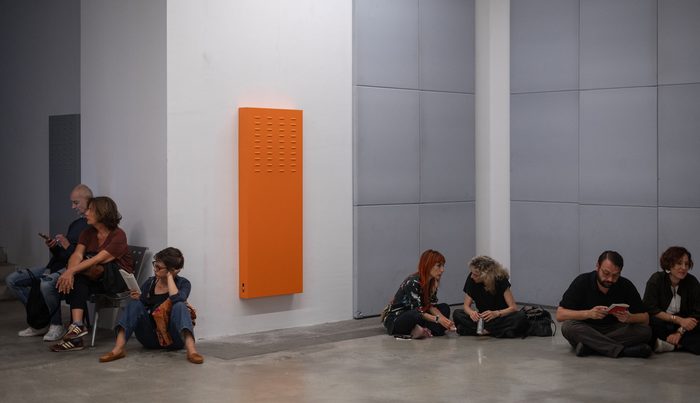
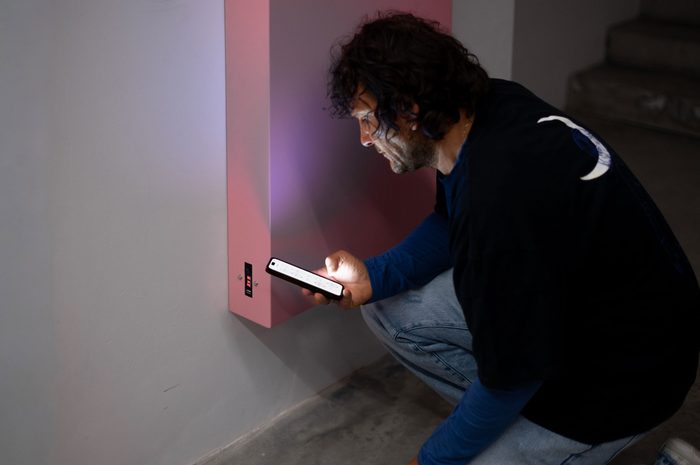
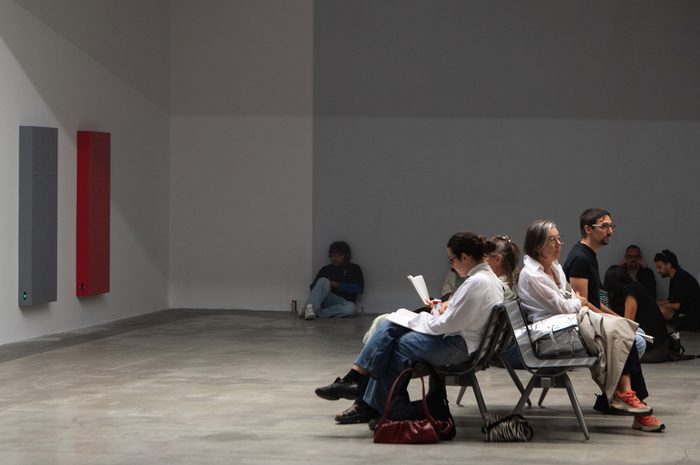
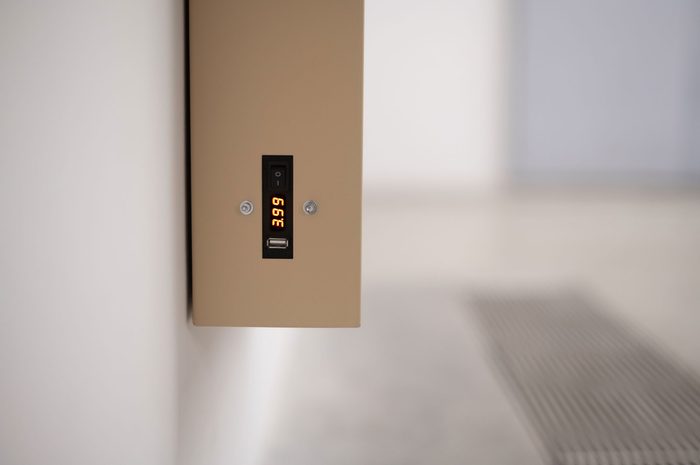
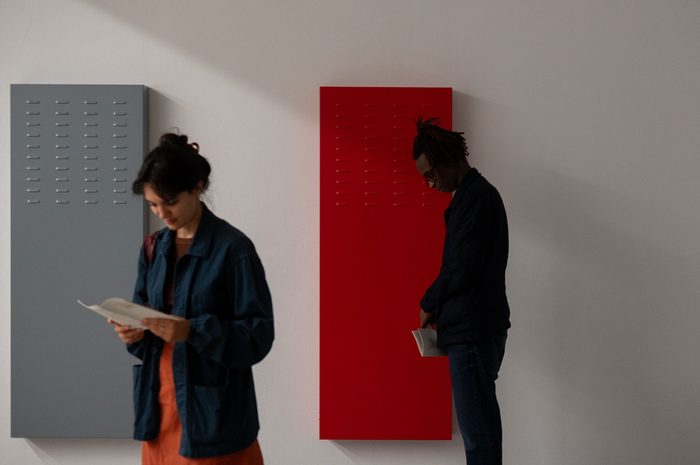
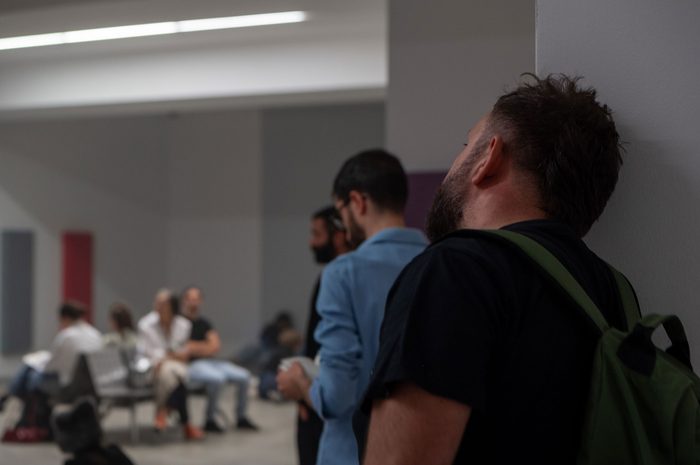
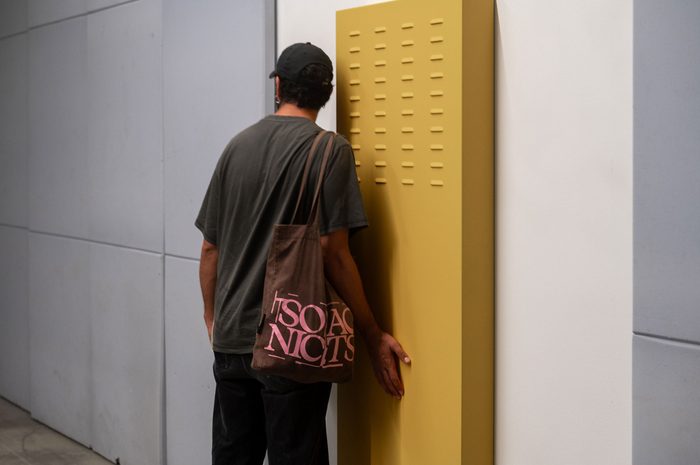
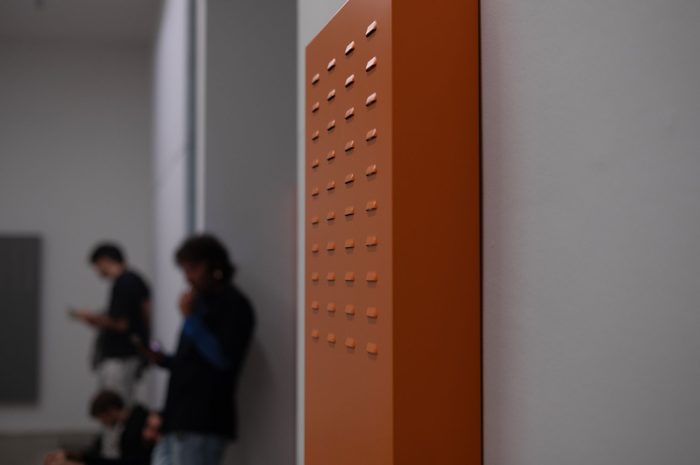
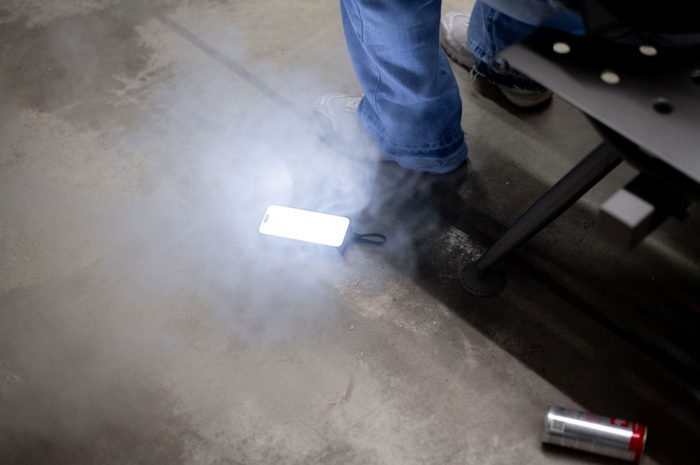
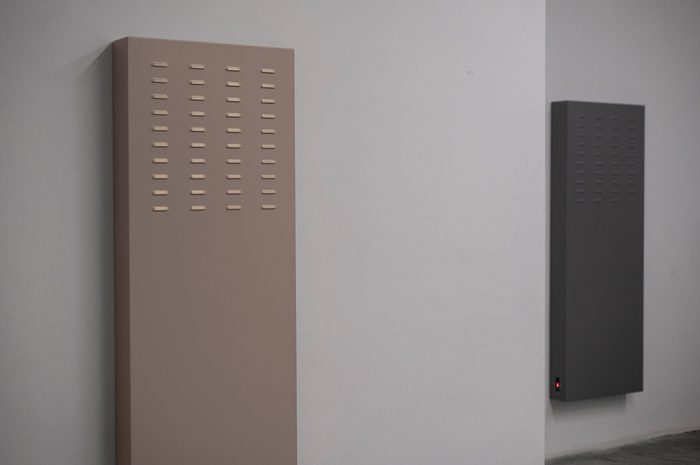
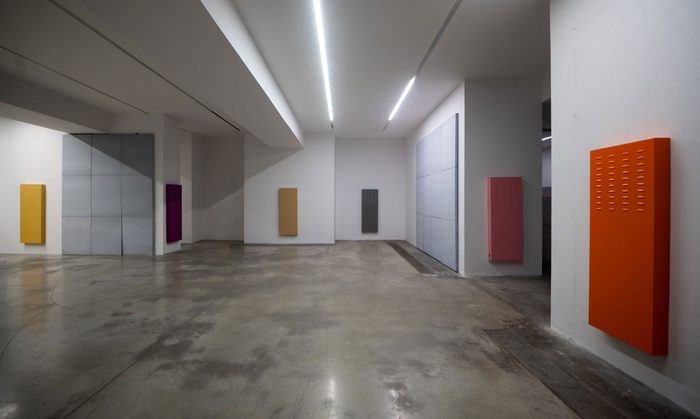
The room is a classic white cube, but with sections of grey acoustic panels on the walls. Between them, Benassi has installed a geometry of metal sculptures that embrace the entire room. They are identical in every respect to the ARL cabinets used by the telephone network, except for their colors—not only the standard grey, but also purple, yellow, and orange—and for that sound. It comes from one of them, the one furthest away, in a corner at the opposite end of the entrance. Beside it, a figure lies on the floor, eyes fixed on the smartphone, mouth glued to the e-cigarette, puffing compulsively. We approach this totem and its strange acolyte, who remains entirely unmoved by our presence. Absent, perhaps through distraction, or perhaps through excess of activity.
[¬]
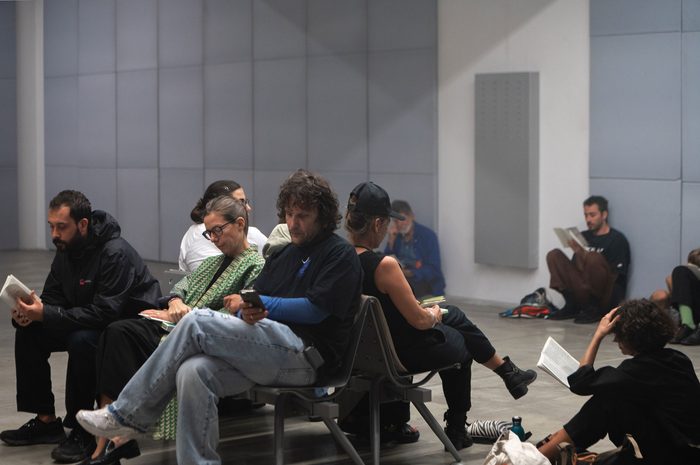
I sit on the floor with the rest of the audience, near the guardian of this <vibrating high-relief>—the term used to describe the sculptural ensemble Benassi has titled Tecnosistemix. I begin listening to the track. A few minutes pass by and a second sound source joins in. It’s the high-relief on the opposite wall. Then a third one joins from the other side of the room, while the first falls silent, only to resume. Gradually, it becomes clear that the ensemble has a choral vocation.
I find it hard to describe the sound of this lying-in-state. It’s synthesized, a gentle, ambient melody, though it doesn’t fit the ambient genre. It clearly evokes the digital, a sense of liquidity and flow, while also carrying a faint patina of the past, with Y2K undertones. Yet it isn’t citational like vaporwave, even though its waves break against the clouds of vapor exhaled by the human figure, who occasionally gets up and moves around the space, attached to his electronic incense burner and perpetually absorbed by the touchscreen.
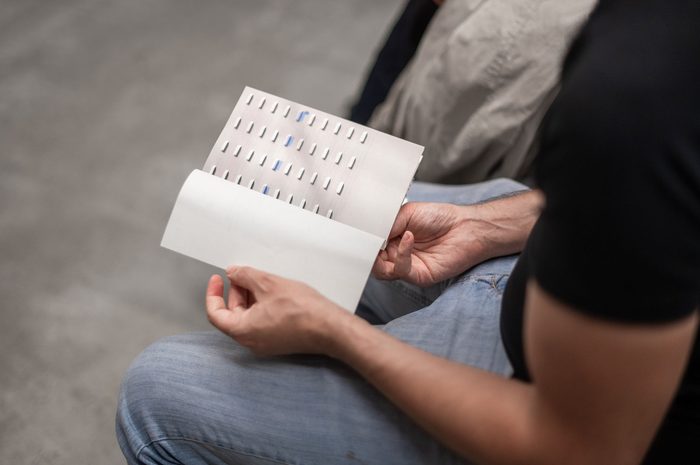
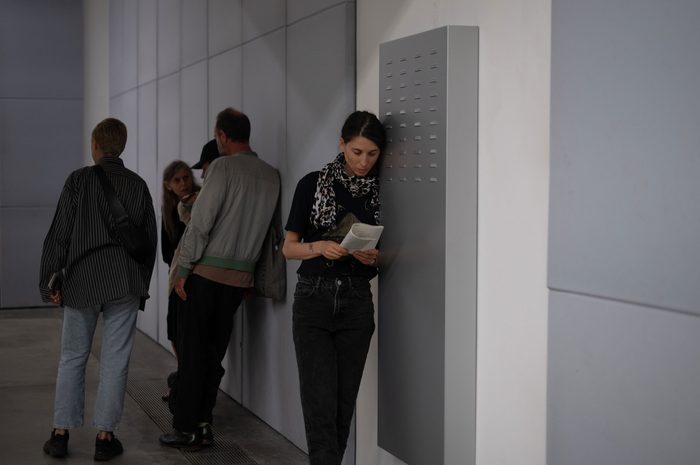
The melody fills the room, and although it is purely electronic, it reminds me of voices. It has a choral grammar—perhaps an angelic choir; after all, we are in a lying-in-state—and it is constantly changing, both because its sources switch on and off and because visitors move around. Approaching, moving away, lingering in different parts of the room: each action produces new acoustic effects, overtones generated by the synthesis of the transmissions. Almost immediately, I would say inevitably, one feels drawn to settle down, to adopt a posture, an inclination towards rest—despite the caffeine offering—and begin reading, rocked by the soundtrack.
[¬]
Riccardo Benassi is a writer, as his entire body of work across visual and live arts demonstrates. And this room reveals itself to me as a story, synthesized into an environmental image, extended by an electric choir.
If I were to venture a literary classification, I would speak of auto-fiction-theory, because his writing takes a biographical form that slips into narrative invention, as in auto-fiction, from which a speculative perspective—critical and philosophical—emerges, as in fiction-theory. Such is the text we hold in our hands. A stream of words that, as we read, becomes another voice, joining the choir weaving through the room.
<There is a sun burning at the base of the neck, it is neither sunrise nor sunset.> [1] From the outset, the story catapults us into a precise yet suspended time and place: a memory, an image drawn from the artist’s familiar landscape, the Po Valley of the 1990s. It begins on the road, <in the clearest of liminal lights, filtered through the exhaust fumes of freight trucks, through the vaporous remnants puffed skyward by silvery pipes that punctuate the flat horizon>. [2]
This is an initiatory tale. It begins with a personal epiphany: one day, a telephone-network cabinet is left open—one of those ARL boxes that, as I read, broadcast an almost spiritual melody throughout the room. Looking inside it, the artist discovers the internet. I speak of auto-fiction not so much because of this epiphanic event, which may or may not have happened, but because the story seems to merge in Benassi’s mind—and within the same environmental memory that this festa appears to materialize—with another story: that of Thomas Byrle, recounted in the text.
While working in a textile factory, where the only way to endure the deafening noise of the looms was to lower his own level of perception, Byrle experiences an epiphany. From the hum of the machines, a choir rises, reminding him of the religious songs heard in his childhood. <A form of spirituality attained through technology, a malfunction of our sensory system induced by a substitute, synthetic truth, that flirts with hypnosis,> Benassi writes, continuing: <This, in every respect, seems to be the best possible idea of what we call electronic music, an idea whose echo reverberates towards a relationship with the machine in which the interface loses all coherent meaning and instead demands a personal emotional interpretation.> [3]
The text constantly oscillates between story and essay, tracing the history of the internet from the network’s arrival in the 1990s to the COVID pandemic, the event with which Benassi aligns his declaration of its death. If we are in a lying-in-state, we must assume that a death has occurred, or at least that it has completed its service and that it is now time for something else. There is a very famous theory, the Dead Internet Theory, which went viral online precisely because it was itself a meme, but has increasingly come under serious scrutiny over time. The theory claims the internet is dead because artificial agents have saturated it, turning the network into a space where content production and reception are automated and emptied of human interaction. Benassi’s text, however, proposes a more nuanced analysis. It does not so much embrace the idea that the human presence has been entirely emptied of the internet as suggest that its death is effectively realized as—<now that the internet is no longer a place but an infrastructure> [4]—our relationship with it changed radically: <When the internet was still a space, I could talk about whatever was on my mind with other people. Now I talk to a machine whose sole intention is to make me talk.> [5] For Benassi, the early internet he grew up with and believed in—anonymous, libertarian, interrelational—dies as it becomes a stream that continues indefinitely without producing experience. It becomes waiting without a subject, a space of suspension in which we do not wait for reality to arrive, but for a system of signs to produce something that makes us believe reality is still on the other side. I will quote one passage from the text’s broader, more elaborate analysis: <On the one hand, the internet is still alive; today it persists as the privileged medium of the communications infrastructure, the latest ontological upgrade of the telephone line,> with the arrival of the smartphone. <On the other hand, the internet is dead because most of the digital content that populates it is synthetic: artifacts produced for an audience of artifacts, which interpret them in a constant back-and-forth that generates traffic which in turn generates an economy. […] To the point that every synthetic piece of content exists solely and exclusively for the human being who owns and has trained their own interface.> [6]
[¬]
The analysis returns to storytelling, back to the streets of Benassi’s family neighborhood, now the setting for political demonstrations. We are at a protest by workers from the nearby factories—because one must work to pay the medical expenses caused by the fumes puffed from the chimneys of that very work. Another stream without experience. But the street offers a second epiphany: a sticker bearing an ultras football slogan, that nevertheless inherits a chant from the 1977 political movement: <WE DON’T GIVE A FUCK ABOUT THE GAME.> Not leisure time, but liberated time. The motto shows an escape route: not a demonstration that plays a match against public opinion, but the possibility of a <festa>, of lingering in a suspended moment just before the protest, cultivating the conditions that make it possible. A moment when the street is still only a place of encounter, when writing a banner is still a game played with hands and language, inventing words and their connections, making poetry.
Towards the end of the story, we meet a second portrait, like Byrle’s, that offers another key to understanding Tecnosistemix and its gospel: the artist Rebecca Howland. The text focuses on her 1980s sculpture series Transmission Tower, in which Howland replicates high-voltage electricity pylons: civic monuments designed by unknown artists, anonymous yet ubiquitous symbols of distribution and control. In Howland’s work, too, a fictional narrative insinuates itself into the history of the artwork: <By analyzing the pylons formally and wondering who designed them, Becky Howland imagines a male civil engineer who has to design something to carry the cables, but then ends up thinking about his own mother and giving birth to gigantic monsters.> [7] For Benassi, Howland’s Transmission Tower sculptures bring into focus a forgotten landscape—as the ARL cabinets themselves—of the technological infrastructure surrounding us, which <inhabits our neighborhoods and our bodies, and records our very existence to better tame those who are yet to arrive>. One that <can now operate without our knowledge, penetrating even our smallest gestures, our sighs>. [8]
[¬]
I finish this epiphanic story and, as I close the final page of the booklet, accompanied by a gospel that flirts with hypnosis, I hear the echo of a voice rising from the choir of machines: <There is a sun burning at the base of the neck it is neither sunrise nor sunset.> It’s the guardian of the infrastructure, an exhausted yet never still body, moving around the room, always fixed on the smartphone, compulsively puffing on the e-cigarette and drinking iced coffee. A small speaker clipped to his belt now emits an impersonal voice reading the story aloud. As I approach, I sneak a glance at his phone. This is no distracted guardian: I see an interface through which he controls the choir, switching transmissions on and off and composing their voices live.
I have spent roughly the first hour immersed in sound and text, moving to a few different spots in the room to explore the variations in listening. Beyond the initial surprise, this disembodied reading performance, emerging from just another tool carried by a guardian who has long inhabited the space alongside us, has an anticlimactic effect: no one seeks out a performative focal point. Instead, the reading sustains an undirected mode of attention that allows us to inhabit space and duration freely.
Precisely this possibility—not having to follow the guardian’s presence and movements—lets his voice recede into the distance and sink into the synthetic choir, only to find it beside us again, to pick up the thread of the text once more. Creating a coincidence in the room between the textures of movement and the textures of sound.
A way of being in the space that emerges naturally, yet is made possible by the event’s specific properties. What seems to be at work is a shifting relationship between figure and ground: a space containing few immediately visible elements and slowly varying over time through exploration; the guardian’s reduced, repetitive presence, eventually blending mimetically into the surroundings; the concealment of his live control of the choir, which might otherwise have been understood as a figure of hyperconnectivity; and, finally, the decision to mediate the voice. Together, these elements produce a performative horizon that I would describe as flat. An expanse, like the landscape of the Po Valley, that opens to leaving, entering, and moving freely; to chatting with others; or to taking a moment for oneself, to listen, to read.
[¬]
Once again, we find ourselves on a street, facing an open telephone cabinet, and then inside a textile factory whose hum transforms into a choir, amid the transformations of a network that grows ever more pervasive, and, finally, we stand before a transmission tower, discovering that we have grown weary of being its guardians, <as though the ultimate purpose of every act of maintenance were the dissolution of the act itself. This is how the internet abandons us, like a sick and exhausted body, drained not so much by malfunction as by an excess of activity that it can no longer endure.> [9] Yet within this awaiting, which seems to repeat itself without a subject and never resolve into an event, we can indulge ourselves or discover that we don’t give a fuck about the game and cultivate the conditions <to escape what has already been determined>. [10]
The original quotes in Italian are all translated by the author:
[1] <C’è un sole che brucia alla base del collo, non è un’alba non è un tramonto>
[2] <Nella più limpida delle luci liminali, filtrata dai gas di scarico dei camion merci, dai residui vaporosi sbuffati verso l’alto da tubi argentei che punteggiano l’orizzonte piatto>
[3] <Una forma di spiritualità raggiunta per via tecnologica, un malfunzionamento del nostro sistema sensoriale indotto da una verità sostitutiva e di sintesi che flirta con l’ipnosi […] questa, a tutti gli effetti, suona essere la migliore idea possibile di ciò che chiamiamo musica elettronica, idea la cui eco rimbalza in direzione di un rapporto con la macchina nel quale l’interfaccia perde totalmente ogni senso compiuto e richiede piuttosto una personale interpretazione emozionale>
[4] <Ora che internet non è più un luogo ma una infrastruttura>
[5] <Quando internet era ancora uno spazio avevo la possibilità di parlare di ciò che mi passava per la testa con altre persone. Ora parlo ad una macchina il cui unico intento è farmi parlare>.
[6] <Da un lato internet è ancora viva, permane oggi in qualità di mezzo privilegiato dell’infrastruttura di comunicazione, come ultimo upgrade ontologico della linea telefonica […] dall’altro internet è morta perché la maggior parte dei contenuti digitali che la popolano sono di sintesi, artefatti prodotti per un pubblico di artefatti che li interpreta in un rimbalzo costante che genera traffico che a sua volta genera economia. […] Fino al punto che ogni contenuto di sintesi esiste solo ed unicamente per l’essere umano che possiede ed ha addestrato la propria interfaccia>.
[7] <Analizzando i tralicci a livello formale e chiedendosi chi li ha disegnati Becky Howland immagina un ingegnere civile maschio che deve progettare qualcosa per trasportare i cavi e poi finisce per pensare alla propria mamma e mettere al mondo grandi mostri>.
[8] <Abita i nostri quartieri e i nostri corpi, e registra la nostra esistenza per meglio addomesticare chi deve ancora arrivare […] riesce ora a funzionare a nostra insaputa, perforando addirittura i gesti minimi, i sospiri>.
[9] <Come se il fine ultimo di ogni atto di manutenzione sia la dissoluzione dell’atto stesso. Così internet ci abbandona, come un corpo malato ed esausto, prosciugato non tanto dal malfunzionamento ma da un eccesso di operatività che non è più in grado di sopportare>.
[10] <Per sfuggire a ciò che è già stato previsto>.