
I laugh when I think
that my eyes persist in demanding objects that do not destroy them
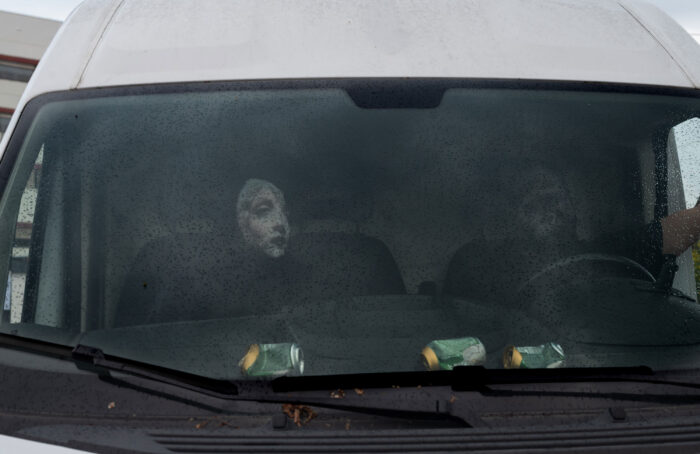
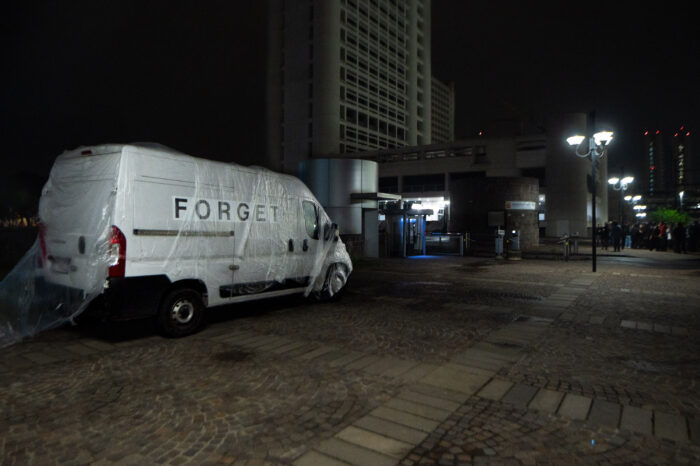
FORGET. I read it written in large letters on the side of a white van, while from behind me comes the sound of a distorted guitar. It’s the stereo of an empty car parked a few steps away. Then a distinct phrase is carried by the wind: <there’s a party in my mind>. I get closer; it’s the Talking Heads, <Memories Can’t Wait>.
I have to write about a festive event though not in the sense of a party, and upon exiting, I find this invitation to forget. A passage by Derrida on the theatre of cruelty and the representational space of the festa, as opposed to classical theatricality, comes to mind: <its act must be forgotten, actively forgotten.> In order to write, I must then imagine myself assuming the perspective of that final figure, absent yet lurking in the car: <Other people can go home/Everybody else can split/I’ll be here all the time/No, I can never quit.>
¬
I have to write about [festa¬], Xing’s new project that will unfold over the next two years in various locations across Italy. The project consists of a series of invitations, each addressed to a different artist, who is commissioned to conceive and create a performative work in response to a question: <Does a use, or at least an idea, of ‘FESTA’ exist within our contemporary world?>
The research began in Bologna with In The Carnival of The Void by British director and choreographer Simon Vincenzi, an artist the city has hosted on several occasions, leaving a mark on Xing’s various production cycles, from Netmage09 with The Infinite Pleasures of The Great Unknown, to FROM THE DEAD AIR ORGY: The Song of Silenus for Live Arts Week VIII, finally opening the subsequent Hole format with a gathering to follow the streaming of the second chapter, FROM THE DEAD AIR ORGY: On the Nature of Things.
I write from a particular perspective: I’m a collaborator at Xing—a collaboration that began while assisting Simon Vincenzi for Live Arts Week—and I followed the conception and production process of this new work from the inside. Festive events don’t have spectators, only participants, and I like to think that in this case those who were participating forgot everything by the time they left. Thus, like a strange witness, that voice coming from an abandoned car comes in handy: I can assume the perspective of someone who participated, but also its denial [¬]. In this way I can elude the invitation to forget In The Carnival Of The Void and the research on festa.
¬
The meeting point is a nowhere. A parking lot located between the towers of the unfinished Bologna expansion designed by Kenzo Tange and the antennas of the RAI Italian Television. A white van drove up onto the sidewalk and is shining its headlights on the entrance to the underground parking. A soft but deep rumble can be heard from the back, while inside two masked figures listen to the car radio. The vehicle plays a frenetic broadcast, combining 1930s music, long litanies of binary code, and messages delivered by an impersonal voice. Some are mysterious, others are warnings of danger: <Be careful>, <They’re coming>, <Arm yourselves>, <Silence is faster going backwards, three times faster>. A gorilla sits in the driving seat, holding an old aerial out the window, trying to stabilize the transmission, while in the passenger seat there’s Marlene Dietrich. The reference is to the famous scene from the film Blonde Venus, in which Dietrich emerges from a gorilla suit and sings the song Hot Voodoo – a scene and a song steeped in the most classic racial imagery, of the savages black people and the primitive celebration threatening and insinuating into the blond civilization.
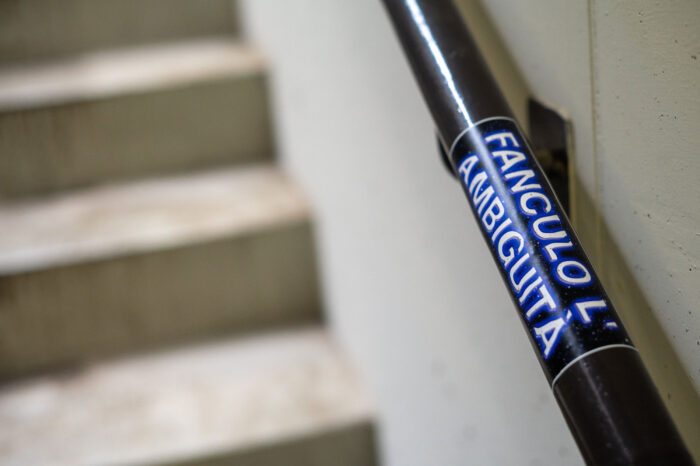
The van turns out to be, in retrospect, a source of clues covering the entire work, which is peppered with references from the arts, especially cinema, but also from signs that hark back to current politics: neo- and techno-fascism, the rubbles of Gaza, police repression, the control society, the assault on Capitol Hill. These are images that are simultaneously enacted and destroyed, nefariously staged and mocked in the reversal of the carnival—a form of celebration which has always had an explicitly political role and imagery.
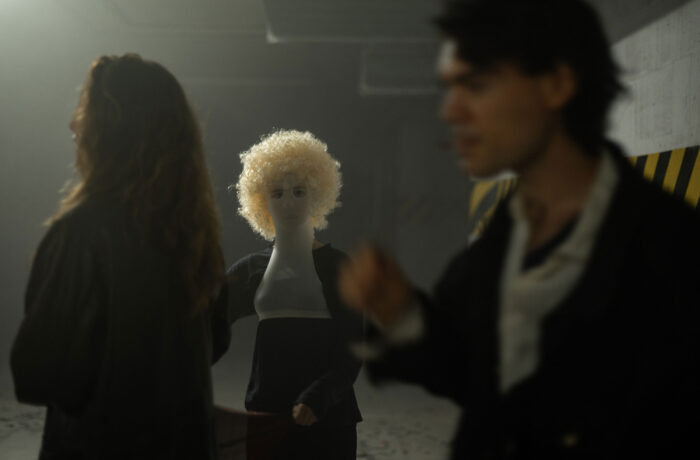
A cloud of white smoke rises from the basement and we are invited to descend—it’s a sort of negative of the towers rising above.
¬
The [festa¬] series is a project that Xing began conceiving in 2025, ideally picking up an exhibition project conceived in 1976 by Alberto Boatto for the GAM in Bologna, which was never realized. The exhibition and the series of festa conceived by Boatto aimed to trace a history of celebration from the beheading of Louis XVI, which for the critic had inaugurated <the acephalous anatomy of the modern,> up to the political demonstrations of the 1970s. In a strange collective alignment, several projects on the theme of celebration are emerging, particularly in the performative area. Xing’s project takes on the term in a wide variety of meanings, less focused on the dimension of the club and the party—including popular festivals, fairs, raves, private parties, picnics, celebratory parties, potlatch—letting the specific form of the celebration to be explored by the invited artist. At the heart of Xing’s investigation is a reflection that has been developing, particularly since 2021, on post-pandemics and live arts as an act of convocation, of gathering. Thus also on the codes of spectatorship that live events can assume beyond the classical dynamics of spectacle and pure programming.
This is a reflection to which I have dedicated two articles—<The Dépense of Gianni Peng> and <Post-Mortem Live Arts>—and on which I will dwell less here, postponing some points of analysis to future festa appointments. This is because, I believe, Simon Vincenzi’s festa takes the position of a negative affirmation; to effect a regime change—spectatorial, political—it primarily enacts what it must liberate. As with popular festivals and rites of passage, it is an attempt to generate difference by crossing the previous state that one wishes to abandon, destroy, dissolve. To recall Derrida, <the mortal limit of a cruelty that begins with its own representation.>
¬
I go backwards again, where silence moves three times faster. We are emerging from the underground at the conclusion of the performance (but before forgetting). A publication is offered, a booklet with images and excerpts from various texts. More clues. They speak of the void and dissolution, of the cosmos and cosmologies, of capitalism and fascism. I quote one of the first pages, by archaeologist David-Lewis Williams: <Concepts of a tiered universe are, of course, not restricted to shamanistic religions. Heaven above, Hell below, and the level of anxious humanity between appear in one form or another across the globe>. In The Carnival Of The Void requires a descent into the underground, a catabasis into the territories of spirits and the dead, leaving behind the anxious life of the surface.
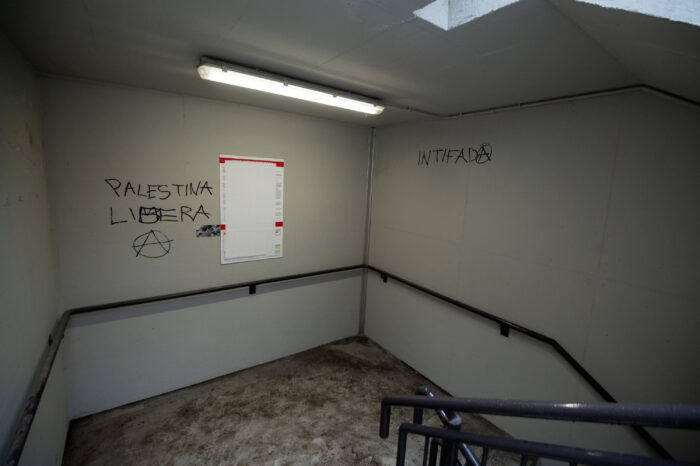
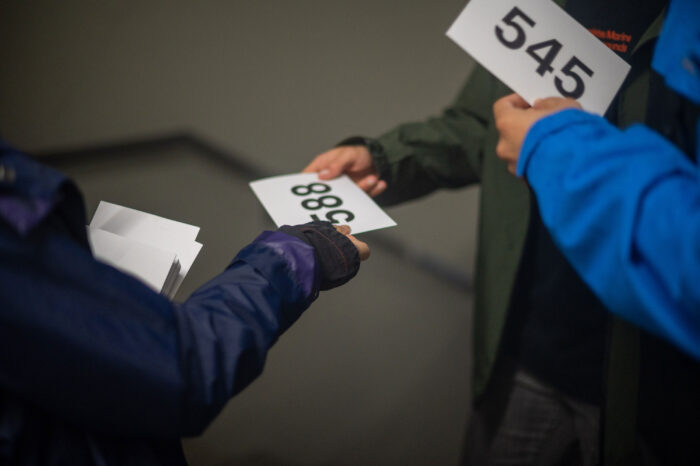
Descending the stairs, you encounter erased security signs, graffiti on the walls—<Free Palestine> is perhaps a pre-existing sign, but <Tear me from myself> is probably not—and stickers: an upside-down photo of destroyed Gaza, an absurd image of Samuel Beckett posing with a mascot, texts quoting <fuck ambiguity> or <fuck granularity>. A hostess halfway down the ramp hands each participant a card with a number and points to a metallic door, essentially asking us to walk through a mirror. I initially thought of the scene from the film The Matrix, but references to the original Cocteau’s Orpheus are starting to crop up: the mirror as a portal to the afterlife, the parked car, the radio sending coded messages from the world of the dead, time rewinding, memory loss.
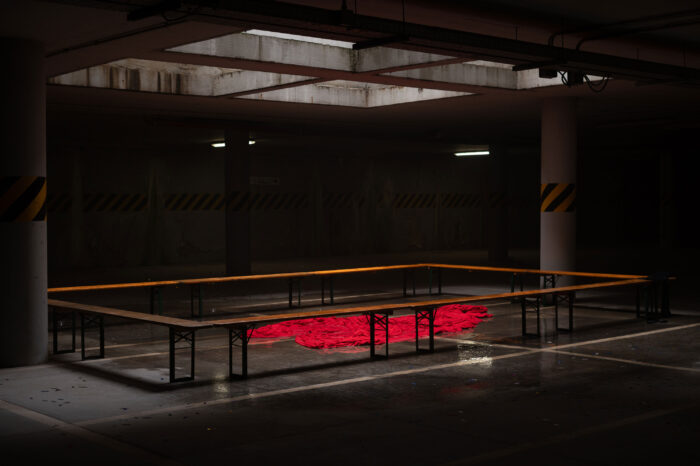
Beyond the door, two more hostesses greet us, a woman and a young figure wearing a strange mask made from a white stocking with eyes and mouth pierced, and a curly wig. It’s a strange mask, but also a little comical. They attach a sticker to our chests, with numbers or names. Some I recognize, like <Signora Vaccari> from Pasolini’s Salò, others recite <The Modern Dance> or <The Wheeping Philosopher>. Upon entering, we become figures of this artwork. The space is vast, stretching as far as the eye can see, and appears like a suspended image. Confetti is scattered on the floor everywhere, and we meet a large opening through which a shower of rain pours down. It is bordered by benches that form a kind of stage space, overlooking a pile of red towels. They remind me of strips of flesh, but I was certainly influenced by other signs scattered throughout the space, such as the image of an ancient painting, tinged red, depicting a satyr upside down being flayed alive, almost certainly Marsyas. There are also abandoned clothes scattered around, a pair of glittery panties on the floor, a robe on a hanger wrapped around the column like a BDSM garter. We wander through the space for about half an hour, without any indication.
A bang and a cloud of confetti recall us from this vision, which is simultaneously an empty stage—it mirrors a performance space but is devoid of bodies, except our own. Looking around, one actually has the impression of seeing a mass of ghosts waiting for a passage, now concentrated toward the single narrow opening.
¬
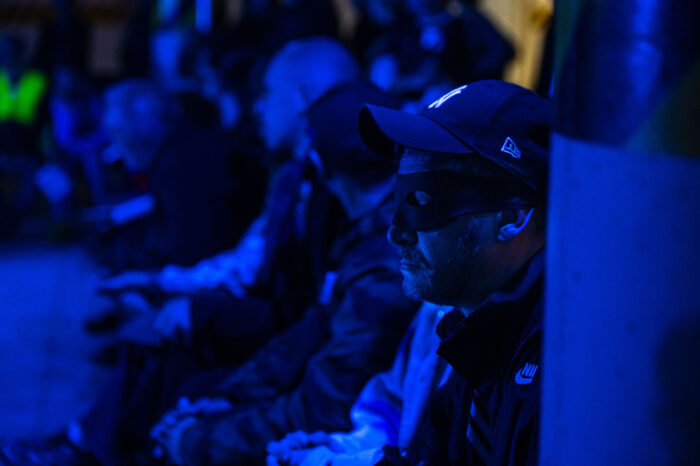
The two hostesses hand out some objects, such as knives and black masks. They’re all cheap, carnival-like items, but some real truncheons are also given out. It’s quite an experience to see people in the audience moving around with truncheons in their hands. There are also some red hats, a clear reference to the MAGA uniform. This space is lit in a lunar blue but otherwise is similar to the first environment: confetti on the floor and a central stage area surrounded by benches, where the audience sits and immediately surrounds them on 4 sides. The performance has codes and norms that the audience has naturalized, and Simon Vincenzi seems to want to insist on them, because from here begins a choreographic sequence lasting almost an hour, organized into parts that are stated out and with a classic spectator dynamic, of seat and stage, but extremely reduced and anticlimactic in its repetitiveness—even if animated by strange events that take place at the perimeter of the stage area.
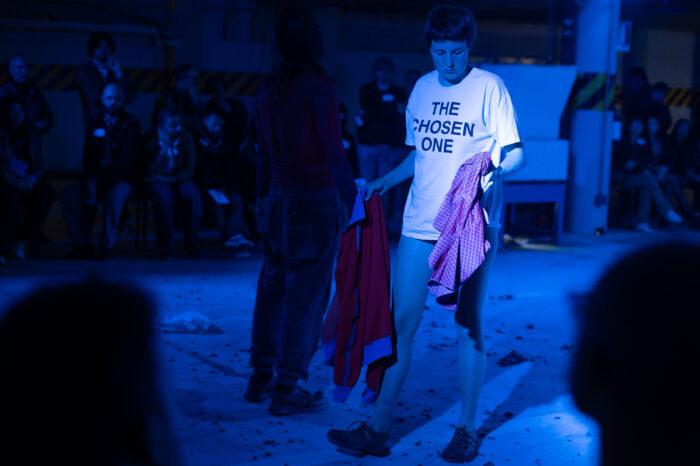
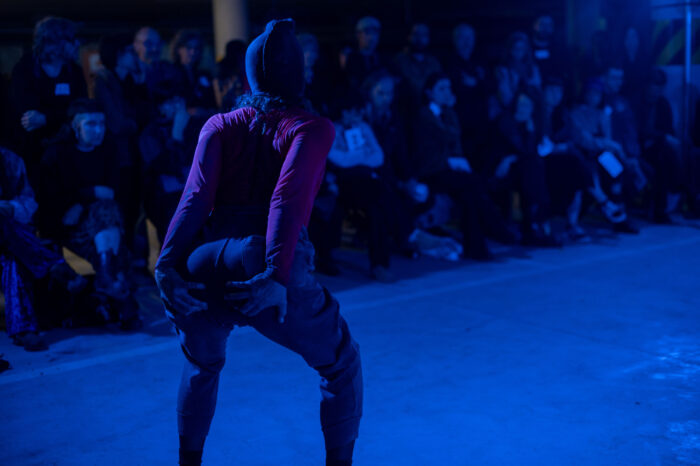
A performer takes center stage, covers his face with a balaclava, puts on earphones, and reveals himself to the audience, sporting a T-shirt that reads <THE CHOSEN ONE>. The sacrificial victim. He removes it to reveal a semi-transparent red shirt, evoking the flayed body in the painting and the mass of flesh in the twin stage space. A voice: <SECTION ONE. THE BEGINNING OF MATTER>, then <PART ONE. L’ABISSO DEL CAOS>. The chosen one begins a convulsive dance that will continue throughout the section, in its twelve parts, with only slight variations—moments that appear more internal, others in which the convulsions explode and take hold. There are key points, the mouth and the anus, which are insistently manipulated, and passages in which more exquisitely choreographic movements can be recognized, perhaps even references, but barely hinted at. The entire performance, both in its convulsion and in these moments, is avowedly anti-virtuosic, grotesque. That roaring sound heard in the van returns in this section, but it too is only hinted at; for the most part, the section focuses on the Chosen One’s body and on its minimal, repetitive act.
The parts alternate in sequence, interrupting the flow just long enough to be announced: <THE WAITING MOUTH/THE GRANULARITY OF FICTION/IL CERCHIO DELLE MANIE/THE YAWNING/THE STRANGE ATTRACTOR/GROTESQUE GRANULARITY/WITHIN THE FUNDAMENT OF MATTER/ THE WILD ASSES SKIN/L’EVOCAZIONE DEGLI ANTENATI/L’INVERSIONE DEL SIGNIFICATO/LO SGUARDO DEI DISTRUTTORI>. However, in the benches at the perimeter of this zone, various phenomena begin to be noticed, some more obvious, others minimal, also because they are carried out by people who until that moment appeared as ordinary bystanders and, moreover, mixed in with an audience wearing thieves’ masks and high-visibility vests or playing with plastic knives and swinging truncheons. I mention a few without remembering the order, nor being sure of having noticed them all. A veiled figure recites intermittently, at various points in the section, excerpts from barely comprehensible texts. A glossolalia which comes through an impersonal voice and as if they too were holding back some sort of internal convulsion. The Chosen One also recites texts at times, which he enunciates with difficulty, words wet with saliva, as if he had something in his mouth. I recognize only one of the sources, but I’ll reveal it at the end. Another figure wearing a red MAGA hat explodes with rage, shouting <fuck granularity>. Two figures enter the staged area and make a sign on the ground with small piles of shredded material. Another, now wearing a stunning glittery monkey mask that ends with a sort of planet or antenna on its head, pulls down their pants, revealing red socks, the other half of the Chosen One’s costume. Yet another pees himself while sitting in the audience and leaves, leaving the puddle on the ground. A performer wanders behind the benches, walking backwards and displaying a phone that emits the same sound that has been recurring since the van’s first appearence, and which, up close, is now more clearly that of a shredder.
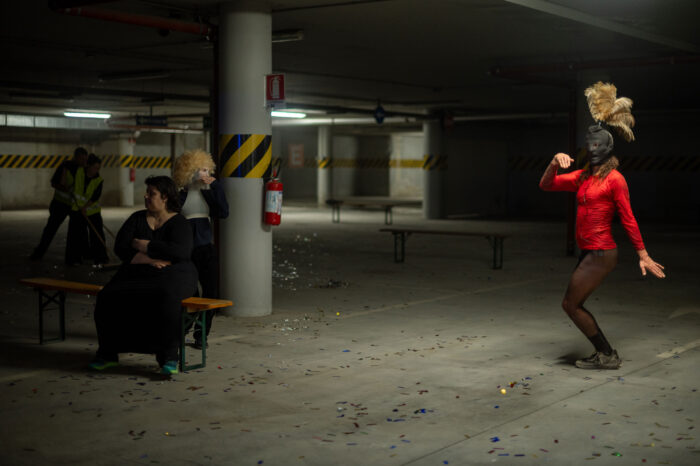
I take another quote from the booklet, by Guido Tonelli, because physics describes better than I can the principle on which this section, dedicated to the origin of matter, appears to be based. This applies both to the dance at the centre, convulsive like an abstract voodoo trance, but also restrained like a bond that refuses to give way and explode, as to the phenomena that manifest at the perimeter, particles of antimatter that correspond to the chosen, nucleus of the scene: <Original chaos, understood as the void, is anything but disorderly. There is no more strictly ordered, regulated and symmetrical system than the void. […] Everything belonging to it is strictly codified, every particle of matter goes hand in hand with its corresponding antiparticle, every fluctuation dutifully observes the constraints of the uncertainty principle>.
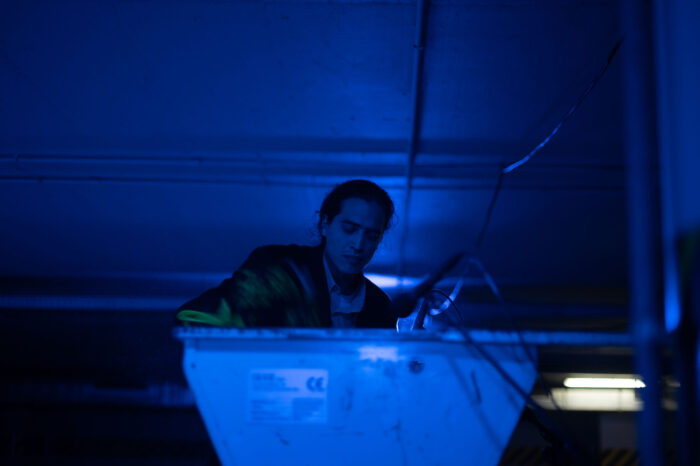
In the final part, two last figures enter the scene; one takes the center and reveals that same shirt <THE CHOSEN ONE> while displaying two dresses held in their fist. The other climbs a ladder next to a large machine, a shredder placed within the perimeter of the benches that has always remained turned off. They wait. <SECTION TWO. THE BEGINNING OF MATTER>. And everything explodes. I continue reading Tonelli’s excerpt: <Somehow this perfect mechanism is interrupted, something suddenly breaks in and takes over the scene, then abruptly initiates the process that will produce an expanding space-time and the mass and energy which bend it. The extreme order that governs everything shatters in a fraction of a second, and the tiny quantum fluctuation inflates disproportionately>.
¬
The monstrous machine is turned on, its mechanical roar beginning. In a matter of seconds, the perimeter is breached and the benches are distributed throughout the space, causing everyone to suddenly stand up. The doors to a third space open, and the various figures who previously performed the events now exit and reenter the space, displaying clothes and objects. They are personal effects, like a shirt or a pair of pants, but also a book or a cell phone. They stand in front of the granulator until its attendant takes them and grinds them. From beneath the machine, a trickle of fabric and plastic confetti falls, falling almost like a small snowfall. These kits of objects and clothing make me think of the memorial museums that display personal effects, the few surviving traces of bodies and lives crushed by the violence of history—and which, we know, have snowed down on the most uncivilized of indifferences. Amidst this concrete, I think of the rubble of our civilization, the buildings reduced to granules that conceal the bodies of the Palestinian population. But also how we know them in a stream of images shredded by social media algorithms, where the body of a murdered child is followed by a meme, then a sloppy AI. I see a standing figure, stiff, displaying a smartphone and a pair of shoes, and I think of migrant centers, the Italian ones (including the attempt to export detention outside national borders, like our best Made in Italy) and the few images arriving from the prisons of Trump’s Gestapo. I think of the world being built by tech oligarchs with clear Nazi dreams and who wield tools of analysis and control never before seen in history, while I see a passerby holding a tag with a number and yet another number on their chest. I think that when asked about festa, Simon Vincenzi was primarily asking himself what there is to celebrate in our contemporary world. But a festa also has a nefarious role, it calls upon violence and becomes an act of destruction, to lay the foundations for a new creation. I believe he therefore asked what needs to be destroyed, and sacrificed, for a difference to emerge: <The concept behind festivals of dissolution derives from ancient creation myths. […] But in order for such a new creation to be possible, the prior stage had to be dismantled and reduced to chaos>. A great carnival of the void that witnesses destruction and creation. A cosmogonic celebration in which the granulation theorized by quantum physics becomes a sea of confetti. A potlatch to crush the most misanthropic and psychopathological things happening in our time.
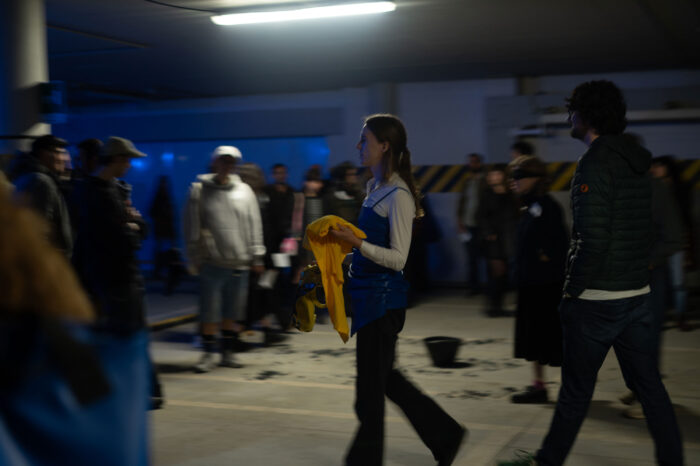
And a difference is evident: we are in that expanding space-time that Tonelli describes, driven by a tremendous, sudden energy. The repression of the previous section is now overturned in a broad, liberating expanse that moves the audience—or rather, participants—as they wander chaotically through the space, as if pushed by the mechanical rotors of the granulator. In this section too, various phenomena manifest simultaneously and throughout the entire space, as the display and grinding of the objects continues. But despite the feeling of liberation, the violence of the times is not hidden. I encounter a tableau vivant, the immobile figure of a girl in a yellow bib, her gaze lost in space and her hand holding a knife. A few meters away, a stunning masked figure sporting a feathered headdress appears amidst the chaos, dancing around a small pile of crushed remains and beginning to move through the space according to the pattern of a slow choreography that highlights measured gestures – I am almost certain it is Vladislav Nijinsky. The figure reaches the third space, dancing between a pair of street cleaners, who are picking up the thousands of confetti scattered on the floor as if they were elsewhere. Meanwhile one of the two hostesses, the young masked woman, tries to replicate the choreography of the feathered figure, creating a spontaneous variation. It’s an image; we’re not allowed to enter, but only to observe it from outside, framed by the gigantic doors that have opened onto this new space. Anyone who attempts to enter is immediately reprimanded by the second hostess stationed on a bench.
It continues like this, I don’t know for how long—the perception of its flow, once pressing, is now very distorted—until a voice announces the end of the performance and invites us to leave the space. Everything fades in an instant, as quickly as it exploded.
¬
It’s October 9, 2025, when I receive an email from Xing. It’s the first collection of research materials on festa, awaiting further enrichment with the various feedback from the invitations. At the top of the folder is the symbol of Acéphale, the magazine and secret society founded by Georges Bataille during the height of Nazi-Fascism, which held rites celebrating the beheading of Louis XVI and aimed at creating a new mythical form that would restructure society. As Bataille himself described it, the headless man on the cover is a parody of hermeticism.
I recognized only one of the passages spat out by the faceless chosen one; it’s the last text from the final issue of Acéphale, published in 1939 and dedicated to <Madness, War, and Death.> It’s a meditation in verse, which Bataille introduces with a short essay titled <The Practice of Joy Before Death.> I recognized it only because its recurring opening line is iconic: <I Myself Am War.> It’s the text that perhaps provides the most access to the rites of Acéphale, because it’s conceived as part of the exercises the group practiced to reach an ecstatic state. It’s a text in the first person singular, in which Bataille contemplates his own annihilation and reminds me of sensations I couldn’t forget and had to try to capture. I close with its final lines:
<I imagine myself covered with blood, broken but transfigured and in agreement with the world, both as prey and as a jaw of TIME, which ceaselessly kills and is ceaselessly killed.
There are explosives everywhere that perhaps will soon blind me. I laugh when I think that my eyes persist in demanding objects that do not destroy them>.
View this post on Instagram