
Tide of Returns
Returning Relations, Unmaking the Gaze
What happens when what the museum has transformed into an object becomes a relation once again? This is perhaps the question that runs through Tide of Returns, the inaugural exhibition of Ocean Space / TBA21–Academy’s 2026 season in Venice, curated by Khadija von Zinnenburg Carroll and developed through the research of the Repatriates Collective.
While the exhibition explicitly addresses the restitution of cultural objects removed during the era of European colonial expansion, it ultimately shifts the discussion onto a deeper and less immediately visible terrain: not simply the return of objects, but the questioning of the very conditions that rendered them objects in the first place. In recent years, debates surrounding the repatriation of colonial collections have assumed increasing prominence within Western museums and cultural institutions. The issue is generally framed in terms of ownership, historical responsibility, and reparation. Who owns these artefacts? Where should they be housed? How can the violence surrounding their acquisition be addressed?
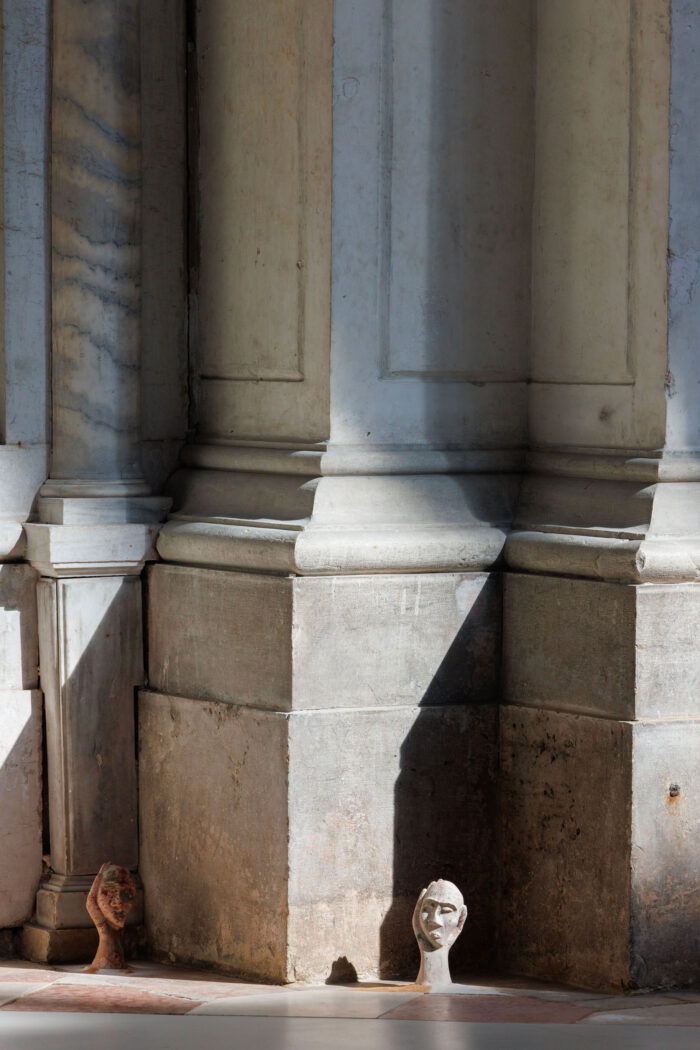
Space, Venice. Commissioned and produced by TBA21–Academy. Photo Jacopo Salvi.
Tide of Returns chooses instead to ask a different question: what happened to these objects when they entered the museum? Such a perspective resonates strongly with the reflections developed by Giulia Grechi on the colonial genealogy of the museum. In her writings, the museum does not appear simply as a site devoted to the preservation of heritage, but as a device for the production of knowledge and the construction of alterity. Through what Grechi calls mostrazione—a term that could be translated as “the act of showing”—objects are not merely displayed; they are defined, classified, and rendered legible through specific regimes of visibility. Exhibition is never neutral; it actively produces meaning. The modern ethnographic museum, emerging at the height of European colonial expansion, fulfilled precisely this function: gathering fragments of other worlds and relocating them within an epistemic order that reaffirmed the centrality of the Western gaze.
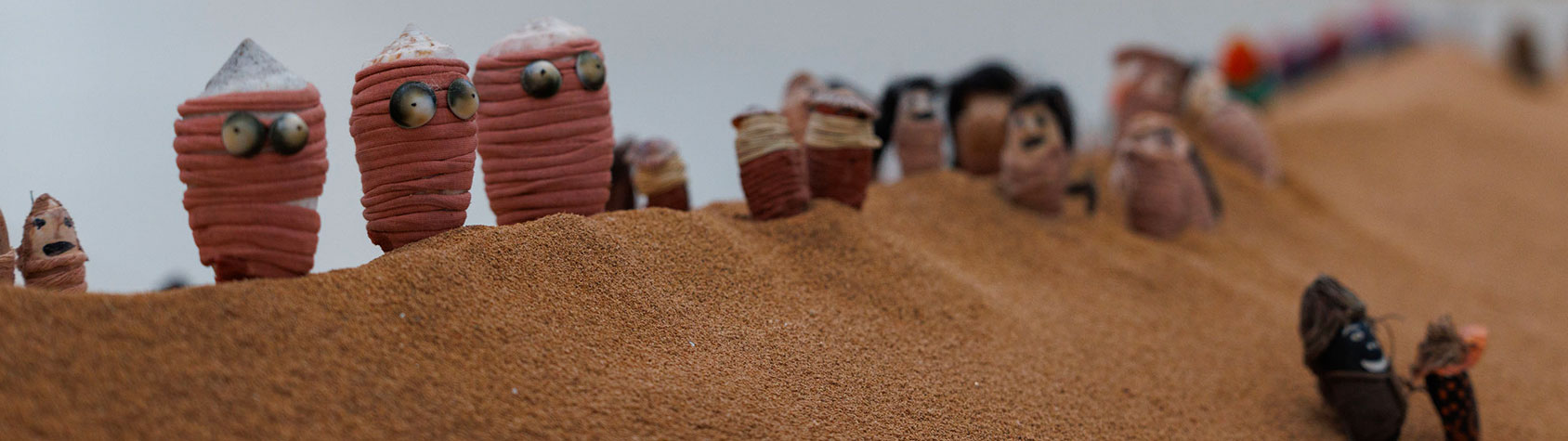
From this perspective, restitution is not only about the material return of cultural property. It is also about interrupting the dispositif that transformed living relations into heritage objects. In other words, what must be restored are not merely objects, but the relationships that colonial musealisation suspended, simplified, or erased. The entire exhibition seems to be structured around this tension. In the western nave of the former Church of San Lorenzo, From My Mother’s Country (2026) welcomes visitors with a landscape of red sand dunes populated by thousands of Dadikwakwa-kwa ritual dolls originating from cultural traditions in Namibia and among the Anindilyakwa communities of northern Australia. The scale of the installation immediately produces a sense of perceptual disorientation. The dunes appear simultaneously monumental and fragile, while the proliferation of dolls transforms them into a collective presence rather than a collection of individual objects.
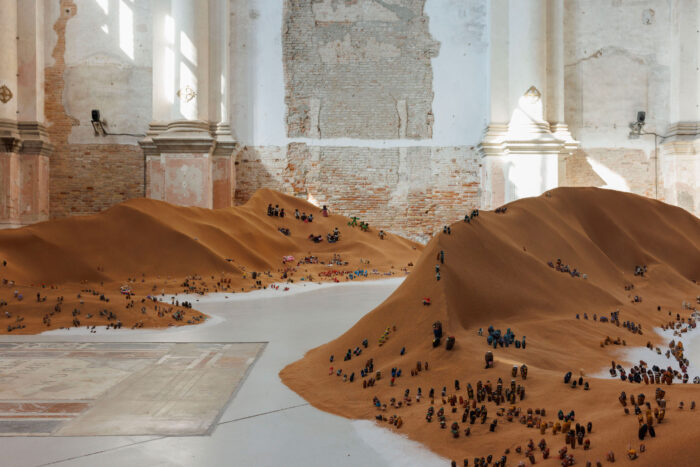
Space, Venice. Commissioned and produced by TBA21–Academy. Photo Jacopo Salvi.
Significantly, the project rejects any exhibitionary logic associated with the collection. The Dadikwakwa-kwa are neither isolated nor catalogued. They are not presented as ethnographic specimens or autonomous artworks. Instead, they are embedded within an environment that reasserts their relational dimension. This choice becomes particularly meaningful when read through Grechi’s reflections on the museum’s construction of alterity. For more than a century, the ethnographic museum operated through a series of separations: between subject and object, observer and observed, culture and life. Objects were extracted from the contexts that had generated them and transformed into mute testimonies of other cultures. Their display contributed to the construction of narratives that simultaneously defined both the Other and the European self. The Dadikwakwa-kwa, however, resist this transformation. More than artefacts, they appear as relational thresholds.
Through these figures, girls learn about the land, the body, fertility, and kinship. In certain regions of Namibia, the name given to a doll later becomes the name of the first child of the girl who receives it. Each figure therefore embodies a genealogy, a memory, and an affective continuity that exceed the Western category of the object. The point is not simply that these dolls were removed during the colonial period and subsequently returned. The point is that their reduction to “cultural property” already constitutes a form of epistemic translation. Once incorporated into European collections, they ceased to be understood as nodes within networks of relationships and became heritage objects. The exhibition renders this passage visible, exposing the subtle violence embedded in processes of classification and cataloguing.
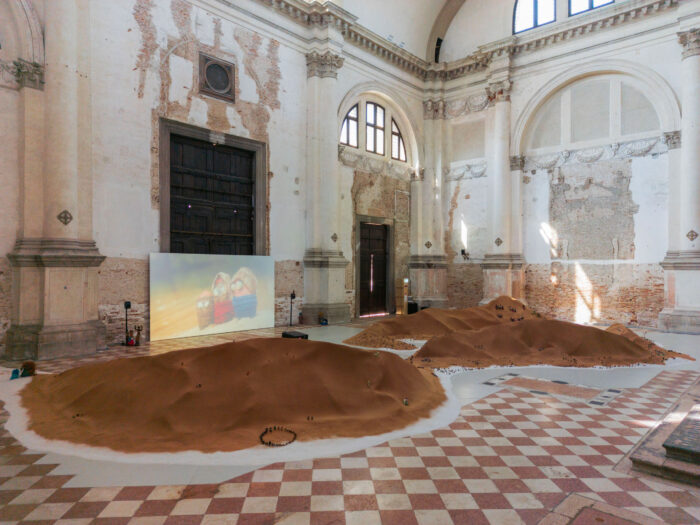
Space, Venice. Commissioned and produced by TBA21–Academy. Photo Jacopo Salvi.
The film accompanying the installation plays a crucial role in this regard. By documenting the making, dressing, and blessing of the dolls before their journey to Venice, it shifts attention away from the finished object and towards the processes that make its existence possible. What is restored to visibility is not only the materiality of the Dadikwakwa-kwa, but the network of relationships that keeps them alive. The exhibition thus suggests that colonialism operated not solely through material expropriation, but also through the disarticulation of the relationships linking objects to communities, territories, and cosmologies. Restitution therefore becomes a process of rebuilding those connections. It is here that one of the exhibition’s most compelling ideas emerges: restitution as a practice of mediation.
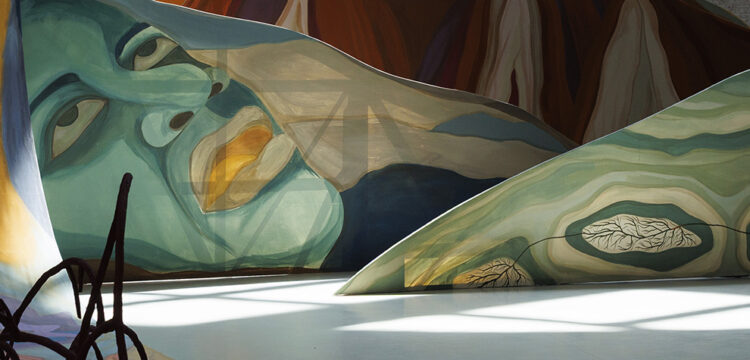
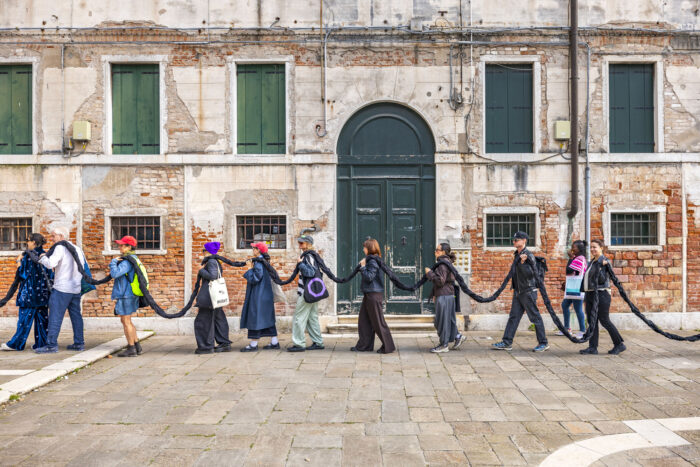
The Dadikwakwa-kwa do not simply represent a culture. They actively produce, transmit, and sustain it. They mediate between generations, between memory and future, between human communities and territory. Restitution, therefore, is not merely a matter of geographic return; it is the reactivation of the relational networks these figures make possible. The same logic informs Weaving Connections (2026) by Verena Melgarejo Weinandt, presented in the eastern nave. If the work of the Repatriates Collective focuses on objects and the genealogies they embody, the German-Bolivian artist approaches the question of relation through the body, gesture, and the construction of imaginaries. The installation consists of large blue textile structures traversed by long black braids that simultaneously evoke hair and waterways. Embedded within this environment, a three-channel video follows a performance involving the preparation, braiding, and washing of textiles in a river.
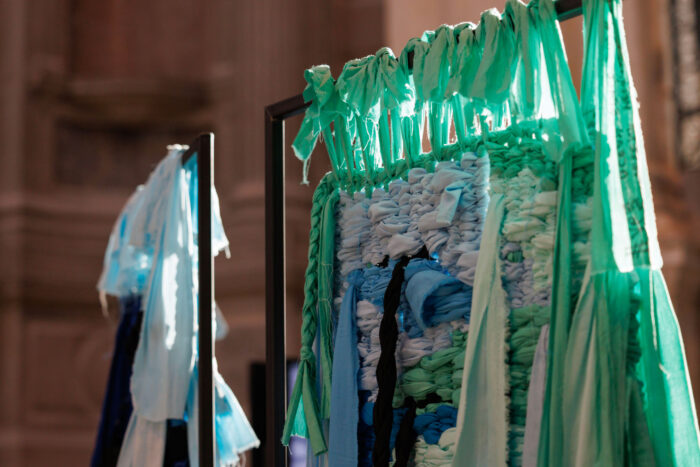
Space, Venice. Commissioned and produced by TBA21–Academy. Photo Jacopo Salvi.
The act of braiding—a recurring motif in the artist’s practice—becomes a tangible metaphor for the construction of collective identities. Melgarejo Weinandt’s research stems from a critical investigation into the ways Indigenous peoples have been represented within German cultural imaginaries and the role such representations played in the formation of modern national identity. Once again, the issue is not limited to the colonial past. Rather, it concerns the persistence of visual and cognitive structures that continue to shape how we perceive the world. If the colonial museum operated through separation and classification, the artist counters with the figure of the braid. Nothing exists in isolation; every element acquires meaning through the relationships connecting it to others. Within this framework, water assumes a crucial role. Not as a romantic symbol of interconnectedness, but as a relational force capable of traversing bodies, territories, and temporalities.
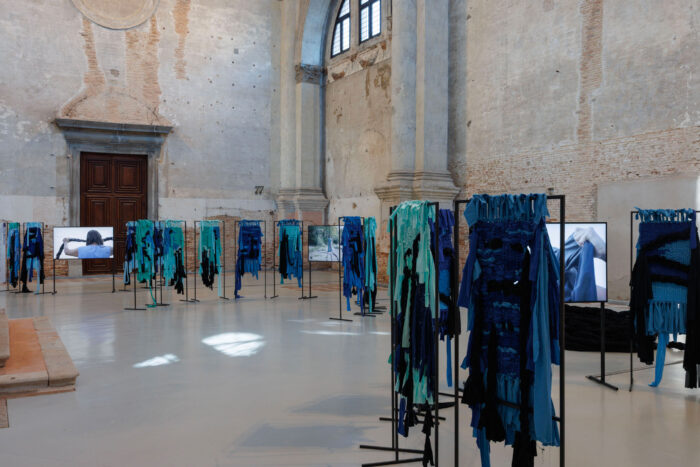
Space, Venice. Commissioned and produced by TBA21–Academy. Photo Jacopo Salvi.
Rivers become oceans; oceans return as rain, forming a continuous cycle that renders any understanding of existence as a collection of autonomous entities impossible. The choice of the former Church of San Lorenzo as the exhibition venue further amplifies these reflections. As Markus Reymann has observed, the building bears within its walls the traces of centuries of trade, exchange, and circulation that contributed to the making of modern Venice. Far from serving as a neutral container, the space becomes an integral component of the exhibition, connecting the histories of restituted objects with broader histories of movement, appropriation, and exchange across the Mediterranean. More than an exhibition about restitution, Tide of Returns ultimately becomes a reflection on the ways in which the world is made visible.
Following a perspective that resonates with Giulia Grechi’s work, the project does not simply denounce colonial violence or advocate for the return of cultural objects. Rather, it interrogates the dispositifs that made possible the construction of alterity and the transformation of relationships into objects. In this sense, the exhibition’s most radical gesture may lie in its attempt to imagine a museum capable, at least temporarily, of relinquishing its claim to be the sole producer of meaning. The works do not simply ask to be seen; they ask to be placed back into relation. Restitution thus becomes something far greater than a heritage practice: it emerges as an exercise in unlearning the colonial gaze and as an attempt to reconstruct those connections that modern museology transformed into objects of observation.