The Work of Accomplices
René Francisco and the pragmatics of being with others
Water comes first.
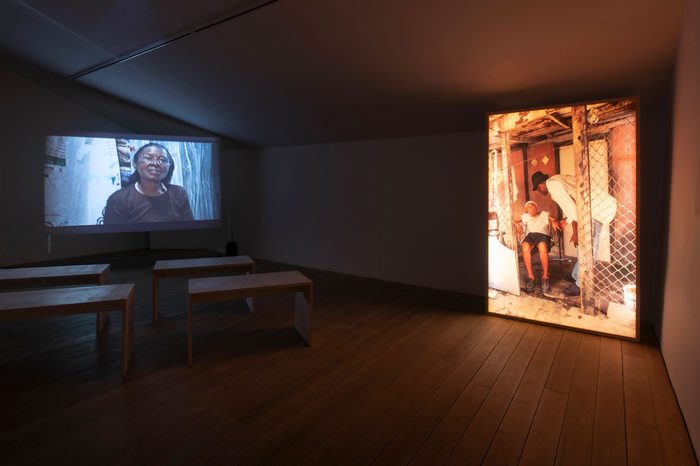
It gushes, drips, recedes, and returns. At times it comes close enough to feel almost tactile; at others it withdraws from the image and persists only as intermittent acoustic pressure. In René Francisco’s Agua Benita (2008), water permeates the film’s visual and sonic field. The camera moves through the house of Benita, an elderly woman in Havana, lingering on stained walls, exposed pipes, buckets, basins, patched surfaces, vegetation, and damaged masonry. The house appears less as a stable architectural enclosure than as a porous membrane marked by water, weather, and time (Göltenboth, 2015).
The title introduces a minor sacrilege. Agua benita refers to holy water, yet here water is displaced from the font and sacramental ritual into the material routines of everyday existence. It must be collected, carried, contained, and channelled; it stains, corrodes, and nourishes. Francisco relocates the sacred within the infrastructure of daily life, bringing the miraculous down to the level of plumbing.
The camera remains close to the woman without rendering her the picturesque inhabitant of a picturesque ruin. It moves between her body and the material intelligence of the house: hands, vessels, walls, utensils, pipes, apertures. Inhabitant and habitation gradually emerge as parts of the same precarious ecology. The building bears time on its surfaces, just as the body does, while the woman knows the house through repetition and use. Her everyday gestures constitute another kind of architecture, composed of adjustments, routines, and acts of maintenance.
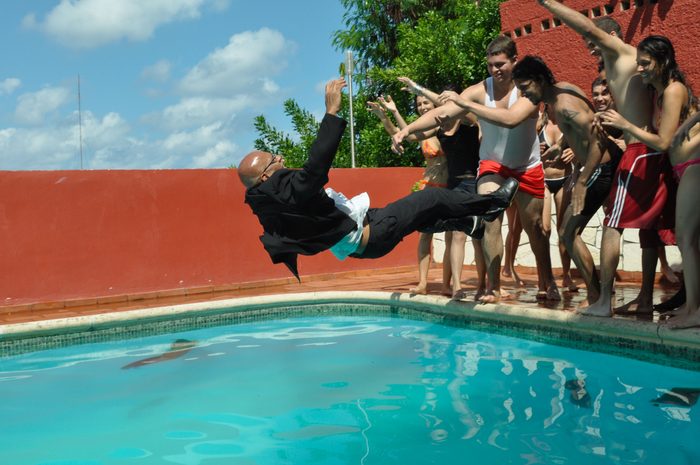
The film then changes register as rubble appears and men begin to dismantle and rebuild. Materials are lifted, carried, and fitted into place; a blue metal structure rises above the existing walls, corrugated sheets form a new roof, pipes are installed, and surfaces are repaired. Francisco gives little attention to the visual gratification of a before-and-after image. He stays instead with the interval such narratives habitually suppress: labour. Hands measure, hold, tighten, paint, lift, and improvise, as architecture ceases to appear as finished form and becomes visible as work. Near the end, water runs through the newly installed infrastructure, and a framed picture is hung on a wall. People gather around the woman, smile, and raise glasses as ordinary life resumes within a house that can once again provide shelter.
Included in Trilogía de Romerillo (2003–2008), Agua Benita provides a useful point of entry into Cómplice, René Francisco’s first solo exhibition in Italy, curated by Lucrezia Cippitelli and Simone Frangi and held at Kunst Meran Merano Arte from February to May 2026. Spanning more than forty years, the exhibition extended from the pedagogical experiments Francisco initiated at Havana’s Instituto Superior de Arte (ISA) at the end of the 1980s to recent paintings, drawings, sculptures, and installations. The curators organised the exhibition around “complicity,” understood as a connective principle in Francisco’s practice that links relationality to collaborations, friendships, pedagogical experiments, and community-based interventions (Kunst Meran Merano Arte, 2026b).
Cómplice, however, is a more troublesome term than “collaborator.” An accomplice is implicated in an act whose participants may occupy different positions, exercise unequal power, and understand their involvement differently. Complicity therefore entails responsibility as well as participation. The distinction matters because Francisco’s practice emerged within a historical constellation in which the vocabulary of collectivity was never politically or ethically neutral.
Pierre Bourdieu develops the concept of “symbolic violence” across several writings, including Outline of a Theory of Practice (1977), The Logic of Practice (1990), and, most explicitly in relation to gender and the body, Masculine Domination (1998). Across these formulations, symbolic violence names a form of power that becomes embedded in embodied dispositions, naturalising historically produced differences, including those coded as biological or sexual, until they appear self-evident. The body is therefore always socialised: gestures, dispositions, perceptions, and apparently spontaneous ways of inhabiting the world bear the imprint of social structures whose historical character has been obscured. In Masculine Domination, Bourdieu describes masculine domination as a paradigmatic instance of symbolic violence, capable of transforming history into nature by inscribing the social order in bodies and in the cognitive structures through which that order is perceived.
Symbolic violence is closely tied to Bourdieu’s concept of habitus because it operates through embodied dispositions that do not require conscious adherence to the principles they reproduce. Domination is sustained through a complicity between incorporated structures—in both dominant and dominated subjects—and the structures of the institutions that organise social life. This complicity names the relation between social structures and the schemes of perception, judgement, and action through which subjects apprehend them. Hence the disturbing efficacy of a form of violence that Bourdieu characterises as “gentle” and largely invisible: it operates through categories of perception shared by those who exercise domination and those subjected to it (Bourdieu, 2001). Symbolic violence can function, in this sense, because it finds support in the cognitive structures of those upon whom it is exercised.
I return below to cognition, pedagogy, and processes of learning, all of which are central to René Francisco’s artistic practice. For the moment, it is enough to register the unease that the notion of complicity carries across different disciplinary fields. Historical studies of the Holocaust have treated complicity through the ethically charged figure of the bystander (Barnett, 1999), while institutional critique has examined the entanglement of cultural institutions, artists, and audiences within economic and political structures that cannot simply be occupied from an exterior position (Fraser, 2005). These uses differ, but both refuse to treat relation as innocent or ethically neutral.
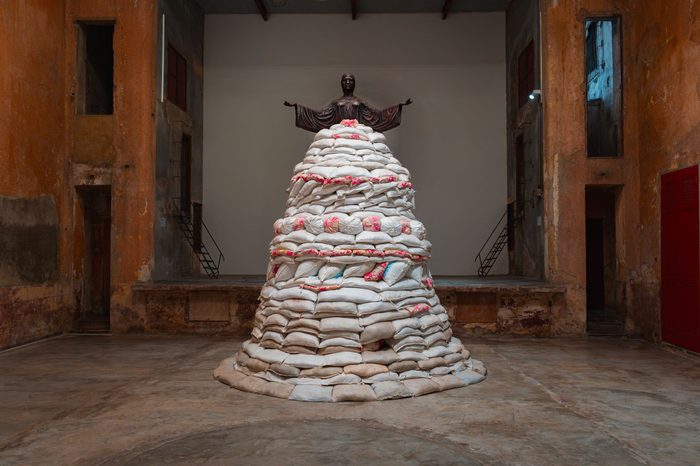
Complicity has therefore served across these fields as a term for thinking about relationality without presuming that relation is innocent or affirmative. Francisco’s practice works within this semantic instability, retaining the term’s associations with implication and belonging while using it to examine a persistent concern: the relations among different forms of knowledge and the power dynamics through which knowledge is produced and transmitted. In the exhibited Manifesto Ocasional (1990), Francisco defines complicity as an original condition of artistic production. Cobijo (2025), the large-scale sculpture that greeted visitors at the entrance to the exhibition, gives this tension material form. Its open-armed black figure evokes the iconography of the Alma Mater and its association with the nurturing role of educational institutions. Yet the apparent welcome remains ambiguous: the figure’s placement, scale, and iconographic reference allow the institution to offer shelter while retaining the authority to regulate access and belonging.
The semantic unease surrounding complicity raises a further problem. Does becoming complicit require the suspension of critical autonomy, or the relinquishment of the distance from which critique has conventionally claimed its authority? Can participation itself become a form of soft coercion when an invitation to collaborate conceals or naturalises the unequal positions from which subjects enter the relationship? These questions become especially pertinent to the pedagogical experiments Francisco began developing in 1989, as his artistic practice turned towards direct engagement with the material and social conditions of everyday life in Cuba.
An important precedent was Proyecto Pilón (1988-1989), a socially embedded project undertaken in Cuba at the end of the 1980s. Developed in the municipality of Pilón, in the eastern province of Granma, it marked a shift within practices associated with the New Cuban Art, moving from the confrontational interventions in urban and institutional spaces that had characterised much of the decade towards sustained involvement in the everyday life of a rural community. The material precariousness encountered there also exposed the limits of this ambition, bringing into view the unstable boundary between artistic intervention, voluntary labour, and social assistance.
Within this contested field, Francisco, together with students from the Instituto Superior de Arte (ISA), initiated Desde Una Pragmática Pedagógica (DUPP). Conceived as an artistic and pedagogical experiment, DUPP moved among the academy, the city, and the domestic sphere, engaging students in projects that responded to concrete situations and, at times, to practical requests from Havana residents. DUPP is most usefully approached as a method for reorganising the conditions under which art and knowledge are produced: engagement with social questions, dialogue with the urban environment, and entry into private homes became inseparable from scrutiny of the pedagogical structure itself (González, 2008; Rodríguez Hernández, 2019; Weiss, 2011).
DUPP also challenged the asymmetrical relationship between teacher and student, attempting to displace the teacher from a sovereign position and to establish processes in which knowledge could be produced, tested, and redistributed. Francisco’s method can be placed in dialogue with Paulo Freire’s critique of the “banking” model of education and his proposal for a problem-posing education in which teachers and students become mutually implicated—accomplices, one might say—in a dialogical process of enquiry grounded in concrete experience (Freire, 1970).
DUPP, however, should not be reduced to an artistic translation of Freirean pedagogy. Its significance lies partly in the fact that it does not resolve the contradiction between the persistence of authority and the redistribution of knowledge, but works within it. Read alongside Bourdieu, the attempt to dismantle the teacher-student hierarchy also exposes the symbolic violence embedded in pedagogical relations. The pragmatism of this practice can be understood as a response to the exhaustion of a particular utopian horizon and to the concurrent dismantling of categories inherited from artistic modernism. Yet, just as artistic autonomy did not end with the supposed end of modernism, neither individual agency nor relations of authority disappeared from Cuban collective practice at the end of the 1980s (Weiss, 2011). DUPP displaced the problem from the declaration of collective identity towards the organisation of concrete situations in which heterogeneous actors entered into relations whose differences could not simply be wished away.
These experiments must be situated within the political and cultural transformations that shaped Cuba during the decade in which the New Cuban Art emerged. By the mid-1980s, strains within the Cuban development model had become increasingly visible. One governmental response was the proceso de Rectificación de Errores y Tendencias Negativas, launched by Fidel Castro in 1986. Presented as a means of returning the Revolution to its proper course, the Rectification Process reversed several market-oriented measures, curtailed material incentives, and renewed an emphasis on state direction and moral mobilisation, diverging sharply from the reformist course associated with Soviet perestroika (Mesa-Lago, 1993). Its ideological horizon remained socialist, even as the campaign revived forms of voluntarism and ethical mobilisation associated with an earlier phase of the Revolution.
The New Cuban Art developed within this ideological landscape. The artists who came to prominence around Volume Uno in 1981 belonged to a generation born around the time of the Revolution and educated within the institutions it had created. As Rachel Weiss has argued, they were heirs to the expanding cultural heterodoxies promoted by the revolutionary project and to the poetic idealism through which independence, social transformation, and cultural emancipation had been imagined. Their work could be sharply critical of revolutionary institutions and assert aesthetic autonomy while remaining invested in the possibility that art might intervene in the life of the country. This helps account for the unusually close relationship between artistic practice and everyday life in Cuba during the 1980s across social, domestic, cultural, and psychological registers.
Everyday life was especially charged because it was also the terrain on which some of Cuban socialism’s most consequential promises had been made: housing, healthcare, education, and social dignity. The domestic interior, classroom, street, and neighbourhood could therefore become sites where apparently minor situations disclosed broader questions of social organisation, authority, and the distribution of knowledge. Francisco’s practice shares with the New Cuban Art a conviction that art can maintain an immediate relation to lived experience, together with its confrontational energy and formal restlessness. DUPP marks a shift from the utopian aspirations associated with the modernist legacy towards a pragmatics concerned with the scale and conditions under which transformative agency could still be exercised. Attention moves from the abstract reconciliation of art and life to specific redistributions of agency within a classroom, a neighbourhood, or a private home.
The vitality of the 1980s, marked also by the first Havana Biennial in 1984, changed decisively after 1989 as socialist regimes in Eastern Europe collapsed and the Soviet system entered its terminal crisis. The 1990s opened onto a crisis that affected Cuba materially and psychologically: the economy contracted catastrophically, food and ordinary commodities became scarce, transport and electricity grew increasingly unreliable, and the expectations that had sustained the revolutionary horizon were severely compromised (Mesa-Lago, 1993; Weiss, 2011). Some artists responded by withdrawing after the intensity of the previous decade. The conditions produced by the crisis nevertheless fostered another cycle of collective experimentation, part of a broader resurgence of collective practices that became especially visible internationally around the turn of the millennium and generated divergent critical positions (Bourriaud, 2002; Bishop, 2004; Kester, 2004). In Cuba, this phase followed the collective formations of the early 1980s and the experiments of the decade’s final years in which Francisco had participated, but it no longer rested on the same expectations.
Developed by Francisco during the following decade through practices of collective involvement and repair, Trilogía de Romerillo (2003–2008) belongs to the aftermath of this transformation. The collectivity at stake in these projects is not predicated on the disappearance of individual agency. Individualism and collectivism persist alongside one another, complicating any straightforward opposition between modernist subjectivity and socially oriented practice. If the modernist artwork has conventionally been understood as the outward projection of an interior artistic subject, collective existence enters the creative subject and participates in constituting it from within (Weiss, 2011). Francisco nevertheless prevents this reversal from settling into another stable model of subjectivity: complicity unsettles the presumed coherence of the collective body by resisting the subsumption of heterogeneous subjects into a unified identity.
This question has particular resonance in Cuba, where the construction of a collective subject was integral to the revolutionary imagination. The “man in Cuba” described as a “multifaceted being” was the ideal citizen of a new political society and the embodiment of a broader project in which the transformation of individual consciousness and the construction of socialism were mutually constitutive (Guevara, 1965). The collective subject thus aspired to become an epistemic condition of revolutionary Cuba itself. Complicity, by contrast, implies belonging without complete identification or the erasure of difference, and therefore resists the formation of a fully unified subject.
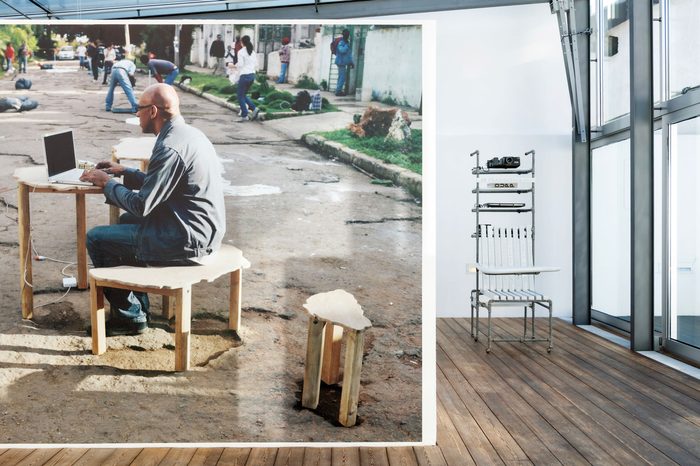
Francisco’s collectivism can take shape through the collective production of a situation even when authorship remains identifiable. Works such as La Silla (2026 [1990]) and Aula a la intemperie (2011) articulate this pedagogical ethos through a sense of shared purpose while retaining their autonomy as objects. Constructed from an incongruous assemblage of wood and water pipes, they give material form to the provisional character of collective relations and to the conditions through which learning occurs and knowledge is distributed (Kunst Meran Merano Arte, 2026b).
Several concepts developed in scholarship on artistic education and pedagogical practice help to specify Francisco’s pedagogical ethos, although none fully accounts for it. “Signature pedagogies” describe forms of teaching that shape how future practitioners learn to think, perform, and act with integrity within their profession (Shulman, 2005, p. 52); in Francisco’s case, however, intellectual formation is inseparable from exposure to confrontation and negotiation beyond the protected environment of the classroom. “Transpedagogy” comes closer to this permeability between education and artistic practice by describing projects in which pedagogical processes become artistic media in their own right (Helguera, 2011). The notion of “author pedagogies” introduces a further complication: these pedagogical structures can remain extensions of the creative practice of an established artist-professor, who continues to occupy the position of principal, though not exclusive, author (Ojeda, 2019). Francisco’s experiments occupy this unstable position, emerging from his artistic practice and institutional role while allowing students and accomplices to redirect their course.
Taken together, these definitions clarify aspects of Francisco’s pedagogical impulse: the formation of the artist through practice and intellectual confrontation, and the intersection of education, art-making, and collective formation. They also open onto the notion of the public sphere, which Habermas defines as a realm of social life in which public opinion can be formed (Habermas, 1974, p. 49). Francisco names Habermas among the writers and thinkers whose ideas reached the ISA despite restricted access to contemporary international theory (González, 2008). For Habermas, the public sphere emerges when private individuals assemble as a public to discuss matters of general interest and, in its political form, to mediate between society and state authority (Habermas, 1974, pp. 49–50).
For Francisco’s conception of artistic practice, the relevance of the public sphere lies in its emphasis on intersubjective communicative processes and their emancipatory potential, in contrast to models of philosophy or politics centred exclusively on the individual subject. Public discourse—or communicative action—offers, within the Habermasian framework, a possible means of coordinating collective life (Habermas, 1985). The question is therefore how such communicative processes intersect with the production and circulation of knowledge in Francisco’s work.
The houses involved in Trilogía de Romerillo are especially revealing in this respect because they become contact zones between public deliberation and the authority conventionally associated with private domestic space. Individual needs and circumstances enter a process of discussion and collective action, while the home becomes a site at which different actors, competencies, and forms of knowledge meet. In Habermasian terms, the public sphere becomes critical through the exercise of reason by a public engaged in matters of general interest (Habermas, 1974, pp. 49–50); Francisco’s projects relocate that exercise to the domestic environment, turning the home into a site of critical deliberation.
Whereas Habermas’s historical account of the bourgeois public sphere diagnoses its transformation under mass democracy and commercial mass media (Habermas, 1989), Francisco invests communication and collaboration with the possibility of counteracting that process. Many works usually described as part of his “socially engaged” practice can be approached in these terms, although the category of socially engaged art has become too broad and exhausted to carry much explanatory weight on its own. Francisco’s projects ask whether artistic practice can create situations in which communication, shared action, and the circulation of different forms of knowledge restore a critical relation between individual experience and collective life.
The Habermasian framework nevertheless leaves another problem unresolved: actors, accomplices, and participants who enter this circulation of heterogeneous forms of knowledge do not do so on equal epistemic terms. Their relations are already shaped by longer histories that determine which experiences are recognised as authoritative and which remain subordinate. The issue therefore shifts from the possibility of communication and participation to the historical constitution of the hierarchies within which communication takes place. This problem acquires particular historical force in Latin America. As Aníbal Quijano argues, colonial domination produced political and economic hierarchies alongside a new configuration of intersubjective relations through which European hegemony extended to subjectivity, culture, and the production of knowledge. Colonialism entailed the suppression of colonised forms of knowledge and meaning, while Eurocentrism became globally hegemonic by subordinating other conceptual formations and concrete knowledges (Quijano, 2000, pp. 540-41, 549-50).
From this perspective, Francisco’s pedagogy brings specialised artistic knowledge into contact with situated knowledge of a house, a neighbourhood, and its material needs and histories, forms of knowledge whose authority is recognised differently. The encounter does not erase asymmetry, and the collective it produces does not become a homogeneous body. Quijano describes social formations as composed of heterogeneous elements and histories articulated through discontinuity and conflict (Quijano, 2000, pp. 553-554); Francisco’s practice of complicity likewise accommodates difference while redistributing the authority to intervene in the conditions under which knowledge becomes operative.
Cómplice forms part of The Invention of Europe: A Tricontinental Narrative (2024–2027), the three-year curatorial programme conceived by Lucrezia Cippitelli and Simone Frangi for Kunst Meran Merano Arte. Taking its title from V. Y. Mudimbe’s The Invention of Africa: Gnosis, Philosophy, and the Order of Knowledge (1988), the programme approaches Europe not as a self-contained geographical or cultural entity but as a historically constructed formation whose modern identity emerged through colonialism and its material, economic, and epistemic relations with other parts of the world. Africa, Latin America, and Asia therefore enter the programme not as external viewpoints from which Europe might simply be observed, but as constitutive coordinates from which its presumed coherence can be unsettled. This investigation is anchored in South Tyrol itself: a multilingual territory shaped by shifting political and economic powers becomes the situated point from which the fiction of a stable European identity can be examined (Kunst Meran Merano Arte, 2026c).
In 2026, the programme continued with Animacies (14 June–11 October 2026), a group exhibition that turns to relations between Europe and Asia through practices connected to Bangladesh, Indonesia, Mongolia, the Philippines, and the Indian diaspora in the Fiji Islands. Taking its title from Mel Y. Chen’s Animacies: Biopolitics, Racial Mattering, and Queer Affect (2012), the exhibition challenges stable distinctions between animate and inanimate, subject and object, asking how agency, vitality, and affect circulate across human bodies, animals, plants, and material things. Textiles, plants, and foodstuffs register colonial histories, migration, memory, and ecological transformation across the exhibition: Shivanjani Lal’s Mere Porvaj (I am remembering) (2024) revisits histories of indenture and the Girmitiya legacy; Bekhbaatar Enkhtur’s Daino (2025) and Serpente (2026) introduce zoomorphic forms; and Elia Nurvista’s The Route (2024) traces the entangled routes of palm oil and Dutch wax cloth across West Africa, Europe, and Indonesia. Together, these works ask what other bodies, materials, and histories become perceptible once Europe is no longer assumed to be the stable centre from which relations with the rest of the world are narrated (Kunst Meran Merano Arte, 2026a).
This displacement returns to a question that runs through Francisco’s practice: what remains of modernism’s utopian ambitions once its claims to universality and collective transformation have been called into question? Malevich recurs insistently in his work, while Beuys provided an important model for thinking about pedagogy and collective creativity. Francisco also identifies a contradiction within this legacy. Recalling Beuys’s continued visibility as teacher and leader, and the black squares worn by Malevich’s disciples as the faithful belonging to a newly branded religion, he concludes that “there is no complete horizontality, no possibility of dissolution” (González, 2008; author’s translation). His understanding of art as a process capable of evoking an “altruism inherent in artistic pragmatism” preserves a utopian impulse, therefore retained at the scale of specific relations that can be reorganised through practice, without requiring the projected totality of the modernist programme.
References
Barnett, Victoria J. 1999. Bystanders: Conscience and Complicity During the Holocaust. Westport, CT: Greenwood Press.
Bishop, Claire. 2004. “Antagonism and Relational Aesthetics.” October 110 (Autumn): 51–79. https://doi.org/10.1162/0162287042379810.
Bourdieu, Pierre. 1977. Outline of a Theory of Practice. Translated by Richard Nice. Cambridge: Cambridge University Press.
Bourdieu, Pierre. 1990. The Logic of Practice. Translated by Richard Nice. Stanford, CA: Stanford University Press.
Bourdieu, Pierre. 2001. Masculine Domination. Translated by Richard Nice. Stanford, CA: Stanford University Press.
Bourriaud, Nicolas. 2002. Relational Aesthetics. Translated by Simon Pleasance and Fronza Woods, with the participation of Mathieu Copeland. Dijon: Les Presses du réel.
Chen, Mel Y. 2012. Animacies: Biopolitics, Racial Mattering, and Queer Affect. Durham, NC: Duke University Press.
Cippitelli, Lucrezia. (2012) ‘Arte y experiencia: René Francisco y la pragmática pedagógica’, in Cippitelli, L. (ed.) Connecting La Havana. Milan: Digicult Publishing, pp. 76–79.
D’Andrea, Francesca. (2025) ‘L’Avana. Appunti per una geografia artistica della città contemporanea’, in Modenesi, M. and Bajini, I. (eds) Metropoli 2.0: “Appunti” cartografici latinoamericani. Milan: Milano University Press, pp. 25–47. https://doi.org/10.54103/criando.211.c391
Fraser, Andrea. 2005. “From the Critique of Institutions to an Institution of Critique.” Artforum International 44 (1): 278–283, 332.
Freire, Paulo. 1970. Pedagogy of the Oppressed. Translated by Myra Bergman Ramos. New York: Herder and Herder.
Göltenboth, Natalie. 2015. “‘I am the instrument that people might play’ – Participation and Collaboration in Contemporary Art from Havana.” Ethnoscripts 17 (1): 58–73. https://doi.org/10.15460/ethnoscripts.2015.17.1.804.
González, Chema. 2008. “Entrevista a René Francisco.” Blog del Guerrero, Centro José Guerrero, 13 August. https://blogcentroguerrero.org/2008/08/entrevista-a-ren-francisco/.
Guevara, Ernesto “Che”. 1965. “El socialismo y el hombre en Cuba.” Letter to Carlos Quijano. Marcha, 12 March.
Habermas, Jürgen. 1974. “The Public Sphere: An Encyclopedia Article (1964).” Translated by Sara Lennox and Frank Lennox. New German Critique 3 (Autumn): 49–55. https://doi.org/10.2307/487737.
Habermas, Jürgen. 1985. The Theory of Communicative Action. Vol. 2, Lifeworld and System: A Critique of Functionalist Reason. Translated by Thomas McCarthy. Boston: Beacon Press.
Habermas, Jürgen. 1989. The Structural Transformation of the Public Sphere: An Inquiry into a Category of Bourgeois Society. Translated by Thomas Burger with the assistance of Frederick Lawrence. Cambridge, MA: MIT Press.
Helguera, Pablo. 2011. “Transpedagogy: Contemporary Art and the Vehicles of Education.” In Pedagogy in the Expanded Field, edited by Pablo Helguera and Mônica Hoff, 290–306. Porto Alegre: Fundação Bienal de Artes Visuais do Mercosul.
Kester, Grant H. 2004. Conversation Pieces: Community and Communication in Modern Art. Berkeley: University of California Press.
Kunst Meran Merano Arte. 2026a. “Animacies.” Exhibition, 14 June–11 October 2026. Accessed 1 October 2026. https://www.kunstmeranoarte.org/en/exhibitions/animacies-en/.
Kunst Meran Merano Arte. 2026b. “René Francisco. Cómplice.” Exhibition, 21 February–25 May 2026. Accessed 1 October 2026. https://www.kunstmeranoarte.org/en/exhibitions/rene-francisco-complice-en/.
Kunst Meran Merano Arte. 2026c. “The Invention of Europe: A Tricontinental Narrative (2024–2027).” Accessed 10 September 2026. https://www.kunstmeranoarte.org/en/info/the-invention-of-europe-a-tricontinental-narrative-2024-2027-en.
Mesa-Lago, Carmelo. 1993. “Efectos económicos en Cuba del derrumbe del socialismo en la Unión Soviética y Europa Oriental.” Estudios Internacionales 26 (103): 341–414. https://doi.org/10.5354/0719-3769.1993.15382.
Mudimbe, V. Y. 1988. The Invention of Africa: Gnosis, Philosophy, and the Order of Knowledge. Bloomington: Indiana University Press.
Ojeda, Danné. 2019. “‘I Shall Be Several’—Cuban Socially Engaged Art Projects as ‘Author Pedagogies’.” Studies in Art Education 60 (3): 186–202. https://doi.org/10.1080/00393541.2019.1640513.
Quijano, Aníbal. 2000. “Coloniality of Power, Eurocentrism, and Latin America.” Nepantla: Views from South 1 (3): 533–580.
Rodríguez Hernández, René Francisco. 2019. DUPP. La experiencia desde una pragmática pedagógica. La Habana: ArteCubano Ediciones.
Shulman, Lee S. 2005. “Signature Pedagogies in the Professions.” Daedalus 134 (3): 52–59. https://doi.org/10.1162/0011526054622015.
Weiss, Rachel. 2011. To and from Utopia in the New Cuban Art. Minneapolis: University of Minnesota Press.