
Hands Across the Water
Navigating the Neocolonial Undercurrents of Italy’s Cultural Diplomacy in the Mediterranean
On 2 July 2026, in the Sicilian city of Messina, MIRA-Mediterranean Institute for Research and Arts was presented to the public. Promoted by Italy’s Ministry of Culture—through the Direzione Generale Creatività Contemporanea and the Unità di missione per la cooperazione culturale con l’Africa e il Mediterraneo allargato—together with the Municipality of Messina and the University of Messina, and with the support of the MAXXI Foundation, MIRA is only the latest project advanced by the Ministry within its ongoing programme of Mediterranean thematisation. And not a new one, exactly. [1]
The project appears to absorb and redirect the earlier proposal to create a third venue of MAXXI, Italy’s National Museum of 21st Century Arts, in Messina, after Rome and L’Aquila. Under the previously announced name MAXXI Med, this had been described as a new museum pole for the Mediterranean. Launched in 2023, MAXXI Med had not yet disappeared from the Ministry’s plans by December 2025, when the Minister of Culture, Alessandro Giuli, announced a protocol for its stable realisation and management. [2] The sites of Torri Morandi and Villa Pace, now allocated to MIRA, had once been designated as the future locations of the museum. MAXXI remains, but no longer as the sovereign name of the project. It is folded instead into the support structure and institutional memory of a new configuration. This does not seem to mark a retreat from the original intentions. If anything, the political horizon has become clearer. As MAXXI Med before it, also MIRA is a project inscribed within Giorgia Meloni government’s Mediterranean agenda of culture, which took form through a growing sequence of programmes in recent years. Ultimately, this project too places contemporary art and research inside a broader framework that define Italy’s official view of the Mediterranean as Mare Nostrum.
The machinery through which the Mediterranean cultural turn of Meloni’s government is administered is the DL Cultura, the government’s Culture Decree-Law, issued on 27 December 2024 and converted into Law no. 16 on 21 February 2025. Article 2 creates the Unit of Mission for Cultural Cooperation with Africa and the Wider Mediterranean, [3] the same body which also appears as one of the initiators of MIRA. What matters is the Unit’s position within the broader governmental apparatus. The official communication states that the director-general responsible for the Unit operates in close coordination with the steering committee of the Piano Mattei per l’Africa—the Mattei Plan for Africa—and sits on it as a “full member.” [4] The parliamentary text confirms the same junction, stating that the relevant offices operate in close coordination with the committee and take part in its meetings. [5] Culture is therefore not merely adjacent to the Piano Mattei, Meloni’s flagship project of international cooperation with Africa, whose vocabulary of partnership does little to conceal the neocolonial ambitions it reorganises. Nor is it a symbolic afterthought. It is inserted into the Plan’s circuitry as one of its central elements.
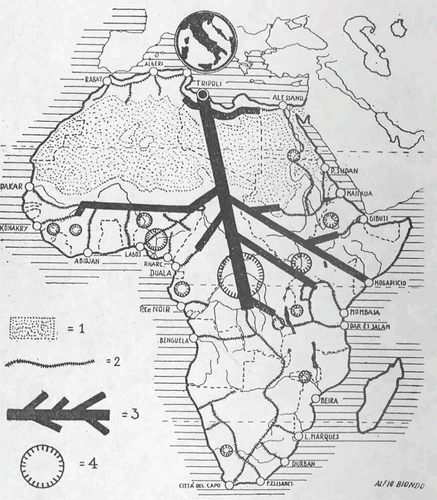
Through the DL Cultura, Italy’s Ministry of Culture makes international cultural cooperation starkly interoperable with the same architecture that organises energy strategy, export finance, corporate expansion, and migration management. The money attached to the Piano Mattei shows how this architecture operates. Its initial allocation was €5.5 billion, made up of €3 billion from the Fondo Italiano per il Clima, the Italian Climate Fund, and €2.5 billion from Italy’s development cooperation budget. By the 2026 reporting frame, the Plan was also supported by €4 billion in guarantees from SACE, Italy’s state export-credit agency, which guarantees and insures Italian business operations abroad. Behind the vapour-thin vocabulary of cooperation, the beneficiaries of this system are perfectly concrete. Eni, Italy’s state-founded energy company, has a Kenyan biofuel operation mobilising approximately €184 million, including around €66 million from the Italian Climate Fund and €118 million from the International Finance Corporation, the private-sector arm of the World Bank Group. Cassa Depositi e Prestiti, Italy’s national promotional bank, and SACE have also provided €250 million to the Africa Finance Corporation, backed by a SACE guarantee covering up to 80% of the facility, in an operation tied to the Lobito Corridor, the railway and logistics route designed to move copper, cobalt and other strategic resources from the Democratic Republic of the Congo and Zambia to Angola’s Atlantic coast. The Plan calls this partnership. Its accounts say something else. Public money, state guarantees and development finance are being used to secure Italian access to African resources, infrastructures and markets. Whatever reciprocal benefits the Plan claims for African partners remain, at this stage, largely promissory. What is already legible is the de-risking of Italian expansion. [6]
Furthermore, and crucially, migration control is explicitly written into the Plan itself.Article 1 names the “prevention and countering of irregular immigration” and the “management of legal migration flows” among its central fields of intervention. [7] It is hardly surprising, then, that Leonardo S.p.A., Italy’s aerospace, defence and security company, appears precisely where extractivism and racialised border management begin to blur into one another.A company that supplied technologies of militarised border surveillance to Frontex, the EU agency patrolling the Mediterranean and policing the Union’s external borders, [8] while maintaining extensively documented ties to Israel’s military apparatus. [9] In 2025, Leonardo S.p.A enters the Piano Mattei through the language of “smart agriculture,” presenting cloud computing and cybersecurity as instruments of sustainable agricultural development. [10] Across the Piano Mattei, development is made to perform as migration pre-emption. Cooperation is asked to do the work of the border before the border appears.
The progressive aura attached to Mattei’s name is only the opening move in the laundering operation that state-sponsored cultural projects aligned with the Piano Mattei are now tasked with carrying further. Enrico Mattei, founder of Eni and patriarch of Italian state energy, is summoned as the emblem of a postwar Italy supposedly less predatory, and more capable of fair exchange, than the colonial powers of old. But Mattei did not move republican Italy beyond extraction, and Eni has never curbed the ongoing (neo-)colonial appetites of the nation. Mattei and Eni just refined the language of exploitation. Mattei furnished Italian energy strategy with a grammar of friendship. Meloni’s Piano Mattei inherits this manoeuvre. It disguises unilateral corporate expansion as shared growth, and the pursuit of African resources as the moral theatre of Italian generosity.
It is the stage set by the Piano Mattei that the Ministry of Culture’s programming is now required to inhabit and activate. Speaking about the Ministry’s plans for international cultural cooperation, Alessandro Giuli once stated: “Geography assigns our nation the role of mediator in the Mediterranean. So that Italy, however, does not simply endure this condition in a state of immobility, it is necessary to anticipate the complexity of the problems and place itself in command of the fundamental historical processes that are unfolding and that cross the Mare Nostrum. In a very concrete and very urgent perspective, this means confronting the problem of no longer considering Africa as Europe’s banlieue. All political, and indeed geopolitical, reflections must be conducted in Euro-African terms.” [11] If we were foolish enough to turn this quote into a game of bingo, with each square marked by one of the key colonial terms of the Italian Fascist ventennio in relation to the Mediterranean, we would not be waiting long before calling house.
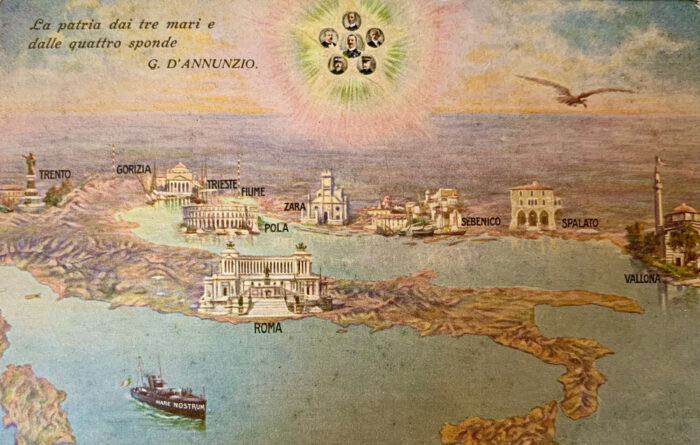
First, we have the hallucination of Italy’s destiny-driven role in the region, a fantasy that runs straight through Fascist Mediterranean thought, where geography was repeatedly made to speak as entitlement. Then comes the charged imperial formula Mare Nostrum, once resurrected by the Fascist regime to tint the Mediterranean with the glow of immediate possession. Fascism deployed this terminology pervasively to identify the sea with Italy’s spazio vitale, its vital space, the territory of imperial expansion recast as the direct historical right of the Italian nation. The genealogy is precise: Fascist Italy used the Roman idea of “our sea” to anchor modern imperialism in the authority of antiquity, while configurations of the ancient Roman Mediterranean served to yoke Africa to Italy within Fascist imperial ideology and to reify the boundary between Europe and the non-European other in contemporary xenophobic discourse. [12] The movement is double and durable. Africa is pulled close when proximity serves Italian ambitions. It is pushed away when proximity threatens white European order. The same elasticity runs through the present. In the liberal and Fascist imperial imagination, Africa could be made near enough to justify possession and distant enough to require discipline.
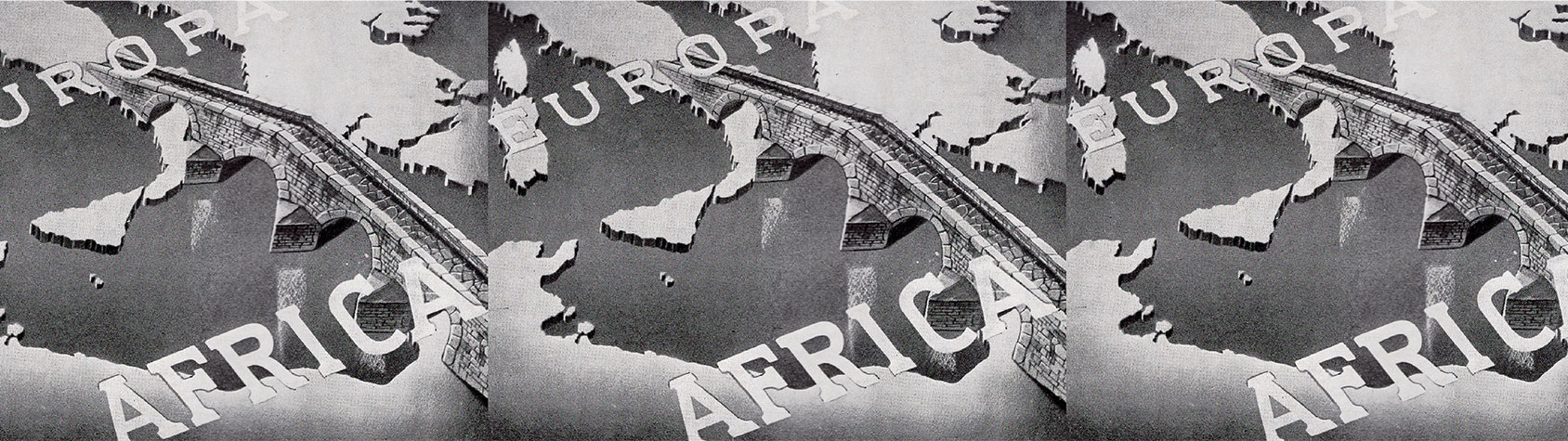
This leads to the final image evoked in Giuli’s words, that of Italy as the Euro-African bridge. Here too, the language makes no excuses for itself. Eurafrica was never simply a dream of intercontinental friendship. In its twentieth-century formulations, it named a project through which Europe could renew itself by binding Africa to its own economic, demographic, and political needs. Africa was imagined as Europe’s resource-base, territorial extension, and developmental reserve, the space through which the continent might survive as a global power also after the collapse of formal empires. [13] The bridge, thus, is not a neutral passage between equal shores. It is the form through which asymmetry is made graceful, and Africa is pulled into Europe’s future as the condition of its own subordination.
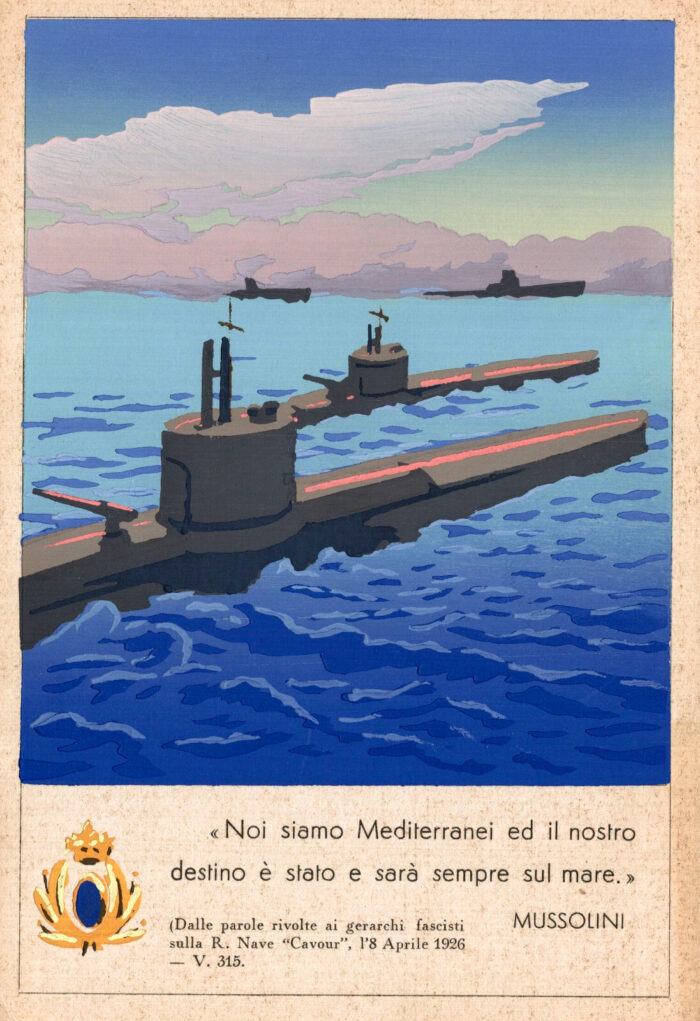
So, if the Italian Ministry of Culture’s operations in 2026 still carry the sulphuric stench of Mussolini’s dream of turning the Mediterranean into an “Italian lake,” it is because Italy’s approach to the sea, and the region gathered under its name, never truly broke from the mould cast by Fascism a century ago. In the language of Italian cultural diplomacy, the “wider Mediterranean” is an invitation. In the language of the state, it is a map of appetite. The sea is stretched until it can contain everything Italy wants to extract, police, and narrate: gas fields and mineral corridors, migration routes and their violent obstruction, naval deployments and offshore detention sites, archaeological inheritances, cultural memory, and the very imagination of who the Mediterranean belongs to. All that is encompassed within the fragile afterlives of the empire. The Mediterranean becomes elastic exactly where the power of the nation requires it to be. Europe sits firmly at the centre of this imagined geography, while the rest is pushed to the margins. Such geographical imagination is constructed and preserved by state-funded cultural projects, through languages of creation that draw identitarian contours around hegemonic fantasies of what the Mediterranean is, was, and could be.
There is no innocence left to grant. To pretend that this treatment of Mediterranean imagination could be reparative, by any stretch of critical desire, is nothing but absolution staged in advance. Participation in projects promoted by the Ministry of Culture under the DL Cultura is already inscribed within a political agenda that unapologetically folds Africa and the Mediterranean into the neocolonial horizon traced by the Piano Mattei. The cultural, curatorial, and artistic ambitions fattened by this framework cannot stand outside the violence of the state that authorises and funds them. They will inevitably contribute to the predatory identification of Mediterraneanness with white Italianness, dressing an old imperial claim in the contemporary garments of cultural exchange. And far from remaining contained within the walls of foundations, museums, biennials, residencies, or any other sanctioned arena of encounter, the fabricated identitarian hinge sustained by these projects will continue to join what official language insists on separating. Border violence and artistic production, military surveillance and the romance of Mediterranean proximity, the management of racialised mobility and the choreography of shared inheritance, all operate as functions of the same regime.
Cultural diplomacy does not reinvent the coercion already embedded in Italy’s international programmes, but masks it behind a language of intimacy and mutual recognition. It allows the Mediterranean to be performed as a space of shared belonging while it is governed as a frontier of exclusion, extraction, and death. The Ministry of Culture’s operations in and about the Mediterranean are not peripheral to Italy’s project of colonial continuity. They are among its core instruments. Across all the ever-shifting “Fourth Shores” that Italy still desires to name and conquer, the so-called soft power of cultural diplomacy does not soften the violence of the geopolitical machine. It sharpens it. It renders its claims palatable, naturalises its authority, and produces the rhetorical conditions of its endurance.
[1] See “Lo Stretto di Messina torna al centro del Mediterraneo. Il Ministro Giuli a Messina ha presentato il progetto del MIRA — Mediterranean Institute for Research and Arts,” press release, Messina, 2 July 2026.
[2] Ministero della Cultura, “MAXXI Med, intesa MiC per nuovo polo culturale del Mediterraneo a Messina,” 13 December 2025, https://cultura.gov.it/comunicato/28462. Last accessed 7 July 2026.
[3] See Law no. 16 of 21 February 2025, converting Decree-Law no. 201 of 27 December 2024, Misure urgenti in materia di cultura, “The Unit of Mission exercises functions of direction and coordination over cultural cooperation projects and interventions with African states and international organisations; promotes dialogue between Italian cultural bodies and institutions and those of African states and the wider Mediterranean; supports the implementation of cultural regeneration projects in southern Italy; coordinates research and higher training programmes promoted by the Ministry of Culture for the benefit of bodies and institutions in Africa and the wider Mediterranean; and promotes forms of public-private partnership to support the valorisation of African cultural heritage.” Translation from Italian by the author.
[4] See Palazzo Chigi, Press release: Council of Ministers no. 109, 23 December 2024, “Urgent measures on culture (Decree-Law),” p. 2. The press release states that the head of the unit “operates in close coordination with the Piano Mattei steering committee (cabina di comando), of which they are a full member.” Translation from Italian by the author.
[5] See Law no. 16 of 21 February 2025, converting Decree-Law no. 201 of 27 December 2024, Misure urgenti in materia di cultura. Translation from Italian by the author.
[6] See Governo Italiano, “Piano Mattei per l’Africa: le risorse e gli strumenti finanziari,” https://www.governo.it/it/articolo/piano-mattei-lafrica-le-risorse-e-gli-strumenti-finanziari/28747; SACE, “SACE and the Mattei Plan,” https://www.sace.it/en/media/press-releases-and-news/news-details/sace-and-the-mattei-plan; International Finance Corporation, “IFC and the Italian Climate Fund Partner with Eni to Support Biofuel Production and Farmers in Kenya,” 9 May 2024, https://www.ifc.org/en/pressroom/2024/ifc-and-the-italian-climate-fund-partner-with-eni-to-support-biofuel-production-farmers-in-kenya; SACE, “Cassa Depositi e Prestiti, SACE and Africa Finance Corporation,” https://www.sace.it/en/media/cassa-depositi-e-prestiti-sace-and-africa-finance-corporation; Reuters, “Africa Finance Corp to sign $320 million deal with Italy to bolster Lobito funding,” 5 June 2025, https://www.reuters.com/world/africa/africa-finance-corp-sign-320-million-deal-with-italy-bolster-lobito-funding-2025-06-05/. Dollar figures converted approximately into euros. Last accessed 5 July 2026.
[7] See Article 1, paragraph 2, of the coordinated text of Decree-Law no. 161 of 15 November 2023, converted into Law no. 2 of 11 January 2024, Gazzetta Ufficiale, 13 January 2024.
[8] See Leonardo, “Leonardo’s Falco EVO drone is used to monitor irregular migration during Frontex operation,” press release, 12 July 2019, available at: https://www.leonardo.com/en/press-release-detail/-/detail/12-07-2019-leonardo-s-falco-evo-drone-is-used-to-monitor-irregular-migration-during-frontex-operation. Last accessed 9 July 2026.
[9] Who Profits, “The Israeli Occupation Industry: Leonardo S.p.A.” Available at: https://www.whoprofits.org/companies/company/7380. Last accessed 9 July 2026.
[10] See Leonardo, “The Mattei Plan: Leonardo and BF SpA join government programmes for Africa,” press release, 17 January 2025. Available at: https://www.leonardo.com/en/press-release-detail/-/detail/17-01-2025-the-mattei-plan-leonardo-and-bf-spa-join-government-programmes-for-africa. Last accessed 9 July 2026.
[11] Annalisa Chirico, “Alessandro Giuli: ‘Non c’è potere senza sapere,’” Fortune Italia, 23 October 2025, https://www.fortuneita.com/2025/10/23/alessandro-giuli-non-ce-potere-senza-sapere/. Last accessed 7 July 2026. Translation from Italian by the author.
[12] See Samuel Agbamu, “Mare Nostrum: Italy and the Mediterranean of Ancient Rome in the Twentieth and Twenty-First Centuries,” Fascism 8, no. 2, 2019, pp. 250–274.
[13] See Peo Hansen and Stefan Jonsson, Eurafrica: The Untold History of European Integration and Colonialism, London: Bloomsbury Academic, 2014.