
The Sacred Screen
Technology is not the future, we are
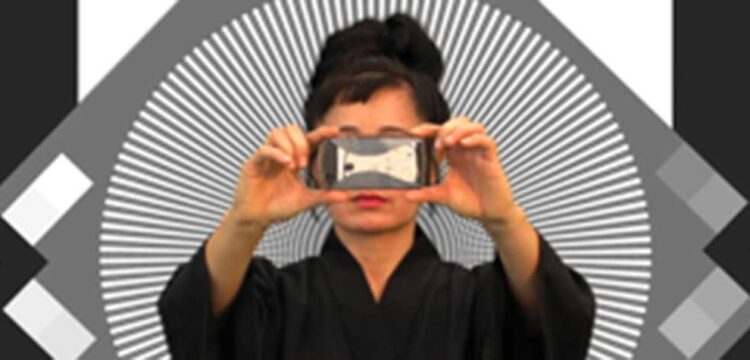
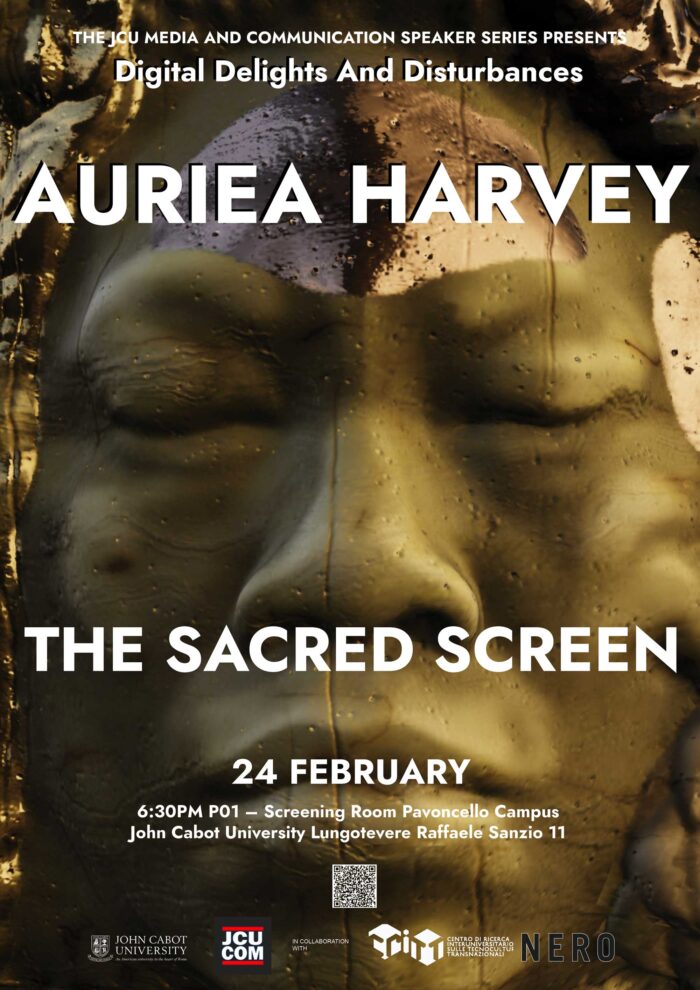
The John Cabot University COM Department’s lecture series Digital Delights and Disturbances presents The Sacred Screen, a conversation with artist Auriea Harvey on Tuesday, February 24 at 6:30pm in PO1 –Screening Room, Pavoncello Campus, Lungotevere Raffaello Sanzio 11, Rome.
After 30 years creating with digital media, through the browser wars, the rise and fall of net.art, indie games, NFTs, and now AI, artist Auriea Harvey has survived enough hype cycles to recognize a pattern. Each technological wave promised unmediated access to truth, democratization, or revolution. Each crashed, leaving behind the question: what actually endures?
Drawing on Bruno Latour’s concept of the “image wars” and the acheiropoietic image (the sacred image “not made by human hands”), Harvey argues that we’ve misunderstood what makes images powerful. The acheiropoietic image isn’t powerful because it wasn’t made but because it asks to be believed in. What if all images, including digital ones, work this way? After watching platforms rise and fall, what remains is the practice itself and hope in the capacity to make images worthy of belief, to create cascades of meaning that survive the hype cycles.
Harvey’s practice moves fluidly between internet art, game design, 3D scanning, digital sculpture, and physical materiality. She treats algorithms with the same reverence as traditional materials. By refusing to specialize, she’s learned that images don’t derive power from their medium or their claim to unmediated truth. They work by connecting to other images, by creating cascades of meaningful interaction with a public, by asking to be believed in.
The talk weaves together personal narrative, art practice, and tech/art history to argue that in facing a crisis of fabricated images we are finally being forced to remember how images actually work.
The Digital Delights and Disturbances Lectures series is organized and supported by the Department of Communication and Media Studies.
Access is free but registration is mandatory, via the form or via email at rsvpevents@johncabot.edu.
What makes images powerful?
Auriea Harvey: I don’t have an answer, but when I talk about images I am not just thinking of a flat visual, it can be an object or experience as well, hopefully a combination of all three. I would give an example which is timely in Italy this year: St. Francis’ bones. His remains have been exhumed and will be on display in Assisi. Hundreds of thousands of people will go to venerate those bones. Most will take photos, I have already seen many videos circulated. Bones in a plastic box. I am told they are the bones of St. Francis. Why are people taking photos? Replicating the image of something they have physically been in the presence of? When he lived he was an example, none of us alive now got to see him, but his spirit lives on in the many brothers who carry his way along today, and through time. He is a powerful image. Do we hope to take away with our pictures a little bit of that holiness? Do we hope our photos prove that we were actually there and present witness to St. Francis? An image is often a way to remember an event you experienced more strongly than if we had not a picture of it at all. It is also just a habit, an obsession, an ultra contemporary condition. We take a photo before we actually see anything. But is it more important to be there in the presence of the bones or to have the picture?
What does it mean to believe in an image? And to create one?
Auriea Harvey: When we talk about believing an image usually we are talking about facts, we are talking about reliability, knowing an image’s origins and who made it, when and where and why and how. This is the uproar over AI right now. Having a computer hallucinate an image of whatever prompt you type in can feel like magic or it can feel like a devaluation of human labor. Are we destroying what it means to create from our own imagination by flattening creativity to an amalgamation of what already is? Images historically have been about consensus, agreement on what symbols mean. We lost that for awhile as we accepted photographs as facts of specific times and places. That is over now, at least for the time being. And now we have a time where algorithms scrape up images and serve variations of consensus of how things look or what things mean. Artists always do this anyway, most originality is built upon what historically came before. The difference I would say is that a human can occasionally change the world by shifting their iconography, saying something new. Let’s not forget that computers only do what we tell them to do and thus even AI images are made by humans… let’s not give the machines too much credit.
How did the algorithm become material and how has your work changed after that?
Using computers as the main material of my practice happened very naturally as it was a most readily available art material, tool and means of communication I had to work with. But there have been many cycles of physical and digital production for me, I think because of my age, having grown up without digital media but then having embraced it so strongly as a young woman. My generation can feel most keenly what we have gained and what we have lost. I was able to go 20 years without making any physical artwork at all, with the exception of drawings and sketches for planning works. But since the world has become so saturated with media I have needed to use my hands, as a coping mechanism! I love to make things which live only online, but I also love creating sculpture and installation which forces a confrontation with bodies and matter. I enjoy 3d scanning objects, sculpture, even architecture I encounter in the world, but I consider this as taking them into a timeless space, as a way to understand their forms better and a way to digest or analyze why something attracted me. Ironically perhaps, I lament that experience of physical art will become a lost discipline, that I will forget how to experience things in an unmediated way. Drawing what I see instead of photographing it, for example. Sitting in absolute silence with no desire to capture anything with my phone, for another.
What kind of pattern did you recognize in the rise and fall of internet hypes and the betrayal of their promises?
The biggest pattern is that there is a lot about it that you cannot control. A lot of money involved. A lot of people promising things which seem outrageous. You feel pulled along and told that certain technologies are inevitable or necessary and that you cannot live without them. You most certainly can. But there is a trade off, always. I find it best to be software and hardware agnostic. To not put faith in technology but in human spirit and ingenuity. Technology is not the future, we are.