The Practice of Tools
From True Counterpower and Reading Counterpower to “Tools for Assembly” at Lateral Roma
The title Tools for Assembly names something that has not yet happened. A tool waits for someone to pick it up, and it can remain unused for a long time when the circumstances that would call for it are missing. The exhibition asked what it takes to gather with others, read together, recognise the conditions in which we live and imagine changing them.
Presented at Lateral Roma from 18 September to 25 October 2026 and curated by Giulia Menegale, Iliada Charalambous’s Tools for Assembly brought together an archive of gatherings, texts and collective notes alongside a wall painting and a publication at the independent art space Lateral Roma. The exhibition drew on her work with activist Serda Demir through True Counterpower and Reading Counterpower, connecting artistic practice with political education and collective organising. Its public programme and bilingual publication, Tools for Assembly: A Reader, were developed with 10 documents, the research platform founded by Ginevra Ludovici and Flavio Michele.
Miriam Rejas Del Pino to Iliada Charalambous: I would like to begin with the present. What makes the question of how we act together urgent for you now? How do you approach it as an artist and an organiser, and what has working with Serda brought to that way of thinking?
Iliada: In the current state of our societies, where state violence has become so normalized, where we are witnessing multiple genocides and where climate collapse is imminent; it is evident that peoples’ organisation and resistance are essential for the possibility of survival and towards a life of dignity. We learn from social and revolutionary movements of the past and present, in order to inspire peoples to struggle for another world, not centered on the hunt for power, exploitation and oppression. To learn from different territories and various movements for us, means to better understand our own struggle today within a genealogy of peoples and movements that have struggled for a different world and for communalism. It means to understand our own histories, not in connection to the rhetorics of the nation-states that we supposedly belong to, but as peoples who were always constituting counterpower and a democratic outlook of life; essentially as part of the peoples whose histories did not make it into the dominant canon of history, but whose struggles have given us whatever sense and consciousness of freedom we have today. In this sense Reading Counterpower, as you say, is a tool which can aid us to bring together theory and practice. We can not have a revolutionary practice without revolutionary theory and vice versa. Therefore, besides being a call to collective learning and to build comradery, it is also a tool for understanding the path that was carved by movements in the past and on which we are walking on today as societies and communities in struggle. Similarly, art has always been part of movements with the aim to inspire and as the saying goes “to make revolution irresistible.” Art has the potential to give form, images and imagination to our political struggle and as a tool for emancipation and collective expression, to be an integral part of it. It has been a question for me, how can one make art that would serve the people and not the art market to whatever extent. Therefore, for me, to learn with and work with Serda has been a privilege, vital as a way that one could attempt to merge art and organising and hopefully to create art as a tool and a proposal towards another world.
Miriam to Giulia Menegale: Your curatorial text recalls meeting Iliada at a Reading Counterpower session at the Afrikaanderwijk Coöperatie in Rotterdam. What did you see there that made you want to invite the practice to Lateral Roma, and what did you think an exhibition could give back to it?
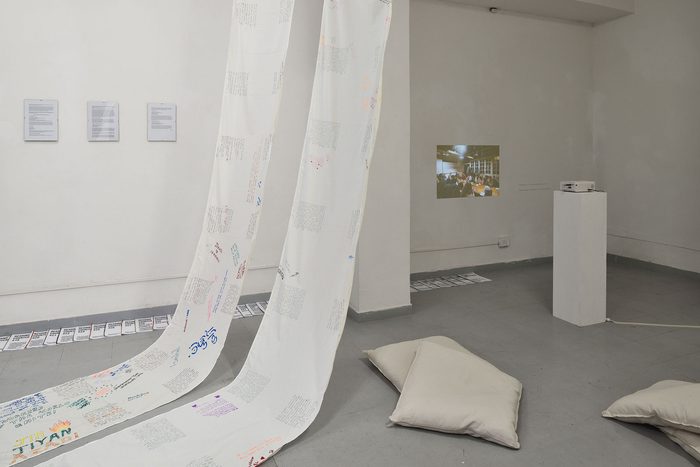
Giulia: I was struck by how the reading group was never “just a reading group.” Meeting every two weeks since 2023, it has created what Iliada describes as a temporary yet also “permanent” community, one that understands itself through political affinities. I thought it was beautiful to have the original booklets they read during past sessions, each printed and bound individually by the artist and bearing the date and title of the text read, line the perimeter of the exhibition space. It was a way of making visible all the times that the community had gathered around those texts. In an increasingly fast-paced society, where relationships are often fragile and circumstantial, I value not only what takes place or what is organised, but also the repetition of the act itself. In this case, repetition changes how I perceive the reading group itself: in the case of Reading Counterpower, reading a text becomes a way of building and sustaining a community, while those who take part are themselves transformed through their ongoing participation.
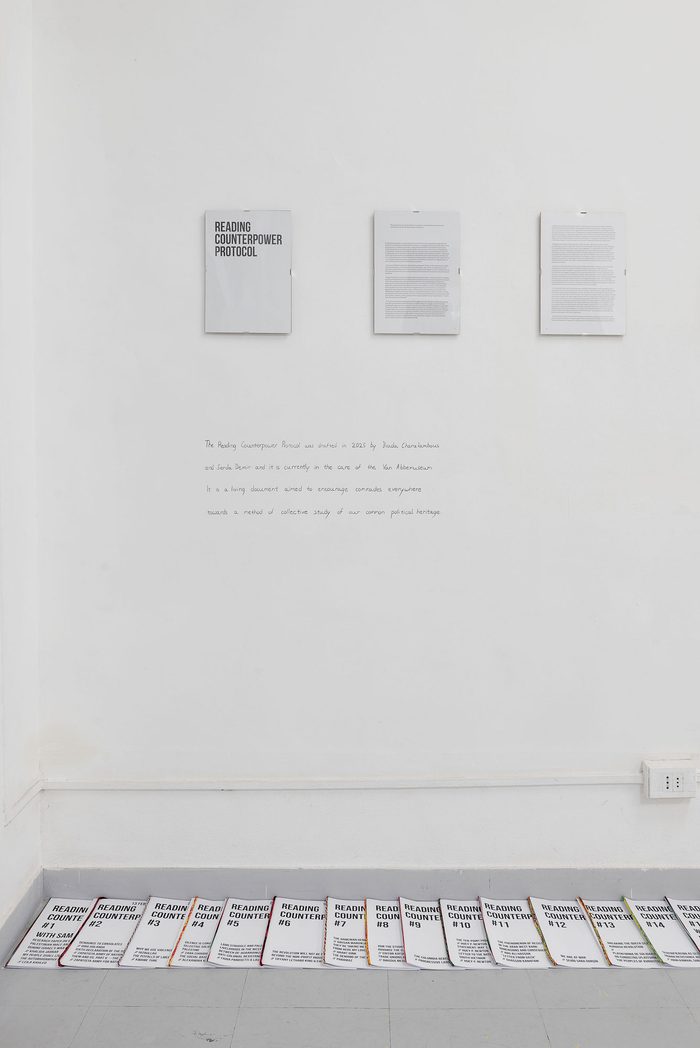
Reading Counterpower emerged from True Counterpower, a series of assemblies initiated by Jonas Staal, organised by Demir and Charalambous and facilitated by the Van Abbemuseum in Eindhoven, gatherings in which activist movements and organisations shared their tools of resistance with one another. The wish to meet regularly with friends and comrades in the city where they lived led Demir and Charalambous to begin, in 2023, a fortnightly reading group at the Afrikaanderwijk Coöperatie in Rotterdam South. Its readings come from the accounts that revolutionary movements have written of their own struggles and forms of organisation, approached with the question of what can be learned from them across places and times. Groups have since formed in Amsterdam and The Hague, and the chapters now work together as a confederation.
Staal has used the term assemblism for the work of giving form to assemblies, a work in which artistic and political means are hard to separate. Seen from this angle, the tools in the exhibition concern the form of the gathering more than its content. They act on what makes an action possible before it takes place, so that speaking or simply listening become possibilities open to everyone present. The Reading Counterpower protocol works almost entirely at this level, and it does so through invitation. Anyone may read a paragraph or less, and anyone who prefers not to read aloud can pass the text on to the person next to them. Readings are chosen with the group by consensus, with a preference for texts written by movements themselves in accessible language. This has a very interesting consequence. The collective that will use these tools does not exist before the encounter, and the protocol contributes to producing it. Each session inherits a form through which people have already acted together, and each one tests whether that form can make room for those who arrive with less confidence or less familiarity with the texts. The method travels from one city to another as a set of conditions for the next group, which that group can then revise.
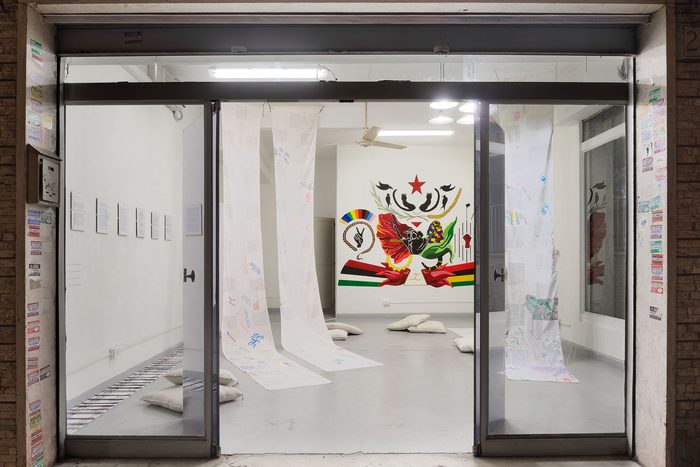
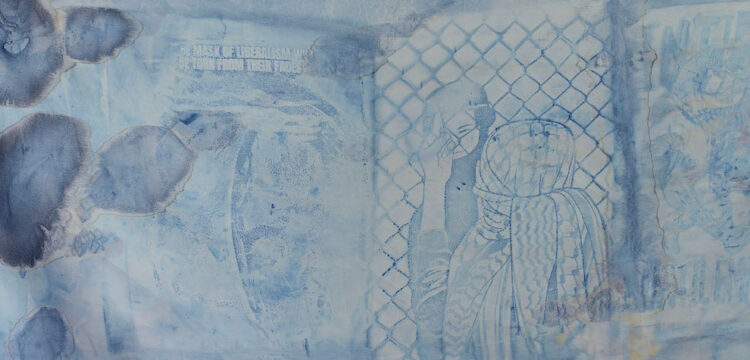
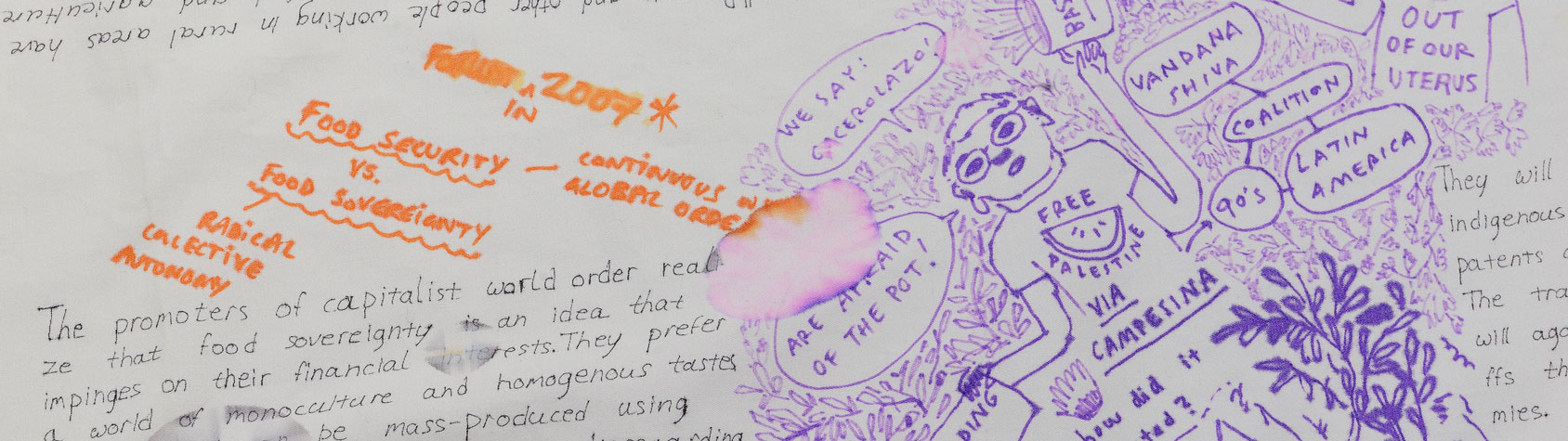
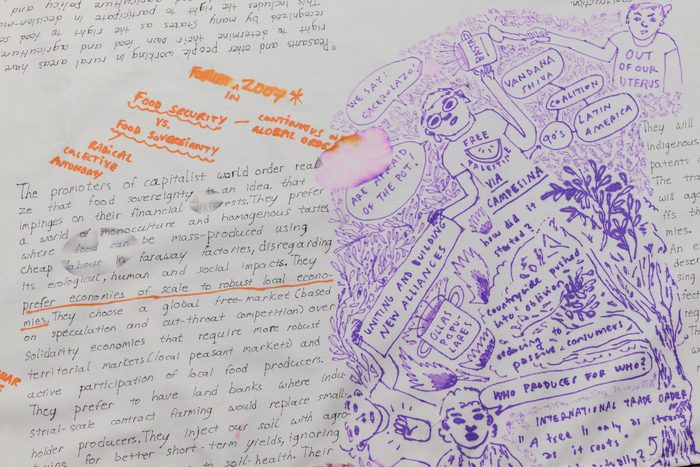
At Lateral Roma, the fabrics carrying collective notes made visible the passage from a gathering to its exhibition. The protocol asks participants to imagine a large piece of fabric on a table, covered with different handwritings, observations, arrows and drawings. On a common surface each contribution takes a position in relation to the others. A remark can be linked to another, contested, underlined or left beside a disagreement that the session did not resolve.
The words text and textile share the Latin root texere, to weave, a relationship that acquires particular force when reading generates another surface of inscription. A cloth written on around a table belongs to a practice. Hung in a gallery, it is offered to visitors as an object and read as a text. The marks remain the same, while the level at which they signify has shifted.
Miriam to Giulia: How did you think about moving these materials from the reading table to the exhibition space? With the suspended fabrics in particular, what did you want the arrangement to make possible for visitors, and what did you accept would remain available only to those who had taken part in a session?
Giulia: As a starting point, I would clarify that inviting Iliada to make an exhibition was not a straightforward proposition, especially if it meant presenting her practice and the collaborations that constitute Reading Counterpower. The risk of reifying those relationships and processes was considerable. As a curator, I felt responsible for moving from making an exhibition “about” Reading Counterpower towards one in which Reading Counterpower could be present. This meant creating the conditions for encounters with the practice to activate processes beyond our control, responsive to the specificity of the present and, in this case, to the city of Rome. Thinking of the materials as a living, evolving archive was one way of mitigating this risk. It meant accepting that what visitors see at Lateral Roma is only one part of an archive that continues to unfold. The protocols lent to us by the Van Abbemuseum allow those who encounter them to discover that a reading group called Reading Counterpower exists in the Netherlands, while also offering a prompt to develop the practice further on their own initiative. They provide the exhibition’s “how-to” dimension.
Another way was through collaboration with the editorial and curatorial platform 10 documents. Since neither of us is based in Rome, they helped us connect with local social and activist organisations, which I believe are Reading Counterpower’s primary interlocutors, rather than the art public. Iliada’s work as an activist and community organiser coexists with her artistic practice in her everyday life, so it felt natural for these conversations to continue with local grassroots organisations in a city new to her. To put it provocatively, there were times when I saw her exhibition at Lateral Roma also as an excuse for her to be in Rome and build connections that are vital to the internationalist perspective running through everything she does.
Holding one of the reading sessions on the street in front of Spin Time, as part of the programme accompanying the national assembly in support of its cause (20th September 2026), was one of these welcome, unexpected developments of having brought Reading Counterpower in Rome. It grew out of the conversations and encounters facilitated by 10 documents, emerging through political affinities and responding to local needs that existed independently of us, rather than being driven by our desire to produce a “nicely curated and thought provoking” exhibition.
Miriam to Iliada: The protocol replaces the individual notebook with a shared surface. Does writing where everyone can see change what people allow themselves to write, and does the cloth hold a different kind of thought from the one we keep for ourselves?
Iliada: In the beginning when we started to engage with this practice of collective note-taking, it actually took a while for people to get used to it. Indeed, one felt more shy to write extensively or very directly one’s thoughts but we saw this changing with time. People got used to this format and eventually were asking for a shared surface to write; because this practice and doing away with individual notebooks (ideologically as well) was understood as important for our communal development. Part of it was understanding that collective reflection is essential in order to move forward together and to enrich both our discussions and the fabrics of notes; and that one is not a consumer or viewer or audience in the space but an active participant without whom the space would already be different. Reading Counterpower is a space of learning with questions welcomed, therefore we saw both the conversations and the notes flourishing with time as people got used to the format and we all started to grow with it. Writing collectively became similar to the exercise of learning to speak in public or learning to read out loud in a group and to sharing your thoughts and questions. Therefore, I believe that with time the fabrics were holding the thoughts that the notebooks might have held but with the conscious idea that these thoughts constitute a collective outlook—with its own diversities inside of course—and that the notes constitute the documentation of a collective process instead of an individual one.
The Reading Counterpower protocol moves between invitation and agreement. It asks the reader to imagine a room, which might be a squat, a museum, a square or a living room. Sessions follow a calendar of uprisings and commemorations, and other cities may adopt the practice if they share its principles, among them internationalism, anti-colonialism, feminism and anti-fascism. The protocol also sets out what an institution owes the practice. At the Van Abbemuseum this means material responsibilities, recognition of the organisers’ authorship, and conditions for the archive’s future use. On the wall, the protocol addresses two readers at once. Its instructions invite visitors to organise or join a session, while the exhibition shows them an agreement made by others. Much of the exhibition’s political interest depends on which of these positions a visitor ends up taking.
Miriam to Iliada: Did any of the rules in the protocol come out of difficulties you and Serda faced, in the sessions or with institutions, or did the document have another purpose?
Iliada: I don’t feel that any of the clauses written in the protocol arose from difficulties per se. The protocol became a document through which Reading Counterpower can be propagated, even in the scenario where Serda and I or any of the current Reading Counterpower organisers are not active or present anymore. The set of instructions was written as a means to share the method that we use and it is open to adaptations according to a community’s needs. The other part of it was to clarify our principals and how these dictate how and if we work with institutions. It designates a clear role to institutions and outlines their responsibility, as infrastructures belonging to the public, in holding our archive materials and the space of Reading Counterpower. We encourage cultural institutions to offer their spaces and resources to hold the space for communities, not because it makes for a good pr but because we believe that institutions, belonging to communities, have to be filled with them, used by them and need to serve these communities. Art, life and the political are inseparable in our view and so the protocol makes this clear and outlines how we may work with institutions.
Miriam to Giulia: Working with a practice that already has its methods, relationships and political commitments, how did you understand your position as a curator, and were there moments when hosting it led you to question Lateral Roma’s own ways of working?
Giulia: All the collaborations with art spaces and platforms around Tools for Assembly were deliberately chosen and actively pursued. The exhibition began with a spontaneous proposal I made to Lateral Roma, with 10 documents subsequently joining us for the public programme. The choice of venue and people to work with was very intentional: knowing some of the people behind Latera Romal, particularly Marta Federici and Jacopo Rinaldi, I knew I would find political and social affinities that would contribute meaningfully to the exhibition. The same was true of 10 documents. Both belong to a fabric of independent culture that offers essential resistance to the way a city like Rome is increasingly organised around tourism and large mainstream events. The communities around them are people with whom I felt the project could resonate, prompting curiosity, questions and meaningful discussions. We were therefore very happy that, towards the end of the exhibition, the artist Giulia Crispiani took the initiative, together with the Lateral Roma team, to organise a final Reading Counterpower session. They organised it independently; Iliada simply provided the materials.
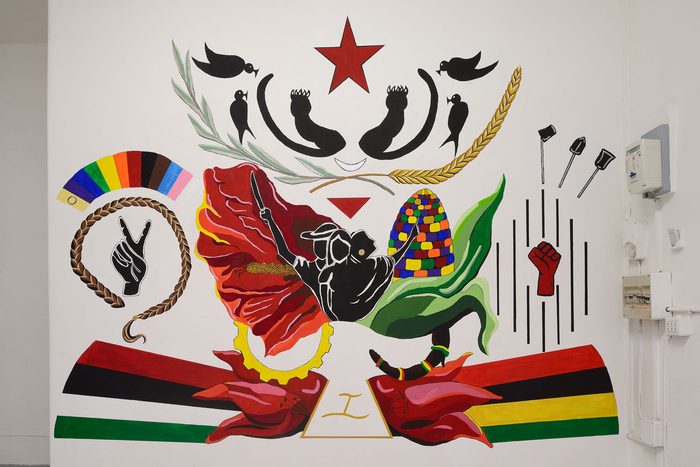
The wall painting brings another kind of tool into the room. An olive branch, an ear of wheat, a hibiscus flower, an ear of corn and agricultural implements share a composition that draws its symbols from different struggles. A handwritten text on the adjacent wall gives their references, among them the Palestinian struggle, the Kurdish freedom movement, the Sudanese Revolution, the Zapatista movement and La Vía Campesina, among many others. The painting places the symbols side by side, and the writing allows viewers to trace each one back to its history, so that the solidarity proposed by their proximity comes with the work of learning where they come from.
Miriam to Iliada: How did you choose the symbols for the mural and the relations between them?
Iliada: The symbols depicted on the mural, all come from the symbols and the imageries of movements from and with whom Reading Counterpower has been learning. After Giulia’s invitation to think of a visual image that would communicate the idea behind Reading Counterpower, I felt that a homage to some of the movements we have been reading from would be appropriate. The composition as well depicts our internationalist ideology which prompts us to learn across time, territory and ideology -on the left and from below. In that sense all the symbols come from our political ancestors and contemporary siblings in an attempt to create an image symbolizing the common struggle and showing the interconnectedness of struggles across time and territory. All the symbols come out of peoples courage, sacrifices, dignities, creativities, lands and cultures and in union, become our path. The written guide that accompanies the mural was necessary for me in order to clarify for the viewer the meaning of each symbol – even with the limit of not going into depth – and to encourage the viewer to do their own research, or engage with the Reading Counterpower archive present in the space to learn more about each movement. In that sense, it is an invitation to engage in the practice of Reading Counterpower and as a way to affirm the commitment of Reading Counterpower towards the movements and our common goals.
The Reader that accompanies the exhibition was produced with 10 documents in English and Italian, it includes Charalambous’s poem “To comrades near by and far away” (2025), written on behalf of True Counterpower, texts by the Community of Squatted Prosfygika in Athens, an excerpt from Revolutions of Our Times: Internationalist Manifesto by The Peoples Want, and a text from the Tricontinental: Institute for Social Research on Brazil’s Landless Workers’ Movement, the MST. Housing, solidarity and political education take different forms in each contribution, and translation into Italian raises again the question of what can move from one context to another. In her afterword, Charalambous addresses Roman readers directly, recognising in the pressure on their self-organised spaces the same logic that is pushing working-class and migrant residents out of Rotterdam South. In their foreword, the editors connect the publication with the pressures on self-organised spaces in Rome. During the night of 29–30 July 2026, a fire led to the evacuation of Spin Time Labs, the occupied building in the Esquilino where housing and social and cultural activities had coexisted since 2013. The judicial seizure that followed prevented residents from returning, displacing a community of around four hundred people. At the Angelo Mai, a space for independent artistic production, police sealed the premises during the night of 27–28 June following safety inspections, just as the procedure to regularise its presence in the building on Viale delle Terme di Caracalla was under way, and an inspection in October established that reopening would take at least a year. The two cases differ, yet in both the continuity of a collective life depends on premises whose future its users cannot decide alone. When such a place closes, the relationships and practical knowledge accumulated there are dispersed with it.
Miriam to Giulia: How did you, Iliada and 10 documents build the Reader’s selection and its relation to the public programme?
Giulia: The Reader took shape through conversations between Iliada and people actively involved in Rome-based networks of social movements and associations. In preparation for her arrival, together with 10 documents, we organised a series of online meetings to introduce her to the local context and the struggles unfolding within it. These conversations were also fundamental in informing the selection of texts for the Reader. It was particularly important that the publication engage with ongoing struggles in the Italian capital concerning spaces for the commons and experimental forms of housing. With this in mind, Iliada proposed a selection of texts that could offer conceptual and practical tools for the groups and organisations involved in these struggles, opening up new perspectives and possibilities for reflection and collective action. The text in the Reader about Prosfygika, a self-managed, autonomous, and solidarity-based liberated zone of urban commoning and social housing in Athens, for example, clearly speaks to what was happening at Spin Time this summer (and it is still happening). Finally, to “close” the publication,. I asked Iliada to write a letter to whoever would read and hold the publication, as a gesture of care towards the transmission of the knowledge we are bringing together. The knowledge collected in the publication has emerged from contexts other than our own—some we know firsthand, others we do not. What mattered to us was to acknowledge the differences between the contexts we speak from while asking how we might come together across them. We wanted to encourage reflection on how we are affected by struggles that transcend national borders, against the grain of current official politics, which has an interest in reinforcing those differences and dividing us, fragmenting both our desire to resist and our shared interests in doing so.
Tools for Assembly closed on 25 October 2026, while its materials continue to circulate. At the time of writing, Spin Time and the Angelo Mai are still closed, and two of the places in Rome where these tools could have been taken up again remain out of reach.