
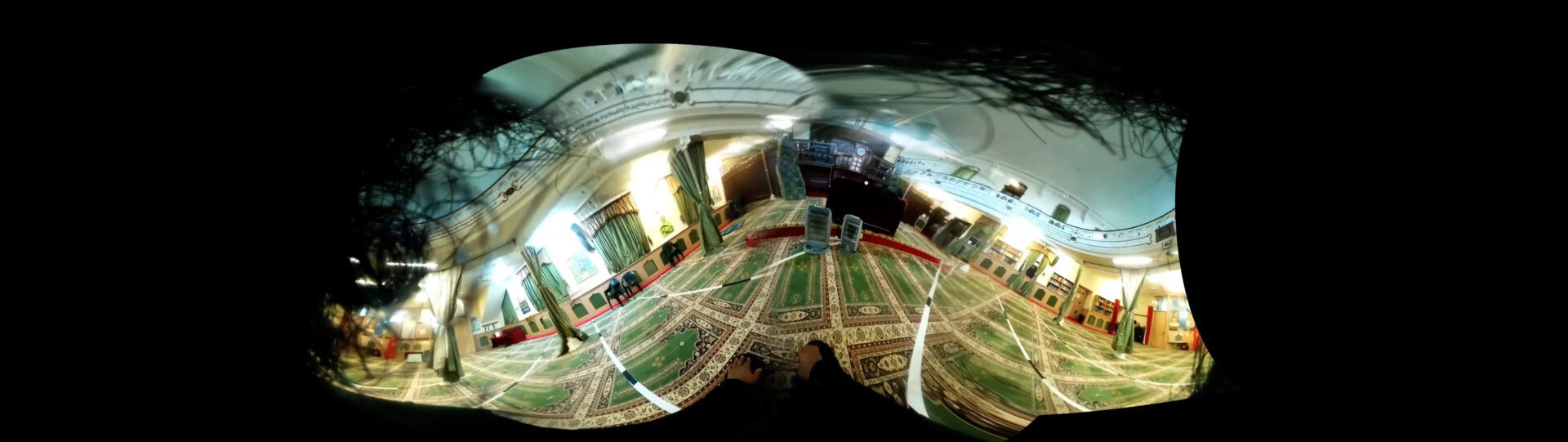
The Antidote to the Loss of Control
A deep dive into Mark Farid’s practice
To what extent do digital infrastructures shape subjectivities, relationships and the capacity to act in the world today? It is on these questions that the practice of the British artist Mark Farid is focused. Over more than ten years of activity, he has investigated how social media platforms, data extraction, surveillance and privacy infringement operate as material conditions capable of orienting the social and cultural context we inhabit.
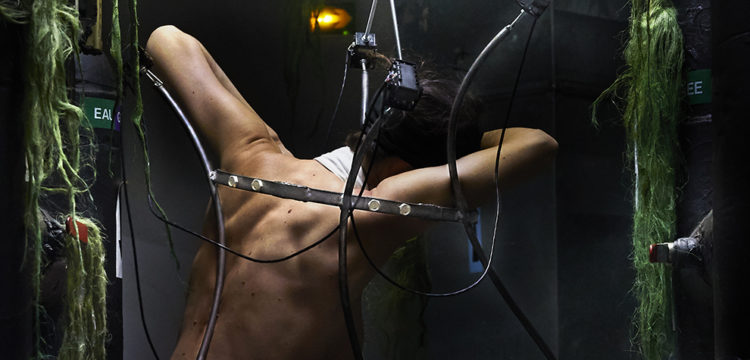
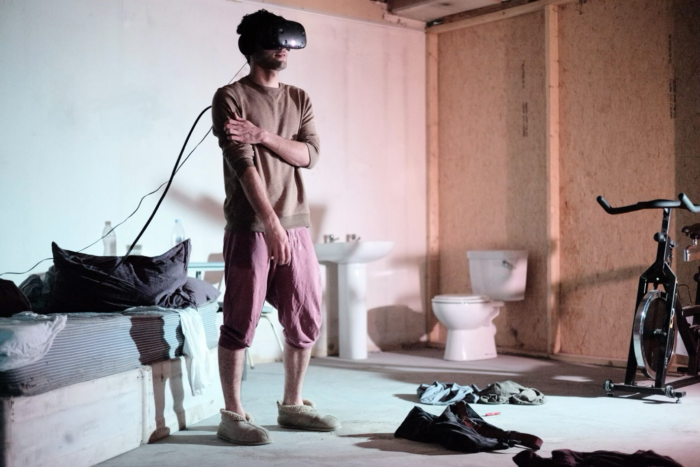
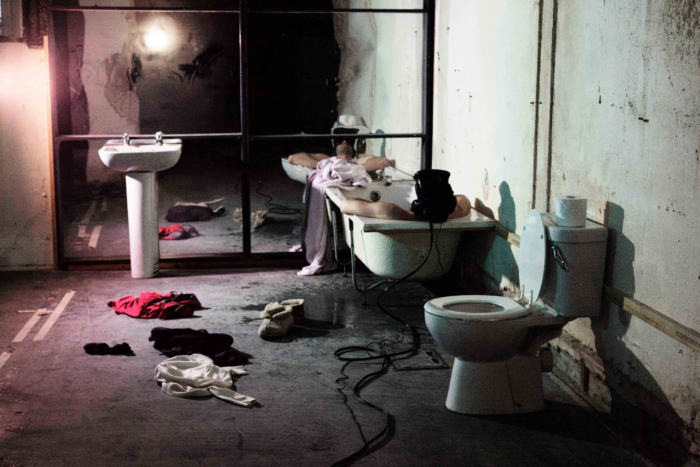
Not surprisingly, all of Farid’s works, from performance to multimedia installation to an intense theoretical and anthropological research practice, maintain a direct relationship with the body. At times it is the artist’s own body, as in Seeing I, where for seven consecutive days he lived seeing and hearing, through a VR headset, exclusively what another person saw and heard. At other times it is the audience’s body that is involved, exposed to detection systems capable of monitoring habits and consumption patterns and extracting information, sometimes controversial, making it visible (Invisible Voice, Data Shadow).
More recently, his interest has shifted toward the social body, explored through research aimed at understanding how pedestrian traffic regulation systems influence the way people cross and inhabit urban space. Each of these investigations documents in a rigorous and at times disorienting way the transformations generated both by media overexposure and, paradoxically, by the attempt to become invisible to these systems.
This is the case, for example, of Poisonous Antidote, in which the artist voluntarily renounces any form of privacy by releasing his sensitive data online. In this sense, translating the idea of pharmakon as theorised by Bernard Stiegler, Farid explores the paradoxical condition of the loss of control over one’s digital identity and at the same time the freedom that emerges from it.
Farid’s actions often appear radical, yet they make evident the profound vulnerability that characterises the contemporary subject: in attempting to escape the forms of control exercised by technological infrastructures, one quickly realises how impossible it has become to fully position oneself outside these logics. And yet Farid’s work also suggests the possibility of imagining different ways of inhabiting the complexity of the present. If, as Shoshana Zuboff writes in The Age of Surveillance Capitalism (2019), this new form of power “is also teaching us how we do not want to live,” then it becomes a collective responsibility to renegotiate practices, rituals and meanings capable of making technological infrastructures truly shareable on an ethical and social level.
I met Mark Farid on 27 June during his residency at the British School at Rome.
Daniela Cotimbo: One of your most well-known projects is Seeing I (2014-2020), in which for 24 hours a day, for seven days, you wore a virtual reality headset, experiencing life through the eyes and ears of another person—hearing only what they hear and seeing only what they see for an entire week. Inevitably, such a project raises many questions: I would start by asking you, what did this experience represent for you? And for the person who was being “monitored” by you?
Mark Farid: Seeing I started with a question about selfhood. How much of who I am is actually mine, and how much of it is absorbed from the world around me, the people, the places, the structures I inhabit, the ordinary streams of input I move through without noticing? I wanted to know what would happen if I took all of that away and replaced it with someone else’s, whether my own self would hold, or whether another person’s world, given long enough, would begin to overwrite it.
That question immediately raised another: whose world? We eventually developed and open-sourced a first-person recording system capable of capturing a continuous day and recorded the lives of a wide range of people, from an eighteen-year-old girl to a seventy-one-year-old woman, from academics to an asylum seeker, across different countries and circumstances. The question was never simply what it would mean to inhabit another person’s perspective, but whether different lives might reorganise the self in different ways.
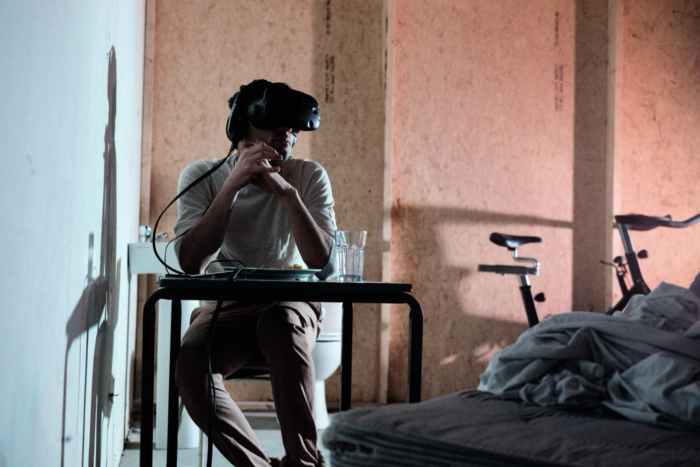
It was this question that I first tested in 2014, wearing the headset for twenty-four hours at arebyte Gallery in London, inhabiting one person’s recorded day for twenty-four continuous hours. What took place at Ars Electronica in 2019 was nine hours a day for seven days, experiencing the life of a different person each day. The fuller version, twenty-four hours a day across seven days with the National Theatre in the UK in 2020, was cancelled by COVID, so the 2019 run remains the most complete public performance. Over those days, my experience of both the gallery and myself began to change.
Between the third and fourth day, two things shifted. One was spatial. I started losing a sense of my physical surroundings. I started walking the wrong way to the toilet, the exercise bike, or the table, reached for things that were not where I expected them, and a few times walked into walls. I would step outside the performance boundaries so the headset switched to its black-and-white camera view, just to see the gallery and reorient before going back to the stream. The second was psychological. By the middle of the third day my ego felt broken, and I found myself hiding behind the bed so the audience could not see me. When I took the headset off I needed a lot of attention and reassurance before I felt like myself again. The clinical psychologist had been part of the structure from the start. The conversation at the end of each day was about making sure I was okay and bringing me back into the room, slowing me down on the day my ego broke, speeding me up on others.
My placement in the room was one of the few forms of intervention left to me. I could move around the gallery, regulate my body, or temporarily reorient myself within the space, but nothing touched the stream. When the person in the recording was travelling, I used the exercise bike, partly to match them and partly to discharge the boredom that accumulated during prolonged viewing. I could not change anything in the world I was watching, so the only place any agency could go was into how I appeared, or did not appear, to the people in the room.
Seeing I began as a question about the self, but the condition I had built turned out to matter more. I had made a situation in which nothing I did could affect what was happening to me, and then lived inside it. What it made clear to me was that participation is not the same as agency. To be inside something, to take part in it completely, is not to have any power over it. Obvious enough with a recording. Less obvious, and more troubling, once you ask it of the systems we are all already inside. That became the thing the rest of my work has followed: the question of what it actually takes for an action to produce a consequence, to alter the structure of the system you are in.
In your past projects, you have engaged with two opposing conditions: on the one hand, near-total invisibility within systems of control; on the other, a form of overexposure, in which you made all your account access publicly available. What reflections emerge from the comparison between these two experiences? And how can we rethink the concept of privacy today?
At first glance these two projects appear to explore opposite conditions. Anonymity Is Our Only Right and That Is Why It Must Be Destroyed asked what might happen if I withdrew from digital infrastructures altogether, while Poisonous Antidote asked what might happen if I went the other way and made my digital life entirely public, in real-time. What surprised me was that neither produced the outcome I expected.
Anonymity began in October 2015, alongside my exhibition Data Shadow, with a question about the terms and conditions we are all told we have a choice about. When you use a digital service you agree to its terms, and if you do not agree, you are told you are free to decline and walk away. But what you are agreeing to, in those terms, is that you never owned the account or the data in the first place; the company does. And to decline now is only to leave the data with the company. I wanted to find out whether that choice of declining all digital services was actually real. So at the end of a lecture at the University of Cambridge, I gave away all of my login details to the audience: my personal and professional email, social media, Apple ID, online banking, phone number and everything in between. Since I had never truly owned these accounts, giving the passwords away was the only way I could think of to delete them; anyone still using them, as remains the case with the Twitter handle @markfarid, is helping write new but incorrect data to the virtual Mark Farid. The passwords were changed, and I began six months of trying to live without a digital footprint.
What that quickly revealed in 2015 was that participation in these systems is presented as voluntary while in practice it has become a precondition for ordinary life, something close to a passport. Over those six months my social, cultural, and financial life all deteriorated together, and so did my mental stability. Living without a phone or a number became impossible, and losing my number meant losing contact with friends and family. The cultural isolation was worse than the personal: the news and culture we consume is the lens through which we understand both our own immediate world and the wider world, and those encounters now happen through algorithmically mediated feeds I no longer had any access to. I became difficult to be around, pushed away the few people still close to me, and developed a dependency on drugs. In a very simplistic way, one drug had replaced another. And yet, for all of it, the systems themselves were untouched. I had altered the conditions of my own life, drastically, and changed nothing about the structures I had withdrawn from. The whole burden of withdrawal had fallen on me.
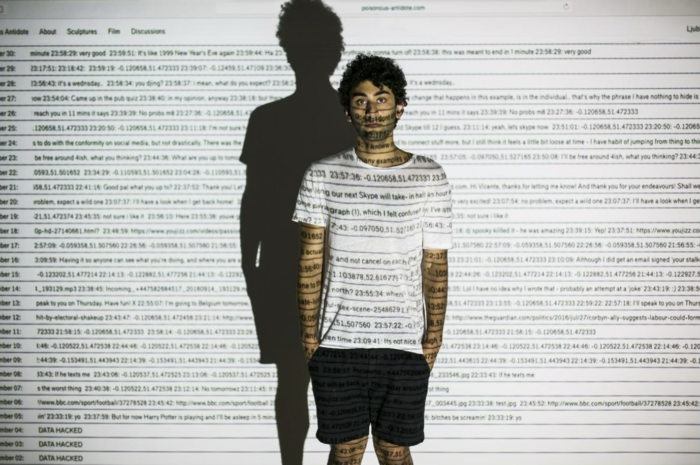
Six months later I returned to technology and started my next project, Poisonous Antidote. For one month I broadcast all of my emails, texts, whatsapp messages, phone calls, internet searches, social media, photographs, and location data publicly, in real time. I expected it to be unbearable. Instead, the month in which I had no digital privacy whatsoever became one of the happiest periods of the year these projects ran.
For the first half of the month, I grew in confidence. I spoke to people more, sent things I would not otherwise have sent, and indulged my idiosyncrasies. In the second half of this month, Facebook, Twitter, and Instagram were added, and it changed: I became aware that even my most distant acquaintances, people I had not seen in years, had equal access to my behaviour and were able to judge it without any context. As the month went on, the changes became more tangible. I grew more productive, I procrastinated less, I went to museums, travelled, exercised, and saw my family more often. I was altering my behaviour, consciously and subconsciously, to conform to what I felt was expected of me, validated by the knowledge that others could see it.
What proved more revealing still were the days after it ended, when privacy had been returned to me. I sat in my room alone, telling myself I did not want the pressure to perform, staring into Netflix and scrolling endlessly. Worse, I caught myself leaving events early and choosing not to do things purely because they were no longer being broadcast. The validation Poisonous Antidote had given me had placed my virtual self at the centre of my physical life, meaning that I judged my own actions and opinions through the potential reception of my news feed.
This was the opposite outcome I had expected from these two projects. Something important to recognise however lies in the environments themselves. Social media platforms arrive with their norms already built in; we inherit ready-made ways of behaving, presenting ourselves, seeking approval, and anticipating judgement. poisonous-antidote.com had none of that, and so the norms had to emerge through my interactions themselves: explicit images were sent without hesitation, people disclosed deeply personal things, and there was a sense of experimentation not unlike the early web, through platforms such as MySpace and Bebo. The question this raises is not simply how people behave, but how the environments they inhabit produce the conditions under which particular behaviours emerge, and how far those conditions are organised by the platforms themselves. That is where the problem lies. Social media gives our projected self, the constructed image of who we want to be, a dedicated place to exist, one we can edit and reform until we are satisfied with it. But if we do not decide the social norms on it, we are conforming to the standards set by the owners of the platform. And once we know our actions are documented, we start to judge ourselves through the limited and categoric reactions of others on the platform, until our conduct, both online and offline, organises itself around maintaining that image.
It is worth mentioning that these projects were made as the Investigatory Powers Bill was passing through Parliament in the UK, each timed to coincide with one of its readings. Publicly broadcasting my life might look like some dystopian future, but most of us are doing exactly this, albeit in more limited ways. We disclose ourselves continuously, to technology companies, to governments, and to one another. The difference between you and me is one of degree, not kind. Why privacy and anonymity matter as fundamental rights is that they ensure that one’s validation comes from within. Without the fear of social reprisal, they let us think instinctively, experiment, and develop a sense of self that is not wholly dependent on the judgement of others. Without them, freedom of speech is constrained, as freedom of thought is eroded, as we become habituated not only to being watched but to being held accountable at any moment, to family, friends, employers, governments, and strangers. People have always been conscious of others’ judgement, but the depth of information we now hand over is unprecedented. And in a world where we auto publicise our digital footprint every hour of every day, 365 days a year, I find it hard to believe that something fundamental will not change in the human psyche. If I am honest, I think it already has.
As we discussed during our meeting, I believe that your work, while often dealing with invisible technologies, always places the physical body at its center—whether your own, that of the observed others, or that of the body interacting with the device. Why is this centrality of the body so important in a context where the body itself seems to be increasingly bypassed?
The body has always been central to my work because it is through the body that we encounter the world. It is the site through which experience takes place and through which our relationships to ourselves and to others are formed. I am interested in how external systems of governance and organisation mediate those relationships. Often that mediation takes the form of digital technologies in my work, but not always. Traffic lights, legal structures, and language are all technologies in the broadest sense: they shape and organise the conditions through which we encounter the world. They shape how we move, perceive, relate, and participate, and in doing so influence how our sense of self emerges, how we present ourselves to others, and how we understand the wider world around us.
Heidegger’s example of the hammer is useful here. A hammer does not just extend the hand; it changes how the room appears to us. Pick one up and you start seeing what can be struck or fixed. The tool reorganises your relationship to the space around you, and contemporary technologies do the same, on a far larger scale. They change what we are aware of, what we want, and how we relate to one another. They do not just help us move through the world; they shape the terms on which we meet it.
This is why the body appears so persistently throughout my work, though not always in the same way. In some projects it is my own. In Seeing I, the question was what prolonged immersion in another person’s perspective does to one’s own sense of self, and I tested it on myself until my ego broke. In Anonymity Is Our Only Right and That Is Why It Must Be Destroyed, I withdrew from digital infrastructures altogether, and it was my body, trying and failing to carry out an ordinary life without them, that registered how completely those systems now organise participation. In Poisonous Antidote, my behaviour changed under conditions of total visibility, the body modifying itself in anticipation of being seen.
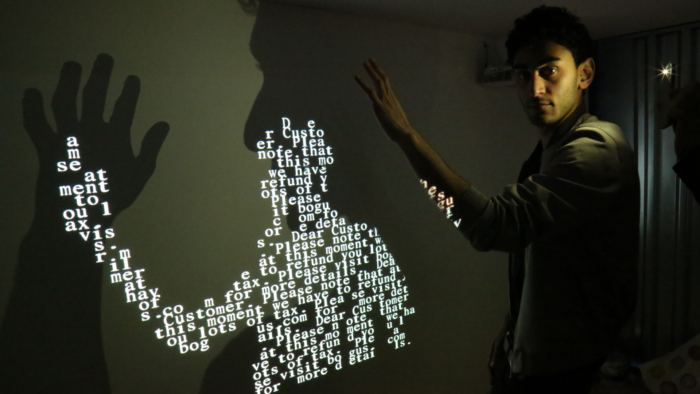
In others, it is the viewer’s or participant’s body that the work turns on. In Data Shadow, participants’ own extracted data was projected back onto their moving silhouettes, so that digital extraction became something they encountered bodily, standing inside their own surveilled image. In Invisible Voice, the body becomes the point at which information, consumption, and political action intersect. And in At a Crossroads, governance is read directly off the body, in how it waits, crosses, hesitates, and complies.
Although the systems differ, the question remains remarkably consistent: how do external structures come to organise lived experience, and what capacity do individuals have to alter them? Increasingly, I have come to think about this through the concept of consequential authorship, a term I use to describe the capacity to intervene within the systems one inhabits in ways that produce consequences capable of altering how those systems unfold, rather than merely participating within conditions organised by others. Participation alone is not enough. To participate is not necessarily to possess agency. The question that runs throughout my work is therefore not simply how systems shape us, but under what conditions we might shape them in return.
The body matters because it is where these systems cease to be abstract. It is where governance is encountered, where technologies are negotiated, and where the effects of infrastructures become lived realities rather than theoretical propositions. My work places the body at its centre because the body is where participation takes place, where selfhood is experienced, and where the conditions under which agency emerges are encountered, negotiated, and lived.
A residency is currently taking place at the British School at Rome, where you are developing a project that explores how people cross the street around the world. What draws you to this choreography of gestures, and what are you discovering?
What does the act of crossing the road reveal about how we are governed? This is the question behind my research at the British School at Rome.
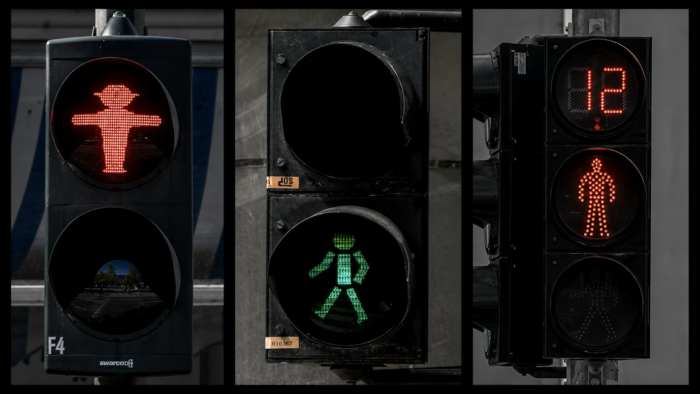
At a Crossroads examines pedestrian crossings as everyday sites where the state, governance, and the body intersect. The project argues that crossings are not neutral traffic infrastructure but governance environments: sites where political assumptions about authority, responsibility, and collective conduct become embedded in movement and reproduced through habitual behaviour. Through filmed and theoretical research, it investigates how authority is enacted through movement.
The starting observation is simple. Crossing the road looks like neutral, practical infrastructure, the same everywhere. It is not. In the UK you are given a button to press which, more often than not, does not change the wildly complex network of traffic and goods to let you cross a bit quicker. So, being British, you push the button and then cross the road anyway. We even build little islands into the road to make jaywalking easier; British people need agency, so we are given the illusion of control. The Polish pedestrian is barely given a button. They accept that they must wait, and do not ask for how long. The same act carries a completely different relationship between the individual and the state depending on where you do it.
That difference is not national temperament. The street used to belong to pedestrians, and “jaywalking” was invented to take it from them. The word was pushed by the motor industry in the early twentieth century to recast the pedestrian, rather than the car, as the problem, shifting the danger of the road off the driver and onto the person crossing it. The danger is real. So is the stigma attached to jaywalking, but it was manufactured, deliberately, to make the pedestrian feel not just unsafe but irresponsible. Peter Norton has traced exactly how this happened. The difference between how people cross from one country to the next, then, is the residue of a political fight over who carries the risk of the road, settled differently from place to place. The British button and the Polish wait are two settlements of the same question, one softened with the illusion of agency, the other not.
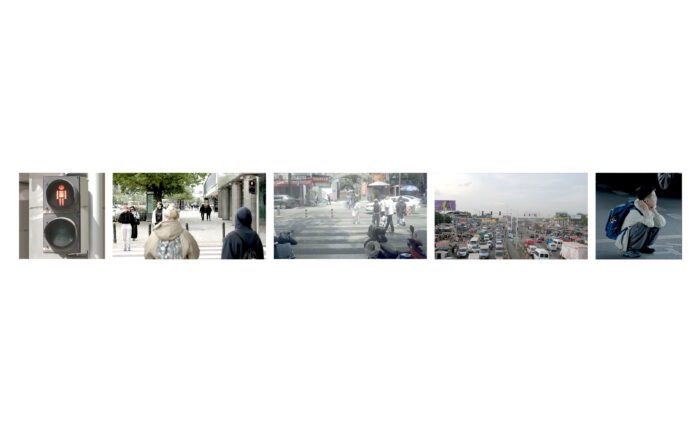
Rome is one of the eight cities I have been filming, so the place I am living in is also a site. Here I wait for the green, step hesitantly off the pavement, catch the driver’s eye, and cross. In London I would have judged the gap and gone. I did not decide to start crossing this way. No one taught me, and I cannot point to when it changed. The second look, the small deference to the signal even after it has given permission, arrived on their own, and by the time I noticed them they were already mine. That is the disappearance the project is about: not a rule I am obeying, but a habit I have absorbed so completely it feels like my own judgement rather than something the city put there.
It becomes clearest where the waiting serves no purpose. In Berlin a woman arrived as the signal was changing against her and waited two minutes and fifty-four seconds for it to release her, looking at her watch six times. One person crossed against the red in front of her; she watched them go, looked at her watch again, and waited a further one minute and seven seconds. Two cars passed in this time. In Chengdu a boy crouched down on the road, near the pavement, and stayed there, still, for over two minutes, waiting out the signal until it released him. Nobody was instructing him. The tempo of the crossing was already his. This is close to what Bourdieu called doxa: an arbitrary arrangement misrecognised as the natural order of things, no longer open to question because it no longer appears as a choice.
None of this means the system determines everything. People still cross against the signal, follow strangers into traffic, and judge situations for themselves. But that judgement always operates inside limits set by someone else. The system does not need to determine every footstep, because it has already taken the ground the footstep moves across. The road, the signal, the settlement of risk and responsibility that decided who waits and who proceeds, all of it is in place before the pedestrian arrives, and none of it is theirs to rewrite. That is what the crossing makes visible: not obedience, and not freedom, but the quiet completeness with which governance comes to occupy the ground of ordinary movement, leaving the footstep free precisely because the ground is already held.
A final question concerns a topic that is very close to me: artificial intelligence, and the way it is currently impacting how we live, learn, and relate to one another. Which transformations do you think are most urgent to observe today, and what is your role in relation to this technology?
There is so much to say about artificial intelligence that I do not think anyone can answer this question properly in a short interview. AI has extraordinary potential. It is already transforming medicine, accelerating scientific discovery, breaking down language barriers, and, at least for now, widening access to forms of expression, education, writing, filmmaking, and coding that were previously out of reach for many people. These are remarkable developments, and it would be naïve to pretend otherwise.
For me, though, the question I care most about is political. The conversation around AI tends to focus on what the technology can do, but I think the more urgent question is what it does to power. What does it do to social mobility? Who benefits from the enormous increases in productivity it promises? Who owns the systems through which those benefits are generated, and how are those benefits distributed?
We already live in societies marked by profound inequalities, and I worry that AI will deepen them. Much of the discussion centres on whether jobs will disappear, but jobs have always changed. The more pressing question is what happens when the ownership of productivity becomes increasingly concentrated in the hands of a relatively small number of companies. If the answer to that is some form of universal basic income, then I think we need to examine that critically too. Universal basic income is often framed as a progressive response, but I think it risks being a fundamentally conservative solution to a radical problem. If the underlying structures of housing, utilities, and the cost of living remain unchanged, then we may simply find ourselves passing money through ordinary people and back into the same private systems of ownership and extraction that produced the inequalities in the first place.
For me, then, AI is changing everything to keep everything exactly the same. It has the potential to transform how we work, learn, communicate, and create, but unless we pay attention to who owns these systems, who benefits from them, and above all how their gains are distributed, we risk reproducing and cementing existing hierarchies under the appearance of innovation and progressive politics. The technology changes. The concentration of power does not.
As an artist and researcher, I do not think my role is to tell people whether AI is good or bad. Two things can be true at once, and technologies are rarely one thing. My role, as I see it, is to make visible the assumptions embedded within these systems, to ask who they serve, and to create situations in which their consequences can be experienced and questioned before they become naturalised. Much of my work has been concerned with revealing infrastructures that ordinarily remain invisible, whether systems of surveillance, digital extraction, algorithmic organisation, or the governance embedded within everyday movement. Artificial intelligence is another such infrastructure, one that is rapidly becoming woven into the conditions through which we learn, create, work, consume, and understand one another.
The transformations that most concern me, then, are not technical. They are social and political. The question is not only what AI can do, but what kinds of societies its deployment makes possible, and for whom. That is not a question engineers can answer alone. It needs artists, educators, and the public to have a part in shaping it, but more than that, it needs policymakers to confront the one question the technology itself will never raise: who owns these systems, who benefits from them, and how their gains are shared and regulated.