
Some Haunted Havens of Precarious Love
I’m Half Sick of Shadows, a conversation with Davide La Montagna
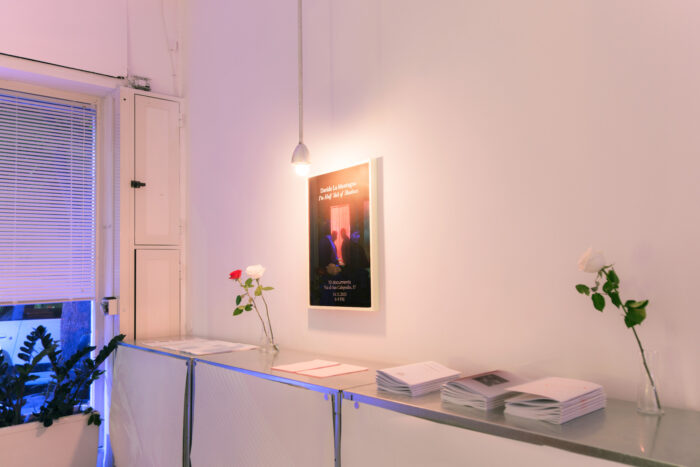
I’m Half Sick of Shadows is Davide La Montagna’s first solo exhibition in Rome, curated for the inauguration of 10 documents, a newly created research platform and exhibition space conceived as a living archive and a space to experiment with a collective lexicon founded by curator and researcher Ginevra Ludovici and sound artist and researcher Flavio Michele. In this first event of a series, the space focuses its investigation on the theme of affection, understood as a relational and political force capable of shaping bodies, imaginaries, and forms of coexistence.
In this context, Davide La Montagna’s work invites us to think of the domestic space of affection as an unstable field, where intimacy is never neutral, and familiarity coexists with latent violence. The artist thus constructs an exhibition environment permeated by a constant tension between appearance and subtraction, desire and dissolution.
Flavia Prestininzi: Inaugurating a new public space means, more often than not, taking responsibility for communicating its stance and, in some way, declaring its intentions. How does I’m Half Sick of Shadows fit into the shared research program of 10 documents, and how did the dialogue with the space and its founders come about?
Davide La Montagna: I first met Ginevra in Turin in 2019. At the time, she was part of the collective CampoBase, which ran an independent space in the Aurora district. We have been friends since then, and for a long time we had wanted to work tête-à-tête on a shared project. That long-standing desire to work together found a natural point of convergence when Ginevra and Flavio began shaping the vision for 10 documents, a platform conceived around research trajectories rather than fixed outcomes. Indeed, 10 documents articulates specific research topics that unfold over time through exhibitions, performances, sound interventions, conversations, and other interdisciplinary formats. Within this framework, “affection” was identified as the first research axis—not as a private or sentimental category, but in dialogue with affect theory, as a relational force that precedes language and organizes how bodies, practices, and forms of attention come together over time.
This theme formed the common ground on which I’m Half Sick of Shadows developed: affection is the basis of the relationship that binds us together, and its centrality emerged as a natural consequence for initiating a dialogue between our individualities, and with the space. The unconventional nature of 10 documents, far from the characteristics of the white cube, offered an ideal context for experimenting with hybrid exhibition forms, in which participatory, sonic, and performative dimensions could intertwine. Within this dialogue, Ginevra curated the project, while Flavio, who is a sound artist, collaborated on the creation of a soundscape to accompany the exhibition, helping to define an immersive experience in which writing, performance, curation, and sound production converge in the making of art. I’m Half Sick of Shadows thus marks the beginning of a collaboration based on affinity, shared experimentation, and a deep emotional dimension. Something like the beginning of a love story.
As you just said, “affection” is the theme around which the first chapter of the project revolves, but it has also been a focus of your artistic research for some time. When did your interest in the emotional dimension begin, and how did it become a priority in your work?
My research is an investigation into love, which can be considered a form of affection. At the beginning, my work was more romantic, dreamy, almost charged with expectations. Now, ten years after my first exhibition and thirty-three revolutions around the sun, I feel that it has become a kind of uncanny, dangerous, transformative technology. These qualities resonate with my deep fascination for Gothic literature, which has increasingly shaped my practice. I am particularly intrigued by the figure of Count Dracula, for example. This character is a millennia-old vampire, seductive, elusive and capable of shapeshifting. But what lies beneath the skin? Sexual anxieties, the dissolution of gender binaries, homoerotic desire, sexual violence—themes that strongly inform my work and that I continue to explore. If affection is understood as a pre-linguistic and pre-emotional experience, it operates before words, concepts, or rational explanation. It is something we perceive through bodies, atmospheres, and relationships. In this sense, it shares a common nature with the figure of Dracula, whose power does not rely on language but on presence, contagion, and transformation. In both cases, there is a subterranean layer of experience that shapes the events of our lives. People, environments, and atmospheric forces—whether imagined as Dracula’s supernatural powers or as uncontrollable emotional states—constantly affect one another. This continuous process of mutual influence is what makes affection intrinsically performative: it does not represent reality, but actively produces it.
The uncanny, which you mentioned earlier, always has to do with the familiar, with the double and with the repressed, and it is precisely in this sense that your research reveals an unstable picture of the affective essence. The title I’m Half Sick of Shadows quotes the last lines of Alfred Tennyson’s poem The Lady of Shalott (1832) and evokes a condition of mediated desire, experienced through reflections and distances, to the point of becoming a real “illness.” How did this image inspire you, to the point of choosing it as the title of the exhibition?
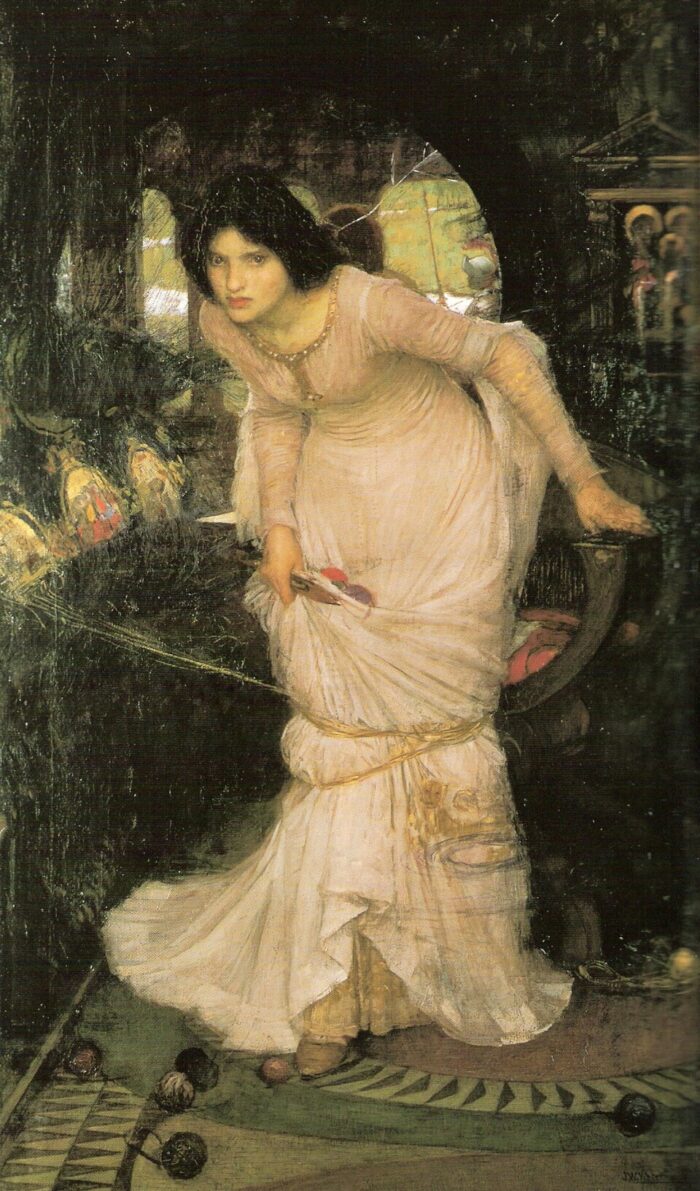
The image of the Lady of Shalott has accompanied my thinking for a long time. The poem unfolds through different moments that John William Waterhouse translated into three paintings produced between the late nineteenth and early twentieth centuries, which I retrace here backwards.
In I’m Half Sick of Shadows, Said the Lady of Shallott (1915), Elaine, the main character, pauses from weaving a tapestry with images of the outside world of her tower she is segregated in–a world she knows only reflected in a mirror. Her experiences are filtered entirely by shadows. Outside the window, on the right, float the heads of two newlyweds walking along the walls of Camelot. The Lady of Shallott Looking at Lancelot (1894), instead, depicts Elaine standing, surrounded by strands of thread that have fallen to the ground, and the mirror that mediated her vision is shattered in two. Lancelot’s passing presence has compelled the noblewoman to look directly out the window, thereby invoking the nameless curse upon herself. In the third and final painting, Lady of Shallott (1888), we find Elaine just outside the tower, ready to depart for Camelot in a small boat–the very boat in which her beloved Lancelot will find her dead body.
Lady of Shalott is one of many examples that inform our collective imagination when we think of romantic love as the only force capable of destroying the very fabric of society. Romeo and Juliet is a similar case, as the protagonists—again driven by love—were capable of extreme acts. In both cases, the force that drives Elaine to leave her tower to meet her death and Juliet to pierce her heart with her beloved’s knife is the same: a pure, intoxicating, addictive love. In both cases, there is an element of secrecy, of something left unexpressed. Concealment—which in Elaine’s case was forced upon her inside the tower—is one of the main themes in my work, both as a production strategy and as a metaphor for the homosexual experience.
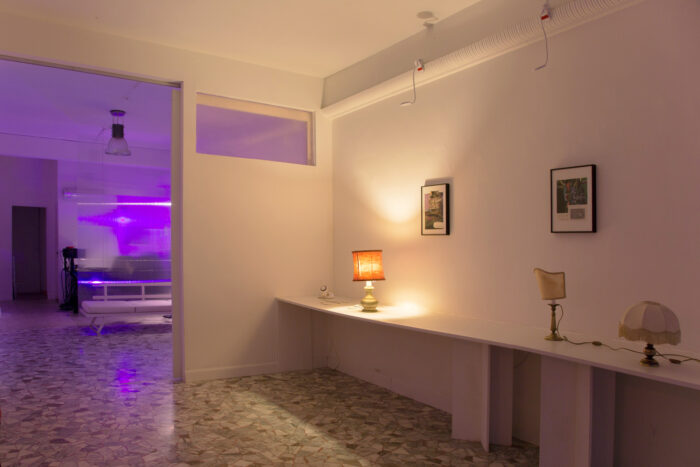
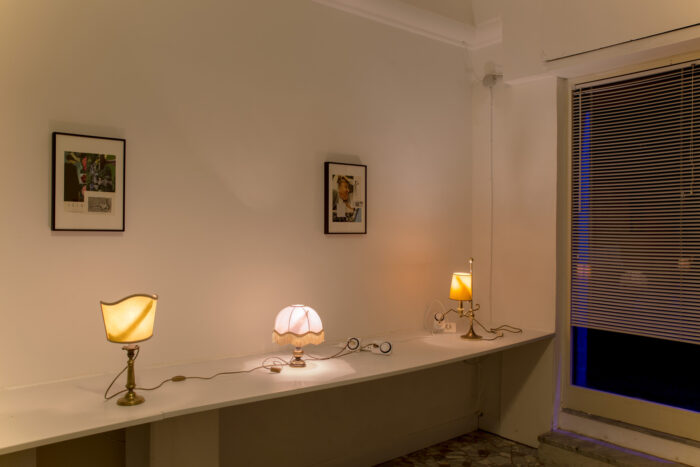
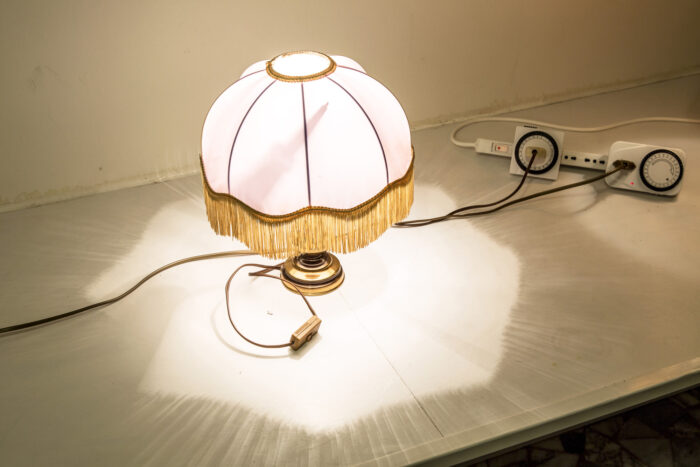
In the space, you have installed bedside lamps whose intermittent light conceals and reveals familiar, with sharp objects hidden inside them. Fever Dream preserves the shadows of these potentially violent domestic objects, projected but never fully revealed. The work seems to oscillate continuously between affection, danger, and everyday life, without seeking a definitive synthesis. It is not so much uncertainty as a state of alertness, an emotional tension that becomes political. What relationship do you see between intimacy and the “common world”?
The allusions within Fever Dream are primarily two. The silhouettes recall shadow puppets; they exist in a suspended time that refers to a playful, childlike dimension, revealed and destroyed by blunt objects that can be found in any apartment. Knives, screwdrivers, nails, hammers, and Allen keys contain within them a dangerous potential. The intermittent flow of electricity, regulated by daily timers, references a pivotal scene from Dario Argento’s 1980 film, Inferno. Inside Sara’s apartment, an irregular drop in voltage makes the lights flicker on and off—a signal that makes her realize someone has entered her home with murderous intent. The exhibition project and the dialogue between the displayed works stem from the desire to adopt a strongly critical stance toward the narrative often constructed around episodes of domestic violence. It is precisely here, within this “infernal” dimension, that I wanted to draw a line: often the sensitivity of an infant, of a human being—as an innate quality—is confused with hypervigilance and romanticized as an “extra-ordinary,” out-of-the-ordinary existential condition. What often occurs instead, for victims of violence (both direct and indirect), is that this heightened awareness develops because they are immersed in a hostile, precarious environment. They are forced to learn how to anticipate the grammar of others’ bodily movements, thereby developing the ability to instantly decipher the emotions of people and the surrounding environment. This ability does not stem from magical or supernatural sources, but emerges as a direct, learned response to the imperative of survival.
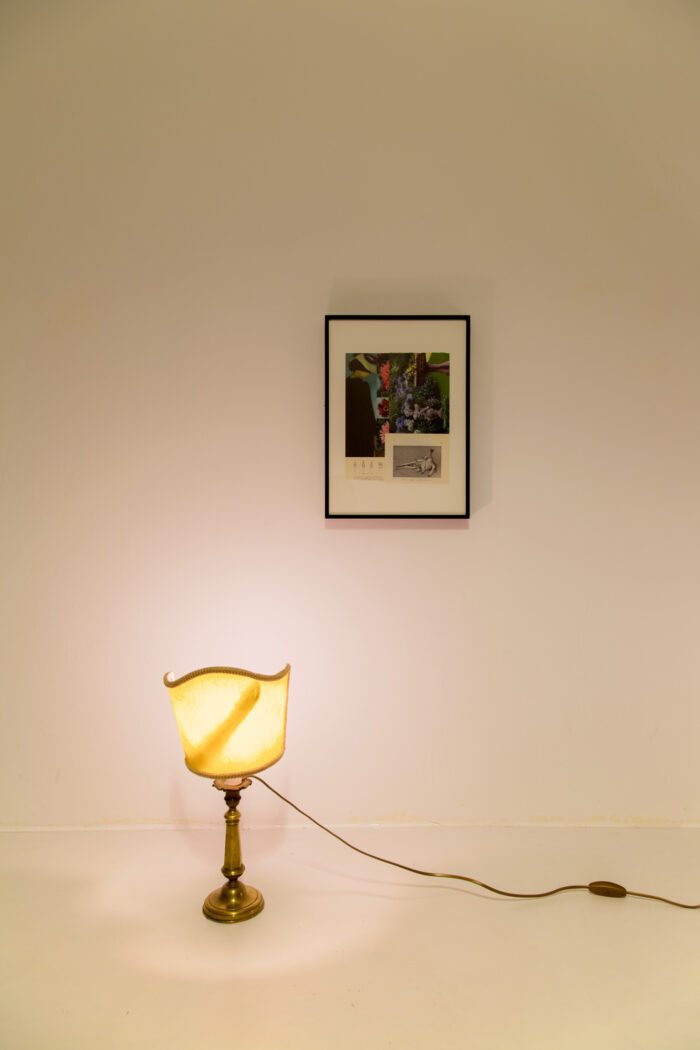
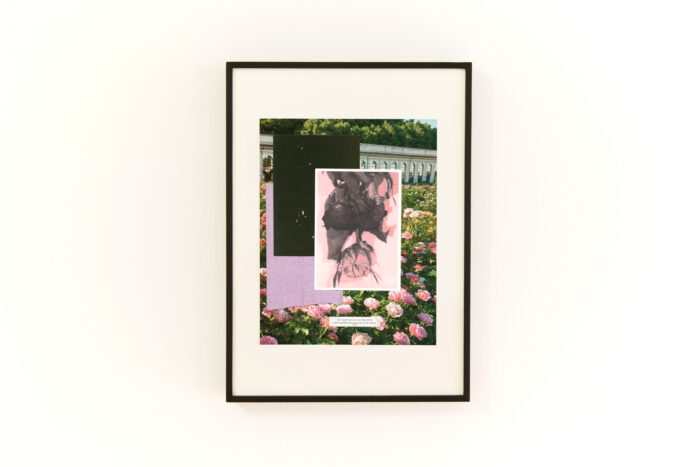
For the exhibition, you created a series of collages destined to deteriorate over time through contact with glass, eventually revealing fragments of personal memory. The familiar image is initially hidden, entrusted to the title, and only through waiting can it re-emerge. The titles are dedication-descriptions that refer to your mother’s wedding and her private life. Why did you feel the need to withdraw these memories from view? The idea of loss seems to be an active process rather than a merely nostalgic one. What do you think?
To hide and to tell are like train rails: they live in proximity. Language—poetry, writing—allows us to build new worlds. It lets us approach and feel the lives of others; it is an exercise in empathy. Imagination functions the same way. If I describe an image in detail without showing it, is it less real? When I say “flower,” what do you see? A rose? A tulip?
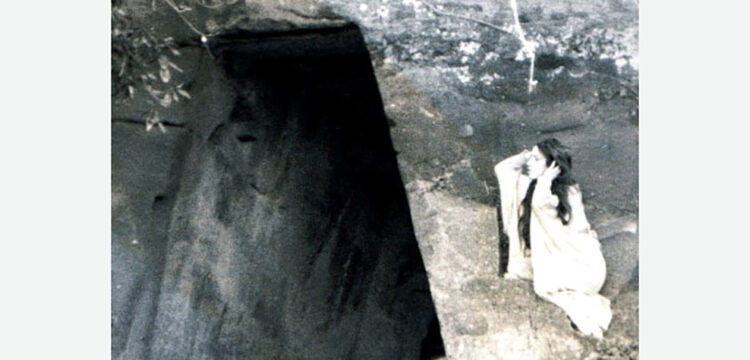
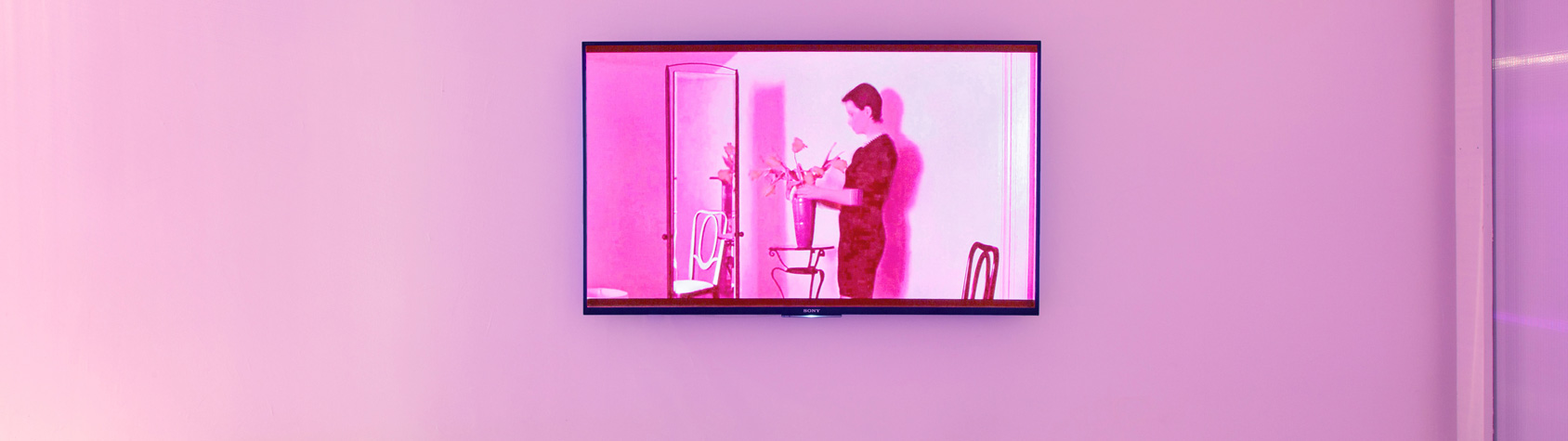
All four collages in the exhibition conceal photographs from my parents’ wedding, taken from the family album. The titles are detailed descriptions of the hidden scene. This gesture didn’t come from afar, but it’s something I stole myself. After her divorce, my mom attended a trompe-l’œil class. Her creations began to invade the apartment, but one of them—depicting a cat sitting on a balcony facing a beautiful garden—received a special treatment: to cover the enlarged photo of her wedding kiss, permanently framed on a wall facing the entrance. This is not the first time I have investigated the institution of marriage in my work. In 2024, I made a video titled The Haunting, which films a florist’s hands assembling a wedding bouquet. The shop is the same one where my mother once commissioned her bridal bouquet, yet the hands now composing an identical arrangement are those of her son, who now runs the family shop. I like to think of these works as time machines, like those seen in films where trinkets—objects charged with symbolic value—are gathered, sealed in a metal box, and buried near a tree, awaiting discovery by some creature after you.
In the video What Sound a Rose Makes, you work on looped montages of film scenes featuring cut flowers. This image recurs in your practice and was already present in some of the works presented at Centrale Fies, as restitutions of your studies at the Dutch Art Institute. Can you tell us about the genealogy of this figure and why it continues to be so central to you?
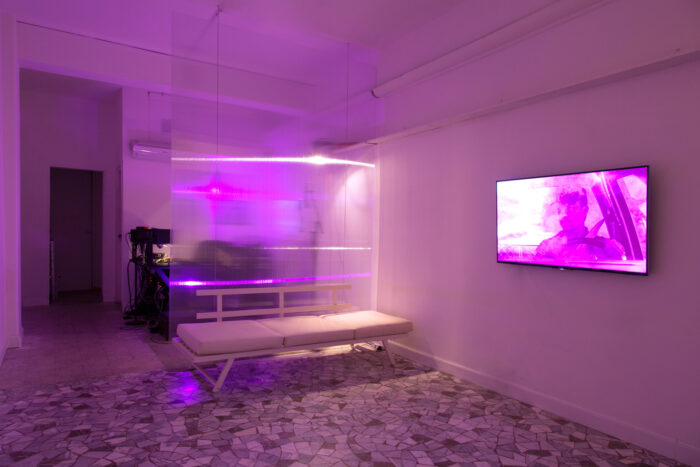
What Sound a Rose Makes is a silent video—the first in an ongoing series—in which I collect scenes from films that, once edited in sequence, create a constellation of encounters, loves, deaths, and secrets around cut flowers. The poet and aristocrat Lady Mary Wortley Montagu invented “floriography” (also known as the language of flowers) out of necessity: to circumvent the strict Victorian social codes in which sexual freedom was scandalous, allowing the bourgeoisie to fully express their sexual inclinations, desires, and contempt. These elements are fundamental to the way we think about others and ourselves: flowers have become essential to the formation of sexual identity in Western civilization. In fact, two hundred years after its invention, we continue to use this grammar of secrets.
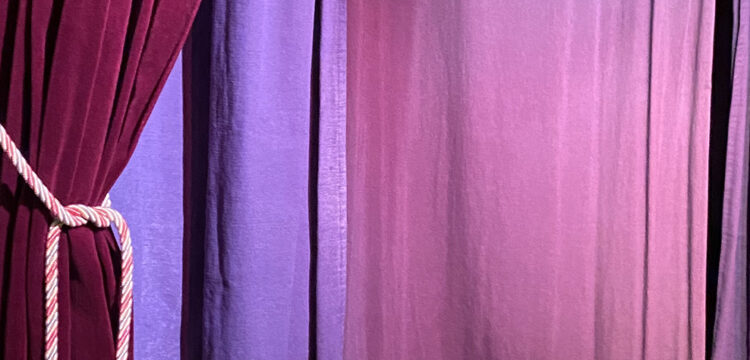
Flowers have fascinated me for a long time, and I have used them as materials for years, but despite the passage of time and the multiplicity of uses, they have transformed into empty vessels that have to be filled with meanings. They can be molded to serve any purpose. As you also mentioned, the work presented at Centrale Fies is titled The Anatomy of a Rose, and it is a performance in which I read a text that blends memories, confessions, painful and obsessive secrets, while the stage lights slowly shift from white to pink, eventually bathing everything in red. It is a kind of slow descent into a rosebud, and in the text I suggest the meaning I attribute to the flower of love: “[…] both my mom, my grandma, and I have the same tattoo: the infamous flower right above our hearts. A holy trinity sealed by violence and a dubious taste in men.”
The title of the video in the exhibition (What Sound a Rose Makes) is the same as that of your poetry collection published for this occasion and presented during the opening. Love, affection, and violence are universal imaginaries that, through your words and storytelling, give rise to scenes situated in everyday life. Alongside evocation, your language brings us back to an inhabited, lived, and sensorial reality: we can identify environments, objects, smells. The text of Insincera [note: poem], for example, guided me through the space—between “wide-open eyes” and “forced vision”; Insincera is set in a possible house in which a bookcase is present, where your desk is. How would you describe the presence of this poetry collection within the exhibition, and more generally, what is your relationship with writing in your artistic practice? Was there a moment when you felt it was more urgent than other languages?
I tend to accumulate things: grocery lists found on the street, tiny colored jewelry bags, keys, product packaging printed with roses, letter envelopes, small-denomination coins. I am fascinated by giving importance to small gestures—the ones that make up everyday life and we take for granted. Writing has always accompanied my work, to varying degrees. During my years of study at the Dutch Art Institute, writing took on a more central role for logistical reasons. The DAI program is not structured around frontal lectures held in the same classroom or place, but rather around seven annual confluences distributed across changing locations: Nida, Saint-Erme-Outre-et-Ramecourt, Essaouira, and Cyprus were a few cities the school allowed me to visit in order to study and live together with students, tutors, and guests. During the exhibition opening, the video was accompanied by a sound piece by Flavio Michele that, at times, harmonized the recording of poems from the collection—ghostly presences haunting the space—and at other times accompanied my voice during the live reading. As of today, I believe that reading—and by extension writing—is a way to shorten the distance between my inner worlds and those that take shape as artworks.
In this regard, it would be interesting to talk about the project you share with Deborah Martino, Ethereal Society of Poetry, and your selection of love poems “LOVE HURTS,” as well as your future projects.
Ethereal Society of Poetry is a platform born out of the need to raise awareness, disseminate, and make poetry accessible through reading, sharing, and the desire to create connections. ESP conceives itself as a collaborative meeting space that takes shape through readings, listening sessions, screenings, and open conversations. Love Hurts is the title of the column I curate, dedicated to love poems. In the first chapter, I selected texts by some of my great literary infatuations: Nina Cassian, Eileen Myles, Wisława Szymborska, and Idea Vilariño. Their poems are often traversed by solitary, sometimes painful dimensions of love, as if experienced from afar, or perhaps preserved in the memory of love itself. To give it a slightly more pop tone, the title of the collection was taken from the infamous Lana Del Rey song Blue Jeans. I do not believe in love as suffering.
For the near future, Deborah and I are considering a slight change of direction to make the project even more “ethereal,” possibly through the creation of podcasts or radio sessions, remotely produced during my upcoming residency at Morpho in Antwerp and made possible thanks to Guido Santandrea and Filippo Berta of Almanac, whom I thank immensely.
As for my personal research, I am writing a project centered on a long-standing obsession: Hans Christian Andersen’s iconic half-human, half-fish creature, The Little Mermaid (1837). Unlike other mermaid representations, Andersen proposes a sanitised, domesticated version–a transformation born of her desire to become human and gain an immortal soul. Andersen’s mermaids have neither souls nor tears, and after three hundred years, they swim into the depths, vanishing forever. I find this to be a symbol that reflects the experience of homosexual life in a world in which sexuality cannot be lived openly without fear of repercussions. An intriguing fact? Andersen appears to have been an aromantic, painfully awkward individual. After declaring his love to his Latin teacher—only to be rejected by him—he decided to write The Little Mermaid.