
Repair and Riot
“Stone Assemblies” gathers voices thinking through the politics of stone, ruination, and dissent
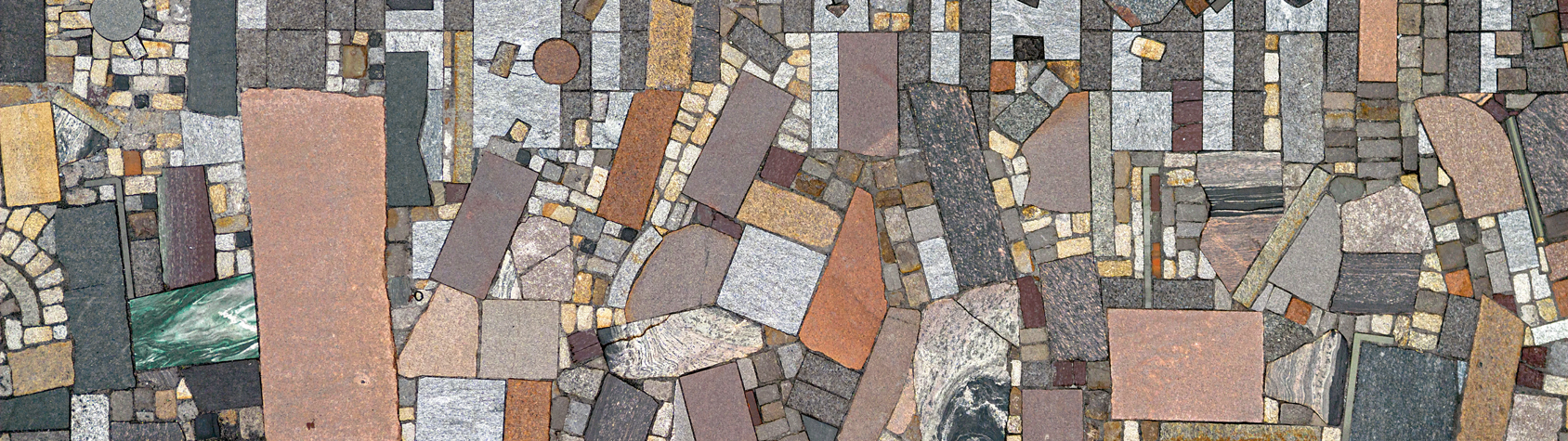
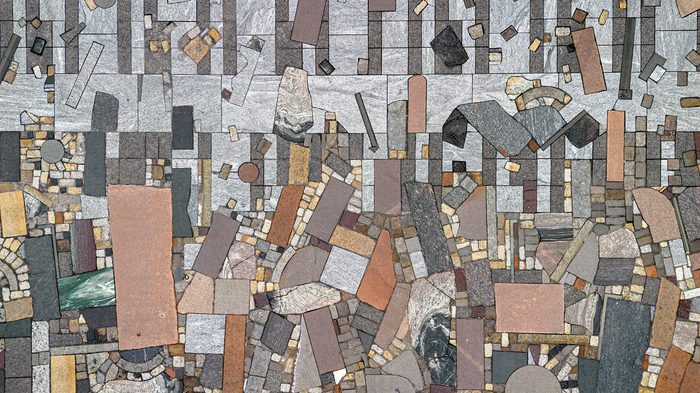
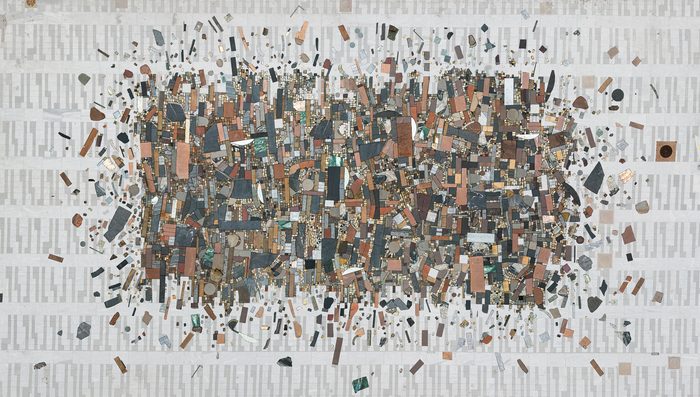
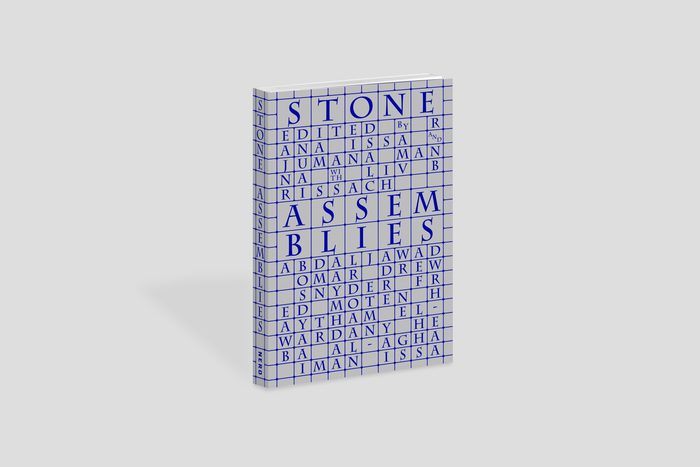
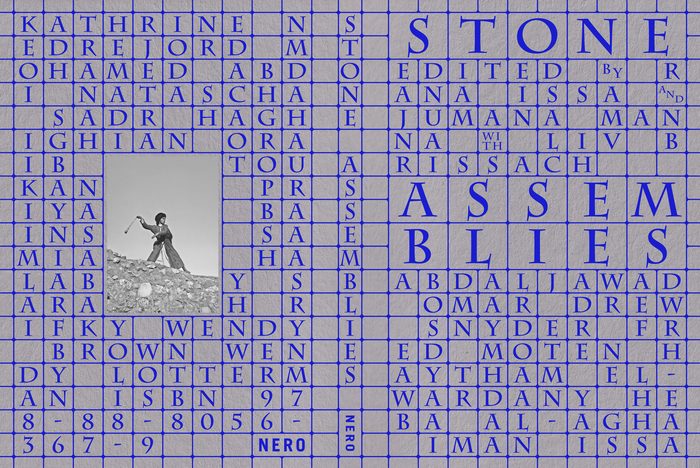
Stone Assemblies is an initiative that unfolded in parallel with, but independent from, the production of Sebastia, an 800-square-meter artwork and city floor by Jumana Manna in the newly rebuilt Government Quarter in Oslo. Taking the political and cultural history of extraction and land struggles in Palestine and Norway as its starting point, this volume offers a set of proposals through which the politics of stone, ruination, and dissent might be reimagined.
Through essays, poems, artworks, and conversations, the diverse contributors critically and creatively intervene into what art, language, and the workings of culture more broadly can do in and against the nation-state’s normative terms of order: ceasefire, assimilation, disposability, and the vertical models of governance and memorialisation.
Shaped by a range of diasporic and Indigenous traditions, Stone Assemblies gestures towards an embrace of all that remains to be reassembled, renewed, and re-membered as we persist in our anti-extractivist, anticolonial practices of art and gathering.
In the fall of 2025, the prime minister of Norway Jonas Gahr Støre was one of only a handful of world leaders who decided to officially mark the International Day of Solidarity with the Palestinian People, underscoring Norway’s recognition of the Palestinian struggle as a just cause. In his speech, Støre mentioned Jumana Manna’s commissioned sculpture Sebastia, located in the new Government Quarter, positioning it as a symbolic restoration of democracy on the exact site of the terror attack of July 22, 2011. Speaking from within Oslo’s Domkirke, the city’s official cathedral, Støre addressed the history of Norwegian solidarity and the choice of a Palestinian artist to define the very foundations of the new Quarter:
“It is only a stone’s throw away from us. This work is precisely about stone, but it isn’t about stone throwing. This Palestinian artist has built an 800-square-meter floor, a patchwork of various stones given by municipalities from all over our country.… There is something very symbolic about this, right in front of our bombed-out offices. A solid Palestinian signature in the middle of Oslo. Out of the destruction, Jumana Manna builds a beautiful, new foundation, a new city floor.”
It is significant that Norway’s prime minister acknowledged the value of learning from Palestinian modes of survival. At a time when many Western states have offered uncritical support to Israel as it perpetrates the gravest of war crimes, Støre welcomed Sebastia’s rootedness in Palestinian creative resilience and showed sensitivity to Jumana as an artist that works with ruins. Moreover, recognizing a Palestinian voice as a legitimate actor in shaping the public sphere constitutes a striking break from established European norms. The prime minister’s carefully chosen words celebrated the participatory gathering of stones toward a democratic rebuilding while making sure to distance the work from the act of stone throwing. With this differentiation, Palestinian resilience is celebrated in the same breath as its history of resistance is carefully managed. We, the editors of this book, would like to propose that Sebastia’s stones carry within them symbolic histories of popular struggle while also mediating other mechanisms and histories of infrastructural ruination, extraction, and preservation from Palestine, Norway, and elsewhere. Indeed, the dual function of stone, as a building block for new foundations and as a weapon in the hands of the oppressed, became central to the political imaginary of this book. Stone figures as an emblem of Palestinian resistance against the constant threat of dispossession and as a lesson in the life-affirming struggle against oppression.
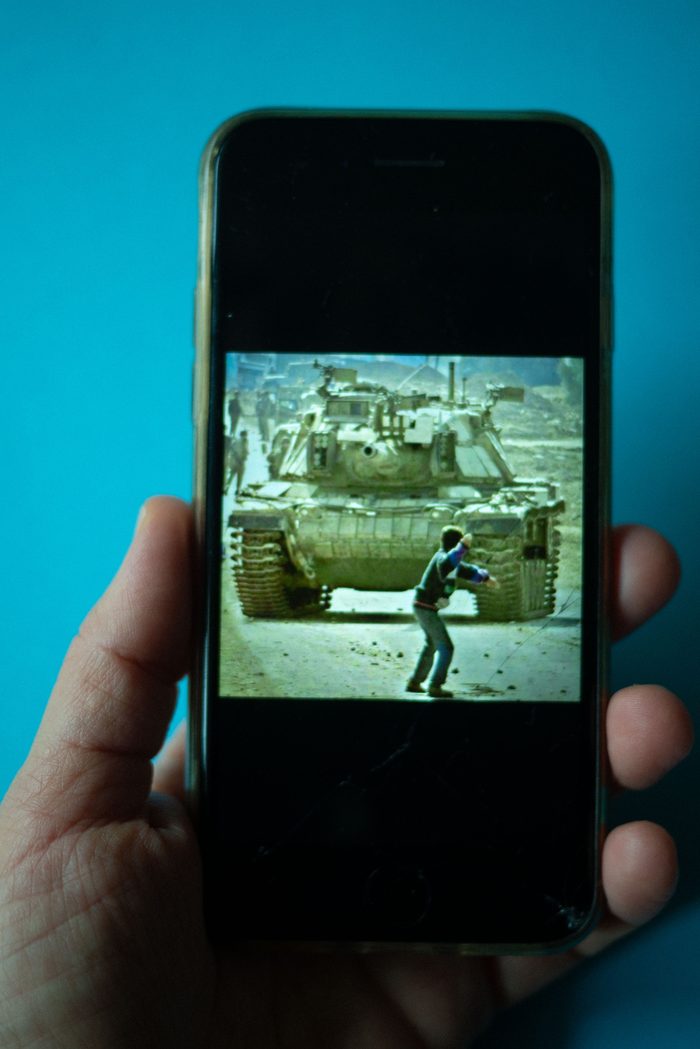
When the First Intifada broke out in December 1987 in Jabalia refugee camp (Gaza), Palestinians from all walks of life took to the streets. The youth hurled stones at military tanks to protest the Occupation. The stones of the land, and sometimes the ruins of their own homes, became weapons. The Zionist myth that narrated the young State of Israel as a figurative David fighting against the Goliath “sea of Arabs” was slowly unraveling, rebutted in image after image of Palestinian children facing overwhelming military force with only stones in their hands. And yet, the media and political establishment then, as now, sided with the oppressor and delegitimized popular uprising. Israeli soldiers were given the green light to break their bones, to subject them to the brutalities of repression, assassinations, and mass arrests. The Palestinian struggle was punished and subsequently stifled under the guise of what came to be known as the Oslo Peace Accords: an agreement that publicly concluded a series of secret negotiations hosted by Norway in 1993 between two highly asymmetrical parties—the State of Israel and the Palestine Liberation Organization (PLO). The Oslo Accords masked their true function as a mechanism to suffocate and dismantle the uprising beneath a framework for disarmament, peace, and Palestinian self-rule. Presenting the agreement as a first step toward “self-autonomy,” the PLO leadership effectively abandoned the Palestinian revolution as it was renewing its vigor in the form of the First Intifada. The years after Oslo witnessed the transformation of the PLO into the Palestinian Authority, a repressive body that administers civil and security matters on behalf of the Occupation. Rather than acknowledge how the Oslo agreements entrenched Israel’s settler-colonial project, further fragmented Palestinian lands, and obfuscated the historic injustice of ethnic cleansing, the current Norwegian government still endorses them and calls for their renewal.
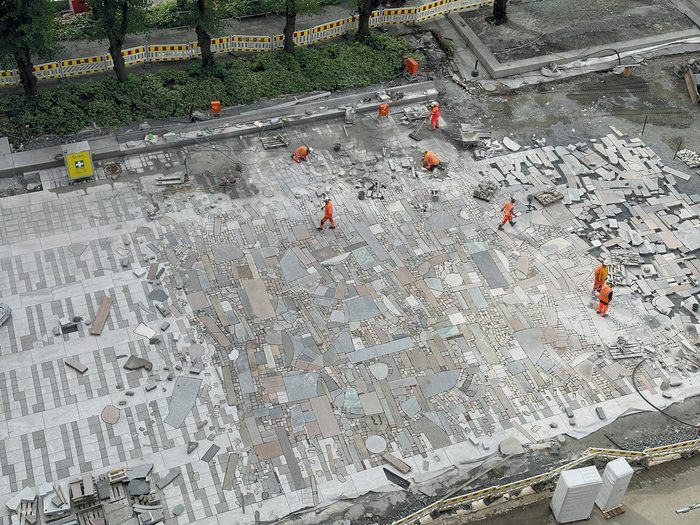
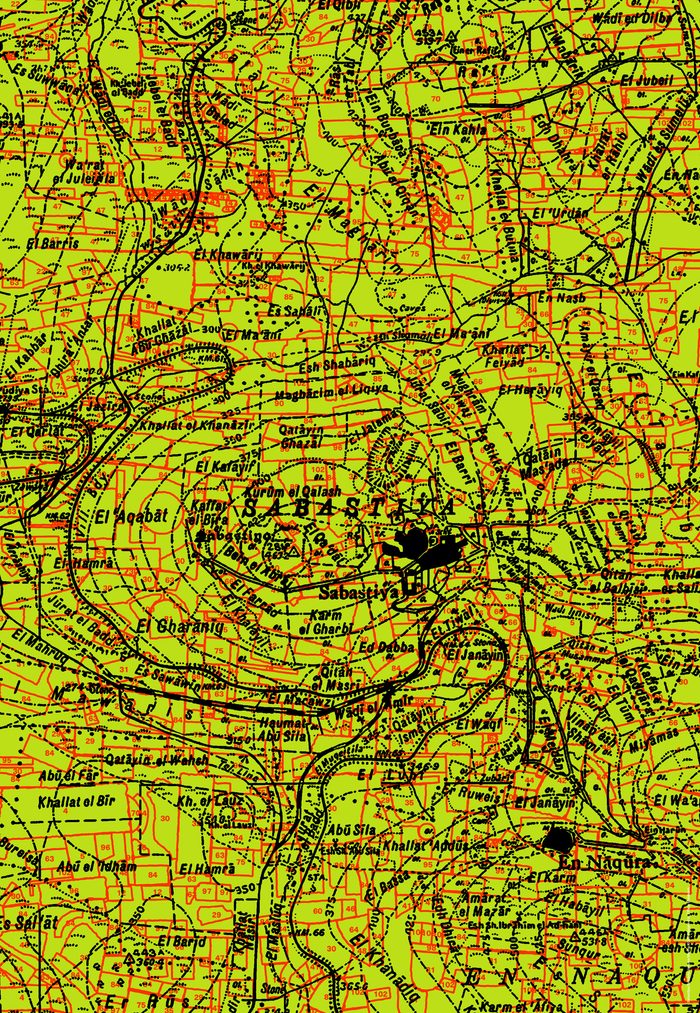
This disjuncture is given spatial form in the opening image to this book: Sebastia’s stones were laid in front of government offices used by the very state that brokered Palestinian capitulation. Considering the unsettling connections between diplomacy and contemporary art, in which the latter is often deployed to distort opinions about the conduct of the former, we saw in the discursive propositions of Sebastia an opportunity to critique and question the role that Norway plays in perpetuating certain forms of oppression and dispossession, at home and abroad. With Stone Assemblies we turn away from the halls of power and the gravitational pull of governance toward a community of dissenters in order to reconfigure Sebastia as part of Akersgata, a historic street and main thoroughfare in the city meant for and used by the people.
Every country develops a set of comforting myths about itself, upheld by architecture, narratives, and ceremonies. With the rise of neoliberalism alongside the Soviet collapse of the 1990s, Norway promoted itself as a trustworthy mediator on this unipolar world stage: offering a Nobel Peace Prize to those who do good in the world, brokering peace in so-called conflict zones, and having a high percentage of humanitarian and voluntary workers across the Global South. Today, in a moment of historic rupture where the myriad performances and rhetorics of human rights have collapsed and unmasked the underlying callousness of liberal internationalism, the poorly understood effects of the Oslo agreements have helped to sediment political narratives that perpetuate dispossession. Stone here functions as material and metaphor. So, we dig, to disinter the themes that were deliberately buried.
Historically, Norway’s stone industries developed in relation to the country’s position atop some of the oldest mountain ranges in Europe. Norwegian granite in particular has long functioned as a metaphor for strength and timelessness across divergent ideological contexts—from its extraction for the unrealized Welthauptstadt Germania project during the period of Nazi occupation (1940–45) to its current status as a premium stone on the global market. Stone is also used to foster narratives of international cooperation, exemplified in Norway’s gift of Gjellebekk marble to the UN Security Council Chamber in New York. Deep geological time and material weight have been repeatedly instrumentalized in the construction of nation-states as apparently stable entities rooted in mythic pasts. As such, granite and similarly strong stone are often a highly desired material in state architecture, as demonstrated by the provenance of Sebastia’s fragments.
Drew Snyder’s contribution situates Sebastia within the context of the Government Quarter’s architectural history, tracing its intermittent development from the initial late nineteenth-century commission of Henrik Bull’s G-blokka and the postwar modernist ideologies of Erling Viksjø to the present moment of expansion. In line with the themes explored in Jumana Manna and Sarah Rifky’s conversation, Drew elaborates on the process of making the floor sculpture and possible readings of it. Together, both texts situate the work as an archaeological palimpsest and erratic index that intervenes within the gridded logic of the surrounding architecture; as an intervention that subverts the formal modes of nation-state building and its modernist foundations.
The donation of stone from the majority of Norway’s districts builds on a dialectical movement between center and periphery that continues to be the bedrock of Norwegian democracy across its varied ideological spectrum. We read this collaborative gift-giving effort as a reflection of a desire of various local municipalities to have their cultural and infrastructural histories included, mirroring the political system of representation in the capital. Perhaps it also represents the spirit of dugnad: a cultural tradition that includes neighborhood cleanups and occasional kindergarten sandbox duties—rather than an official state practice—rooted in the voluntary and unpaid participation of individuals for the collective good of the community. Whatever the multilayered motivations for participating in the gathering and sending of stone, Sebastia demonstrates that public infrastructure can be built as a commons outside of extractive relations and through a coordinated recirculation of resources. Yet, we find it important to remember that the building and renovation of state infrastructure in the territory called Norway, like all nation-states, is not equally distributed and only partially represents the populations that have lived and continue to live on this land. Infrastructures are expressions of governance and intent, propositions on how to live, control, gather, and move; they emerge from and in turn reflect the stories that are told about a place. It is in the infrastructural gaps, and thinking about what and who might not be represented, as well as which stories are not being told through the cultural history of the donations, that this book emerged and wishes to dwell in. Stone Assemblies recognizes that these positionalities, legacies, and historical struggles cannot and perhaps should not be integrated into the state. They belong to a generally antagonistic surround, as Stefano Harney and Fred Moten would put it, on the outside of the state’s homogenizing forces and beside the coercive integration of governance.
Norway has long been regarded as a beacon of social democracy with a relatively liberal public sphere regarding freedom of expression on internal as well as international affairs. Yet the egalitarian principles underpinning its welfarist model have been steadily eroded by decades of neoliberal policy shifts. From the late twentieth century onwards, the Norwegian nation has displayed a tendency to sustain a startling discrepancy between its self-mythology as the “world’s best country” and its governmental practices, particularly in such core issues as the privatization of state welfare, the rights of Indigenous peoples, ecology, stringent migration policies, and racial discrimination. For years, the state has allowed the selling of concessions to mining companies that dump their waste in Norwegian and Sámi fjords, a practice that is harmful to already declining fish populations and wider ecosystems. In the case of Repparfjord, this happens in the very district where Sámi reindeer herders were forced to reduce their herds because of “ecological concerns,” reminiscent of more oppressive but similarly restrictive foraging and herding policies that the Israeli Occupation imposes on Palestinians. Building a participatory floor for such a government is at best a complex, anxiety-ridden task. This book takes seriously the ambivalences and anxieties of Sebastia’s literal proximity to power, that is to say, to governance and government, and turns this problem for thought into a collective conversation worth having, first and foremost about land—the fundamental resource from which everything else flows.
While the categories of settler and native do not apply as neatly to Norway as they do in clearer cases of settler colonialism, national sentiments emergent in the early nineteenth century intensified colonial relations toward the Sámi people. The Sámi were subjected to the official assimilation policy of “Norwegianization,” which piggybacked off earlier successful attempts to Christianize them simultaneously as their pre-Christian spiritual practices were forbidden. Historical migration routes that Sámi people have habitually followed were cut off and families split apart as the Fennoscandian borders that intervene into Sápmi (the land of the Sámi people) were enforced and fortified. Extractive land use on all sides of these borders, perpetrated by companies with the nation-states’ blessing, has made the Sámi right to land and water an ongoing struggle.
The most mediatized recent case was the construction of over 130 wind turbines in the herding areas of the Fovsen-Njaarke sijte (“Fosen reindeer herding district”). Judged illegal by the Norwegian Supreme Court in 2021, it took the government over two years before they finally agreed to compensate the herders and acknowledge some of their rights. Meanwhile, in October 2023 protests coinciding with the start of the genocide in Gaza were held in ministries, the Government Quarter, and in front of the Parliament. The Fosen case is neither an isolated failure of consultation nor a simple legal oversight. Rather, it exemplifies what Fred Moten calls a “war against subsistence,” waged at various speeds and intensities: gradually through legal delays and bureaucratic inaction as well as abruptly through the violent encroachment of industrial machinery onto agricultural grounds.

In our conversation piece, Fred directly addresses collective refusals of geocidal and genocidal notions of disposability and elimination, and reads Sebastia in this light as a mode of study grounded in practices of subsistence. By rejecting extraction in favor of recycling leftover stone, Sebastia activates practices of gathering and unfinishedness set against the value of perfectionism assigned by capitalism. Furthermore, Fred calls for artistic practice to become a mode of study, a commitment to sit with the trouble and strive to articulate new imaginaries that move away from the machinery of the art world and its extractive tendencies toward practices of sustenance. Inspired by Fred’s thought more broadly, we have been committed to making Stone Assemblies a provocation for collective study: to prepare the ground for thinking communally by holding divergent struggles and creative practices in ongoing and futurial relation; to consider how aesthetic practices might sustain themselves according to the “aesthetic socialities” they give way to rather than monetize and take away from.
The connections between ground and gathering on the one hand, and disarmament and ceasefire as an extension of warfare on the other, are picked up again in Abdaljawad Omar’s contribution, “I Hate Oslo.” Abdaljawad unpacks the meaning of Oslo for Palestinians and how it has come to represent the perpetuation of war waged against them by other means. Oslo is a process that is beyond the notion of betrayal, describing instead “a melancholic structure that sutures defeat with performances of sovereignty.” In Oslo, “the metaphor of the stone,” sedimented in the First Intifada, “was not merely set aside but actively disarmed, rendered obsolete by technologies of domination, by economies of counterinsurgency, by aid and civil society, by treaties that wrote Palestinians out of history while pretending to seek peace.” The accords transmitted a series of repeated speech acts of recognition, empty of revolutionary content. Instead of peace and liberation, we arrived at occupation as an investment model, and accelerated genocide as material horizon. Nevertheless, Abdaljawad maintains that Palestine continues to hold the capacity to unsettle and deform the world, materially and epistemologically. He reads Sebastia as a metonym for Palestine, as a “ground that refuses settlement.”
Three months after we started work on this book, Israel and its allies began a genocidal war on Gaza. Little in our coping mechanisms or strategies of resistance prepared us for the utter dehumanization and destruction we have witnessed. All sense of meaning and strategy was thrown into question, forcing us to reconsider much of what we do. Through the lens of the genocide and what it means to witness this moment, Gaza’s destruction reconfigured the themes we had started out with.
The Hamas-led offensive maneuver of Tufan al-Aqsa on October 7, 2023, shook the settler-colony’s confidence and became the pretext to accelerate an ethnic cleansing project that was set in motion over a century ago with the Balfour Declaration’s cynical promise of a national home for one people on another people’s land. The 1948 massacres that depopulated more than 500 Palestinian villages; the 1967 military occupation of what remained of Palestine that legalized land seizures under the guise of “security”; the 1993 Oslo framework that turned the PLO into a subcontractor of that same Occupation, with a tiered legal system that codifies colonial policy and denies Palestinian self-determination; and now the 2023 genocide, livestreamed—all are part of the same battery of brutalizing technologies.
As the genocide continues to unfold, stories we grew up with about the dispossession of our grandparents are violently revived and fortified as we witness the destruction of our last coastal Palestinian city. Over three years of witnessing, the genocide remains incomprehensible. We try, as Palestinians, artists, writers, and people in solidarity to confront the atrocities perpetrated by Israel and its enablers. We follow the effort of journalists and others on the ground, uploading videos and images about endless cycles of displacement, mass death, mutilation, and futile searches for safety. Their remarkable methods of survival, including collecting the shattered fragments of their lives, go largely ignored by Western corporate media and political establishments. And yet, despite our communication with family and colleagues on the ground, as well as the illusion of proximity and embeddedness that social media affords, our physical distance from the destruction of life in Gaza has forged an incommensurable gap between those inside experiencing the genocide and those witnessing it from afar.
Knowing that the stone in the rubble of Gaza is part of the same topography quarried to build settlement roads, we partake in the collective task of remembering the dismemberment of our people, our geographies, and our language; of continuing to narrate, make art, write, organize, and assemble; of insisting on a shared liberatory horizon that ends our dispossession. This horizon is as much anchored in the reappropriation of certain structures as it is about divesting from others and actively transforming a broken world into a livable one. Writing about the history of slavery in Jamaica, Orlando Patterson remarks that “[g]enocide, fast or slow moving, is unknowable. Unimaginable … in its hollowing banality, it defies all understanding.” Indeed, despite the continuum of genocide throughout colonial history, anything we try to write is paradoxically both never enough and always too much. The annihilation of material and immaterial infrastructures, the methodical attack on medical, educational, and cultural institutions that nurture the fabric of life and its reproduction in Gaza, is a cruel and calculated effort to render Palestinian society utterly crippled and destroyed. For the occupiers, Palestinian lives are meaningless, excessive to the narratives they wish to perpetuate. While we are once again confronted with the inadequacies of language, poetry returns as a fierce response to our collective grief and commemoration of martyrs. Gazan poet Heba al-Agha attends to the mangled rubble enmeshed, again and again, with the bodies of the city’s inhabitants:
I will stumble on a head here, a foot there, a friend’s face
on the ground, his bag carrying crumbs for the little ones.
Scattered eyes, I’ll see them everywhere
and a heart that has gotten lost, panting
will settle on my shoulder
and I’ll walk it through the rubble
this broken stone with which we were killed.
(Heba al-Agha, “When the War Parts”)
Through aesthetic practice, we respond to the war on truth through our insistence on meaning making in the face of obliteration. Haytham el-Wardany’s contribution to Stone Assemblies reminds us that what we need is a restoration of language’s kinetic force—an escape from the enclosures of genocidal discourse toward a language of liberation. He recollects the names of our dead and finds solace in thinking with the animals and the stones as companions that support the path toward friendship and relationality in the midst of isolation and grief. With care, Haytham attends to language:
“crushed beneath the rubble of Gaza’s homes, beneath the rubble of European humanism, beneath the rubble of national liberation movements and postcolonial regimes. The rubble of monarchies. The rubble of republics. The rubble of liberal democracies. The rubble of American freedom. The rubble of Erinnerungskultur: Germany’s ‘culture of remembrance.’”
Haytham’s contribution is an elegy, a practice of listening to the rubble, looking for life, a work of mourning, and celebrating language as commons while building an adequate alphabet in the struggle against the death of forms and meaning that is ongoing in Gaza. We recognize the war on Gaza as entangled within a longer colonial genealogy and this particular episode as but an intensification of the West’s unfinished hostility toward its neocolonized others. Norway’s participation in that history is less brutal than Germany’s, less direct than Britain’s, less genocidal than Belgium’s. But it is not exempt.
Norwegian liberalism’s entanglement in public art (including the budget of Sebastia and the vast majority of cultural funding in Norway) is not only an entanglement with the state but the Oil Fund as well. Grappling with the contradictions of this generous funding system for the arts, which has generated extensive grants, institutions, and infrastructures while remaining aligned with extractive profiteering, demands constant attention. Since the discovery in the 1970s of North Sea oil, often called the oljeeventyr (“oil fairytale”), offshore extraction has generated immense profits, making Norway the world’s fourth-largest exporter of natural gas and Europe’s second-largest petroleum producer after Russia. Through a proposal presented to Norway by Iraqi petroleum geologist and migrant worker Farouk al-Kasim, Norway took national control over its burgeoning oil industry and chartered a history that was unlike many other oil-producing nations plagued with tales of corruption and siphoning profits for private gain. In 1990, the Norwegian parliament finally passed a law legislating the investment of oil profits in financial capital as surety for when the oil wells run dry. These profits strengthened the welfare state at home while contributing to planetary-scale devastation far and wide.
Activists in Norway and abroad have for decades protested the impact of Norwegian investment patterns on the environment. While successfully reducing its climate emissions at home, Norwegian oil and gas burnt abroad accounts for a tenfold increase in emissions, making Norway the fourth-highest per capita greenhouse gas emitter in the world. Since the start of Israel’s genocidal onslaught on Gaza, Norway’s sovereign Oil Fund (estimated at a staggering USD 2 trillion in January 2026) has faced unprecedented popular protests against its financial investments in the Occupation. In the years it took to work on this edited volume, the demands carried by weekly protests forced the Labour-led coalition government to partially divest from a handful of implicated companies shortly before the 2025 national elections. Strengthening the Oil Fund’s ethical guidelines was one of the rallying points in the political programs of Labour’s left-wing allies. Having secured a second term in office, however, the Labour Party rejected these demands and instead relied on conservative support to suspend the Fund’s ethics council altogether, under the pretense of reviewing its guidelines. While Norway offers symbolic recognition of a Palestinian state, it avoids the difficult material choices needed to support the Palestinian struggle for liberation. Even after partially divesting, the Oil Fund remains a key investor in the brutalizing economies of Israel’s genocidal regime.
This tension between symbolic posturing and material complicity is not confined to foreign policy and is deeply rooted in the very stories Norwegians tell themselves about who they are. Kathrine Nedrejord, writing about the importance of storytelling and narrative building, unpacks how the denigration of Sámi heritage has been part of the construction of a dominant Norwegian subjecthood. As narrated in her contribution, Kathrine had to move out of Norway in order to challenge her own role as a carrier of Norwegian nationalist myths; stories repeated so often that they had to be true. After moving to France, where the interweaving of colonialism and the nation-state’s project was always more obvious, she realized that the creation of the myth of a pure Norway had shaped her subjecthood. Kathrine asserts that Norwegian culture was never pure: “On the contrary, it was a culture that, since the 1800s, had been trying to assimilate itself into purity—but luckily, it was never successful.”
These historical patterns of attempted assimilation set a precedent for how newcomers would be met. The same logic that targeted Sámi heritage now resurfaced in response to the growing Muslim population, beginning with guest workers in the 1960s and accelerating with refugees from the Balkans and the Middle East starting in the 1990s. In Mohamed Abdi’s contribution, the Oslo-based writer discusses how Islamophobia and anti-migrant sentiments reverberate in the Norwegian media, specifically in the aftermath of the July 22 terrorist attacks. The racially and politically motivated act of terrorism, committed by the far-right Anders Behring Breivik, was met with attempts to clamp down on Islamophobic violence as part of a policy of promoting national unity, at least in rhetoric. Nevertheless, as Mohamed demonstrates, Islamophobic speech has found its way back into mainstream outlets. This anti-Muslim, anti-migrant rhetoric repeated by right-wing politicians and media outlets throughout Europe has provided a base for designating entire populations killable. As we have learned, genocides are planned and perpetrated first through language and narratives of dehumanization and engineered ignorance. Norway’s growing anti-migration sentiment mirrors rising trends in Europe that place impossible demands on migrants in order to chastise them for not integrating more effectively.
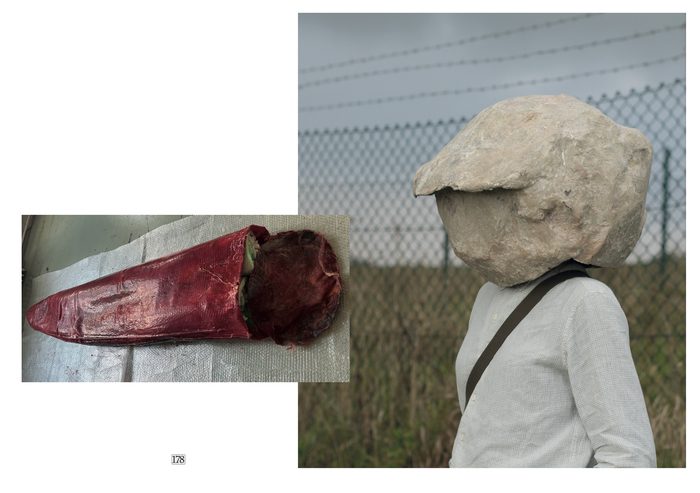
Natascha Sadr Haghighian’s photographic essay Good Citizens refuses the expectations of being a good migrant, and the violent erasure that expectations of integration might entail toward the body, language, and mother tongues. In Ankersentrum (surviving in the ruinous ruin), first presented at the 2019 German Pavilion of the Venice Biennale, her algorithmically sleeked artistic persona Natascha Süder Happelmann wore a stone head in all public appearances, from journeys to visit and demarcate asylum centers in Europe to the artist’s representative role during the Biennale. The stone head acted both as a silent witness to the brutalities of state borders and made the artist unavailable for the expectations of performative diplomacy that are assumed in high-profile cultural engagements. Natascha’s refusal to submit her body to the expectations of assimilation echoes a deeper question running through this book: what happens when a people’s relationship to land cannot be reduced to ownership, commodity, or the terms set by those who would erase them?
For Palestinians, land is more than the real estate value that so interests their enemies. The life of the land structures their indigeneity, not as a question of whose ancestors have legitimate claims to it but rather as the ongoing cultivation of certain relations to land, to community, and to ancestry. Historically, Palestinians shared with other native communities a long-standing reluctance to privatize land, which contradicted the capitalist principle of commoditization as the cornerstone of force and commodity value. Palestinians, especially peasants, considered themselves stewards of the land, ashab al-ard (ashab has the double meaning of “friends”/“owners of the land”):
“One does not own land, nor does one own a boat; instead, one is friends with land and with boats and with other non-human beings that we have a relationship with. Respect mediates the relationship with what is called an object in Western languages. Arabic grammar is quite clear: what is called ‘object’ is maf’ul bihi, or that which is affected by an action. What do our actions show about our relationship to the world?”
Indigeneity’s relationship to ancestry is not in the fetishized form of material inheritance and wealth accumulation, nor even in the notion of a regionally bounded ethnic purity, but rather as a persistent trace, a transhistorical dialogue with the legacies of shared habitation that have labored and reproduced us, that make a claim on us as habitation’s futurial offspring. Oraib Toukan’s contemplative contribution reflects on these legacies of habitation in their stubborn resistance to occupation. Inspired by Munir Fasheh’s pedagogical notion of turbeh, Oraib reminds us of the etymological connections between turbeh (“local soil,” or “soil grains”), tarbiyeh (“to nurture”), and tarbawi (“educational”), and how communal learning emerges from nurturing the pluralism of and within soil. Through addressing the infamous photo of Edward Said throwing a stone alongside two other iconic photographs, Oraib meditates on their circulation from the position of someone who wants to simultaneously mourn and learn. Palestinian stone, as image and metaphor, is the material frame for grappling with visibility and invisibility when it comes to representations of Palestinian territory. Stone is also geologically significant, as a keeper of time and a carrier of the collective unconscious, of multiplicities of knowledge and becoming with the land. Oraib thinks through the spirit of geology, and zooming in on the granularity of stone enables a material-philosophical leap from sediment to photographic images and back.
The granularity of the Palestine question, across historical narrative and moving image, has made Palestine a case study for abstract universalizing, a singular struggle that nevertheless stands in solidarity with many other struggles that intersect and converge in their resistance to the workings of racialized capital. Over the past years we have seen how fascist violence, often driven by extraction and the necropolitical monetization of life, deepens as the accelerated Nakba becomes increasingly unhindered and unhinged. As the people of Palestine, Lebanon, Sudan, Iran, and elsewhere are forced into ruin, this material destruction is supported by a deliberate corruption of language within Europe that is taking on new forms of surveillance and technological control. Protesters across the West become targets of police violence, their liberties curtailed, their livelihoods rendered more precarious, their words distorted, and the cause of Palestine emerges once again as the “world symptom:” a world order premised on “never again” for some and sustained oppression and persecution for others.
The conversation between Wendy Lotterman and Wendy Brown discusses how right- and left-wing populism, though opposed in their targets, both arise from a shared crisis of liberal democracy and a deep anxiety over diminishing resources. Brown and Lotterman dissect the failure of coalition building across these polarized uprisings against perceived elite domination while diverging in their respective periodization of liberalism’s midwifing of fascism across a historical continuum leading to our present. It is precisely these themes of resource extraction and racialized anxieties that find expression in Priya Bains’ newly commissioned anti-capitalist poem on environmental destruction from a diasporic perspective in Norway:
a black sun an oil-sun
blood-dripping sticky syrup
a burning sun a fire-sun a pure sun
an aryan sun
a twinkling snow-white sun
a blood-dripping sticky syrup-sun
(Priya Bains, “Black Sun After Etel Adnan”)
As we began discussing what we wanted from this book, ruination became one of the central themes we kept returning to. Following Ann Laura Stoler, colonial and imperial projects are ongoing processes of ruination, “processes that bring ruin upon, by exerting material and social force on, the present.” Even before the genocide in Gaza accelerated toward the threshold of incomprehension, and certainly during its fiercest moments, we witnessed how Palestinians persisted in showing love and embracing their surroundings, by repurposing the material rubble of their lives to rebuild time and time again. As early as 2018, civil engineer Majd Mashharawi innovated a method to repurpose rubble into what she called “green cake,” blocks of concrete that can be used to rebuild with what Israel destroys. Similarly, initiatives such as the Gaza Mutual Aid Solidarity Project and Gaza Soup Kitchens, which rely on intimate relations and networks to re-member social ties and spread aid to hundreds of people, have refused to succumb to the ravages of ruination as their ultimate fate. Palestinians have organized themselves around crafting the tools of their own survival, from inventing dignified recipes that are committed to both nutrition and flavor during periods of intense food insecurity to setting up free internet hubs at great risk of assassination by the Israeli army for the initiative takers.
The truth of their—which is to say the world’s—predicament is that some things have been irrevocably lost, and that much of what has been crushed under the constant barrage of negation and erasure is beyond the point of restoration. And yet, the facts of their collective struggle to gather, repair, and rebuild perform a material preservation of life and manifests what Achille Mbembe understands more broadly to be an orientation not only from absence or what has been destroyed but toward an “anticipatory presence.” These enduring efforts to rebuild and repurpose the ruins, at whatever the cost, are not about a simple return to what was but a re-preparing or a re-composing of the ground, a common and deborderized ground, without which “it will be impossible … to repair the Earth or set the living back in circulation.” Mbembe’s work on repair suggests how this radical Palestinian tradition of living in excess of the material and psychological ruination of their lives is shared with other colonized and “blackened” peoples who seek the reparation of relations to each other, to the land, and to a horizon of liberatory possibility amidst what colonial and imperial brutality decimates. This choice to continue living, breathing, and practicing forms of collectivity in the face of annihilation is an ongoing testament to how anticolonial resistance is anchored in everyday practices of persistence. Demonstrated in several of the diverse contributions to Stone Assemblies, resistance to ruination percolates through Gazans’ refusal to accept defeat. In its will to life, sumud (or what the native peoples of North America refer to as survivance) is only as good as it is practiced and passed on by the dispossessed.
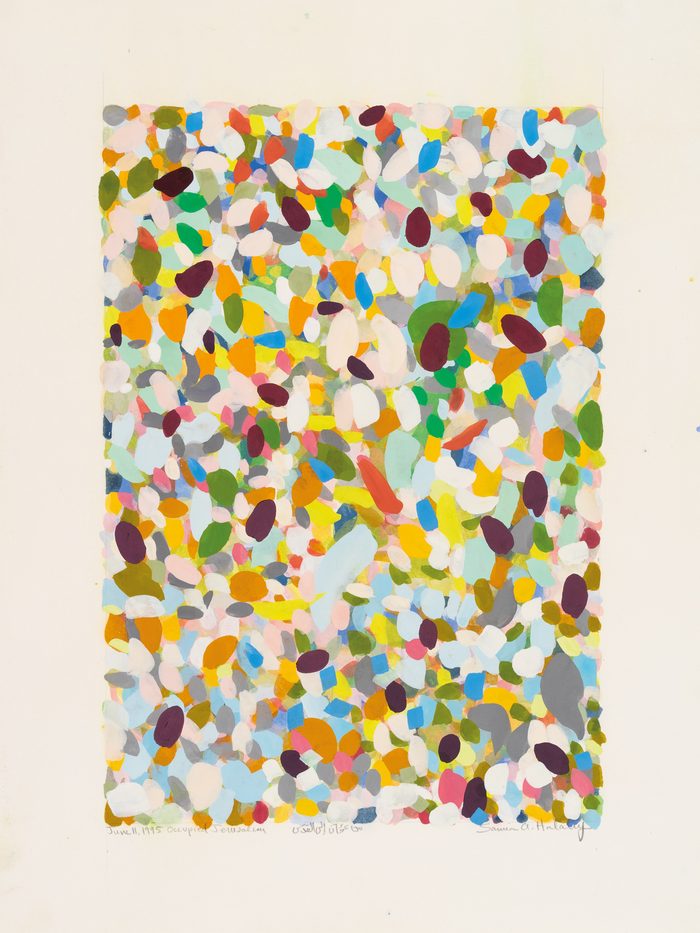
Amid constant threats of genocidal violence, we continue to find inspiration in our elders: predecessors who guide us in their understandings of art, aesthetics, and alternative political futures. Samia Halaby’s series of small abstract gouache paintings from 1995 is an attempt to come to terms with Jerusalem’s suffocation and fragmentation on the occasion of her visit to the city she was born in and exiled from during the Nakba. Samia chose to write a letter to accompany Occupied Jerusalem’s digital reproductions in this book. Her personal text expresses the pain and love she has for the city, a persistent attachment to the details that many Jerusalemites share amid the damaging and debilitating rot of the Occupation. Reflections on stone, light, breakage, and a ruinous Jerusalem are the themes that connect Samia’s series and Sebastia. Her committed captioning responds to settler violence through a tradition of image making that insists on the role of abstraction within revolutionary histories and practices of resistance.
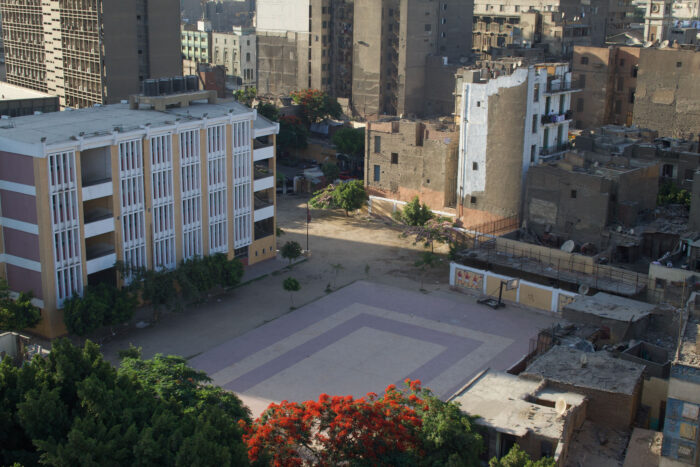
In an overlapping vein, the photographic essay by artist Iman Issa provides an analysis of sites of conflict that she has engaged with through research, architectural proposals, and withdrawals. Her interventions are digitized on sites that may be similar or not to the Government Quarter. They are plans for monuments that we will know nothing about because she insists on preserving the sites as secret locations. Stripped of contextual data, the viewer has no way of knowing what is being erased in the process. For an inquisitive mind this is an infuriating gesture, and yet it persists in our world as the dominant approach to working on sites of conflict or otherwise. Often, architects hide and erase, disregarding the history and cultural embeddedness of a site. Iman purposefully strips the monuments of context, thus rendering them visible.
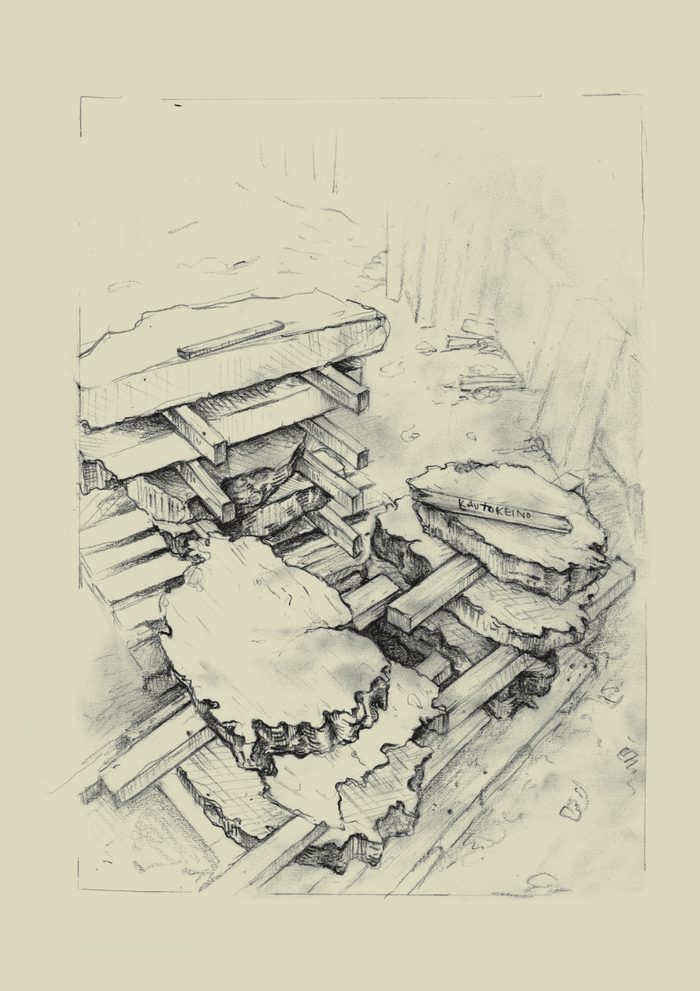
With a nod to the images of Sebastia’s construction phase, the book is interspersed with Jumana’s drawings of the stone donations in mid-transit. These chapter markers are object studies that highlight the unfinished, open-ended trajectory of work and material, with an emphasis on their potential and transformation. As exercises in how to see the materials that went into the production of Sebastia, the drawings dwell on the straps, pallets, and overall transitory context the stones have been subjected to in ways that bring out their dislocated state. The same stone that can be thrown can also lay a foundation—and here, they are caught in mid-flight.
- Jonas Gahr Støre, “Speech by the Prime Minister at the International Day of Solidarity with the Palestinian People,” Oslo Cathedral, November 28, 2025, translated from Norwegian by Rana Issa: “Det er kun noen få steinkast herfra. Og det er nettopp stein det handler om, men ikke steinkast. Den palestinske kunstneren lager et 800 kvadratmeter stort steingulv, et lappeteppe av ulike steiner, gitt av kommuner fra hele landet vårt…. Det er noe veldig symbolsk over dette, foran det som var et utbombet kontorbygg. En solid palestinsk signatur, midt i Oslo. Opp fra ødeleggelse bygger Jumana Manna et vakkert, nytt fundament, et bygulv,” www.regjeringen.no/no/aktuelt/statsministerens-tale-pa-fns-internasjonale-solidaritetsdag-med-det-palestinske-folk/id3141496/.
- The phrase break their bones concerns a well-known order (“the policy of ‘might, power and beatings’”) by former Defense Minister Yitzhak Rabin to suppress the First Intifada in its early months. Rabin famously changed his position and came to recognize some Palestinian rights when he became a key figure in the signing of the Oslo Peace Accords. The policy was reported at the time by Nabil Ramlawi, who was serving as the permanent observer for the Palestine Liberation Organization to the United Nations Office at Geneva. See, Nabil Ramlawi, “Letter Dated 25 January 1988 from the Permanent Observer for the Palestine Liberation Organization to the United Nations Office at Geneva Addressed to the Under Secretary General for Human Rights,” United Nations, www.un.org/unispal/document/auto-insert-179161/.
- For more information on Norway’s connection to the Welthauptstadt Germania, see “Organization Todt and forced labor in Norway 1940–1945: Technology as Propaganda,” The Norwegian Museum of Science and Technology, www.tekniskmuseum.no/en/gross-room/grossraum-technique-as-propaganda: “In the summer of 1940, Albert Speer sent a delegation to Norway to investigate whether the Norwegian granite was suitable for the monumental buildings he planned in Berlin. Various samples were presented to Hitler, and he was ‘very excited about the colors in the Norwegian stone’. Speer ordered huge quantities of stone in Norway. The entire Norwegian stone industry from Aust Agder to Østfold was involved in the enormous deliveries. Parts of the industry were reorganized under German auspices, and Norwegian stonemasons traveled to Speer in Berlin for training. Due to a lack of transport options, only a fraction of the granite ended up in Berlin.”
- On the UN Security Council Marble, see Jørn Holme ed., The Security Council Chamber (Oslo: Forlaget Press, 2018).
- In Norway the high number of kommuner—357 for a population of 5.6 million—affords a heightened level of democratic participation administered by local self-rule. The kommuner (“municipality”) is the most local form of democracy and is run by a local administration and an elected committee.
- Stefano Harney and Fred Moten, The Undercommons: Fugitive Planning and Black Study (Wivenhoe: Minor Compositions, 2013).
- Anders Johansen Eira, Svein Ole Granefjell, Isak Henrik Eira, and Elli-Ristin Tuorda, “Analyse av virkningen for reindriften ved planlagt gruvedrift i Nussir og Ulveryggen i Kvalsund Kommune” [Analysis of the impact on reindeer herding of planned mining in Nussir and Ulveryggen in Kvalsund Municipality], Sametinget (“The Sámi Parliament”), www.sametinget.no/_f/p1/i34eef697-e763-4735-8ab6-8390038be43b/analyse-av-virkningen-for-reindriften-ved-planlagt-gruvedrift-i-nussir-og-ulveryggen-i-kvalsund-kommune.pdf; see also, Máret Ánne Sara, “The Reindeer is Central to our Philosophy,” YouTube video (13:25 min.), from an interview conducted by Tate Modern, January 6, 2026, www.youtube.com/watch?v=aqFriolQpY0. Sara talks about the need to have a critical debate about “what [is] going on in the Norwegian legislation and politics toward Sámi reindeer husbandry, especially with an open reflection about land policies, how they are carrying out both massive industries in our grazing lands but simultaneously slaughtering down our reindeer herds by presenting it as a protection for those very same lands” (Sara, “The Reindeer is Central to our Philosophy,” 2026, 4:54).
- The relationship between Norwegians and the Sámi is asymmetrical in its distribution of power and has been so for hundreds of years. The proximity of these respective peoples living on overlapping territories has been longstanding and continues to be complex. Written accounts on this history also reflect that asymmetry, with textual records being produced mostly by Norwegian or other non-Sámi scholars.
- See, e.g., Eva Maria Fjellheim, “Wind Energy on Trial in Saepmie: Epistemic Controversies and Strategic Ignorance in Norway’s Green Energy Transition,” Arctic Review on Law and Politics 14 (2023), 140–68, www.arcticreview.no/index.php/arctic/article/view/5586. Moreover, the state-owned company Statkraft AS has been the subject of numerous protests, official complaints, and legal actions because of its failure to obtain consent from the Indigenous Mapuche in Chile before starting the construction of three hydro-power plants in the Pilmaiquén River. See, e.g., Mapuche-Williche v. Statkraft AS, National Contact Point for Responsible Business Norway, September 14, 2023, www.responsiblebusiness.no/en/unique-grievance-mechanism/specific-instances-handled-in-norway/mapuche-
williche-vs-statkraft-as/. - Supreme Court of Norway, “Vedtak om konsesjon til vindkraftutbygging på Fosen kjent ugyldig fordi utbyggingen krenker reindriftssamenes rett til kulturutøvelse” [Licences for wind power development on Fosen ruled invalid as the construction violates Sami reindeer herders’ right to enjoy their own culture], judgment October 11, 2021, HR-2021-1975-S, www.domstol.no/no/hoyesterett/avgjorelser/2021/hoyesterett-sivil/hr-2021-1975-s/.
- For a full timeline of the Fosen case, see Rebecca Biong “Fosen: En Tidslinje,” Naturvernforbundet, October 10, 2023, www.naturvernforbundet.no/fosen-kort-forklart/. Although this particular case has reached an agreement between the parties, the Supreme Court ruling on the matter might serve as precedent for similar cases in the future.
- Laura Harris, Experiments in Exile: C. L. R. James, Hélio Oiticica, and the Aesthetic Sociality of Blackness (New York: Fordham University Press, 2018).
- This legal-tiered system refers to the stratification and classification of Palestinians into at least five different legal statuses and enclaves based on where they live: “Across Israel, the West Bank, the Gaza Strip, Jerusalem, and refugee camps, Palestinians now occupy distinctive and discounted coordinates in a convoluted matrix of law, whereas Jewish Israelis maintain a singular and superior status, regardless of territorial divisions,” (Rabea Eghbariah, “Toward Nakba as a Legal Concept,” Columbia Law Review 124/4 (May 2024) 887–992, www.columbialawreview.org/wp-content/uploads/2024/06/May-2024-1-Eghbariah.pdf).
- Orlando Patterson, “Introduction,” in The Sociology of Slavery: Black Society in Jamaica, 1655–1838 (Cambridge: Polity Press, 2022), lxi.
- Sonia Benghida, “Norwegian Oil Management Structure: Farouk al-Kasim Innovative Solutions,” International Journal of Civil Engineering and Technology 8/4 (April 2017), www.iaeme.com/Home/article_id/IJCIET_08_04_060. See also, Lisa Margonelli, “How Farouk al-Kasim Saved Norway from its Oil,” Pacific Standard, January 28, 2014, www.psmag.com/
environment/iraqi-vikings-farouk-al-kasim-norway-oil-72715/. - The Oil Fund has invested heavily in numerous companies with questionable ethics and/or that clearly violate human rights and international law. Among the most debated cases were the investments in the companies constructing the Dakota Access Pipeline in the United States, and the billions invested in Israeli-occupied territories which, until the summer of 2025, made Norway the largest European investor in the Occupation. For more on this discussion, see Carl-Gøran Larsson, Anna Sunna, Mariela Idivuoma, Tor Emil Schanche, Ewa-Mari Hedman, and Adam Alexander Johansson, “Krigen om ‘The Black Snake’: De norske interessene i den omstridte oljerørledningen tilsvarer mer enn 13 milliarder kroner,” NRK, October 31, 2016, www.nrk.no/sapmi/xl/krigen-om-_the-black-snake_-1.13203851
#authors–expand; and Lucy Brooks, “Oljefondets systemsvikt,” Fremtiden i våre hender, September 1, 2025, www.framtiden.no/artikler/oljefondets-systemsvikt. - Rolv Christian Topdahl and Astrid Rommetveit, “Slik går Norge fra å være miniputt til utslippsgigant på klimastatistikken,” NRK, November 1, 2021, www.nrk.no/klima/xl/norske-co_-utslipp_-slik-gar-norge-fra-a-vaere-miniputt-til-gigant-pa-klimastatistikken-1.15600846.
- The Labour Party attempted to compensate by allocating USD 208 million in handouts to Gaza and the West Bank, a sum hardly commensurate with the USD 53 billion that the World Bank estimates to be the extent of the damage.
- Per mid-January 2026, the Oil Fund was invested in sixty-one Israeli companies, valued at NOK 22 billion. See Norges Bank Investment Management, www.nbim.no/en/investments/all-investments/. Francesca Albanese, the UN Special Rapporteur on the situation of human rights in the Palestinian territories occupied since 1967, tweeted on X that “#Norway is a wondrous country, including to debate Palestine: I found Norwegian politicians, trade unions, media and civil society to be generally more educated, aware and principled about Palestine/Israel than many of their peers in Europe. That is why I can’t believe the Norwegian Oil Fund/Pension Fund is still so involved in Israel’s unlawful occupation. This must end, totally and unconditionally, like Israel’s occupation itself – no more excuses,” @FranceskAlbs, 23:02, March 2, 2025, www.x.com/FranceskAlbs/status/1896335457534841334.
- For Palestinians and other colonized Arabs, the colonial project primarily undermined the commons or the musha’, a land relation that is based on stewardship and communal rotation rather than possession. For more on this concept, see the conversation between Sasha Plotnikova, Jumana Manna, and Noura Alkhalili, “War on the Mushaa’: Noura Alkhalili and Jumana Manna in Conversation,” Failed Architecture, August 2, 2024, www.failedarchitecture.com/war-on-the-mushaa-noura-alkhalili-and-jumana-manna-in-conversation/.
- The thought was built on and completed by Munir Fasheh in a public talk he gave called “Radical Pedagogies: Lessons from Palestine,” presented as part of the 2025 Masahat Festival, at Litteraturhuset, Oslo, September 18, 2025. Rana Issa continued the thought in “Solidaritet som vennskap: Palestina, Sápmi og landkamp,” Agenda Magasin, April 16, 2026, www.agendamagasin.no/debatt/solidaritet-som-vennskap/.
- See Sami Khatib, “Singularity-effects: Palestine as Symptom and Cause,” Radical Philosophy 2/16 (Summer 2024), 21–32, www.radicalphilosophy.com/wp-content/uploads/2024/09/Khatib_Against-singularity-.pdf.
- Ann Laura Stoler, “Introduction ‘The Rot Remains:’ From Ruins to Ruination,” in Ann Laura Stoler ed., Imperial Debris: On Ruins and Ruination (Durham: Duke University Press, 2013), 1–35.
- “Maintaining the Social Fabric: Mutual Aid in Gaza, An Interview with Hadeel Assali,” by Lucy Garbett, Jerusalem Quarterly 100 (winter 2024), 66–75, www.palestine-studies.org/en/node/1656919.
- Achille Mbembe, “Introduction,” in Brutalism (Durham: Duke University Press, 2024), 8.
- Ibid
- Matthew James Milbourne, “Repertoires of Black Radicalism” (PhD diss., Vanderbilt University, expected 2027).
- Rana Issa speaks about sumud as praxis in “Nakba, Sumud Intifada: A Personal Lexicon of Palestinian Loss and Resistance,” The Funambalist, October 25, 2023, www.thefunambulist.net/magazine/redefining-our-terms/nakba-sumud-intifada-a-personal-
lexicon-of-palestinian-loss-and-resistance.