People Over Profits
A chronicle from Torino Art Week
The ribbons
Now that the so-called Art Week is over and we have all had a moment to catch our breath, let’s look back at what we witnessed this year, shall we?
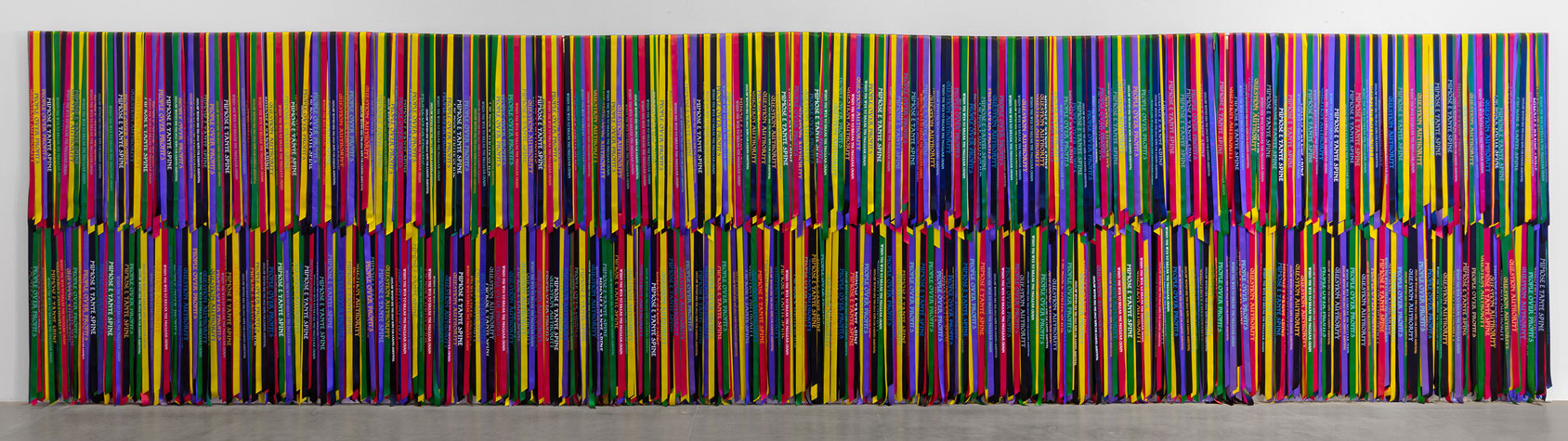
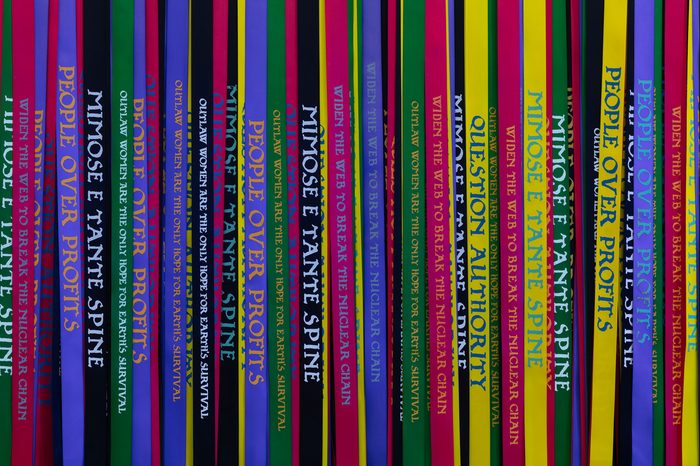
At the opening of five solo shows at Fondazione Sandretto Re Rebaudengo, by Andrea Bowers, Joseph Yaeger, Aziza Kadyri, Nan Goldin and Louis Morlæ, a wall held the ribbons of Andrea Bowers, political ribbons, each printed with a slogan from a historical struggle, which visitors could take and wear. Words travelling from the body of the museum to the body of people. After careful consideration, I chose PEOPLE OVER PROFITS, written in yellow on a thin purple band.
Minutes later, in a conversation with an art historian and teacher I dearly look up to, it turned out that she had picked the very same slogan. She found it particularly relevant at this fair moment, she said, in the strange suspended time when a whole city arranges itself around a market, and I remember thinking that the piece I owed this publication had just walked up and introduced itself.
The rest of the Sandretto’s curation, as well, was the closest thing I have seen in a while to perfection. Goldin’s The Ballad of Sexual Dependency is a work one does not need to be persuaded of, and Yaeger’s paintings were solid. But the ribbons were indeed the protagonist of the night.
The questions they raise are small and a little uncomfortable. What becomes of a political message when it lands in a place where everything, inherently, is meant to be bought and sold? In the art world nobody argues with “people over profits.” A slogan that nobody disputes costs very little to agree with.
The elephant in the city
Given the historical moment we are living in, it was impossible to avoid politicisation this year, so let us start with the elephant in the city, the trilogy dedicated to Marisa Merz. For the first time the sole female protagonist of Arte Povera was in the spotlight, across three key institutions of the city, the Castello di Rivoli, the Fondazione Merz and the GAM, each showing a version of her under the same title, La danza delle ore. I held a catalogue at the Fondazione Merz in which the usual “Mario and Marisa Merz” had been turned around to read “Marisa and Mario Merz.” A tiny inversion, and in a week of slogans it worked like one.
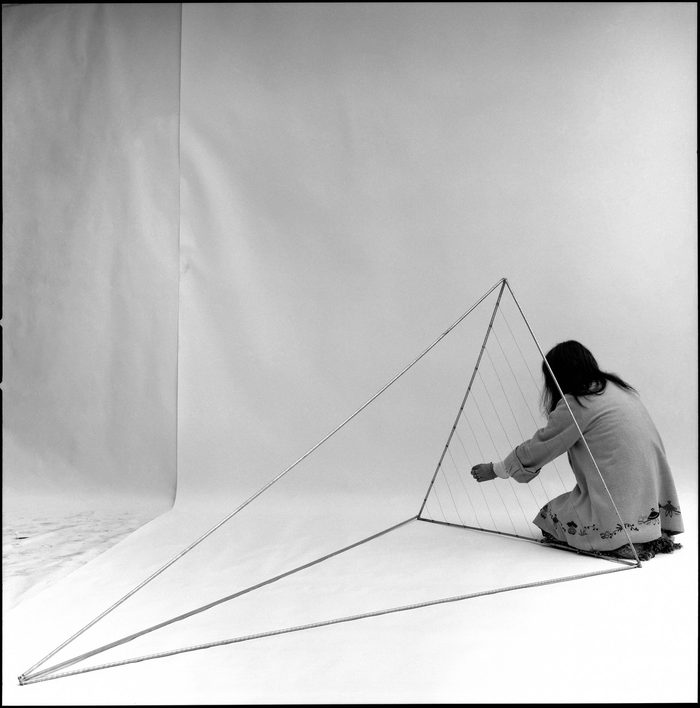
The Rivoli chapter, curated by Francesco Manacorda and Marianna Vecellio, was the only one of the three to place Merz’s work in real dialogue with other artists, ten of them in all, and, may I add, it was my personal favourite. What follows are only some of the works that caught my eye among many others. The very first thing placed right before the visitor’s eyes when one enters the room is a medieval triptych by Agnolo Gaddi, once the upper register of a polyptych, hanging next to a vase of flowers. Further on comes a net installation whose slow, repeated structure I could have watched for an hour. Then came drawings, video installations, photographs and sculptures, and finally, at the far end of the manica lunga, a small fountain runs, a pale bone-like form in a shallow basin of water, so that the works seem to speak across centuries and materials. The variety of mediums somehow keeps a consistent harmony. Seen among other, younger voices, Merz reads less as a monument and more as a participant in a conversation that is still going on.
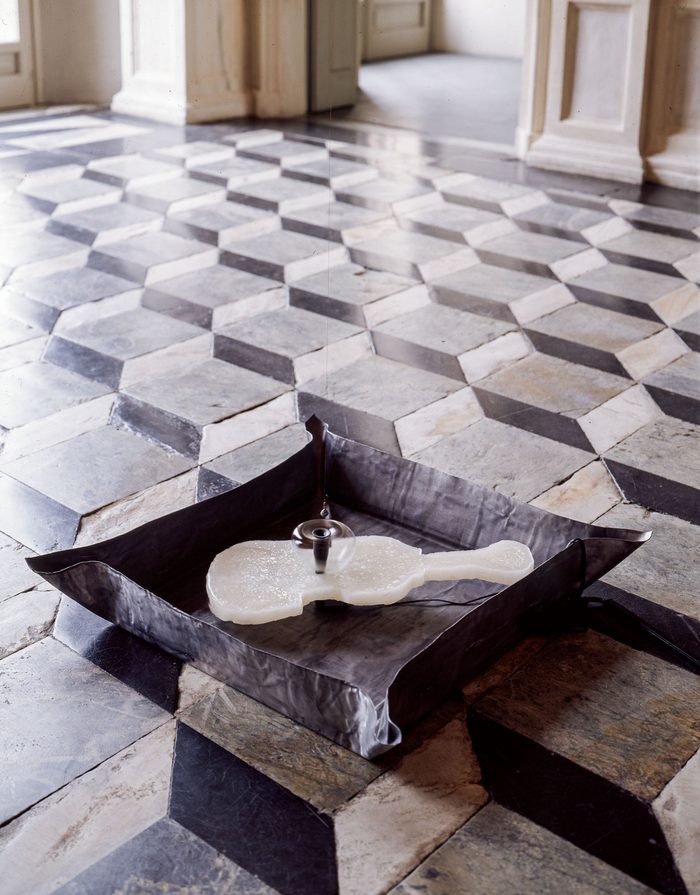
The Fondazione Merz, with Beatrice Merz and Sébastien Delot as curators, gave almost the whole space to Marisa alone, and the tone grew more reverent. Her charcoals were the strongest part of it for me, and one of her photographs held my eye for a long time. What looks like fishnet turns out to be copper wire, a detail that changes how the works bear weight and light. A sculpture placed slightly above one’s eye line, framed by a window, was an interesting choice of installation. The foundation had also left part of its previous exhibition, GAZA, the future has an ancient heart, on the walls, a scrolling LED text counting destroyed museums and heritage sites, and Phantom Votives by Dima Srouji in the last room. The wall text read as more humane, which after seasons of machine-sounding museum prose was almost news. In the end, I left slightly less persuaded than I had hoped to be.
At the GAM, Chiara Bertola curated with Chiara Parisi what I think is the finest group of Merz’s drawings on show, and I loved, loved, loved them, where her command of technique is most legible. The mediums are more consistent here, somehow classic. The copper nets appear again, with some photographs. The curators wanted the display to be poetic and scattered little poems as a way of structuring the sections, which tipped into sweetness for my taste, but I could admire the Venetian elegance. Visitors, in fairness, seemed to love it, some even called it the best of the trilogy.
In the week of the fair, each of the three institutions had to decide how near to come to things heavier than its own programme. None of them could be neutral, and the telling part was watching how each chose to be seen.
Gilardi: The Man of the Week
The most, and maybe the only, openly political show I saw all week was at the PAV, the Parco Arte Vivente, where Marco Scotini has curated “Piero Gilardi: From Art to Life”. Gilardi became famous for his foam Nature Carpets, and at the height of that success, in 1968, he stopped making objects. That May he set up a popular atelier in Turin, printing by night the posters that the student movement and the factory committees asked for, and he went on to work with the workers of Fiat Mirafiori and Teksid. Then he entered the city’s psychiatric hospital with a collective of volunteers and backed the strike that raised the patients’ pay from 175 to 500 lire. In 1981 he wrote that if life, society and its concrete institutions are not open to the freedom of art, then they have to be changed.
The show makes that statement concrete. Screen-printed posters from Christmas 1968 read “Padrone Panettone Repressione”, and foam caricatures of the powerful, from Agnelli Morte to the Squalo Marchionne, were built in open workshops and brought to life in May Day marches. In 1976, in the Aurora district, he proposed an open atelier shared by “the sane and the mentally ill”, convinced that widespread distress and psychotic disorder have the same social root. Elderly residents staged their own evictions in a play called Lo sfratto, joined by young musicians, workers and housewives, and in 1980 some 1,500 people filled the streets of Aurora for a carnival they had all prepared together. The wall text calls it the aesthetic community, a forerunner of the political community.
History does indeed repeat itself, and it was a delight to watch an institution dive so deep into that. The museum stands on the former site of a Fiat supplier, and while the city revolved around the fair, over a thousand workers at the Stellantis plant in Mirafiori were sent home on temporary layoff, a measure the metalworkers’ union Fiom calls the nineteenth consecutive year of its kind.
The fair
On the day of the preview I walked the fair from the far left to the far right. Present Future, the section for emerging artists, was my favourite, and a common question ran through its practices: what contains a body, or a life, and on whose terms. Emma Scarafiotti works on violence against the female body and on the link between femininity and the animal kingdom, in video and light boxes where bodily and natural elements mix. C. Mae Bloom treats time as an exchange: she works with found objects and comes from a family of fabric workers, so that labour enters her practice as inheritance. She raised the question I wrote down at once, who has the right, and the time, to produce objects? It runs underneath the whole fair.
A good deal of the work was political. Among it was the Mexican artist Beatriz Morales, whom I spoke with at length at Dep Art about the long Mexican heritage of the agave plant and how she reclaims it as her artisanal material, and the Kurdish artist Zehra Dogan, imprisoned in Turkey, at Galleria Prometeo. Dogan works with hair, a material that comes straight from the body and that widely represents Kurdish female resistance. There was Fiona Lutjenhuis, a Dutch artist who grew up in a cult, and a long run of feminist discourse. A preview day is a performance of taste, and it was one, but it also contained people who loved what they were showing, and I want that on the record. When so many works carry urgency, does urgency become a category, one more thing a stand can offer? The border between the market and human creation was hard to find. For a while the friction was easy to feel, two things rubbing because neither was sure it belonged next to the other. Then it eased, the way friction does at a party.
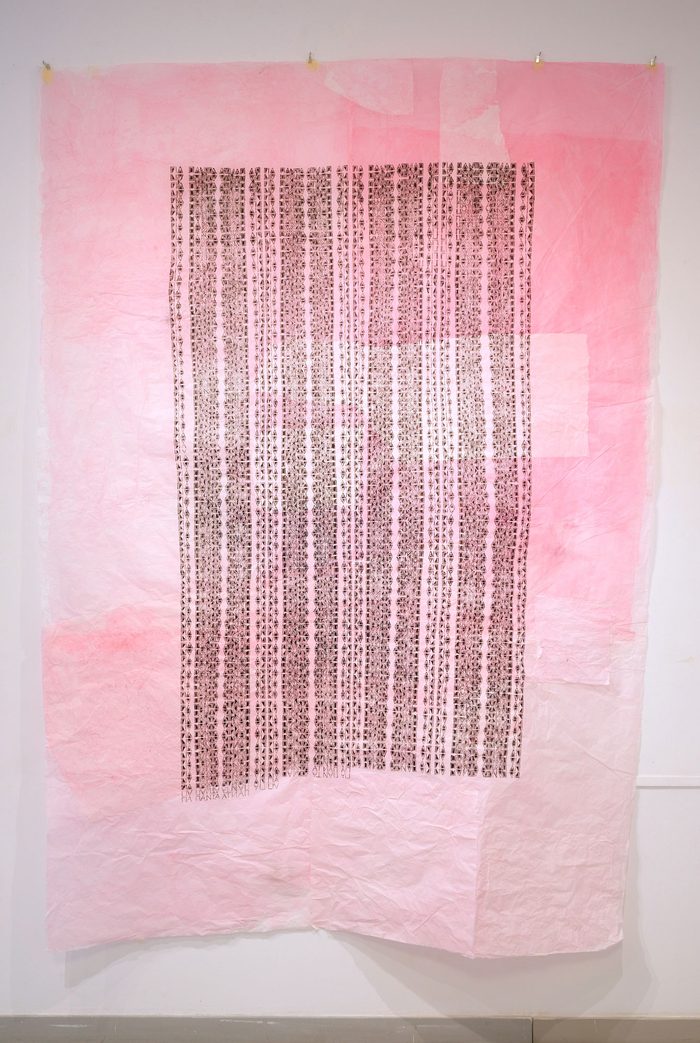
I kept going, admiring the bold presence of craft out in the open, beside the fainter presence of AI that still bugs most of us just by existing.
In the end though, all of these were hanging in a commercial presentation, in a space where things are sold. This is no accusation of anyone. The artists are not responsible for that, the galleries that show them are doing their job, and I was there too, admiring and taking notes, aware that my admiration was part of how the whole system worked. The same goes for some of the collectors, though not all.
We are all in this together, one way or another. The collector, the gallerist, the museum, the artist and the person writing this are not separate parties, and the borders between market and institution are blurry for everyone. Moving through this world feels a little like walking on eggshells.
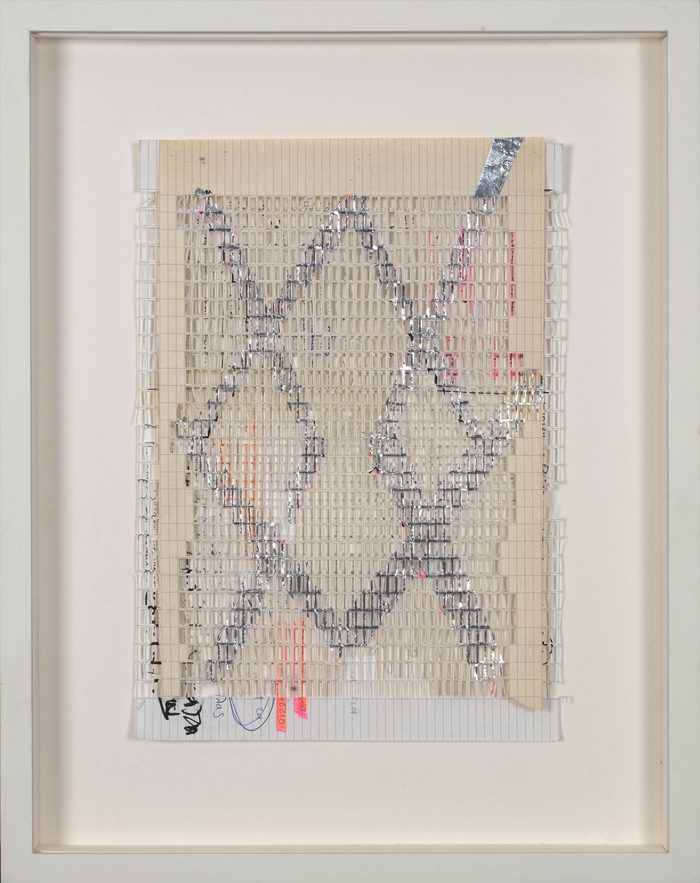
I do not have a conclusion that would please everyone. I think “people over profits” is true. I also think it is easy to say in a setting where profit is the very reason it exists. The fair needs the artists and the museums, and the artists and museums need the fair, to be seen and to meet each other. The tension between those two sentences is visible, and I would rather leave it there than smooth it over.
What I will carry out of the week is smaller than any of that. Among the collectors I met was a lovely couple from Bologna who owned two works by Abolfazl Harouni, a young Iranian artist and a friend of mine, currently based in Tehran. I almost cried. People collect for so many different reasons, and sentiment is surely one of them. Finding two of his works in the middle of the fair felt like a breath of fresh air. The same thing happened over and over, in studios and at the edges of stands: the warmth of listening to someone’s story, with no network to build behind it. If “people over profits” means anything at all, it starts there. Does the fair need us? Do we really need the fair? Who among us can afford to answer? I am still deciding what it means to wear the ribbon.