
On Breath
(or How to Avoid Asphyxiation)
There were a lot of agitations, gesticulations, slogans, idiocies, illusions in ‘68, but this is not what counts. What counts is what amounted to a visionary phenomenon, as if a society suddenly saw what was intolerable in it and also saw the possibility for something else. It is a collective phenomenon in the form of: “Give me the possible, or else I’II suffocate…” May ’68 Did Not Take Place, Deleuze e Guattari (1984)
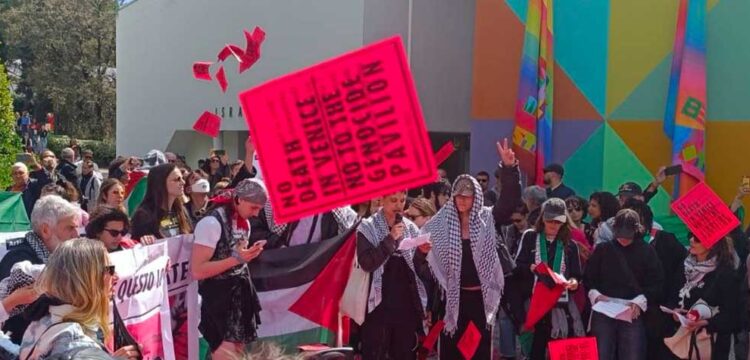
On May 8 in Venice, during the opening of the Biennale, we went on strike. For a free Palestine, against the presence of the Israeli Pavilion, and against the precarious working conditions faced by art workers. We were more than two thousand people.
What happened that day exceeded the usual frameworks of protest and political struggle. It belonged instead to the sphere of collective imagination. To me, it felt like the emergence of a new—and urgently needed—sense of possibility in a time defined by deep uncertainty and instability.
The possible is not something that pre-exists. It is something we produce collectively, with our voices and our bodies.
Immersed in this hyper-body composed of friends, artists, and precarious art workers like me, I found myself reflecting on a simple proposition: the possible, or else I suffocate. I understand “thinking” not as an abstract cognitive act but as a critical practice inseparable from embodied experience.
In contexts where breathing (both literally and metaphorically) is compromised, one can either surrender to suffocation or experiment with a political alternative: breathing together. To conspire, in the most literal sense. To share the same breath, to join breath with breath until hegemonic power begins to crack, to tremble, to lose its footing.
The air we breathe has always already been breathed—we are told. All the more reason to urgently create new worlds, before the existing one leaves us breathless.
Acting within the sphere of the possible—of the as if—brings us back to questioning the fictionality of artistic practices. Fictionality reveals glimpses of possible futures. In this sense, to expand the limits of the real is to create new conditions for breathing.
///
The text that follows assembles the remnants of two performances oriented toward the search for new air. Both works generate fleeting apertures onto possible futures: worlds saturated with voices, whispers, hypnotic songs, flashes of light, and diminutive fantastical creatures that circulate through and beyond the body, attaching themselves to the skin of participants. It is written in the first person, interlacing theoretical reflection with embodied experience.
Canti fossili, Annamaria Ajmone
A fossil is moment*
In her rereading of Science as a Vocation, Jane Bennett suggests that disenchantment names the historical process through which magic is progressively displaced by calculation, the latter becoming the dominant technique for governing, mastering, or placating spiritual forces. Yet this demystifying trajectory, she argues, never unfolds according to a linear logic. It advances unevenly, through interruptions, suspensions, and restarts. Such malfunctioning—as with all processes marked by contingency, unpredictability, and disorder—should be welcomed. For in these moments of impasse, the possibility of enchantment emerges once more, and the world regains its capacity to surprise.
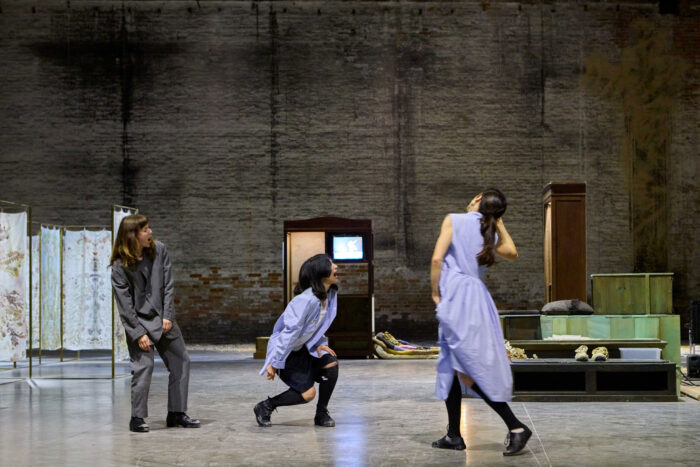
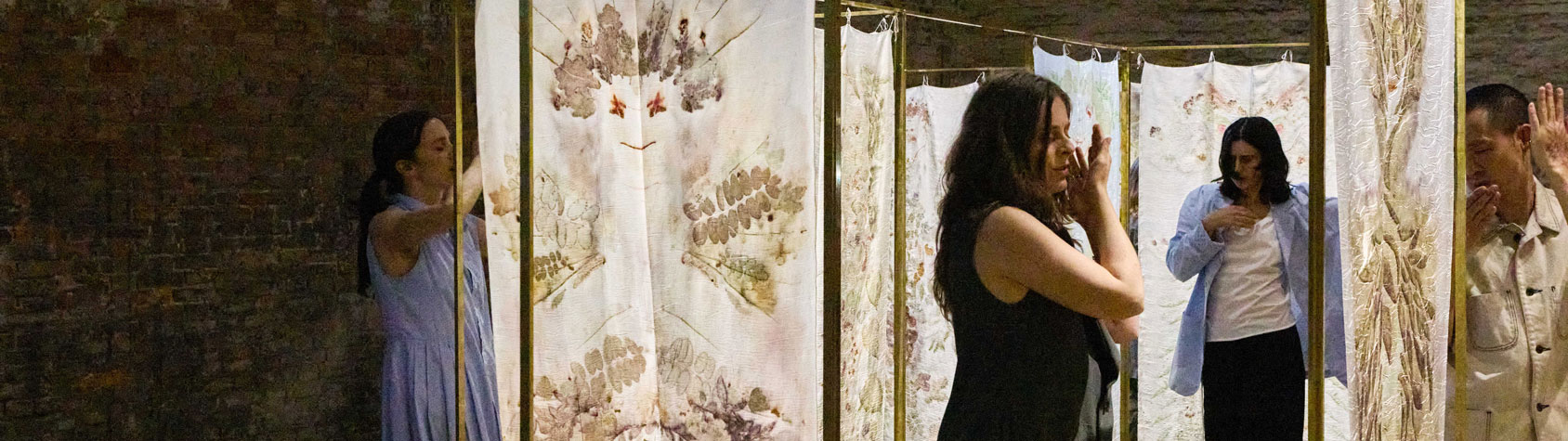
As I traverse the pavilions of the Biennale, an institution that functions as a stronghold of regimes of representation and visibility organized according to geopolitical and military logics, the appearance of dancing bodies constitutes a significant rupture. Inviting us to depart from the coordinates of our own bodies and inhabit alternative dimensions, this apparition draws us toward a temporary, ephemeral, and elusive condition of enchantment. In Canti fossili, Annamaria Ajmone, together with Veza Fernandez, Erwan Ha Kyoon Larcher, Emma Saba, Toni Steffens, creates an imaginary sedimentation of gestures and whispers. As the ancient philosophers suggested, sound—and especially repetitive forms such as choruses, chants, and refrains—provides a privileged access point to the cosmological dimension of existence. Following these sounds as though they were interwoven threads entrusted to guide us out of some unknown labyrinth, we discover that our human bodies attune themselves to more-than-human frequencies, creating new forms of transspecies proximity.
We become aware of a strange epidermal sensation that spreads from our hands throughout the body. As though we were sensing the flow of an unknown energy, so strange that it makes us doubt it truly belongs to us. Perhaps the contagion radiates from the performers’ bodies, infecting the space as they move through it. While I was contemplating the alchemical trajectories of contagion, one of the performers approached my crouched body. I am certain she did not touch me, yet I seem to remember that, in that instant, we exchanged skin. Then I thought: perhaps they are not the agents of contagion after all; perhaps there is no contagion at all. We are moving through a world overflowing with creatures that affect one another. Stacy Alaimo would call this trans-corporeality.
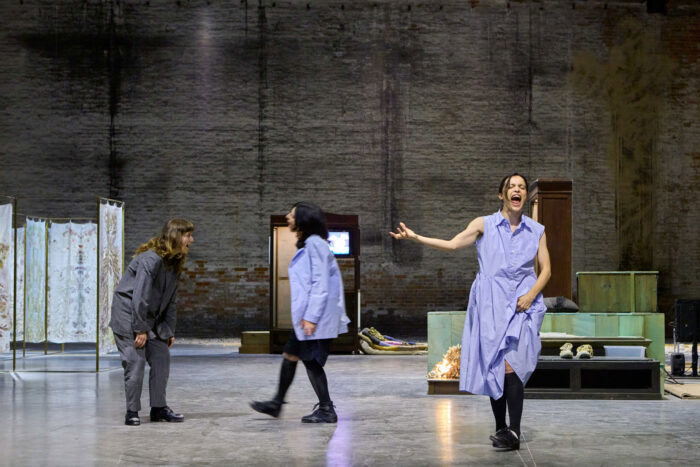
Etymologically, the earliest meaning of the verb vocare, from which the word voice (vox) derives, is to invoke. As Adriana Cavarero writes, before becoming word, the voice is an invocation addressed to the other, trusting in an ear that will receive it. “In the play of voices that invoke one another, the sequence of emissions configures a reciprocal dependence.” It indeed seems that the performers are playing, like in one of those children’s games governed by rules unknown to all other humans.
I feel like we want to do, do, do, but I think that if we create our own conspiracy, it will be easier to play, to have less intensity.*
These bodies, attuned to one another through the most subtle vibrations, move through a space that did not exist before and that they have traced through movement. All surfaces—including those we lean on—have changed shape, becoming immensely large or infinitely small. And certainly viscous. As though that small cluster of bright resin that once lay in a corner had now spread to cover everything.
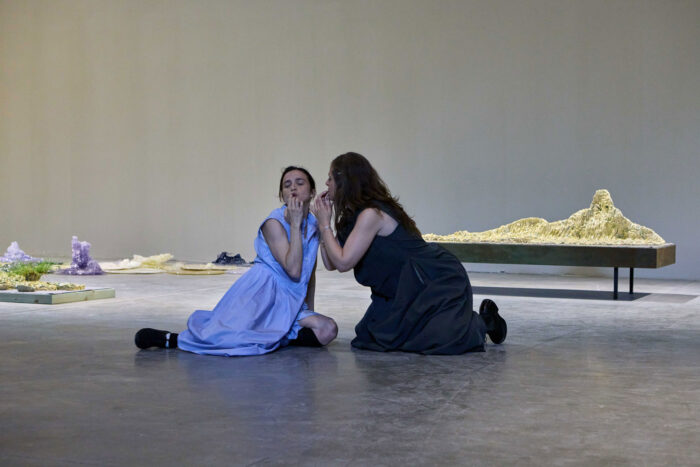
Born in dialogue with the artist Chiara Camoni and with the project Con te con tutto, conceived for the Italian Pavilion 2026 curated by Cecilia Canziani, Canti fossili is a slow dance. Its rhythm is the same as breathing. Moving through Camoni’s world-in-formation—magical, yet of a transtemporal kind of magic—these bodies subvert any distinction between organic and inorganic matter. I like to think that what is prefigured in the time of the dance is a world of anti-dualist philosophies, where what matters are encounters, affects, and supersensible bonds. A world in which fixed forms do not exist, and everything is in a perpetual state of entanglement.
At some point, the dance comes to an end. Woven entirely from echoes and resonances set in motion by every human and spectral presence moving through the space, each dance is singular, impossible to anticipate or repeat. In our bodies, whose shapes we once again begin to recognize, the traces of this apparition remain, slowly sedimenting.
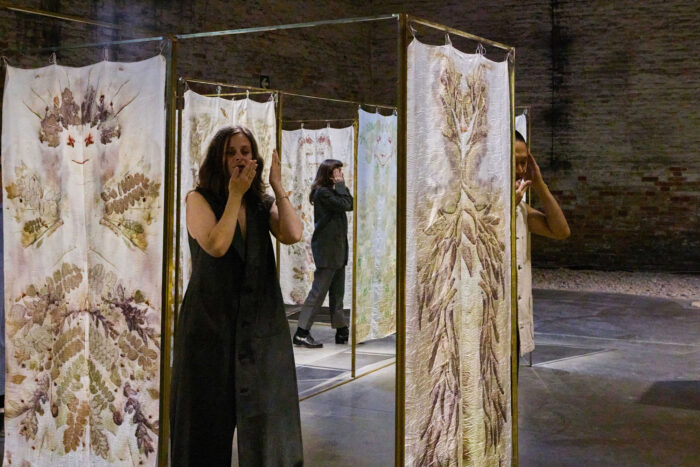
For a few hours, the more-than-human little creatures that had gotten inside me kept moving at high speed, making my fingers tremble. I imagine they were moving through a wind that my human-only body was no longer able to perceive.
I gather some information, take it in, and make it my own, and then somehow it spills back toward you.*
Memories I did not know now live resting upon my body (I borrow these words from Avery Gordon).
The Galeazze Project, Faustin Linyekula
C’est-à-dire fragments et autres boues recyclés**
For Walter Mignolo, temporal racism consists in the colonial invention of “modernity,” which extended geopolitical prejudice from space into time. The West has self-proclaimed itself the sole reference point for any present and future, as if the Western measurement of time—a straight line with an arrow pointing in only one direction, as we are taught from birth—were the only possible system.
A suggestion: in Lingala, a Bantu language spoken by about ten million people in Central Africa, the word lobi has two meanings: yesterday and tomorrow, depending on the context in which it is used.
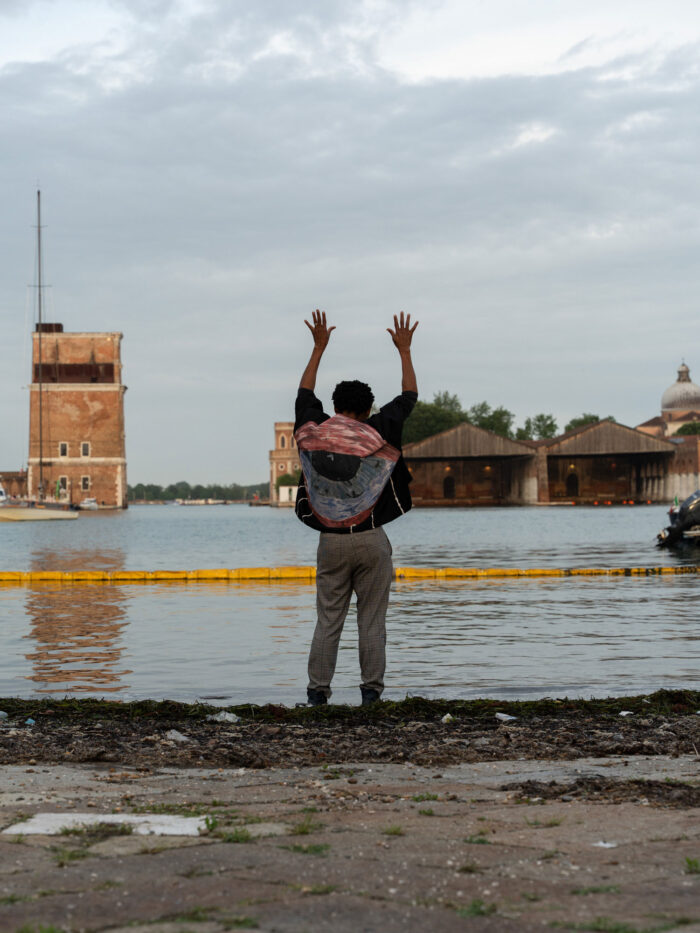
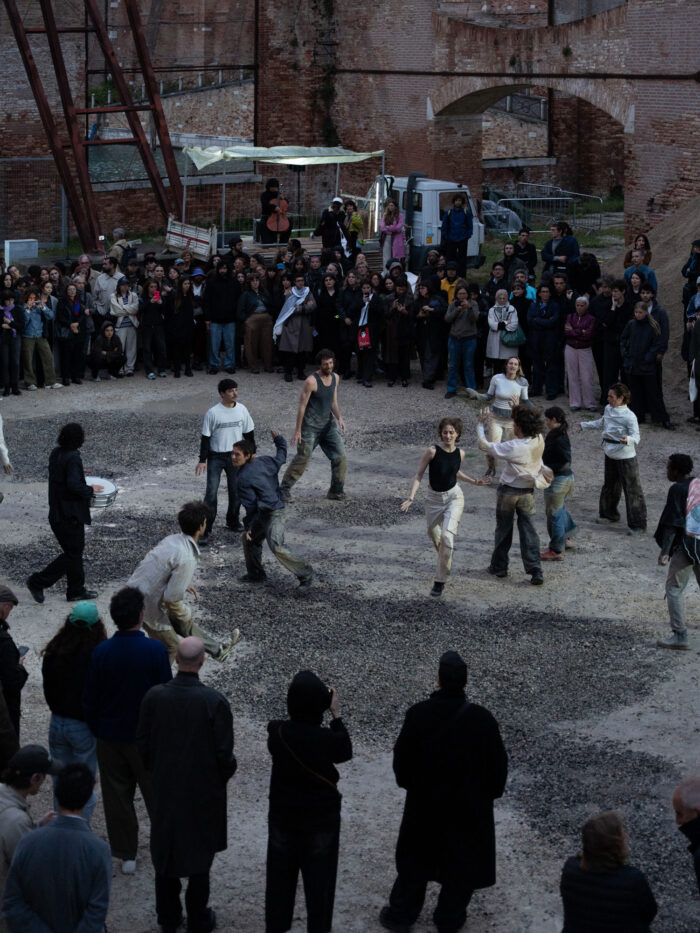
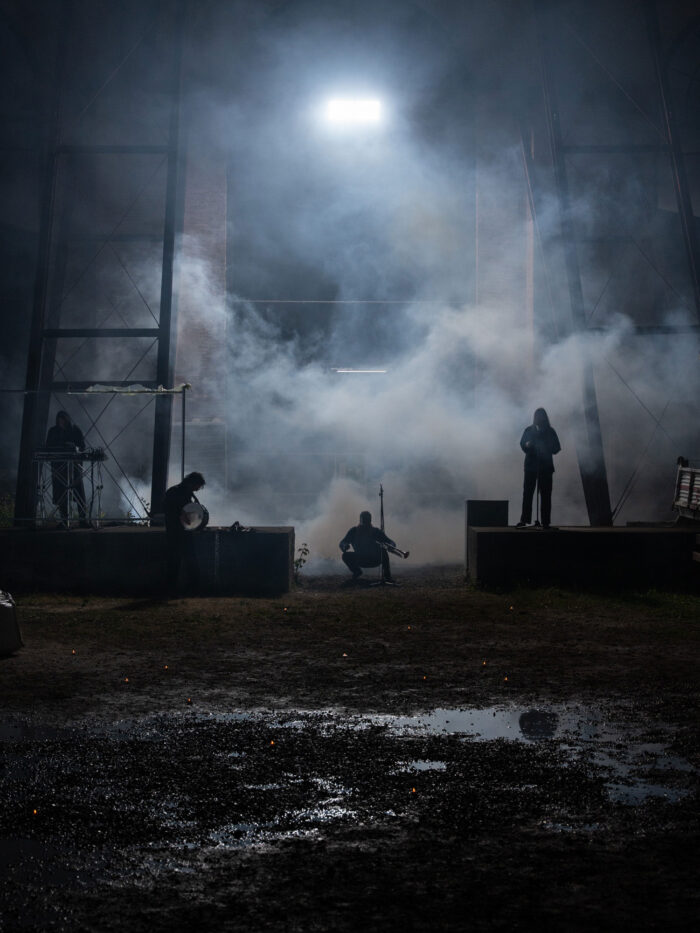
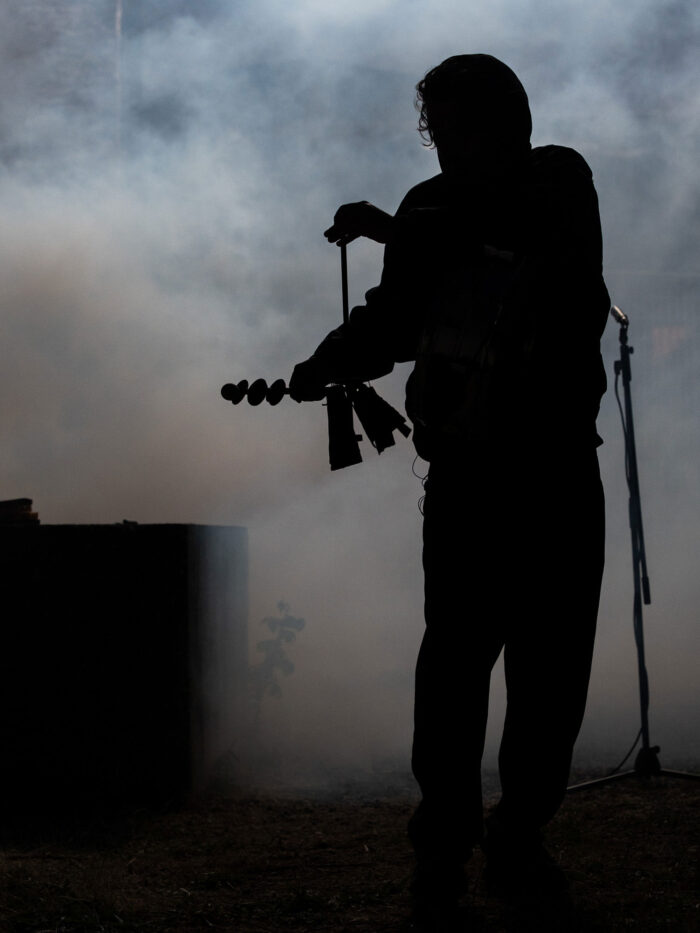
Hosted in the outsized space of the Galeazze in the Venetian Arsenal, once used for the construction of the fleets of the maritime republic, The Galeazze Project is a performance by Faustin Linyekula, in collaboration with Heru Shabaka-Ra and with Marco Bertani, Davide Di Liberto, Gaia Ginevra Giorgi, Trevor Louw, Luca Maino, Bianca Martinelli, Tulls Primultini, Nuvola Ravera, Vittorio Tommasi, and Denise Tosato, live music by Simone Carraro, Sofia Pozdnyakova, Gabriele Tai, Emanuele Wiltsch Barberio. Curated by Edoardo Lazzari for Scuola Piccola Zattere, this site-based project is constructed through movements that return, that propagate, that change bodies; through voices and whispers that break apart and then give shape to a song. A song that then disappears and becomes light, and again and again. The sensation is one of a kind of perceptual disorientation, of the senses. As if the conceptual categories with which we are used to interpreting the world had suddenly crumbled into dust.
A friend suddenly said to me: I wouldn’t know how much time has passed anymore. Are we talking hours or minutes since we’ve been here? No one could answer her with certainty.
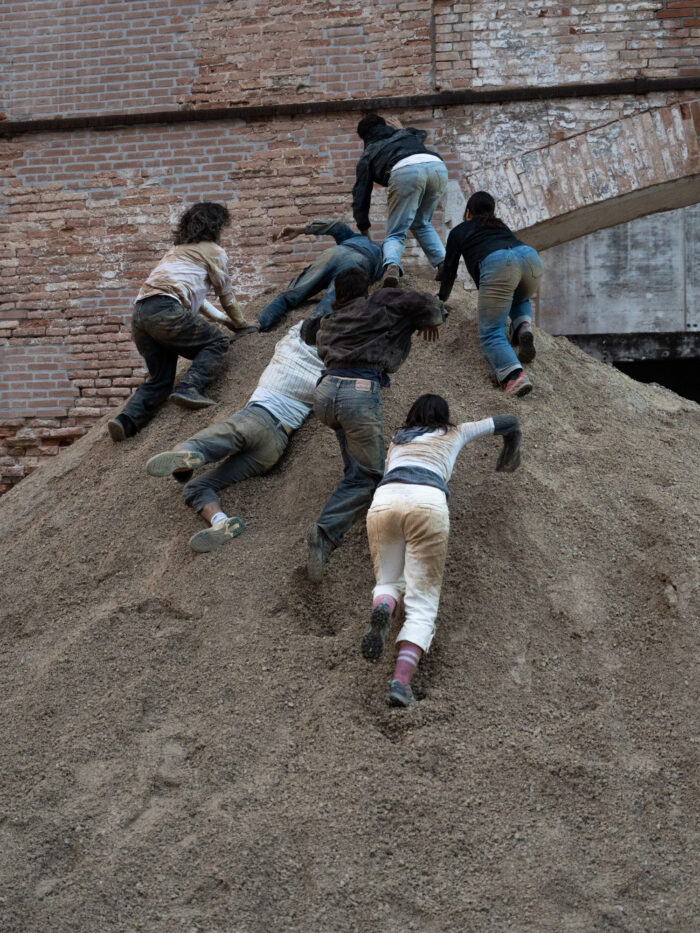
Ten bodies remain motionless on a sand mound a few meters high, while beneath them the sand gradually crumbles, collapses, as if bearing witness to a passage of energy from flesh to dust. Then a first slip: to avoid falling, one body clings to another, which in turn slides down, then gathers momentum and throws itself back onto the sand mound. Meanwhile, someone is playing a trumpet behind us.
In the (imprecise) time of this performative ritual, I changed position seven times: my body was searching for a “center” that kept eluding me. I moved in order to get closer to the bodies, to the music, or to the light, but then discovered that something else was always happening. The closest image to my embodied memory is this: a stone dropped into water produces concentric ripples that transmit its vibration. But then another stone falls, and the circles overlap, forming shapes that are no longer concentric. Then another, and another, until the search for the first center becomes both impossible and unnecessary.
Founder of Studio Kabako in Kisangani, Congo, Faustin Linyekula works on colonial legacies not in a didactic sense or as translation, but as a methodology that inscribes itself into the bodies of performers and spectators—everyone of them animated by an extraordinary spirit of restlessness. They snake around.
In an interview a few years ago, he said: “They say my work is dance, theatre, music, noise, agitation, anything. I don’t know. Most of the time I feel like someone who has escaped a catastrophe and whose only inheritance is a pile of ruins.”
[Since 1996, in the eastern part of the Democratic Republic of the Congo, one of the longest-running humanitarian crises in history has continued to unfold, fueled by the illegal exploitation of precious minerals by Western multinational corporations and by clashes between the army and more than 120 militias. The conflict has already caused millions of deaths and forced over seven million people to leave the country.]
Et continue la marche dans les ruines du pays natal.**
There is no explicit political statement or manifesto in Faustin Linyekula’s work, but rather a rhythmic score that returns intermittently, marking the phases of this strange ceremony where autobiographical echoes, social and political histories, traditional music, and rituals inherited from uncertain times all intermingle. The final scene—Faustin approaching the water and singing—is identical to the first, like a collective illusion leaving only faint traces on the bodies and on the spaces we have moved through.
Conclusion (What asphyxia has to do with it)
In In Catastrophic Times: Resisting the Coming Barbarism Isabelle Stengers writes: “What we have been ordered to forget is not the capacity to pay attention, but the art of paying attention. If there is an art, and not just a capacity, this is because it is a matter of learning and cultivating, that is to say, making ourselves pay attention. Making in the sense that attention here is not related to that which is defined as a priori worthy of attention, but as something that creates an obligation to imagine, to check, to envisage, consequences that bring into play connections between what we are in the habit of keeping separate.”
Before reading this passage, I would never have imagined that paying attention could be connected to imagination. This, too, is part of a Western legacy of thought.
Taking place in Venice during the same days as the protest, the performances of Annamaria Ajmone and Faustin Linyekula embodied the possibility of attending to the urgencies of the present through imagination—the capacity to evoke what is possible beyond the bleakness of contingent existence. To inhabit imaginary spaces in which, perhaps for the first time, one can breathe new air.
///
*The sentences marked with an asterisk are drawn from the book Canti Fossili, whose dramaturgy is by Stella Succi, whom I warmly thank for generously sharing it.
**The sentences marked with two asterisks comefrom Triptyque sans titre (2002) by Faustin Linyekula.
Note: all the artists mentioned joined the strike on May 8.