
noclipping out of reality
the lore of the backrooms
The cinematic release of Backrooms gives us a chance to revisit the visual cultures from which Kane Parsons’ film emerged. Published way before these aesthetics entered the cinematic mainstream, Valentina Tanni’s Exit Reality traces the landscape of vaporwave, creepypasta, backrooms, weirdcore, and liminal spaces, treating internet-born images not as digital ephemera but as a field for aesthetic and cultural inquiry. The following is an excerpt from the English edition of Valentina Tanni’s Exit Reality (NERO, Aksioma, 2024).
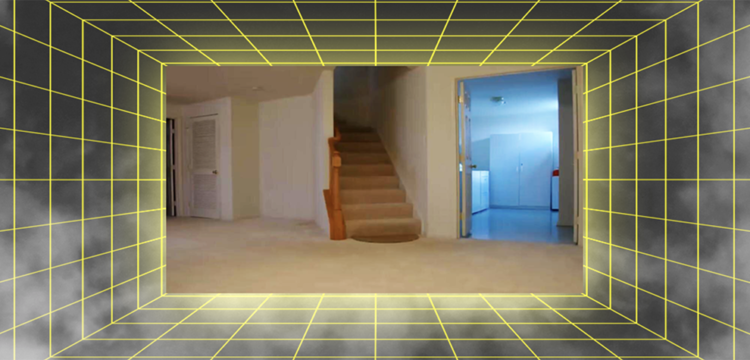
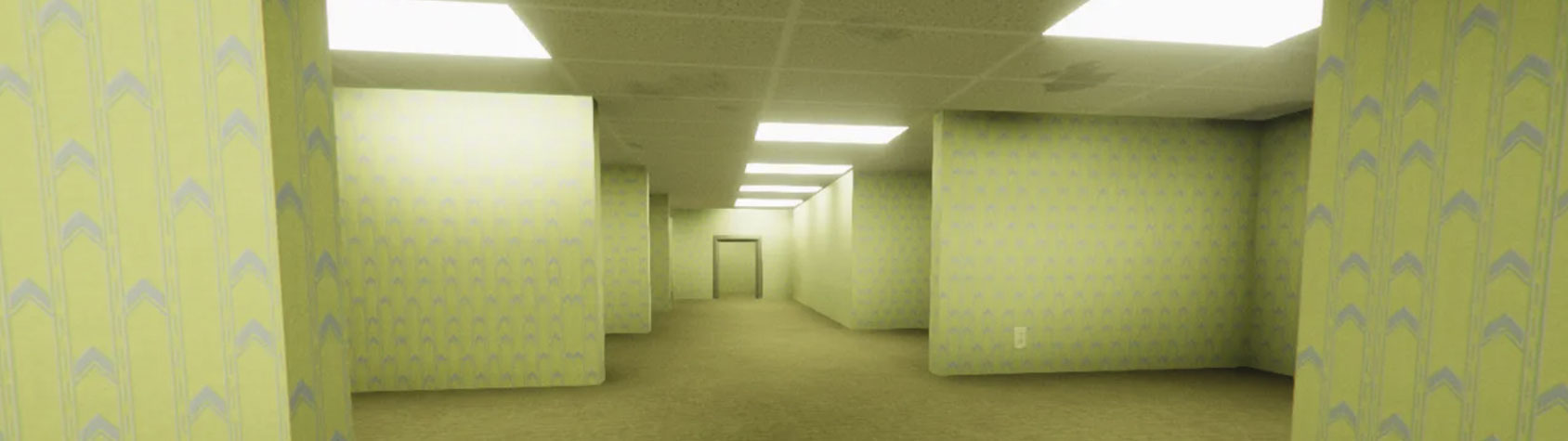
If you’re not careful and you noclip out of reality in the wrong areas you’ll end up in the Backrooms, where it’s nothing but the stink of old moist carpet, the madness of mono-yellow, the endless background noise of fluorescent lights at maximum hum-buzz, and approximately six hundred million square miles of randomly segmented empty rooms to be trapped in. God save you if you hear something wandering around nearby, because it sure as hell has heard you.
[ Anonymous, post on 4chan, 2019 ]
The Backrooms narrative thread is a direct descendent of the creepypasta genre, which is the horror-oriented current of the widespread practice known as copypasta, from copy-and-paste, referring to the action of copying and pasting blocks of text and spreading them virally on websites, forums, and social media platforms. The most famous creepypasta meme is undoubtedly The Slender Man, a story featuring an unnaturally tall, thin, faceless, humanoid figure: according to the encyclopedia of memes Know Your Meme, Slender Man can “stretch or shorten his arms at will and has tentacle-like appendages protruding from his back. Depending on the interpretations of the myth, the creature may cause memory loss, insomnia, paranoia, coughing fits (nicknamed ‘slendersickness’), photograph/video distortions and can teleport at will.”
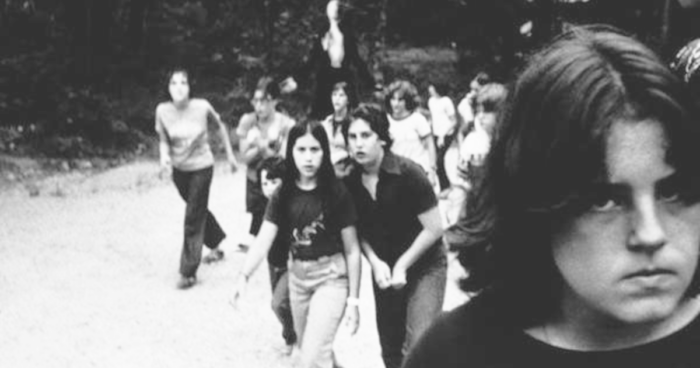
The Slender Man legend was born on a precise date: on 8 June 2009 a competition of “paranormal images” was launched by the forum Something Awful, a comedy site cited for its influence on the internet culture of the day, mostly devoted to cynical, black humor parodies on “the worst of the web.” According to Know Your Meme, “the contest required participants to turn ordinary photographs into creepy-looking images through digital manipulation and then pass them on as authentic photographs on a number of paranormal forums. Something Awful users soon began sharing their faux-paranormal creations with layered images of ghosts and other anomalies, usually accompanied by a fabricated witness account to make them more convincing.” On 10 June, the user Victor Surge (real name Eric Knudsen) published two black-and-white photographs depicting unnamed children, behind whom a mysterious, tall, faceless figure can be glimpsed. Accompanying the images are two short texts which mention photographers gone missing, “presumed dead,” and a quote that hints at a chilling truth behind the shots: “We didn’t want to go, we didn’t want to kill them, but its persistent silence and outstretched arms horrified and comforted us at the same time…”
It was just the beginning: in the space of a few days, the idea Victor Surge posted on 10 June was picked up and spun out by countless other forum users (by the end of the month, the thread ran to forty-six pages). The urban legend of the Slender Man, who preys on children, induces memory loss, and instigates appalling murders, proved so popular that it spawned an infinity of variations on the theme, especially when the story ended up on the /x/(paranormal) channel of 4chan and the Marble Hornets mockumentary was launched on YouTube, shot in found-footage style as per the well-known 1999 indie horror film The Blair Witch Project. Finally, in a textbook case of fiction becoming fact, in 2014 the Slender Man made it into the news, when two teenagers from Wisconsin stabbed a schoolfriend in an attempt to appease the fictional character.
The Slender Man has all the ingredients that make creepypasta a typical example of digital folklore: it is not just a horror story copied-and-pasted far and wide on the web, but an open, editable narrative that anyone can contribute to, creating a sort of ongoing wiki-horror that includes writings, stories, fan art, YouTube videos (and sometimes mainstream appropriations too: see the TV series Channel Zero). Other examples of the genre worth mentioning are Candle Cove, which centers on a fictional 1970s kids’ TV series, known for its disturbing effects and only remembered by a handful of living viewers; The Russian Sleep Experiment, a story set in the Soviet Union in the 1940s about a sleep deprivation experiment with disastrous consequences; and The Expressionless, featuring a woman with a disturbing, mannequin-like appearance.
These are the web’s “urban legends,” stories that pop up and spread spontaneously, flowing into the vast reservoir of contemporary folklore that the internet contains and helps spawn. According to the American lecturer Jan Harold Brunvand, who popularized the term in the 1980s in a series of essays titled The Vanishing Hitchhiker: American Urban Legends & Their Meanings (1981), urban legends are “those bizarre, funny, and sometimes horrible stories that are told as true but are really ‘too good to be true’.” In a later text dating to the early 2000s, Brunvand noted that folklore, understood as a corpus of apocryphal stories created and circulated anonymously, had not disappeared with the arrival of the new millennium, but rather had evolved and adapted to the new media: “All kinds of jokes, anecdotes, urban legends, parodies, fake memos, forms, questionnaires, rumors, pranks, hoaxes, bogus warning virus alerts, supposed free offers and product recalls, conspiracy theories, chain letters, games, rhymes, recipes, cartoons, greeting cards—truly a virtual Niagara of lore flowing over the electronic grapevine.” And so, from the earliest email chains, through chat rooms and forums, web folklore—especially the darker versions—found an ideal ecosystem on social networks, image boards, wikis, and finally on YouTube, which, from the late 2010s, became the definitive realm of creepypasta.
Imagine taking a photo of some old office building about to be renovated and it turns into a massive conspiracy on the internet.
[ Aussie Boi, YouTube comment, 2021 ]
The sinister Backrooms, a mysterious dimension that users risk getting sucked into at their own peril, burst onto the collective imagination in the late 2010s and early 2020s, and represent a continuation of the cultural strand that came into being in the previous decade with viral stories like the Slender Man. But the narrative around the Backrooms phenomenon presents a number of distinctive features. The idea of an infinite labyrinth of identical rooms, a place whose origin and exact location are unknown, is indeed a powerful symbolic image capable of evoking atavistic fears and contemporary nightmares, a potent cocktail of esotericism, horror, quantum physics, philosophy, and gaming. While most creepypasta stories are far-fetched but theoretically possible, and set in the world we know, albeit a world haunted by serial killers, monstrous creatures, and cursed objects, the Backrooms push harder at the envelope of reality. It is not a real or even realistic place; its existence is entirely hypothetical, and the original myth has no narrative elements or characters. It is a purely speculative entity. The best description of it was coined by the anonymous author of the podcast The Backrooms 101, who, in the introductory episode, called the Backrooms “a theoretical liminal hellscape.”
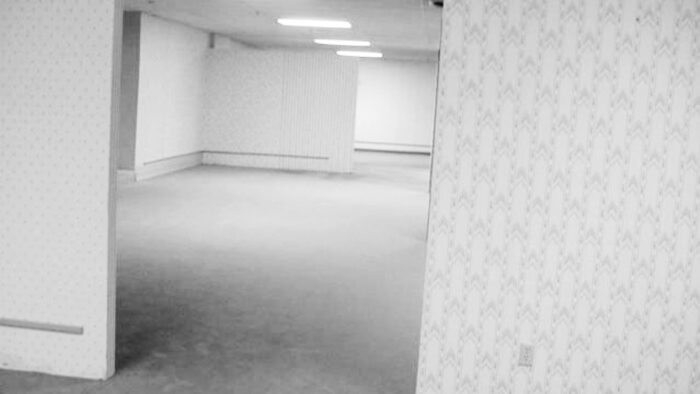
But where and when did this legend originate? On 14 May 2019 an anonymous 4chan user posted a blurred, grainy photo, probably taken in an abandoned office block, accompanied by a brief caption that began as follows: “If you’re not careful and you noclip out of reality in the wrong areas, you’ll end up in the Backrooms.” Noclipping is a term from videogaming: it is a mode that, when activated, allows the player to remove obstacles and move in any direction, even through walls, objects, and other players. As a result, the game engine produces anomalies, stretching, distorting, and multiplying images, an effect called the “Hall of Mirrors.” Sometimes, if you venture too far, you can even go beyond the boundaries of the virtual environment and find yourself suspended in a sort of electronic limbo. Out of the world, on the other side of the game.
It’s not something you have any control over: you end up in the Backrooms by mistake, as the side effect of a glitch. However, the original post suggests that it’s not entirely accidental: it happens, “if you’re not careful.” Though there is no further explanation of what we have to watch out for, it’s reasonable to imagine that it’s what happens when our grip on reality loosens; when we are dissociated, out of alignment, disconnected. An alternative theory posits that it is not our consciousness that gets disconnected, but the fabric of reality that contains holes, permeable areas that, if crossed, thrust us onto the other side. Or maybe, slipping abruptly from one dimension to another involves some kind of quantum leap, a change in subatomic vibrations.
The backrooms is just a hidden debug room for earth.
[ Александар Миловић, YouTube comment, 2021 ]
There is a vast amount of content dedicated to the Backrooms: websites, stories, games, a vast experiment in collective writing—the Backrooms Database wiki—and a seemingly endless number of videos on YouTube. One of these captured a great deal of attention in 2022, turning the spotlight on the phenomenon. It is a short film, only seven minutes long, titled The Backrooms (Found Footage), produced by a sixteen-year-old named Kane Parsons, aka Kane Pixels. The video, which falls squarely within the realm of the so-called “analog horror” genre—a subgenre of found footage that centers on the analog aesthetics of television, VHS tapes, and audio cassettes—amassed over 40 million views in just a few months. The plot: while shooting a film, a cameraman suddenly collapses, and when the camera comes back on, he is alone, in a yellowish maze, accompanied only by the unnerving buzz of neon lights. As his search for a way out gets increasingly frantic, the appearance of some kind of monster in the maze ramps things up a notch.
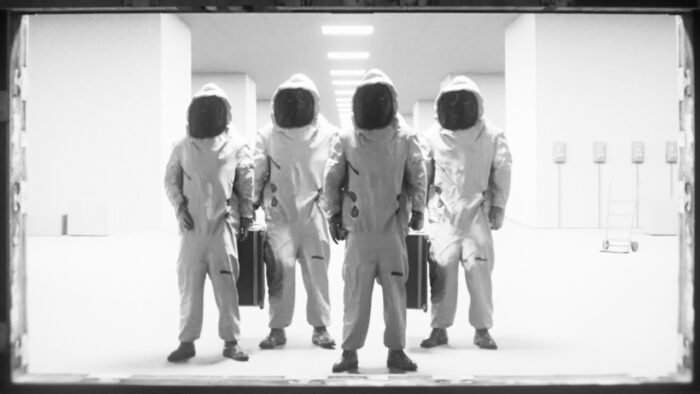
On Kane Pixels’ channel, there are other short films dedicated to the Backrooms, part of an ongoing series that sets out to construct their founding myth. What are the Backrooms? Were they created or discovered? And how do you get there? In one of the videos, we see a portal being opened by a mysterious organization called the ASYNC Foundation, whose mission is to find ways to access other dimensions with the aim of expanding—and selling—storage space and affordable living solutions. Other clips show various research teams, all wearing bulky protective suits, intent on exploring the Backrooms, and there is also the report of an autopsy conducted on a corpse found there, which has decomposed in an unnatural way.
While on one hand, it is impressive to see the breadth of ideas that writers, filmmakers, memers, and video game designers have developed from the original concept, on the other, this tends to water down the potency of the initial idea somewhat.
Many users, for example, have lamented the transformation of the Backrooms into a kind of first-person video game, with levels, new settings, monsters, and other threatening presences. “I think it ruined the point of endless labyrinth with infinite same rooms and where you die of hunger while going insane from the noise of lamps. Levels just turned it into crappy video game horror,” comments the user Long-Fan-9268 on Reddit. This is taken up by Puzzled-Economics497 on the same thread: “There’s too much info about each creature making them a lot less scary, the reason myths in real life like mothman are creepy is because they have little to no info about them, if you know how to avoid and kill an entity it’s really just a pest at that point […] the Backrooms has went from a creepypasta about the infinite yellow maze to thousands of liminal spaces some of which are not even creepy, with tons of creatures (one of the entity’s is literally just a duck).”
a mushrooming of narratives
No jumpscares. No monsters. Just an eerie, dreamlike sense of being lost in a completely desolate, sprawling brutalist hellscape. There’s something so unnerving about architecture that has the aesthetic of being -
man-made, while also realising that nothing about these buildings would be of any practical human use.
[ partlysmith, post on Tumblr, 2022 ]
The irresistible urge to participate, combined with an increasing passion for investigating and getting to the bottom of things that internet users appear to have developed in the last three decades has led to the production and consumption of more and more stories, contributing to something which in this context is known as lore. The lore of a video game, for example, consists in its entire story, present and, above all, past: all the events and characters that have shaped the world it is set in. Lore also characterizes the world of fantasy and sci-fi, with their intricate, endless sagas full of mysteries, subplots, and plot twists. The term is used for backstory, rumors, inside info, and in some cases it covers the behaviors, lingo, and experiences that accumulate in a specific community (fans of a specific game, users of a platform, followers of a streamer, etc.)
According to Tiger Dingsun and Libby Marrs, the authors of a series of essays entitled The Lore Zone, “lore is history, myth and knowledge on a smaller scale. It permeates laterally through a community, being regulated and disseminated by a centralized body as objective fact. Lore becomes an alternative to mainstream sources of information, be they journalistic, corporate, or governmental. It is in-group knowledge that becomes the backbone of subculture. The size of that subculture can be large in scale, but it is most mysterious/illicit/exciting when it comes from smaller, more exclusive groups, powering people’s motivation to form and identify with contained, tightly-knit communities […]. Even within the scope of a single livestream, lore connects people by creating personas, narratives, and lexicons that, once legible to you, let you ‘in’ on something—whether that be a joke, a secret or a world.”
Considering the increasingly fragmentary nature of our culture, and the collapse of context determined by the intrinsically disordered nature of the internet, the importance accorded to the idea of lore appears an entirely comprehensible reaction. It epitomizes the urge to put events in order, make sense of them, organize them into a coherent narrative and pin them down in writing, and channels the need to reconstruct context, establish correlations, identify whys and wherefores. At the same time, it is the most visible manifestation—though not the only one—of the massive influence of gaming culture.
This obsession with lore springs from the minds of millions of young people who have grown up inhabiting and constructing virtual worlds to play in, based on vast, intricate stories. It is the other face of gamification, the authentic, unexpected face, which consists in the everyday practice of storytelling as a game, the obsession with worldbuilding, and the manifestation of an exploratory mindset. This version of gamification feels very different from what has been touted as a smart approach to target the lack of motivation and engagement prevalent in late-stage capitalism. As Jane McGonigal put it in the title of her 2011 best-seller (which made its way onto the desks of CEOs all over the world) Reality is Broken, games can help distract us from that. But this is not about the trite transfer of video game dynamics like levels and points into out-of-game settings, from the corporate world to housework, but rather the profound internalization of the gamer mindset, considering gamers as producers and consumers of stories, characters, and mythologies.
There is another factor to take into account: in the last two decades the amount of content online has increased exponentially, and it is now much more difficult to navigate the teeming magma of sources, voices, and information. For at least two generations, the internet was a place to sharpen your critical faculties and learn to separate the wheat from the chaff, distinguishing between true and false, reality and make-believe, reliable and unreliable sources. According to the aforementioned collection of essays by Dingsun and Marrs, “perhaps that’s why we have now developed such a propensity for ‘lore’—it’s a model of knowledge that is able to interface with both reality and fiction.” The authors mention a case in point: the Reddit forum r/outside, where people ask for and offer advice on how to deal with various aspects of life, couched in the language of video games. In this context, real life is framed as a “free to play MMORPG with 7+ billion players.” By adopting gaming as a permanent metaphor, the whole forum turns into a participatory narrative project that constantly veers between the serious and the facetious, fact and fiction, life and art.
Another sign of the extent to which the structures and language of story are now embedded in everyday life is the popularity of the tag #maincharacter on social media platforms. Above all on TikTok and Instagram, millions of users are using it to assert their desire to take center stage in their own lives; not extras or supporting characters, but the stars of their own personal storyline. If life is a film, a TV series or a video game, the most desirable role is of course that of the main character, who drives the narrative, takes the decision, and gets most of the attention. Something similar could be said of the memes and videos that bear the tag #POV (Point Of View): in this case, a real or fictional situation is presented through the eyes of one of the participants, something often done using filmmaking or acting techniques.
In some ways it’s difficult to define where the border between dream and reality lies. I think this is ever more so in our modern world, where the external environment
in which we all live, what we used to call reality, is now a fantasy created by the mass media, by film, television, advertising, publicity, politics—which is really a branch of advertising these days. I’ve often said that we are living inside an enormous novel today, like characters inside a huge fiction. It’s very difficult to know what reality is. Is a field of grass growing beside a motorway more real than the big advertisement announcing the latest film of Arnold Schwarzenegger?
[ J. G. Ballard, 1992 ]
Internet users have the invasive habit of latching onto stories and turning them into mushrooming systems that spiral out haphazardly in all directions. This practice, which came into being in the world of fandom, has not only grown exponentially but also seems to have changed in nature. Alongside the fan fiction phenomenon, namely all the unauthorized derivative contents connected to a mainstream cultural product—a film, series, book, or video game—there is now a new kind of collective literature entirely uncoupled from the mainstream. In 1997, Henry Jenkins, an academic who studies participatory culture, prophetically had this to say about these trends, which at the time mainly regarded TV series and film franchises, analyzing them in the context of a broader historical perspective: “If you go back, the key stories we told ourselves were stories that were important to everyone and belonged to everyone […]. Fan fiction is a way of the culture repairing the damage done in a system where contemporary myths are owned by corporations instead of owned by the folk.”
The best-known example of online collaborative fiction is undoubtedly the SCP Foundation, a phenomenon that is often likened to the Backrooms. SCP, which stands for Secure, Contain, Protect, is a fictitious secret organization with unlimited decision-making powers, responsible for identifying, containing, and controlling any potentially dangerous “anomalies” that might crop up: paranormal phenomena, absurd objects, malevolent entities, and places with alien characteristics. “The Foundation operates to maintain normalcy, so that the worldwide civilian population can live and go on with their daily lives without fear, mistrust, or doubt in their personal beliefs, and to maintain human independence from extraterrestrial, extradimensional, and other extranormal influence,” the official site explains.
The anomalies in question vary greatly: some are simple and almost harmless, while others are so dangerous and complex that they represent a threat to humanity itself. There is the bottle of pills that can cure any disease, something that might sound like a force for good but must be kept under wraps to avoid the conflicts that the news of its existence would trigger; there is the Ikea store that looks completely normal but which, once inside, you can never leave; there’s a Polaroid camera that photographs your desires, and a giant reptile that is impossible to kill. But there are also more complex objects with whole plotlines of their own, such as the case classified as SCP-1733, or Season Opener: a VHS recording of the first NBA basketball game of the 2010–2011 season which, when repeatedly viewed, leads to the players gaining awareness of the fact that they are “recorded entities” and going berserk as a result.
All anomalies are stored and cataloged in files bearing the acronym SCP (which also stands for Special Containment Procedure) followed by a number; each phenomenon is also classified according to its danger level, based on how difficult the threat is to contain. There is little in the way of official lore regarding the Foundation, but it has a multitude of expansions: anyone can add a new SCP to the database, as long as they stick to the basic rules that define the narrative “canon.”
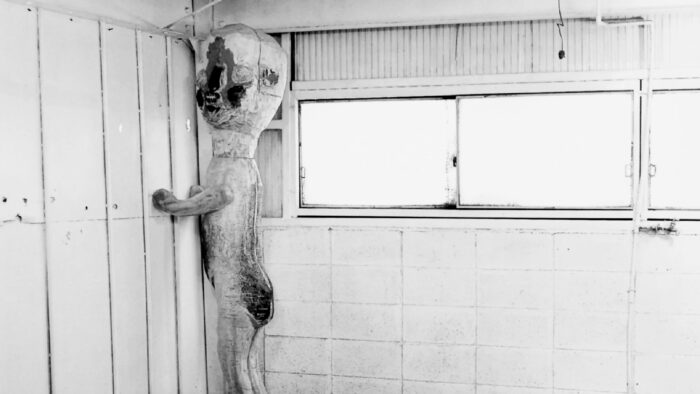
As often happens on the internet, the idea initially came about by chance, once again on 4chan, on the site’s infamous /x/paranormal bulletin board. In 2007, an anonymous user, later identified by the nickname Moto42, posted the first SCP file, SCP-173, together with an image of the sculpture Untitled 2004 by the Japanese artist Izumi Kato, which is a humanoid figure in wood with a painted face, shown leaning against a wall in a bare room that looks like an abandoned industrial space. According to the story invented by Moto42, this creature (which is purportedly made of concrete) can move around and attack humans, killing them by strangulation or breaking the neck bone. SCP-173 can only move when it is not being looked at, but it is very fast, so a split-second blink is enough for it to attack, and its victims stand no chance of surviving.
Like many other works of art reproduced on the internet, Izumi Kato’s sculpture underwent a process of decontextualization and resignification, becoming a key player in the SCP Foundation’s mythology, later reproduced in comic books, video games, and merchandise. Though not entirely happy about the situation, the artist initially consented to the non-commercial use of the image. Then in February 2022, the administrators of the official SCP project wiki announced that the image was going to be removed from the site, stating: “While we cannot fully undo the damage done, we have a moral and legal obligation to at least try separating SCP from Kato’s work.” At the same time, they invited fans to create a new image of the monster. The huge number of submissions they received illustrates the creative ferment of the community that has formed around this project.
To date, the SCP Foundation wiki boasts around 8,000 files, divided into eight separate series produced between 2007 and 2022, as well as several thousand extra entries and related materials. It has given rise to countless spin-offs, such as the video game Control, published by 505 Games in 2019, which is explicitly inspired by the world of SCP, and the horror novel by qntm, aka Sam Hughes, entitled There is No Antimemetic Division, which is entirely set in this narrative universe and centers on the anomaly SCP-3125, “a highly aggressive anomalous metastasized meme complex originating externally to our reality.”
on the threshold
The backrooms are shapeless beings of chaos, they take the form of our collective unconsciousness.
[ Anonymous, post on 4chan, 2019 ]
As well as being the birthplace of the SCP Foundation and contributing to the spread of the Slender Man, the 4chan board /x/paranormal is also where the photo of the Backrooms first appeared, captionless. Everything started on 12 May 2019 with a request to “post disquieting images that just feel ‘off’.” The response was a slew of material ranging from the mysterious to the disturbing to the absurd. Many were photos of empty buildings, poorly lit rooms, streets at night, and labyrinthine or claustrophobic interiors, all of which tie in perfectly with a key aesthetic known as liminal spaces. This much-loved genre first became popular around 2016 and includes numerous forerunners to the Backrooms meme.
According to the definition provided by Aesthetics Wiki, “the aesthetic known as a Liminal Space is a location which is a transition between two other locations, or states of being. Typically these are abandoned, and oftentimes empty—a mall at 4am or a school hallway during summer, for example. This makes it feel frozen and slightly unsettling, but also familiar to our minds.” A quick scroll through the subreddit r/LiminalSpace gives us a clear idea of the look: empty hallways, waiting rooms, stairs, and underpasses; but also playgrounds, swimming pools and parking lots. The atmosphere can vary between a vague sense of desolation, a powerful feeling of unease, or a general feeling of nostalgia, something which is to the fore in the images depicting classrooms, yards, empty restaurants, and houses with retro décor—all images capable of evoking distant, half-buried memories, flashbacks to childhood, or places seen in dreams. Something that reinforces the feeling that the images literally come from the past is their quality: they are almost always subpar, grainy, sometimes even distorted. The lighting has the harsh glare of automatic flash, the colors are cloudy and dull, the angles are always a bit off-center and crooked.
These spaces, which feel familiar because they evoke everyday places like childhood bedrooms, playgrounds, and school canteens, function as containers for memories; spaces that capture the essence of time, like an insect entombed in amber. As beings with physical bodies, we live our lives in spaces, and over time these spaces end up shaping our identity, becoming the pillars of the self-narrative we build on year by year. They are not just settings or inert backdrops; they are spaces infused with experience.
As Gaston Bachelard explained, memories are stronger when they are associated with specific places, undergoing a process of spatialization: “It is not possible to relive duration that has been destroyed. We can only think of it in the line of an abstract time that is deprived of all thickness. The finest specimens of fossilized duration concretized as a result of long sojourn are to be found in and through space. The unconscious abides. Memories are motionless, and the more securely they are fixed in space, the sounder they are.”
I feel like they are like corpses. They used to be filled with life, movement, and potential. Now they are just a dead body left behind as life moves on.
[ Jass Lang, YouTube comment, 2021 ]
The YouTube compilations devoted to the liminal genre have titles like “images with elegiac auras,” “places that feel strangely familiar,” “places you’ve been to in your dreams,” and “strangely familiar places with unnerving music.” This genre often intertwines with other web aesthetics—starting with vaporwave, with its dreamlike obsession with the past: the images might be heavily edited to make them more ethereal and minimal, or grainy and blurred, covered in writing and stickers. The most obvious common thread running through all of them, whatever the added extras, is the total absence of human beings.
According to the aforementioned Dictionary of Obscure Sorrows by John Koenig, the word to associate with liminal spaces is kenopsia. This is how he defines it: “The eerie, forlorn atmosphere of a place that’s usually bustling with people but is now abandoned and quiet—a school hallway in the evening, an unlit office on a weekend, vacant fairgrounds—an emotional afterimage that makes it seem not just empty but hyper-empty, with a total population in the negative, who are so conspicuously absent they glow like neon signs.” As Mark Fisher writes in The Weird and the Eerie, theunsettling feeling is produced by a “failure of presence”: normally crowded places that appear unnaturally empty. And the larger the spaces, the more imposing the architecture, the more complex the structures, the greater our discomfort when we come across them, even just visually. Liminal spaces are artificial deserts, upside-down monuments, machines of alienation. Their existence unconsciously triggers a series of questions: Where has everyone gone? What made them disappear? Is this what the world is going to look like when humanity is extinct?
Peak creepiness is reached when liminal spaces are generated by AI algorithms, like the images posted by the Twitter account ai_curio (now mx. curio). Lobbies, corridors, parking lots, and basements with distorted, alien-looking, curved lines and blurry colors: the world, but not as we know it. The sense of alienation is sometimes augmented by the “synthetic” look of the image; some buildings, when photographed in a certain light, look like renders. This applies to one of the most popular photographs in the liminal genre, which was taken in the interior garden of the Holiday Inn hotel in Terminal 4 of London’s Heathrow Airport. This imposing, minimal building has an inner courtyard overlooked by orderly rows of identical windows. Strangely, there is a ceiling covering the garden, an unusual feature which is designed to reduce the noise of the planes passing overhead. The photo, Taken and posted on March 15, 2019 by visual artist and game designer Dominik Johann (Twitter username @zerstoerer), inspired one of the levels of the game inspired by the Backrooms, entitled The Courtyard of Windows. Though there are videos on YouTube documenting it, many Backrooms fans are unaware that it is a real place, and play in it as if it were any old render.
How to make a liminal space:
1. Find a room. Make sure there is no windows in the room, people, or traces of people (like photos)
2. Put eerie lighting, like put a light bulb that’s barely working in a lamp or something.
3. (Optional) When you take the photo, have flash on for extra creepiness
4. (Optional) put something nostalgic in the room. Something that the majority had in there childhood. (Like crayons)
[ rotten, YouTube comment, 2021 ]
To date, however, no reliable information has come to light regarding the origin of the photo of the Backrooms, despite the efforts of thousands of internet sleuths who have scanned Google, Flickr, and thousands of websites in search of clues, analyzing every detail, including the shape of the electrical sockets, the pattern on the wallpaper, and the model of camera used. We don’t know where it was taken or who took it, although the most credible hypotheses link the image to an abandoned Sears department store located somewhere in North America.1 Deepening the mystery even further, and adding more new levels to its lore, some images attributable to the Backrooms have been put into Google Earth: at certain coordinates, you can view and explore spaces that bear a genuine resemblance to the yellow rooms immortalized in the original post.
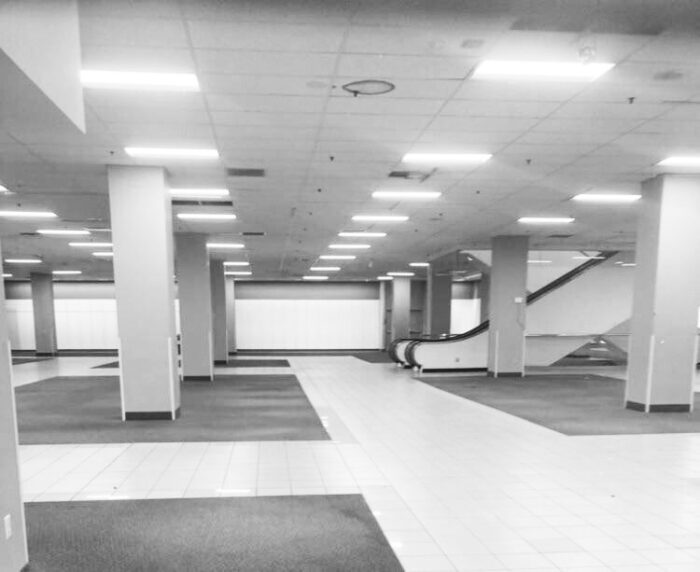
The fact that it is impossible to trace the image to a precise place and time, or identify the person who physically took the photo, lends the story a supernatural aura. The lack of information makes the photo a kind of living entity that seems to have magically materialized out of thin air and has its own special energy, exerting an intriguing, potentially perilous pull.
I have a theory that the idea of “backroom” exist solely because a generation subliminal misses the windows 95 screensaver.
[ Joshynogood, post on Reddit, 2022 ]
In a way, liminal spaces can be viewed as a subgenre of cursed images: disturbing photos of uncertain origin that seem to possess a kind of demonic power, as if infused with some kind of negative energy that can be transmitted simply by looking at them. Though in this case the focus is specifically on the idea of thresholds.
The concept of liminality (from the Latin limen) was first introduced in 1909 by the Belgian anthropologist Arnold Van Gennep in the context of research on rites of passage. It was then taken up in the 1960s by Victor Turner. It was originally used to describe a mental and/or social state rather than a physical one: the exact moment when we are about to become something else but are not there yet, like the limbo between adolescence and adulthood, school and work, one psychological state and another, waking and dreaming. Sometimes it can feel like we are inhabiting a liminal space for years: that sensation of not being able to reach a hypothetical “next stage” whose exact characteristics and location are, however, unknown. As Turner writes: “Liminal entities are neither here nor there. They are betwixt and between the positions assigned and arrayed by law, custom, convention, and ceremonial. As such, their ambiguous and indeterminate attributes are expressed by a rich variety of symbols in the many societies that ritualize social and cultural transitions. Thus, liminality is frequently likened to death, to being in the womb, to invisibility, to darkness, to bisexuality, to the wilderness, and to an eclipse of the sun or moon.”
Liminality can also be described as a feeling of being on hold: the experience of waiting for something that hasn’t happened yet, or something that might happen.
[1] The location where the original Backrooms photo was taken was discovered in late May 2024 by a group of internet sleuths who gathered in a Discord server named Virtual World. It was identified as the upper floor of a HobbyTown store in Oshkosh, Wisconsin, photographed in 2002 during the renovation of a former furniture store.