
Moving with Care
Exhaustion, Institutions, and Caring for One Another as Cats
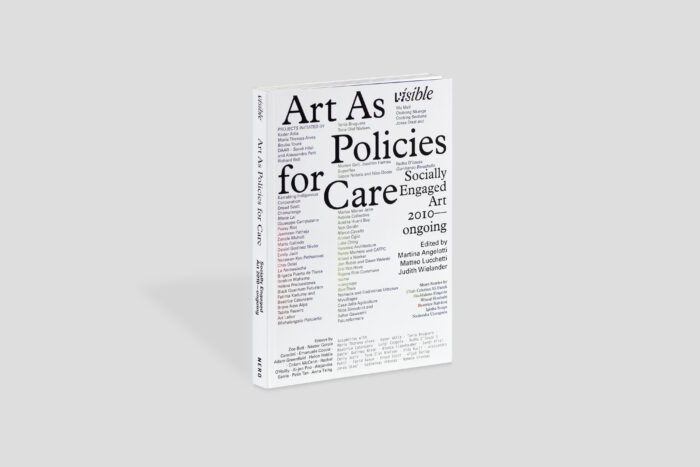
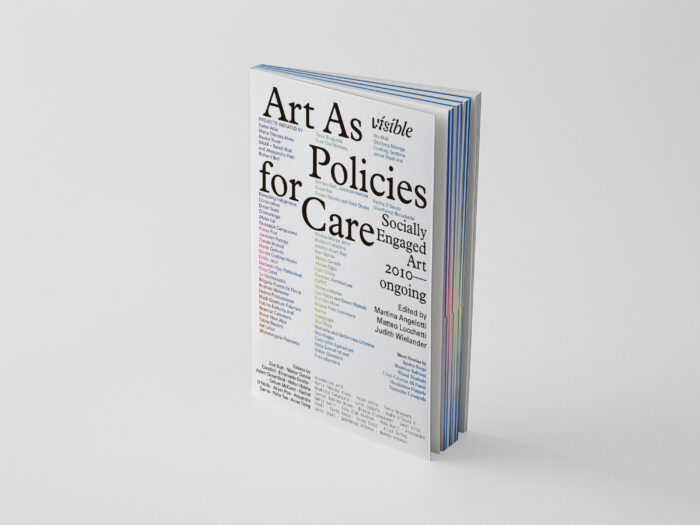
The book Visible: Art as Policies for Care. Socially Engaged Art (2010–Ongoing) was born from the editors’ enduring curatorial research into long-term situated art projects that exist within the social sphere, beyond the logic of the traditional art system, confronting unjust systems, and prefiguring novel visions for living together.
The socially engaged art projects collected here hold a significant place in the constantly evolving trans-local art scene of the past two decades, and form a lens through which to observe changing realities and their urgencies; they redefine the concept of art in light of current climatic, political, and social changes and foster the dematerialization of the artwork in processes that become policies of culture and care.
You can read the Spanish version of this essay below.
We have had forbidden conversation; we have had oral intercourse; we are bound in telling story upon story with nothing but the facts. We are training each other in acts of communication we barely understand. We are, constitutively, companion species. We make each other up, in the flesh. Significantly other to each other, in specific difference, we signify in the flesh a nasty developmental infection called love. This love is a historical aberration and a naturalcultural legacy.—Donna J. Haraway, The Companion Species Manifesto: Dogs, People, and Significant Otherness
I.
Can I speak about art and share something about myself without it seeming unprofessional?
I believe we have all experienced extreme exhaustion. It feels like an internal collapse where the body enters a lethargic mode, loses track of time, and can no longer distinguish one action from the next. It is a visceral dissociation that activates as a defense mechanism.
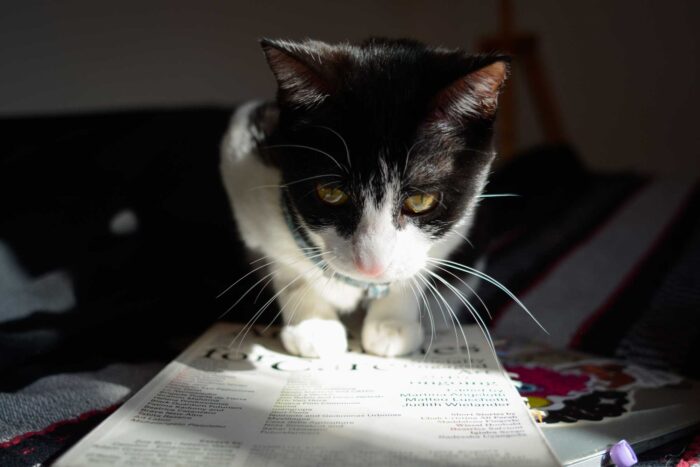
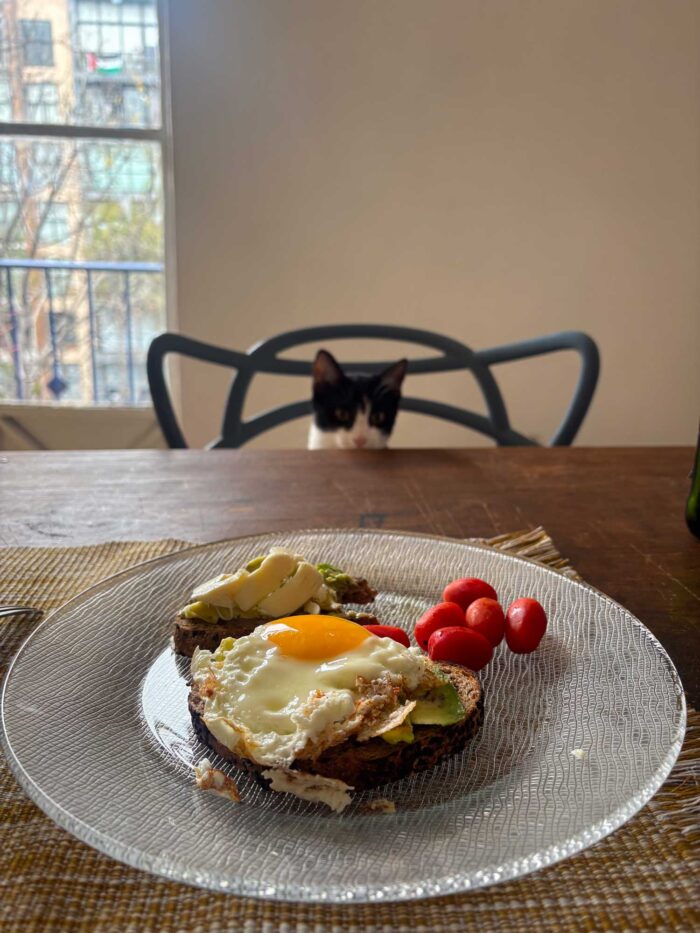
A few weeks ago, my body collapsed. In-person and online meetings without breaks, constant headaches, news, and videos accumulating on Instagram: the saturation I felt paralyzed me. I was too exhausted. I couldn’t keep moving. I self-exiled at home with my cat, Noga, who arrived recently in the midst of another crisis. Without being fully aware of it, she has become a minimal pedagogy against the mandate of effective performance.
Her presence reactivated a question I had read in Maria Puig de la Bellacasa’s Matters of Care, quoting Donna Haraway: “Why should our bodies end at the skin?” When Noga looks at me and streaks across the living room to sit on my chest, I recognize how my skin extends into hers. Haraway’s question ceases to be theoretical and becomes tactile. Her company liberates me, makes me more animal; she teaches me to communicate through a disjointed language that exceeds words and learned gestures. We care for each other, and this affection returns me, once more, to my body.
My relationship with Noga has been accompanied by reading Art as Policies for Care. Socially Engaged Art 2010-Ongoing, edited by Martina Angelotti, Matteo Lucchetti, and Judith Wielander—a book that has nourished my interests. [1] Between essays, interviews, assemblies, and literary narratives, alongside my new coexistence with Noga, I have encountered a vast network of artistic projects that foster political debate, community bonding, social participation, circular economy networks, and collective dialogue. These stand far apart from the vertical structures of art institutions. On the contrary, they promote plural models where care—not always mentioned, but always practiced—becomes the axis.
Thus, bodies and their subjectivities matter. The more than 43 projects gathered in the book transcend traditional institutional dependence. Ranging from concerns over heritage, “being-in-common,” transfeminisms, and alternative pedagogies to legal loopholes, the climate struggle, and radical agrarianism, these diverse initiatives show how the transformation of complex political scenarios happens collectively, outside State hegemony, through common organization.
My lethargic body wakes up to imagine the microworlds we constantly inhabit. Articulating a structure that encourages a non-linear reading, the book reveals a multiplicity of artistic actions on a planetary scale. The essays, interviews, assemblies, and literary narratives—imagination and “being-together”—enhance spaces of joy against the numbness produced by capital. This is already a radical act in itself.
And between the movement of emotions—my body waking from numbness and Noga’s leaps—I ask myself: why do we do what we do? What is its purpose?
Through somatic recovery, I am learning ways to relate to other beings. I know there is a difference between a feral animal and a domestic one; however, I like to think that companion species return us to a forgotten site of our animality, one that does not allow itself to be domesticated by productive performance. I recognize the specificities of each bond: I have a cat, my cat has a human. This differential relationship requires naming to open itself to forms of learning not limited to the human. From there, portals open to worlds in common, where relations are not governed by extraction but by interdependence. The animal-human dialogue leads us to the margins, where deciding to jump the fence means finding other paths of connection and resonating in a sense of common belonging.
In this more-than-human collaboration, the notion of work as a function of capital—which operates by turning us into body-machines living only to produce—begins to be dismantled. Attending to others—listening, observing, caring—is a practice of community transformation in times of crisis. When the body leaps, the heart beats more intensely, as if seeking a shared presence. Ongoing global genocides and the violence in the country I inhabit—cartel takeovers, gentrifying displacement, and the burning of forests for the real estate industry—break the heart over and over again.
Networks of interdependence, where amidst a system of death we bet on life in the plural and collective to accompany each other through grief, lead me to think about the power of connecting with other beings. I think of Daniel Godínez Nivón, a Mexican transmedia artist included in the book with his work Tequiografías (2010-ongoing), [2] who participated in an initial assembly where he spoke about his joint work with midwives and migrant women, the tequio, [3] and the act of dreaming. Dreams and their revelations; rest as a radical act of collective care connected to reality. A vital pedagogy that confronts the incessant production of thought, allowing us to listen, navigate, and face the current situation through dreams. [4] In this context, resting operates as a tool that counters the states of alert in our bodies that cannot close their eyes amid hyper-virtuality and control.
II.
Burnout produces fatigue and a bodily withdrawal that leads to isolation. Amidst the vortex of notifications—emails, DMs, and WhatsApp—there is a constant demand for presence (live broadcasting), while the internal sensation is that of a bottomless void. This image resonates with the figure the Vietnamese monk and activist Thich Nhat Hanh uses to diagnose contemporary societies: the hungry ghost. A being of insatiable hunger and thirst, condemned to perpetual desire because, in its desperate search for belonging, it has lost its roots.
I share this work-induced exhaustion with other friends: it is the symptom of a loss of meaning. What do we truly prioritize? This is how many institutions function—like hungry ghosts that never satiate their productivity. Every completed task generates another. There is no pause.
When we are immersed in productivity, bodily pain and mental health are eroded by a constant sense of threat to our communities. In May 2025, I had the opportunity to present the book Art as Policies for Care at the Museo Universitario del Chopo, alongside the chief curator, Miguel A. López, [5] Andrés González, from the Assembly of Indigenous Migrants of Mexico City (AMI), who presented Tequiografías; and the editors Judith Wielander and Matteo Lucchetti.
In that first reading of the book, one of the questions that arose from my position—as a curator and writer—was how, within an art system that perpetuates dynamics of doing-doing-doing, reduces affirmative actions to quota fulfillment, and precaritizes cultural work, we could generate strategies to hold each other. Holding each other, like a shared embrace, imagining “pathway connections” where, through care, we can create spaces of collective support, decentralized from any paternalistic vision. Some ideas to share:
- What care practices do we foster in our immediate communities?
- As cultural workers, we should question the institutional verticality of representation vs. performativity.
- Rethink the notion of the “center” in favor of collectivity; acts of networked care.
- Dream together, rest together, and talk about what we dream.
- “To seek intimacy with the land” and “to see ourselves as a speck amid the Great Whole, yet an essential, unique part of it,” as artist and healer Tabita Rezaire points out in her interview about Amakaba. [6]
- Recognize ourselves as vulnerable beings, dependent on other beings and entities beyond the human and its institutions.
- Promote assemblies and plural dialogues.
III.
I watch Noga before every jump. She concentrates. She traces my arm with her gaze. She moves her hips. She lifts one paw to grip, then the other. She balances on me as if I were a tree. With a calculated leap, she lets go, lands on her feet on the wooden floor, and runs toward the living room. Her daily company reminds me that another temporality exists, another rhythm, sometimes accompanied by a sonic vibration: purr. Noga’s touch, rubbing her body against mine, returns the vital impulse to me. I feel, once again, at home with myself.
I think about how little we usually communicate our emotions publicly. Speaking about mental health remains almost a taboo, as if we didn’t want to see the pains we endure on a planetary scale that impact our bodies directly. In this pause—that minimal space of care I managed to grant myself—I began to ask myself what care practices I sustain in my work and about the need to find an interspecies refuge. The time I spend with Noga expands my imagination to practice how to survive through cat-like movements.
It is important to pay attention to how this demand for constant visibility is modeled in the art world. The need to produce incessantly to avoid disappearing becomes a mandate for hyper-presence that, when we cannot sustain it, translates into anxiety. This is how the FOMO effect (Fear of Missing Out) takes hold. In museums, this logic manifests in the exhibition: understood as the goal and peak of visibility for both curatorial and artistic production, it operates as a form of meritocracy linked to the accumulation of symbolic capital. Who are we under the spotlight? [7] In its pursuit, the body and coexistence with others are relegated.
The institutions in which we work push bodies to the limit, promoting an idea of success built on exhaustion. They promote the illusion that, after enough sacrifice, the wear and tear will gain meaning. Although they appear solid, their structures are fragile and flawed. Questioning their legitimacy doesn’t necessarily mean stopping collaboration or refusing to produce within them, but rather recognizing that we are sensing bodies, with agency, limits, and reactions. What would it mean to reconcile institutional demand with the limits of our bodies and their finitude?
Perhaps it is in the friction of being together, away from virtuality and the spotlight, where we can collectively negotiate our feelings. Crossing the threshold of my friend Lucía’s house, her cats look at me. I have just interrupted their assembly on the bookshelves. They come down to recognize me and then return to their places, but now I am part of their dynamic. Cats’ meeting spaces operate from a verticality in motion: they go up, they go down, they change spots. A continuous choreography of bodies constantly calculating where to run and jump.
I align myself with the possibility that, even within an institution, we can look from the margins, like curious cats, and transform our relationship with it. Using them as tools, ensuring our practices are not co-opted, implies relocating their agency: occupying them critically and exploring how to open them to forms of collectivity.
Adopting “cat movements” in cultural work means resisting the logic of permanent wear: moving laterally, occupying interstices, dosing exposure, and prioritizing collective survival over individual visibility. From there, institutions stop operating as ends in themselves and can be activated as unstable spaces, capable of being traversed, reconfigured, and cared for.
IV.
Dismantling the institution as an omnipresent entity and instead understanding it through the interpersonal relationships that configure it can help us stop being “on guard” and reduce the constant stress we subject our bodies to. Within the framework of a capitalist structure that keeps us in a constant state of alert, resignifying and readapting infrastructures from imaginative perspectives—understanding them as political laboratories that activate a situated citizenship—has been a recurring strategy in artistic projects since the 1970s, aimed at generating social impact that overflows the art circuit.
This stance dialogues with the practice of Argentine curator Kekena Corvalán, who has elaborated on curating as a daily activity, a “love machine.” Her notion of “vital arts” [8] proposes a territorialized curatorship that shifts the scopic regime—centered on the observation of objects—toward a disposition to let oneself be affected by what crosses the communal and the territorial.
An example of doing/being in common is the work of artist and filmmaker Emily Jacir, who, in one of her contributions to the book, shares about her project Dar Yusuf Nasri Jacir for Art and Research. [9] The artist-run space created by her, in collaboration with many cultural agents in a family home in Palestine between Jerusalem and Hebron, near the Israeli military occupation, invites us—reclaiming memory against mass destruction—to work with mourning and the colonial wound as insistent material. Not to close off the pain, but to sustain it in common: making the Palestinian scar visible and remembering that art can also be a place where grief is named and shared without demanding immediate reparation. [10]
Institutions can be founded as spaces of citizenship, as artist Tania Bruguera proposes in the discussions of the second assembly. Still, they can also be woven as a home, as a realm of intimacy, as Jacir suggests. Buildings that already function as institutions can serve as meeting spaces to be “okupa-do” [11] by multiple voices, destabilizing the functional order of how things should be.
Thus, the spaces of citizenship proposed by Bruguera in the book and the affective and territorial curatorships proposed by Corvalán are not limited to guaranteeing representativeness in terms of numbers, but activate the political reaction of art through performativity, listening, and the forging of collective memory.
Amidst despondency and in friction with traditional institutional operational logics, alternative meeting spaces emerge. I think of Kader Attia’s La Colonie, which brought together a diversity of dissident groups with the intention of promoting anti-colonial debates and having a good time. [12] Or Bait al Karama in the West Bank, a project initiated by Fatima Kasumi, Beatrice Catanzaro, and Cristiana Bottigella, which allowed for the preservation of the region’s culinary legacy while promoting a circular economy for the women in the community. [13]
If we rethink the criteria and values that determine what is worthy or pertinent to be shown, we could imagine spaces not as closed containers but as refuges: places that do not reproduce exclusionary discourses but rather enable future possibilities through conversation about the needs of surrounding communities (human and non-human).
V.
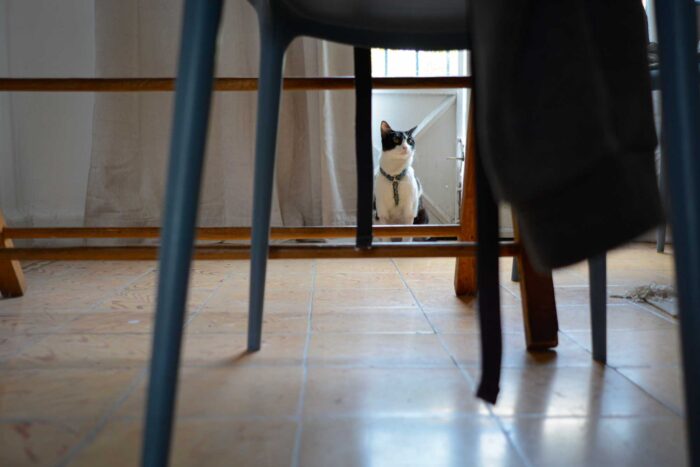
I remember Misho, my maternal grandfather’s cat, jumping toward the second-floor window of his small house. Before I even entered, he had already come down the stairs to greet me at the door. This itinerant movement of cats through space—and through areas that seem uninhabitable to a human—proves that other possible routes exist, other ways of inhabiting and questioning the uses we give to places. Their stealthy displacements contain a subtlety that sometimes borders on the invisible.
As Ursula K. Le Guin points out in entry 129 of her blog, one of the many she dedicated to her cat Pard, cats’ transitions are almost imperceptible: “All we know is that we say kitty, kitty, and there is no cat; we don’t say kitty, kitty, and there is one.” This game between presence and non-presence—distinct from absence—allows us to see the institution as a playful, rotating space that is important to break. In that invisible/visible game of cats, we can not only negotiate and seek its “thresholds,” but also contaminate it, bastardize it, and un-purify its solemnity. Leave hair everywhere.
VI.
In the section Assembly 2, Palestinian architect Sandi Hilal responds to the cross-dialogue on the role of institutions in the production, exhibition, and critical correspondence of art in times of crisis: “I agree that we have to be inside and outside of institutions, but each of us in some way is an institution unto themself. We have to move away from thinking that commoning and the collective can only come from institutions that are co-opting us.” [14]
Reading her response, something in me makes sense: we don’t just inhabit institutions; we also embody them. Recognizing ourselves as institutions within ourselves allows for the redistribution of agency, shifting it from the hierarchical building toward the relationships we forge day by day. With this idea, Hilal dismantles the assumption that our bodies are obligated to sustain institutions and gives us the cue to think that, as a collectivity of cultural workers, we exercise forms of autonomy that can overflow the museum infrastructure and art capital.
We can create more flexible dynamics where the community isn’t thought of only within the art circuit to which each of us belongs. Thus, we move toward relationships that go beyond networking to create solidarity networks in which we care about one another, even when no project is involved. How do we create a circular network in which we can hold ourselves against precarization and the fragility of physical and mental health?
A few years ago, I began collaborating on the curatorial platform Lava, alongside the Mexican curator and one of my loves, Adriana Flores. Over time—and although today we no longer work together as closely as at the beginning—we came to understand that our way of relating there was also crossed by logics of self-exploitation: the urgency to secure resources, the need to respond to everything, and the difficulty of slowing down. Seen now with distance, I recognize that in that space we didn’t just produce projects, but a continuous conversation that wove a friendship capable of sustaining us beyond work.
In retrospect, that network resembles the circular network I wonder how to build: an affective web that activates to decide to pause, to suggest rest, and to remind us that bonds matter more than disciplined compliance. What remained between us, besides permanent complicity, is a way of accompanying each other that tunes rhythms and limits, as if we had learned to move laterally and attentively—a bit like cats—so as not to push each other and to hold each other before the collapse. This practice has been inserted into our own ways of curating: going a little slower; no one is watching us.
Attending to “cat language,” as another form of sense-making beyond the human, allows us to review practices of solidarity that we already exercise with our companion species. If replicated on a human scale, these could configure bonds of care that exceed transactional economies. This language is not based on words, but on specific little gestures where the proximity of bodies allows us to face lethargy, anxiety, and self-demand. Presence opposes the demand for an immediate response. Care then appears as a continuous practice that activates our power of agency by being “institutions in ourselves,” as Hilal points out. For this, we need to redirect and distance ourselves from our own over-saturation and open our attention toward collective work.
For practicing being together, it is necessary to insist on “building not solidarities in terms of statement” but as situated practices. [15] I evoke this comment as a way to action, organization and the creation of spaces where the encounter enhances our imagination of the future. Not to capitalize on bodies, but to strengthen the web that connects us with other beings. These gestures are often subtle “because sometimes, invisibility is preferable.”
The overwhelming self-demand for our practices to be recognized constitutes one of the fundamental cores of burnout. At various moments, Adriana and I have had burnout and have supported each other through listening. No one is chasing us. Facing the excess of exposure, another possibility opens: understanding how, through cooperation and negotiation, we can weave a network of mutual support. The notion of sustaining one another then becomes a practice rather than a slogan: a way of remaining in relationship without replicating the exaggerated idea of sacrifice that sustains meritocratic capital.
This notion interests me because, in the gesture of accompanying, a shared force is activated between bodies. In the free fall produced by fatigue and despondency, remaining together becomes one of the few possible forms of survival. Accompanying implies recognizing the existence of others and knowing ourselves to be part of an embrace in which the impact on one has consequences for coexistence with the others.
VII.
I turn to recognize my hands. They have become claws. I recognize that in constant touch with others, my hair stands on end. My hearing sharpens, and I begin to meow. Someone answers me from afar. It is another cat who, unlike me, is brown with continuous stripes. Soon, multitudes of cats appear everywhere. I stop on the ledge of a massive gray building that, from below, looks like a mountain. I wait to enter my new habitat.
Another gray cat arrives; her name is Sandu. [16] We talk a little and enter, determined to occupy the space once and for all. Inside, we see mountains everywhere. We try to run toward them, but, scratching them with our claws, we realize there is nothing behind them: only a wall.
There are piles of papers that we climb up and down, throwing them to watch them fly. After sniffing and arranging the place, we decide it will be our refuge. We don’t know what anything it contains is, or what it’s for. We simply try to survive; we play and look for food. After running up and down, we end up tired. It is time for a collective nap. We don’t know what awaits us after 18 hours of sleep. It doesn’t matter. There is silence, and, at last, we can huddle together to give warmth and sustain each other if nightmares appear.
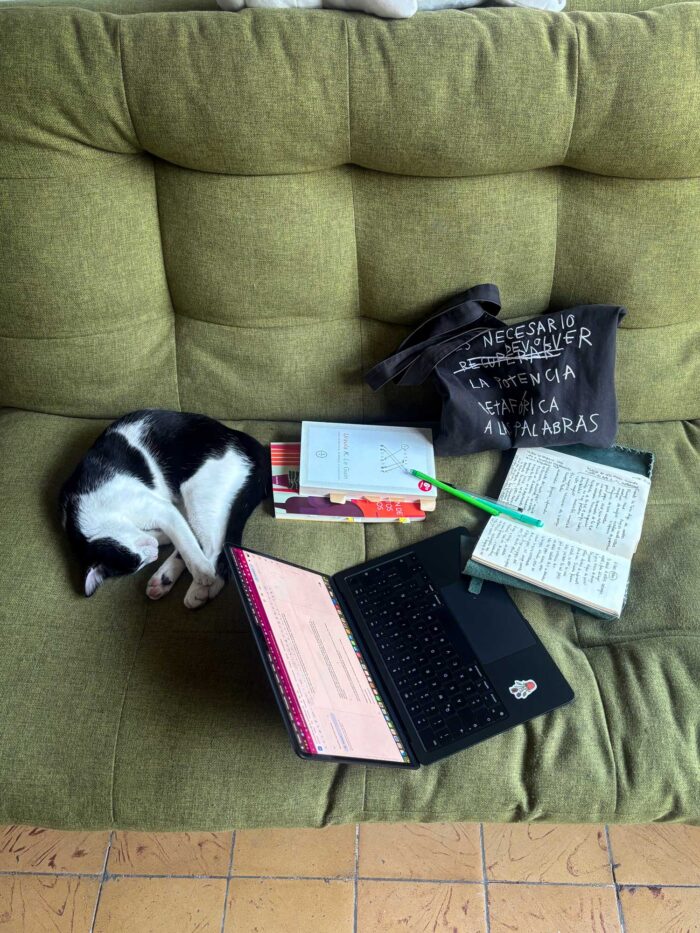
Lying among cats, half-asleep, half-awake, I feel that those shared dreams are a small strategy to keep going, to keep curiosity for others alive, even when fatigue covers everything. It is no longer the search for “doing more,” even if the world insists we always be available, but of being and accompanying each other. Evoking my cat connection and what I learn from her language reveals to me the strategy of resisting capital: to sleep, to dream, and to imagine—between scratches and tumbles—what other universes of meaning we can create.
These “cat reflections” stem from an interest in expanding the reading that Art as Policies for Care has left on me. Between each gesture learned from other humans and more-than-humans, there lies the power to rekindle the reciprocity that unites us. This text is an invitation, also, to approach the book and think of your own unexpected connections.
[1] I think about how a book can travel with you through time and space, about those moments that re‑signify your own practices and are world‑changing. Art as Policies for Care. Socially Engaged Art 2010—ongoing has been with me for almost a year now and has changed my curatorial approach to care, a concept I have mostly been working through in my writing, but bringing it into the everyday dynamics of my job is still a kind of challenge. The compendium that Matteo and Judith have put together does not just show art, but art as a tool for change.
[2] Tequiografías is a collaborative project where Daniel Godínez Nivón and the Asamblea de Migrantes Indígenas in Mexico City rewrite Mexican school “monografías”, using tequio to produce educational booklets from their own perspectives instead of state stereotypes.
[3] “Tequio” is a communal, unpaid work practice in Indigenous communities in Mexico, where people collectively contribute labor or resources for the benefit of the community.
[4] About Daniel Godínez Nivón comment in Assembly 1, p. 91.
[5] Acknowledgements to Miguel A. López for the invitation to this presentation and also for his accompaniment and careful reading throughout this process.
[6] About Amakaba by Tabita Rezaire, p. 115.
[7] In the story “All Expenses Paid” by Maddalena Fingerle, the protagonist is curious about her sister’s life. She snoops on her computer and discovers an invitation to participate in an exhibition. Angry at the way artistic work is precarized, she replies that, for her to attend the event, they must cover all expenses. When she receives an affirmative answer, she decides to pretend to be her sister, going to the opening and stepping into the spotlight. This story made me wonder how we end up accepting unworthy conditions just to be seen and how, through this constant practice, we keep working in art because we love what we do, without questioning how institutions fail to consider what it means to care for our bodies and mental health, pp. 287-292.
[8] Corvalán, Kekena, “Curaduría afectiva: La curaduría como potencia del deseo” en Lo curatorial desde el sur. Instituto Distrital de las Artes-Idartes Marzo de 2023. Bogotá, Colombia, pp. 124-126.
[9] About Dar Yusuf Nasri Jacir for Art and Research by Emily Jacir, pp. 75-76.
[10] Emily Jacir has created other spaces of resistance beyond art institutions because over decades, these structures routinely censor, depoliticize, or instrumentalize Palestinian voices instead of supporting them. Jacir criticizes institutions for upholding a fantasy of neutrality and “two equal sides”, which obscures colonial violence and leaves no room for the collective mourning, listening, and co‑resistance that ground her practice.
[11] he Spanish word okupa—a deliberate misspelling of ocupa (“occupy”) using a rare k—names a squatter movement that frames occupation as a radical, collective political practice.
[12] About La Colonie by Kader Attia, pp. 30-32.
[13] About Bait Al Kamara by Fatima Kasumi and Beatrice Catanzaro, pp. 108-109.
[14] Extract from Sandi Hilal’s comment in Assembly 2, p. 167.
[15] Extract from Farid Rakun’s comment in Assembly 1, p. 91.
[16] Sandu is the cat of Chilean artist Valentina Guerrero and Colombian curator David Ayala‑Alfonso, my friends with whom I share a love for cats and a recognition of how they have changed our mental health.
[Spanish version]
Hemos tenido conversaciones prohibidas; hemos tenido relaciones orales; estamos unidas al contar relatos tras relatos sin nada más que los hechos. Nos estamos entrenando mutuamente en actos de comunicación que apenas entendemos. Somos, constitutivamente, especies de compañía. Nos constituimos la una a la otra, en carne y hueso. Significativamente distintas la una de la otra, con diferencias específicas, representamos en carne y hueso una repugnante infección evolutiva llamada amor. Este amor es una aberración histórica y una herencia naturocultural.
—Manifiesto de las especies de compañía, Donna Haraway
I.
¿Puedo hablar de arte y contar algo sobre mí sin que parezca poco profesional?
Creo que todxs hemos experimentado agotamiento extremo. Se siente como un colapso interno en el que el cuerpo entra en modo letárgico, pierde noción del tiempo y ya no distingue una acción de la siguiente. Es una disociación visceral que se activa como mecanismo de defensa.
Hace unas semanas, mi cuerpo colapsó. Reuniones presenciales y en línea sin pausas, dolores de cabeza constantes, noticias y videos que se acumulaban en Instagram: la saturación que sentí me paralizó. Estaba demasiado exhausta. No podía seguir moviéndome. Me autoexilié en casa junto a mi gata Noga, quien llegó hace poco, en medio de otra crisis. Sin ser del todo consciente, se ha convertido en una pedagogía mínima contra el mandato del rendimiento efectivo.
Su presencia reactivó una pregunta que había leído en Matters of Care de María Puig de la Bellacasa, citando a Donna Haraway: “Why should our bodies end at the skin?” Cuando Noga me mira y atraviesa la sala a toda velocidad para sentarse sobre mi pecho, reconozco cómo mi piel se extiende hacia la suya. La pregunta de Haraway deja de ser teórica para volverse táctil. Su compañía me libera, me vuelve más animal; me enseña a comunicarme desde un lenguaje desarticulado que rebasa las palabras y los gestos ya aprendidos. Nos cuidamos mutuamente y esta afección me devuelve, una vez más, a mi cuerpo.
Mi relación con Noga ha estado acompañada por la lectura de Art as Policies for Care. Socially Engaged Art 2010-Ongoing, editado por Martina Angelotti, Matteo Lucchetti y Judith Wielander, un libro que ha nutrido mis intereses. [1] Entre ensayos, entrevistas, asambleas y narraciones literarias, a la par de mi nueva convivencia con Noga, me he encontrado con una amplia red de proyectos artísticos que procuran el debate político, la vinculación comunitaria, la participación social, las redes de economía circular y el diálogo conjunto, que distan de las estructuras verticales de las instituciones artísticas. Al contrario, promueven modelos plurales donde el cuidado – no siempre mencionado pero sí practicado – se convierte en el eje.
Así, los cuerpos y sus subjetividades importan. Los más de 27 proyectos reunidos en el libro trascienden la tradicional dependencia en las instituciones. Desde la preocupación por el patrimonio, el estar en común, los transfeminismos y pedagogías alternas, las lagunas legales, la lucha climática y el agrarismo radical, estas distintas iniciativas muestran cómo la transformación de los escenarios políticos complejos sucede en colectivo, fuera de las hegemonía del Estado, en la organización común.
Mi cuerpo aletargado se despierta para imaginar los micromundos que habitamos constantemente. Articulando una estructura que propicia una lectura no lineal, el libro revela una multiplicidad de acciones artísticas a escala planetaria. Los ensayos y entrevistas, las asambleas y narraciones literarias, la imaginación y el estar juntxs potencian los espacios de alegría frente al adormecimiento que produce el capital. Esto ya es un acto radical en sí mismo.
Y entre el movimiento de las emociones – el despertar de mi cuerpo del entumecimiento y los saltos de Noga–, me pregunto: ¿por qué hacemos lo que hacemos?, ¿cuál es su propósito?
Desde la recuperación somática aprendo maneras de vincularme con otrxs seres. Sé que hay una diferencia entre un animal feral y unx doméstico; sin embargo, me gusta pensar que las especies de compañía nos regresan a un sitio olvidado de nuestra animalidad, uno que no se deja domesticar por el rendimiento productivo. Reconozco las especificidades de cada vínculo: yo tengo una gata; mi gata tiene un humano. Esta relación diferencial requiere ser nombrada para abrirse a formas de aprendizaje que no se limitan a lo humano. Desde ahí se abren portales a mundos en común, donde las relaciones no se rigen por la extracción, sino desde la interdependencia. El diálogo animal-humano nos lleva a los márgenes, donde decidir saltar la barda es encontrar otros caminos de conexión y resonar en un sentido de pertenencia común.
En esta colaboración más allá de lo humano, la noción del trabajo en función del capital – que opera convirtiéndonos en un cuerpo-máquina que vive solo para producir – comienza a desmantelarse. Atender a lxs otrxs – escuchar, observar, cuidar – es una práctica de transformación comunitaria en tiempos de crisis. Cuando el cuerpo salta, el corazón palpita con mayor intensidad, como si buscara una presencia compartida. Los genocidios en curso a nivel global y la violencia en el país que habito – la toma de los cárteles, el desplazamiento gentrificador y la quema de bosques en pro de la industria inmobiliaria – quiebran el corazón una y otra vez.Las redes de interdependencia, donde en medio de un sistema de muerte apostamos por la vida en plural y colectiva para acompañarnos frente al duelo, me llevan a pensar en la potencia de conectarnos con otros seres. Pienso en Daniel Godínez Nivón, artista transmedia mexicano, incluido en el libro con su obra Tequiografías (2010-ongoing), [2] quien participó en una primera asamblea, donde conversó sobre su trabajo conjunto con mujeres parteras y migrantes, el tequio [3] y el acto de soñar. El sueño y sus revelaciones, el descanso como un acto radical de cuidado colectivo conectado con la realidad. Una pedagogía vital que hace frente a la producción de pensamiento incesante, para escuchar, navegar y hacer frente entre sueños a la situación actual. El descanso, aquí, opera como una herramienta que rebate los estados de alerta de nuestros cuerpos que no pegan los ojos en la hipervirtualidad y el control.
II.
El burnout produce fatiga y un repliegue corporal que conduce al aislamiento. En medio de la vorágine de notificaciones —correos, DM y WhatsApp— existe una demanda constante de presencia (live broadcasting), mientras que la sensación interna es la de un vacío sin fondo. Esta imagen resuena con la figura que el monje y activista vietnamita Thich Nhat Hanh retoma en el libro para diagnosticar las sociedades contemporáneas: el hungry ghost. Un ser de hambre y sed insaciables, condenado al deseo perpetuo porque, en su búsqueda desesperada de pertenencia, ha perdido sus raíces.
El cansancio a causa del trabajo lo comparto con otres amigxs: es el síntoma de una pérdida de sentido. ¿A qué realmente le damos prioridad? Así funcionamos en muchas instituciones, como fantasmas hambrientos que nunca sacian su productividad. Cada tarea concluida genera otra. No hay pausa.
Cuando estamos inmersos en la productividad, los dolores del cuerpo y la salud mental se ven mermados por la sensación constante de amenaza hacia nuestras comunidades. En mayo de 2025, tuve la oportunidad de presentar el libro Art as Policies for Care en el Museo Universitario del Chopo, junto al curador en jefe del recinto, Miguel A. López; [4] Andrés González, de la Asamblea de Migrantes Indígenas de la Ciudad de México (AMI), quien presentó Tequiografías, y lxs editores Judith y Matteo.
En esa primera lectura del libro, una de las preguntas que surgió desde mi espacio de enunciación –como curadora y escritora– fue cómo, al interior de un sistema del arte que perpetúa dinámicas de hacer, hacer, hacer, que reduce las acciones afirmativas al cumplimiento de cuotas y precariza el trabajo cultural, podríamos generar estrategias para sostenernos mutuamente. Sostenernos, como un abrazo compartido, imaginando pathway connections donde, desde el cuidado, podamos crear espacios de sostén colectivo, descentralizados de toda visión paternalista. Algunas ideas para compartir:
- ¿Qué prácticas de cuidado propiciamos en nuestras comunidades inmediatas?
- Como trabajadores culturales, habría que cuestionar la verticalidad institucional de la representación vs la performatividad.
- Repensar la noción de centro en pro de lo colectivo, actos de cuidado en red.
- Soñar juntxs, descansar juntxs y conversar de lo que soñamos.
- “To seek intimacy with the land” y “to see ourselves as speck amid the Great Whole, yet an essential unique part of it”, como señala la artista y sanadora Tabita Rezaire en su entrevista sobre Amakaba.
- Sabernos seres vulnerables, dependientes de otrxs seres y entidades más allá de lo humano y de sus instituciones.
- Promover asambleas y diálogos plurales.
III.
Observo a Noga antes de cada salto. Se concentra. Recorre mi brazo con la mirada. Mueve la cadera. Alza una pata para agarrarse y luego la otra. Se balancea sobre mí como si fuera un árbol. Con un brinco calculado se suelta, cae de pie sobre la duela y corre hacia la sala. Su compañía cotidiana me recuerda que existe otra temporalidad, otro ritmo, a veces acompañado por una vibración sonora: purr. La caricia de Noga al restregar su cuerpo con el mío me devuelve el impulso vital. Me siento, otra vez, en casa conmigo.
Pienso en lo poco que solemos comunicar nuestras emociones de forma pública. Hablar de salud mental sigue siendo casi un tabú, como si no quisiéramos ver los dolores que atravesamos a escala planetaria e impactan directamente en nuestros cuerpos. En esta pausa —ese espacio mínimo de cuidado que logré otorgarme— empecé a preguntarme qué prácticas de cuidado sostengo en mi trabajo y sobre la necesidad de encontrar un refugio interespecie. El tiempo que paso con Noga expande mi imaginación para practicar cómo sobrevivir mediante movimientos gatunos.
Resulta importante prestar atención a cómo se modela esta demanda de visibilidad constante en el mundo del arte. La necesidad de producir sin cesar para no desaparecer se convierte en un mandato de hiperpresencia que, cuando no podemos sostenerlo, se traduce en ansiedad. Así se instala el efecto FOMO (Fear of Missing Out). En los museos, esta lógica se manifiesta en la exposición: entendida como meta y punto máximo de visibilidad, tanto para la producción curatorial como para la artística, esta opera como una forma de meritocracia ligada a la acumulación de capital simbólico. ¿Quiénes somos bajo el spotlight? [5] En su persecución, el cuerpo y la convivencia con otres quedan relegados.
Las instituciones en las que trabajamos llevan los cuerpos al límite, promoviendo una idea de éxito cimentada en la extenuación. Estas promueven la ilusión de que, tras suficientes sacrificios, el desgaste adquirirá sentido. Aunque aparentan solidez, sus estructuras son frágiles y fallidas. Cuestionar su legitimidad no implica necesariamente dejar de colaborar ni rehusarnos a producir dentro de ellas, sino reconocer que somos cuerpos sintientes, con agencia, límites y reacciones. ¿Qué significaría conciliar la demanda institucional con los límites de nuestros cuerpos y su finitud?
Quizá es en el roce del estar juntxs, lejos de la virtualidad y de los reflectores, donde podemos negociar colectivamente nuestros sentires. Al atravesar la puerta de la casa de mi amiga Lucía, sus gatos me miran. Acabo de interrumpir su asamblea sobre los estantes del librero. Bajan a reconocerme y luego regresan a su lugar, pero ahora formo parte de su dinámica. Los espacios de reunión de lxs gatos operan desde una verticalidad en movimiento: suben, bajan, cambian de sitio. Una coreografía continua de cuerpos calculando todo el tiempo hacia dónde correr y saltar.
Me alineo con la posibilidad de que, incluso dentro de una institución, podamos mirar desde los márgenes, como gatos curiosos, y transformar nuestra relación con ella. Usarlas como herramientas, cuidando que nuestras prácticas no sean cooptadas, implica reubicar su agencia: ocuparlas críticamente y explorar cómo abrirlas a formas de colectividad.
Adoptar movimientos gatunos en el trabajo cultural supone resistir la lógica del desgaste permanente: moverse de manera lateral, ocupar intersticios, dosificar la exposición y priorizar la supervivencia colectiva por sobre la visibilidad individual. Desde ahí, las instituciones dejan de operar como fines en sí mismas y pueden activarse como espacios inestables, susceptibles de ser atravesados, reconfigurados y cuidados.
IV.
Desmantelar la institución como entidad omnipresente y, en cambio, entenderla desde las relaciones interpersonales que la configuran, puede ayudarnos a dejar de estar en guardia sin propiciar y reducir los niveles de estrés constantes a los que sometemos al cuerpo. En el marco de una estructura capitalista que nos mantiene en alerta constante, resignificar y readaptar infraestructuras desde perspectivas imaginativas – entendiéndolas como laboratorios políticos que activen una ciudadanía situada – ha sido una estrategia recurrente en proyectos artísticos desde los años setenta, orientados a generar impacto social que desborde el circuito del arte
Esta postura dialoga con la práctica de la curadora argentina Kekena Corvalán, quien ha elaborado sobre la curaduría como una actividad cotidiana, una máquina de amor. [6] Su noción de “artes vitales” propone una curaduría territorializada que desplaza el régimen escópico – centrado en la observación de objetos – hacia una disposición a dejarse afectar por aquello que atraviesa lo comunitario y lo territorial.
Un ejemplo del hacer/estar en común es el trabajo de la artista y cineasta Emily Jacir, quien en una breve entrevista comparte sobre su proyecto Dar Yusuf Nasri Jacir for Art and Research. El artist-run space creado por ella, en colaboración con muchxs agentes culturales, en una casa familiar en Palestina entre Jerusalén y Hebrón, cerca de la ocupación militar israelí, invita, reclamando la memoria frente a la destrucción masiva, a trabajar el duelo y la herida colonial como material insistente. No para clausurar el dolor, sino para sostenerlo en común: hacer visible la cicatriz palestina sin prometer reparación, recordando que el arte puede ser también un lugar donde el daño se nombra y se comparte sin exigirle redención inmediata. [7]
Las instituciones pueden cimentarse como espacios de ciudadanía, como las plantea la artista Tania Bruguera en las discusiones de la segunda asamblea, pero también pueden ser entramados como casa, como ámbito de intimidad, como plantea Jacir. Las edificaciones que ya fungen como instituciones pueden ser espacios de encuentro a “okuparse” por múltiples voces y desestabilizar la operación funcional del deber ser.
Así, los espacios de ciudadanía propuestos por Bruguera en el libro y las curadurías afectivas y territoriales que propone Corvalán no se limitan a garantizar la representatividad en torno a temas de números, sino que activan la reacción política del arte a través de la performatividad, la escucha y el forjar la memoria colectiva.
En medio del desasosiego, y en fricción con las lógicas tradicionales de operación institucionales, surgen espacios de encuentro alternativos. Pienso en La Colonie de Kader Attia, que reunió a una diversidad de grupos disidentes con la intención de promover debates anticoloniales y pasar un buen momento. O en Bait al Karama en el West Bank, proyecto gestado por Fatima Kasumi, Beatrice Catanzaro y Cristiana Bottigella, que permitía, por un lado, preservar el legado culinario de la región, a la vez que promovía una economía circular para las mujeres de la comunidad.
Si se replantean los criterios y valores que determinan qué es digno o pertinente de ser mostrado, podríamos imaginar espacios no como contenedores cerrados, sino como refugios: lugares que no reproduzcan discursos excluyentes, sino que habiliten posibilidades de futuro a través de la conversación sobre las necesidades de las comunidades (humanas y no humanas) circundantes.
V.
Recuerdo a Misho, el gato de mi abuelo materno, saltar hacia la ventana del segundo piso de su pequeña casa. Antes de que yo entrara, ya había bajado las escaleras para recibirme en la puerta. Ese movimiento itinerante de lxs gatxs por el espacio —y por zonas que para un humano parecen inhabitables— evidencia que existen otros recorridos posibles, otras maneras de habitar y de cuestionar los usos que damos a los lugares. Sus desplazamientos, sigilosos, contienen una sutileza que a veces roza lo invisible.
Como señala Ursula K. Le Guin en la entrada 129 de su blog, una de las tantas que le dedicó a su gato Pard, las transiciones de los gatos son casi imperceptibles: “Lo único que sabemos es que llamamos gatito, gatito, y no hay gato; no llamamos gatito, gatito, y sí lo hay”. Este juego entre la presencia y la no presencia – distinto de la ausencia – permite ver la institución como un espacio lúdico, rotativo e importante de quebrar. En ese juego invisible/visible de lxs gatxs, no solo podemos negociar y buscar sus “umbrales”, sino contaminarla, bastardearla y despurificar su solemnidad. Dejar pelo por todos lados.
VI.
En la asamblea 2 del libro, la arquitecta palestina Sandi Hilal responde al diálogo cruzado sobre el papel de las instituciones en la producción, exposición y correspondencia crítica del arte, en tiempos de crisis: “I agree that we have to be inside and outside of institutions, but each of us in some way is an institution unto himself or herself. We have to move away from thinking that commoning and the collective can only come from institutions that are co-opting us”.
Al leer su respuesta, algo en mí cobra sentido: no solo habitamos las instituciones, sino que también las encarnamos. Reconocernos como instituciones en unx mismx permite redistribuir la agencia, desplazándola del edificio jerárquico hacia las relaciones que gestamos día a día. Con esta idea, Hilal desmantela el supuesto de que nuestros cuerpos están obligados a sostener las instituciones y nos da pauta para pensar que, como colectividad de trabajadorxs culturales, ejercemos formas de autonomía que puedendesbordar la infraestructura museística y el capital del arte.
Podemos crear dinámicas más flexibles donde la comunidad no esté pensada solo adentro del circuito del arte al que pertenecemos cada une. Así pasamos de tener relaciones que rebasan el networking para crear redes solidarias donde nos importamos unxs a otrxs, incluso cuando no hay un proyecto de por medio. ¿Cómo crear una red circular en la que nos podamos sostener frente a la precarización y la fragilidad de la salud física y mental?
Hace unos años comencé a colaborar en la plataforma curatorial Lava, al lado de la curadora mexicana y una de mis amores, Adriana Flores. Con el tiempo – y aunque hoy ya no trabajamos juntas de manera tan cercana como al inicio – fuimos entendiendo que nuestra forma de relacionarnos allí también estaba atravesada por lógicas de autoexplotación: la urgencia por conseguir recursos, la necesidad de responder a todo y la dificultad para frenar. Visto ahora con distancia, reconozco que en ese espacio no solo produjimos proyectos, sino una conversación continua que tejió una amistad capaz de sostenernos más allá del trabajo.
En retrospectiva, esa red se parece a la red circular que me pregunto cómo construir: una trama afectiva que se activa para decidir pausar, sugerir descanso y recordar que los vínculos importan más que cumplir disciplinadamente. Lo que quedó entre nosotras, además de la complicidad permanente, es una forma de acompañarnos que afina ritmos y límites, como si hubiéramos aprendido a movernos de manera lateral y atenta – un poco como lxs gatxs – para no empujarnos mutuamente y sostenernos antes del colapso. Dicha práctica se ha insertado en nuestras propias formas de hacer curaduría: ir un poquito más lento, nadie nos está vigilando.
Atender al lenguaje gatunx, como otra forma de producción de sentido más allá de lo humano, permite revisar prácticas de solidaridad que ya ejercemos con nuestras especies de compañía y que, si se replicaran a escala humana, podrían configurar vínculos de cuidado que exceden las economías de la transacción. Ese lenguaje no se basa en palabras, sino en los gestos mínimos en donde la proximidad de los cuerpos nos permiten hacer frente al letargo, la ansiedad y la autoexigencia. La presencia se opone a la demanda de respuesta inmediata. El cuidado aparece entonces como una práctica continua, que activa nuestro poder de agencia al ser instituciones en unx mismx, como señala Hilal. Para ello, necesitamos reconducir y tomar distancia de nuestra propia sobresaturación y abrir nuestra atención hacia el quehacer en colectivo.
Para estar juntxs es necesario insistir en la construcción de solidaridades, no entendidas como declaraciones – que suelen operar en un plano representacional –, sino como prácticas situadas. Evoco el comentario de la asamblea que apela a la organización y a la creación de espacios donde el encuentro potencie nuestra imaginación de futuro. No capitalizar los cuerpos, sino fortalecer el entramado que nos conecta con otrxs seres. Estos gestos suelen ser sutiles porque, en ocasiones, la invisibilidad es preferible.
La abrumadora autoexigencia de que nuestras prácticas sean reconocidas constituye uno de los núcleos fundamentales del desgaste: en varios momentos, Adriana y yo hemos tenido burnout y nos hemos apoyado a través de la escucha. Nadie nos está persiguiendo. Frente al exceso de exponerse se abre otra posibilidad: comprender cómo, a través de la cooperación y la negociación, podemos tejer una red de apoyo mutuo. La noción de sostenernos unas a otras se vuelve entonces una práctica más que una consigna: un modo de permanecer en relación sin replicar la idea exagerada del sacrificio que sostiene al capital meritocrático.
Esta noción me interesa porque en el gesto de acompañar se activa una fuerza compartida entre cuerpos. En la caída libre que producen el cansancio y el desasosiego, permanecer juntes se convierte en una de las pocas formas posibles de supervivencia. Acompañar implica reconocer la existencia de les otres y sabernos parte de un abrazo donde el impacto en une tiene consecuencias en la convivencia con lxs otrxs.
VII.
Volteo a reconocer mis manos. Se han convertido en garras. Reconozco que en el tacto constante con otrxs, mis vellos se erizan. Mi escucha se agudiza y empiezo a maullar. Alguien me responde a lo lejos. Es otrx gatx que, al contrario de mí, es pardo con rayas continuas. Pronto, aparecen multitudes de gatxs por todos lados. Me detengo sobre la barda de un edificio gris inmenso, que desde abajo parece una montaña. Espero para entrar a mi nuevo hábitat.
Llega otrx gatx gris, se llama Sandu. [8] Platicamos un poco y entramos decididxs a ocupar el espacio de una vez por todas. Adentro vemos montañas por todos lados. Tratamos de correr hacia a ellas, pero al arañarlas con nuestras garras nos damos cuenta de que no hay nada detrás: solo muro.
Hay pilas de hojas de las que subimos y bajamos, las lanzamos para verlas volar. Después de olfatear y acomodar el lugar, decidimos que será nuestro refugio. No sabemos qué es nada de lo que contiene, ni para qué sirve. Simplemente tratamos de sobrevivir, jugamos y buscamos alimento. Tras correr de arriba a abajo, terminamos cansadxs. Es hora de la siesta colectiva. No sabemos qué nos espera después de 18 horas de sueño. No importa. Hay silencio y, por fin, podemos acurrucarnos para darnos calor y sostenernos si se asoman las pesadillas.
Acostada entre gatxs, medio dormida, medio despierta, siento que esos sueños compartidos son una pequeña estrategia para seguir, para mantener viva la curiosidad por les otres, incluso cuando el cansancio lo cubre todo. No es ya la búsqueda del hacer más, aunque el mundo insista en que estemos siempre disponibles, sino de estar y acompañarnos. Evocar mi conexión gatuna y lo que aprendo de su lenguaje me revela la estrategia de resistir al capital: dormir, soñar e imaginar, entre arañazos y revolcones, qué otros universos de sentido podemos crear.
Las reflexiones gatunas parten de un interés por expandir la lectura que Art as policies for care, me ha marcado. Entre cada gesto aprendido de otros seres humanos y más que humanos, existe la potencia de reavivar la reciprocidad que nos une. Este texto es una invitación, también a acercarse al libro y pensar sus propias conexiones inesperadas.
[1] Pienso en cómo un libro puede viajar contigo a través del tiempo y el espacio, en esos momentos que resignifican tus propias prácticas y son capaces de cambiar el mundo. Art as Policies for Care. Socially Engaged Art 2010—ongoing ha estado conmigo casi un año y ha transformado mi aproximación curatorial al cuidado, un concepto que hasta ahora había trabajado sobre todo desde la escritura, pero incorporarlo en la dinámica cotidiana de mi trabajo sigue siendo un desafío. El compendio que Matteo y Judith han armado no solo muestra arte, sino el arte como herramienta de transformación.
[2] Tequiografías es un proyecto colaborativo en el que Daniel Godínez Nivón y la Asamblea de Migrantes Indígenas en la Ciudad de México reescriben las “monografías” escolares mexicanas, utilizando el tequio para producir cuadernillos educativos desde sus propias perspectivas en lugar de reproducir estereotipos estatales.
[3] “Tequio” es una práctica de trabajo comunitario no remunerado en comunidades indígenas de México, en la que las personas aportan colectivamente su trabajo o recursos en beneficio de la comunidad.
[4] Agradezco a Miguel A. López por la invitación a esta presentación y también por su acompañamiento y atenta lectura a lo largo de este proceso.
[5] En el cuento “All Expenses Paid” de Maddalena Fingerle, la protagonista siente curiosidad por la vida de su hermana. Husmea en su computadora y descubre una invitación para participar en una exposición. Enojada por la manera en que se precariza el trabajo artístico, responde que, para que ella asista al evento, deben cubrir todos los gastos. Cuando recibe una respuesta afirmativa, decide hacerse pasar por su hermana, asistir a la inauguración y colocarse en el centro de atención. Esta historia me hizo preguntarme cómo terminamos aceptando condiciones indignas solo para ser vistas y cómo, a través de esta práctica constante, seguimos trabajando en arte porque amamos lo que hacemos, sin cuestionar cómo las instituciones dejan de considerar lo que significa cuidar de nuestros cuerpos y de nuestra salud mental. pp. 287–292.
[6] Corvalán, Kekena, “Curaduría afectiva: La curaduría como potencia del deseo” en Lo curatorial desde el sur. Instituto Distrital de las Artes-Idartes Marzo de 2023. Bogotá, Colombia. Pp. 124-126.
[7] Emily Jacir ha creado otros espacios de resistencia más allá de las instituciones artísticas porque, desde hace décadas, estas estructuras censuran, despolitizan o instrumentalizan de manera sistemática las voces palestinas en lugar de apoyarlas. Jacir critica a las instituciones por sostener una fantasía de neutralidad y de “dos partes iguales”, que oculta la violencia colonial y no deja lugar para el duelo colectivo, la escucha y la co‑resistencia que fundamentan su práctica.
[8] Sandu es la gata de la artista chilena Valentina Guerrero y del curador colombiano David Ayala‑Alfonso, mis amistades con quienes comparto un amor por los gatos y el reconocimiento de cómo han transformado nuestra salud mental.