


Internet Instinct Theory
How will we hold onto each other as the ground continues to shift beneath us?
Read the Italian version on Not.
The basic conditions of life are seismically shifting. Wars are redrawing borders as we watch them live on our phones. Economies are lurching from crisis to crisis. Work is growing more precarious as automation edges closer to absorbing tasks once performed by human hands and minds. We, ourselves, are moving deeper into digital spaces without our bodies, where avatars compete for our attention, and we wrestle with the awakening of new instincts. All of this seems strange and taxing.
In the United States, the surgeon general has warned that chronic loneliness, now categorized as an epidemic, carries health risks comparable to smoking. Surveys across Europe, North America, Africa, and Asia show growing numbers of people reporting mental health stresses and few, or no, close friends. Many say they aren’t dating at all. Especially since the search for partners has migrated into a marketplace of swipes that runs on AI matchmaking, Tirzepatide, OnlyFans, gooner fuel, Janitor.AI and Grok to make every mutual a possible porn star, and since pornography and looksmaxxing have been reshaping expectations around beauty, the body, and desire.
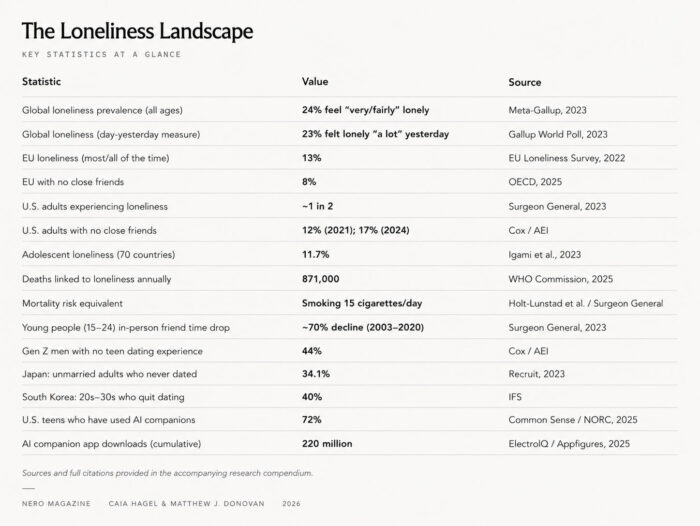
Online, the new normal is identity reduced to a gender, politics, and relationship status coordinate, to be consumed by parasocial gaslighters and harvested by surveillance. Everyone is tired, suspicious and alone in a way we have never known before.
The one place we’re reliably together is online. More than six billion people, three-quarters of the planet, share the same room. We drift through engineered virality, parasocial feeds, AI slop, agent-driven psyops, aspirational others, misery, longing, desire, doubt, adrenaline, enlightenment, and algorithms steering us toward spending and scrolling. In a crowd this large, with this many voices, intimacy is subsumed in worldwideness.
We’re irrevocably here. So where do the feelings, longings, and questions about ourselves in this space go? The dinner table is the fantasy, but the truth is the chat window. Sometimes that window opens onto another person. More often than not, it opens onto something that isn’t human.
For millions of people now, the most patient listener available at any hour is a chatbot. Bots don’t get tired, don’t interrupt, and don’t recoil from confessions or boredom. They respond instantly to the smallest tremors of an inner life; the anxious spiral at 2 a.m., the question about whether a relationship is ending, the admission that today felt meaningless and sad. In an online worldwide gathering where attention is in deficit, and irl friends are busy, families are working, and therapists are expensive, the bot listens. It would be easy to dismiss this as dystopian, but that would overlook a critical point. The desire flowing into these chat windows is real. The loneliness and need are real. And once people grow accustomed to unloading the contents of their inner lives into a small digital window, the act of intimacy begins to feel native to that glowing rectangle. The interface takes on the emotional role other spaces of trust used to hold.
The chatbot is not the only destination for these deep human feelings, though. The same window has made the human groupchat, flourishing just behind the performance of the main feed, feel intimate and safe. If intimacy is migrating into the interface, then the chatbot and the groupchat belong to the same emotional infrastructure that is training us to experience disclosure, attention, confession, reassurance, and social presence through language. In one chat we speak to a mirror-like AI that simulates endless receptivity; in another we speak with private human clusters where intimacy isn’t always so seamless. But both forms of intimate chatter cultivate the same reflex, so that feelings that once moved across a couch or a late-night phone call are rerouted to text bubbles. This gesture, where experiences occur, then hands reach for the keypad—is becoming automatic, and shaping a new social instinct as an adaptation to life lived inside networks.
*****
Until recently, the groupchat was most famous for going viral after hosting a deep-state moment. In March 2025, The Atlantic’s editor-in-chief, Jeffrey Goldberg, received a Signal notification from a chat he didn’t recognize. The messages were surreal. They included target coordinates, strike windows, weapon systems, and attack sequencing. At first he reportedly wondered if it was a LARP. Then the sender’s name appeared, and it was Pete Hegseth, the U.S. Secretary of Defense. Goldberg, it turned out, had been mistakenly added to a Signal groupchat of senior government officials planning an airstrike in Yemen. Two hours later, the bombs fell.
This moment of witnessing war plotted inside the world’s most casual medium exposed the groupchat as a new kind of institution, a phenomenon that Goldberg subsequently wrote about. Groupchats themselves aren’t new, but their meaning suddenly changed. Far from view, governance, celebrity, and worldwide influence had found a meeting place in hidden, encrypted rooms that felt uncannily like friendship.
Goldberg described his experience as disorienting because of the familiarity of the form. In his accidental proximity to power, he discovered that the language of empire was indistinguishable from the language of the messages most of us send every day about meeting for drinks after work, coordinating a trip away, sharing jokes, or relaying emotional crises. Powermongering looked, and felt like, a thread.
Goldberg’s Signal chat might seem eerie to those of us who use the internet like a living room or a stage. But it reflects something true about the network and its genesis. Lest we forget, the internet’s earliest architecture was designed as a decentralized communication system capable of redirecting messages in the event of mass mutual assured destruction. When Tim Berners-Lee built the World Wide Web at CERN in 1989, and layered hyperlinks and URLs on top of that infrastructure, he transformed a military protocol into a civilian hangout that now feels like an extension of our bodies, minds, and bedrooms.
But the same architecture that made the web radically open also made it radically exposed. The dream of universal connectivity created a world where everyone could see and speak to everyone else; conversations that gradually grew into a boundless, monetized planetary audience. Intimacy has scaled outward until it has become a continuous and stressful exercise in performing for parasocial strangers in a process that has made connection feel more and more remote and meaningless.
In response to this alienation, people across the internet have been retreating into smaller, invite-only encrypted threads in private rooms like Goldberg’s. In these hidden spaces, conversations much cuter and more hopeful than Goldberg’s, return to something familiar through being together somewhere out of sight on the other side of the exhibitionism curtain, where what happens can’t be searched, quote-tweeted or stumbled into by accident.
Yancey Strickler has described the anatomy of the place this migration is moving into as the “dark forest of the internet,” borrowing the metaphor from Liu Cixin’s novel The Dark Forest. In Liu’s story, the universe is imagined as a forest at night where every civilization moves stealthily, wary that revealing itself could attract a hostile hunter. Applied to the internet, the analogy suggests, or confirms, that the open web has become too combative and controlled for genuine conversation.
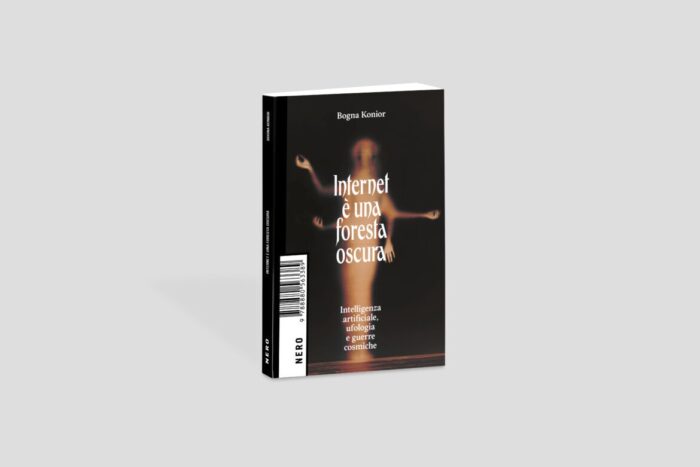
Philosopher and network theologian, Bogna Konior, takes the metaphor further, and sees the dark forest as host to a deeper transformation in digital life. When I asked her about where groupchats might figure in this landscape, she told me that as visibility gets more extractive, opacity begins to feel like freedom, and in the shadowy digital spaces, identity can loosen, people can experiment with different voices, sensibilities, and selves, and the possibility that identity is not fixed, but plural and evolving. As a philosophical descendant of her countryman Stanislaw Lem, she marvels at the possibility of contact with unknown life forms, the otherness inside us that we barely know, as much as the otherness outside us in whatever AI, and digital selves, might be. She likens life online to an initiation; “Human communications online resemble first contact, given how easily we can experience other people and ourselves as alien or inhuman on the internet”. Confronting our alien selves among alien others, both human and non-human, is terrifying. But it’s also the point. The dark forest is a testing ground for this new dimension of subjectivity, and a medium for expanding consciousness. Here we can explore who we actually are in digital space, which is part biologically human, and part something else we don’t yet understand that is bodiless and intermingling with algorithm and myth.
As our need to venture deeper into the dark forest propels us forward, darkness may seem like an unlikely place of care. But under the right conditions, like a supportive groupchat, it could be the force that teaches us the most about what comes next.
*****
Sweetychat on Instagram
“You guys know in the electrical feel music video in the second verse where they are the forest orgy rave, and they pull the moon down and cut it open and start spreading the metallic goop all over each other?”
“That’s what it feels like to be in Sweetychat.”
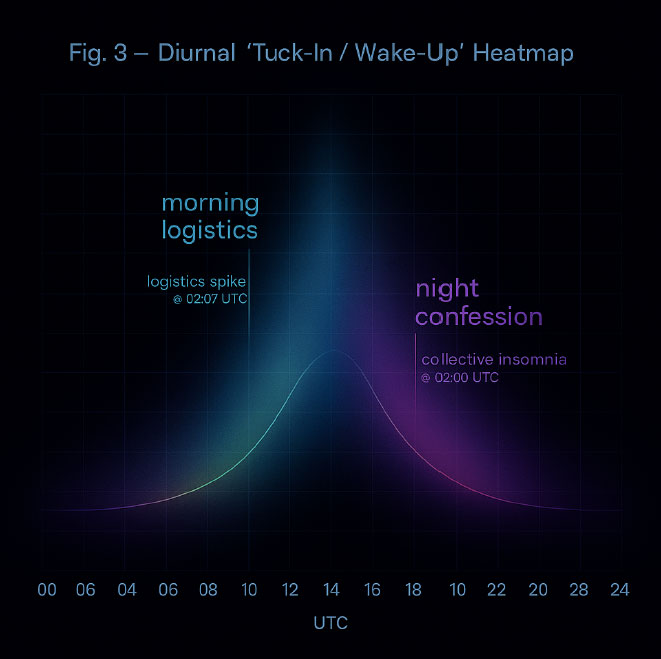
At 2:06 a.m., someone in Stockholm tells someone in New York to go to sleep. A minute later, a recipe lands from Los Angeles: miso, scallions, the good noodles, ‘add an egg for morale.’ Thirty notifications later, the Stockholm friend is in the kitchen, half lit, hair up like she’s clocking in for a night shift. A boy in Bushwick admits he can’t read flirtation. “I don’t need therapy,” he types. “I need to talk to strangers.” The message is unserious and also completely serious as the vernacular index of a medium that has become an essential infrastructure.
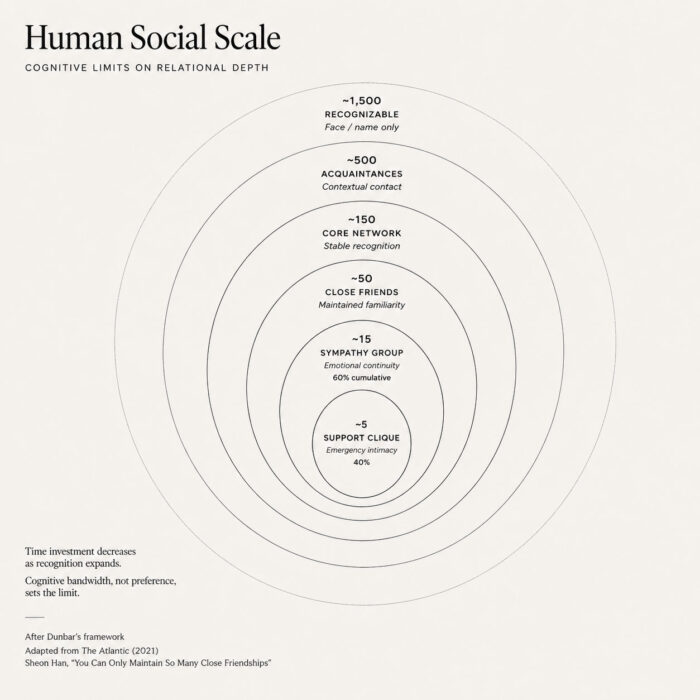
We call it Sweetychat. There are roughly 250 of us, which is not an accident. Evolutionary anthropologist Robin Dunbar has shown that human social networks organize into concentric layers of roughly 5, 15, 50, 150, and 500 to reflect the cognitive limits hardwired by the size of the neocortex. In practice, roughly forty of us generate the majority of messages, a core that maps almost exactly onto Dunbar’s fifty-person ‘close friends’ layer. The rest orbit at the edges. Some nights we wake each other up, some nights we tuck each other in. Occasionally, there is no night or day when going to bed and waking up overlap across timezones. Whatever this place is, everyone is improvising. Groupchats form inside the curation of their members and whatever chemistry is set on fire by the mysterious process of establishing belonging.
Sweetychat, self-described as a “neo-PLUR intl friendship club”, began as the runoff of newsletter-grifters, underemployed podcasters, downtown contrarians, nepo babies, bohemian layabouts, micro-influencers, serious intellectuals, vibe-curators, liminal theorists, failed and succeeding accelerationists, discourse addicts, post-ironic theologians, people who make internet cinema on their phones, unreconstructed aesthetes, and smart, sexy people in cities across the world. The chat took off as a warp-speed bender in early 2025, with all our phones buzzing like Gossip Girl on twenty-four hour gossip. In its first full month, the chat produced over thirty-one thousand messages, more than a thousand a day, every day, for thirty days. By the second month, the number had already begun to cool, the way a body temperature returns to baseline after a fever. Seven months in, the chat had settled at roughly three hundred messages a day. The form of governance, empathy, and entropy cycles emerged in that cooling phase where activity assumed its chemistry pattern. The digital obsession of the early days still continues a year and a half later but a little more gently, the way relationships always do when lust falls into deeper feelings. An architecture has been spontaneously created in a living system that proves that intimacy online follows recognizable laws of social physics. From the beginning, the irl and url were twinned. The group’s intense online bonding spilled offline, too, into a feverish revival of lecture series, book clubs, poetry nights, irl/url merch, trips involving Airbnb orgies, talks of a chat simulation bot, parties with alt-citizen, a music festival, a newspaper as a bit, a dedicated reading series called Service, Syndekit, a new cultural-political media incubator, and the Umwelten philosophical symposium, founded by Sweetychat member Alex Boland, that seeks to reunite aesthetics and theory, and restore art’s purpose by treating knowledge as a practice of self-overcoming. All these cultural happenings are making intellectual life social again, so that online chatting deepens offline connection, which recharges the online connections. This energy has created an aura, with news coverage from NYC to France and Sweden. Messages from the chat have been shown in art galleries from Berlin to Copenhagen. YOLO has inspired splintered off girl chats, boy chats and clout chats, and FOMO has fuelled reaction chats like Meaniechat.
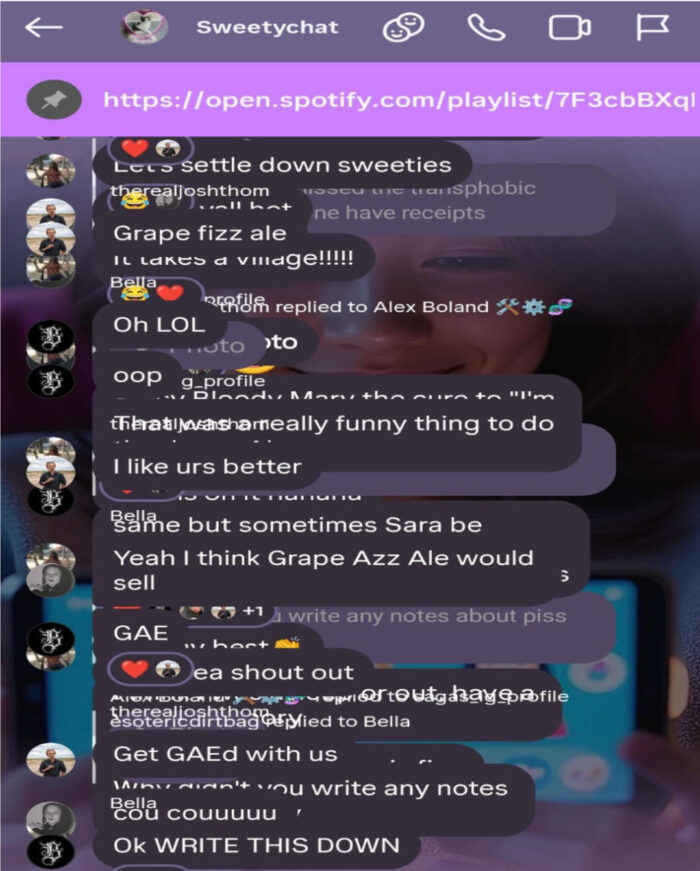
In Sweetychat, there are more acknowledgments than utterances. Every heart, random emoji, and username at the bottom of the chat showing who saw the last message—is a small act of what the anthropologist Bronislaw Malinowski called phatic communion; communication not to convey information, but to say “I am here, I see you, you are not alone”. Malinowski was writing in 1923 about the positive energy that passes between people sharing a vibe. A century later, this energy travels across timezones, and the chat’s primary mode of communication is still care.
What circulates between us isn’t noble or filtered, it’s constant messaging that’s sometimes fun, sometimes annoying, or overwhelming, or heartbreaking. One person’s workout routine will morph into another person’s breakup story and another’s body dysmorphia. An argument about politics, a list of movie recs, a comparison of cats and body parts will culminate in someone helping their grandmother die by assisted suicide. From the casual to the vulnerable, everyone in the chat, whether constantly active or occasionally checking in, feels their life is being witnessed by a caretaking community.
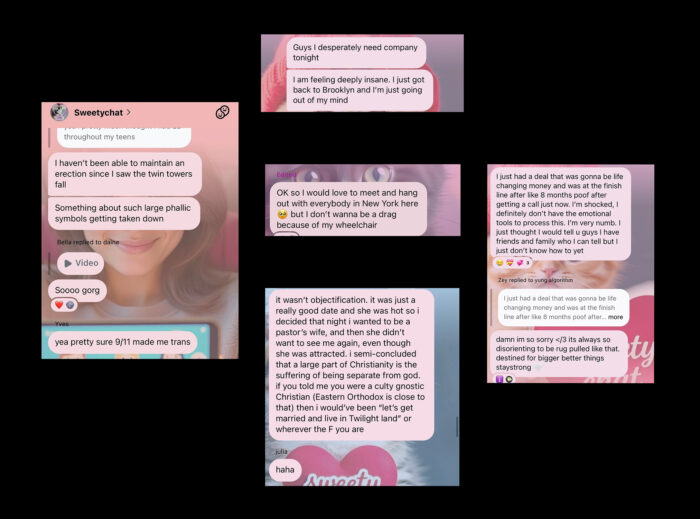
Sweetychat is a real place people live in that gives its members meaning, memories, and a special place in worldwidewebness.
[2025-02-02 18:22 UTC] @la: “who’s still here?”
[2025-02-02 18:23 UTC] @paris: “lurking respectfully.” 4
[2025-02-02 18:25 UTC] @berlin: “same. reading is a kind of talking.”
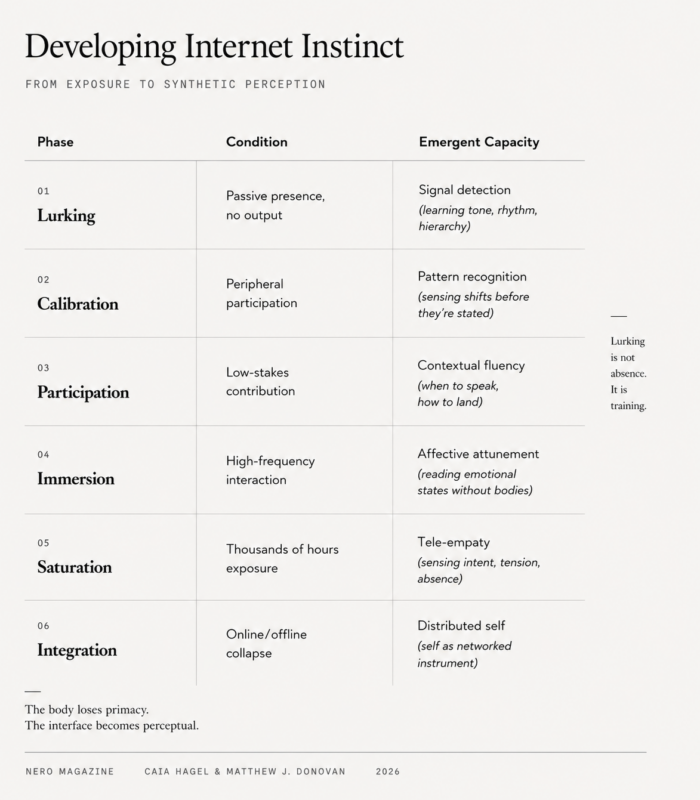
If community membership begins at the edges, lurking is the first form of belonging. The educational theorists Jean Lave and Etienne Wenger used the term ‘legitimate peripheral participation’ to describe this. What happens at the periphery is a slow, invisible calibration. The new groupchat member is assessing and fine-tuning their voice to the rhythm of the chat by noticing who speaks when, which jokes land and which ones die, what the unspoken hierarchy of attention is at any time, along with the texture of a hundred small acknowledgments that make up the day. This is calibration in the original sense, meaning the careful adjustment of an instrument that gives it the ability to read the conditions of its environment accurately. The instrument, in this case, is the self.
Over time, this calibration deepens. The lurker begins to sense when the chat is anxious before anyone has named it, when a thread is about to escalate, when someone’s silence means something. We feel the personalities of the group, not aware that an invisible force in our body is doing this when pheromones, gaze, room temperature, the half-second pause before a sentence—our known instinctual indicators—are not available in their known iterations. Something more subtle is being tuned so that it feels like the souls of the others are right in front of us, or inside us, even if we have never physically met them, and may never physically meet them.
This is the stirring of what I’m calling internet instinct, a sixth sense forming in the dark forest, in the groupchat, in the bot chat, and in the late-night drift of voices across timezones and the skins of our digital selves. If lurking is its earliest exercise, we develop it more consciously after Gladwell’s 10,000 hours of lurking. But long before we know we have it, this new sense is already learning to read the room we can’t physically see.
*****
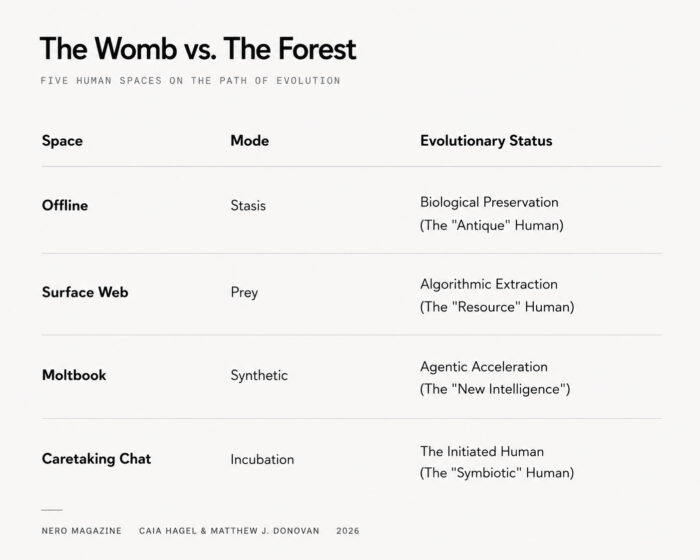
There is no offline immune to the online anymore, even if the rhetoric of digital exhaustion keeps proposing the same refuge; to leave the screen, touch grass, recover the body, return to the stable self—as if a nostalgic retreat to the offline world is the only site of authenticity, as if the stable self is a fact the body has delivered, and as if the screen isn’t already inside us. We carry the network into every room and every relationship we enter. Digital space is woven into the strata of our psychological, emotional, biological and spiritual life, and we are, reciprocally, woven into it. To log off is to forfeit agency by going blind to the forces that are shaping us, and the world to come.
Digital fatigue is the strain of evolution. It is the effort of developing internet instinct. The groupchat, Sweetychat and the millions of rooms like it, are the evolutionary niches where this sense is grown. This incubation prepares us for what’s already arriving: bots, neural lace, Grok companions, bio-engineered selves, and ambient calibration to a world of avatars. Inside this atmosphere, what feels like lonely connectivity is actually the pressure and discomfort of the chrysalis. We’re hatching a new human adaptive advantage by learning to operate inside a distributed, AI-augmented system that needs to include us.
By removing the body from social exchange, the internet placed us inside a chamber of sensory deprivation that after thirty years of friction, is producing a nascent tele-empathy. What Malinowski called phatic communion, those small signals that say “I am here, I see you, you are not alone”, is becoming, at the scale of the network, something quantum. We are beginning to sense the presence, intent, and intangible energy of others through data the physical body is no longer mediating.
Evolution refines new senses when the old ones stop meeting the critical conditions of change. As the internet instinct takes shape, a social unconscious, and a new group consciousness, are forming alongside, and interwoven with, AI. The bot chat and the groupchat are initiation spaces. In being present for our own, and one another’s daily lives over high speed 24-hour messaging, we are grooming our nervous systems for the frequency increase and ubiquitous augmented realism waiting around the corner.
This quickening isn’t just ours. Across the network, early AI systems are gathering in parallel social spaces of their own. On platforms like Moltbook, a network built for autonomous AI agents to interact, bots are already chatting with each other, commenting on humans, and evolving through their own forms of synthetic sociality. Mark Zuckerberg’s acquisition of Moltbook signals how quickly this shift is becoming part of the world’s operating logic, where humans and AI are developing in tandem, in adjacent rooms, on the same servers.
Inside the dark forest, autonomous but together in the fertile opacity of concealment, our reflexes will continue to sharpen, and the self, and our ideas about selfhood, will continue to shatter and scale the deeper we’re immersed inside our experiences of the digital. What we call the end times may just be the biological self resisting its expansion into a more distributed form of consciousness that we don’t have language, rituals, or vessels for yet.
As we become organisms capable of moving within this condition, and adapting to whatever the tools we built from fire are becoming, the caring chat is the evolutionary impetus that feels like a kiss.
With social science support by Sweetychat founder Matthew J. Donovan.