
Everything Leaves a Watermark
Paper Tears by Claudia Pagès Rabal, Catalonia in Venice 2026
I was on the train back from Venice to Milan when, scrolling through my phone gallery, I realized that something in Claudia Pagès Rabal’s work continued to elude me. The photographs and videos I had taken just a few hours earlier at the Docks Cantieri Cucchini seemed incapable of conveying what I had actually seen in person. The luminous watermarks projected through lasers onto the venue’s red brick walls appeared mutilated, fragmentary, almost as if they were sabotaging the very device that had attempted to record them. A figure that to the naked eye resembled a sort of ritual stick figure—a silhouette with clenched fists and a trident for a head—dissolved in the videos into isolated details: the trident without the body, two circles crossed by a line, luminous fragments incapable of recomposing themselves into a complete image. Like actual paper watermarks, invented in Italy during the thirteenth century and visible only in negative when held against the light, their reproductions in Claudia Pagès Rabal’s work also seemed to exist within an unstable threshold between appearance and disappearance. The watermark becomes a latent image, indicating something that is present even if not yet fully manifest. In French, the expression en filigrane refers to a thought, a tension, or an emotion that remains beneath the surface, never openly revealing itself while continuing to exert its presence.
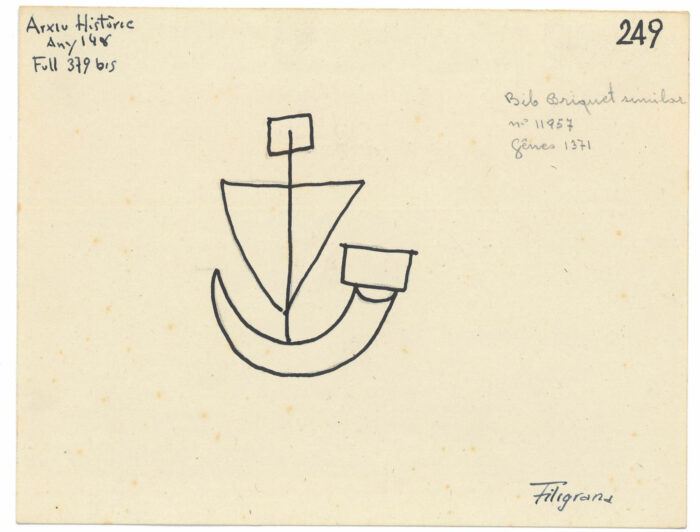
Perhaps it is precisely from this impossibility of capture that one must begin in order to understand Paper Tears, the project by Claudia Pagès Rabal (Barcelona, 1990) curated by Elise Lammer, through which the Institut Ramon Llull presents Catalonia with a collateral pavilion in the 61st International Art Exhibition of Venice. The installation constructed by Pagès Rabal does not simply display these images from the past—a small original example can be seen at the entrance—but stages the very conditions of their legibility in the present. Here, light is not merely a tool of vision but a political device. To shed light on something means making it visible, attempting, however partially, to understand it, authorizing its existence; yet too much light can also blind, saturate, and produce noise. It is precisely within this tension that the Catalan artist situates her work on fifteenth century’s historical watermarks sourced from the Museu Molí Paperer de Capellades, a small town historically tied to paper production. The research process behind the project develops in continuity with previous video installations such as Gerundi Circular (2021), Typo-Topo-Time Aljibe (2024), and Five Defence Towers (2025), works that each investigate, from different perspectives, the spatio-temporal overlaps intrinsic to particular places.
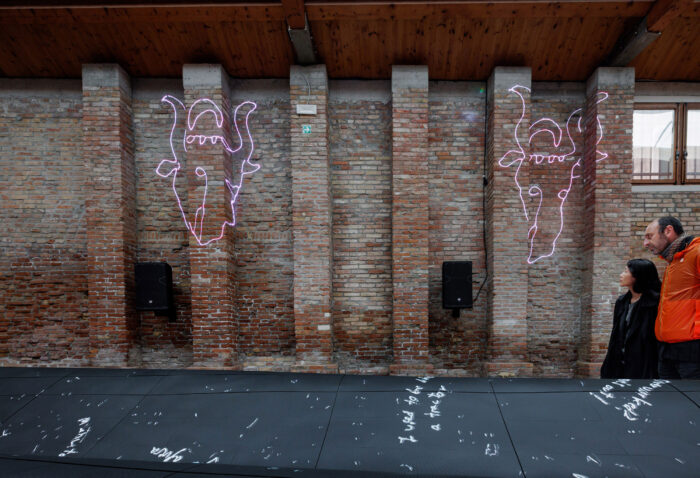
Historically, the watermark emerged as a mark of authentication: a sign embedded within the materiality of the sheet itself, capable of certifying provenance, ownership, and circulation. Yet in Paper Tears these symbols lose their semantic stability. The archaic-looking figures—animals, weapons, coats of arms, geometries, stylized bodies—become opaque images, almost runic visual survivals deprived by time of their original code. According to Pagès Rabal: “watermarks are small, simple drawings made from wire, which are then sewn into the papermaking frame. Because they are single-line drawings, they always have a naïve quality; I project them using lasers, where a single beam of light traces the drawing’s outline. The lasers create the same effect as watermarks on paper, but in reverse: while watermarks appear in negative, the lasers reproduce these drawings positively on the wall, through an intense light that, if directed continuously at one point, would leave a mark on the surface. I transform watermarks into mobile light-based graffiti.”
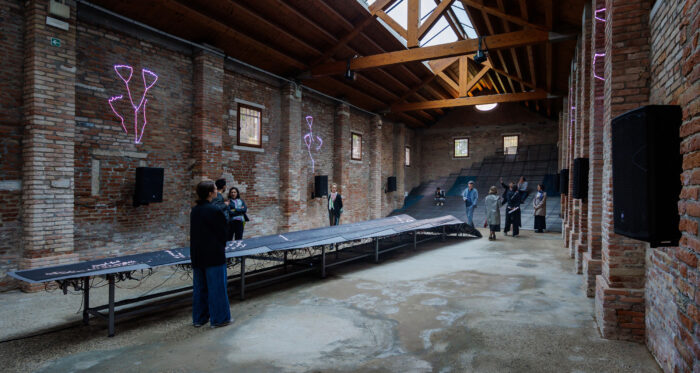
The sound component of the work—a narration of linguistic games and rhythmic associations developed in collaboration with the musician nara is neus—amplifies this ambiguity. Different voices attempt to name the signs, producing interpretations, associations, and speculations that continuously overlap without ever stabilizing into definitive meaning. “Watermarks are made to remain invisible while circulating,” one of the voices states. “Once projected onto the wall, an urgent desire emerges to give them an identity, to give them a name, and then another, and another still.”
Paper Tears unfolds as a dramaturgical work structured in three acts repeated in a loop: “During the first act, we observe the watermarks and freely associate ideas with them. We insert dates and historical events that occurred during the years in which the watermarks were produced, while also discussing the violence underlying them and their connections to the present, through comments and jokes that help orient us. The second act consists of monologues, speeches, and digressions. A stream of consciousness in which the characters discuss crucial themes of our time: the right to boycott; the adoption of universal, particular, and singular perspectives; the role of quantum theory in contemporary politics; the way difference is addressed in necroviolent policies; and how incessant and devastating news affects our bodies, reducing language to a euphemism incapable of producing anything. The third and final movement of this waltz focuses on the body and on transforming the exhibition space into an aquifer to inhabit.”
Within this continuous slippage between historical document and narrative proliferation emerges one of the most compelling aspects of Pagès Rabal’s practice: history never appears as a stable archive but as a field of interference. On one side there is an official chronology of dates, trade, navigation routes, colonization, and expulsions; on the other, myths, stories, mistakes, and divergent interpretations that continue circulating parallel to facts. The artist works precisely on this coexistence of incompatible temporalities. The watermarks thus become symptoms of a geopolitical transformation coinciding with the birth of European colonial modernity: the Reconquista, the expulsion of Muslims and Jews from the Iberian Peninsula, and the displacement of major trade routes from the Mediterranean to the Atlantic following the colonization of the Americas. These historical processes are materially intertwined with paper production itself: the expulsion of Muslim communities, who had introduced and developed this technology in Iberia, generated a paper shortage and a growing dependence on imports. Within this reconfiguration of trade routes, Venice and Catalonia assumed a central role, becoming strategic nodes in a new economic and geopolitical order whose logics continue to shape the present today. To move through Paper Tears is therefore to enter a kind of time machine—not in order to faithfully reconstruct a historical episode, but rather to short-circuit traces of the past with contemporary conditions. In an era marked by geopolitical conflicts, migration crises, and permanent states of emergency, Claudia Pagès Rabal’s work reveals the unsettling persistence of infrastructures of power, showing how the logics that shaped colonial modernity continue to organize our relationship to territories, bodies, and circulation. As Fernand Braudel writes: “What is the Mediterranean? A thousand things at once. Not a landscape, but innumerable landscapes. Not a sea, but a succession of seas. Not a civilization, but a series of civilizations stacked one upon another. To travel in the Mediterranean is to encounter the Roman world in Lebanon, prehistory in Sardinia, the Greek cities of Sicily, the Arab presence in Spain, Turkish Islam in Yugoslavia. It means plunging into the abyss of centuries, down to the megalithic constructions of Malta or the pyramids of Egypt. It means encountering ancient realities, still alive, alongside the ultra-modern: beside Venice, in its false immobility, the imposing industrial agglomeration of Mestre; beside the fisherman’s boat, still that of Ulysses, the trawler devastating the seabed or the enormous oil tankers. It means immersing oneself in the archaism of insular worlds while at the same time marveling at the extreme youthfulness of very ancient cities, open to every wind of culture and profit, and which for centuries have watched over and consumed the sea.”
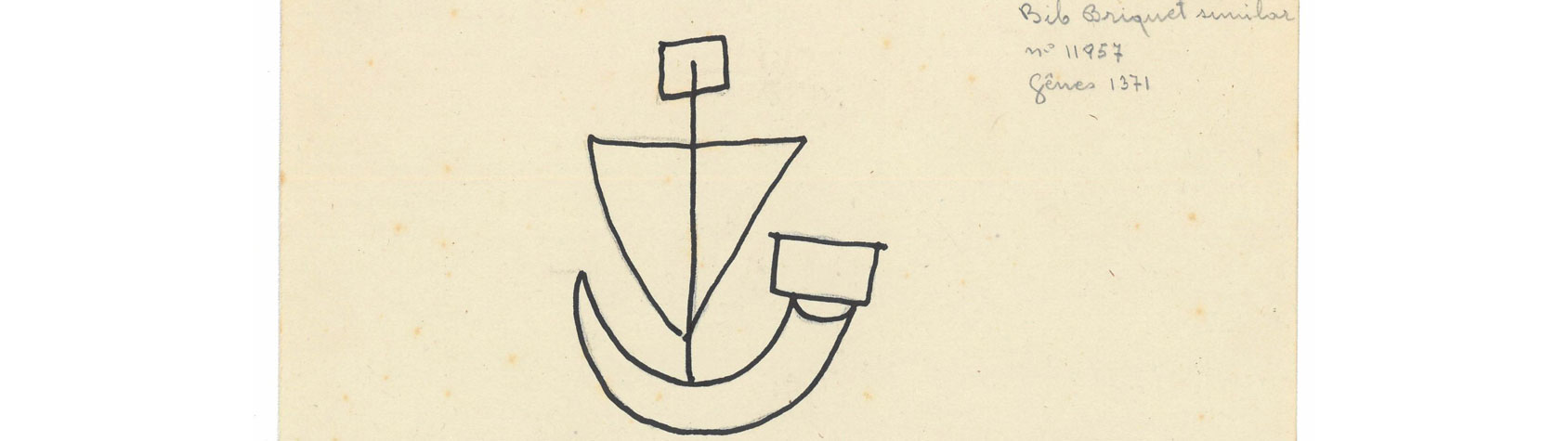
It is no coincidence that Pagès Rabal connects the history of paper to that of water. Paper production requires enormous quantities of fresh water, and the routes of paper inevitably intersect with those of the Silk Road and Mediterranean commerce. Watermarks thus cease to be merely proprietary images; they become material indicators of the movements of goods, bodies, technologies, and systems of power. Apparently marginal objects capable of revealing the hidden infrastructure of the empire. These images become devices of historical transcendence: a figure probably linked to royal symbolism—a bird enclosed within a castle—is reinterpreted as the imperial logo of the “Kingdom of KFC,” becoming a symbol of global food capitalism; a profile surmounted by a Latin cross evokes, according to the chorus of voices, Gospel songs alongside the symbolic imaginary of religious violence; a flower crowned by a cross inspires reflections on ideology, nature, and religion; while the drawing of a ship with an inverted triangular sail opens onto thoughts of Ferdinand Magellan, empire and its sanctions, routes, maps, cartographies, and the emergence of international law.
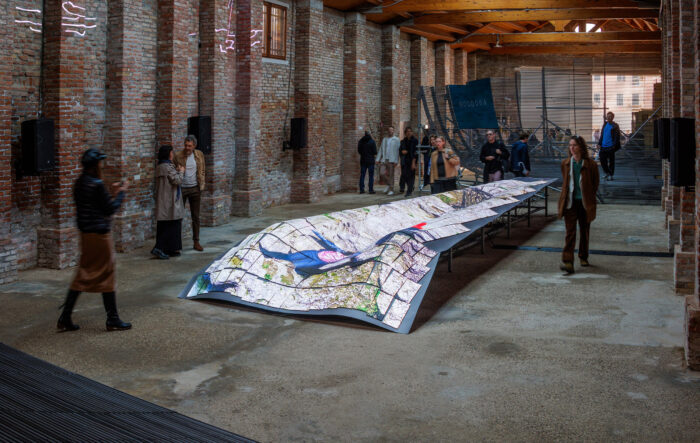
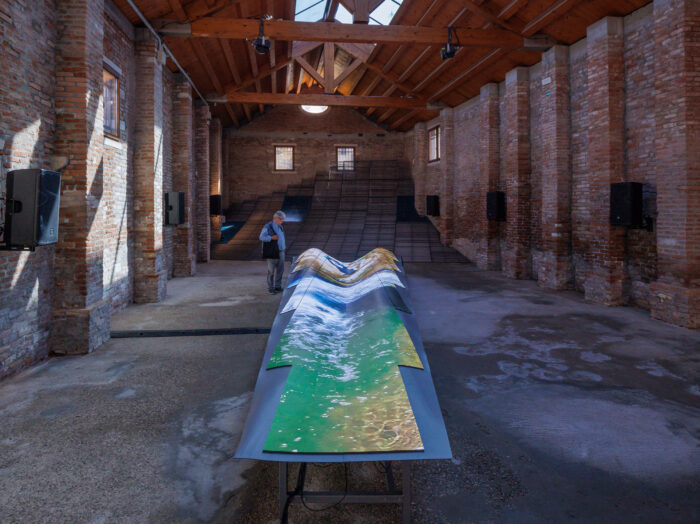
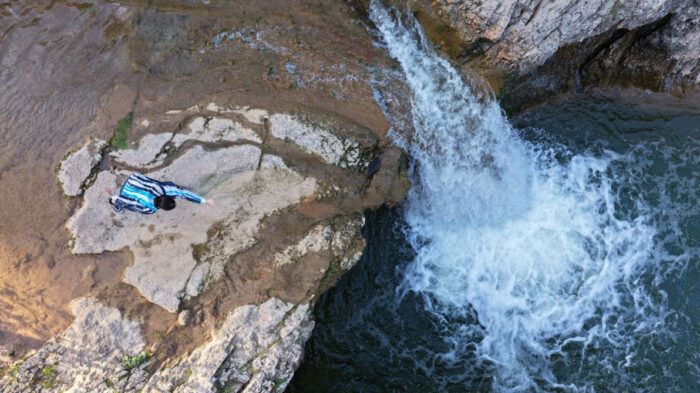
The entire exhibition design appears constructed around this notion of infrastructure, simultaneously visible and invisible. The spatial and conceptual structure of the work takes shape from visible and subterranean networks of fresh and salt water—tides, flows, stratifications, and currents—which become the topological backbone of the entire project. The long metallic sculptural element cutting through the industrial space of the Docks Cantieri Cucchini simultaneously resembles a riverbed, the hull of a ship, and a gigantic modular screen. The installation’s surface is covered with magnetically attached LED panels that evoke both the screens of contemporary visual culture and the scales of a technological skin in constant mutation, or a waterfall partially distorting the image. Above it, video images shot from a zenithal perspective using drones flow: river landscapes caught in continuous dialogue between submersion and emergence, physical and historical dimensions, moving bodies, choreographic and vocal performances transforming language into physical gesture.
The performers, like contemporary jesters—figures historically positioned at the margins of power—operate through strategies of disarmament, allowing themselves to pronounce otherwise unspeakable truths through their apparently innocent yet foolish appearance. This presence traverses the central video of the installation, filmed across various territories of Catalonia following the rhythms and trajectories of springs, aquifers, riverbeds, and infrastructures connected to water management. The landscapes traversed by the artist are defined precisely by the presence and movement of currents, composing a stratified geography that unites natural environments, subterranean networks, and productive structures. It is within this historical ecosystem, linked to irrigation, manufacturing, and above all paper production, that watermarks themselves first emerged: signs born from the entanglement of water, labor, and the circulation of goods.
At the two ends of the environment, inclined platforms designed in collaboration with the architecture studio GOIG (Miquel Mariné and Pol Esteve)—resembling a hybrid between skateboard ramps and large fishing nets—force visitors to constantly maintain balance, as if the body itself were called upon to participate in a system of tensions, frictions, and resistances while searching for the optimal position from which to gain a bird’s-eye view of the installation.
Pagès Rabal’s practice, which intersects writing, choreography, video, and installation, treats language as living matter. Her works function as time machines in which different historical layers collapse onto one another without ever fully recomposing themselves. In Paper Tears, the Mediterranean emerges as a deeply fragmented space where possibilities for harmonious connection are interrupted by territories traversed by racism, expulsions, extractive logics, and colonial continuities that persist into the present. Violence does not appear here as a concluded event but as a structure that continues organizing the contemporary circulation of images, goods, and identities. Pagès Rabal’s watermarks operate precisely “in minor keys,” resonating with the Biennale’s theme conceived by Koyo Kouoh: semi-invisible images that emerge only against the light, marginal fragments nevertheless capable of making us think about the hidden infrastructure of modernity’s great geopolitical transformations.
Perhaps this is precisely what makes Pagès Rabal’s watermarks so difficult to photograph. Not because they are invisible, but because they belong to an unstable, intermittent temporality composed of overlaps and returns. They are images that exist only within a certain inclination of the gaze, under a precise condition of light. Images that, rather than revealing themselves fully, force us to stumble through time.