
Engineering Ascension
A review of Alex Chalmers’ exhibition at A Sud, Pescara
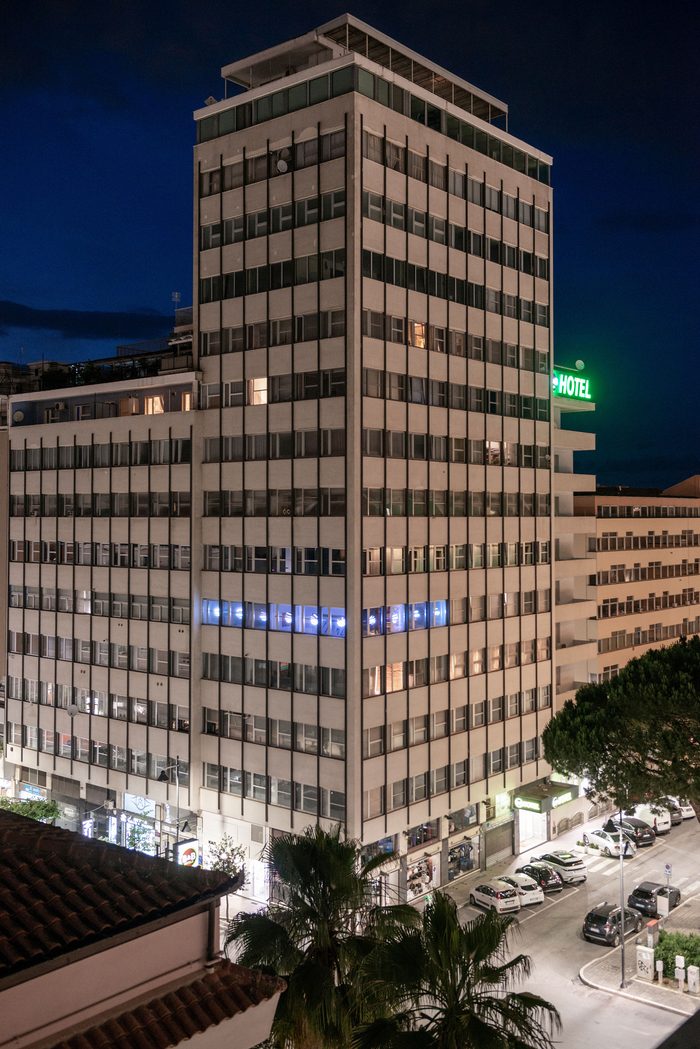
Set along Corso Vittorio Emanuele II in Pescara, a boulevard named after the first king of united Italy and emblematic of the country’s post-unification urban identity, this exhibition unfolds within a city shaped by cycles of destruction and reconstruction. Largely rebuilt after World War II, Pescara’s architecture reflects a modern, functional fabric in which vertical expansion and civic standardization replaced much of its historical past. The building, one of the city’s early postwar skyscrapers, stands as a marker of this transition toward a contemporary urban condition.
The works by Alex Chalmers presented in the exhibition at A Sud, Pescara, engage directly with this context, drawing connections between construction, image-making, and urban narratives. Central to the exhibition are construction meshes sourced from Rome in anticipation of the Jubilee of 2025, a global religious event that transforms the city through both spiritual and infrastructural renewal.
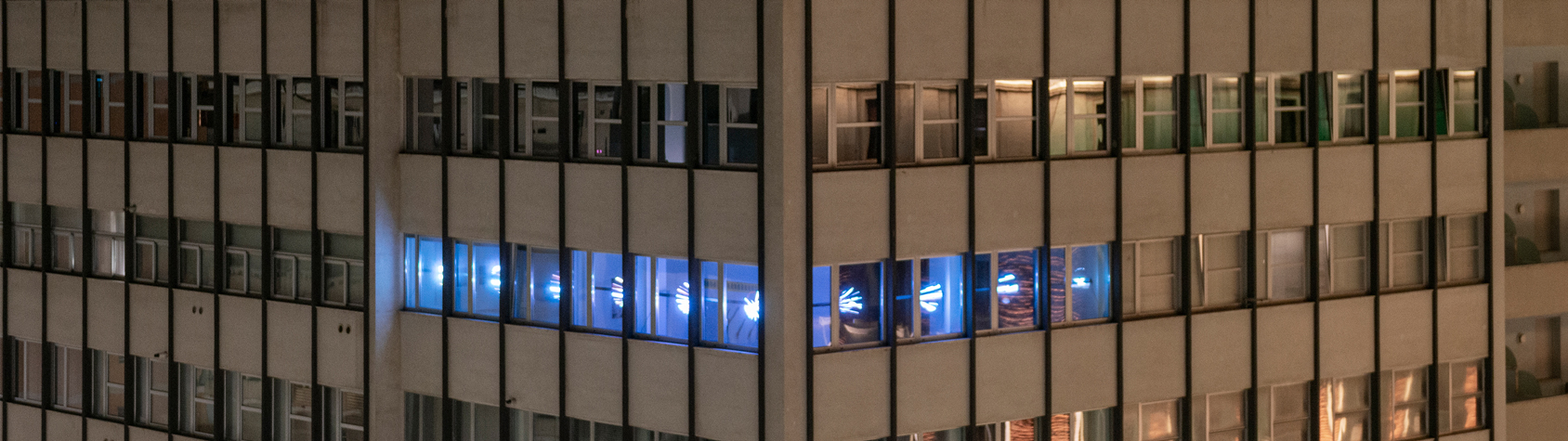
At night on the fourth floor of a tall, unassuming office building in Pescara, a pulsing light cuts across the windows, as if a construction worker were making their way across the dark room with an angle grinder. The lights move slowly, ritualistically, then repeat—metal sparks that flicker out into the surrounding streets. Over and over again, the edifice is held in a suspended state of fabrication.
Curated by Massimiliano Scuderi, Alex Chalmers’ exhibition at A Sud uses its materials to stage a state rather than a set of things: a perpetual becoming, an arrival that never quite completes. Together, the works turn the space into a threshold where process, labour, exposed systems and preservation coexist.
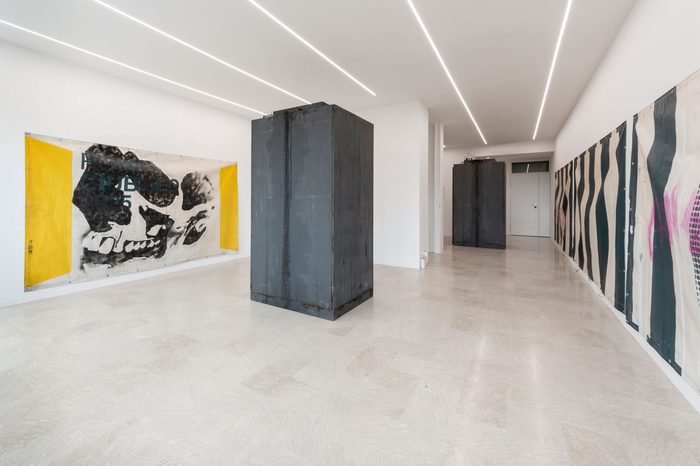
A vestigial smile hangs to the right of the gallery entrance, tapestry-like, with a silver scribble of graffiti across it. It’s a familiar sight to anyone from Rome, where Chalmers lives and works, as one of the panels of polyethylene mesh that continue to cover the construction sites of the 2025 Jubilee’s renewal projects.
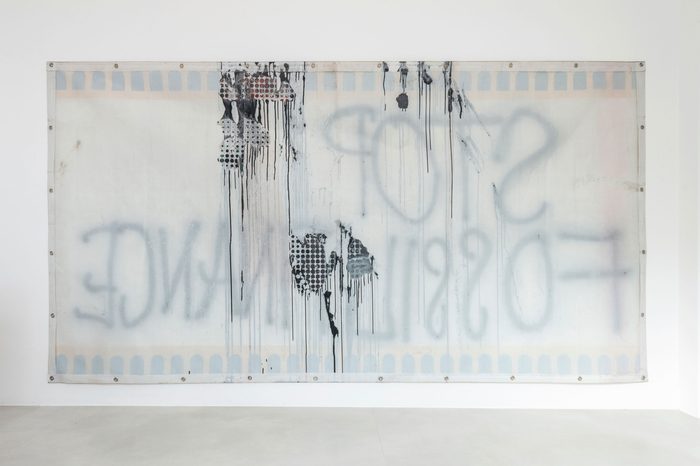
The exhibition gathers a series of these artworks: Teschio veils the text ROMA GIUBILEO 2025 with a spray-painted skull, another has ‘non sei solə’ written haphazardly in fuchsia over a stylised eye, another is left as thick black and white stripes, the next carries the words ‘BRUCIA TUTTO’. Between a border of yellow stylised portici is the word ‘VIRAL’, alongside ‘STOP FOSSIL FINANCE’, turned to face the wall, its reverse exposing a damaged, paint-splattered street canvas borrowed from the city. What is unclear is the graffiti’s authorship, an ambiguity between street and studio that lifts a Roman vernacular off the surfaces the city ignores.
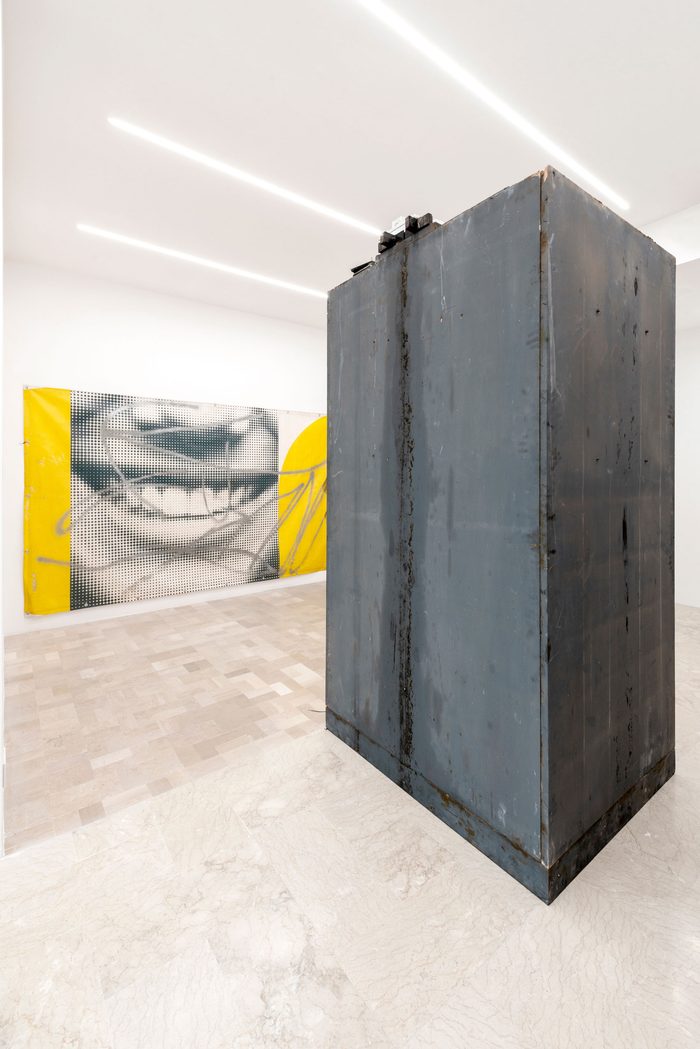
Designed by studio FM milano, the covers belong to an industry whose task is to make a building site at once invisible and legible, dressing the cantieri of the centro storico in “iconic images of the most important monuments of each district of the city”, the city printed onto the plastic that hides the city in a game of self-mythologisation.
Caput Mundi—repeated across the Roman hoardings—is not only a rhetorical claim about Rome’s centrality but the name of the €500 million Italian funding initiative financed by the European Union’s Next Generation EU via the PNRR (National Recovery and Resilience Plan), the delivery handed to the mayor in his second capacity as commissario straordinario for the Holy Year. When the Jubilee closed, the government spoke of patenting the “metodo Giubileo” and applying it to Caivano, prison building and the Terra dei Fuochi: the Holy Year has long been known to mobilise regeneration in a city that is usually tied up in bureaucratic red tape and arduous cooperation between the national government, the Vatican, and the city council.
Limen, the Latin from which Arnold van Gennep drew the liminal, means threshold, and in Les Rites de passage (1909) he referred almost literally to the doorway of a house or temple, where you have left one world and not yet entered the next. Victor and Edith Turner later read pilgrimage as the voluntary version of that condition, a threshold drawn out over the length of a journey rather than stepped across in a step. Both accounts are attentive to whoever stands in the doorway, and far less to whoever builds it, staffs it and keeps it open. Contemporary pilgrimage is logistics on a considerable scale: the Hajj moves some 1.7 million people through Mecca in a matter of days; Jerusalem manages its visitors across three overlapping liturgical calendars by means of permits, closures, checkpoints and military force; Rome’s Jubilee closed with a figure in excess of thirty-three million, a number the Vatican reached by counting crossings of a doorway rather than persons. Chalmers’ interest lies one step back from the door, in the scaffolding, the covered façade, the mechanism, the interval between the street and the object. He neither demystifies, criticises nor romanticises this material, but holds it still long enough to be deliberated as and through sculpture.
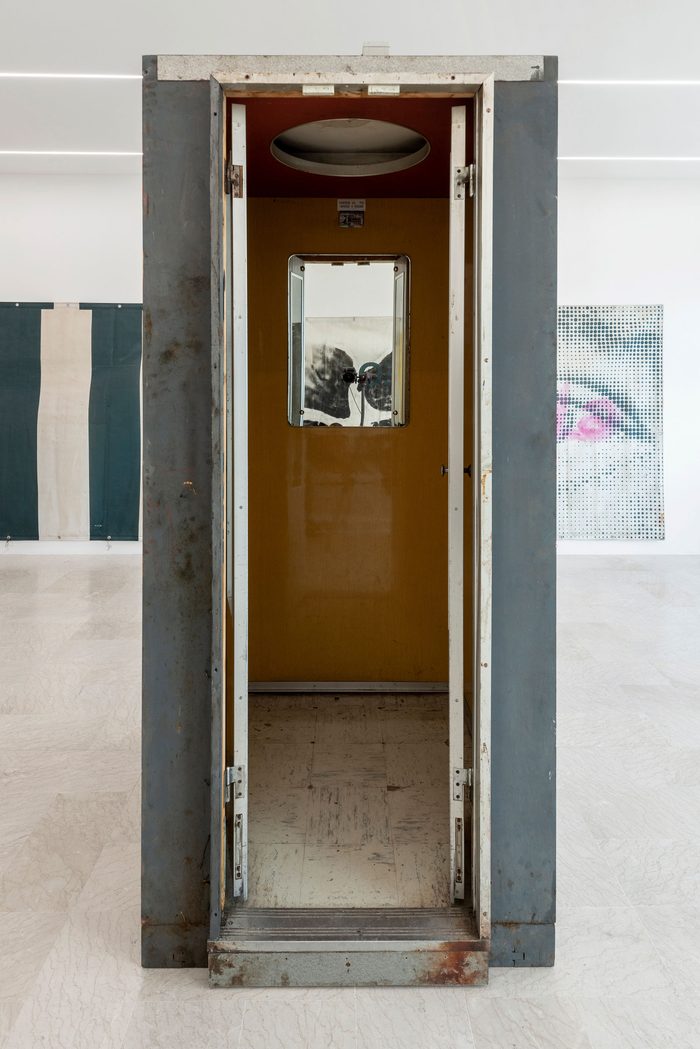
In the middle of the gallery space stand two elevators, sourced locally as they are for each of his exhibitions, taken apart then reassembled within the gallery as Frankenstein constructions that the artist encourages visitors to enter. Mundane machines whose workings are never fully revealed, here they present the surfaces no passenger encounters: exterior insulation, adhesive residue, abrasion, the accumulated wear of a mechanism made for effortless upward movement and whose exterior was never finished to be seen. Made static, they are ascent rendered as objects, their occupants held in an interval with no exit and no duration.
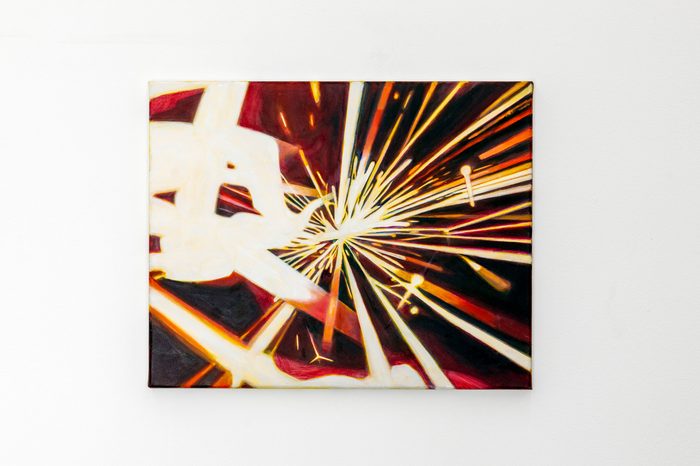
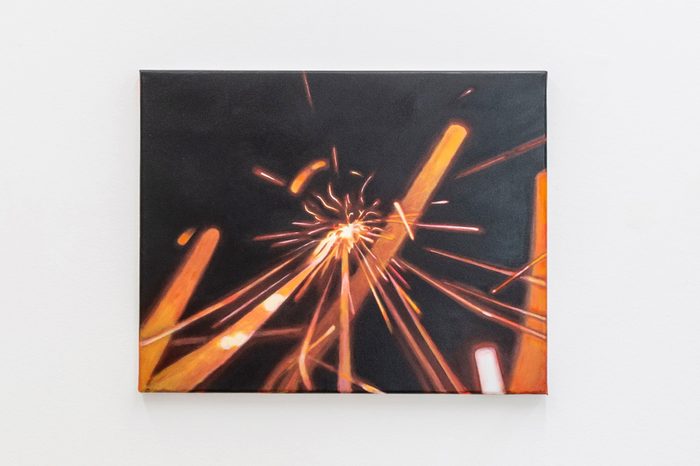
Cut line is a work originally commissioned for The Lightship, a large-scale LED video wall installed at the port of Auckland, New Zealand, and has since splintered into a variety of works, such as video, holographic light installation and oil painting. Each form plays back into the original: the holographic technology mimics the circularity of the grinding tool, and the act of cutting is central to both fabrication and film editing. The oil paintings invert the work’s relation to time—construction sparks rendered as shooting stars flying towards the viewer, an instant rendered in a classical format that suggests timelessness.
A Sud’s gallery windows run the length of the space, and for Chalmers it was an opportunity to turn the former office building into a public artwork at night. Space is inverted and the show becomes situated within its location, the holographic apparatus looping the ephemeral moment, not suspending the image, as photography does, but isolating the actions of both becoming and undoing.
Pescara is a city with an unusually short and unusually documented relation to its own making. Constituted by royal decree in 1927, it lost around eighty percent of its built centre to Allied bombing in 1943. The reconstruction that followed was rapid: through the 1950s and 1960s the rebuilding was among the most intensive in the country, and by the 1970s the municipality had reached the limits of its own territory. Vertical expansion and standardisation give “an Italian urban context in which contemporary architecture rarely exceeds the symbolic height of the church”, as the curatorial text puts it, and the building that houses the gallery is a document of that transition.
The exhibition establishes a set of correspondences between the two cities: one with its historic fabric largely removed within living memory, the other with its history permanently under suspended renewal. And what the curation makes clear is that the gallery is not a neutral container that objects are placed into; it is a place that has to be reached, assembled, and made solemn by classification, as with a holy site.
Chalmers refolds the transitory into the transcendental, a reappropriation and fixing of what should be fleeting, procedural and constructive. Rather than institutional critique, his work consistently isolates pieces of enabling infrastructure—legal, financial, architectural, mechanical—and shifts them from precondition to material in sé. The transcendental content that these transitory elements were quietly holding up—spiritual, artistic, ideological—is neither left intact nor denied.