
Cartographies of Darkness
…and the politics of visibility: Emilia Estrada in conversation with Alessandra Franetovich
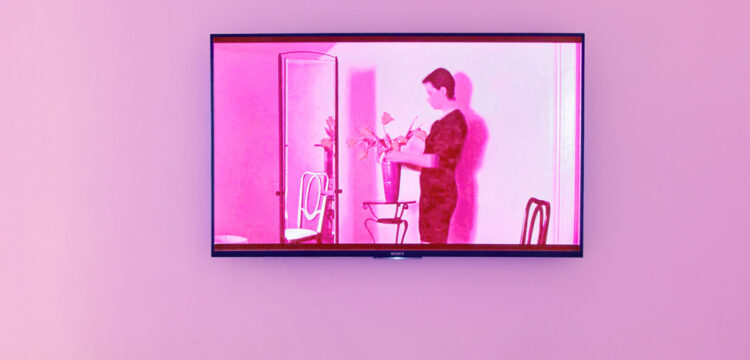
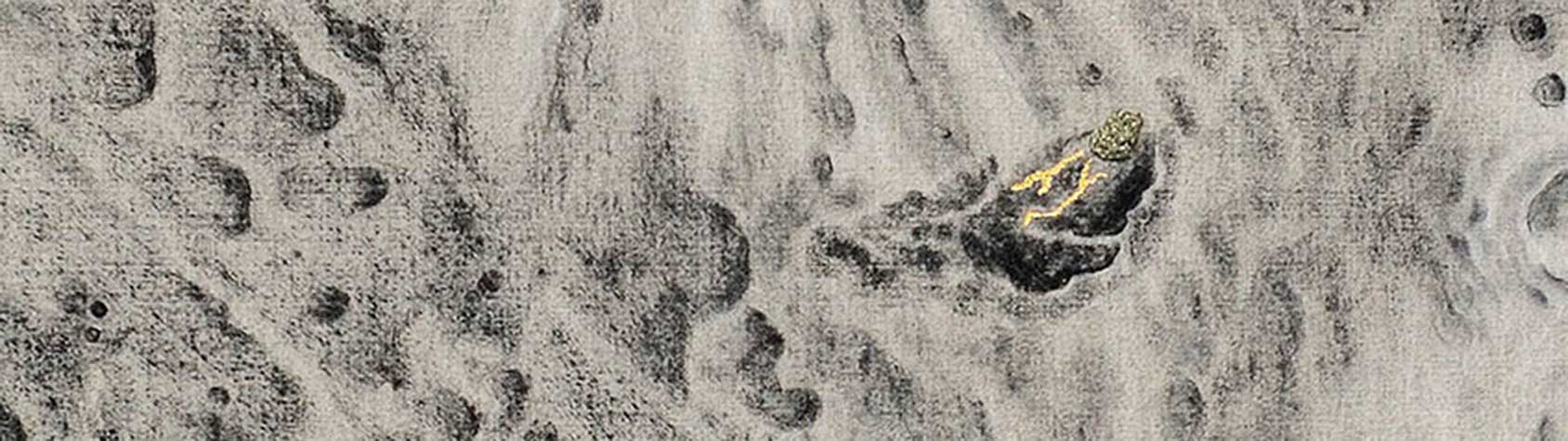
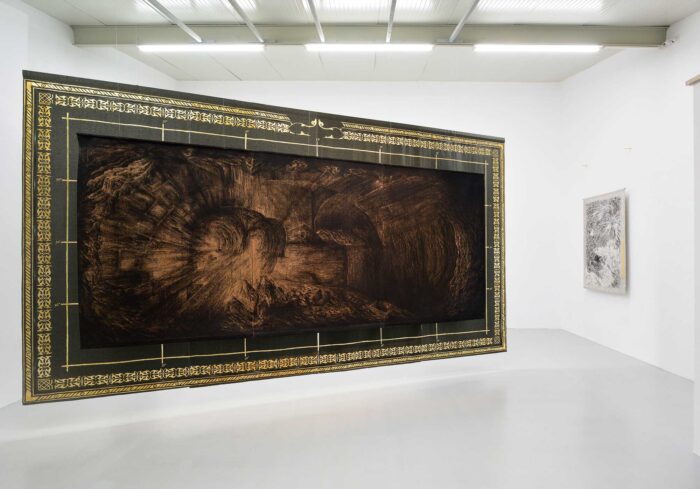
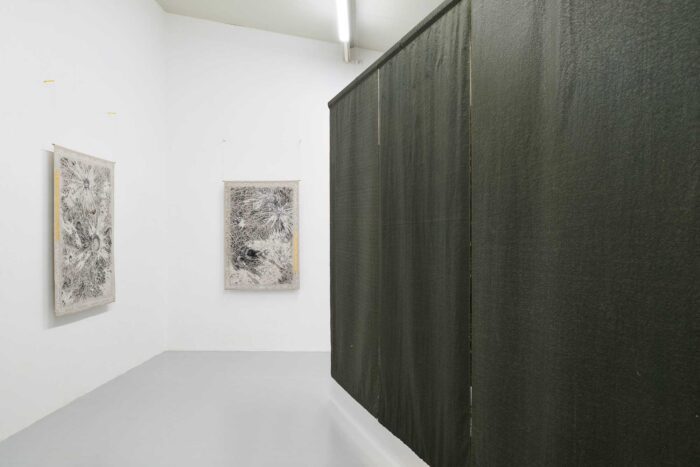
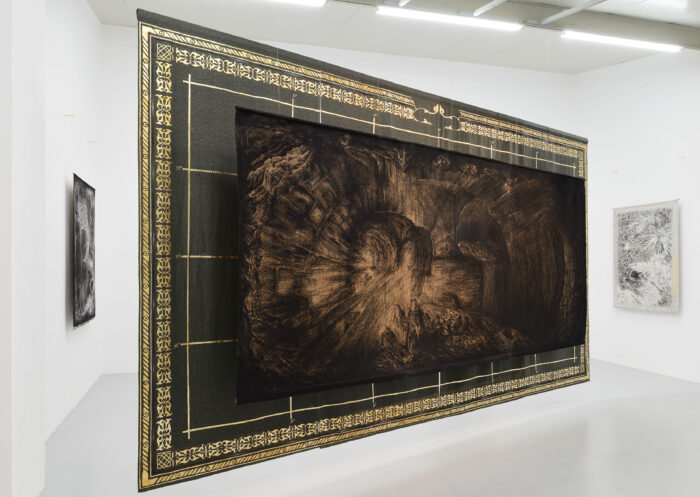
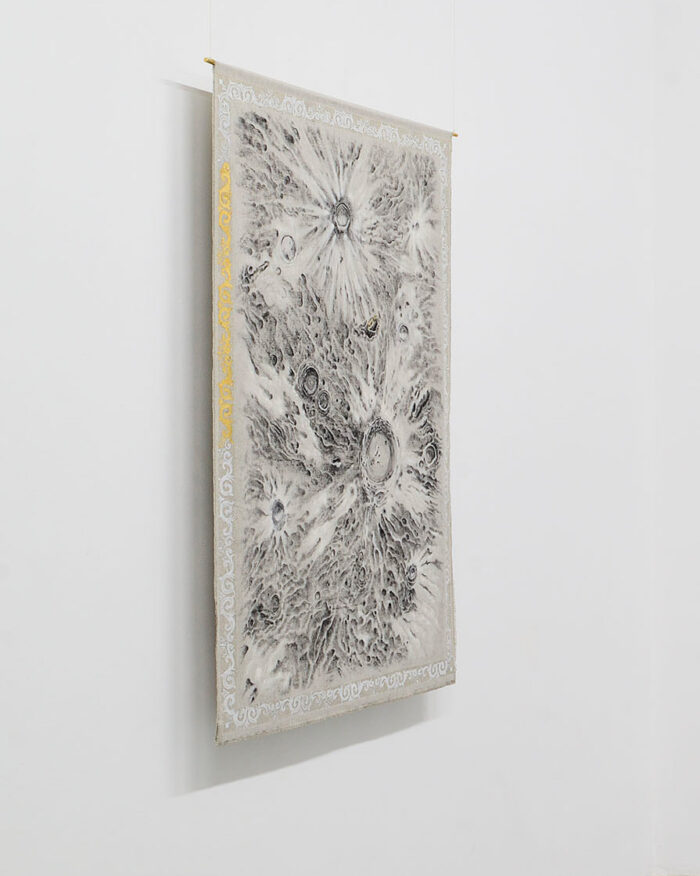
On December 12, 2025, Permanently Shadowed, a solo exhibition by Emilia Estrada, opened at Cantadora Gallery, a newly founded space for contemporary art in Rome. Living and working in Rio de Janeiro, Estrada presents a large-scale installation that interrogates the genealogy of the image as an instrument of power. At its core, a five-by-two-meter work combines charcoal on cotton with a green nylon grid framed in gold leaf, overlaying two nineteenth-century visual paradigms: the subterranean views of Jerusalem produced by the Scottish artist William Simpson (1823–1899) during British expeditions in Palestine, and the staged lunar illustrations devised by James Nasmyth for his book The Moon: Considered as a Planet, a World, and a Satellite (1874).
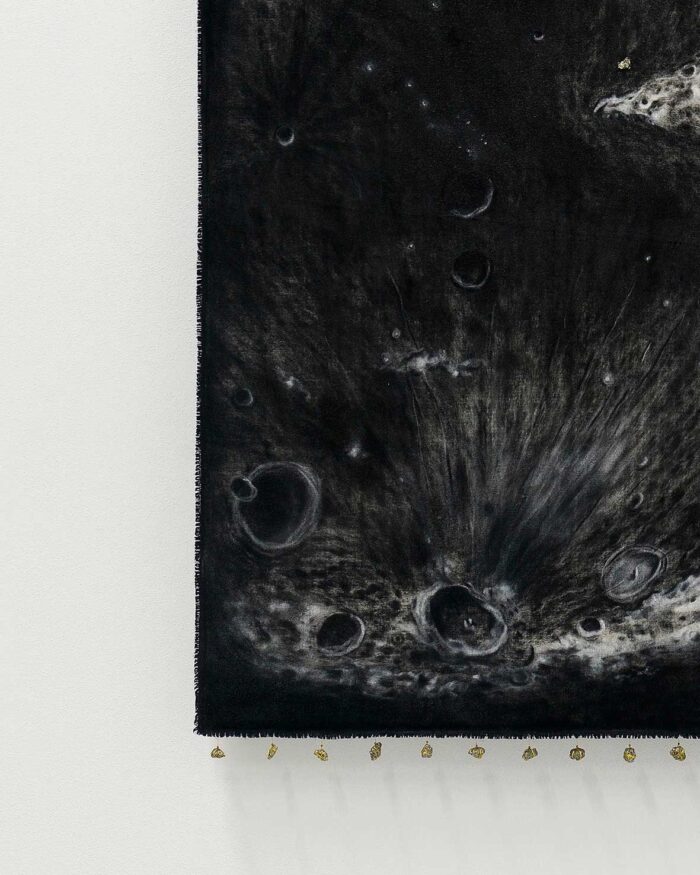
By bringing these coeval images into dialogue, Estrada reveals a shared imperial logic in which scientific inquiry, visual representation, and territorial ambition converged. Archaeology and astronomy emerge as parallel technologies of illumination, transforming both Jerusalem’s underground and the Moon’s surface into spaces to be measured, mapped, and eventually conquered. Through subtle reversals, editorial shifts, and material interventions, the artist exposes the staged nature of supposedly objective images, unsettling their claims to truth. Charcoal maps of lunar pits and fragments of pyrite—“fool’s gold”—further extend her reflection on extraction, illusion, and the politics of visibility. The archive, in her hands, becomes unstable terrain: a site where light itself is a political decision and where dominant narratives can be displaced.
In the following interview with curator and writer Alessandra Franetovich, Estrada expands on these tensions, outlining a practice that does not seek to correct history but to fracture its visual certainties from within.
Alessandra Franetovich: Your solo exhibition, presented in Rome at Galleria Cantadora, already suggests through its title, Permanently Shadowed, a sense of abandonment and forgetting—one that calls for a position to be taken. What is cast into shadow are the imperial and colonial methods through which forms of power have constructed, and continue to construct, worldviews, producing hegemonic narratives and a persistent confusion between reality and representation. By acknowledging the dissonance between simplified narratives and the complexity of lived experience, your reflection unfolds within an imaginary shaped by apparent contrasts. The present resurfaces through a past era, the nineteenth century, in the encounter between two environments located at extreme distances from one another: the lunar surface and the subterranean depths of the Earth. Both are experienced and interpreted through nineteenth-century historical narratives: on the one hand, underground Jerusalem; on the other, early scientific images of the Moon. You thus stage a transtemporal and, at the same time, intergalactic scenario, yet one that is contained within a confined space—a single room. Where does this need to bring together such distant elements within a limited spatial setting come from?
Emilia Estrada: I do not understand this movement as a necessity, but rather as a working method. I work primarily with spatial representations of distinct territories that, when placed in relation to one another, reveal shared colonial structures. In my work, there is often a pendular displacement between regions that also form part of my personal geography—Latin America, particularly Argentina and Brazil, and Palestine. Between these contexts, there is a recurring historical pattern of imperial and colonial mediation that has shaped their images, contributing in both cases to their exoticization and over-mystification.
Some years ago, I incorporated the Moon into this movement. It functions as an imaginary surface of projection upon which imperial ambitions have been cast and which today returns to the center of a new race, this time for extractivist interests. The West constituted the Moon as a field of study and representation, producing a visual repertoire in which, by being mapped and named, it became simultaneously distant and near.
In the exhibition at Galeria Cantadora, however, there are iconographic references that may call this notion of distance into question by bringing together images conceived to circulate outside their territories of origin, displaced from the experience that produced them or constructed to simulate presence, attempting to render remote landscapes somehow accessible. For the maps and subterranean representations of Jerusalem and the Moon in the central installation, for example, I worked with images from underground Jerusalem by William Simpson that depicted the excavations conducted by Charles Warren within the framework of the Palestine Exploration Fund; and images by James Nasmyth, who represented the lunar surface through plaster models that were lit and later photographed. These images share not only the same decade of production, but also the fact that they reorganize remote landscapes through visual devices, aiming to render them intelligible. In both terrestrial and extraterrestrial territories, the landscape becomes transparent, turned into a symbolically available surface.
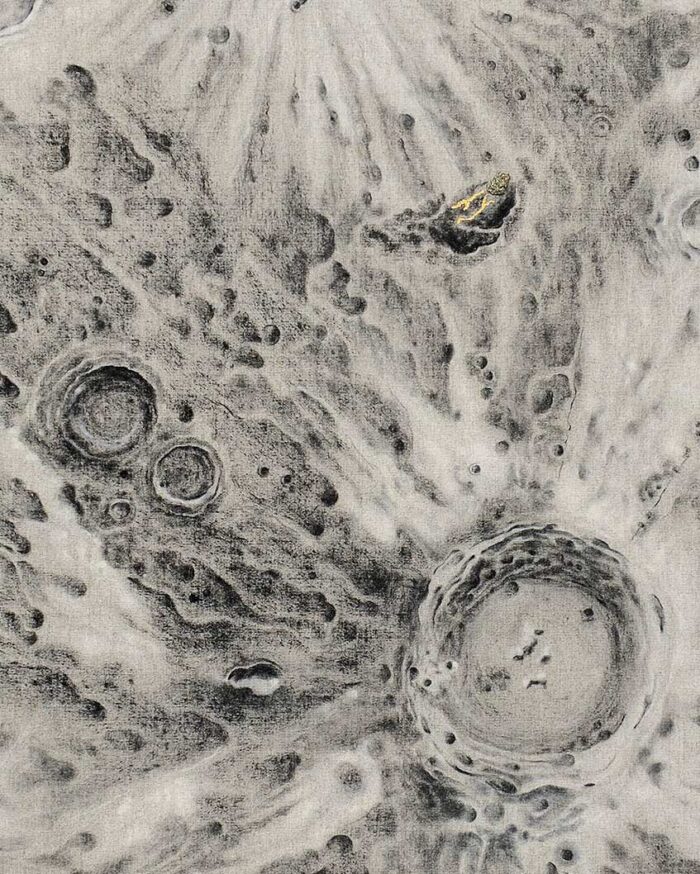
The exhibition includes three maps of regions with lunar pits, which are openings into lava tubes formed by ancient basaltic eruptions. There has been recent speculation that these sites may be promising for the installation of future exploration bases on the Moon, as they offer natural protection against radiation and extreme temperature variations. From this hypothesis, I find it extremely interesting to consider that a possible physical occupation of the Moon might begin through its subterranean routes. I came across this information during my research on lunar geography, shortly before I began investigating the archives of the Palestine Exploration Fund in London. At the time, I was interested in the iconographic production of British missions in Palestine during the Mandate period, and I became particularly drawn to William Simpson’s water colors because they shift the point of view to the underground. In representing the ruins of ancient Jerusalem, Simpson produced images that looked simultaneously backward and forward, toward the biblical past and toward a projected future under British administration. Or, rather, fabricating a version of the past precisely capable of grounding and justifying a future colonization. I see these representations of the undergrounds of Jerusalem and of the Moon as scenarios of temporal friction where past and future coexist in tension.
Bringing these distant elements into a single room allows for their underlying structures to become visible. I believe the spatial compression somehow mirrors the conceptual operation of my work: collapsing distances in order to reveal how imperial imaginaries reorganize territories and allow them to be seen.
In your work, you engage with historical documents that carry with them the expectations, ideologies, and biases of the period in which they were produced. At the same time, visual representation is reactivated as a tool for retrospective re-reading, capable of bringing to light stories that have been forgotten or marginalised. Your practice seems to function as a double device: an observatory, from which to look outward through specific lenses at fragmented and opaque histories, and a laboratory, an enclosed space where experimentation, reworking, and the reactivation of visual codes and alphabets take place. How do these two dimensions coexist within your practice?
I do not see the observatory and the laboratory as separate or sequential stages, but as two intertwined dimensions of the same practice. The observatory names the position from which I approach historical material, one that implies attention and an awareness that I am looking through lenses shaped by specific epistemologies and power structures. It is a space of analysis and exposure. The laboratory, in turn, is where this material undergoes transformation, a space of cutting, recomposition, displacement, where images are re-scaled, redrawn or recontextualized. If the observatory examines how images were constructed and circulated, the laboratory tests how they might be reconfigured and reactivated.
These two dimensions coexist because observation already implies intervention. Selection and isolating are in themselves transformative acts. Conversely, experimentation is never detached from research because it remains anchored in the historical and political conditions from which the images emerge. The work unfolds in this simultaneity, where distance is never neutral and neither is intervention. So I don’t feel I step fully outside the material to observe it, nor do I enter it without first having studied its conditions. Research and manipulation occur together shaping the other as the work takes form.
A defining aspect of your research lies in its relationship with history and with processes of historicisation, tools and disciplines often perceived as objective and neutral. Your work instead appears to question the role of institutions such as the archive, showing how omissions, distortions, and areas of opacity actively contribute to shaping our understanding of history, culture, and identity. Within this framework, a strong sense of agency also emerges. What role does the political dimension play in your artistic production, and where do you feel it manifests most clearly: in content, in method, or in the exhibition as device itself?
The political dimension does not reside exclusively in content, method, or display, but in the way these layers intersect. It emerges through the convergence of elements and temporalities within the work. Working with archives always implies a dialogue and a negotiation with colonial institutions of preservation, whether scientific societies, museums, or other custodial structures. Beyond issues of access, I am concerned with the historical conditions that enabled these materials to be preserved and the mechanisms that shaped their circulation and legibility. I often work with images that were widely circulated in their historical contexts, while trying to remain attentive not only to the image itself but also to the infrastructures that sustain and allow for it: who produced it, under which regimes of knowledge, for which audiences, and with what effects.
In another dimension of my work (what you described as the laboratory) I explore ways to dismantle these found scenes, which have been crystallized through processes of historization. In this dismantling, the trace can function both as a suture of the scene and as a point of departure towards other imaginaries. There is an operation of cutting, but also of reinvention, through which I test possible reconfigurations of the image.
The way these images are exhibited is also crucial. By altering their scale, I reactivate and reposition them within the exhibition space. This shift in scale operates not only visually but physically, engaging the body and creating a space of tension between imagination and corporeal experience.
Your practice could also be situated within the theoretical framework of the archival turn in contemporary art. How do you relate to the archive, both as an imaginary and as a concrete institution? And to what extent do issues of access, gaps in documentation, and the material conditions under which knowledge is preserved and transmitted affect your research?
I see the archive as a field of tension, where visibility and permanence are constantly negotiated. It is both an imaginary structure (shaped by promises of continuity and authority) and a concrete institutional apparatus governed by protocols, hierarchies and restrictions. I approach it as a site of narrative dispute and historical debt.
Looking back, I realize that when I first started working with archives, I was really driven by a desire to use those gaps as a starting point. Over time, something has shifted, and I no longer feel that I start from absence or void, but from what remains—often in fragmented form. This fragmentation reflects the material conditions under which knowledge was selected, preserved and then transmitted. Issues of access, classification, and conservation directly shape my research, not only by limiting what can be seen, but by revealing the power structures that determined what was worth preserving in the first place. Confronting this condition requires breaking with the idea of linear time and of the past as a static relic. This perception allows me to think beyond the artificial stagnation of time, thus allowing for my understanding of archival material as something unstable and open to reconfiguration.
From another perspective, a latent sense of the present pressing toward the future seems to run through your work, particularly in relation to the renewed techno-optimistic imaginary of the new space age. In your works, however, we do not encounter rockets or the hyper-codified, artificially enhanced images of the cosmos disseminated today by space agencies on social media. Instead, your practice engages with historical, hand-drawn cartography, whose scale is determined by the reach and force of your own body—a more essentially human measure. What are your sources and aesthetic references?
I am particularly drawn to scientific illustrative traditions: cartographical, botanical, archaeological, and topographical. I work with references ranging from Renaissance and Baroque nautical cartography to 17th-century selenography and the iconographic production of European exploration missions in the 19th and 20th centuries. I am also very attentive to elements of the heraldic tradition. What interests me are the formal devices that structure these images: composition, framing, typography, and the ornamental details accompanying titles and legends, all of which guide perception and construct authority.
In a different register, I also recognize the influence from the Brazilian samba school carnival, particularly as a space for symbolic reinvention of historical narratives. My experience of living in Brazil allowed me to observe how history can be re-staged visually and collectively in this context, a tradition for which I have deep admiration.
At the same time, I work intensively with satellite imagery. Many of my drawings originate from captures of visualizations produced by monitoring systems and space exploration programs. I try to bring these contemporary images into dialogue with historical cartographic forms.
Previously you spoke about the overlap between portrait and landscape, describing this relationship as emblematic of the correspondence between context and personal history. Could you expand on this idea and explain how it translates into your work? In this relation, where does the shadow reside?
When I speak of the overlap between portrait and landscape, I refer to a historical operation of representation in which territory and body are governed by the same visual logic. In many 19th-century colonial images, the body does not appear as a historical subject but as an ethnographic element, absorbed into the environment and stripped of agency. The landscape becomes a stage, and the figure becomes part of its naturalized scenery.
A precise example of this politics of vision appears in one of William Simpson’s scenes included in the exhibition. In the original watercolor, he depicts an excavation scene with three figures. The lamp illuminating the so-called Wilson’s Arch is held by a Palestinian assistant as the British explorer descends underground. In the version later published in The Illustrated London News (1869), the light source shifts to the British explorer, pushing the figure who previously held it further back, almost absorbed into the shadows of the arch. That subtle yet powerful editorial intervention completely transforms the scene, redistributing the authority to see and to reveal. Light—a metaphor for knowledge and truth—passes from local hands to imperial ones. A minimal change that condenses an entire political regime of visibility.
Confronting the archives of the British Mandate period also means confronting the time when my family was still in Palestine, prior to their migration to Argentina. It means encountering representations structured by the idea of “a land without a people”, a depopulated desert awaiting inscription. Here, in this context, landscape is already ideological. The moon enters these reflections as another inhospitable terrain, another landscape imagined as empty and available. In both cases, what is framed as void or shadow often conceals presences that have been obscured or displaced.
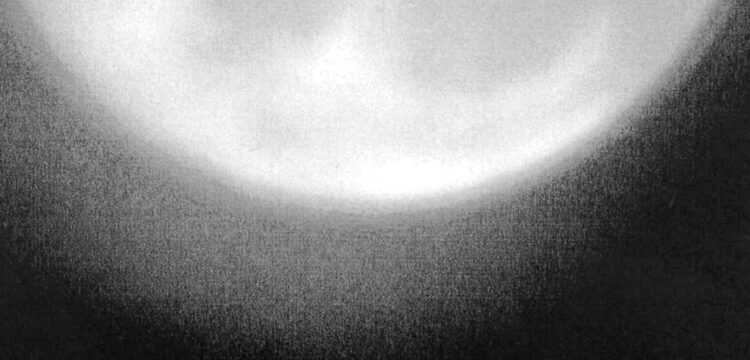
“Permanently shadowed” is the term used in astronomy to describe craters of eternal darkness—depressions on a lunar body that contain regions which never receive sunlight. These areas may also be advantageous for space exploration and potential colonization, as they preserve deposits of water ice. In the context of the exhibition, and in dialogue with the references presented, this terminology led me to reflect on how what remains in shadow is precisely that which—through a representational logic that absorbs bodies into the landscape and naturalizes historical subjects as scenery—is erased as an agent. Yet that same shadow, as the limit of visuality, also opens up a way of thinking about opacity as a condition that resists and refuses full capture.