Can a Fallen Cherry Tree Be a Speculative Infrastructure?
Speculative infrastructures are in your brain, your cognition, your lungs
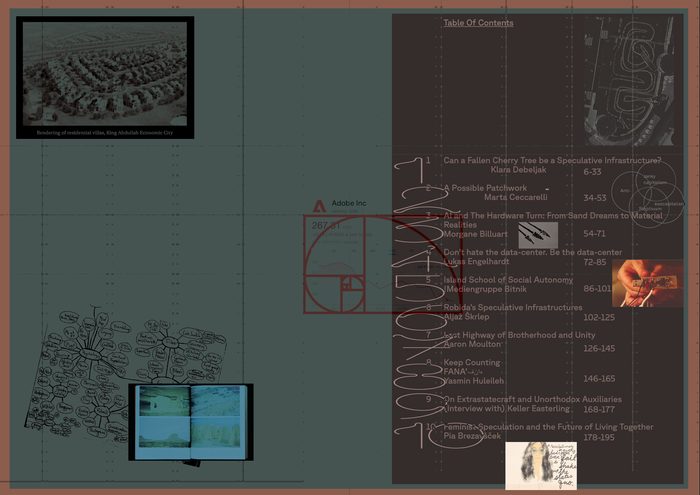
This is the introductory essay of the book Speculative Infrastructures. Outpost in Collapsing Realities (2026), published by MASKA, Institute for Publishing, Production and Education edited by Klara Debeljak, with included texts by Marta Ceccarelli, Morgane Billuart, Lukas Engelhardt, !Mediengruppe Bitnik, Aljaž Škrlep, Aaron Moulton, Yasmin Huleileh, Keller Easterling and Pia Brezavšček.
This question came up during a conversation with Robida collective—robida meaning “blackberry”—when we were deciding whether to change the title of this publication. An old professor of mine had said that Speculative Infrastructures was a lame title: too institutional, too commonplace, too often used and abused in contemporary design and multidisciplinary spatial practice circles. Too vague, he argued, too corporate and empty. So, in response, we consulted with Robida about the title, and the fallen cherry tree came up as we tried to define what an infrastructure is, or could be.
While we were discussing “opening zones” in the landscape as spaces of communion, I found it touching when Aljaž described it this way: “A speculative infrastructure, for me, is a fallen cherry tree we have in our forest here. It was used in a project as a kind of dramaturgical tool to tell a story, but it became a place of gathering. Next year it might not be there anymore, because it’s dead—it’s fallen—and this was already the second season we were spending time with the fallen cherry tree. Can an infrastructure be something temporary? Should it be something temporary? Does this give another meaning to the word? All of this opening of different spaces in the landscape, giving back worth—it’s all a part of this.”
Infrastructure is often understood as a stable, largely invisible system that sustains circulation and order. Speculative infrastructure, by contrast, names formations that do not simply maintain the present but actively test possible futures. It gives me pleasure to tag something as quickly morphing and dynamic as speculation and imagination onto the hard surfaces of infrastructure, because the current situation will simply not do. Of course we need to talk about infrastructures: we need to talk about abstract, digital, and physical architecture; borders; and speculative adaptations to our future infrastructures—because the current situation will simply not do. We are being reduced, moulded, and rendered weak and spineless, role-playing horizontality and solidarity in the organization of our micro-institutions of resistance, mechanically enacting steps toward visibility and individual success while criticising late-stage capitalism. I wrote this part when I was a bit madder, some time ago; I’m sure you can sense my anger and recognise it in yourself as well.
This anger is a product of systemic mismanagement, rampant Western imperialism, technocratic feudalism, and elite money-hoarding and laundering—causing global inequality that places the world’s Gini index at that of the most unequal country in the world, which remains South Africa, due to its racialised corruption and land distribution. This anger is the consequence of an escalating global housing crisis and an AI-fueled economic bubble which Hito Steyerl argues is a product of technologies developed for the US, Israeli and Chinese military-industrial complex—where taxpayer wealth, in the shape of government contracts, and increasing amounts of freshwater are being funneled. This anger is certainly connected to platform economies that capture radical, revolutionary terminology and actions, profiting off ever expanding sources of capital accumulation, which have now punctured the horizons of our attention, friendships, dreams, wishes, identities, and communities. It is this anger that led me to investigate what are the infrastructural conditions and spatial ownership policies that control our possibilities for navigating both virtual and material worlds. Better yet, what actions are being taken that affect these infrastructural conditions? Although it is easy to lean into the fear and disappointment produced by a collapsing system or empire, there is hope in alternative infrastructures.
For this wide and crucial conversation to take place, we must first further define infrastructure and consider how the speculative can be woven into its hard surface—as a method of constructing substitute scaffolding that holds our social and material conditions of reality, our imagination, and our urbanities. And when I say “ours,” I am speaking from a universalist standpoint, however unpopular this kind of encapsulating identity may be. Perhaps that, too, is an example of infrastructural conditioning.

In the seminal text Between Not Everything and Not Nothing: Cuts Toward Infrastructural Critique, Marina Vishmidt defines infrastructures as something that can be addressed at a transcendental level and brought down to the empirical level in the same breath. She suggests that time itself, in its Kantian diagnosis, could be conceived as an infrastructure—as well as something made of infrastructures. Infrastructures are also positioned as “mechanisms to control time.”[1] If time is an infrastructure, then a fallen cherry tree can certainly be one.
The temporality that Aljaž raises in proposing the fallen cherry tree as an impermanent speculative infrastructure is crucial, because there is a mode of temporal repetition that Vishmidt and other authors often outline in various definitions of infrastructure. This repetition is based on the material conditions that enable a system to function smoothly—to repeat and replicate in order to maintain its material status quo—and these (pre)conditions are neither visible nor relevant until they stop functioning.
A famous example of the invisible temporal and spatial organisation of infrastructures comes from The Ethnography of Infrastructure, written in 1999 by Susan Leigh Star, where she gives the example of pipes, plumbing, and water systems that disappear into the background during normal functioning but become visible when something fails and the water ceases to flow, thus “becoming visible upon breakdown.”[2] This description is useful because it uses water as a metaphor for any material travelling repetitively from source to destination, and pipes as a metaphor for the system that enables circulation. Often, infrastructure theory deals with physical conditions dedicated to the circulation of tangible materials such as water and pipes, electricity and power grids, traffic and bridges, internet and fiber-optic cables, shit and sewage systems, and so on.

What is interesting about infrastructures is that the definition can be as wide as “matter that enables the movement of other matter,” which makes it easy to bring the concept back up to the transcendental and immaterial. In The Politics and Poetics of Infrastructure, the definition is widened to include “any system that appears to underlie and give rise to the phenomenal world,”[3] which includes culture, episteme and social structure.
Infrastructures can be separated from purely technical functions and perceived as meaning-making and aesthetic vehicles directed toward subjects, determining how subjects are addressed and constituted in parallel with the system’s technical operationality. In this sense, infrastructures provide the base on which modern economic and social systems operate, by forming the polity of public life through the distribution of cultural codes and the mediation of relationships between users and their environments.
Even if we refuse to separate the technical operations from conceptual world-building potential—evident in everything from roads and railways to the undersea cables and data centers of the World Wide Web—these systems can never be regarded as purely technical. They operate on the level of fantasy, desire, and encoded dreams not only in their professing of modernity and mobility, but also in more convoluted and complex ways.
For instance, in the same text, Russian investment in infrastruktura is framed as a precondition of socialist modernity, dedicated to material and, above all, ideological progress. These investments were not planned as rational in any narrow economic sense, but understood as investing in “a new being, a new humanity and a new cosmos.”
No matter which definitional layer we dip into, infrastructures are always bound up with controlling and realising the future—an elevated, quasi-divine future—and with providing a sense of progress and mobility as part of society’s collective fantasy, despite the adverse effects on global polity they can produce when mismanaged.[4]
Infrastructures are thus responsible for the distribution of desire through the supervision of our relations to the future, and to one other. It is not my intention to analyse traditional, material conceptions of infrastructure. We will not be talking about pipes and cables much longer, but rather about the conceptual spaces architecturally and digitally distributed cultural codes enable—or block.
I began this text by describing a conversation I had with Robida collective, who live in a peripheral village nestled in the forested mountains between the Slovenian and Italian borders. Follow my memory to a late-summer afternoon, sipping Turkish coffee and talking on fold-out wooden chairs in a small grassy square, surrounded by stone houses (where they told me the collective often watches films on a projector in summer). They outlined the necessity of flipping infrastructures inside out, emphasising the ways their organic institutions hold together.
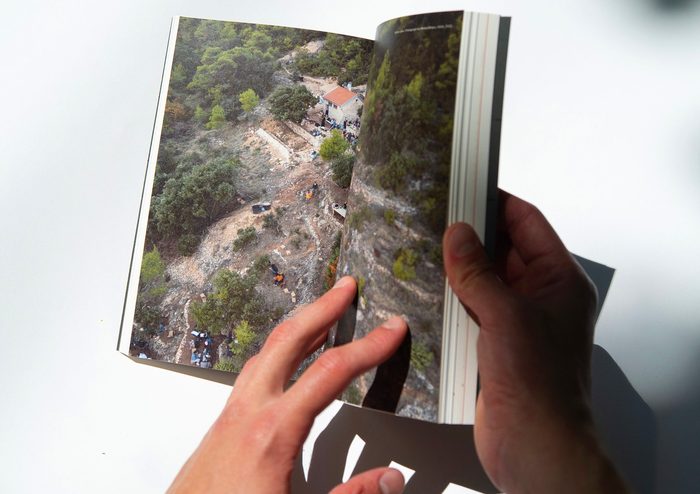
Robida collective exemplifies the notion of “people as infrastructure,” as outlined by AbdouMaliq Simone: the need “to generate concrete acts and contexts of social collaboration inscribed with multiple identities,” rather than following enforced, modulated transactions. They run a series of speculative institutions or infrastructures, such as a radio station streamed from different houses and rooms in the village, and a DIY annual magazine. Through the ether and the circulation of their printed matter, they trace the abandonment of rural areas, alternative ways of building domestic and urban structures, the growth patterns of forest moss, the path of the river running through their valley, and the idea of conceptual islands and their relationship to the mainland. This notion of islands as autonomous nodes is not only conceptual; it can also be seen in material experiments on actual islands. In a text for this publication, !Mediengruppe Bitnik describe the Island School of Social Autonomy on the island of Vis, roughly 500km south of the Slovenian–Italian border village, where a group of friends similarly explore the material conditions of autonomy in practice.
But let’s return to Robida. Vida and Aljaž, the initiators of Robida collective, agreed that infrastructures answer to the needs of a collectivity, and emphasized the care necessary for their organic institutions or infrastructures to function: cleaning spaces after events, maintaining buildings, and tending to the social bonds that constitute their work. They honour the careful attention it requires. “How do we bring out these processes and actually explore the conditions that are necessary for the structures to function?” they ask, and answer: “We put the infrastructure out. That’s why we like the term infrastructure: to say that it is hidden, but it should be hidden no more.”
This process of revealing the underbelly of social infrastructures and organic institutions resonates with the way Keller Easterling, an architect and a key voice in infrastructure theory, analyses infrastructure space. Here, we bridge a collective named Blackberry, rooted in the dense forests of the Mediterranean, to a wider contemporary web of meaning-making that spans the internet, mobile communication, and incentivised urbanism. This bridge between a small publishing community in a moss-covered village and a Yale professor studying the embedded architectural and media frameworks that shape behaviour over time can be built smoothly because both Robida collective and Keller Easterling open possibility spaces of perception. By outlining the often undeclared logics that structure spatial mechanisms, through practices of living, organising, and educating on the one hand, and through analysis and publishing on the other, they attempt to redirect and redistribute information and power.
In her writing, Easterling asks: “Who is treating space itself as information? Who is writing the software or the protocols in which spatial variables take the lead?” Tracing the spatial regulation of encoded relationships between individuals—me and you—our surroundings, our communities, and the topographies we inhabit (whether natural, architectural, or digital) reveals the dynamics of contemporary infrastructure space. These mechanisms can be examined by peeling back layers of digital siloing and urban redlining and looking at the distribution frameworks and incentives below.
Slowly, we can begin applying ideas of spatial control to the dysfunctional internet of the contemporary techno-social sphere. You might think the counter-actions of Robida collective in their mossy yards have nothing to do with incentivised urbanisation, which has nothing to do with the ballooning housing crisis tracked in cities all over the world, which is further disconnected with the ownership of broadband infrastructure or the effects of digital gentrification we face across social media and news platforms. But you would be wrong.
The interlacing of material and immaterial spaces, and the business partnerships that combine “infrastructural assets with content,” is unavoidable when thinking about infrastructure space. Opaque regimes of ownership and decision-making produce spatial software and policies that bind digital and architectural metropolises, collapsing distinctions between online and offline cultural codes. Digital infrastructures are not separate from housing: they are financed, scaled, and stabilised through property markets.
As Easterling writes in her book Extrastatecraft: “Some of the most radical changes to the globalising world are being written, not in the language of law and diplomacy, but in these spatial, infrastructural technologies—often because market promotions or prevailing political ideologies lubricate their movement through the world.” To demonstrate the collusion of digital and material real-estate ownership, lubricated by politics, we need not look far.
While considering the opacity of convoluted contracts between state-initiated investment firms and private entities, let us briefly examine the reported sale of TikTok’s US operation in early 2026. TikTok is a short-form video platform turned search engine known for its deliciously addictive algorithm. It hosts a chaotic range of content: from extreme right-wing “lonely boy” ecosystems around figures like Andrew Tate, to far-left anti-imperialist news, “dark feminine” manipulation tactics, and accounts run by thirteen-year-olds promoting baby Botox.
Anyway, TikTok’s US operation was reportedly sold under American national security requirements imposed by Donald Trump to a select consortium of partners, including Oracle and MGX.[5] Oracle is a consequential actor in the tech infrastructure scene. It provides cloud hosting and back-end services for facial recognition vendors, identity databases, and predictive analytics tools—enabling scalable biometric surveillance for government clients around the world. Oracle also has ties with Israel; its systems have been reported as being used by the Israeli military for data processing, storage, and logistics, and in 2023 it declared “Oracle stands with Israel.”[6] To accommodate this, it builds massive campuses housing servers, networking equipment, and power systems, and acquires critical fiber-optic routes across the Middle East, Africa, the Americas, and Asia–Pacific. That is some pretty widespread infrastructural monopolisation.
The shift in TikTok’s US ownership is said to have brought changes to the algorithm, aligning platform operations with the political orientation of its infrastructural hosts. The administration that mandated this sale nudges the platform’s algorithms to lean pro-Israel, pro-ICE, and anti-immigrant, reflecting racialised borders in body, mind, and land. The WizardBisan account, run by a young Gazan journalist with 1.5 million followers, was reportedly permanently banned just days after the sale, and the term “Epstein” has reportedly been blocked in private messages, officially attributed to a storm-related technical glitch. Ownership of TikTok encompasses not only the material infrastructures of information highways, but also the algorithms and cultural codes they govern, constituting a form of spatial governance.
That is Oracle in short. Let us now turn to MGX, and to a broader financial ecosystem that reinvests profits extracted from real-estate monopolisation, segregation, and commercialisation into expanding layers of digital infrastructure ownership.
MGX Fund Management Limited is an Emirati state-backed investment firm focused on AI and advanced technology infrastructure, and it frequently partners with BlackRock, Global Infrastructure Partners, and NVIDIA. Together, they form investment consortia and handle large-scale AI infrastructure projects, with BlackRock providing capital directed toward constructing or acquiring data centers and semiconductor facilities.
While this is not housing in the narrow sense, BlackRock’s capital is heavily entangled with property-based investment vehicles. As the world’s largest asset manager, it oversees trillions for governments and institutions, working with real estate investment funds, managing assets, and investing in mortgage-backed securities. BlackRock reportedly owns around a 6% share of the Swiss real-estate sector.[7]

Blackstone, which founded BlackRock in 1988, further illustrates how property-based income is redirected into the monopolisation and control of technological hardware. Alongside fewer than ten firms, it reportedly controls over 50% of institutionally managed real estate globally.[8] In the UK, Blackstone has become a major provider of newly built “affordable” housing, transforming rental and sub-market housing into tradable financial assets, strengthening corporate landlords while deepening the housing crisis.
Housing and digital infrastructure do not operate as separate domains, but as mutually reinforcing systems of spatial governance where the extraction of value from living space finances the control of informational space. This convergence reflects what Morgane Billuart describes as the hardware turn, or how digital technologies, often imagined as weightless and abstract, are grounded in material resources and power relations. Digital architectures and cyber infrastructures are inherently tied to the distribution of land and resources. From this convergence emerges not only a consolidation of infrastructural power, but a narrowing of the conditions under which alternative forms of life can be imagined, precisely the conditions that speculative infrastructures attempt to reopen.
We witness material and digital segregation through zoning regimes, algorithmic filtering, and pricing that sorts populations by class, race, or labor value—as well as through paywalls, shadow-banning, and linguistic hierarchies that marginalise certain users. These processes multiply borders upon borders, fragmenting access into smaller and smaller slivers of increasingly monetised public and private space.
From displacement to invisibilisation, from absurdly rising rents to monetised reach, from gated communities and countries to platform enclosure—you just need to open your windows to see the evidence. I would go so far as to propose that the same mechanisms driving the gentrification of urban metropolises are now driving the gentrification of the internet and the information sphere, through spatial capital extraction on steroids and the financial “optimisation” of space.
We must realise that we live at the convergence of authoritarian power and digital technologies, perched on the brink of techno-fascism in our overpriced little square metre. Or perhaps we have already accelerated past that edge, during our lockdown-induced depressive haze. I speak for myself, but isn’t it possible we’re already living in techno-fascism?
We, the civic population, whether we are positioned as freelance writers in relatively well-off Ljubljana or as fruit sellers on the streets of Dakar, Senegal (where apartment prices are rising by 5-8% annually, coincidentally the same rate as in Slovenia), are trapped in precarious conditions across different magnitudes of existential urgency. Addicted to short-form brainrot and juggling multiple jobs in the latest manifestation of the gig economy, we are stranded in increasingly isolated lives, seemingly devoid of solutions and prospects for a more just infrastructure space. Or so we are meant to believe. I want to point here to the text in this publication by Yasmin Huleile, co-founder of the publishing collective Fana’ in Ramallah, where she writes of the possibility of colonised thought: “Or does there remain a space of negotiation between context and self?”

As far back as 2008, the anarchist David Graeber wrote that hopelessness is not a natural phenomenon; it must be produced. As a species, just like any other on this sweet earth of ours, humans are in fact quite adaptable. We are able to generate hope naturally and insistently survive various adverse conditions, a predisposition I tend to link to evolutionary survival instinct. Graeber describes a global bureaucratic apparatus constructed to “shred and pulverize the human imagination, to destroy the possibility of envisioning alternative futures.”[9] The notion that this pervasive feeling of hopelessness is manufactured, malleable and must be challenged runs through Jameson, Fisher, Žižek, Berardi, and earlier through Gramsci and Bourdieu, the latter defining neoliberalism as a “programme for destroying collective futures.” Yet when we are deeply immersed in compromised media infrastructures and post-truth rhetoric, it becomes difficult to track—let alone trust—the shifting infrastructural realities that are silently, slowly and continuously being constructed under the radar, beyond what is served to us on rented communication real estate.
The layers of our own personal bureaucratic hellscapes still exist—the zoning standards, fences, tax havens, convoluted distribution logics, and billionaires guzzling unimaginable resources still exist. But there is also a whole lot of something else. Something we often disregard, forget, or simply don’t see because cynicism has permeated our cognitive filter so thoroughly. If we sift through this defense mechanism, we begin to identify various counter-structures rising up.
Socially anchored and locally oriented initiatives exist everywhere: pathways being built by collectives that harness radio frequencies, distribute information through organic channels, buy food for neighbours in need, or hide neighbours from state prosecution. These local initiatives have the potential to scale into strategic and territorial networks that embody alternative forms of ownership and resistance to colonial land grabs. Recent examples are countless, but two I especially like are the civilian-led crowdsourcing of $78 million to purchase and protect forests in Northern Patagonia, targeted by corporations for timber and water sources, and a solar-powered hospital in Burkina Faso, erected in the first three months of 2025 using only recycled solar panels. These are material infrastructures and formations, but they also function as speculative gestures toward alternative organizational modes. And yet, they are frequently muddied by political propaganda or buried in the depths of war-oriented search engines.
Not only do cynicism and realism around the housing crisis and the tangible spiralling of foreign policy and politics stand in our way. Across platforms, policy, finance, urban planning and journalism, mechanisms converge to suppress or absorb generative initiatives before they can scale. As Graeber wrote: “Nothing terrifies the rulers of the world, and particularly of the United States, as much as the danger of grassroots democracy.”[10] If we examine the violent erasure of squat networks across Europe and the US, the bureaucratic and financial attacks on housing cooperatives, the minimisation of global protests against inequality, and the under-reporting of assassinated journalists—from the Panama Papers reporter in Malta to investigators of corporate pillage in the Amazon—a pattern begins to emerge. Violence, obfuscation, and administrative pressure operate together as infrastructural enforcement mechanisms. As you and I know, infrastructure and information cannot be neutral; they are steered to obstruct dissidence and obscure its ongoing manifestations. We consume information under an averted media gaze, sweeping real dissident structures under the rug of outsourced memory and fragmented identity clusters, which mould our collective consciousness and our capacity for collectivity until we feel utterly powerless. Manufactured hopelessness narrows the field of perceived possibility, aiming to stabilise and consolidate power by ensuring that certain realities remain unreported and therefore politically inactionable, pre-empting calibrated resistance.
If Easterling’s Extrastatecraft maps how infrastructure becomes the medium through which power circulates beyond formal law, Marina Vishmidt’s Cuts Toward Infrastructural Critique asks what happens when that medium begins to degenerate. Vishmidt describes the deteriorating built environment of the United States as the clearest view onto the “formerness of the ‘West’ as a progressive theodicy, levelled down by necrocapitalist extraction,” while still retaining “a disproportionate capacity to project violence across the globe and its residents.” The contradiction is stark: infrastructural decay at home paired with infrastructural dominance abroad, enforced through an insistent web of structural and cultural hegemony.
What we are witnessing is not the disappearance of Western power but the erosion of its ideological coherence. That is certainly why TikTok’s US operations were tactically purchased: to shore up Western, or specifically American, ideological coherence, which is currently in freefall. Much as in the later centuries of the Roman Empire, the slow unravelling of the British Empire, and the final decades before the Soviet Union’s collapse, administrative and geopolitical strength persist even as the narrative that once justified it fractures from within. The “West” persists as an infrastructural regime even as its claim to linear progress, developmental inevitability, and moral universality collapses. Its formerness is not geographical; it is temporal and ideological.

The formerness of the “West” names a system that continues to operate but no longer convincingly explains itself, increasingly unable to ignore its “dangerously frayed built environment”[11] and internal discord. It also names the increased transparency of an organisational order that operates globally through neoliberal, arrogant economies, forming the same financial architectures that underwrite digital platform ownership, AI infrastructure and land monopolisation.
This formerness is visible not only in discourse but in material reconfiguration. A slow but perceptible shift away from US-controlled financial infrastructure, through de-dollarization efforts, alternative payment systems, gold repatriation, and BRICS realignments, signals both a top-down multi-polarisation and a bottom-up dissonance and fragmentation already in motion. The system does not collapse all at once; it loosens unevenly.
And it is precisely this loosening—made visible to the masses through infrastructural failures, contradictions, and exclusions—that signals the break. The water has, in some metaphysical way, stopped flowing. The entire previously uncontested or invisible system of organisation “leaps into our cognitive field.” As Vishmidt writes: “Infrastructure might be that which repeats, but this repetition is not without difference: it can monotonously produce the same differences (such as infrastructures that reproduce social inequalities), but it can also be a means of ensuring the reproduction of a wholly different form of social life over time.”[12]
Well-functioning infrastructure space should provide reliable access to space, time, water, energy, digital networks, information, and transport, enabling equality through social mobility, participation, and inclusion. Infrastructural critique, redefined in the post-internet era, has resurfaced in the 2020s to the point of oversaturation. No wonder my old professor advised me to change the title, since the terms “speculative” and “infrastructures” capture a sentiment that is globally and intensely felt. Infrastructures, in their multi layered definition, have clearly ceased to function as they should. This ongoing malfunction is perceived across the political spectrum, even as traditional left–right distinctions increasingly blur. Hence the over-use of “speculative,” signaling a yearning for a different reality.
The exposure of infrastructures, stripped of the myth of progress that once naturalised them, reveals a layer of reality in which systems are already being adapted and moulded through fragmented and patchy approaches. Marta Ceccarelli, a young author included in this publication, writes about a possible patchwork and borrows the term from her grandmother’s writing, which frames patching as the art of gathering “fragments of material and fragments of time.” This idea of patchiness keeps reappearing as a counterweight to overarching, globalised solutions for cohesive political and organisational systems. It evokes patches of grass pushing through cracks in asphalt, or the spaces between concrete tiles. It is within these unofficial cracks and institutional workarounds that the idea of speculative infrastructure is born.

Speculative infrastructures are networks and collectives that challenge dominant techno-social systems through creative, real-world practices and imagine new ways of organising, owning, and resisting—often from within or alongside existing institutions. Speculation is the activity of guessing possible answers to a question without having enough information to be certain. If we borrow the definition from finance, speculation involves buying into or betting on a version of the future, hoping its value will increase, and then profiting from that bet. Both definitions apply here: in the context of speculative infrastructures, speculation means investing thought, hope, and action in an alternative vision of the future, hoping the practical and conceptual value of that version of events will grow.
Speculative infrastructures are not merely hypothetical goals, distant dreams, or live-action role-play; they are already material realities manifesting in the gaps of failing systems. Not as a twentieth-century-style binary political ideology, but as an archipelagic formation of nodes that form messy coalitions with diverse methods and principles that can nonetheless link into strategic and territorial networks.
By quietly erecting outposts for alternative infrastructure space, these initiatives propose wholly different forms of social life, slowly shifting existing frameworks toward ways of organising and inhabiting the world on our own terms, with more independence and integrity. In this gradual, bottom-up process of fragmentation, it is clear that seeds for alternative ways of organising and consuming were planted long ago by generations of activists, writers, and marginalised or Indigenous communities. Having experienced the collapse of infrastructural modernity far earlier and more viscerally than the broader white Western polity, it is unsurprising that radical Black authors such as Assata Shakur, Angela Davis, Audre Lorde, and Octavia E. Butler are experiencing a resurgence. Their work speaks directly to contemporary struggles over systemic inequality, anti-authoritarian praxis, and collective survival.
Crucially, many less radicalised communities are organically attempting to construct shared and alternative spatial, social, digital and architectural infrastructures as confidence in dominant institutional logics erodes, often mobilised through the concept of the “commons.” Collective actions in the arts, critical theory, academia and urbanist initiatives emphasise locality and care (to the point of exhaustion), while also attempting wider critique and counter-action. In parallel, various state and privately funded institutions, alongside self-organised and self-funded collectives, steadily supply sturdier, less algorithmic, more analogue ways of distributing information, often with strong anti-imperialistic sentiments. Here I’m referring to a wide variety of publishing initiatives, pirate radios, podcasts, newsletters, Substacks, raves, residencies, cultural programs, and mutual-aid networks. Empires fall—that is a fact, in histories written by lions and sheep alike. The question is how to direct the transition.
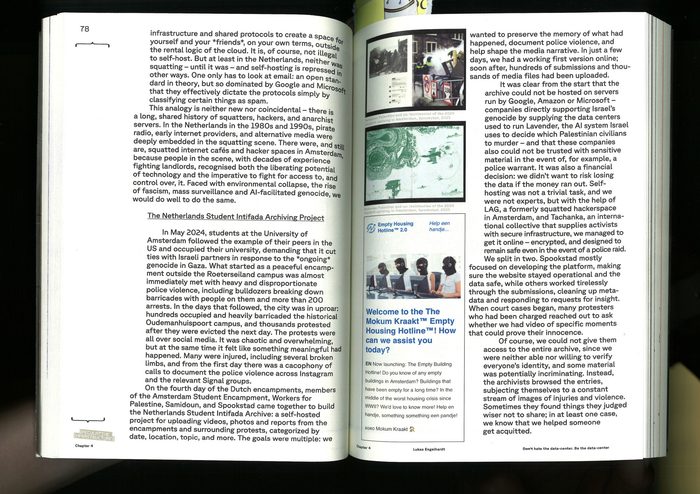
Tracing the history of liberation movements reveals that cultural and intellectual autonomy is almost always built through “patchy” infrastructures, with information transmitted through guerrilla education programs, radio frequencies, and printed matter long before formal political autonomy is won. Across historic examples of European state formation and liberation movements in South America and Africa, the rise of alternative media formats is closely tied to the collapse of larger power conglomerates. As dominant systems for organising land and power begin to fail, networks of resistance emerge through alternative media infrastructures, attempting to redirect cultural codes. As Lukas Engelhardt argues, resilient movements cultivate their own archives, servers, and communication systems rather than relying on centralised platforms. In this light, DIY publishing functions as a low-tech yet autonomous channel, showing how alternative networks can persist and spread while evading censorship or erasure.

Let us examine a selection of historic revolutionary examples. Before and during the French Revolution of 1789, pamphlets produced on small presses circulated widely. Later, during the Paris Commune of 1871, workers produced improvised newspapers and bulletins, creating a decentralised communication network. By the time of the Spanish Revolution of 1936, anarchist unions (CNT) were running collectivised print shops to sustain their vital communication. Slovenia’s independence was deeply influenced by vernacular DIY print circulation as far back as the 1550s, with materials smuggled through underground networks to build identity and encourage autonomy. This legacy continued through the Yugoslav Partisan resistance, which spread anti-fascist news via leaflets, culminating in 1941 when Radio Kričač began broadcasting illegally in occupied Ljubljana to circumvent Axis propaganda and mobilise resistance.
In Ghana in 1947, anti-colonial activists used DIY newspapers linked to Kwame Nkrumah to lay the groundwork for the first African independence of the era. Similarly, the Algerian National Liberation Front used pamphlets in 1953 and later the illegal radio station Voice of Fighting Algeria to mobilise resistance. The list extends to the mountains of Cuba (1959), with Che Guevara’s Radio Rebelde, and to the mining communities of Bolivia in the 1980s, where Radio Pío XII organised against military rule.
In a recent Robida collective publication titled TRANSMISSIONS: Radio Essays on Edges, Crossings and Narrowcasting Borderlands, Aljaž refers to Frantz Fanon and his writing on Voice of Fighting Algeria. Fanon described the broadcast as fragmented and choppy because of constant imperial sabotage. Both Fanon and Aljaž see something emancipatory in that choppiness: “Listeners became active co-fighters, forced to actively search for new frequencies in their living rooms as the authorities jammed the current one.”[13]
The examples listed above are remarkable in their shared reliance on media formats to cultivate new audiences and impact existing ones. This is not unlike the various meme accounts, pirate radio stations, and rising zine production we can observe today, if we direct our attention toward a wave of content production that tries to subvert or supplement the information most easily within reach.

Evidence of a contemporary global rise in DIY media infrastructures, recontextualised as outposts of dissident networks, is visible across multiple forms of media circulation, from the airwaves to the spoken and printed word. The Federal Communications Commission (FCC), the US government agency responsible for regulating radio, satellite, and cable communications, has reported increasing unlicensed FM broadcasting activity in urban hubs such as Boston and Miami. Regulatory crackdowns and field reports suggest that unlicensed radio broadcasting is also widespread and rising in Africa and Latin America. Authorities in South Africa have recently targeted dozens of newly formed unlicensed pirate radio stations, while in countries such as Brazil pirate broadcasters operate in dispersed, largely untracked networks. In cities such as Buenos Aires, São Paulo, Mexico City, and Santiago, independent publishing fairs and zine networks assemble dense, self-organised circuits of small presses. One of the clearest statistics supporting the claim that DIY publishing correlates with a drive for political autonomy is that, worldwide, the number of self-published books rapidly expanded by 32.5% in 2025 alone, surpassing 4 million titles.[14]
Founded in the late 2010s, The African Art Book Fair exemplifies a newer layer of informal, para-institutional publishing infrastructures centered on independent print culture. Its collaboration with international Lumbung Radio extends this ecosystem into transnational networks of open culture and activist media, operating tirelessly across time zones. At the same time, the organisation initiates capacity-building networks for small-scale publishers across the continent in collaboration with the Goethe-Institut, demonstrating how these infrastructures are being expanded from within and alongside existing institutions. As Aaron Moulton suggests, art can be strategically mobilised as a subtle form of social engineering that, when consciously developed and critically engaged, can be harnessed to cultivate emancipatory and transformative forms of social organisation. The rise of DIY publishing, book fairs and pirate radio stations is not an isolated trend, but signals a fundamental shift away from centralised, legacy media structures toward self-organised and resilient networks. Communities are increasingly taking responsibility for the production, archiving, and circulation of narratives outside monopolistic ownership and control.
Think of Robida’s fallen cherry tree, described as a dramaturgical tool used to tell a story, which then transcended its initial purpose by becoming an opening in the landscape and a gathering place. In the same way, tactical media initiatives and DIY media infrastructures often surpass their original function as dramaturgical tools for circulating narratives and ideas. Operating as social, material, and spatial nodes, they are born from, and open up, new spaces for connection, collaboration, and community that exceed their intended purpose.
This process includes the proliferation of publishing and pirate radio collectives, but it also extends into mesh networks, self-hosted server communities, and other autonomous digital platforms. What often necessitates this production is independent energy, which today can be linked to the growth of solar communities. These community conduits reinforce social infrastructures alongside material ones, producing renewed collectivism. This becomes a crucial base for “worldmaking, aimed at building and rebuilding actual structures of social connection and movement, rather than mere critique of the ones we already have.” Organic frameworks of friendship and camaraderie unfold quietly on hidden terraces soaked in laughter. They may feel negligible, but they have always been the backbone and scaffolding for any speculative variation of the future.

While researching social infrastructures and trying to define speculative infrastructures, I interviewed Seid’ou Karî’kachä in Kumasi, Ghana, about his work as the de facto initiator of the Blaxtarlines collective: a polymorphous initiative spanning contemporary art, performance, theory, and pedagogy, shifting and expanding over decades. I was attempting to map successful methods of horizontal organising in collectives that initiate bottom-up cultural and infrastructural shifts over time. Starting as a few friends in the 1990s who saw space for change within Ghanaian educational institutions, Blaxtarlines has now grown beyond comprehension. Members of the collective were invited to curate the 35th Graphic Biennale in Ljubljana in 2023, reinvigorating cultural and infrastructural exchange rooted in the legacy of the Non-Aligned Movement. Ibrahim Mahama, also a member of Blaxtarlines and the artistic director of that edition of the Ljubljana Biennale, was awarded “most influential artist of the year” in 2025 and is the first African artist to receive the title. The extent of the collective’s influence has “changed the past,” according to Karî’kachä, who refused to claim the title of initiator.
Our conversation took place in 2024 in a building called the Senior Staff Club on the Kumasi campus: a beautiful Brutalist structure with open terraces and wide staircases that interlock at sharp angles, built by the Croatian architect Miro Marasović in the 1960s as a result of bilateral technical cooperation between Yugoslavia and Ghana. An impressive architectural remnant of Non-Aligned Movement heritage, it felt like a Yugoslav Brutalist vision among the tropical trees and falling dusk, far from anything I expected to recognise as familiar. Karî’kachä laughed and explained precisely: “It isn’t a chronological thing. What is happening today changes what the past was. So it’s very difficult for me to tell it like that, like how it began. The fact is that yes, at that point, at the beginning, I was there. But now looking at what has happened, you know, it’s gone beyond the facts. There’s no point thinking that where you begin to do your politics should also be the destination.”
Just like the Robida collective, the members of the Island School of Social Autonomy, the Fana’ collective, and Lukas Engelhardt’s Spookstad publishing initiative, Karî’kachä was adamant that friendship is essential to Blaxtarlines’ foundation and current activities. He outlined the care, respect, and resourcefulness without which the undefinable sprawl of Blaxtarlines could not function.
Blaxtarlines is a conglomeration of students who became professors at the Kwame Nkrumah University of Science and Technology, alongside newer generations of students growing into a fresh legacy. It encourages the development of cultural codes that have yet to be symbolised because, as Karî’kachä put it, “Speculative space is where none of us have mastery.” I try to push him to define Blaxtarlines’ mechanisms of growth and dissemination more precisely, to understand how a completely horizontal organisation with no centralised control or programming mechanism can function as effectively as it does.
What becomes clear through this exchange is that Blaxtarlines collective does not operate as infrastructure in the conventional sense. There is no blueprint, no centralised logic to replicate, no stable origin to return to. Instead, it behaves as a living social organism, expanding through relations of trust, pedagogy, and shared experimentation. This resonates across the other essays in this publication. The temporality of such movements is constantly rewritten through present activity, retroactively reshaping the past while prefiguring the future.

This dynamic echoes what Pia Brezavšček identifies as a core condition of neofuturist practices in her definition of Yugofuturism, a movement that draws on unrealised potentials of the past—such as regional coalitions and housing principles of socialist Yugoslavia—and reworks them into future possibilities. Brezavšček argues that neofuturist practices emerge from peripheral or minoritarian positions and intervene not by accepting projected futures, but by actively reconfiguring them. In this sense, speculative infrastructures become proactive distortions of imposed narratives, refusing inevitability and instead playing with improbable futures as a form of friendship and collective agency.
It is no coincidence that these truths were clarified in a building that embodies historic South–South cooperation and Non-Aligned solidarities. Karî’kachä and I sat there among stones shaped by that history, unwittingly echoing the layered temporality of neofuturist practices.
In Slovenia, we have a proverb: “Zrno na zrno pogača, kamen na kamen palača,” which translates to “grain by grain makes a loaf, stone by stone makes a palace.” It expresses the idea that you reach a goal through tiny, cumulative steps that can feel insignificant in isolation. The same principle holds for coalition-building: interlinking across marginalised communities and across the borders of identity can produce durable alliances that result in material, architectural consequences you can touch, and land distribution strategies that remain referential over time. It is precisely this kind of interlinking, across different scales and conditions, that enables people to collectively imagine beyond modulated relationships and imposed infrastructural limits—and to create the conditions in which new imaginaries can flourish.
Much like Blaxtarlines or Afrofuturism, Yugofuturist imaginaries do not attempt to restore a lost past or stabilise a singular future. Instead, they assemble fragments of memory, ideology, and unrealised potential into new configurations, moving across different temporal registers. They acknowledge contradiction and incompleteness as conditions to work through rather than problems to resolve. As Brezavšček writes in her Yugofuturism manifesto, a text several authors in this publication return to, “to imagine different futures does not mean to make all antagonisms disappear, but to invent feminist strategies to steer between them better.”[15]
Feminism here functions as a method for navigating fragmentation with precision and care. And it brings us back, again, to patchiness as a strategy that can outlive the monopolisation of land and information. When fragmentation is practiced on our own terms and recontextualized as archipelagos or nodes of resistance that can align, connect, and scale into territorial networks across a pillaged globe.
Speculative infrastructures, in this light, are not merely alternative systems waiting to replace dominant ones. They are already embedded within existing conditions, quietly re-routing flows of information, resources, and affect. They are the grass we must touch, forcing its way between slabs of concrete that loosen under the weight of trillions of steps and an ever-changing climate.
Speculative infrastructures operate through friendship, mutual aid, pedagogy, tactical media, DIY publishing, and cultural production, through the very social fabrics so often dismissed as secondary or informal. Listing their nodes does not do justice to what they enact, or to the possibility of immersing ourselves in the islands of light rising around and between us. They are not only relations between friends and collaborators, but also tangible places in which those relationships blossom and deepen. They can be in your living room. They are certainly in mine.

A fallen cherry tree is a speculative infrastructure, but so is the invisible path between that fallen cherry tree and the Senior Staff Club in Kumasi. They are a shifting terrain, shaped by those willing to inhabit uncertainty without mastery, and with the courage to lean into hope and perseverance without drowning in cynicism.
Speculative infrastructures are in your brain, your cognition, your lungs; they are shifted cultural codes, words that sit like marbles in your mouth. They do not offer a singular vision, but they insist that other ways of organising space and communication are not only imaginable, but already underway, scripted in alternative temporalities since the beginning of time.
Footnotes
[1] Marina Vishmidt, “Between Not Everything and Not Nothing: Cuts Toward Infrastructural Critique”, in Former West: Art and the Contemporary after 1989, ed. Maria Hlavajova and Simon Sheikh (Cambridge, MA: MIT Press, 2016), 265.
[2] Susan Leigh Star, “The Ethnography of Infrastructure”, American Behavioral Scientist 43, no. 3 (1999): 382.
[3] Brian Larkin, “The Politics and Poetics of Infrastructure”, Annual Review of Anthropology 42, no. 1 (2013): 329.
[4] Larkin, “Politics and Poetics,” 333.
[5] Justin Hendrix and Michael Kwet, “How to Make Sense of Trump’s TikTok Deal”, Tech Policy Press, January 6, 2026, https://www.techpolicy.press/how-to-make-sense-of-trumps-tiktok-deal/.
[6] Sam Biddle and Mara Hvistendahl, “Oracle Executives Side With Israel as Its Military Launches a Cloud Revolution”, The Intercept, November 15, 2023, https://theintercept.com/2023/11/15/oracle-israel-gaza-cloud-military/.
[7] “BGF World Real Estate Securities Fund – BlackRock”, BlackRock Investment Management, February 28, 2026, 1–4, https://www.blackrock.com/ch/individual/en/literature/fact-sheet/bgf-world-real-estate-securities-fund-class-a6-usd-factsheet-lu1499592464-ch-en-individual.pdf.
[8] “ANREV/INREV/NCREIF Fund Manager Survey 2025”, INREV, June 3, 2025, https://www.inrev.org/news/inrev-news/global-real-estate-aum-falls-third-consecutive-year.
[9] David Graeber, “Hope in Common”, David Graeber Institute, November 14, 2008, https://davidgraeber.org/articles/hope-in-common/.
[10] Graeber, “Hope in Common”.
[11] Marina Vishmidt, “Between Not Everything and Not Nothing: Cuts Toward Infrastructural Critique”, in Former West: Art and the Contemporary after 1989, ed. Maria Hlavajova and Simon Sheikh (Cambridge, MA: MIT Press, 2016), 268.
[12] Vishmidt, “Between Not Everything and Not Nothing”, 268.
[13] Aljaž Škrlep, “TRANSMISSIONS: Radio Essays on Edges, Crossings and Narrowcasting Borderlands”, in Transmissions: Radio Essays on Edges, Crossings and Narrowcasting Borderlands, ed. Aljaž Škrlep (Gornje Topolove: Robida Collective, 2025).
[14] “Book Output Topped Four Million in 2025”, Publishers Weekly, March 17, 2026, https://www.publishersweekly.com/pw/by-topic/industry-news/publisher-news/article/99943-book-output-topped-4-million-in-2025.html.
[14] Pia Brezavšček, “A Manifesto for Yugofuturism: Maska’s Tools and Strategies for Imagining Possible (Feminist) Futures Inspired by Regional Pasts”, Feminist Encounters: A Journal of Critical Studies in Culture and Politics 9, no. 2 (September 1, 2025): 26.