
Bouncing From City To City
Between India, Germany, Pakistan and the rest of the world: an interview with Sarnath Banerjee
This conversation with Sarnath Banerjee follows the release of Absolute Jafar, “wonderful… a real cure for anxiety in the form of a graphic novel.”
Delhi in February is surprising. The blanket of smog and fine particulate matter—a feature that has, sadly, become typical of the Indian capital during the winter months—has almost completely lifted. Instead, an unusually blue, almost clear sky has emerged, along with a shy, warm sun. Despite the almost fairy-tale-like and mild awakening of the Indian spring, accompanied by the chirping of parakeets now inhabiting the city’s green spaces, Delhi maintains its tireless rhythm, between sudden moments of calm and the constant buzz of a dynamic city: exceptional events, shows and festivals, international exhibitions, and talks with special guests alternate with the metropolis’s daily grind, the everyday lives of ordinary people passing through the crowded alleys of Chandni Chowk in Old Delhi, Connaught Place—the commercial heart—or the more residential areas of Greater Kailash and Saket.
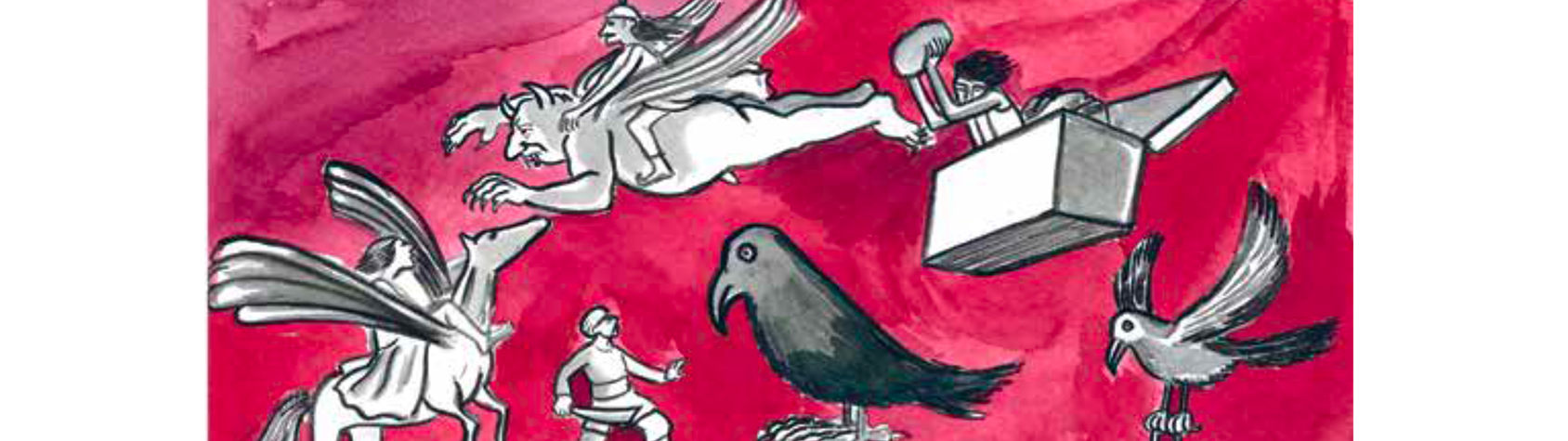
With Absolute Jafar, published this February, Sarnath Banerjee returns to wander through some of these places, and these sensations, in the streets of Kolkata, Karachi and Berlin. Sarnath Banerjee (1972), born and raised in Kolkata, is a writer, visual artist, illustrator and much more. He prefers the “losers” who inhabit everyday life, describes himself as an “oblique chronicler of insignificant things,” and explores what lies hidden in a seemingly ordinary life; he loves walking (and sometimes even running), often aimlessly. Although he would never admit it, Sarnath is now one of India’s most acclaimed comic artists and graphic novelists, ever since his hugely successful work Corridor (2004), followed by The Barn Owl’s Wondrous Capers (2007), The Harappa Files (2011), All Quiet In Vikaspuri (2016), Doab Dil (2019) and his recent work as co-author and illustrator of Julia Hauser’s The Moral Contagion (2024). His works are brilliant, varying in terms of formal structure, yet in every instance revealing a refined literary take on the mundane: Sarnath manages to weave marginal stories into broader narrative (and visual) frameworks, resulting in a compelling and genius collection of tales that are at once daring, ambitious and modest.
Corridor is set amidst the streets of Kolkata and the chaotic Connaught Place and Lutyens’ Delhi—the administrative heart of the former colonial capital. The protagonist is the young Brighu, “a postmodern Ibn Battuta” in search of unusual collectables. This visionary and harmonious combination of text and image results in a mosaic of encounters and interactions that often revolve around the intriguing second-hand bookshop of Jehangir Rangoonwalla, a wise purveyor of tea. The indecision of Digital Dutta, a young character torn between the American dream and Marxist philosophy, Brighu’s sense of alienation and Shintu’s marital problems, are layered into a fragmented narrative that oscillates between individual stories, the everyday life of urban spaces—narrow and transient like “corridors”—and the interplay of grand dreams and existential irony.
In Absolute Jafar Sarnath returns to wander between Delhi, Kolkata, Karachi and Berlin. The journey, almost disjointed, recounts the passing of time, bureaucratic hells, and a complicated love story born on the Indo-Pakistani political border: Bhrigu returns as an adult, and almost stepping aside, he lets the story tell itself, at times apathetic, nostalgic, simultaneously profound and carefree. With this latest publication, the reflection on spaces and protagonists, oscillating between irony and bitterness, has become systematic, yet it presents a turning point—or a setback—to the pervasive sense of pointlessness: the birth of Jafar, a non-traditional protagonist, becomes a narrative metaphor amidst fading memories and the boundaries that shape the family narrative between the worlds of Bhrigu and Mahrukh. It is no coincidence that in cricket the expression “absolute jaffa” refers to a flawless delivery: precise, surprising and almost impossible for the batsman to hit.
Ever since our first “session”—a playful nickname he gave to our meetings, referring to my naturally calm tone of voice—he has devoted himself wholeheartedly to lengthy discussions. Sarnath wears dark-framed glasses with thick lenses, electric blue trousers, and a large ring on his left hand. He is spontaneous, thoughtful and, at times, hilarious, even when discussing matters that are not quite so innocent. His works are deeply relational, witty and sparkling commentaries on the neoliberal and postcolonial millennium; he is a visual storyteller of Generation X, a critical observer of everyday visual history who involves the reader as an integral part of the work.
After the ritual question “kophī ya chāy?”, I wait for a cup of black tea and look around the living room, trying not to let on just how curious I am about my surroundings. Paintbrushes, watercolours, ashtrays, books in Bengali, old comic books, sketches, several pairs of spectacles… as well as the more or less identifiable objects scattered across the work tables, there is a long, reddish-wood bookcase running the entire length of the wall opposite my armchair: I wouldn’t be surprised if it suddenly burst open and I found myself buried under books.
This surreal image of the imminent explosion of pages of literature finds a perfect parallel in our conversation: Sarnath tells me about Vinod Kumar Shukla, the acclaimed Indian writer and poet, and his short story Dīwar Me Ek Khidki (There Was a Window in the Wall), which we both agree reminds us of Italo Calvino’s The Baron in the Trees. He seems to have an answer for everything, weaving together anecdotes and curiosities, drawing on topics that span the literary, artistic and cultural landscapes of India, Bengal and Pakistan, as well as Italy, Europe and America. Sarnath asks me many questions and I realise that the interview is almost turning on its head. I break the ice and step forward with my first question.
Marta Varini: During the presentation of Absolute Jafar, you jokingly said that you are not very good at drawing. Given your recent experience at the 2025 Berlin Art Biennale, how would you define yourself? As an artist, illustrator, writer, or something else? But do you think it is necessary to define one’s artistic expression in order to understand how your work should be interpreted?
Sarnath Banerjee: Yes, I was joking—or at least partly. Although my drawing skills have improved over the years, they’re nowhere near those of the extraordinary artists I admire. I lack their lightness of touch, their expressiveness, their natural ability to draw whatever they please. Even today, when I’m faced with a blank sheet of expensive paper, I panic. But I’ve accepted this limitation of mine. I just want to live long enough to improve my skills a little. I always try to beat my own records, the ones I’ve set for myself. Like a high jumper competing only against himself.
Even though I’m not able to achieve ideal perfection, I personally think I’m the best person to draw the people, places, and objects that live in my mind. If my skills were greater, I’d probably find it harder to express myself naturally.
I tell stories in a pictographic-textual way. This means I can’t write a text without interspersing it with images. Although comics are often regarded as a visual medium, I believe they are primarily textual artefacts. Even when there is no text. Because images can be read, just like text.
Returning to the question of “self-definition,” yes, I’d like to belong to a community. Writers, illustrators, artists, visual storytellers, filmmakers: I don’t think anyone would want me on their team. Every field has its own boundaries. Comics and graphic novels are quite independent. I’d say that our closest cousins—in terms of the creative process—might be musical composers. A comic, even if it’s well-made, visually appealing and cleverly written, can still be rather out of tune. And nobody likes comics that are out of tune.
There is a common thread running through many of your works: the nostalgia that pervades various events and aspects of life, the sense of alienation, and the fragmented realities that come together in the search for identity—a theme typical of citizens in postmodern society. How do you think your style has evolved over the years? Do you feel you have “exhausted” this kind of theme in your latest book?
Nostalgia, hmm… actually, it’s a feeling that makes me uncomfortable. For me, nostalgia is a selective memory of a glorious past, and therefore certainly distorted. It conceals privilege and injustice. It’s a bittersweet feeling, a mechanism that alters reality to create a private utopia, very often a delusional one.
I am a chronicler of events. Ordinary events in extraordinary times. I record things remembered poorly but fondly. Trivial matters. For example, how a generation felt at a particular historical and social moment. Of course, over the years my style has changed; it has become simpler, more essential. I find that Absolute Jafar, my most recent work, is less performative. I have learnt to approach things calmly and find great pleasure in the process I choose to adopt. Since my finances are not tied to my comics, I don’t have to be extremely productive. I work daily and live very frugally, but I allow myself the time to experiment and learn.
I draw my narrative and visual references from the fruits of urban life: the people, places and architecture one encounters in everyday life. Whereas my influences used to be external, my process (or style) has now become increasingly internal, more intimate. In this, I recognise that Indian classical music and the Navarasa (the nine rasas) have certainly helped me to process my thoughts and put them down on paper.
In conclusion, no, I don’t think I have fully explored these themes, particularly that of migration. Migration facilitates many micro-encounters within a collational culture. The story of movement or displacement is one that is here to stay, and it directly reflects my life—as it does that of billions of people.
Your work over the years has been consistently brilliant, stimulating, meticulous, unexpected and engaging. Thinking about the “humanistic notion” that reading should teach as well as entertain, have you ever thought of using the medium you master, the graphic novel, in an “educational” sense?
Yes, education is important, but above all I believe in self-learning. I have a curious mind that loves to learn. Every time I create a comic, I learn. I learn anew how to draw, how to stage a story, how to understand the inner world of my characters, objects and sounds, as well as how to hold back and let myself go. In this process, I also acquire human qualities, such as patience, humility and the virtues of hard work. And it is when you learn that others learn with you too.
In Corridor, the stories alternate and intertwine, constructing an intimate narrative of urban Delhi, where the architecture seems to reflect Bhrigu’s thoughts and emotions, to the point that the city itself becomes a real protagonist. In this context of “glocalisation,” nostalgia and the search for belonging, who do you think is more aware of their marginality or sense of not belonging: the Bhrigu of Corridoror the adult Bhrigu we meet in Absolute Jafar?
The younger Brighu from Corridor is a product of his environment; he is not troubled by internationalism. The older Brighu from Absolute Jafar must constantly deal with it; he must explain his own background, tread carefully, and go to great lengths to avoid misunderstandings. This makes him vulnerable, but also more empathetic.
If we consider Hindu mythology or tradition, whatever one wishes to call it, one passes through various stages of life: the Brahmacharya stage, childhood and youth devoted to learning; adulthood—Grihastha—marked by responsibilities one must fulfil (in Bhrigu’s case, marriage, the birth of a son and the sense of futility of the middle class); followed by Vanaprastha, the “retreat into the forest,” and Sannyasa, total renunciation.
You don’t have to believe in it: when you’re young, it’s not natural to question religion and everything surrounding it, but as you grow older, you begin to fear—the fear of becoming like your own parents—to the point of questioning the choices you must make for your own children.
Brighu is a weak yet complex character: he does not reveal his desires or his thoughts, he does not rebel, he lacks the energy to do so. He is a character far removed from the idea of patriarchal masculinity; he is not shaped by the political terminology we know today and which defines us. From this perspective, in his youth he seeks a sort of aimlessness from which a sense of disaffection emerges: it is this disinterest, this sense of futility or lack of direction—as many young people unfortunately experience today—that characterises him, before the “adult” pressure of self-improvement.
As you revealed during the official book launch in Delhi, your latest book is very personal. Looking back at your previous works, what prompted you to adopt such an intimate narrative style?
I’m just over fifty, and I’m starting to forget things. I’m constantly meeting new people and having different experiences. Every time a new connection is formed, something from the past is pushed aside. Yes, it was definitely the right time; if I hadn’t written this now, I never would have done so. Why? It’s like an appetite: if you’re hungry and keep waiting to eat, your appetite is lost, or at least spoiled. It’s as if there were a precise window of opportunity: I felt I was in the right moment to write Absolute Jafar, to remember it, to capture the details before my appetite waned and I lost that voracity again. And why do people lose their appetite? It could happen to me too, which is why I seized the moment and the “hunger.”
In various passages of your latest book, you talk about music—citing, for example, the music of Kundan Lal Saigal and Narendra Chanchal. But that’s not all: the temporal scan of the story has a specific, pressing rhythm. So what role does music play in your creative process? Did you listen to any particular songs while writing? If so, how does it help you?
I have very long playlists covering a wide range of genres. And now that I’ve stopped using Spotify (because it’s deeply unethical), I’m worried I might lose them all. Among the programmes I used to listen to most often whilst drawing, I’d definitely mention Cerys and Late Junction, but the BBC has turned its back on its international migrant listeners, and now I can no longer access BBC iPlayer.
My experiences with BBC and Spotify have taught me to do more with less. To make the most of the limited material available. I could simply go back to the old cassettes I have. In fact, my son is also looking for a cassette recorder… The good thing about getting older is that you need fewer and fewer of the things you once thought you couldn’t do without.
Moving back to Absolute Jafar: Maharukh, the female character, features prominently in the story, even though the dialogue is often driven by other characters or the narrator. Was this a narrative choice, or is there another reason? What do you think of the male protagonists in your books?
I tried to convey as much as I could of my female character: Maharukh’s expressions, reactions and actions, and the world around her. And I welcome criticism on this point. But getting inside her head wasn’t easy without abandoning the male point of view. When I write about a female character, I don’t want to “think for her”; it isn’t even a question of respect for the character or what she represents. I know male writers who have managed to write books with female protagonists, but at times I’ve had the feeling that something was missing, as if there remained a gap between the imagination and the real character. Something very small, almost imperceptible.
So I got around the problem: I included enough sequences, events and visual clues to bring out the various aspects of her character, to try and guess what might be going through Mahrukh’s mind, without resorting to the clarity of language. It’s probably a descriptive approach stemming from my own insecurity and lack of confidence. However, I believe the character’s ambiguity makes her, in some way, richer and more complex. The masculinity in Absolute Jafar is not merely fragile, nor ironic, nor even performative: I would rather call it an attempt.
In Absolute Jafar, the panels almost disappear and the frame of the images is almost entirely removed: the large pages leave ample space for pure drawing or only briefly illustrated scenes, creating a genuine “breathing space” within the narrative. What fascinates me most about graphic narratives is that they have three levels, three separate spaces that interact seamlessly: the drawing, the writing and the intersection between the two, a sort of “third space.” How does this formal choice fit into your vision? How much importance do you attach to the writing and the choice of language? And do you think that, between the verbal and visual components, there is a precise balance to be maintained, or that each project finds its own balance?
That’s a good question; the answer might be a bit technical…
“Comic book time” is different from “film time” or “novel time”. Comics distort time. Everything happens simultaneously, and many things don’t even happen on the page, but directly in the reader’s mind. It’s a natural simultaneity: as a medium, it allows you to move back and forth along the timeline, across pages and panels, just as you do when reading a map. This cartographic approach isn’t standard in films and novels.
People who don’t read graphic novels often find this process difficult and ask questions like: “Should I read the text first and then look at the image, or vice versa?” And I understand them. Come to think of it, there’s something neuro-divergent about reading comics… perhaps that’s why it doesn’t have a large readership?
Comics are a medium built on silences and omissions. As I create an illustration, I interact with the reader, even coming to rely on their role in order to produce meaning. To put it another way: your eyes are your Sherpa, guiding you through a scattered and fragmentary narrative. It is you who imbue it with meanings, associations and personal memories. It is like looking at old photographs: often we do not dwell on the image itself or the people in it, but on the memory of what happened around that frame, before or after the photo was taken. This is how you create a narrative in your head. In your mind, you create your own film: the director does not do it for you.
Returning to anomie and structural freedom: the technique of black-and-white drawing is a “classic” choice, whereas colour has not always been essential in the history of illustrated narrative forms such as graphic novels, manga and comics. In many of your works, you have chosen both colour schemes: is it the story itself that “suggests” the colour or visual impact you need as you create it?
It’s very difficult to work with colour. I find it easier to create atmospheres using monochrome, with light and shadow; when colour comes into the picture, it’s a whole different ball game.
I started using colour precisely because of the unease I felt with it. I tried to learn everything I could—colour theory, values, balance—but I still can’t achieve what I set out to do. I have to surrender to colours, because I have very little control over them. My fellow cartoonists, Amruta Patil and Joshy Benedict, have a perfect grasp of colour usage, probably the result of years of practice and an innate instinct. I have neither. But there is a joy in trying to achieve something and failing. It keeps the whole process interesting. I don’t decide in advance whether a panel will be in colour or black and white: the panels themselves decide whether they want colour or not.
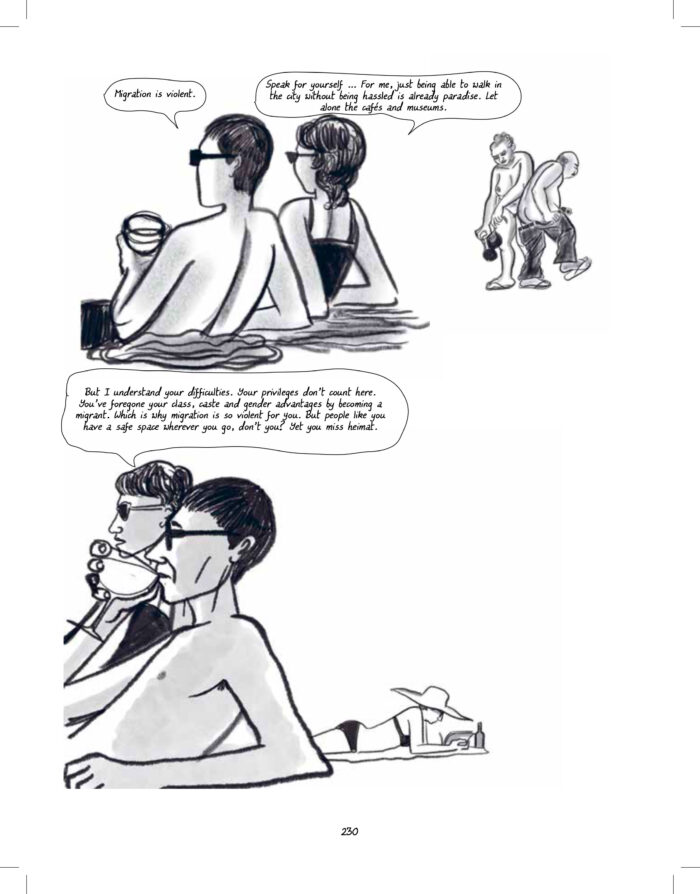
You live bouncing from city to city; you’ve travelled all over the world. When we met in Delhi, you told me about your process of “reacclimatisation” every time you move from one city to another. I was struck by the fact that, when asked about your return trips to Delhi, you replied without a moment’s hesitation: “In twenty minutes, I feel at home again.” One of the last chapters of Absolute Jafar is dedicated to the concept of Heimat: sweet, strong, untranslatable. How does this mobility or continuous migration influence your work?
I don’t think it’s so much about an international perspective as it is about the distances that travel and moving around create between people, places, memories and objects. In my case, Delhi. I’ve become more and more of a “local” the more I’ve travelled abroad. Living in other cities, you realise that there are many local inhabitants, “locals,” besides yourself. And you find them strangely familiar and appealing. Les Paniers in Marseille, the Beyoglu district of Istanbul, Villa Blanc in Algiers, the outskirts of Mostar, a small soy sauce-producing island in western Japan, the centre of Addis Ababa, the Bund in Shanghai… they all become a local universe for me. But I think this happens when you are a product of your own territory: there is a sort of very strong recognition or resonance with the locals of other places in the world. And, unless you want to commodify the ancient ways of life of others, you are accepted.
South Asians often think that, when we travel to a European city, we will only meet white people. In reality, you meet people from very different worlds: Moroccans, Peruvians, Iraqis, Mongolians. This is the greatest achievement of European cities, even if right-wing parties are trying to undo it. My interactions with “real” Germans account for only a quarter of all my exchanges and relationships in Berlin.
Living here is particularly beneficial for my son, who was born in Berlin to a Pakistani mother and an Indian father. He is growing up in a neighbourhood where Palestinians and Jews march side by side in demonstrations, where a Kurdish bakery makes the best naan, and where a Yemeni restaurant serves people from all over the world. My son moves freely throughout the city, mingling with Iraqis, Brazilians and Peruvians at social events. His school friends are as likely to be German as they are Indonesian, Tanzanian or Lebanese. He also feels perfectly at ease on the streets of the upper-middle-class neighbourhoods of North Calcutta and Karachi. This is a real privilege.
I don’t think this is internationalism or some sort of 1970s cosmopolitan project. It is about living with difference, appreciating it and not merely tolerating it. It offers a broader understanding of humanity; it is an antidote to the rising nationalism in India and elsewhere. But if you don’t understand your own people, you might as well give up on it.