
Beyond the Limits of the Artwork
A conversation with Yazan Khalili
Sudario is a visual arts magazine dedicated to amplifying voices from and about the Mediterranean. Its mission is to look beyond the seductive surface of the region—to probe its miracles and its curses, its beauty and its unrest. Sudario embraces a radical, often uncomfortable realism. It is experimental, sometimes psychedelic, and always engaged in confronting contemporary crises. The aim is to open new paths of thought and action through a blend of critical inquiry and artistic experimentation. The magazine brings together both existing works and newly commissioned pieces that address themes we consider urgent and underrepresented. Conceived as a platform for reflection and storytelling, Sudario fosters alternative narratives of the Mediterranean through our printed publication as well as through exhibitions, workshops, and concerts. The magazine is committed to a clear aesthetic and ethical stance. Sudario collaborates with artists and thinkers who challenge romanticized portrayals of the region, offering instead incisive, grounded perspectives.
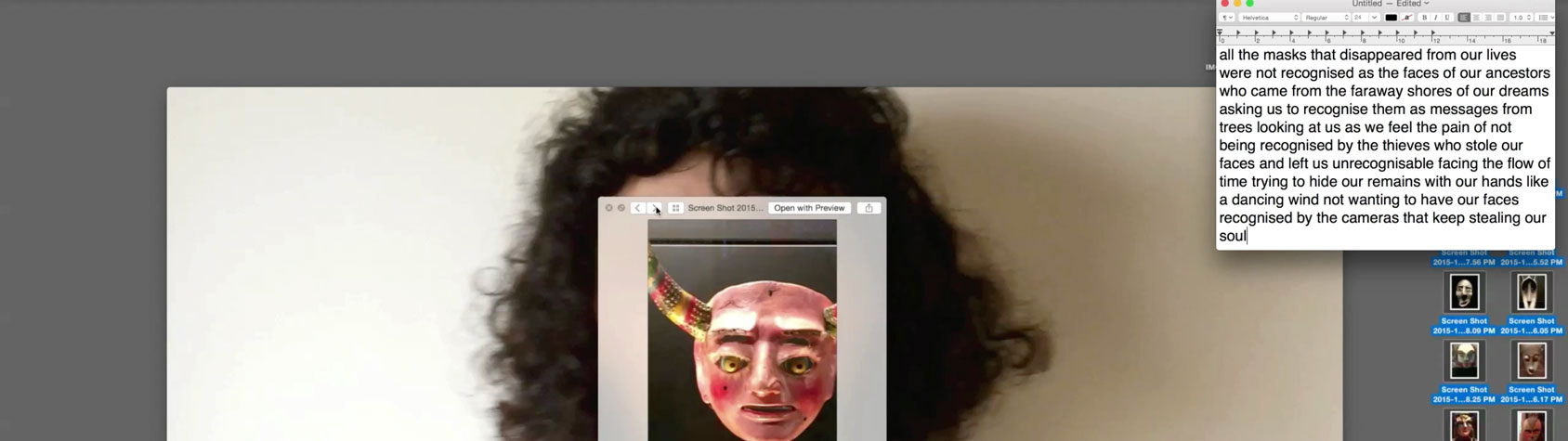
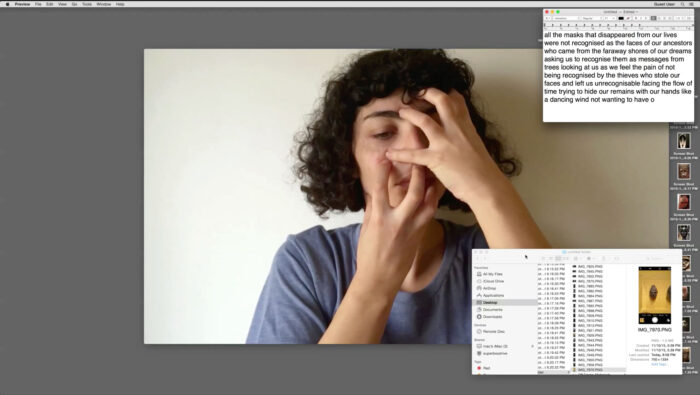
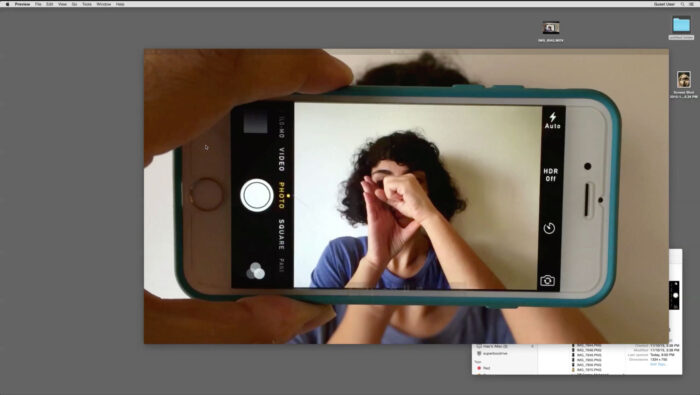
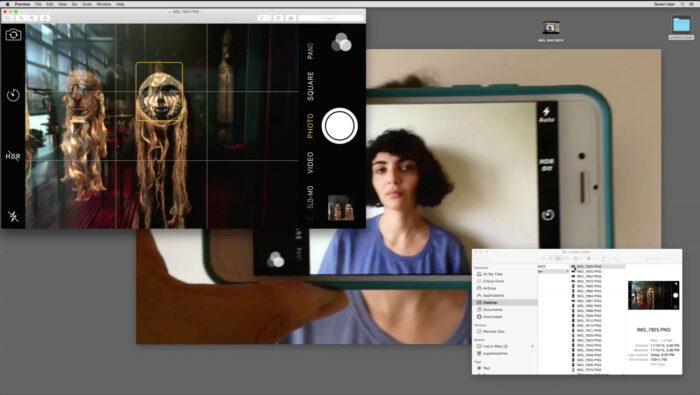
In the following conversation, Giulia Crispiani asks Palestinian researcher, visual artist, and cultural activist Yazan Khalili a few questions around his practice. His work selected for Sudario, Hiding Our Faces Like a Dancing Wind (2016), questions the use of technology and its tendency to typecast. In the video, the artist features a woman’s face captured on a camera screen, which appears to confuse the facial recognition system as a sequence of ethnographic masks interrupts the frame. This work recalls colonial mechanisms of racial classification and the construction of historical narratives.
Giulia Crispiani: In your latest works, there seems to be a shift towards merchandise, “as a type of economy” and wearable claim (or piece of poetry), can you tell us a bit about that?
Yazan Khalili: In several of my recent projects, I have worked with merchandise as a way of building a small economy around the structures and communities I am part of. This started very practically, for example with Radio AlHara, where we produced T-shirts to generate some support for the radio itself or for communities and initiatives we wanted to stand in solidarity with. In that sense, merchandise functioned as a tool for redistribution and mutual support.
In the two projects you mention, Against Total Meaning and All the Languages of Our Tongues, merchandise becomes more than a support mechanism and turns into a space of exhibition and artistic form in itself. In All the Languages of Our Tongues, for instance, I wrote a longer text on what it means to act collectively that is printed on scarves. These scarves are then knitted together into a tapestry-like structure, which is exhibited as an artwork. At the same time, since it is a merchandise, 25 copies of each scarf could be bought individually and worn. The text therefore circulates between being collectively displayed and individually carried on bodies in public space.
What interested me here was creating an artwork that can be used, worn, and lived with, while also producing a form of financial support for initiatives I am involved in, especially those that do not receive, or actively refuse, institutional funding. In this sense, the production budget of the artwork is not only about making an exhibition piece, but is transformed into unconditional money that can be redistributed to support these initiatives. It is an attempt to work on the relationship between art and its economy: rather than relying on the art market to create value after the exhibition, the work turns towards the public, offering an object that sits between artwork, wearable object, and a small economic gesture.
The text itself is fragmented across different scarves, meaning that no single person holds the full statement. The public, collectively, carries the fragmented text, and meaning only emerges through this dispersed circulation. In that way, the artwork exists both as a shared structure and as something that moves through everyday life, on bodies and in public space.
How can an artwork be conceived and circulate as a form of solidarity?
I don’t have a definitive answer to how an artwork can perform solidarity, but I have ways of approaching this question through practice. For me, solidarity cannot be located in a single layer of the artwork—neither only in its message, nor only in its aesthetics. It has to be interlaced across the different dimensions of the work: its modes of production, its economy, its meaning, and its aesthetic form. It is the relation between all these elements that can create a practice of solidarity, rather than any one of them on its own.
In that sense, solidarity is not simply something represented inside the artwork as content. It is also about how the artwork exists and operates in the world. How does it circulate? Who does it support? What kinds of relations does it build or refuse? Bringing politics and economy into the artwork is part of this, not as external themes, but as structural conditions that shape how the work is made, distributed, and sustained.
So the question of solidarity is also about how the artwork spills beyond the framework of art. How does it connect to, and become woven into, larger communities and collective struggles? For me, an artwork performs solidarity when it is entangled with community projects and initiatives that are trying, in their own ways, to change the world we live in towards greater justice.
What is the role of text in your work? How is it often combined (or not) with the image?
Text has been taking on a more central role in my work over time. I’ve become increasingly interested in text as a way of taking a clear position—of stating more directly what I want to say, sometimes even in a didactic way. There is a desire for clarity in the text itself, in terms of meaning and political positioning. But at the same time, the work is never only about what the text says. The text is always interlaced with other dimensions of the project: its mode of production, its economy, and its relationship to elements that exist outside the artwork itself—its connection to communities, networks, and the broader contexts it belongs to.
So while the artwork might center text and take a clear position through language, it is simultaneously extended beyond what the text alone offers. There is a life of the work beyond the exhibition space: in how it circulates, how it functions economically, and how it operates in relation to people and structures outside the art context. These aspects complicate and stretch the meaning of the text, and sometimes even exceed it.
Language itself has become more important to me, especially in the context of AI and contemporary forms of mediation. I am interested in what it means to exist in the world through language today. I believe in poetry as a political and ethical medium. The poetics of language become, for me, a way of resisting the occupation and instrumentalization of our languages. In that sense, writing is not only about communication, but about defending a space for complexity, ambiguity, and situated meaning.
Formally, the texts I work with often challenge conventional ways of reading. I tend to write long, looping sentences that require the reader to take a position in relation to the text. Meaning is not immediately given; the reader has to situate themselves within the language in order to extract a scene or a stance. This positioning of the reader is important to me—it mirrors the way political positions are never neutral, but always require an act of locating oneself in relation to what is being said.
Has your work changed after October 7th? How?
Yes, I would definitely say my work has changed since the genocide began. I’ve been questioning, very fundamentally, what it means to make art at this moment: why we do it, how we do it, and what it can or cannot do in the world. A lot of my thinking has shifted toward the life of the artwork beyond the exhibition—how it fits into the world, and how it can actively become part of the struggles it is responding to.
Through this, I’ve also started to think more carefully about the difference between the artist, the art practice, and the artwork itself. My practice now feels like it needs to be much more directly involved in solidarity and in collective struggles, in Palestine and elsewhere, and to liberate itself from what I would call the liberal conditions of much contemporary art practice. Many of the things I am involved in today as “art practice” actually escape or defy the idea of producing an artwork that can be exhibited, owned, or even clearly claimed by me. They are more about being connected, about engaging in the world—sometimes even anonymously—through questions of economy, production, and relations.
In that sense, I’ve started to think of art practice more as a set of tools and forms of knowledge that have been built up over time, and that can be used in the world outside the artwork as such. These tools feel very important to me now. At the same time, I haven’t abandoned the question of the artwork. I’m still thinking about what kinds of artworks are possible, and how they can be involved in these questions around practice, production, and responsibility. Even if I want to push my practice beyond the limits of the artwork, I still see value in remaining in dialogue with the art world, its institutions, and its exhibition formats—also to create frictions, extensions, and points of leverage from within.
So yes, my work has changed—but in a way, it is always changing, even before the genocide began, these questions have been brewing in different projects and intiatives I have been part of. What feels different now is that I see this change as something that has to evolve alongside struggles, not as something that leads them. The work needs to transform, to build on previous experiences, sometimes to invent new forms, sometimes to return to older ones, and to keep searching for a position between them.
What are you working on at the moment? As your contribution for Sudario magazine is a work from 2016, what is your relationship with your older works like this one?
The work from 2016 was not something I initially proposed to show now; I was invited to present it, and I agreed. For me, artworks are products of their own time, but they also live beyond that moment. In a way, artworks have a different life from the artist. The artist moves on, continues working, changes positions, develops other fictions, tensions, questions, and struggles. But the artwork does not simply end when it is made. It continues to live, to circulate, to return in different moments, and to be re-activated in new contexts.
What I find moving is that older works can suddenly speak again to contemporary conditions in ways I could not have anticipated when I made them. They are read differently, activated differently, and taken up by others who find in them something that resonates with the urgencies of the present. In that sense, the artwork is never fully closed. It keeps responding to new political, social, and historical situations as the world changes, even while I, as an artist, am already elsewhere, dealing with new questions.
As for what I am working on now, it is not one single project, but a set of ongoing concerns. I am thinking a lot about economies, about form, about medium, and about how these things shape what an artwork can do in the world. I am trying to engage with different formats and ways of working that allow me to question how artworks circulate, how they are produced, and what kinds of relations they enable. So rather than having one fixed answer to “what I am working on now,” I would say that what I am working on is something that is still in the process of appearing in the world. The work is unfolding, and it will only become fully visible through what takes form next.