
Wayward Waters
Dana Michel’s “YOU CANNOT CAN”
Waywardness is an ongoing exploration of what might be; it is an improvisation with the terms of social existence, when the terms have already been dictated, when there is little room to breathe.—Saiydia Hartman
Black aquatic histories were difficult and damaging, and they discouraged children from getting near the water.—Kevin Dawson
“Black people cannot swim.” Few racial myths have proven as persistent as this one. In recent years, historian Kevin Dawson and scholar Amanda Herbert have traced the genealogy of a set of beliefs that still circulate widely within and beyond Black communities: that Black people have heavier bones, less body fat, lower buoyancy; that they are somehow naturally less suited to swimming; that they have always been distant from aquatic practices. These narratives, they argue, are not only false. They are the afterlife of a historical amnesia: modern assumptions that “black people cannot swim” are contradicted by centuries of aquatic practices carried from Africa into the Americas.
Dawson’s research dismantles the racist and colonial assumption that Black people do not swim by showing precisely the opposite. Across Atlantic Africa, long before the transatlantic slave trade, swimming, diving, surfing, canoeing and fishing constituted sophisticated aquatic cultures. Water was not an alien environment but an extension of everyday life: “Most African-descended people, both in Africa and enslaved in the Americas, were as comfortable in the water as they were upon land” (Dawson 2018: 5). Swimming was not merely a survival skill. It was a form of embodied knowledge, a social practice, a source of pleasure: a “sensual experience,” allowing bodies to “glide weightlessly through liquid depths as body and water slipped into fluid motion” (10). Aquatic practices were embedded within broader cosmologies in which water functioned not only as an environment but also as a spiritual realm: “water was a sacred space populated by deities and spirits” (Herbert & Dawson 2025: 173).
The crucial point is that the relationship between Black communities and water does not originate in trauma. It is modern racism that interrupts it. “Nineteenth and twentieth-century racism, more than any other factor, discouraged Black swimming” (Dawson 2018: 3). Segregation systematically denied Black people access to pools, aquatic infrastructures and recreational waters. Public pools became infrastructures of whiteness, while rivers, beaches and lakes likewise became sites of racial interdiction. What had once been a realm of familiarity was progressively transformed into a regime of exclusion. The pool, therefore, is never simply a place of learning and pleasure. Historically, unequal access to aquatic spaces made it one of the infrastructures through which racial domination was reproduced and internalized, sedimenting forms of mistrust and self-limitation across generations.
When live artist Dana Michel enters the swimming pool in her last performance YOU CANNOT CAN, she steps into this history. The work begins from an apparently personal question. Why, despite years of attempts, does she still not trust water? Yet the question immediately exceeds autobiography.
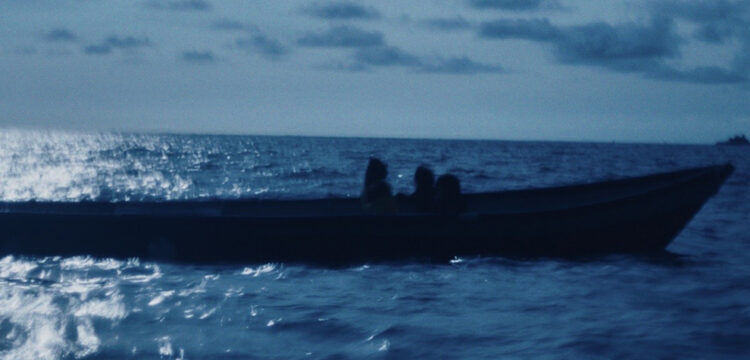
Premiered at Kunstenfestivaldesarts 2026 in Brussels, in the final edition curated by Daniel Blanga Gubbay and Dries Douibi, YOU CANNOT CAN unfolds from a precise contradiction: Dana Michel comes from a Caribbean genealogy, from an insular world surrounded by the Atlantic Ocean, and yet she cannot surrender her body to water with confidence. Neither her parents, her aunts and uncles, nor her siblings ever truly learned to swim. [1] Yet not knowing how to swim emerges less as a personal impasse than as the embodied trace of a historical subjection. A fracture between those who inherited water as pleasure, recreation, and safety, and those for whom water has been marked by trauma. Christina Sharpe reminds us that Black life in the diaspora continues to unfold in the wake of the Atlantic. The ocean that carried aquatic knowledge also carried the slave ship. The water that sustains life also bears the memory of disappearance, displacement and loss, as an archive of violence (Sharpe 2016). Dana Michel’s performance is suspended within this tension. She enters the water not simply to learn how to swim but to renegotiate a relationship with an element haunted by conflicting inheritances, whose traces persist as embodied forms of fear, memory and dispossession.
Poolside in the Wake
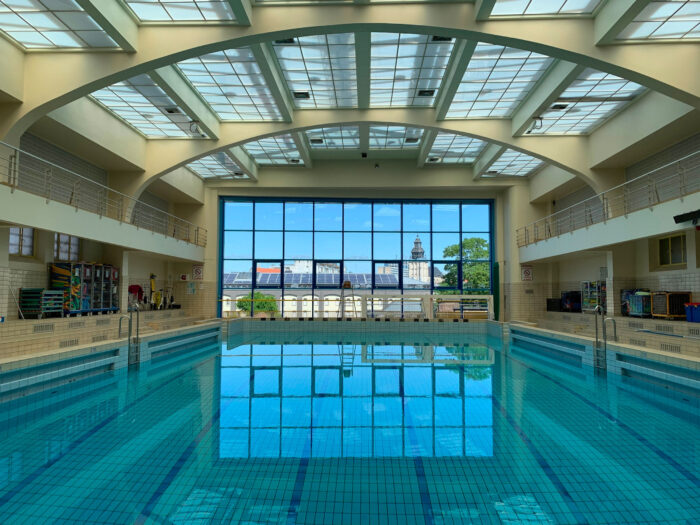
The smell of chlorine arrives first. It saturates the humid air long before the pool itself comes into view, activating a sensory memory familiar to anyone who has spent time in public swimming facilities. Reaching the basin where YOU CANNOT CAN unfolds requires a gradual ascent through the Bains de Bruxelles. Dana Michel’s performance takes place in the main pool on the upper floor of the building, a public bathing complex whose unusual vertical organization—two pools stacked one above the other—creates the improbable sensation of swimming above the city. Beneath the vast glass roof and beside a panoramic window overlooking the rooftops of the Marolles and the silhouette of the Église de la Chapelle, natural light, reflections on the water, and the subtle reverberations of urban life continually stratify perception. Water, body, and city are gathered into an entangled shifting composition, where none remains a stable backdrop for the others.
A closer look at the architecture reveals a caustic irony. Designed by Maurice Van Nieuwenhuyse and inaugurated in 1953, the Bains de Bruxelles embody a late-modernist vision marked by traces of Art Deco. Their streamlined horizontality, balconies and corridors overlooking the pools evoke the imagery of the great transatlantic liners so emblematic of the period, in the so-called paquebot style. Yet the fantasy of oceanic mobility embedded in the building’s design sits uneasily with the histories that Black bodies also carry: displacement, segregation and subjection. Michel’s presence introduces a productive short circuit into this architectural imaginary. The transatlantic liner ceases to signify mobility alone. It becomes a reminder that the Atlantic has never been traversed under the same conditions by all bodies. The same ocean that came to symbolize mobility and modernity was also the medium through which the Black Atlantic was forged, the routes of forced displacement that shaped the modern Black diaspora through transatlantic slave trade. (Gilroy 1993). [2]
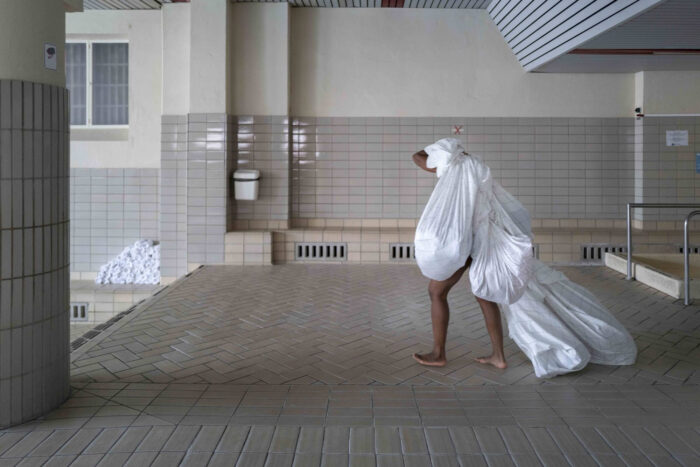
Dana Michel leaves the architectural framework untouched. No theatrical apparatus redefines the space. A few white sheets draped over the pool equipment stored along the sides are the only intervention, lending the site a subtle sense of abandonment and suspension. Rather than transforming the venue, the performance inhabits its existing conditions, allowing architecture, water, and natural light to assume a compositional agency of their own.
Improvised Life
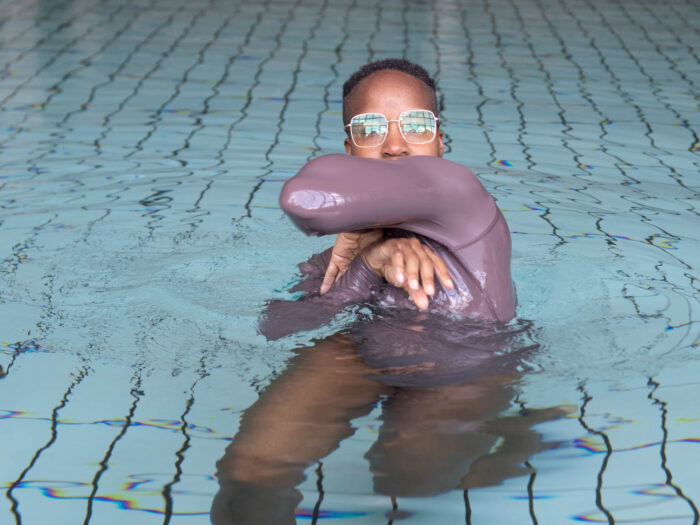
Barefoot and carrying the towels handed to them at the entrance, spectators gather along the sides of the pool. The intense blue of the water spills across the glazed surfaces and white ceramic tiles. At one end of the basin, near the entrance, Dana Michel emerges from behind a parapet wrapped in layers of white blankets, cocooned within a soft protective envelope that both shelters and conceals her body. As the coverings gradually fall away, a shiny brown latex bodysuit is revealed. Her face is suddenly eclipsed by a voluminous curly wig—an unmistakable Beyoncé silhouette—topped with an NBA cap. As often in Michel’s work, familiar cultural references appear only to become unstable. Pop iconography, Black celebrity culture, athletic performance and gendered codes accumulate in a shifting assemblage. Recognition is constantly solicited and immediately frustrated. The spectator is offered fleeting points of association only to lose them again as the figure slips elsewhere, in a fugitive choreography of appearances, that passes through dominant imaginaries while continually escaping their capture.
The performance begins not with an action but with a form of fumbling. What unfolds is a sustained negotiation between body, objects and the peculiarities of the site. It takes shape through a tactic of gestures marked by hesitation, recalibration, delay and awkwardness. Rather than entering the water, Michel appears as someone still learning how to approach it, dwell alongside it, and submit to its proximity.
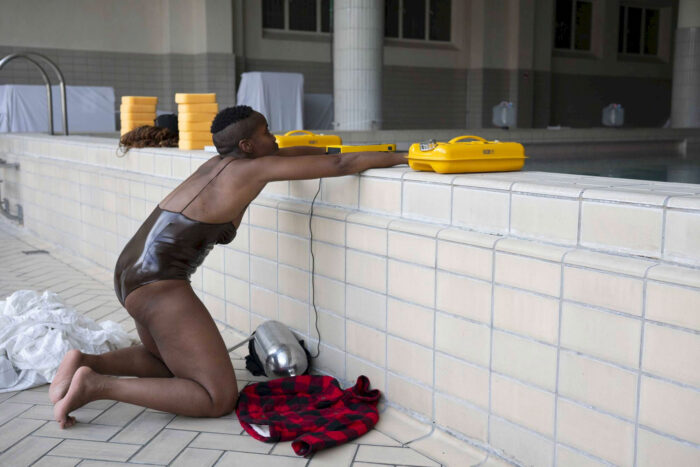
Scattered along the poolside is an assortment of objects. Most are yellow, or variations thereof: containers, floats, sound-making devices, and other items whose function remains elusive from the spectator’s vantage point. Michel moves among this collection of objects without assigning priorities. She picks them up, discards and relocates them, probing provisional and unforeseen relations. Repeatedly surfacing from behind the edge of the basin, the figure never fully offers herself to view. The action proceeds through minimal displacements, moving by way of repetition and redirection rather than progression. She stumbles, scrapes along the ground, crawls, then stands beneath the shower at the far end of the pool. Water drenches the wig obscuring her face and runs down her legs, clad in embroidered white stockings rising above the knee. Repeatedly, she tugs at the latex bodysuit where it has ridden up between her buttocks, each adjustment producing a dry, rubbery snap. The gesture returns again and again, anchoring the scene in a deliberately low register of mundane bodily discomfort.
Dana Michel sets a vinyl record spinning on a portable yellow turntable. Its crackling texture merges with fluid sounds, mechanical hums, and intermittent noises, becoming indistinguishable from the breaths, groans, and repeated high-pitched emissions issuing from her body, as though a ventriloquial force had taken hold of her. These sounds are woven into a sonic filigree at the threshold of audibility, suspended within the humid acoustics and muffled quiet of the pool.
The curly wig is suddenly removed and thrown into a large pot. Shortly afterwards, she reappears wearing a pair of fur-covered platform slippers and oversized prescription glasses. Barely able to walk, she moves along the edge of the pool beside the audience, slowly tracing the perimeter of the basin.
As the performance drifts toward the opposite side of the basin, Michel’s body becomes the site of a growing accumulation. Red tights, layered garments, a life jacket and inflatable accessories progressively thicken her figure., mutating from one moment to the next: lifeguard, clown, castaway, makeshift creature. No image stabilizes. Each appears only to dissolve into the next. Paradoxically, every object intended to aid flotation makes swimming seem less possible. Wrapped in layers of red, tongue protruding, face twisted into childlike grimaces, Michel moves within a narrow interval between precision and misalignment.
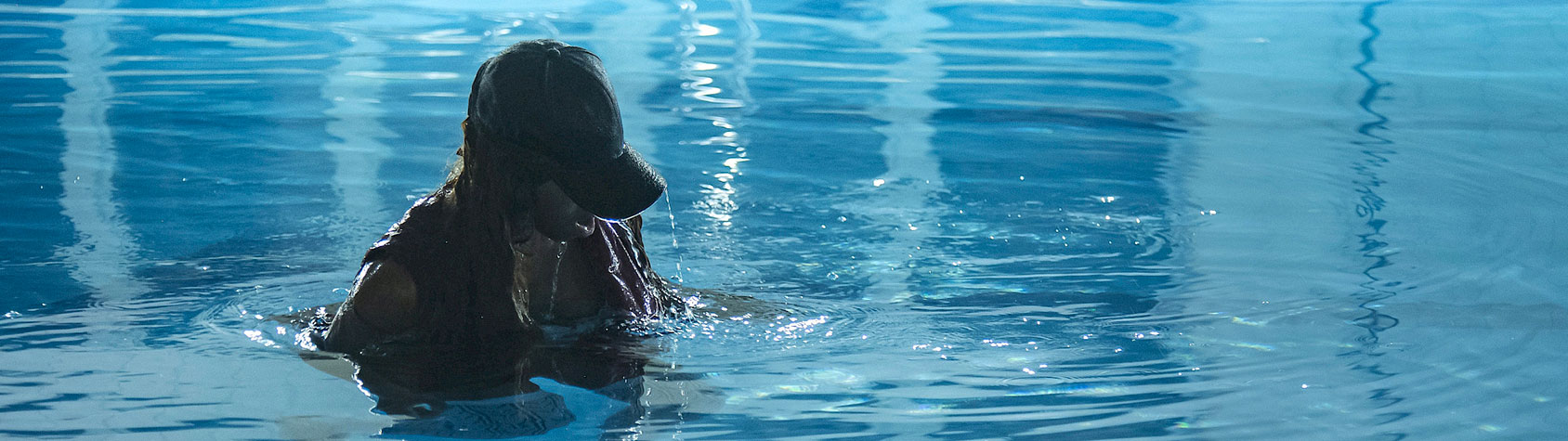
After sounding a toy trumpet—an antiheroic fanfare—Michel finally enters the water from one of the pool’s side accesses. She does not dive. There is no triumph. Assisted by children’s kickboards and encumbered by an excess of flotation devices, she lowers herself into the basin fully clothed, wearing oversized swimming goggles. Fabrics absorb water. Weight shifts. Balance falters.
What unfolds is not swimming but an ongoing negotiation with buoyancy. Michel searches for an unstable equilibrium, clinging to two red canisters that reveal themselves to be containers used to transport human organs for transplantation. Without comment, the image short-circuits life and death. The floating body appears suspended between survival and corpsehood, between the effort to stay afloat and the memory of bodies consigned to the water. Entering the pool fully dressed is not without significance. For Black subjects, the body is never granted the neutrality of mere embodiment. It is always already captured by regimes of objectification, fungibility and death in life. Michel neither illustrates nor represents this condition. She drifts through it. Her body, waterlogged and overequipped, becomes the site of an improvised life (Solomon 2025).
At moments, the gestures evoke a kind of self-birth, as if Michel were struggling to emerge from herself. The pool turns amniotic, a space of gestation yet always shadowed by the possibility of drowning. To float is also to be carried. To surrender weight is also to shed oneself. Michel’s conduct remains erratic, lateral, faintly clownish. She stumbles, lingers, invents detours. In this sense, the performance produces a form of improvised coexistence with water. Her wayward movement can be understood as an improvisational and fugitive practice: neither mastery nor emancipation, but a stubborn situated experimentation with the very terms of survival as a process of unlearning internalized fear.
Aquatic Untiring Practice
YOU CANNOT CAN could be read as a performance about the slow unlearning of fear. In this sense, it functions as a practice of aquatic liberation. The title itself, with its cacophonous negation, disrupts the grammar of willpower. It is not enough to say “you can do it”—to swim. Such an appeal to individual determination cannot account for what exceeds the subject: the historical infrastructures of violence, dispossession and racial subjection that continue to shape Black life.
Black critical thought has long insisted that racism does not operate solely as an external force. It settles into perceptions, habits, and capacities for action, producing embodied constraints that are lived as personal limits while remaining structurally imposed. Fear, here, is sedimented in the body, in material conditions, in family histories, and in the infrastructures of dispossession imposed upon Black communities by the afterlives of slavery. The question, then, is not whether one “can”, but how to undo what history has taught the body to carry.
The performance unfolds within this fragile zone, where the body attempts, hesitates, courts failure, and repeatedly corpses itself, disclosing itself precisely through withdrawal from the white gaze and through fugitive forms of presence. It inhabits, simultaneously and remarkably, a space of extreme formal rigor and scandalous attunement to present feeling. Here, swimming emerges not as mastery but as a situated practice of survival, gradually shedding the traces of embodied coercion. In Saidiya Hartman’s words, it is “the untiring practice of trying to live when you were never meant to survive” (Hartman 2019: 228). The pool becomes an arena of attempts without guarantee, where movement proceeds without the promise of resolution.
Dana Michel asserts a posture that does not seek recognition. It holds complicity and opacity in unresolved tension. Throughout the performance, she frustrates the logics of representation and visibility, displacing attention from the spectacle of trauma toward the forces, intensities and sensations that traverse the body. The question is no longer what the body signifies, but what it can do, endure, and set into motion.
Rather than offering itself to interpretation, the performance bends the gaze and jams its habitual mechanisms. It does not explain; it operates. Michel proceeds through an errant and unproductive conduct composed of hesitation, dead time, subtle humour and apparent misfires. In doing so, she abandons the very imperatives of choreographic legibility. Nothing is granted to the spectator. There is no wink, no invitation to intimacy, no reassuring gesture of disclosure. Moving sideways, appearing in fragments, remaining perpetually out of reach, Michel cultivates a mode of presence irreducible to capture. Her micro-political gestures unfold through a fugitive body, recalcitrant imaginaries. In her work, the body is never a transparent vehicle of meaning nor an organism disciplined by choreography. It is a terrain traversed by memory, visual interference, cultural residues, embodied stereotypes and transgenerational ghostly transmissions.
In Scenes of Subjection (1997), Hartman demonstrates how slavery relied on a entanglement of terror and enjoyment. Enslaved people were compelled to sing, dance and display pleasure. The fabrication of joy was not incidental to domination; it was one of its constitutive techniques. YOU CANNOT CAN, like several of Michel’s earlier works, enters this scene only to elude its terms. What it refuses is not simply performance, but the injunction to perform for others: the demand for visibility, redirecting attention toward the unstable and often opaque processes through which a body senses, absorbs and survives. YOU CANNOT CAN inhabits this scene of subjection only to move sideways through it. What Michel evades is the demand to convert experience into display, suffering into legibility, presence into a consoling image for the white spectator. Her body remains elsewhere, continuously and insistently: sensing, listening, lingering, refusing incorporation into new regimes of capture.
[1] The inspiration for YOU CANNOT CAN came to Dana Michel six years ago, during her son’s swimming lesson.
[2] From its inception, the complex functioned not only as a swimming facility but also as a public bathing service, providing baths and showers for the inhabitants of Brussels. The building thus remains tied to a more fundamental politics of water: questions of hygiene, access, maintenance and collective care.
Bibliography
Dawson, Kevin. “Parting the Waters of Bondage: African Americans’ Aquatic Heritage.” International Journal of Aquatic Research and Education, vol. 11, no. 1, 2018.
Gilroy, Paul. The Black Atlantic: Modernity and Double Consciousness. Cambridge, MA: Harvard University Press, 1993.
Hartman, Saidiya. Scenes of Subjection: Terror, Slavery, and Self-Making in Nineteenth-Century America. New York: Oxford University Press, 1997.
Hartman, Saidiya. Wayward Lives, Beautiful Experiments: Intimate Histories of Social Upheaval. New York: W.W. Norton, 2019.
Hartman, Saidiya. Vite ribelli, bellissimi esperimenti. Storie intime di ragazze nere ribelli, donne problematiche e queer radicali. Traduzione di Maria Iaccarino. Roma: minimum fax, 2024.
Herbert, Amanda, and Kevin Dawson. “Black Aquatics: Early Modern Past, Present, and Future.” Huntington Library Quarterly, vol. 88, nos. 1–2, 2025, pp. 169–198.
Moten, Fred. Black and Blur. Durham: Duke University Press, 2017.
Sharpe, Christina. In the Wake: On Blackness and Being. Durham: Duke University Press, 2016.
Solomon, Marisa. The Elsewhere Is Black: Ecological Violence and Improvised Life. Durham, NC: Duke University Press, 2025.