
Waiting as Method
On time, books, and alternative forms of knowledge at Shanghai’s Power Station of Art
It took ten years to build the library located on the third floor of the monumental Power Station of Art: a former power plant that played a crucial role in the city’s industrial development, and was converted in 2012 into a major state museum dedicated to contemporary art. Since its inauguration, this “Power Station of Art” standing on the banks of the Huangpu River has become a landmark embodying the contemporary, urban, and humanistic spirit of Shanghai.
The creation of the library is part of an ambitious project promoted by Chanel: to revitalize the third floor of PSA to integrate humanistic reflection, design exhibitions, pioneering performances, and cultural leisure. With a library, a theater, the “Power Station of Design” (psD), and a riverside leisure terrace, the space—inspired by the mother of the maison—pays tribute to all creators who dare to challenge themselves and their time, embracing the spirit of cross-cultural exchange.
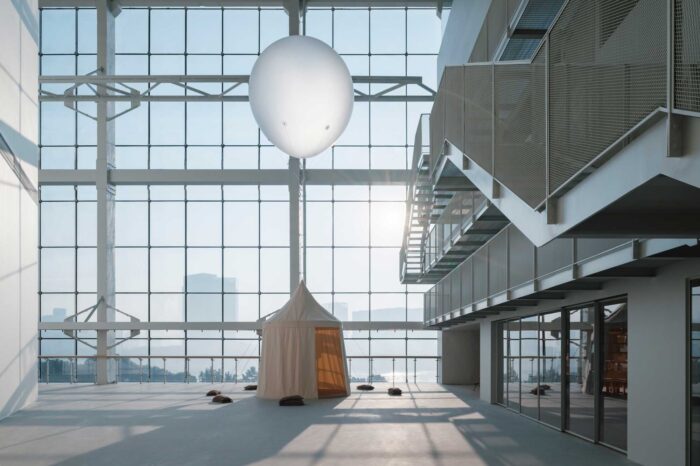
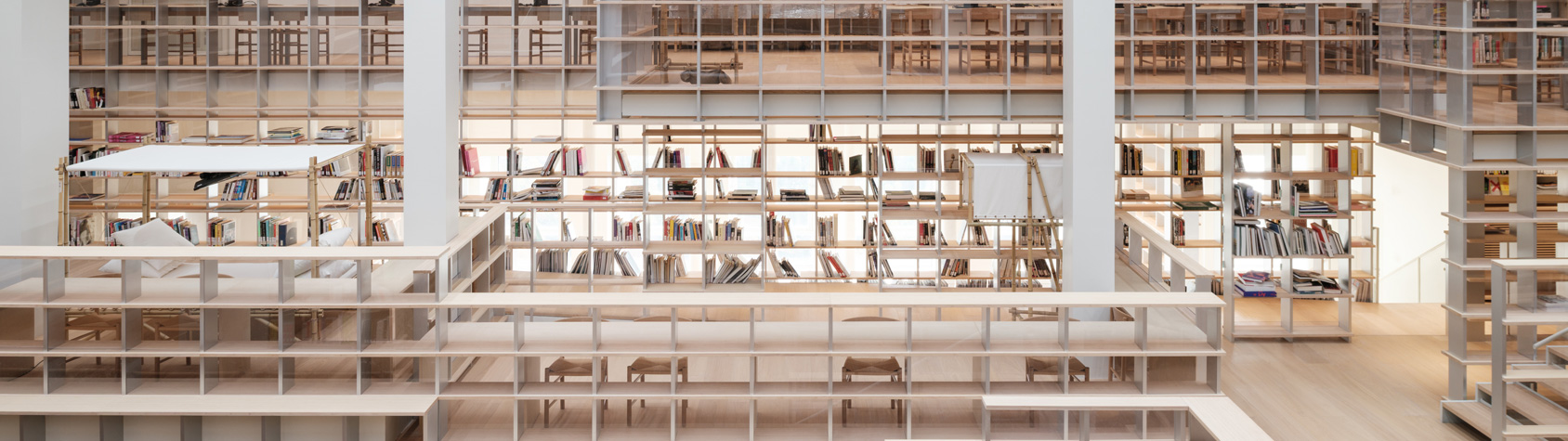
“Waiting” is the title chosen by renowned Japanese architect Kazunari Sakamoto for the library, which spans 1,700 square meters and houses a collection of 50,000 volumes dedicated to contemporary art and design. Indeed, time became a central element not only in regards to the complex realization process, paused for about two years by the pandemic, but also that active yet suspended state of mind between one phenomenon and another: a stability within a transformative process.
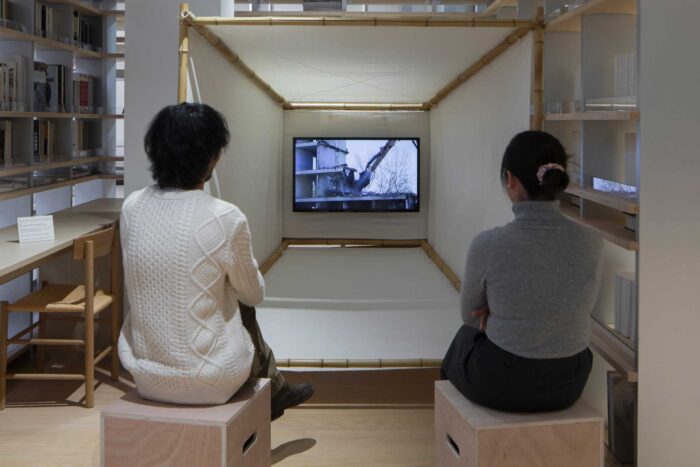
At the moment, the library is a marvelous blend of vertical and horizontal lines, with 10,000 volumes already available for consultation, situated in an “overhanging” space with minimal openings no larger than a few meters, facing both the belly of a massive industrial building on one side, and the river that crosses Shanghai from west to east on the other.
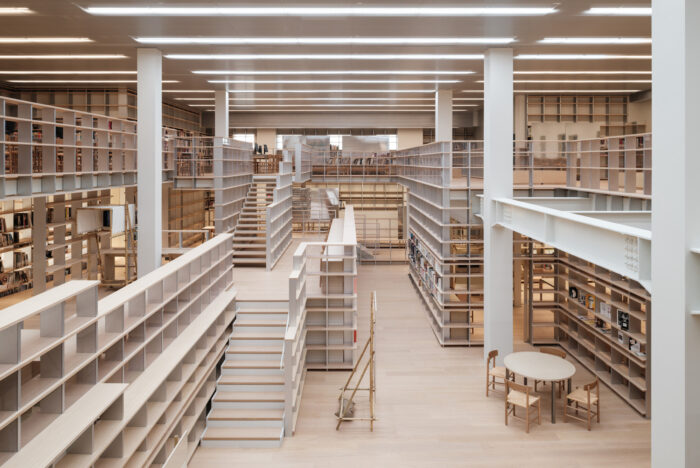
Thus, the library acts as a bridge between the exterior space, marked by the river and the hyper-layered complexity of the urban landscape, and the interior of the post-industrial building. The space was designed by Sakamoto starting from a key interaction between the human being and the book. In its design, horizontality in a system of boxes within boxes evoke in its design a walkable, quiet, intimate, and stable dimension, much like that found in a domestic setting. As Italian architect Ettore Sottsass once said, books and artworks offer protection to culture, which is the most subtle and refined dimension for home, protecting and cleansing it from sins, far from storms, calms, uncertainties, and fragility.
The library is also a place to host exhibitions forming, as Chinese curator Hou Hanru suggests echoing Hakim Bay, what are known as T.A.Z.—Temporary Autonomous Zones—to face and endure the “real world” while providing some chance to “improve” it through alternative visions beyond aesthetic and cultural-social conventions.

Not for nothing, Hou Hanru chose to explore as the first chapter of a “retrospective” exhibition of his curatorial projects the way the concept of home has formed and developed as a redline linking all expansive projects. According to Hanru, “the question of home (for art and for life) is the very seed that has germinated and generated a rhizome of actions to explore and experiment with the changing reality of the world, by means of mobilizations and collaborations with artists, art communities and various publics across the world.”
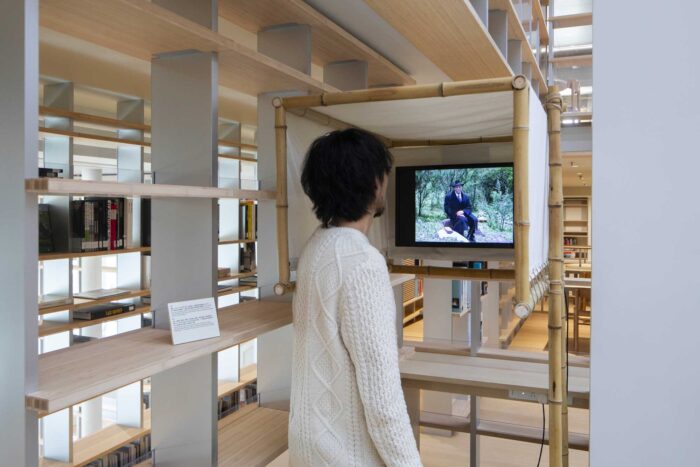
The exhibition titled Home and Beyond is a collection in the form of archival documents of works of art printed on paper and accompanied by short explanatory texts, that reinterpret the concept of home going far beyond its stereotypical definition. The exhibition is a veritable archive of A4 sheets where the artwork is depicted with a descriptive image and text, installed with an original display design curated by Shui Yanfei, Zhang Da, and Another-Design.

As Hanru himself stated, this represents “the first chapter of a ‘retrospective’ exhibition of my curatorial projects (…) I decide to explore how the issue of home has been formed and developed as a redline that links all expansive projects. (…) Together, we have tried our best to reinvent our home… for our freedom and aspirations.”
Drawn from works Hou Hanru has presented in various exhibitions over the course of his career, the exhibition is divided into seven subchapters corresponding to seven conceptual nuclei: Home for Art, seen as an alternative construction of a space for art; Alone at Home, as a dimension of negotiation from “self-expression” to the public gaze, from protection and uncertainty to control and freedom; Home Everyday, as a “home-made revolution” that brings new vitality, detouring from and transforming the ordinary; Home for Workers, as we creatively redefine and redesign the notion and form of home in the age of the “world factory”; Home as Battle Field, reclaiming physical space and historical memory while constructing innovative home-building projects based on social justice and sustainability; Street as Home, where the concept of home meets the free outdoor dimension, where the “street” becomes a playground for inventing new forms of home-life, but also a sign of class disparity; Towards an “Unhomely Art”, where the domestic space becomes a platform for exploring unfamiliar and unknown conditions, allowing art to find its place again, and eventually leading to the question of making homes all around the world in the age of globalisation and postcolonial migration.

A long list of interconnected concepts with an encyclopedic reach, where art is not only activated as a tool for contemplating the poetic spectrum, but also becomes a genuine tool for exploring how to interpret our living space in many different ways, in its “social” and intimate dimensions. This initiative also holds onto another distinction: this library is the first public contemporary art library that will host an extensive bibliography of publications from around the world.

This is a noteworthy milestone in the history of Chinese art and its publishing landscape, particularly since the “great opening” of the late 1980s and early 1990s after the Cultural Revolution. It is a milestone that metaphorically compels us to reconsider what China represents today—not merely as a participant in global cultural exchange, but as a context capable of articulating other models of social, cultural, and economic organization to those long normalized in the West. In this sense, the library functions less as an institutional endpoint than as a signal: an open structure through which different temporalities, forms of knowledge, and modes of coexistence can be tested and reimagined. Moving beyond simplified readings, such developments demand careful observation and critical engagement, especially at a moment when Western paradigms themselves appear increasingly unstable.
Once the books are placed, organized, and fully operational, the library will be complete. Everything around it is moving at full speed, but here we are invited to remain in a suspended moment between potential action and its actual manifestation, between books and works of art, between the city and the emptied belly of early industrialization, now filled with new possibilities while the clock is ticking…