To Kill the Colonizer Within
On “Welcome To My Jungle” by Ndoho Ange
There are certain songs that stick to one’s mind for days, even months. Looping in patterns, they circulate through the body, craving to be materialized back into sound. One finds oneself humming, moving around, almost possessed by the memory of its rhythms. It usually manifests in fragments, rather open-ended, repeating itself relentlessly, as the mind cycles back to try to fill its missing parts. There is something quite erotic in the structure of this feeling: desire as the ache of the incomplete. The haunting quality of the inner loop feels like a memory seeking to exist again through the body. One won’t be able to focus unless they play those sounds once more. It is, in a way, beyond their control. Something else is touching them, asking to be re-lived again, and again.
More than a month has passed since I saw Ndoho Ange’s performance Welcome to My Jungle at Santarcangelo Festival’s 56th edition, and I still can’t get its sonic landscape out of my head. Each time Dawn Penn’s You Don’t Love Me (No, No, No) refrain returns, Ndoho’s movements reappear in front of me, and I am transported back to that afternoon. It was a heated July evening; my friend G and I arrived at Teatro Petrella straight from Rome, slipping into the theatre just before the doors closed. Immersed in shimmering red, green, and orange light, we sat in a circle mirroring the four subwoofers arranged on what would become Ndoho’s stage.
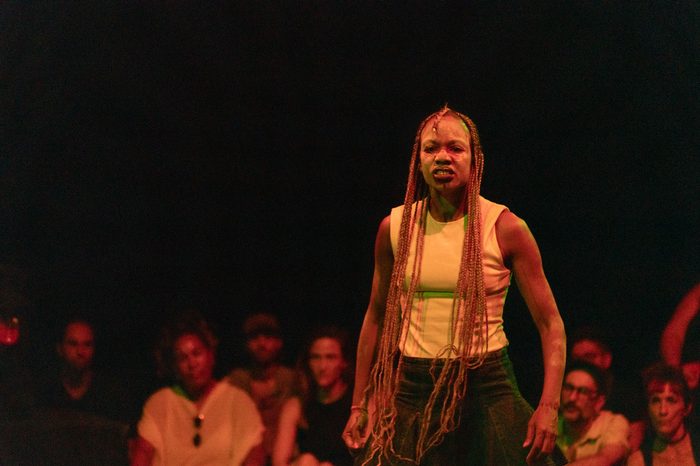
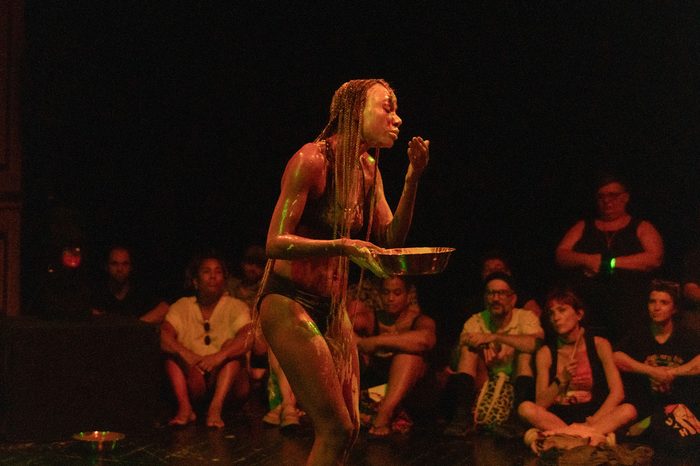
The environment was warm, minimalist, almost deserted, evoking the solitude that follows a night out and the relics it leaves behind. Two speakers held mannequin faces wearing turbans; another one the headless bust of a woman with a cowrie-shell necklace circling its neck. A few bowls and a bottle lay near them. It felt like a preparation for a ritual. The performer sat on one of the speakers in silence, gazing down, perhaps daunted by something kept secret. Her stillness built tension. She cautiously began to look around, as if only then realizing she wasn’t alone. She rose and moved towards the center of the arena—our eyes weighing on her figure.
And then, a loud, repetitive rhythm reverberated through the room followed by the intonation of: No, no, no / You do’t love me / Yes I know now / (Tell the people) / ‘Cause you left me, baby / And I’ve got no place to go now / (Tell the people, zeen). The pleasure of the sound was palpable. Despite its sorrowful lyrics, the upbeat trumpets of the song were familiar and comfortable. It was one of those songs that a DJ drops after a long set to crown the night—a famous, uplifting mood one could easily vibe to. In a white top and a denim skirt, Ndoho began to move to the beat, circling her hips while gently stamping her feet on the floor. Suddenly, the song glitched into itself, locking into a repetition of the refrain that would grind on, obsessively, across the whole fifty-minute life of the piece.
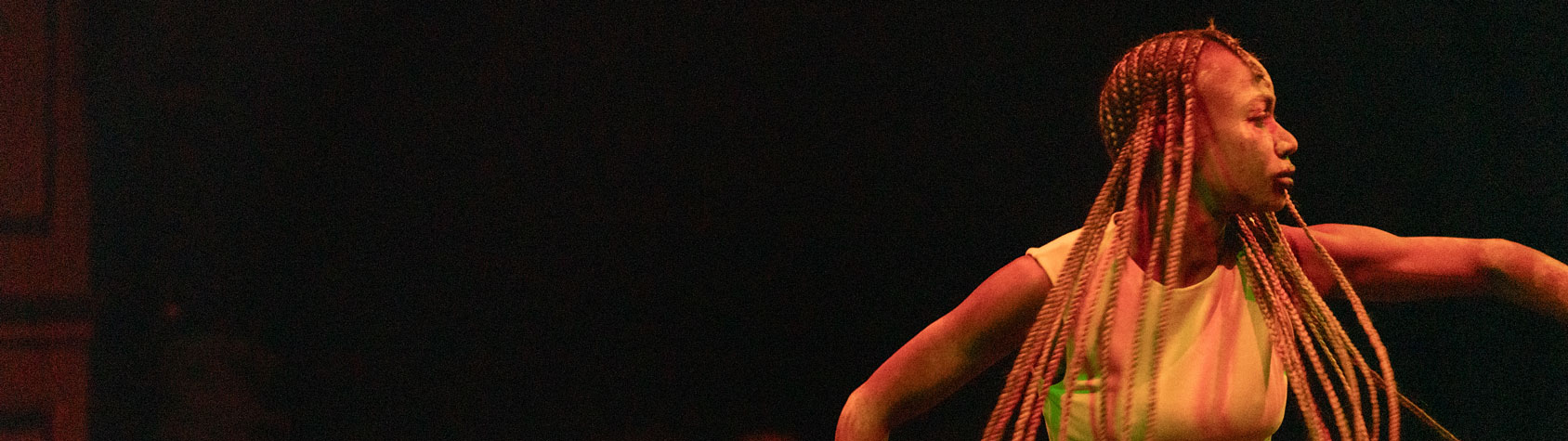
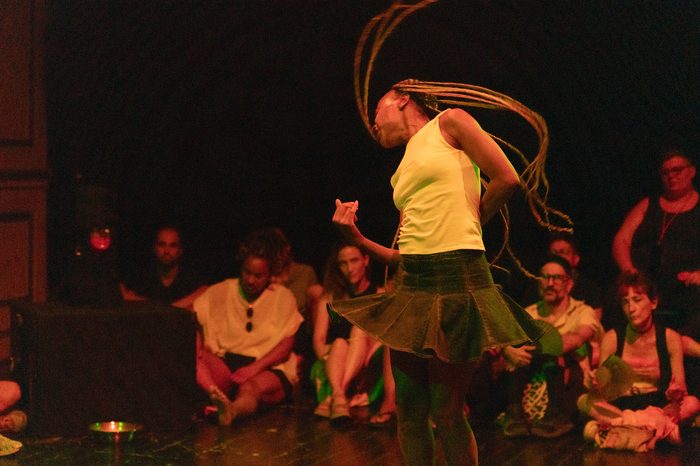
Driven by a continuous sonic variation, the artist’s body began to disarticulate—sensual and jerky at once, shaking, fragmenting into patterns dominated by the beat. She became haunted by the rhythm, addicted to its breaks, distortions, feedback, and loops, pulling from drum and bass, acid techno and jungle, holding herself in a continuous state of conflictual metamorphosis. Pushed by invisible forces, her body no longer seemed her own. Every motion and expression stretched across a range of stratified emotional layers—fear, joy, desire, anger, resistance, desperation, and surrender. Her long thin braids circled in the air, turning her upper body into a restless, jellyfish-like creature, or a diagram of firing neurons. A plurality of selves appeared and vanished in a figure that refused to settle.
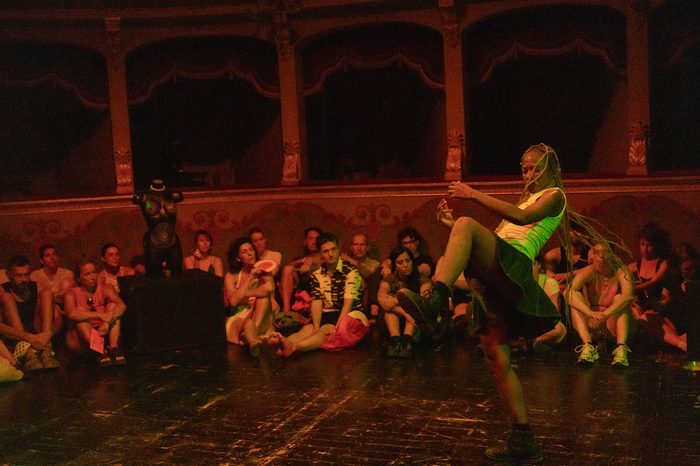
With each transfiguration, the meaning of the song’s lyrics loosened. What we had first recognized as a mournful yet groovy reggae tune about accepting a lost love, twisted into a spiraling drama of a body that could not escape itself. From familiar, almost-too-easy-to-like sticky music, it became an ambiguous, tormenting matter. Diffracting on itself like a wave gathering momentum before crashing onto the shore, these sonic alterations opened different paths and perspectives on how we could relate to the song’s now multiplied meanings and rhythmic textures—so that each time it would return, it would never really feel the same. Voluntary and involuntary bodily memory had taken the stage, creating a battle shaped by the artist’s restless movements. Ndoho became the earworm made flesh: the itch that won’t be scratched, the trope that won’t resolve. And we were in it with her, aching for the loop to close. I began to wonder who, or what, she was fighting, and where the opponent was coming from.
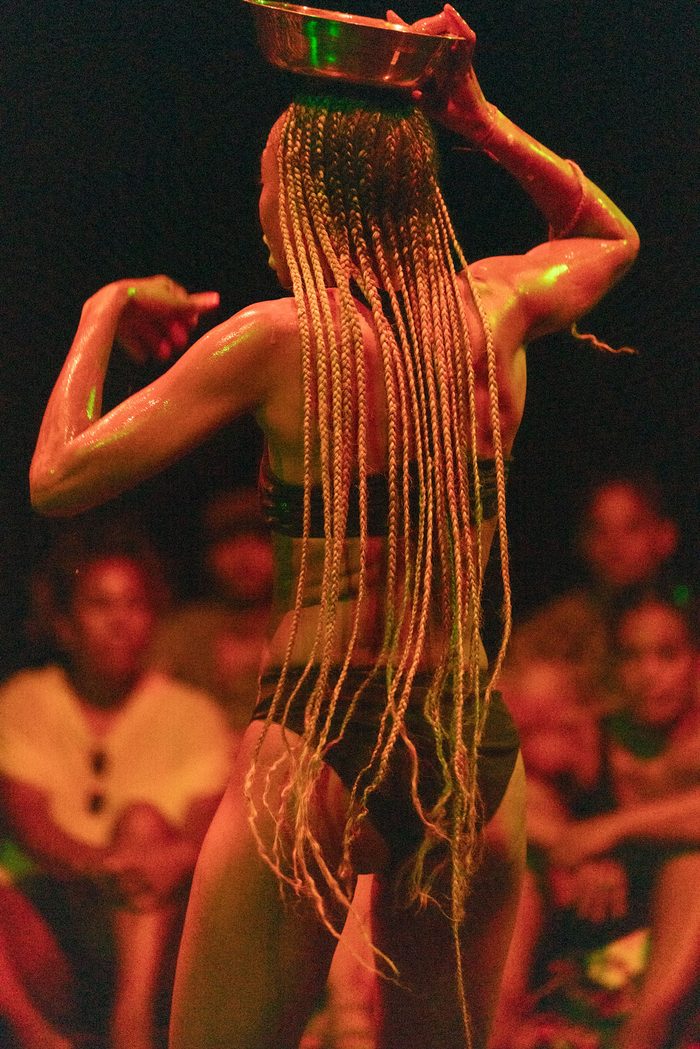
Ndoho became a vessel for the brutality of rhythm. It seemed as if we were living inside a tropical neurosis: sunny, suddenly pouring rain, then sunny again. Each time the refrain returned, ghostly, she seemed able to take a breath—to slow down through grounding, sensual movements. At one moment she was smiling, sticking her tongue out, mocking us, hugging, caressing and kissing herself, spreading a white liquid over her face and body, taken from one of the bowls—which she eventually shared with us, inviting participation beyond mere witness. She drank from a glass bottle, hinting at a possible inebriated state. I wondered if she had been bad tripping the whole time. When I turned to G, her eyes were full of tears.
No, no, no I’ll do anything you say boy (Tell the people, zeen) / ‘Cause if you ask me, baby I’ll get on my knees and pray boy (Tell the people, zeen)
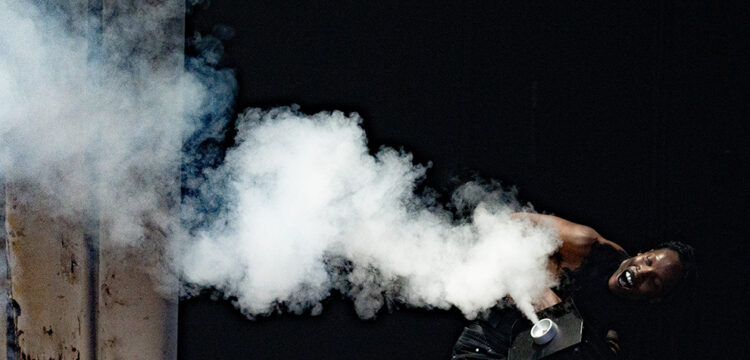
The repeated sounds created a spiraling force, at once coming into being and leaving something else behind. I was hypnotized. Then, Ndoho began to stare back with provocative eyes. This sudden change in gaze made my body feel heavier in my seat. There was a shift in power over who was being watched now. I felt suddenly exposed. And then she shouted, producing a sound that reverberated through the room as an extension of her body. It was a refusal to remain inside, both material and symbolic—a liberating vomit of something stuck within.
The shouting seemed to have dissolved the internal fight, bringing her body to a different state of consciousness. Lying on the floor, she began to tremble incessantly, this time letting herself be traversed. Sounds and images were overlapping into a climax of frustration, resistance, and abandonment that I could feel now expanded in my own flesh. Then, the music gradually quieted down and, flickering like a candle flame in the dark, she slowly stood again. The song refrain came back once more and then dissolved. Ndoho went back to the same position she had started in—this time looking straight ahead of her.
Outside the theater, G told me that for her, the performance was about grief: the performer’s desperate need to fight against the loss of a love, and the aggressive vortex that kept her returning to the same place. What moved G was the impossibility of her escape from this vicious cycle because, ultimately, she didn’t want to. To me, Ndoho’s final expression was telling another story—it traced a transformation, a deep release that I couldn’t name. We remained outside the theatre smoking cigarettes and wondering. Perhaps we needed to complete the circle to feel at peace.
No, no, no…
The day after, Ndoho described Welcome to My Jungle as a reaction to the world as it is—an internal battle among her multiple selves. «The enemy is invisible. He is inside of me. I am fighting with myself», she said during a public talk. Reading Frantz Fanon’s Black Skin, White Masks (1952), she had come to name what she was fighting: a colonizer internalized since birth—“baby colonizer” who grew up alongside her—holding the place of her own self-inferiorization and self-criticism: the internal replay of a racist social order that had installed itself before she could refuse it. The performance was an attempt to kill the colonizer within, so that she could meet herself without him.
In Ndoho’s dramaturgy, repetition was the engine for this transformation. The stuck refrain of Penn’s song became the mechanism of both the problem and its solution: it began as inherited judgment grinding on a loop until it started to sound like her own voice, then pushed past that into extremity—into a corporeal knowing—where other possibilities of liberation could unfold. Repetition gradually loosened preconfigured meanings from their “common sense,” much as when we repeat a single word until it grows too strange to mean anything at all. A love song is displaced into the intimacy of a racialized body, where diasporic histories, memories, and lived experiences intersect.
This decontextualization, or déplacement, exposed the artificiality of the mechanisms by which we build reality and, conversely, by which reality builds us. Echoing Fanon, once reason itself had been rigged against her by the dominant cultural order, the only move left was to abandon it: «I had rationalized the world, and the world has rejected me in the name of color prejudice. Since there was no way we could agree on the basis of reason, I resorted to irrationality». Dance, trance, and ritual performance—jungle as both forest and music genre—become for her a chance to tap into other states of consciousness, to reconnect with her Caribbean descent and her ancestral memories, delinking from the inner, self-destroying mechanism to reclaim her power of self-determination.
Ndoho also talked about the fear of becoming an object of entertainment, like the human displays of the nineteenth-century world’s fairs. This made me think of Coco Fusco and Guillermo Gómez-Peña’s work Two Undiscovered Amerindians Visit the West (1992–94), in which the two artists posed as members of a fictional “undiscovered” tribe, exhibited publicly in a golden cage. The piece was really about the audience: many visitors genuinely believed they were looking at rare specimens of an “authentic people”—feeding them, touching them, taking pictures. It works through irony and fiction to produce evidence about the viewer’s colonial imaginary; its drama happens outside the artists, in the audience’s belief. The work becomes a mirror of the white gaze.
In Welcome to My Jungle the drama happened to Ndoho, in front of us, and the aim was not to expose the audience but to free herself through its presence. Here, there was no representation, but the embodiment of a refusal, in which the final scream rejects the terms on which recognition had been withheld: «My body is not enough to express how I feel. The anger. The pain. Every pore of my body opens and lots of things disappear. I shout from everywhere. » In these two works, the cage and the jungle are inverse solutions to the same inheritance: one stages the gaze to indict it, the other undergoes it to break its internalized hold. Behind both lies the same colonial apparatus of display of black bodies—the world’s fair, the human zoo, the ethnographic exhibit—a way of racializing bodies through a reiterated white perspective internalized as “universal.”
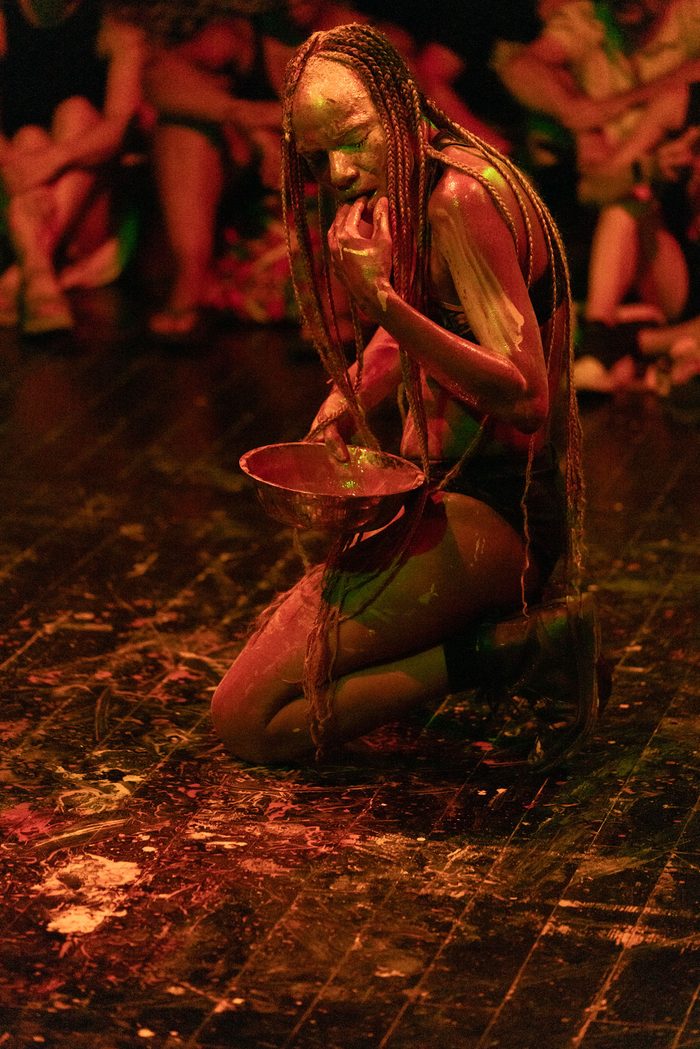
By exposing her inner struggle, Ndoho undertook a path of disalienation, caressing the wounds of her childhood and its silenced memories to let pain and ugliness turn generative, learning how to love enough to «become one’s own tribe». What was visibly different in her posture at the end was in fact her expression and the direction of her gaze—holding space to meet other versions of herself, in front of us, freed from the fear of rejection. What G had felt—the pain and exhaustion of having to repeat oneself endlessly to make oneself known otherwise—reached here beyond the limits of personal history. It was a sensation we could all understand in the threads of our different experiences, backgrounds and projections into the future. Surely, once we came out of the theatre, our bodies were different. We were both shaken, but also somewhat released.
Today, sitting in my living room, the song’s refrain returns to me again and again… this time less as an aching for resolution but more as an ongoing transmission—a part of Ndoho’s life pressed into our hands for us to carry. Through her, I picture my life as an urban jungle made of uncertainties and unexpected possibilities. It is through our difference that newfound understandings can be shared shared. A love story after all—one that keeps moving from body to body. I don’t think I will be ever capable of listening to Dawn Penn’s song without Ndoho Ange in it. She found shelter and, even if only for a while, welcomed us in.
Yes I know now / Tell the people (zeen)
**final trumpets dissolving