
Things that Make You Go Hmmm
The sonic ecologies of Vida Vojić and Tati au Miel
Sound is vibration, frequency, disturbannnce. Moving across bodies and environments, sound enables relations that are sensory, spatial, affective. To listen is to be touched, perhaps unsettled, and transformed by that which is grasped in hearing: all that is sound, and all that remains unsound. On May 3, 2026, A Flicker of Mercy, an evening curated by o—mag in collaboration with Spazio Supernova in Rome, unfolded as a shared threshold of performance practices by Swedish artist Vida Vojić and Haitian Canadian artist Tania Daniel—known as Tati au Miel. Bodies came together in dimness, moving through fog, feedback, the sound of glass and noise. The space lay bare its brick walls, echoing the shadows of passersby, whilst recording what trembled, receded, returned. In these fleeting temporalities, we approached knowledge as embodied—a partial and relational something, emerging through attunement, with a desire to unlearn, to move through the how.
“All that you touch you change. All that you change changes you.”—Octavia Butler (1993)
The event took its name from Timothy Morton’s notion of flickers of mercy: moments when the systems through which we organize meaning begin to loosen, allowing ambiguity and uncanniness to emerge as generative states of relation. They write that hell is a human-made dimension on earth «saturated with meaning» (Morton 2025, o—mag): a condition in which everything is overdetermined, already captured by definitions, categories, and claims to certainty. In Morton’s world, mercy appears when something exceeds recognition, interrupting the fantasy of separation between self and other, body and environment, causing an abrupt displacement with what is already there. What they call the «sacred feel of biology» (Morton 2024)—the strangeness of being a body among bodies, matter among matter.
Yet, the body is not a neutral site of experience but a contested terrain, produced and policed at the intersection of racial capitalism, heteropatriarchy, and colonial governance. Experiences often celebrated in contemporary theory as emancipatory—instability, ambiguity, ontological estrangement, the loosening of identities and meanings—are not encountered from equivalent social positions. For those securely situated within dominant structures, such forms of uncertainty may appear liberating. But, as Donna Haraway argues, knowledge is never disembodied: it emerges from specific bodily, social, and historical locations and is therefore always situated and partial (Haraway 1988). Ambiguity and ungrounding cannot be abstracted from the material condition in which they are lived. From what epistemic ground, then, do we name the uncanny, the ambiguous, or the mispronounced? The question is not simply whether meaning loosens, but whose meanings are allowed to loosen, and under what conditions. As artist Kateryna Sopelkina asks in response to Morton: what form does meaninglessness take when one lives under the constant threat of a missile strike? (Sopelkina 2026, o—mag).
When dominant meaning starts to quiver, the body experiences life through a different kind of knowing. Perhaps, a corporeal distortion that refuses the objectification of otherness. A dissolution of the dualisms—self and world, nature and culture, matter and meaning—that have organized Western thought for centuries: a glitch in the colonial matrix. These are not abstract conditions. They are inscribed in bodies, languages, and landscapes. Historically, Western metaphysics derives part of its power from forgetting its own situatedness, presenting a particular inheritance as universal ground. Accordingly, the paradigm of Man as the measure of all things acts performatively to reenact the fantasy of separability of the human from the environment, causing what researcher Francesca Abbado—borrowing from scholar Richard Schechner — names a twice-frustrated frustration (Abbado, 2026 o—mag).
What if we conceived our bodies as something that set aside the “mine”, for perhaps the body is not truly ours at all (Murphy, 2026 o—mag)? Sound offers a different point of departure. As vibration, it moves across bodies and space, complicating the distinction between matter and signification. It reorganizes the conditions through which meaning is produced and shared. Sound and listening are the point of contact between body and culture, between the visible and the invisible, between the self and its continuous becoming-other. Sound does not resolve difference into unity: it carries difference, sustains it, makes it resonate. Rather than producing shared meaning, Vida Vojić and Tati au Miel generated a sonic ecology of disidentification (Muñoz 1999), in which European mysticism, fugitivity, nonlinear time, and colonial history entered into relation. Their performances opened a space in which distinct genealogies, sensibilities, and modes of knowing coexisted without being reconciled. Hmmm
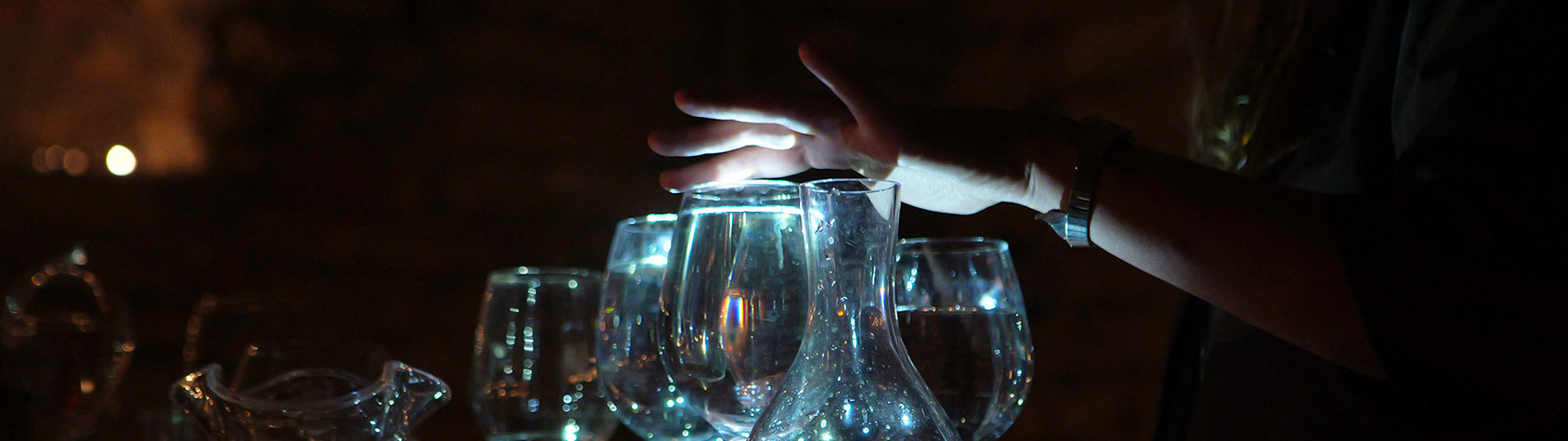
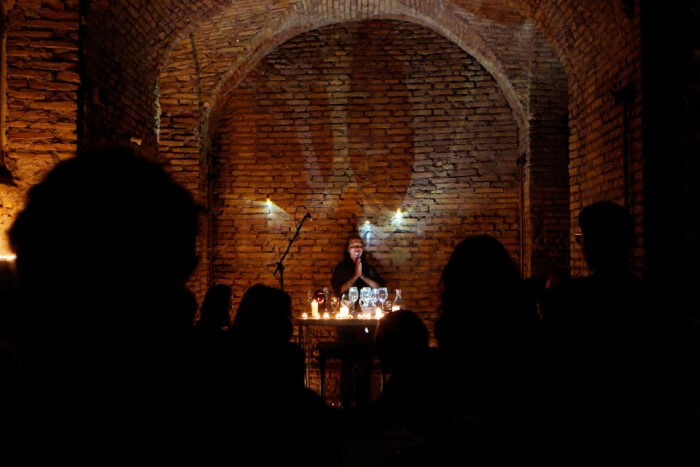
In the first performance, ATTO I, Vojić worked with glass harp and voice, drawing on the medieval mystical tradition of Hildegard from Bingen—the Sibyl of the Rhine, a twelfth-century Benedictine abbess, composer, and philosopher whose visions articulated a world alive with divine energy. Chants and spontaneous acoustics, interwoven with the resonances of water and glass, became a way for Vojić to invoke subtle encounters: expanding perception, gently distorting time, and opening the room to forms of contemplation that resist recalibration. Vojić describes her approach as kitchen magic, arte povera, following sound wherever it leads: dissolving the fracture between body and mind in favor of intuition, improvisation, and receptivity. At the center of Hildegard’s zoe-centric cosmology is viriditas: an animating force flowing through all matter. Vojić became a medium of this living resonance, summoning the human as a “spark,” a nomadic subjectivity, resistant to definition (Braidotti 2011, 2013).
“Dialect of hurricanes. Patois of rains. Language of storms. I speak the flow of the spiralling life.”
— Frankétienne (1968)
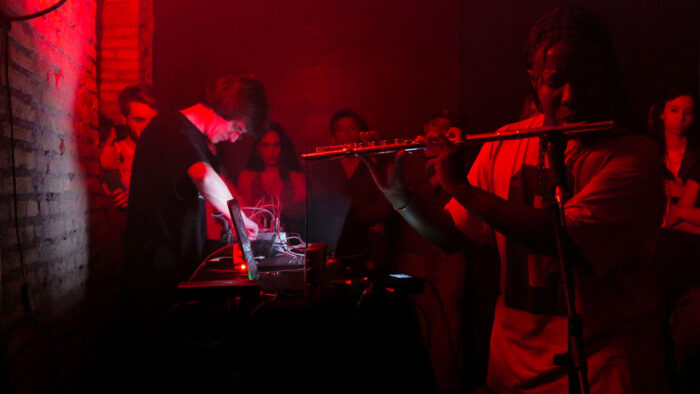
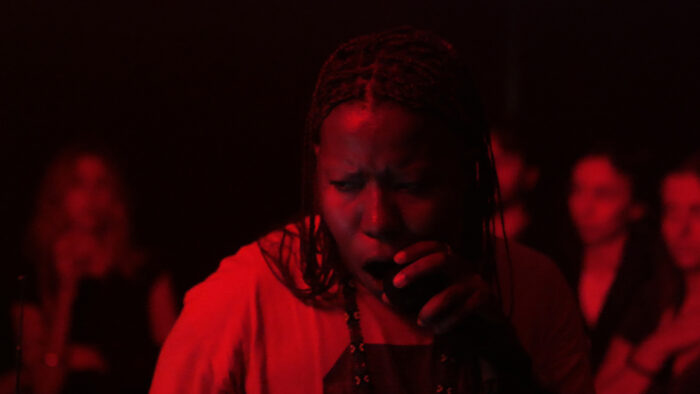
During the second performance, ATTO II, Tati au Miel moved through space differently. Alongside New York-based artist Miles Scharff, they layered drone, noise, field recordings, and fragmented voice into volatile immersive environments. Screams, whispers, high screeches, and residues of language stratified until they no longer belonged to a single body. Sound fed back into itself, proliferating, looping, exceeding linear time. Drawing on trance, nonlinear perception, and altered states of consciousness, au Miel constructs thresholds where multiple realities coexist as pressure, frequency, and a refusal to resolve. Their practice is shaped by Haitian Spiralism—a literary and philosophical movement born in Port-au-Prince in the 1960s, which proposed the spiral as an alternative to linear history: a form that returns without repeating, that holds multiple temporalities at once, that refuses the colonial demand for legibility and progress. Fugitivity, in their practice, is not an abstract philosophical position but a lived condition—a refuge within opacity (Glissant 1990), a way of moving through systems of power that have repeatedly sought to contain or dissolve what they could not name.
The conversation that follows expresses the artists’ own perspectives, exploring how sound and spirituality operate as embodied practices of transformation. These talks were held separately. The dialogue between them is ours.
Greta Voeller & Camilla Giaccio Darias: Can you tell us about your experience with spirituality, ecology and sound, and how they dialogue with each other?
Tati au Miel: From a very young age, I realized that sound held a strong influence in my life. Through discovering avant-garde and experimental music, I began to understand sound as a tool for accessing a form of spirituality that wasn’t tied to any specific religion. It became a space of refuge, free from imposed structures, where I could experience expanded states of awareness. Over time, this evolved into what I now understand as an ecological listening practice, one that is attentive to the relationships between body, environment, and vibration. I would consider my first conscious experience of working with spirituality in sound around ten years ago while creating my first EP. I remember feeling guided by an intuitive process, as if the sounds themselves were leading me toward unfamiliar yet necessary territories.
Vida Vojić: I grew up in a non-religious home, but music was always a life giver. Singing, completely changed my relationship to the world. People today are into sound healing and gong baths, having sound intentionally penetrate you, which can be an erotic and awakening experience. But when you produce the song yourself it’s different—like the inner fire they talk about in qi gong, it heals you on another level, makes you feel powerful, like you matter, like you have agency. For me, music and spirituality are completely integrated because of the mystery that is melody. Sound is the vibration that makes the body move. Ecology is an awareness of everything manifested in the physical realm—what the hell guides that process? I guess the spirit! Spirit comes in and out of me, allowing the body to be in flow.
Your work engages deeply with Hildegard from Bingen, where sound, vision, and matter intertwine—how do you navigate between interpretation and invocation when working with historical material?
VV: What led me to Hildegard was an obsession with nun life—nuns as an alternative to the nuclear family, a life dedicated to study, prayer, and contemplation. I’ve always identified with the hermit figure, enjoyed solitude, imagined life before industrial timekeeping. On my mother’s side I come from a lineage of classical and church musicians, so existing inside music has always been instinct. As a drummer, I once started playing a window with my hands during an improvisation workshop—beautiful tonal resonances came out. The fragility of glass challenges me: you really have to be sensitive and listen. Playing wine glasses used to be my party trick, but I realized it’s also a way to create a bordun—a drone used in medieval music. For this performance, Hildegard gives me structure, but she’s also a fierce advocate in igniting creativity as a form of prayer.
Your practice is inspired by Haitian Spiralism, where chaos becomes a generative force—can you tell us how it shapes the way you think about time, accumulation, and composition?
TaM: I approach composition as something that resists linear time. Rather than moving from beginning to end, my works expand, fold, and mutate. I often focus on isolating and reworking sonic textures to explore their emancipatory potential. The technique of sound-on-sound layering is central here—it mirrors the logic of the spiral, where each layer both builds upon and distances itself from previous iterations. In this process, sound is constantly regenerating while simultaneously decaying, allowing new forms to emerge from what came before. The movement of Haitian Spiralism situates itself within the ongoing state of chaos that Haiti has endured since its independence in 1804. As a member of the Haitian diaspora, my identity has involved navigating and, at times, undoing cultural constraints embedded in my upbringing. In coming into my own being, fugitivity and transformation have become central to my creative process. Spiralism resonates deeply with this, particularly through its use of the spiral as a motif of continuous evolution—an endless turning where chaos becomes generative rather than destructive. This thinking informs my work as I engage with environments shaped through improvisation, density, and abstraction. I am interested in how these unstable structures can converge to produce new environments, ones that resist fixed meaning and instead open space for emergence, questioning, and transformation.
Your performances often emerge in relation to specific sites and their resonances—what does it mean to “listen” to a place?
VV: The acoustics are very central—it’s important to hang out in the space before the show—I want to be receptive to its energy, let it influence my decisions. I work with feedback and subtle amplification, and depending on the space, certain frequencies get heightened. A loose plan always emerges during soundcheck;
I have to try out the glasses, consider their tuning and decide what to sing. Since I know several Hildegard chants by heart now, the entire performance becomes a conversation with the space, the glasses and the mood of the day. When I perform, I dissociate from my identity and merge with the place. Everything becomes qi. I channel the work, I give the voice, I don’t think about myself. I become my action.
What is a rite for you? Would you say your performative works are rituals?
TaM: A ritual often implies a fixed structure or shared symbolic system. My work resists that kind of framework. Instead, I think of my performances as spaces that hold the possibility of transformation without prescribing its outcome. They invite both myself and the audience into a liminal state, where something is unfolding but not fully defined. In that sense, I wouldn’t call them rituals in a traditional way, but they do operate as sites of heightened presence and embodied attention. The body and the space begin to blur, and what emerges is not a message to be decoded, but an experience to be lived. I am careful not to impose belief systems; rather, I aim to create conditions where questioning and sensing can take place.
VV: Our culture is deprived of ritual. We have habits, but ritual is when a habit becomes intentional — you are meant to achieve transformation through it. We speak of entering a liminal state, a limbo between past and future people try to access it through meditation, drugs, dance, trance. Music can put you there. I’ve learned to enter a certain state of consciousness, to imagine the horizon in front of my gaze, to create a different time zone—a kind of presence needed in performance.
Ritual in indigenous cultures often includes hardcore elements: slaying a lion, crossing fire, surviving alone in the desert. A ritual is not necessarily a neat, cute thing. In our culture, the concept of trauma is seen as something to avoid and heal from, as if being traumatized means being broken. But the brokenness is sometimes needed to create change. Trauma can put you into a state of total presence like when somebody dies, or you fall in love, or something magical becomes apparent. When we perform, we willfully create that kind of liminality. It’s not a formula, but it’s an act of creativity always at the edge. The presence of the performer emanates to the audience. Whatever the performer is experiencing, the room feels too.
In dialogue with Timothy Morton’s thinking, where ambiguity and strangeness are conceived as generative and liberatory forces, how does noise and its continuous relocation function in your work?
TaM: Each performance is shaped by its specific conditions—the space, the audience, the energy in the room—and these cannot be replicated. I work in response to what is happening in the moment, which means that each piece exists only once in that particular form. For instance, during my performance for o—mag at Spazio Supernova, I collaborated with Miles Scharff, who used a custom electromagnetic receiver that he created. Our interaction unfolded in real time, shaped by the space and by each other’s intuition. That kind of exchange cannot be reproduced; it belongs entirely to that moment. Noise functions in my work as both a language and a field of potential. It allows me to communicate intensities that exceed verbal articulation. By treating my voice as texture through screams, whispers, and distortions, I move it beyond recognizable identity, opening it to abstraction. This disorientation is important: it disrupts habitual ways of listening and locating meaning. In line with Timothy Morton’s thinking, I see ambiguity and strangeness as generative forces. The loss of orientation becomes a way to access other modes of perception, where identity is less fixed and more fluid. Within a shared performance space, this can create a collective experience of displacement that invites new forms of relation and awareness.
VV: Music is a way of listening—all you have to do is follow. I’m not often aware of meaning whilst creating. Meaning becomes feeling in the instance, where synchronicities appear naturally, as though everything becomes harmonious with the flow of the world. The noise and it’s explicable meaning emerge in retrospect.
The arte povera aspect of my Hildegard performance came from my no-budget, constantly-on-the-road reality—I had to use what I had: my body, my voice, wine glasses found everywhere. It became a kind of kitchen magic, which subtly comments on domestic and women’s history. The glass harp assembled in each new place with glasses lent by locals makes a point about how music exists in each living thing—as Hildegard suggests. These aspects emerged unconsciously. If I let intellect guide me, creativity lessens, I become a critic. Letting music guide me is another type of awareness. At some point I picked the fool card in the tarot and started wandering like a blissful idiot, singing, rejoicing in an empty mind and open body.
In a context where identities and meanings are often fixed or imposed, what does it mean for you to exist—and create—within that tension today?
TaM: In a context where identities and meanings are often fixed or imposed, my practice is a way of resisting that stabilization. I approach existence as an ongoing process of questioning and transformation. The idea of superposed realities—where multiple states are coexisting—guides how I think about both identity and matter. I lean into abstraction and ambiguity as strategies to avoid being reduced to a single narrative. Noise, in this sense, becomes a powerful tool that has supported my own evolution while also creating space for others to encounter a sense of openness and potential within themselves.
References
Abbado, Francesca. “Variations on a twice-frustrated frustration”. o—mag, 2026. https://www.o–mag.com/article/49
Braidotti, Rosi. Nomadic Subjects: Embodiment and Sexual Difference in Contemporary Feminist Theory. New York: Columbia University Press, 1994. Second edition 2011.
The Posthuman. Cambridge: Polity Press, 2013.
Butler, Octavia E. Parable of the Sower. New York: Four Walls Eight Windows, 1993.
Frankétienne. Mûr à crever (Ready to Burst). Port-au-Prince: Presses Port-au-Princiennes, 1968. Trans. Kaiama L. Glover. New York: Archipelago Books, 2014. https://modernpoetryintranslation.com/poem/dialect-of-hurricanes/
Glissant, Édouard. Poetics of Relation. Paris: Gallimard, 1990. Trans. Betsy Wing. Ann Arbor: University of Michigan Press, 1997.
Morton, Timothy. Hell: In Search of a Christian Ecology. New York: Columbia University Press, 2024.
“Meaninglessness: A Flicker of Mercy.” o—mag, 2025. https://www.o–mag.com/article/1
Muñoz, José Esteban. Disidentifications: Queers of Color and the Performance of Politics. Minneapolis: University of Minnesota Press, 1999.
Sopelkina, Kateryna. “Flowers of the Rocket.” o—mag, 2026. https://www.o–mag.com/article/34.
Tomadin, Murphy. “Gocce di cera”. o—mag, 2026. https://www.o–mag.com/article/21.