
Taranto, 20XX A.D.
A multitude of possible futures in the “in-between” of a damaged life
In its original sense, a monster is something that unveils itself for the first time. Thus, the future is inevitably monstrous.
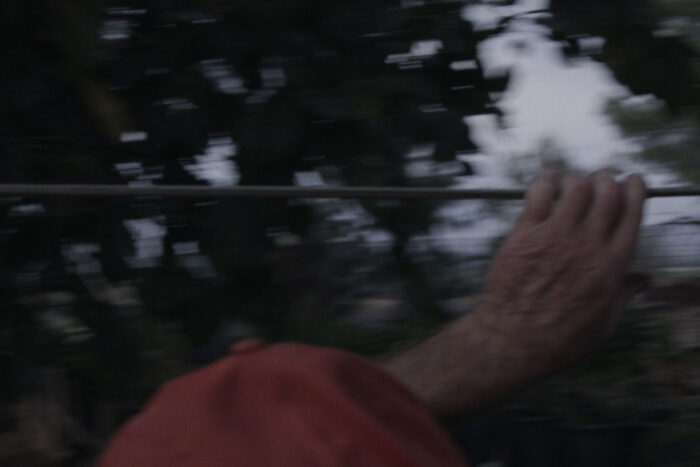
Taranto is a specific place, and yet it is many places at the same time: all those that reveal the cruelties of gradual, normalized processes of modernist and capitalist “slow violence.” A system that decides which lives—human or non-human—are sustained, sacrificed, or left to decay. To inhabit these territories necessarily means existing in a state of territorial anxiety. But it is not about passivity: it is rather a suspension that compels a renegotiation of everyday life, pushing toward new, undisciplined forms of care, relationality, and adaptation, in the “in-between” of a damaged life.
In Queste cose non avvennero mai ma sono sempre, Pierluca Ditano goes beyond the mere representation of these lives: it envelops us in a suspended space that dissolves the boundaries between subject and object, here and elsewhere, past and not-yet. The work exists in a deliberate liminal space between the material and the emotional, where affects are essential to experiencing space as a system of intensities emerging between rational understanding and imaginative perception.
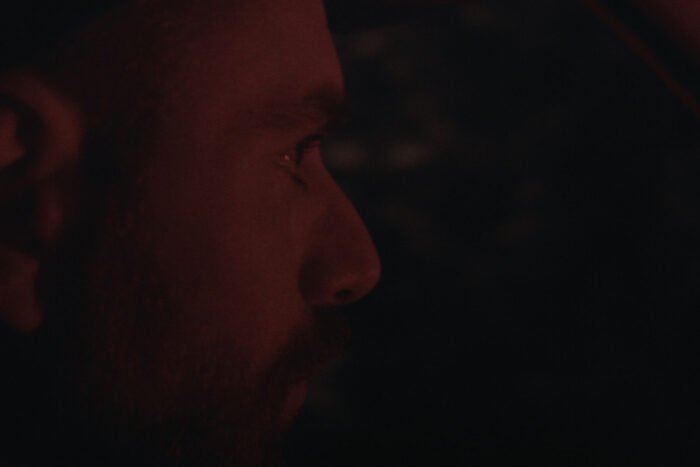
The city (Taranto) emerges only in the background: throughout the documentary we remain at a distance, never crossing into it. The approach is radical: to narrate a territory not through conventional representations—data, maps, diagrams, narratives—but through practices that enact a (re)territorialization, exploring varied temporalities and affective intensities, shaped by particular sub- and countercultural aesthetics, embodied knowledge, and multisensory emotional experiences.
It remains uncertain whether we are moving through a dystopian or utopian realm, whether the territory has already died, is dying, or whether new hopes are already rising from its ashes. What emerges instead is the feeling of a reverberation, inhabited by endless endings. In the practices and attachments staged by the film, these endings become events where the time of anticipation and the time of delay collide in a tangle of possible futures, which Ditano—and this is all the information he gives, aside from the city’s name—calls 20XX A.D.
Within the multiple intersections the documentary implies—bridging theoretical frameworks and situated processes—we have selected three key concepts as orienting devices for navigating a work that deliberately eludes fixed categorization.
Shamans
Our knowledge of the spaces we inhabit reaches only up to a threshold, real or imagined, that distorts our perception of reality and destabilizes space-time. Beyond this threshold, a subtle fog envelops the world in a permanent veil of the unknown. Shamans alone are those who truly understand these spaces. As guardians of the boundary between the visible and invisible, they have always lived in a suspended realm, poised between cultivated fields and wild landscapes (Mille Plateaux, 1980). In a way that is secretive yet profoundly intimate, Ditano has observed three figures as they become shamans, on the edges of a city that is both haunting and enchanted.
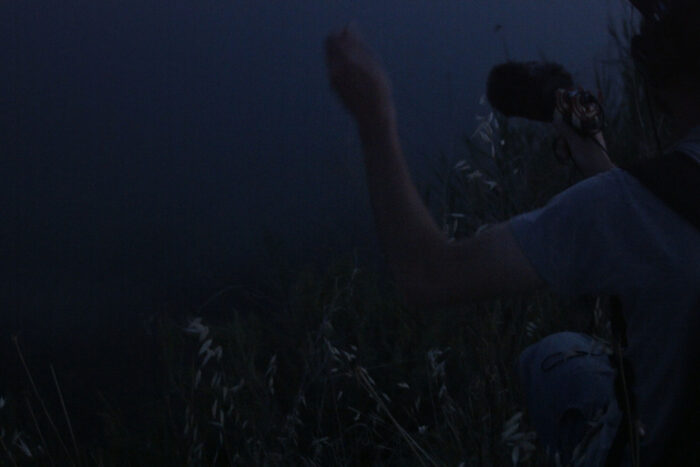
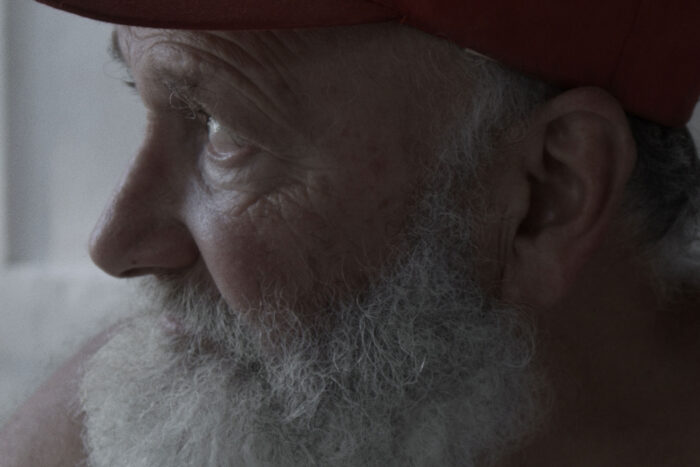
A boy, armed with field-recording equipment and analog radios, moves through the wild vegetation that has overtaken abandoned bunkers and deserted construction sites, turning the subtle, almost invisible movements of inert objects into sound. An elderly blind man speaks of philosophy while wandering through a garden, guided by a network of woven nets and wires that allow him to move among the plants independently. (We recognize him instantly: one of the founders of the Owen Social Cooperative in San Giorgio Jonico.) A young woman wanders with her dog through the reclaimed marshes, performing small animist memory rituals seemingly dedicated to non-human communities. None of these actions has a predetermined purpose; all exist in the act of happening itself. These people have experienced the Limit of the Useful—along with the neoliberal dogmas that define legitimacy solely by productivity—and have chosen to dedicate themselves to unproductive practices.
A suggestion drawn from local folklore: in Southern Italy, particularly in Puglia and Basilicata, the term maciara referred to a person who performed magical acts, or who possessed powers that were not only medicinal but also sorcerous, capable of dissolving the invisible forces present in the air and in the light of darkness. Gaspare, Sandro, and Maria (whose names appear only in the end credits) could be described as maciare, insofar as they embody a deviant stance toward the world. Their powers do not lie in transforming reality, but in making it porous, allowing what has been repressed to circulate again. They navigate through invisible memories, electromagnetic fields, toxic debris, and collective traumas, guided by a knowledge that is prophetic and beyond the present.
Engaging with these evocative, magical, and spiritual gestures, we are introduced to a hidden dimension situated just beyond the gates of Europe’s largest steel district. A sound dramaturgy, shaped from Gaspare Sammartano’s ambient recordings, immerses us in landscapes completely alien to the structured urban world. These territories arise from compost, stitched together from heterogeneous fragments of residual matter—discarded objects, ruins reclaimed by vegetation, abandoned sites—evoking what are called “Frankenstein landscapes” (The Landscape is a Monster. Wild Cities and Hybrid Natures, 2022).
Futures
Sci-fi blockbusters have made us believe that all dystopian futures unfold after a traumatic event that irreversibly destabilizes the order of things. Taranto challenges this causality linking dystopia to catastrophe: disaster here is not sudden or spectacular, but unfolds through slow, normalized processes driven by neoliberal structures. The very brief shots in which the steel plant’s chimneys appear on screen suggest precisely this condition: habituation, everyday life, and coexistence with disaster.
“I saw a powerful explosion, drawing closer slowly. I closed my eyes and allowed myself to be bathed in its light,” Maria begins recounting her dream.
In a place where the sacrifice of all living beings has been confirmed and made official (in 2022 the UN classified Taranto as a “sacrifice zone,” permanently scarred by environmental damage and economic neglect, usually against local consent), no dystopian vision could ever feel extreme enough. The epidermal sensation of living amid an ongoing catastrophe has even permeated dreams.
Instead of letting the dominant narrative of sacrifice—one that poisons, discourages, and obliterates life—take hold, the film becomes a sounding board for human and non-human voices alike, nurturing a process of re-enchantment. Re-enchantment here is a deliberate act, a strategy to prevent the current crisis from eroding the possibility of social transformation. As Appadurai’s “capacity to aspire” suggests, communities can collectively imagine, plan, and strive for futures beyond the limits imposed by the present. By cultivating this capacity, communities can transform hope into practical, actionable outcomes, making imagination a concrete tool to rethink the forms of everyday life (The Capacity to Aspire, 2004).
Dusts
Western thought has often focused on the distinction between life and non-life, neglecting the ways in which land, rocks, infrastructures, and non-living environments actively shape social and political relations. These material forms face a dual destiny: they may serve as an economic substrate, exploited until exhaustion, or become abandoned spaces (Geontologies: A Requiem to Late Liberalism, 2016). In Taranto, both scenarios have occurred: part of the marshland has been reclaimed to make way for the massive infrastructures of modernity, while another portion has become a zone where slags, debris, and all kinds of waste accumulate.
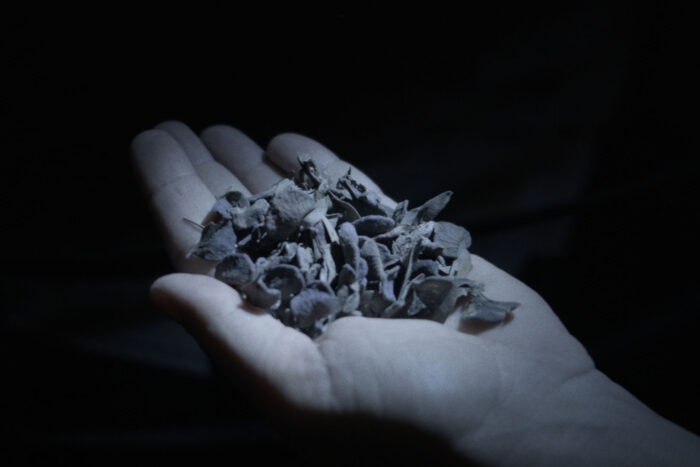
Often regarded as the lowest form of residue, the product of human-accelerated decay, these sediments have wound themselves into our very lives. Fine dust aggregates carry an almost uncanny vitality, expressed through an ongoing process of co-emergence. Jane Bennett describes this as “the force of things” (The Force of Things: Steps Toward an Ecology of Matter, 2004). Watching how this vitality merges with bodily experience, the film evokes a post-materialist sensibility: all life and non-life share a contaminated atmosphere. Contamination embodies the most intimate relationality.
The PM10 and PM2.5 produced by industrial activity manifest as solid and liquid particles drifting through the air toward the city. With no physical barriers able to stop their spread, the committees responsible for monitoring citizens’ health have established “wind days”—days when outdoor exposure is strictly discouraged due to the wind direction carrying the poisoned dust. In other words, even the right to breathe has been partially inhibited in the city. Queste cose non avvennero mai ma sono sempre proceed by rarefaction. The sensation is that the air itself becomes thinner, that breathing grows precarious, and that all forms of life are close to collapse.
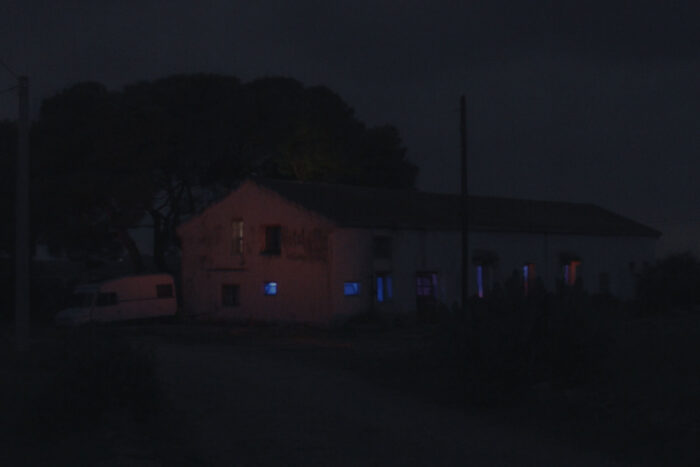
Taranto 20XX A.D. is neither a future to be predicted nor a past to be interpreted. It is a field of intensity in which time ceases to be linear and to follow the single trajectory suggested by progress. Time and space lose their power to order. Only by opening ourselves to the performative force of affective atmospheres—to what collective emotions can enact and enable—can we escape the grip of dogmas and dominant narratives.