
Photography as Fabric
Performing the Invisible: a conversation with Margret Wibmer on image, textile, and body performativity
Seeing today in art and fashion photography a tendency to present the female body as a fluid, performative entity exploring the urban landscape brings an urgency to understand the nature of this impulse. Addressing artists who investigate this matter allows us to imagine how to reclaim the space through the body and restore our relationships with the environment, without losing the meaning behind the contemporary trend.
Amsterdam-based Austrian artist Margret Wibmer offers a deeper perspective on this topic working with image-making, performance, and textile. My introduction to Margret’s work began with reading about Time Out, a participatory performance held at Palais de Tokyo, Paris in 2016, where she invited the audience to experience time by wearing coats she crafted, acting as mediators between the architecture of the museum and the internal landscape of the participants. Later, assisting Margret on another edition of the performance at Oude Kerk, Amsterdam (2023), and working closely, I found striking how coherent and interwoven her practice is—how textile acknowledges performance, and performance extends into photography. It feels as if Wibmer proposes to unlearn how we perform daily and how we relate to clothes and objects, in order to restore a shared ecology. In the context of her newly opened exhibition of selected works at the Hoxton, Lloyd Amsterdam, we discussed how her photographic practice investigates questions of identity, visibility, and the shifting power dynamics between bodies and objects.
Anastasia Nefedova: Margret, for decades you have worked with performance, installation, video, and photography. What interested you when you first addressed photography?
Margret Wibmer: Actually I was thinking about it this morning and it’s an interesting question because I wasn’t studying photography. The questions I was concerned with: what is the image? What is an image telling me? Back then I was living in New York and still working in painting. When my daughter was born, I realized I couldn’t express the political issues that were coming into my mind through this medium, so I started looking for something else. In New York in the 80s a lot was going on. Like the Central Park jogger case, and other injustices that raised deeper concerns about identity, discrimination, and body politics. When I started working with photography, it was not so much about operating with the camera but it was about the image.
Can you tell more about what interested you in image in relation to identity?
In my early works in the 1990s I was already thinking about what an image is and how we can relate to it and read it. What concerned me was the image as an external presentation or how one is perceived by others. My practice of this period was about finding an identity. I was pretty lost after leaving New York and moving to Amsterdam. At this moment, I experimented with latex rubber and did a series of objects stretching latex rubber inside a frame, photography came later. I imagined the stretched latex rubber to be like a trampoline that holds the image but not very well. Then I did a photo series with the rubber suit I sewed for Performance for No Audience (1997) and Off the Wall (2000) . In these photographs the rubber would seal the body and hide identity. It was about refusal to be identified and categorised.
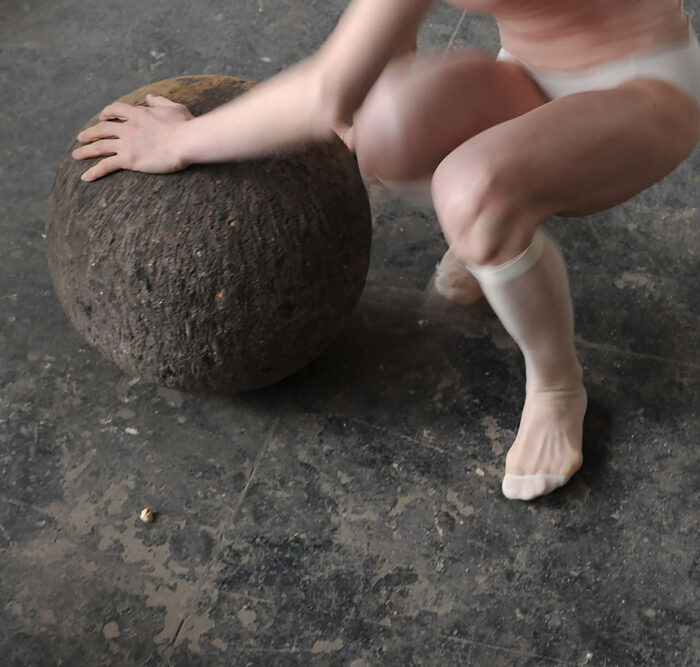
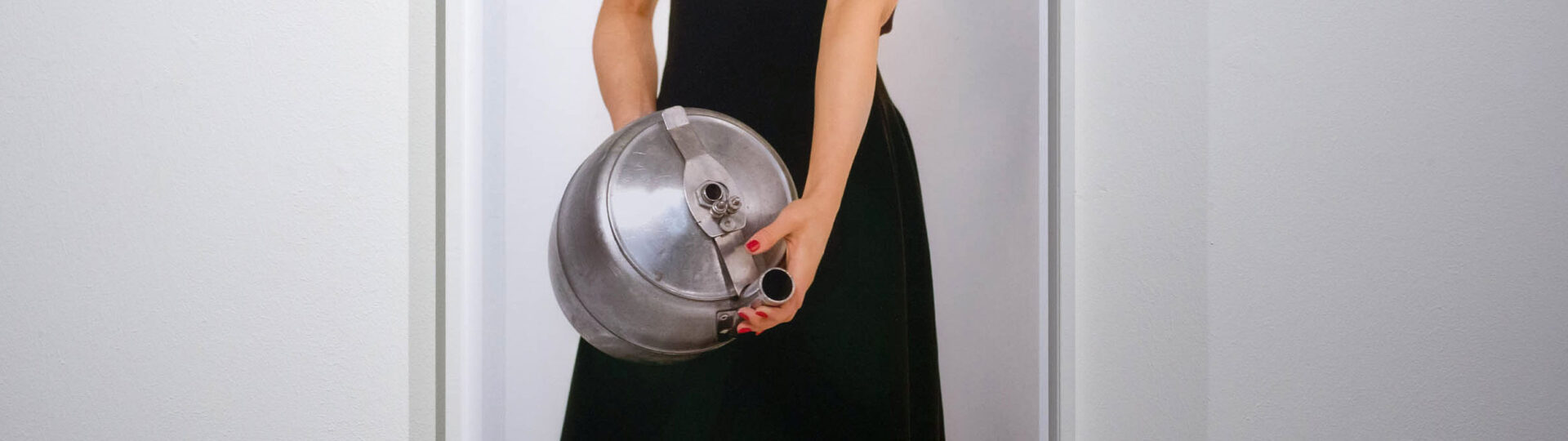
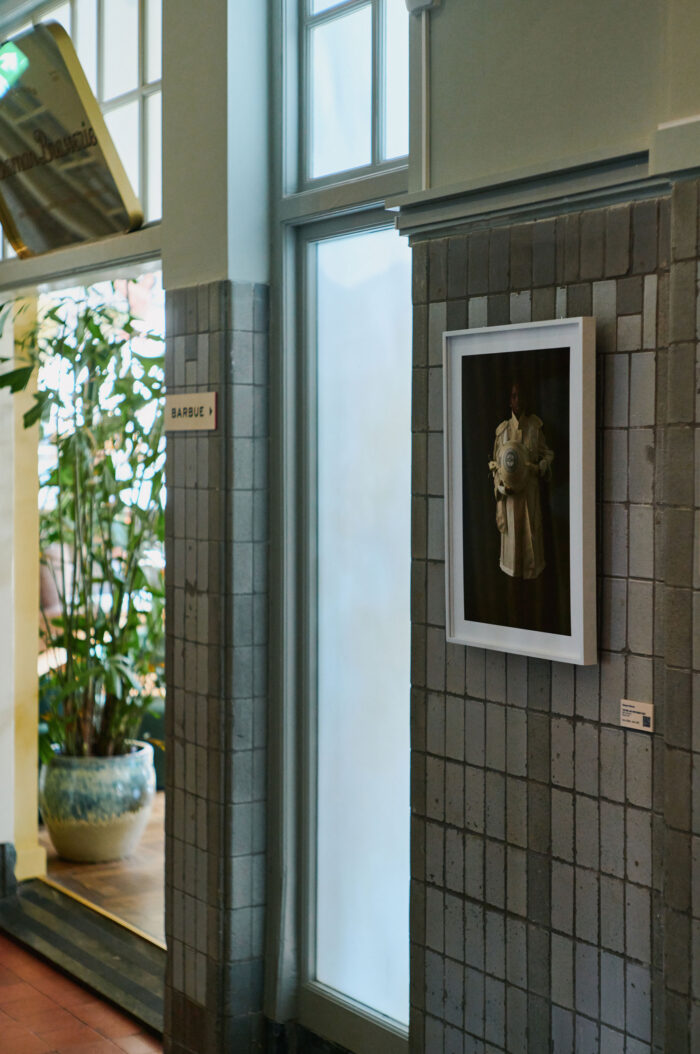
Speaking of identity, I would like to ask you about your new show at The Hoxton, Lloyd Amsterdam, where you show selected photo works. It feels that the building itself, with its diverse and complex history, amplifies the layers of displaying photographs. Walking down the corridor and seeing The Girl and The Object and The Walze made me think about the juxtaposition of subject and object. What is the relationship between a female body and an object they interact with in these works?
Here I’m also interested in the relation between the image and the person, the woman in the image, and the question of who is the subject and who is the object. Especially since women are often used in advertisements to promote a product, where the woman becomes the object and the object becomes the subject. I find this compelling not only as a critique of how women are portrayed, but also regarding the implicit value of the object. For me it also becomes a question of who is visible and who is not.
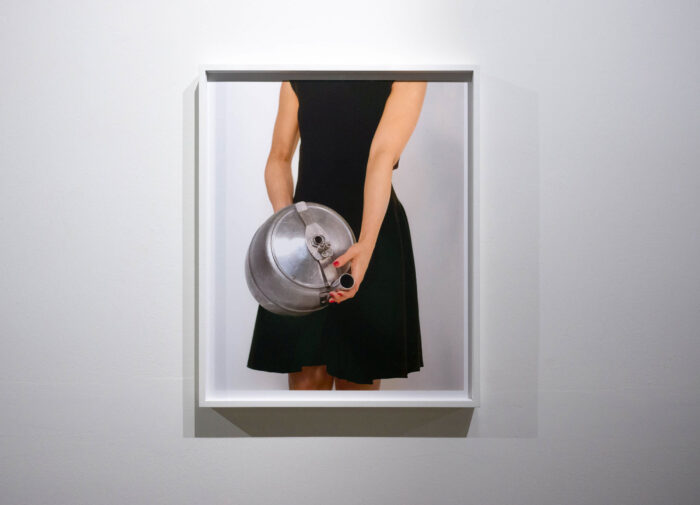
Would you say that objects in your work carry their own agency?
Exactly. One of my earliest photographs, which is currently at The Hoxton, engages with this idea. I changed the title for the exhibition—it’s in English now—because the original German title is difficult to translate. The German word is Gegenstand: while it is usually translated as “object,” its meaning is wider. “Stand” means “standing” and “gegen” means “opposite,” and the word can also mean “topic,” as in the Gegenstand of a discussion. Gegenstand is about the relation between the body and the object, how they face each other and relate, and in that sense it also explores the agency of the object, how the object can declare itself, act back, or shape the encounter.
You mentioned, use of languages. Indeed, we can find German, English and French in the titles of your works. Does this relate with your personal geography?
I would say it is not really related to my personal geography. I mean, I speak four or five languages, but it is more about what I can express with a specific word. For instance, in the title you mentioned earlier, The Walze, if you pronounce it in English, it can refer to a ballroom dance. But if it’s written in German, it’s die Walze, which means a road roller used for compacting surfaces. I like to have multiple associations: the dance is fluid and free, while a roller flattens and can also destroy.
I find the link between how bodies are performing in your photograph and how Valie Export defines the body as an “inclined” subject that resists hierarchy and engages actively with the environment. Looking at Einhalt or Ride, I’m attracted by how the subjects move, they are not just posing, but performing and interacting with surroundings and objects. Could you talk about the role of performance in your work?
I think my first interest in performance really comes from my mother, who was a tailor. She didn’t make clothing for sale, she made it for all of us in the family, and she also taught courses to women in the village in Austria where I grew up. For me, the room where she made our clothes was always a kind of performance: she would cut the fabric, stitch it together, and then we’d try it on. She had this instrument to mark the seam with white powder. Even if your body was slightly uneven, the seam would be correct in relation to the ground. I found that very special. Everything in this room added to the performance, like the sounds of the sewing and knitting machines—it all created an environment and rhythm. I suppose that’s where my attraction to performance originally comes from, and later in my photographic work, which gave me the possibility to register the performance, bring together the body, and the clothing, which is crucial in my practice.
I actually see your use of photomontage as a form of stitching. Going back to your time in New York, made me think of Martha Rosler and how she used photomontage to reveal distorted realities and critique gender politics. I’m curious about how you work with photomontage, both in placing the subject in different environments and in constructing the image itself through framing, especially since you often choose not to show the face.
It’s about bringing together different elements. For instance, in No Questions Asked, the background was photographed in Cameroon and the subject in Japan. Bringing together different narratives lets me show how the objects carry traces of colonial history and global connections, and how these relate to the present.
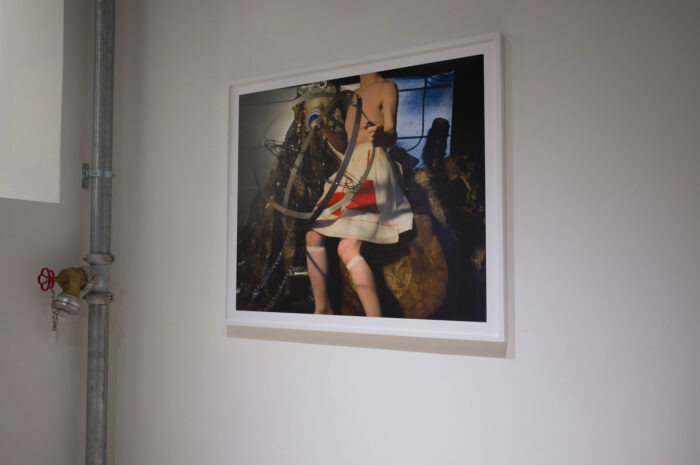
The reason I frame the images so the viewer doesn’t see the subject’s face is that I’m not focusing on the person’s identity, age, cultural background, or emotions. I’m interested in the body itself, its position and presence. In The Ride, for example, the photograph isn’t a montage, but it’s still like a collage because I put together many different elements on site. It’s both a composition and an improvisation. The only thing I usually bring beforehand is the clothing.
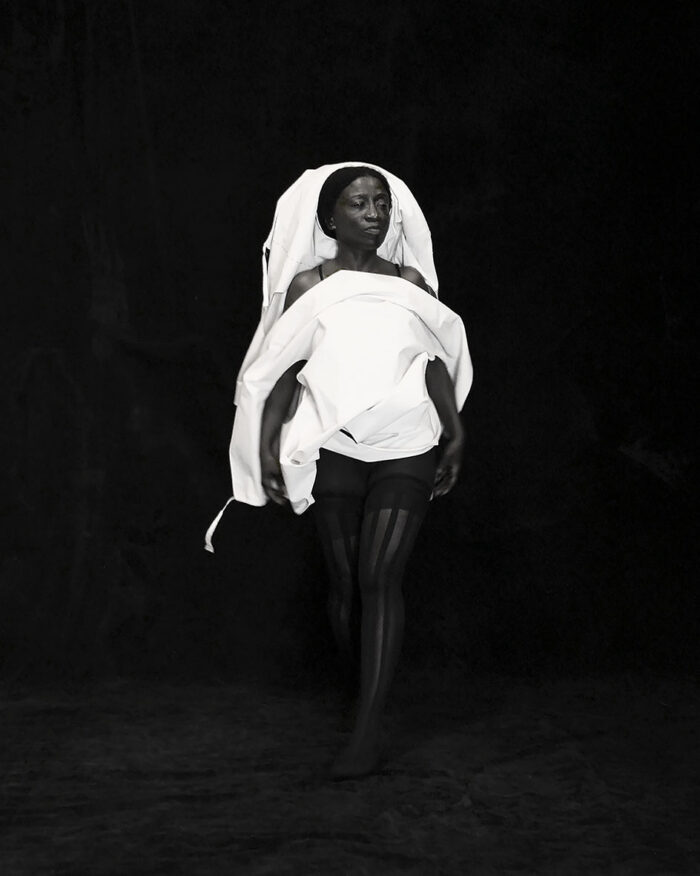
Textile is a connecting thread unfolding though all your practice. Did textile immediately become something you used, or did it come into your work later, at a moment when you realized your connection to it?
For the longest time, I didn’t use textile. One reason was that back in the 1980s, if a female artist worked with textiles, you were not taken seriously; it wasn’t considered art. Then I saw the exposition of Franz Erhard Walther for the first time in New York, at a gallery where I was temporarily an assistant helping to mount his show, and I realized it was possible to use textile and performance as artistic practice. After that, it still took time to develop my own language and introduce textile into my work. When I was doing Performance for No Audience, I made a full-body suit from rubber, and later I made sculptures from rubber and other textiles, always related to the body.
But then around 2005, when I started photographing again, textile came into my practice as clothing—very specific clothing. It’s not just about style or aesthetics, but also about the texture and surface of the garment. For example, in The China Series, you see a woman wearing a Chinese red silk dress full of wrinkles. I love this because the wrinkles tell me it was just taken out of a bag and put on—it wasn’t ironed or treated—so it’s a kind of performance in itself. At the same time, it enables me to read the fabric, it tells me that it’s silk. Photography allowed me to explore this, to literally put a lens on the textile and capture these layers.