
People’s Liberation
The Art That Goes on Strike
At Sale Docks in Venice—a self-managed and independent space that serves as a meeting point between art and activism—the exhibition People’s Liberation dissolves the boundaries between exhibition, participation, and political practice, highlighting how every artistic device is also economic and relational.
A Palestinian flag fixed to the entrance welcomes visitors from outside. Next to the captions, a transparent donation box and a table of Taring Padi’s merchandise stand, where a young woman explains what can be freely taken, inviting visitors to support the project with a voluntary contribution. This passage not only signals a political stance but also immediately introduces the visitor into a different economic model. Before even seeing the artworks, one is already involved in an informal micro-economy based on exchange and direct support, in which value is built through relationships. In a system that rejects the logic of cultural consumption and replaces it with shared responsibility, you do not enter as a simple spectator but as a participant .
The space appears inhabited, almost domestic: people linger, talk, and move without the silent distance typical of institutional exhibitions. There is no imposed code, but rather a movement one learns from within—a rhythm that immediately orients the body’s behavior. In this sense, Sale Docks puts into practice what it has been theorizing for years: returning art to a dimension of common use, withdrawing it from the form of product, or of an experience deprived of vital impulse.
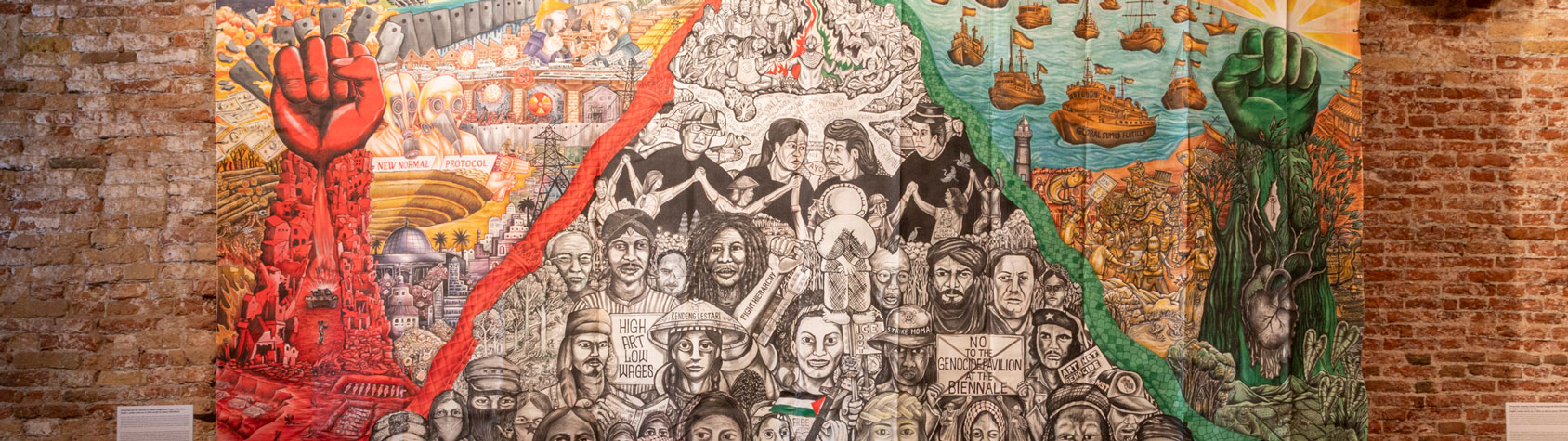
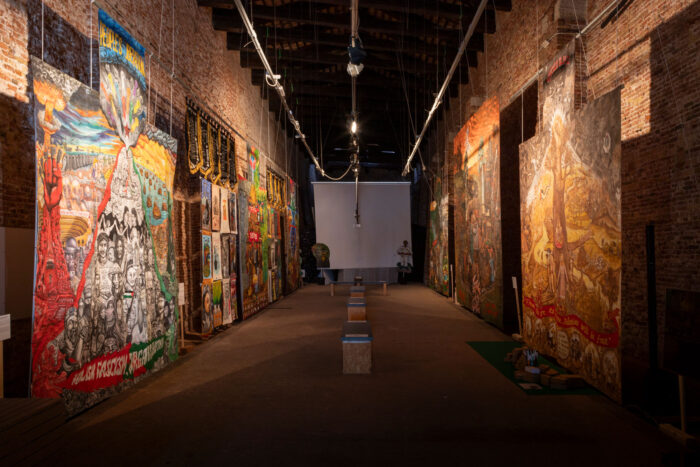
Within this context, People’s Liberation takes shape, composed of large banners (measuring 450×450 cm) created from 2022 to today by the collective Taring Padi, which since its beginnings has used art as a tool for political mobilization and shared pedagogy. Founded in 1998 in Yogyakarta (Indonesia), after the fall of Suharto’s regime, the group proposes a vision of art as a practice of organization, resistance, and solidarity, weaving together aesthetic and social dimensions to form a synthetic fabric in which political action itself becomes the synthesis of spontaneous, heterogeneous, and collective impulses that emerged after the collapse, even the semantic one, of the thirty-year authoritarian regime known as the New Order (Orde Baru). Painted on large canvas surfaces with acrylic colors, the works arise from common processes that unite the energy of demonstrations with the manual activity of collective making.
The walls of Sale Docks are entirely covered by these monumental banners, difficult to contain within a single gaze or to photograph in their entirety. Dense and layered, the images entwine mythical and political figures, slogans, and anti-colonial symbols in a rhythm that is both visual and musical. Among the phrases—now part of the global language of protest—appear “Abolish Fascism, Organize Autonomy,” “From the river to the sea, Palestine will be free,” and “People Justice is Life.” These are not captions but a militant visual language in which text and image coexist in the same communicative urgency.
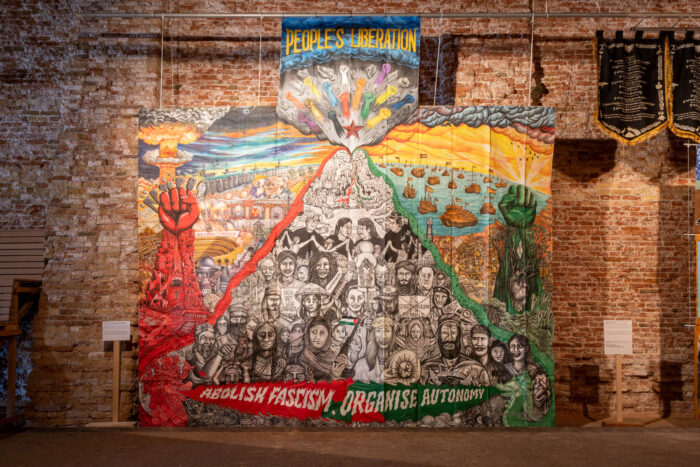
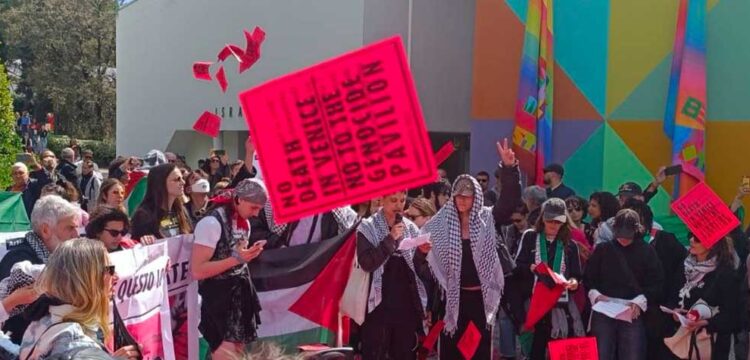
Within the banners emerge direct references to the current political moment: placards such as “No to the genocide pavilion at the Biennale,” responding to the controversial participation of Israel and Russia in the Venice Biennale; a bandana reading “Food not bombs,” opposing the production of death to the need for life; and people gathered around a fire beneath a red setting sun, an image of brotherhood and collective rebirth. Every centimeter of canvas is crossed by colors, words, and signs: nothing is decorative; everything contributes to a choral narrative of struggle, solidarity, and hope.
These works were not meant for galleries but for the street. Bringing them inside an exhibition space inevitably transforms them, but does not deprive them of their original strength: the walls become temporary stops, transitional places where the relationships they embody continue to circulate through those who witness, move through, and discuss.
A participatory energy manifests beneath People Justice no. 7 (2024), created together with collectives engaged in the Palestinian cause. In front of the banner, a green carpet invites the public to intervene: markers and sheets of paper are available, and passersby leave marks, phrases, drawings. Children and adults write messages overlapping the images, transforming the surface into a shared, ever-evolving archive. Participation thus becomes a real, not symbolic act—a way to physically enter the work. Yet the question remains, how far this gesture can produce concrete transformation beyond the exhibition walls, within the individual conscience of each participant.
Alongside the monumentality of the banners, Mosaab Abusal’s works introduce an intimate and fragile register. The series Geography of the Body: Archive of Survival, created during the war in Gaza, presents notebook pages covered with delicate, hesitant marks suspended between drawing and writing. Made in conditions of extreme precarity, these fragments become gestures of daily survival, a way of maintaining contact with reality when reality itself contracts.
A poet, graphic designer, and teacher, Abusal dedicates his work to individual memory, restoring dignity to lives erased by the violence of numerical reduction. Though seemingly minimal, his line constitutes an act of intimate resistance that does not relinquish vulnerability. When seen beside the banners, his works create a necessary friction: while the large surfaces speak the language of collective imagination and mobilization, the notebooks return the political to a diaristic, fragile, and human dimension. It is in this tension—between chorus and single voice—that the exhibition finds its equilibrium.
During the opening on May 3, Indonesian food cooked by the group became the real center of the evening. Around the large table a continuous queue of people kept on going; everyone ate, talked, and shared stories. Live music accompanied the space’s movements and culminated in a collective singing of Bella Ciao, uniting historical memories and different geographies, transforming conviviality into a structural part of the exhibition device. Not a pause, but a practice of building through encounter. In this harmony between artistic gesture and everyday gesture, one perceives the deep coherence of an environment where critique of institutional art logics is not formulated in theory but translated into practices of cooperation and shared care.
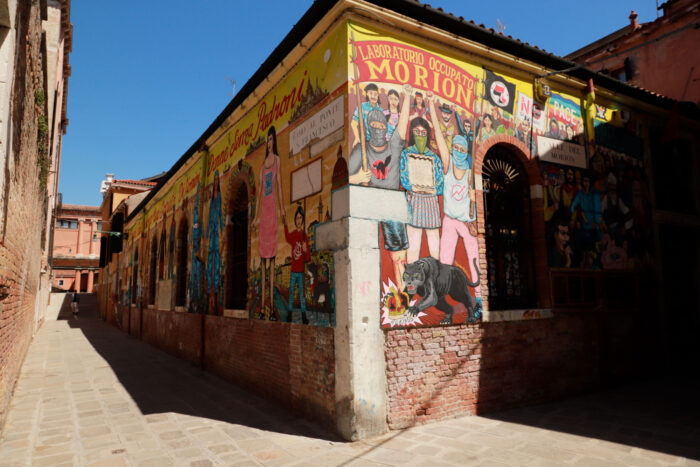
On May 7, the exhibition expanded with the Art Talk Autonomy and International Solidarity in Times of Genocide and Censorship, organized with the Institute of Radical Imagination and moderated by Marco Baravalle, a key figure in the Sale Docks project.
On stage alternated Mosaab Abusal, Rana Anani, Sara Buraya, Charles Esche, and Manuel Borja Villel, together with members of Taring Padi, invited to intervene freely in the discussion. The voices did not limit themselves to theoretical formulations but reaffirmed that artistic practice can be a form of social and political organization. The distinction between artist and art worker recurred frequently—not as a terminological nuance but as a declaration against the neoliberal idea of individual creativity. Topics included strike, cultural boycott, and the need to build autonomous collective infrastructures—with the Venice Biennale explicitly mentioned as an antagonist rather than an aspiration. Within this context also emerged ANGA (Art Not Genocide Alliance), an international network of artists and activists promoting a cultural boycott against the normalization of violence and Israel’s participation in the Biennale. Its actions, in dialogue with Sale Docks, broaden the exhibition’s field of reflection, situating it within a wider mobilization that connects Venice to transnational struggles.
Baravalle attributes to Taring Padi’s banners a “pedagogical” value in the most radical sense: tools for transmitting shared knowledge and collective political imagination. In this sense, the space appears not as a neutral container but as a living infrastructure, capable of generating organization and new alliances.
The day concluded with the militant performance by Gran Teatro Popular Niño Fernandito Tupac Amaru, directed by Daniela Ortiz, Il Gigante senza Cuore e la Grande Torre di Leonardo. Una storia per la classe lavoratrice italiana (“The Giant Without a Heart and Leonardo’s Great Tower: A Story for the Italian Working Class”). Through the language of puppetry and popular theatre, Ortiz gives political reflection a bodily and collective presence, turning theory into shared storytelling. The shift from word to stage thus becomes the symbolic gesture of an art that does not illustrate the world but sets it in motion.
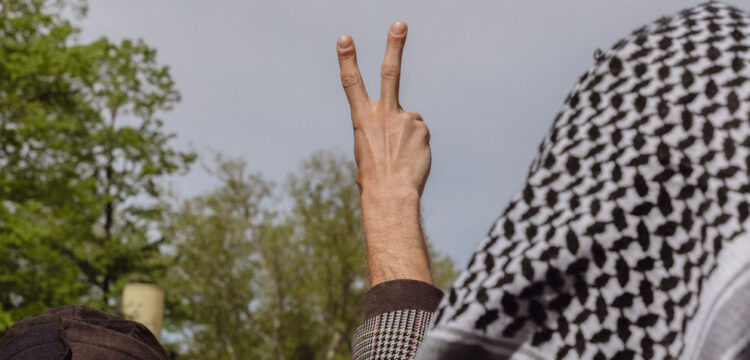
Yet, it is on the following day—during the strike—that People’s Liberation finds its fullest expression. The phrases from the banners leave the space and turn into real voices, shouted through the streets of Venice. Artists, students, and workers march together through the city toward the Arsenale, opposing Israel’s presence at the Biennale and calling for freedom for Palestine. The same words once written on canvas now resonate in the air.
From one bridge to another spreads a powerful chant: Venezia lo sa da che parte stare, Palestina libera dal fiume fino al mare (Venice knows which side to stand on—Palestine free from the river to the sea).
These are no longer images but moving bodies that pronounce them. The distance between artwork and action disappears, and the language of art becomes lived language. In that moment, the banners no longer represent the struggle—they extend it directly. The march becomes their physical translation, and the exhibition ceases to be a container, transforming into an operative passage within a living mobilization. The emotion and palpable sense of belonging to something that exceeds the artistic context make clear that People’s Liberation does not construct a discourse on the intertwining of art and politics—it inhabits it. Here, art does not serve to represent conflict but to recognize oneself within it.
In retrospect, even the risk of self-referentiality takes on another meaning: a community already aligned is not a limitation but the very condition for the project’s possibility. It is the network of material and affective relationships that precedes the works, legitimates them, and extends them into urban space. The strike and march reveal what the exhibition had suggested from the beginning: not a device that “shows” the struggle, but a point from which the struggle propagates.
In this sense, People’s Liberation is not an exhibition to be reviewed but an experience to be traversed over time—first through one’s gaze, then via listening, and finally with one’s body in the city. Art does not occupy the center; it becomes a pretext for encounter, discussion, and the construction of collective subjectivities.
What remains after living it is not a set of works but an unstable field of forces in which images, words, and gestures coexist without ever stabilizing or separating from one another. They demand not so much to be understood as to be inhabited. In this ongoing exchange between art and life, the liberation evoked by the title does not remain a metaphor but becomes practice: a collective gesture of real transformation.